“We Didn’t Come to Celebrate”
“We didn’t come to celebrate, Miss Maggie.”
Those were the first words Noah said after I opened my front door on the morning of my sixty-eighth birthday.
For a moment, I thought I had misunderstood him.
A sleek black SUV was parked in my driveway. Standing on my porch were four adults I had not seen together in more than twenty years.
Noah and Owen Carter.
Sophie and Sadie Bennett.
Two sets of twins who had once filled my days with laughter, tears, sticky fingers, scraped knees, and endless questions.
They were grown now.
Noah was tall and broad-shouldered, with the same serious brown eyes he had possessed as a little boy. Owen stood beside him in a charcoal suit, though his tie had already been loosened. Sophie wore blue medical scrubs beneath her coat, and Sadie had her curly hair pulled into a loose bun.
I recognized them immediately.
A mother always recognizes her children.
Even when they were never legally hers.
My eyes filled with tears.
“You really came,” I whispered.
But then I noticed what they were carrying.
Noah and Owen each held a large cardboard box. Sophie had an old wooden sign tucked beneath one arm, and Sadie was holding a thick folder with several official-looking papers inside.
My smile disappeared when I read the words printed across the boxes.
LITTLE PINES DAYCARE—PERSONAL ITEMS OF MARGARET TURNER.
Little Pines had been my entire life for more than thirty years.
And now pieces of it were sitting in battered boxes on my front porch.
“What happened?” I asked.
The four of them exchanged a look.
Then Sophie stepped forward and gently took my hand.
“Miss Maggie,” she said, “we need you to come with us.”
The Day My First Life Ended
Before I became Miss Maggie, I was simply Margaret Turner.
I was twenty-seven years old, married to a kind man named Daniel, and convinced we had all the time in the world.
Daniel worked construction. He left the house every morning before sunrise, usually carrying a silver thermos filled with coffee and two sandwiches wrapped in wax paper.
He always kissed me before leaving.
Even when we were running late.
Even when we had argued the night before.
“Never leave angry,” he used to say. “Life is too unpredictable.”
I never imagined those words would become the lesson that defined the rest of my life.
One Tuesday afternoon, there was an accident at the construction site.
A supervisor came to my door with Daniel’s brother.
The moment I saw their faces, I knew.
One day, I had a husband, a home filled with plans, and the hope of having children.
The next, I was standing in our silent kitchen, staring at Daniel’s untouched coffee cup and wondering how I was supposed to keep breathing.
For weeks, I moved through life as though I were underwater.
Friends brought casseroles. Relatives called. People told me I was strong.
I did not feel strong.
I felt hollow.
Daniel and I had talked about children, but we had never been able to have any. We had assumed there would be more time to explore our options.
After he was gone, the empty bedrooms in our little house felt enormous.
Eventually, the bills began arriving.
Grief did not stop the mortgage company from expecting payment.
I needed a job.
I had no college degree and very little experience outside the home. The only place willing to hire me quickly was Little Pines Daycare, a small childcare center located in an aging yellow building near the edge of town.
I told myself it was temporary.
I would stay until I figured out what came next.
But sometimes life does not reveal its purpose all at once.
Sometimes it places you exactly where you need to be and waits for you to understand why.

My First Morning at Little Pines
Little Pines was not glamorous.
The roof leaked near the back hallway whenever it rained. The playground fence leaned slightly to one side. Half the crayons were broken, and the nap mats had been repaired with strips of silver tape.
The pay was barely enough to cover my bills.
But on my first morning, a little girl named Molly climbed into my lap during story time and rested her head against my chest.
She did not know I was grieving.
She did not know that my house had become painfully quiet.
She simply needed someone to hold her.
For the first time since Daniel died, I felt useful.
The children did not care that I had cried in my car before work. They did not ask me to explain why I sometimes stared out the window with tears in my eyes.
They needed snacks.
They needed stories.
They needed someone to tie their shoes, settle arguments, clean paint from their elbows, and reassure them that their parents would always return at the end of the day.
The more I cared for them, the more pieces of my broken heart seemed to find their way back together.
Months became years.
I learned every song, every game, every trick for calming a frightened child during a thunderstorm.
I became the teacher who remembered birthdays.
The one who kept spare mittens in winter and extra hair ties in her apron pocket.
The one parents trusted when their children were having a difficult day.
Soon everyone called me Miss Maggie.
And then the Carter twins arrived.
Noah and Owen
Noah and Owen were four years old when their mother first brought them to Little Pines.
They looked almost identical, but their personalities could not have been more different.
Owen entered the classroom as though he owned it. Within ten minutes, he had introduced himself to every child, reorganized the toy cars, and announced that he planned to become president.
Noah remained by the door, clutching his mother’s coat.
He was quiet and anxious. When he became nervous, he struggled to get his words out. Some children grew impatient with him, which only made it worse.
That first morning, after his mother left, Noah crawled beneath a table and refused to come out.
I sat on the floor beside him.
I did not pull him out.
I did not tell him to stop crying.
I simply remained there.
After several minutes, I slid a toy dinosaur beneath the table.
“This is Daniel,” I told him.
I had named the toy after my husband without even thinking.
Noah looked at it suspiciously.
“He’s scared of new places,” I continued. “Maybe you could help him.”
A small hand emerged from beneath the table.
By lunchtime, Noah was sitting beside me, holding the dinosaur in his lap.
From that day forward, he carried it everywhere.
Owen, meanwhile, seemed determined to test every rule I created.
He climbed bookshelves, traded his vegetables for cookies, and once convinced half the class that the storage closet contained buried treasure.
But beneath all his confidence, Owen was deeply protective of his brother.
Whenever Noah struggled to speak, Owen attempted to speak for him.
One afternoon, I gently stopped him.
“Your brother has his own voice,” I said. “Sometimes we just need to give him enough time to use it.”
Owen frowned, but he listened.
Years later, Noah stood on the Little Pines stage during our spring program and delivered three full sentences without assistance.
His voice trembled.
His knees shook.
But he finished.
Owen applauded louder than anyone.
So did I.
Sophie and Sadie
The Bennett twins arrived two years later.
Sophie was fearless. She climbed higher, ran faster, and asked more questions than any child I had ever met.
Sadie was different.
She observed everything quietly.
She communicated through drawings before she felt comfortable speaking. Every picture included a house, a bright yellow sun, and five people holding hands.
Her mother explained that the fifth person was me.
I kept one of those drawings in my locker for more than twenty-five years.
The Bennett family was going through financial difficulties at the time. Their mother worked long hours at a grocery store while taking evening classes, and their father repaired heating systems.
Some mornings, they arrived before sunrise.
Some evenings, they were the last children picked up.
I never minded staying late.
We would sit in the reading corner, sharing crackers while I made up stories.
Sophie always demanded dragons.
Sadie wanted the dragons to be rescued instead of defeated.
When the twins turned six, their parents could not afford a birthday party.
I knew they were disappointed, though they tried not to show it.
So the staff and I decorated the classroom after closing. I baked two uneven chocolate cakes, tied balloons to every chair, and asked the other children to make cards.
When Sophie and Sadie entered the next morning, they froze.
“Is this for us?” Sadie whispered.
“It is,” I said.
Sophie threw both arms around my waist.
That afternoon, Sadie handed me a folded piece of paper.
Inside, she had written:
Dear Miss Maggie, thank you for making ordinary days feel important.
I still have that note.

The Family I Never Expected
I knew the Carter and Bennett twins had parents who loved them.
I never tried to replace their families.
But love is not a limited resource.
Caring for them did not take anything away from anyone else.
It simply gave all of us more.
I attended school plays when their parents were working.
I cheered at soccer games.
I helped with reading lessons and science projects.
When Owen broke his arm after falling from a swing, he asked the nurse to call me after calling his mother.
When Sophie decided to cut her own hair with safety scissors, I repaired the damage as best I could before her parents arrived.
When Sadie’s beloved hamster died, we held a small ceremony beneath the maple tree behind Little Pines.
When Noah was teased for his speech difficulties, I reminded him that speaking slowly did not make his thoughts less valuable.
The four of them became friends even though they were not related.
Every summer, they returned to Little Pines as volunteers.
For years, my classroom walls were covered with their drawings and photographs.
Then childhood did what childhood always does.
It ended.
The Quiet Years
The twins moved on to middle school, high school, and college.
At first, they visited often.
Then the visits became less frequent.
There were exams, new friends, part-time jobs, relationships, and opportunities in other cities.
I understood.
Children were supposed to grow up.
That was the entire purpose of caring for them.
Still, every goodbye left the classroom slightly quieter.
I continued working at Little Pines until my knees began aching and lifting toddlers became difficult.
By the time I retired, I had spent more than thirty years there.
The staff held a small party in the multipurpose room. Former students sent cards. Parents thanked me.
I smiled through all of it.
Then I returned to my quiet house alone.
At first, retirement felt peaceful.
Soon, it felt empty.
Without the daycare schedule, my days stretched endlessly before me.
I tended a small garden. I volunteered at the library. I watched my neighbors’ children occasionally.
But birthdays were difficult.
Daniel had always made birthdays feel special. At Little Pines, the children had covered my desk with homemade cards and paper flowers.
After retirement, the cards stopped coming.
I never blamed anyone.
People became busy.
The Carter twins moved to Chicago. Sophie became a pediatric nurse in Denver. Sadie worked with nonprofit organizations in Boston.
At least, that was what I had heard through mutual acquaintances.
I assumed I was nothing more than a sweet childhood memory.
The older I became, the more I wondered whether the life I had lived had truly mattered.
Then, one week before my sixty-eighth birthday, my phone rang.
The Call
“Miss Maggie?”
I recognized Noah’s voice even before he introduced himself.
For several seconds, I could not speak.
“Noah?”
He laughed softly.
“Yes, ma’am.”
I sat down at my kitchen table.
He told me Owen was with him. Then another voice came through the phone.
“Don’t forget us,” Sophie said.
Sadie laughed in the background.
All four of them were together.
They told me they were coming to visit on my birthday.
“We’re coming to celebrate with you,” Owen said.
The moment the call ended, I cried.
I cleaned the house even though it was already clean. I bought groceries, baked my old cinnamon cake, and placed fresh flowers on the dining table.
For the first time in years, I looked forward to my birthday.
I thought they were coming to eat cake, share memories, and perhaps stay for an hour or two before returning to their busy lives.
I was wrong.
What Was Inside the Boxes
Standing on my porch, I touched the top of one of the cardboard boxes.
“Where did you get these?”
“From Little Pines,” Noah answered.
My heart tightened.
“I thought the center was still operating.”
“It closed six months ago,” Sadie said gently.
I stared at her.
No one had told me.
The woman who had owned Little Pines passed away, and her children decided to sell the building. Enrollment had been declining, repairs were expensive, and a property development company had made an offer.
The remaining staff had been given only a few weeks to clear everything out.
“Most of the records went into storage,” Owen explained. “But a lot of the old classroom materials were going to be thrown away.”
Sophie carefully placed the wooden sign against my porch railing.
It was the old sign that had hung above my classroom door.
MISS MAGGIE’S ROOM.
The paint was faded. One corner was cracked.
Seeing it felt like discovering a piece of my heart in a trash pile.
Noah opened the first box.
Inside were drawings, photographs, birthday cards, paper flowers, and handmade Christmas ornaments.
Thirty years of children’s lives.
Thirty years of my life.
I picked up Sadie’s drawing of the five people holding hands.
My fingers began trembling.
“You saved all of this?”
“We saved everything we could,” she answered.
I looked at the folder she was carrying.
“What are those papers?”
“That’s why we need you to come with us,” Owen said.
“Where?”
“To Little Pines.”

One Final Visit
During the drive, I sat between Sophie and Sadie in the back seat.
No one would tell me exactly what was happening.
When we turned onto Pine Street, I prepared myself for the worst.
I expected to see bulldozers.
I expected broken windows and demolition fences.
Instead, the old yellow building was still standing.
But the parking lot was full.
Dozens of cars lined the street. People were gathered near the entrance, holding balloons and signs.
As the SUV stopped, I recognized faces.
Former students.
Parents.
Teachers who had worked beside me.
Children I had once rocked to sleep were now adults holding children of their own.
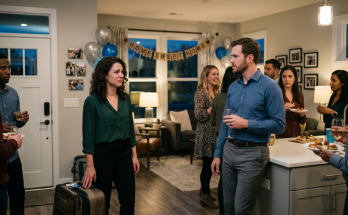
A banner stretched across the entrance.
WELCOME HOME, MISS MAGGIE.
I covered my mouth.
“What is this?”
Noah opened my door.
“We told you we weren’t here to celebrate,” he said. “At least, not only your birthday.”
They led me inside.
The building had been transformed.
Fresh paint covered the walls. New flooring had been installed. The roof no longer leaked. The classrooms contained new books, toys, art supplies, and furniture.
The old storage closet had become a small children’s library.
Above the entrance was a new sign.
MAGGIE’S HOUSE EARLY LEARNING CENTER.
I stopped walking.
For several seconds, the room seemed to tilt around me.
“I don’t understand.”
Owen opened the folder.
Inside were legal documents, property records, nonprofit registration papers, and plans for a childcare scholarship program.
The four twins had learned about the closure months earlier.
Noah, who now owned a construction company, had inspected the building and organized the renovations.
Owen, a family attorney, had handled the legal work and negotiated with the property company.
Sophie had helped design health and safety programs for the children.
Sadie had secured grants and organized donations from former Little Pines families.
Together, they had purchased the building.
Not for themselves.
For the community.
For families who could not afford expensive childcare.
And, they said, for me.
“We didn’t want the place that saved all of us to disappear,” Sophie said.
“Saved you?” I whispered.
Noah looked at me.
“You taught me that needing time didn’t mean I was weak. I speak in front of hundreds of employees now. Every time I step onto a stage, I remember the day you waited for me to finish three sentences.”
Owen smiled.
“You taught me to stop speaking over people and start listening. That’s probably the only reason I became a decent lawyer.”
Sophie squeezed my hand.
“You made me want to care for children when they’re scared.”
Sadie’s eyes filled with tears.
“And you taught me that ordinary days matter. I built my entire career around helping community programs because you showed me what one safe place can do for a child.”
I looked around the room.
Everywhere I turned, someone was crying.
Including me.
The Question They Came to Ask
Owen placed the documents on a small table.
“The center already has a director and a full staff,” he explained. “We’re not asking you to run it.”
Noah handed me a small brass key.
“But we are asking you to help guide it.”
They wanted me to become the honorary founder and community advisor.
I could visit whenever I wished.
I could read to the children, train young caregivers, organize birthday traditions, or simply sit in the garden.
They had even rebuilt the reading corner from my old classroom.
The same style of wooden shelves.
The same soft rug.
And sitting in the center was a small green dinosaur.
A replica of the one I had given Noah on his first day.
I picked it up.
“You remembered Daniel,” I whispered.
“Of course I did,” Noah said. “He helped me survive my first day.”
That was when I finally understood something I should have known years earlier.
Love does not disappear simply because people grow up.
The lunches I packed, the stories I read, the scraped knees I bandaged, and the hours I spent sitting beside frightened children had not vanished.
Those moments had traveled with them.
They had influenced the way Noah led his company.
The way Owen listened to his clients.
The way Sophie comforted sick children.
The way Sadie fought for struggling families.
I had believed I was merely helping children make it through ordinary days.
But ordinary days had shaped extraordinary lives.
The Birthday I Will Never Forget
After I signed the honorary founder documents, the crowd moved into the largest classroom.
There was a cake waiting for me.
Sixty-eight candles would have been a fire hazard, so the children had placed eight candles around a large sugar number six.
Everyone laughed when Owen insisted it was mathematically close enough.
Before I blew them out, Sadie handed me one final envelope.
Inside were letters from more than one hundred former students.
Some remembered the songs I had taught them.
Some remembered the snacks.
Some remembered being held during storms or comforted after their parents left.
One woman wrote that I had been the first adult outside her family who made her feel important.
A man serving as an elementary school principal said he entered education because of me.
A young mother wrote that she spoke gently to her own children because she still remembered how gently I had spoken to her.
I could not read all the letters that day.
My tears made the words blur together.
That evening, after the celebration ended, Noah, Owen, Sophie, and Sadie drove me home.
The four boxes were placed carefully in my living room.
Before they left, we stood together on my porch.
“For years, I thought you had forgotten me,” I admitted.
Sophie wrapped her arms around me.
“We never forgot.”
“We just took too long to come home,” Sadie added.
Noah looked toward the darkened street.
“You spent your life making sure children knew they mattered,” he said. “We came back to make sure you knew the same thing.”
The Family I Had Already Built
Maggie’s House opened the following Monday.
I now visit three mornings a week.
I read stories in the corner Noah designed. I help new teachers understand that frightened children do not always need instructions. Sometimes they simply need someone willing to sit beside them.
Every birthday, the center holds two celebrations.
One for the children born that month.
And one called Ordinary Days Day, inspired by Sadie’s childhood note.
On that day, we celebrate small things.
Tying a shoe for the first time.
Sharing a toy.
Speaking in front of the class.
Helping someone who feels lonely.
The Carter and Bennett twins visit whenever they can.
They still argue.
Owen still talks too much.
Sophie still asks endless questions.
Sadie still notices details everyone else misses.
And Noah keeps a green dinosaur on the desk in his office.
I never had biological children.
For many years, I believed that meant I had missed my chance to have a family.
I know better now.
Family is not always created in a hospital or recorded on a birth certificate.
Sometimes family is built quietly.
It is built through packed lunches, bedtime stories, bandaged knees, patient conversations, birthday cakes, and the decision to keep showing up.
I spent thirty years believing I was raising other people’s children.
But on my sixty-eighth birthday, four of those children came back carrying boxes from my past.
They had not come merely to celebrate.
They had come to return everything I had given them.
And to show me that the family I thought I had lost had been growing around me all along.