My father only asked one question, but it left me breathless.
“Why did you arrive in a taxi, Jenna? Where is the Honda Civic I gave you?”
The words landed in the middle of the dining room with more force than any shout could have carried. My parents’ house had always been the kind of place where people lowered their voices before they crossed into the dining room. Not because it was cold, but because it was careful. My mother had spent years making those monthly family dinners look effortless, and even after she got sick and my father quietly took over more of the work than anyone bothered to notice, the effortlessness held. There was always fine china on the table. There was always soft music drifting from the speaker in the hallway. There was always a roast or steaks or something expensive enough to make my uncles murmur that Richard had gone too far again, as though generosity were a mild character flaw he refused to correct.
And at the head of the table there was always my father, Dr. Richard Hale, sitting with the calm posture of a man who understood, better than anyone I have ever known, the difference between panic and urgency. He was a surgeon for thirty-four years. He could walk into a room where everyone else was shaking and make one clear decision, and the whole room would exhale around it. That was what people admired about him. It was also, if you paid attention, what people feared.
I had spent most of my childhood believing his calm meant softness. By the time I was old enough to actually understand the man, I had learned that calm was only the container. What lived inside it depended entirely on what you had done.
Patrick never understood that. My husband thought calm meant weakness. He thought politeness was a kind of permission. He looked at a man who did not raise his voice and concluded he could be managed, the way he believed most obstacles could be managed, with enough confidence and the right choice of words. Patrick had been in my life for three years, and for most of those three years I had been quietly busy translating him into someone kinder than he actually was. When he made jokes at my expense, I called it nervousness. When he criticized what I spent, I called it budgeting. When he used my credit card and informed me only afterward, I called it marriage.
The first time he borrowed money from me for his mother, he cried. His mother needed her prescriptions. His mother was humiliated. His mother had given up so much for so many years. I believed him, because I wanted to be the kind of wife who did not keep score, the kind who gave freely and trusted completely. That was the first thing I handed him, and it was not money. It was the benefit of the doubt. He learned to weaponize that gift better than anything else I owned.
By our first anniversary, his mother’s emergencies had quietly become a second household in our budget. A water heater. A church fundraiser she simply had to contribute to. New tires. A medical bill I was never actually shown. A birthday gift she deserved after such a hard year. Patrick always made each one sound temporary, a one-time thing, the last time he’d have to ask. And he always, somehow, made me sound selfish if I asked for details, as though wanting to see a receipt were a small betrayal of the family we were supposed to be building.
My father noticed before I was willing to admit any of it to myself. He noticed the way I checked my phone every time Patrick started speaking at dinner, bracing for whatever he might say. He noticed the way I had started saying “we” when I clearly meant Patrick. He noticed that I had begun refusing second helpings, not because I wasn’t hungry but because I was too tense to eat comfortably in front of other people. Still, he waited. That was his rule with his adult children, one he held to with the same discipline he brought to everything else. He gave his advice exactly once. Then he stepped back and watched what you chose to do with it.
Six months before that dinner, he gave me the Honda Civic. It was not a flashy car. It was silver, practical, clean, and safe, which was exactly how my father thought about the people he loved. He handed me the keys in the driveway after Sunday brunch and said, “This is yours, Jenna. Not a household car. Yours.” I laughed, because he sounded so formal about it, like a lawyer reading a clause aloud. Then he handed me a folder. Registration. Insurance paperwork. A copy of the title documents. A service record from the dealership. He had even clipped a small yellow sticky note to the front that read, in his careful block letters, keep this in your desk, not in the glove compartment.
At the time, I thought it was just my father being my father. Methodical. Overprepared. A little dramatic about paperwork, the way surgeons often are about the things that keep people alive. I understand now that he had already seen, with that same clarity he brought into operating rooms, the exact thing I was working so hard not to name.
The Civic changed my life in small, quiet ways that added up to something larger. I could drive myself to work without first negotiating with Patrick about when he might need our shared car. I could stop at the grocery store on the way home without having to explain the detour. I could see my parents after work without arranging the whole thing around Patrick’s moods and his schedule and his sudden needs. For a few months, I remembered what independence had felt like before I married, and I had not realized until then how much of it I had slowly surrendered.
Then Patrick began mentioning his mother.
At first it was casual, almost offhand. Mom’s car is getting embarrassing, he’d say. Then it became practical. You barely drive that far anyway, he pointed out, as though the distance I drove were the measure of whether the car belonged to me. Then, inevitably, it became moral. It’s sad, he told me one evening, that you can sit here watching an older woman struggle while you sit on a gift you don’t even really need.
I said no the first time. I said no the second time. By the third time, he had stopped asking in any way that expected an answer from me at all.
The Civic disappeared on a Thursday. I came out of work at 5:23 in the afternoon and stood in the staff parking lot with my keys in my hand, pressing the unlock button at empty air, at the blank rectangle of asphalt where my car should have been. For a full minute I genuinely believed it had been stolen. In a way, I suppose it had. I called Patrick. He did not answer. I called again. He texted me back six minutes later. Don’t start. Mom needed it. We’ll talk at home.
There are moments in a marriage when you realize the argument has already happened without you, that it was held and decided and closed in a room you were never invited into. Someone else weighed it. Someone else ruled. Someone else had already decided on your punishment for objecting before you had even opened your mouth to object.
I took a taxi home that night. Then another one the next morning. Then rideshares when I could afford them, and my own two feet when I couldn’t. Patrick told me I was being dramatic, that plenty of people got by without a car. His mother sent me a single text that said, thank you for understanding sacrifice. I read it three times. I had not sacrificed anything. Sacrifice is something you choose. I had been stripped.
For almost two weeks, I told no one. But I kept the dealership folder in my desk drawer, and in secret I began adding things to it. Screenshots of Patrick’s text. The taxi receipt from 5:51 that Thursday evening. A credit card alert for gas purchased at a station near his mother’s church, a place I had never once driven to. A photo of the empty parking space at my office, taken for reasons I could not have explained at the time. A voicemail transcript from Patrick that read, you’re making a car more important than family.
I did not know what I was building. I only knew, with a certainty that ran deeper than logic, that I needed proof I had not imagined the shape of the disrespect. Memory gets bullied when there is no proof standing beside it. Patrick was very good at making me doubt the evidence of my own life, and some quiet part of me had begun collecting the things he could not talk me out of.
By the time the monthly dinner arrived, I was exhausted from all the pretending. I almost didn’t go. Patrick went early, ahead of me, claiming he had a client call scheduled near my parents’ neighborhood. It was another lie, but by then his lies had become furniture in our home. They were simply always in the room, and everyone had learned to step around them without comment.
I arrived in a taxi at 7:18. The driver pulled away before I had even finished closing my purse. My parents’ driveway was lined with cars that all seemed too polished under the lights. My uncle’s BMW. My cousin’s Mercedes. My brother’s SUV. And the space where my Civic should have been sitting looked almost accusatory in its emptiness, a gap in a smile where a tooth used to be. I stood there in my simple dress, smoothing the fabric down over my waist, feeling the cold evening air press against my cheeks, and then I made myself walk inside.
Patrick was already at the table. He did not stand when I entered. He did not look guilty. He was cutting his steak with the unhurried appetite of a man who believed control had already been firmly established, that the difficult part was behind him and only the enjoyment remained.
My father watched me come in. He watched my hands as I set down my purse. He watched my shoes as I crossed the room. Then, without turning his head much at all, he watched the empty place in the driveway through the front window. He waited until I had settled into my chair. He waited until the first careful attempt at conversation had picked back up around the table. And only then did he ask the question.
“Why did you arrive in a taxi, Jenna? Where is the Honda Civic I gave you?”
The entire table went quiet. And so did I.
I was going to lie. That is the part of the evening I am still most ashamed to admit. In the space of a single breath, I had already decided to protect Patrick from a humiliation he had not hesitated for one second to hand to me. I was going to say the car was at the mechanic. I was going to say I simply preferred not to drive lately. I was going to say anything at all that would make my marriage look less broken than it truly was, because after three years of translating him into someone kinder, protecting him had become a reflex I no longer questioned.
But Patrick spoke first.
He wiped his mouth with his napkin. He lifted his wineglass slightly, almost as though he were toasting his own generosity. And then he said, “I gave it to my mother. She needed it more.”
The sentence came out so clean it almost sounded rehearsed. No apology. No explanation directed at me, the person the car had belonged to. No acknowledgment that it had ever been mine at all. He spoke as though my father had handed him an asset, and he, in his superior judgment, had simply redistributed it more wisely. Then he added, warming to it, that his mother had been embarrassed arriving at her church meetings in that old car of hers. He said I worked close by anyway. He said I could take taxis, Ubers, “those things.” He said it was practical.
Practical. That word sat on the table between us like a dirty plate no one wanted to clear.
My face burned, but my hands stayed still in my lap. I remember pressing my nails into my palm hard enough to leave small crescent marks that were still there an hour later. For one ugly second, I genuinely wanted to throw my water glass at him, and not because of the car itself. Because he had finally, in a room full of witnesses, said the quiet part out loud. What was mine was not mine if he could imagine a better use for it. What my father had given me could be quietly transferred to his mother. What I objected to could be renamed selfishness and handed back to me as my failing.
The worst part was watching everyone else process it in real time. Aunt Lauren looked down at her spoon. My uncle stopped chewing mid-bite. My cousin Jason glanced from Patrick to me, and the easy smile he always wore slid right off his face. My brother’s hand tightened around his glass until his knuckles paled. And no one defended me. Not at first. That silence hurt almost as much as Patrick’s words had, because in it I heard how thoroughly I had trained the people who loved me to step around the furniture too.
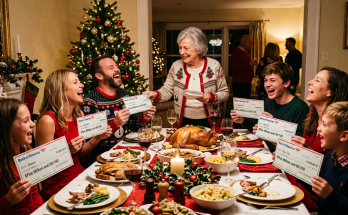
The table just froze. Forks hovered halfway to mouths. Wineglasses hung suspended in the air. A serving spoon leaned against the rim of a bowl while sauce slid slowly down the white ceramic. Aunt Lauren stared at the silver pattern on her spoon as though it might rescue her from having to choose a side. Nobody moved.
My father did not yell. He did not slam his palm on the table. He did not make the scene that Patrick would later claim, to anyone who would listen, that he had made. He simply looked at Patrick. And then he smiled, faintly. It was brief. Almost elegant. But I knew that smile. I had seen it before, when hospital administrators tried to explain away a preventable mistake in front of him. I had seen it when a contractor charged my mother twice for the same repair and thought no one would check. I had seen it once at a restaurant when a man spoke over me three separate times, and my father waited, unbothered, until the fourth before he ended the conversation entirely with two quiet sentences. That smile did not mean peace. It meant the decision had already been made, somewhere behind his eyes, and the rest of us were simply waiting to find out what it was.
“I understand,” my father said. Nothing more.
Patrick relaxed immediately. I watched the tension leave his shoulders. He thought the moment had passed. He thought my father had accepted the explanation because Patrick had invoked the word mother and trusted the whole room to soften around it, the way I always had. He returned to his steak with the satisfied air of a man who had navigated a small awkwardness gracefully.
Then I saw the blue glow under the tablecloth. My father had taken out his cell phone. His thumb was moving, quick and precise, and he did not look down at the screen long enough for anyone to notice unless they knew him well enough to catch it. I knew him. At 7:42, while Patrick cut another bite of steak, my father sent a message from beneath the white linen. Then he slid the phone back into his pocket and went on eating his dinner as though nothing at all had happened.
For the first time in weeks, I felt something loosen in my chest. It was not relief, not yet. It was hope, and I had almost forgotten what it felt like.
The conversation tried to recover, but the whole room had changed temperature. My uncles spoke more softly now. Aunt Lauren avoided looking at me for too long, as though eye contact might commit her to something. Jason no longer laughed at Patrick’s little comments about business. Patrick kept talking anyway, of course. Men like Patrick often mistake silence for victory, because they have never once had to hear what people say about them after they leave the room. He talked about his contacts. He talked about his plans. He talked about an investment opportunity he was seriously considering. He leaned back in his chair with the posture of a man who had won something, who owned the evening.
Then his phone rang. He glanced at the screen and smiled. “It’s my mother,” he announced, and there was real pride in his voice. I think he expected her to thank him again. I think part of him hoped to put her on speaker and let the whole table hear how grateful she was for the wonderful thing her son had done for her.
Instead, he answered, and he went still.
The change happened slowly enough that everyone at the table got to watch it arrive. His smile thinned and vanished. His shoulders climbed and stiffened. The wineglass in his hand lowered slowly back to the table. “Mom?” he said. Then, after a pause, “Slow down. What are you talking about?”
My father set his knife and fork neatly together on his plate. Patrick looked at him then. Really looked at him, in a way he never had before.
“No,” Patrick said into the phone, and his voice had changed entirely. “Don’t sign anything. Tell me you didn’t sign anything.”
That was when my father’s phone buzzed against the table. He looked at the screen once, then turned it slightly, just enough, toward me.
It was a photograph. The Honda Civic sat beneath the bright white lights of a gas station not far from his mother’s church. A tow truck was backed up in front of it, its hook already lowered. A man in a dark jacket stood holding a clipboard. And Patrick’s mother stood beside the car with one hand raised in the air, her mouth open mid-argument, caught by the camera in the exact posture of a woman losing a fight she did not understand she had already lost. Stamped across the top of the digital form displayed on my father’s screen was the name of his medical group. Hale Surgical Associates.
And I understood then. All of it, at once.
The Civic had not been purchased casually, the way I had assumed. My father had bought it through an employee vehicle assistance program attached to his practice, and then transferred its use to me with very specific paperwork that kept the program’s ownership protections intact. That was what the folder had been. That was why the sticky note told me to keep it in my desk. He had told me the car was mine because, functionally and legally and within our family, it was mine and only mine. But Patrick had never had the authority to give it away. And his mother had never had the authority to sign anything connected to it. Patrick did not know that, because Patrick never read paperwork in his life unless he was convinced it could benefit him somehow. My father read everything. My father had, I now realized, read this particular situation the moment he clipped that yellow note to the folder six months before.
The man with the clipboard was not merely a tow operator. He was the fleet compliance manager for Hale Surgical Associates, and my father had texted him from beneath the tablecloth at 7:42, the way another man might have texted for a taxi.
Patrick lowered the phone from his ear. “Richard,” he said.
Not Dr. Richard. Not Dad, the way he sometimes performed it for the family. Richard. The name of a man he suddenly, desperately needed, instead of a man he had spent three years believing he could impress and manage.
My father looked at him and said, evenly, “You gave away a vehicle you did not own.”
Patrick’s mouth opened. No sound came out of it. Then he tried to laugh, and it was a terrible little sound, thin and cracking at the edges. “Come on,” he said. “This is family.”
My father nodded once. “That is exactly why I asked in front of family.”
Aunt Lauren covered her mouth with her hand. Jason whispered my name, but I could not look away from Patrick’s face. For three years I had watched that man turn every boundary into a debate, every no into the opening move of a negotiation, every hurt I expressed into fresh evidence that I was simply too sensitive to be reasoned with. And now, for the first time, he was facing a boundary that did not tremble, that had no interest in his charm, that had been drawn six months in advance by someone who had seen him coming.
My father held out his hand for the phone. Patrick hesitated. “Put it on speaker,” my father said.
The room froze again, but this time the silence did not belong to me. Patrick put the call on speaker with the slow reluctance of a man setting down a weapon. His mother’s voice filled the dining room, crying and furious at the same time. She said a man was taking the car right out from under her. She said Jenna had embarrassed her in front of everyone at the gas station. She said Patrick had promised her, promised.
Then my father spoke, in the same calm, level voice he must have used a thousand times to deliver news that changed people’s lives.
“Mrs. Collins, this is Richard Hale. The Honda Civic was never Patrick’s to give to you. You will hand the keys to Mr. Alvarez. You will sign the release acknowledging that you received the vehicle without authorization. And if you refuse, I will have him contact the local police and file the report tonight.”
She stopped crying. The silence that came down over the phone was so complete that I could hear the faint hum of the chandelier above the dining table. And then she said, in a smaller voice, “Patrick told me Jenna said yes.”
Every eye at the table turned to me.
“I did not,” I said.
My voice did not shake. That surprised me more than anything else that entire night.
Patrick turned on me instantly. “You could have helped my mother,” he snapped.
And there it was again, one final time. The old trick, the one that had worked on me for three years. Not I took your car. Not I lied to my own mother about you. Not I humiliated you at your parents’ table. You could have helped. The endless, exhausting reframing that made his theft into my failure of generosity.
My father leaned back in his chair. “Jenna,” he said, “do you want the car returned to your apartment, or here?”
It was the first time all night, the first time in longer than I could remember, that anyone had asked me what I wanted. That simple question very nearly broke me right there at the table.
“Here,” I said.
Patrick stared at me. “You’re really going to do this?”
I looked at the watch on his wrist, and the shirt I had paid for, and the confidence he had worn into my parents’ house like a suit of armor he was certain would never be tested. And then I said, “No, Patrick. You did this. I’m just finally done paying for it.”
My brother stood up first. Then Jason. Then my uncle. Not dramatically, not the way it happens in a movie, no chairs knocked over, no raised fists. Just enough. Just enough for Patrick to understand that the room he had counted on for its silence had quietly shifted its weight, and that he was now standing in it alone.
My father did not ask him to leave. He told him. “You can wait in the study until your ride arrives,” he said. “Jenna will not be leaving with you tonight.”
Patrick laughed again, but this time there was real fear underneath it. “She’s my wife,” he said.
My father said, “She is my daughter. More importantly, she is herself. You seem to have forgotten both of those things somewhere along the way.”
I don’t remember standing up. I remember my chair moving back. I remember Aunt Lauren whispering my name like an apology she knew was arriving too late to matter. I remember walking up the stairs to the guest room where I had slept as a teenager, and locking the door behind me with both hands, and then sitting down on the edge of the bed and shaking so hard the frame creaked beneath me.
The Civic was returned at 9:16 that night. Mr. Alvarez drove it into my parents’ driveway himself and handed the keys to my father, who brought them upstairs and set them on the dresser beside me without a word. He also handed me a folder. Inside were copies of the vehicle documents, the unauthorized transfer release his mother had been made to sign, the tow record, and a printed screenshot of Patrick’s own text message admitting exactly what he had done. My father had already made copies of all of it. Of course he had. That was the whole shape of the man, the thing I had mistaken for softness my entire childhood.
“You don’t have to decide everything tonight,” he said.
It was the first merciful sentence anyone had offered me in months, and I have never forgotten it.
I did not decide everything that night. But I decided enough. I did not go home with Patrick. The next morning I called my bank and removed him as an authorized user on the credit card he had come to treat as a family fund. I changed my passwords, all of them. I photographed receipts. I packed only what actually belonged to me while my brother waited quietly in the hallway of the apartment that had never really felt like mine. Patrick alternated between rage and apology so rapidly that both began to feel rehearsed, two masks on the same face. His mother called me ungrateful. Then cruel. Then dramatic. Then she stopped calling altogether, the day my father sent a single message through his attorney requesting that all further communication be documented. That one word changed everything. Documented. Cruel people cannot stand documentation, because it steals their favorite hiding place, the soft uncertain territory where it is always your word against theirs and they have had years of practice making you doubt your own.
Over the following month I learned how much of my life had been silently rearranged around the project of keeping Patrick comfortable. I learned that my credit cards had funded far more of his mother’s lifestyle than I had let myself understand. I learned that he had told our friends I was unstable with money, all while using my accounts to make himself look generous to those very same people. And I learned that the Honda Civic had never been the beginning of anything. It was simply the first theft he had grown arrogant enough to announce out loud, over dinner, in front of the one man who had seen him clearly from the start.
The divorce was not cinematic. Most endings aren’t. They are forms and signatures and passwords and cardboard boxes. They are waking at three in the morning wondering whether you overreacted, whether you were too harsh, whether you should have tried harder, and then opening a folder on your nightstand and remembering that facts do not care how guilty someone spent three years training you to feel. Patrick tried to frame the car as a misunderstanding. The documents made that difficult. He tried to claim I had agreed verbally. His own text message made that worse. He tried to say my father had manipulated me into the whole thing, and my attorney simply asked why a grown man had needed his father-in-law’s permission in order not to give away his own wife’s car. That question ended the meeting early.
Six months later, I still drive the Civic. There is a small scratch on the rear bumper from the towing bracket, and for a while I hated seeing it every time I walked up to the car. Now I keep it exactly as it is. It reminds me that recovery is not the same thing as erasing the evidence. It reminds me that a person can return what they took from you and still never restore what they damaged in the taking. And most of all, it reminds me of that dinner table. The scrape of a fork against china. The blue glow beneath the white linen. The way nobody in that room moved until, at last, one person finally did.
For three years, I believed my marriage had taught me to be quiet. That night, at his own table, my father taught me something far better. Silence is not always surrender. Sometimes it is only the last held breath before the truth begins, finally, to ring.