
I looked at the brass key in the evidence bag and felt something colder than fear settle in my chest.
It had a strip of faded blue tape around the head, the same tape I had wrapped around my spare key years ago because I was always misplacing it in my purse.
The officer held it carefully between two gloved fingers while the printed still from my foyer camera lay on my hospital blanket.
Bethany was in my hallway in that picture, one suitcase upright at her feet, another already halfway inside.
She hadn’t been waiting for permission.
She had been waiting for me to bleed.
“No,” I said.
“My parents never had permission to copy that key.” My voice sounded thin under the hospital fluorescent lights, but it didn’t shake.
The officer wrote something down.
The other one looked at the fresh bandage above my eyebrow, then at the screenshot again.
“Patrol is at your address now,” he said.
“Your sister and her husband were inside when your alarm company flagged movement.
Your mother arrived five minutes later and told officers it was a family move-in.
Then she produced a notarized occupancy agreement with your signature on it.”
Even through the pounding in my head, that landed hard.
“My signature?” I asked.
The officer nodded.
“We’re not treating it as valid.
We just need your formal statement that nobody had permission to enter.” Richard’s voice came through my phone on speaker, steady as stone.
“Give them exactly that, Sally.
The house is solely in your name.
No one has permission.
No one has residency.
No one stays there tonight.” I said it twice, once to the officers and once to myself.
The nurse returned to clean the cut more thoroughly.
It needed stitches, not just a bandage.
While she worked, I answered questions in short, careful sentences.
My father, Harold Donovan, had thrown the wine glass.
My mother, Virginia Donovan, had called me selfish as I bled.
My sister, Bethany Cole, had been pressuring me for weeks to let her, her husband Kenneth, and their children move into my house.
No, I had not invited them.
No, I had not agreed verbally.
No, I had never signed anything.
The officer taking notes paused.
“Do you know why they thought this would work tonight?” he asked.
I gave a bitter laugh that hurt my stitches.
“Because my family mistakes silence for surrender.” That was the simplest version.
The longer one started two months earlier, when Bethany’s landlord sold the little rental on Maple Court and gave them sixty days to leave.
Bethany called me crying the same night she got the notice.
Kenneth had just lost overtime at work.
The kids were in school.
They needed somewhere to land, just for a few weeks, she said.
A few weeks was a lie everyone in my family knew how to tell with a straight face.
Ten years earlier, when I had just bought my house, Bethany had moved in “temporarily” after Madison was born.
Three months turned into eleven.
Her boxes multiplied.
Her bills followed.
Mail started arriving with my address typed under her name, and when I asked about it, she told me I was being uptight because “family shares.” Getting her out had taken one ugly winter, three screaming
matches, and my threat to file formal eviction papers.
We did not speak for almost a year after that.
So when she started saying “the family house” this spring, I heard the old machinery start up again.
At first it was casual.
Which bedroom got the best morning light? Was the school district near my street better than theirs? Could Tyler’s bunk bed fit upstairs? Then it sharpened.
My mother called to say I had “empty rooms and no children, which means you have space.” My father said I owed Bethany help because she had “more responsibilities than I ever would.” Bethany stopped asking whether she could stay and started talking about when she would.
The thing that scared me wasn’t the entitlement.
I was used to that.
It was the organization.
They weren’t only talking to me.
They were talking around me, building a version of reality where my refusal was temporary and unreasonable, like a childish stage the adults would soon correct.
My aunt called to say she had heard I was “considering taking the kids for the summer.” A cousin asked whether I needed bunk beds.
A church friend of my mother’s mentioned Bethany would be “closer to family soon.” I hadn’t said yes to anyone.
Somehow, my answer had already been edited out.
The day I called Richard Stevens was the day I found a school fundraiser flyer tucked into my mailbox with Madison’s name handwritten across the top and my home address filling the parent line.
Bethany claimed it was nothing, just something she had filled out while distracted.
Richard didn’t agree.
He looked at my saved texts and told me to stop treating the situation like hurt feelings.
“This is documentation,” he said.
“They are laying groundwork.
Change your alarm codes, move any spare keys, put cameras inside and out, and do not meet them anywhere without assuming they’re trying to create leverage.”
I followed every instruction except one.
I still went to Easter dinner.
Not because I trusted them.
Because I knew the pressure campaign had reached the point where they would force a showdown, and I wanted witnesses.
That part of the plan shamed me later.
I had not expected violence, but I had expected an ambush of another kind.
I had expected tears, accusations, maybe an aunt on speakerphone, maybe the kids brought in at the perfect moment to make me look cruel.
I wore a navy blouse instead of white because Richard had said, half joking and half not, “Never attend a family intervention in clothes you can’t ruin.”
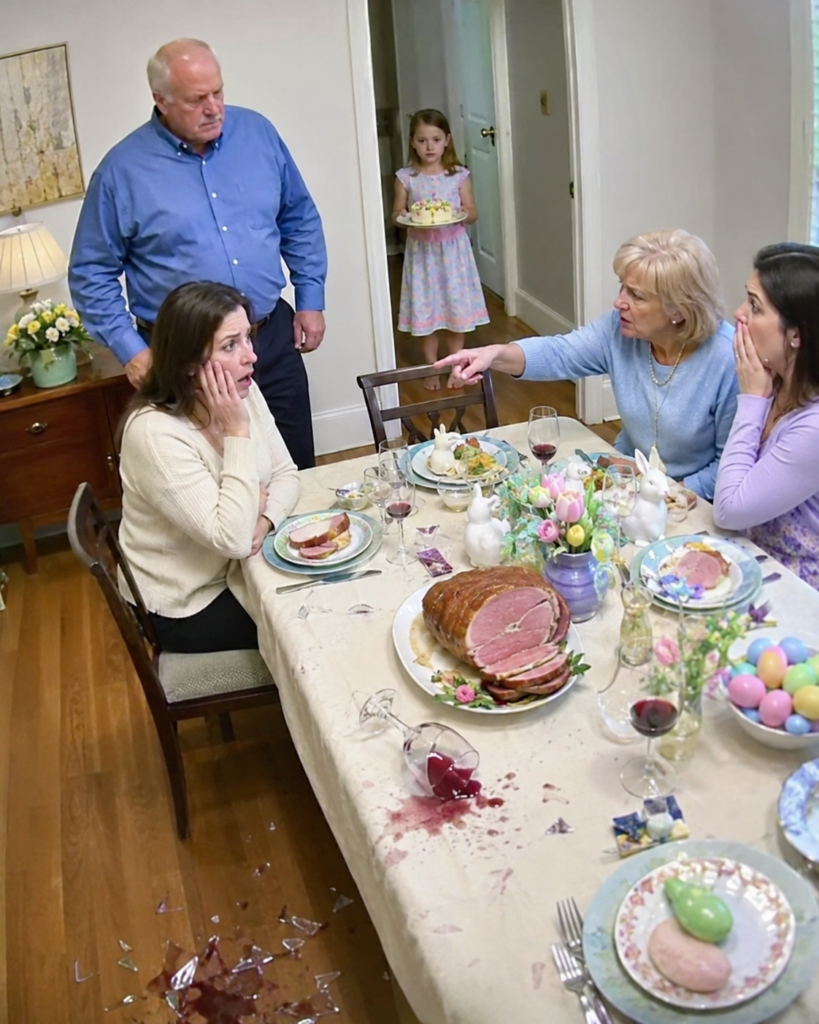
Dinner had hardly started before my mother turned it into a hearing.
Ham on the table, pastel eggs untouched, candles burning down.
Bethany sat with her napkin twisted in both fists.
Kenneth stayed quiet.
My father poured another glass of red wine and asked when I planned to “stop punishing children for adult problems.” I said I wasn’t punishing anyone.
I was refusing to lose my home.
My mother leaned forward and said, “You have three bedrooms and one body.
Explain that math to me.” I remember Madison in the den watching cartoons.
I remember Tyler’s feet thumping upstairs.
I remember realizing nobody at that table had invited me to Easter.
They had summoned me.
When I said no for the
last time, everything moved quickly.
My mother’s mouth flattened.
My father stood.
Bethany whispered, “Please don’t make us do this the hard way,” and I barely had time to turn my head before the wine glass flew.
The impact was sound before pain, a cracking pop against bone, then wet heat sliding past my ear.
My mother didn’t scream.
She said, “You’re being selfish.” My father pointed at the blood on my hand and said, “You have empty bedrooms.” Even in the moment, that sentence told me something important.
They believed what they wanted so completely that my injury barely registered as relevant.
By the time the nurse finished my stitches, Richard was on his way to both the hospital and my house.
The officers took photographs of my face and collected the blood-spotted towel I had brought in from my car.
One of them stepped out to call patrol, then came back with a tighter expression.
“Your sister and her husband are being removed from the property,” he said.
“They had two suitcases, children’s bags, and a plastic file box with documents.
Your mother is still insisting there was permission.
Your father is not at the house.” Of course he wasn’t.
Harold had always preferred to wound from a safe distance once the damage was done.
I asked about the children.
The officer said the kids were still at my parents’ home with a neighbor who had been called over after the argument.
Relief hit me so suddenly I almost cried.
Whatever else Bethany had planned, Madison and Tyler had not been dragged into my foyer that night.
Only their backpacks had.
Richard arrived minutes later, rain on his coat and a leather folder tucked under one arm.
He didn’t waste a word on sympathy.
He squeezed my shoulder once, looked at the stitched cut, then opened the folder on my hospital tray like he was laying out surgical instruments.
“Here’s where we are,” he said.
“Your father assaulted you.
Your mother and sister attempted to establish unlawful occupancy while you were in the emergency room.
They produced a forged document.
Because we have injury, digital evidence, and active trespass, this moves from family drama into criminal and civil territory tonight.” I stared at him.
He held my gaze.
“This is why I told you to stop arguing and start preserving.
Phase one was never getting hurt, Sally.
Phase one was them finally showing the truth in a form the law can use.”
The next hour passed in signatures.
Statement for the assault.
Statement for the unlawful entry.
Statement authorizing the police to remove anyone from my property and seize the copied key and the supposed occupancy agreement as evidence.
Richard also called a locksmith he trusted and had every exterior lock changed before dawn.
By midnight, he had emailed my parents, my sister, and Kenneth formal no-trespass notices.
By one in the morning, he had filed for an emergency protective order against Harold and Virginia.
I watched him work and understood something ugly but useful: the opposite of chaos was paperwork.
I was discharged just after two.
Richard drove me home.
The porch light was on, and the blue door I loved looked normal from the street, almost gentle.
Inside, it felt violated in ways that took me
a second to name.
My entry rug was twisted.
My umbrella stand had been knocked over.
One of Bethany’s suitcases had leaked a trail of glitter from a craft bag across my floorboards.
On the console table, next to the bowl where my spare key used to sit, lay a folded sheet of paper the officers had left for Richard.
It was a photocopy of the occupancy agreement my mother had waved at patrol.
The document would’ve been laughable if it hadn’t been so brazen.
It said I was allowing Bethany, Kenneth, Madison, and Tyler to reside in my home for an indefinite family emergency period.
The signature line bore my name in a stiff imitation of my cursive.
The date was that morning.
The notary stamp was smudged.
Richard pointed to the witness line and almost smiled.
My mother’s name was misspelled.
“Sloppy,” he said.
I looked at the page and thought about Bethany sitting somewhere with my blood still drying at my parents’ house while she dragged a suitcase into my hallway with this in her purse.
By breakfast, the story they were telling the family had already started circulating.
My aunt texted that she was praying for “peace after a dinner accident.” A cousin said she couldn’t believe I had “called cops over a misunderstanding.” My mother left a voicemail crying hard enough to sound frail.
“Your father didn’t mean it.
Bethany thought you had reconsidered.
Please stop this before strangers ruin the family.” I saved every message and sent them to Richard.
Then I turned my phone face down and slept for three hours with an ice pack on my eye and every light in the house on.
The hearing was set for the next afternoon because of the assault and the attempted move-in.
I walked into the courthouse bruised, stitched, and angrier than I had ever been in my life.
My mother was already there in pearls and soft beige, looking like a woman who donated casseroles after funerals.
My father wore a pressed shirt that couldn’t hide the small cut on his knuckle.
Bethany held a tissue but no tears.
Kenneth stood apart from them, tie crooked, eyes red-rimmed.
For one dangerous second, I wondered whether they would still manage to make me look unstable.
Then Richard handed me a bottle of water and said, quietly, “Let them talk first.”
They did.
Virginia told the judge there had been a family disagreement over housing, that Harold had gestured too sharply and a glass had slipped.
Harold said he was heartbroken that a clumsy moment had become a legal spectacle.
Bethany claimed she entered my house because she believed I had finally agreed and had sent their mother to bring over paperwork.
She even said the children had already been promised rooms and were devastated.
It was polished.
Respectable.
If you ignored the blood.
If you ignored the key.
If you ignored the timing.
If you ignored how greed always dresses itself as necessity when it wants an audience.
Richard stood only when they finished.
He did not raise his voice.
He submitted the emergency room photographs first.
Then the officer’s report.
Then the stills from my foyer camera showing Bethany and Kenneth entering my house while I was under treatment.
Then the bagged spare
key recovered from Bethany’s purse.
Then the no-trespass report made before midnight.
My father’s jaw tightened, but my mother stayed composed.
It was Kenneth who broke the symmetry.
He looked at the table, then at the judge, and asked whether he could make a statement.
Bethany hissed his name under her breath.
Kenneth ignored her.
He said Bethany had told him, on the drive over to Easter, that by the end of the night they would be “sleeping at Sally’s place whether she likes the conversation or not.” He said Virginia had texted the family group chat that afternoon, “Once the bags are in, she won’t drag children back out.” He said he had believed, or wanted to believe, that everyone was pushing too hard but not actually doing anything illegal.
Then he saw me bleeding.
Bethany told him to load the suitcases anyway.
“That’s when I knew,” he said, voice cracking, “that nobody had permission.
They were counting on her being too shocked to stop it.”
You could feel the air change.
Richard asked for the group chat records Kenneth had brought printed from his phone.
The judge read them in silence.
There it was in black and white: my mother planning the timing, my sister discussing backpacks and toothbrushes, my father writing, “She’ll fold when she sees the kids.” There was even a message from Bethany sent an hour before dinner: “Don’t forget to bring the copied key.” My stomach turned over, but not from surprise.
From confirmation.
They had built the whole evening like a trap and expected my love, or my shame, to keep me inside it.
Bethany tried to say Kenneth was lying because he was angry about money.
The judge asked why, if she had permission, she needed a copied key and a notary form.
No one answered.
Richard then introduced one final piece: a voicemail my father had left while I sat in triage.
It played through the courtroom speakers, flat and ugly.
“It was an accident caused by your attitude,” Harold’s voice said.
“Stop being dramatic and get back here so we can finish this.” Not sorrow.
Not panic.
Not even denial.
Just ownership of the violence and annoyance that it had delayed the plan.
The orders were granted within minutes.
Harold was barred from contacting me or coming near my property.
Virginia got the same restriction because of her role in the attempted occupancy scheme.
Bethany and Kenneth were formally trespassed from my home, though Kenneth’s cooperation kept him from being rolled into the immediate filing.
The judge referred the forged document to the district attorney’s office and ordered every copied key surrendered by the end of day.
Harold was taken downstairs on the assault complaint after the hearing.
He looked stunned, not guilty.
That was the part of him I knew best.
The criminal side moved slower, but it moved.
The notary stamp on the fake agreement had been reported stolen from a shipping store two weeks earlier.
Bethany was charged for the document.
Virginia spent the first month insisting she had only been “helping with paperwork.” Then detectives pulled security footage from the copy shop showing her at the counter with Bethany the same afternoon the form was printed.
Kenneth eventually filed for separation and took the children to
his sister’s place until he found an apartment.
He apologized to me once, outside the courthouse, with the exhausted face of a man who had confused cowardice with peace for too long.
I told him the apology mattered most if he told the truth consistently.
He did.
The family fallout was messier than the legal one.
Relatives split into camps.
Some sent me long messages about forgiveness.
Others quietly admitted they had suspected something was wrong when my mother started talking about my “extra bedrooms” as though they were community property.
A few people disappeared entirely when I refused to smooth things over.
I let them.
Peace stopped meaning keeping everybody comfortable.
Peace started meaning unlocking my front door and knowing no one inside believed they had a claim to my life.
Six months later, Harold entered a plea on the assault charge.
Bethany’s case on the forged agreement was still winding through court, but the protective orders held, and nobody had set foot on my property without permission since that night.
I repainted the dented patch of hallway wall where one suitcase had clipped the corner on its way in.
I replaced the console bowl.
I installed a heavier lock on the blue door, though by then the new habit was mostly for my own nervous system.
Some injuries take longer to leave the body than the skin.
The strangest part of the aftermath was how ordinary the house looked while I was relearning safety inside it.
Morning coffee still tasted like morning coffee.
The lilac bush still bloomed crooked.
The soft green office still caught good light in the afternoon.
Yet every object also carried proof that I had kept it.
The extra bedrooms were mine because I paid for them, painted them, cleaned them, and said no when no was required.
Ownership, I learned, is not only a legal category.
It is the quiet courage to remain the authority in rooms people have been training you to surrender.
The following Easter, I did not go to my parents’ house.
I roasted a small ham for myself and two friends who knew enough not to ask foolish questions.
We ate with the windows open.
No one turned dinner into a trial.
No one counted my bedrooms.
Halfway through dessert, my phone buzzed with a message from an unknown number.
It was a photograph Kenneth had sent with no extra commentary.
Madison was holding a school art project: a paper house painted bright blue with a crooked purple bush beside the steps.
On the front, in careful block letters, she had written, “Aunt Sally’s House.”
I set the phone down and looked around my dining room.
Sunlight on the table.
Clean plates.
No raised voices.
No one reaching for what wasn’t theirs.
For a long time, my family had treated my boundaries as a personal insult, something to punish until I became useful again.
They were wrong.
A boundary is not an insult.
It is a door with a lock, a deed with one name, a police report with the truth written plainly enough that no amount of bloodline can edit it.
That Easter, in the quiet I fought to keep, I finally understood what had been saved.