He thought the suit, the flowers, and the church would hide what he really was. He didn’t know fifty engines were already turning into the parking lot.
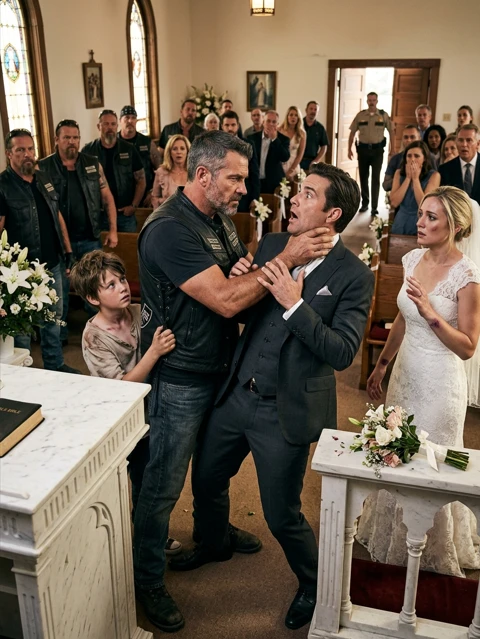
The July heat sat heavy over Pine Hollow, warping the road outside the old church. Inside, the air smelled of lilies and expensive perfume. Guests smiled into their phones. The minister opened his book. At the altar, Richard Sterling looked polished, calm, untouchable.
Beside him, Sarah stood in white gloves despite the heat. Her bouquet trembled so lightly most people would never notice. But fear has a way of shaking through fabric.
Then the doors exploded open.
The sound hit first—a deep mechanical thunder rolling through stained glass and polished wood. Every head turned. Sunlight cut across the aisle, and in it stood a broad man in worn leather, face carved by years and silence. Behind him came rows of bikers, filling both sides of the church without saying a word.
The room forgot how to breathe.
Sarah’s eyes locked on the small figure beside him.
She dropped the bouquet. “James.”
Richard’s hand snapped around her wrist before she could move.
Richard forced a smile. “What is the meaning of this?”
The biker kept walking, boots striking the floor one measured step at a time. He carried no hurry, no panic, no need to raise his voice. He reached the altar and threw a crumpled drawing onto the marble.
A woman in white. A little boy. A man with a red X carved over his face.
“You left this on the highway,” Hawk said.
Whispers spread like fire through the pews. Richard’s jaw tightened. The perfect mask slipped for half a second—and everyone saw something ugly underneath.
“That boy lies.”
Sarah stared at the paper, then at her son’s bruised collarbone, then at the hand still gripping her wrist.
For the first time all morning, her fear changed shape.
Another biker stepped forward and placed a thick envelope beside the drawing.
“We know why you moved here,” he said.
Richard’s fingers loosened.
Hawk lifted his eyes, calm and cold. “This wedding is over. What happens next depends on what’s inside that file…”
PART 2: No one moved. Even the minister kept his hands off the Bible. Hawk opened the envelope with slow, deliberate care and spread the papers across the altar like evidence in a courtroom.
Police reports. Hospital photos. A relocation record from Ohio. Dates lined up too cleanly to argue with. Richard glanced once, and the color drained from his face.
Sarah looked at the documents, then at the man she had been told to fear, then at the boy she had failed to protect. Something inside her went still.
Richard stepped forward. “This is harassment.”
Ember folded his arms. “No. This is a timeline.”
James tightened his grip on Hawk’s vest. Hawk didn’t look at Richard. He looked at the sheriff entering through the back doors, taking in the papers, the bruise, the silence in the room.
The balance had shifted, and everyone felt it.
Hawk slid the final page to the center of the altar. “Read the last name.”
The most dangerous sound in the church wasn’t the engines outside.
It was Richard trying to breathe…
The asphalt on Route 9 had been throwing heat since nine in the morning, turning the two-lane road into a wavering strip of silver. The summer air in Pine Hollow hung thick and wet, the kind that pressed against a man’s lungs and made even ordinary breathing feel like work. Hawk Turner rode straight through it like he was riding through memory. At forty-five, he had shoulders thickened by labor, a face sharpened by years of wind and winter, and a silence people mistook for menace until they looked into his eyes long enough to understand it was restraint.
The vibration of his Harley-Davidson Street Glide moved through his hands, his back, his ribs. It was the only thing that ever really quieted him. Therapy hadn’t worked. Apologies from the past had arrived too late to mean anything. Sleep was unreliable. But the road—steady, loud, honest—never lied to him.
Behind him rode the Iron Saints in a clean staggered formation that took up the highway like a rolling stormfront. Fifty men. A few gray beards, a few younger veterans, some fathers, some grandfathers, a couple of mechanics, one former paramedic, one retired deputy, one welder who could fix almost anything except his own marriage. To outsiders, they were exactly what Pine Hollow’s nicer neighborhoods warned their children about: patched leather, heavy boots, black bikes, broad frames, hard faces.
But appearances had always been the easiest thing in the world to weaponize.
They were cutting past the old textile mill when Hawk saw movement break from the sawgrass at the side of the road—a small shape, too fast, too desperate.
“Brake!” Hawk roared.
His boot slammed down. Tires screamed. Rubber burned. Chrome shook. Fifty heavy machines fishtailed and snapped into a violent, controlled stop that left a hot chemical smell hanging over the yellow line.
And there, dead center in the road, stood a boy.
Barefoot. Maybe nine. A shirt buttoned wrong and stained green at one shoulder. Knees dusty. Chin trembling so hard he had to clench his jaw to keep his teeth from chattering.
But it was his eyes that made Hawk kill the engine and swing off the bike without thinking.
Those were not the eyes of a lost child.
Those were the eyes of a child who had already learned exactly what fear looked like in daylight.
“Please,” the boy said, voice cracking open around the word. “Stop the wedding. You have to stop it.”
All around them, the engines ticked as they cooled. Leather creaked. Boots hit pavement. The Iron Saints formed an instinctive circle around the scene, big bodies blocking the road from both directions. No one laughed. No one swore. Even the men who usually met the world with jokes went silent.
Hawk crouched until he was eye-level with the boy. Up close, he saw the bruise rising dark beneath the collarbone—fresh enough to still have that deep blue-purple edge.
“What’s your name?” Hawk asked.
“James.”
“James what?”
The boy swallowed. “James Whitmore.”
Hawk glanced once at Ember, his Sergeant-at-Arms. Ember was forty-two, compact where Hawk was broad, with close-cropped dark hair gone silver at the temples and the patient watchfulness of a man who never missed anything twice. Ember was already reading the bruise, the dirt, the split skin at one knuckle.
“Who’s getting married?” Hawk asked.
James fumbled in his pocket and pulled out a folded paper gone soft with sweat. He opened it with both hands, careful even in panic. It was a child’s drawing made with cheap crayons: a woman in a white dress, a little boy beside her, and a tall man. Over the man’s face, James had ground a violent red X so hard it had nearly torn through the page. In the man’s hand was a belt drawn in thick black crayon.
“He’s going to marry my mom,” James whispered. “Everyone thinks he’s nice. He’s not nice. He smiles when he hurts us.”
Something old and ugly stirred low in Hawk’s chest.
He had not heard words like that in years, not spoken so plainly, not in the flat tone children use when they are already too tired to dramatize the truth.
“Where is your mom now?” Hawk asked.
“At the church.” James pointed through the trees, toward a white steeple visible above the tops of the pines. “First Methodist. He said if I made any trouble today…” The boy’s voice collapsed for a second. “He said if I make a sound, he’ll make sure I never speak again.”
Hawk did not move. Did not curse. Did not let the rage show on his face.
Inside, though, something shifted.
He remembered a kitchen floor. A belt buckle. The sound a grown man’s footsteps made when everyone in the room knew what came next. He remembered promising himself that if he ever had the size, the strength, the chance, he would never again look away while someone smaller paid the price for other people’s cowardice.
Ember stepped up beside him. “Hawk,” he said quietly, “that’s Richard Sterling’s wedding.”
The name landed with weight. A few of the men exchanged looks.
Richard Sterling wasn’t just some groom in a rented tux. He was Pine Hollow’s favorite success story—a real estate developer with polished teeth, charity photos in the town paper, and money tied up in half the strip malls and subdivisions in three counties. Men like Richard built their reputations out of donations and handshakes, then used them as shields.
Hawk straightened to his full height. “I don’t care if he’s the President.”
He turned to his club.
“Schedule’s changed.”
No one asked what that meant.
No one needed to.
Ember was already barking quiet instructions. Axle and Boone peeled off with two others to make calls. Doc, their former paramedic, crouched to check James’s bruising with the gentlest hands on a man shaped like a refrigerator. Wrench dug a small bottle of water from a saddlebag and twisted the cap loose. Another brother produced a clean bandana for the boy’s scraped foot.
“Can you ride?” Hawk asked James.
The boy stared up at him with a mixture of terror and hope that made Hawk feel older than forty-five.
James nodded.
Hawk lifted him carefully onto the front of the gas tank, settling him between his arms, then lowered his voice. “You hold on to the bars, kid. I’ll do the rest.”
James’s fingers tightened.
Hawk looked at Ember. “What can we prove?”
Ember’s face was all angles. “Maybe enough. I heard Sterling came from Ohio two years ago after some quiet mess disappeared. Thought it was just gossip.”
“Find out.”
Ember nodded once. “On it.”
The engines came back to life one after another, loud enough to shake birds from the telephone wires. The procession wheeled off Route 9 and thundered toward town, a black-and-chrome column cutting through sleepy Saturday traffic. Pine Hollow stopped and watched from porches, gas pumps, sidewalks, diner windows.
Hawk felt James flinch at every sudden sound. After a mile, he heard the boy breathing too fast.
“You’re okay,” Hawk said over the engine rumble. “Nobody’s touching you while you’re with me.”
James didn’t answer, but the small body between Hawk’s arms loosened by a fraction.
They reached the church in under eight minutes.
White clapboard siding. Perfect lawn. Flower stands at the steps. Silver ribbon tied to parked cars. Two teenagers in matching dresses smoking behind a hedge froze when the bikes pulled into the lot. Guests near the entrance turned in a ripple of confusion, then apprehension, then open alarm as the Iron Saints dismounted in waves.
Hawk killed the engine and lifted James down. “Stay close.”
The boy looked toward the church doors and went pale.
Hawk bent, putting himself squarely in the child’s line of sight. “Listen to me. You came for help. That was the brave part. The rest is mine.”
James swallowed and nodded.
Inside, the ceremony had already begun.
The sanctuary held the stale coolness of overworked air conditioning, cut with the sweet rot of too many lilies and too much perfume. Sunlight filtered through stained glass and painted the pews in soft reds and blues that did nothing to soften the man standing at the altar. Richard Sterling wore a tailored charcoal suit and the kind of expression that said he expected rooms to arrange themselves around him. He was handsome in the practiced way that depended on lighting, posture, and money. His hair was neat. His smile was measured. His cuff links flashed when he adjusted his sleeve.
Beside him, Sarah stood in white gloves despite the heat.
She was beautiful in the worn, careful way of a woman who had learned to make herself smaller without ever actually disappearing. Her veil softened the bruise hidden beneath makeup near the edge of her jaw. Her bouquet trembled so lightly it was almost invisible.
Almost.
The minister lifted his hands. “Dearly beloved—”
The church doors slammed open hard enough to rattle the glass.
The sound of the motorcycles did the rest.
Heads turned all at once. Gasps broke loose. A woman in the third pew dropped her program. The organist stopped playing mid-note.
Hawk stepped through the doorway first, James beside him, Ember one pace behind. Then the Saints fanned in, lining both aisles in black leather and silence until the whole church looked flanked by judgment.
Sarah saw James and made a sound that didn’t quite reach the level of a scream. It was more private than that, more damaged. She took one step forward.
Richard’s hand closed around her wrist.
Not hard enough to shock the room.
Hard enough that Hawk saw the truth instantly.
“What is the meaning of this?” Richard demanded, turning toward the minister first, the guests second, the intruders last—as if authority might naturally restore itself if he arranged his attention correctly. “Who let these people in?”
“The door,” Ember said.
A nervous laugh died before it spread.
Hawk walked down the center aisle, boots striking the polished floor with slow, deliberate force. James stayed half a step behind him, small and rigid, one hand clutching the side seam of Hawk’s vest.
Richard’s eyes flicked to the boy and hardened. There it was. The flash behind the mask. Brief, but rotten all the way through.
Hawk reached the altar and tossed James’s drawing onto the white marble.
“You left something on the highway.”
The minister looked down first. His face changed. Then the nearest guests leaned forward. Then the whispers started.
A little boy. A woman in white. A man marked out in red with a belt in his hand.
“That is a child’s scribble,” Richard snapped. “James has problems. He lies when he’s upset.”
Sarah stared at the drawing like she had been struck.
And then she looked at James’s bruised neck.
Something in her expression shifted. Not healed. Not fixed. But moved.
“He’s not the one lying,” she said.
It wasn’t a scream yet. Just a sentence. Barely louder than the whispers. But in a church that quiet, it sounded like the first crack in a dam.
Richard turned his head toward her so fast the smile fell clean off his face. “Sarah.”
One word. A warning wrapped in her name.
She flinched.
That was all Hawk needed to see.
Ember stepped forward holding a thick manila envelope. “We made a few calls on the ride over.”
Richard’s posture changed. Just slightly. The way a man changes when he realizes the script he built his confidence on has been taken from him.
“What nonsense is this now?”
Ember laid the envelope on the altar. “Ohio, mostly.”
Richard went still.
Hawk looked at him for one long second, then said the line that changed the temperature of the room.
“This wedding is over. What happens next depends on what’s inside that file.”
No one moved. Even the minister kept his hands off the Bible. Hawk opened the envelope with slow, deliberate care and spread the papers across the altar like evidence in a courtroom.
Police reports. Hospital photos. A relocation record from Ohio. Dates lined up too cleanly to argue with. Richard glanced once, and the color drained from his face.
Sarah looked at the documents, then at the man she had been told to fear, then at the boy she had failed to protect. Something inside her went still.
Richard stepped forward. “This is harassment.”
Ember folded his arms. “No. This is a timeline.”
James tightened his grip on Hawk’s vest. Hawk didn’t look at Richard. He looked at the sheriff entering through the back doors, taking in the papers, the bruise, the silence in the room.
The balance had shifted, and everyone felt it.
Hawk slid the final page to the center of the altar. “Read the last name.”
The most dangerous sound in the church wasn’t the engines outside.
It was Richard trying to breathe.
Sheriff Dale Mercer had known Richard Sterling for eighteen months and trusted him the way small-town lawmen too often trusted polished men with donations and immaculate lawns. Mercer was sixty, sunburned at the neck, careful by habit, and not naturally dramatic. He stepped into the center aisle with one deputy behind him, hat in hand, expression already prepared for disorder.
Then he saw the papers.
Then he saw James’s bruised collarbone.
Then he saw Sarah’s face.
His expression changed from inconvenience to concentration.
“What exactly have we got here?” he asked.
Richard found his voice first. “Sheriff, thank God. These men have interrupted a private ceremony and are making defamatory accusations in front of my family and business associates. I want them removed immediately.”
Mercer did not answer him.
He moved closer to the altar, took the top report, and scanned the header. The church seemed to lean inward with him.
Ember had done more than make a few calls. On the ride over, he had reached out through a chain of Iron Saints chapters across two states. One brother in Toledo knew a records clerk. Another in Dayton knew a former patrol supervisor. A third had access to archived public filings through a legal aid office where his wife volunteered. They hadn’t forged anything. They hadn’t needed to. Men like Richard depended on the assumption that no one would ever bother connecting the dots.
But the Iron Saints had built a life out of connecting dots other people ignored.
Mercer turned one page. Then another.
“Domestic disturbance,” he read quietly.
Richard gave a short laugh with no humor in it. “An unfounded complaint from years ago. My former partner was unstable. This is absurd.”
“Scrubbed follow-up,” Ember said. “Then a private settlement. Then a move. Then another emergency room visit tied to a woman with the same address as you, but no charges filed because she recanted.”
Sarah’s lips parted. “What?”
Richard’s voice sharpened. “You don’t know what you’re looking at.”
Mercer kept reading. “This here says neighbor statements. Repeated sounds of yelling, a child crying, impact noises.”
Sarah’s bouquet slipped from her fingers and dropped onto the marble step below the altar.
James stared at his mother like he was afraid not to.
Hawk remained still. That was the thing about him that most unsettled violent men. He did not puff up or bark. He just occupied space with the absolute confidence of someone who did not need permission to stand where he stood.
Richard tried a different angle. Softer, smoother. “Sarah, sweetheart, they are manipulating you. This is exactly what abusers do—they isolate, they create fear, they twist old stories.”
Hawk finally looked at him.
“Don’t use that word unless you’re ready to hear it defined.”
The silence after that line was so complete that the air conditioner kicked on and everyone heard it.
Sarah lifted one trembling hand to her jaw. For years Richard had explained her bruises before she could name them. Clumsy. Emotional. Tired. Stressed. She had lived inside his language so long she had mistaken it for reality. But a document from another state did something his charm never could: it told her she had not imagined the pattern. She had entered a script already written for her.
“What was her name?” Sarah asked.
Richard turned too slowly.
Mercer had already found the page. “Lena Carver.”
Sarah took the paper from him with gloved fingers. Her eyes moved across the statements. The room watched a life rearrange itself inside a woman’s face.
“She said he apologized after,” Sarah whispered.
Nobody answered.
“She said he bought toys for the boy after.”
James looked down.
Sarah swallowed once, hard enough to move the muscles in her throat beneath the powder and lace. “How old was her son?”
Mercer checked the report. “Nine.”
The church did not gasp this time. It did something worse. It understood.
Richard stepped toward Sarah. “Listen to me.”
She moved back.
That was the first time anyone in the room had ever seen Richard Sterling lose direct control of a woman’s body. The shock of it flashed across his face like a misfired signal.
“Sarah,” he said again, and now the civility was cracking.
James pressed himself tighter against Hawk’s side.
Hawk lowered one hand without looking, and James slipped his smaller fingers into the callused grip. Hawk kept his eyes on Richard.
“You don’t get to say her name like that anymore.”
Richard’s composure tore.
He lunged—not at Hawk, not first, but at James. Instinct. Source of exposure. Eliminate the witness.
The move lasted less than a second.
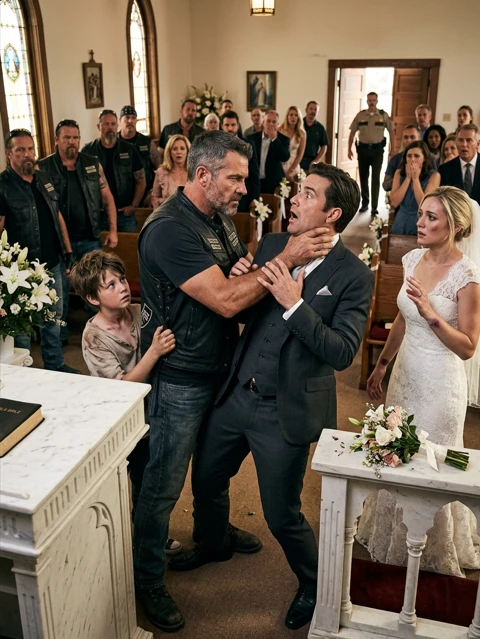
Hawk’s hand caught Richard clean at the throat and drove him backward into the altar with a crack that sent the Bible skidding sideways. Gasps broke everywhere at once. The Iron Saints stepped forward in perfect unplanned unison, a black wall sealing the aisles. Mercer’s deputy reached for his weapon, then stopped when Mercer lifted a hand and saw exactly what the rest of the room saw: Hawk was not attacking. Hawk was intercepting.
Richard clawed at Hawk’s wrist, feet half off balance. “Get your hands off me!”
“No,” Hawk said.
That was all. One syllable. Cold and flat.
Richard’s face reddened. “You can’t touch me in front of witnesses!”
Hawk leaned in just enough that only the nearest row heard him clearly. “Try reaching for that kid again.”
Mercer stepped forward. “Turner. Let him go.”
Hawk held Richard one beat longer—not out of defiance, but out of calculation. Long enough for every guest to see the terror on Richard’s face. Long enough for Sarah to see that the man who ruled her in private was not untouchable in public. Then Hawk released him.
Richard staggered back, coughing, fixing his collar with shaky hands.
“There,” Hawk said. “Now you can talk.”
Richard looked to the guests, to the minister, to the sheriff, hunting for the old arrangement of power. He found none of it.
Sarah removed one glove finger by finger, then the other. Under the fabric, yellowing bruises stood out against the inside of her wrist.
The front pew saw them first.
Then everyone did.
Richard’s mouth opened. No words came.
Mercer’s entire posture hardened.
“Ma’am,” he said, voice gentler now, “did he do that?”
Sarah’s eyes filled, but she did not cry. That was the surprising part. Some grief moves beyond tears and becomes clarity.
“Yes,” she said.
The single word hit harder than shouting would have.
James made a sound like he had been holding his breath for months.
Richard turned toward Mercer at once. “She’s emotional. You know how these situations get. This is a misunderstanding being amplified by armed gang members.”
“Careful,” Ember said. “We’re bikers, not a debate club, but we do know slander when it isn’t true.”
Mercer stepped up onto the altar platform. “Richard Sterling, put your hands where I can see them.”
Richard stared at him, stunned. Truly stunned. Men like him always believed procedure belonged to them.
“This is insane,” he said. “On what grounds?”
Mercer lifted the drawing in one hand, the report in the other, then glanced at James and Sarah. “Enough grounds to start.”
The deputy moved around Richard’s side.
Richard’s gaze flicked to the nearest side exit. Hawk saw it. So did three Saints stationed along the aisle. They did not move aggressively. They simply occupied the route. It was enough.
“This town knows me,” Richard snapped. “I fund the youth center. I built half of Mercer Heights. I serve on—”
“The board?” Mercer said. “Then they can hold the meeting without you.”
The cuffs clicked shut around Richard’s wrists.
There are sounds that split a room. Gunshots. Glass breaking. A scream. But sometimes the smallest metallic click can do more damage than all of them, because it tells the truth without raising its voice.
The congregation sat frozen in silk and pressed linen, watching the man they had invited into their homes, their businesses, their church committees, stand handcuffed at the altar where he had expected vows.
One of the bridesmaids started crying silently into both hands.
The minister sank onto the front pew as if his knees had stopped trusting him.
Richard twisted once toward Sarah, and for an instant the mask fell completely. Not charm. Not indignation. Pure hatred.
“You did this,” he hissed.
James flinched.
Sarah did not.
“No,” she said. “You did.”
Mercer heard it. So did the deputy. Richard was turned toward the aisle before he could answer, guided down the steps past the flowers, the guests, the drawing, the altar that had failed to crown him with respectability.
As he passed James, he tried to smile again. It came out as a twitch.
Hawk stepped slightly forward—not touching, not threatening, just entering the line of sight so the boy never had to meet Richard’s eyes alone.
The doors opened. Heat rushed in. For a second, the church smelled less like lilies and more like summer and gasoline and reality.
Then Richard Sterling was gone.
Nobody moved until the sound of the patrol car door closing echoed back through the open entrance.
Sarah stood perfectly still at the altar, veil crooked, hands bare now, staring at the doors like she did not know what to do with the next second of her life.
James hesitated.
Hawk released his hand.
The boy crossed the space between them in a stumbling run and threw himself into his mother’s arms.
That was when Sarah broke.
Not loudly. Not theatrically. Her body simply folded around him as though every muscle that had kept her upright through the past year had finally been given permission to stop performing. She sank to her knees in her wedding dress on the church floor, clutching James so tightly one of the guests had to look away.
“I’m sorry,” she whispered into his hair. “I’m sorry. I’m sorry.”
James cried too, but the sound was different from before. Less trapped. Less swallowed.
The room around them remained stunned into reverence.
Hawk looked away first. He always did that for grief when it deserved privacy.
Ember came to stand at his shoulder. “Sheriff’ll want statements.”
“We’ll give them.”
Ember nodded toward Sarah and James. “Kid did the hardest part.”
Hawk watched the small boy holding onto his mother like he was making sure she would not disappear. “Yeah.”
Mercer came back inside a minute later, hat tucked under one arm, a young female deputy beside him to speak with Sarah away from the crowd when she was ready. He stopped in front of Hawk.
“You know,” Mercer said, “storming a church with fifty bikers is not a tactic I usually recommend.”
Hawk’s face didn’t change. “Worked.”
A tired breath escaped Mercer that might have been the beginning of a laugh. “That it did.”
He glanced at the altar, at the documents, at the guests pretending not to stare. “I’ll need copies of everything.”
“You’ll have them.”
“And statements.”
“All of us.”
Mercer lowered his voice. “You were right to bring him in. If that boy had gone anywhere else first, I’m not sure this ends today.”
Hawk did not say thank you. Men like him and Mercer rarely used the phrase when something more serious had just passed between them.
Instead Hawk said, “Make sure it ends at all.”
Mercer’s jaw tightened. “It will.”
The rest of the afternoon moved in fragments.
Guests drifted out in hushed clusters, their shock already turning into the version of the story they would later tell over dinner tables and county lines. The minister made tea nobody drank. One of the bridesmaids found Sarah a cardigan to wrap over the torn lines of the dress. The female deputy took photographs of bruises with quiet professionalism. Doc checked James again and confirmed what everyone already knew: the boy needed a real doctor next, and probably more than one kind of help after that.
Ember coordinated copies, witness names, a timeline from the road to the sanctuary. The Iron Saints were suddenly a filing system in boots. Men who looked like they broke rules for fun turned out to be meticulous with dates, names, and chain of custody. They had learned long ago that justice rarely arrived on volume alone. It arrived with documentation.
By three in the afternoon, the church parking lot had mostly emptied.
Sarah sat on the stone steps in borrowed flats, the hem of her dress dust-streaked, James leaning against her side with his head tucked under her arm. For the first time since Hawk had seen him, the boy was still without being frozen. Just tired.
Hawk stood a respectful distance away beside his bike. He had no script for endings. Rescue was one thing. After was harder.
Sarah rose and crossed to him.
Up close, without the veil and with the makeup streaked away, she looked younger and older at once. Not because trauma had vanished, but because the energy required to hide it had.
“I don’t know how to thank you,” she said.
Hawk shook his head. “Don’t.”
“I should have left sooner.”
He did not lie to comfort her. “Yeah.”
She absorbed that, then nodded. “I know.”
James came up beside her, looking very small in the bright sun, but not quite as haunted as he had been on the road. He studied Hawk’s cut, the silver pins, the weathered hands hanging at his sides.
“You came back,” James said.
Hawk frowned slightly. “Back?”
The boy shrugged. “Like thunder. You hear it, and then it gets closer.”
Something in Hawk’s chest tightened for reasons he would never explain to anyone in full.
He reached into his vest pocket and pulled out the silver medallion he kept on a chain. The Iron Saints crest was worn with age, edges smoothed by years of his thumb rubbing across it during long rides and bad nights. It wasn’t official. It wasn’t ceremonial. It was his.
He crouched and held it out.
James looked at Sarah first. She nodded.
Hawk placed the chain in the boy’s palm. “You were the bravest man on that road today.”
James curled his fingers around it as if he didn’t trust metal to stay real unless he closed his fist.
“If you ever feel scared again,” Hawk said, voice low and steady, “listen for the sound of thunder. That’s us.”
Ember, already straddling his bike, glanced over and smirked without mockery. “You just made that up.”
Hawk stood. “Didn’t sound made up.”
A few of the Saints chuckled softly. The tension broke without breaking the moment.
Sarah looked from the medallion to Hawk. “Will we be safe?”
Hawk didn’t offer false guarantees. “Today, you’ve got the sheriff, a case file, witnesses, and half this town seeing what he is. That’s better than yesterday.”
She let out a breath she seemed to have been holding for a year. “Better than yesterday,” she repeated.
Mercer stepped from the church doorway and lifted a hand. “Ms. Whitmore? Victim advocate’s on her way.”
Sarah nodded, then looked back at Hawk with eyes that held gratitude and shame and exhaustion and the smallest beginning of belief.
Hawk put on his sunglasses because some moments felt too personal to meet without glass between people.
The Iron Saints mounted up one by one.
Engines turned over. Chrome flashed. The parking lot filled with that deep rolling thunder again, but this time it didn’t sound like interruption. It sounded like warning. It sounded like witness. It sounded like something arriving exactly when it was needed.
James stood on the church steps clutching the medallion.
As Hawk pulled away, he checked his mirror once.
The boy was still there, Sarah behind him with one hand on his shoulder. The white church rose over them. The flowers were still out front. The ribbon still hung from two cars. If a stranger drove by at that exact second, they might still mistake the day for something celebratory.
But Hawk knew better.
So did the whole town now.
The Iron Saints rolled out in formation, down Main Street, past the diner and the hardware store and the barber shop where old men paused mid-conversation to watch them go. Pine Hollow would talk for months. The tale would grow, bend, and gather embellishments like burrs on a jacket. Fifty bikers crashing a wedding. A child in the road. A groom in cuffs. A sheriff who chose evidence over money.
Some versions would make the Saints bigger and meaner than they were.
Some versions would make Richard smaller.
Neither would tell the whole truth.
The truth was quieter than rumor. The truth was a boy who had stood in the middle of a hot road because terror had finally become less frightening than silence. The truth was a woman who had almost married the next chapter of her own captivity because she thought survival was the same thing as safety. The truth was that monsters rarely looked like monsters when the room was full and the lights were good.
And the truth was that sometimes the people who saved you were the exact people the town had taught you to fear.
An hour outside Pine Hollow, the group stopped at a gas station off the interstate. The men stretched, smoked, filled tanks, bought coffee thick enough to strip paint. Conversation returned in fragments, as it always did after something heavy.
Boone slapped money down for a bag of beef jerky and said, “Kid had grit.”
Doc nodded. “Kid had no choice.”
Wrench took a long drink from a paper cup. “Sheriff surprised me.”
“Maybe he surprised himself,” Ember said.
Hawk leaned against his bike under the hard white sun, staring at nothing in particular.
Ember joined him after a minute. “You good?”
Hawk considered the question, which among the Saints never meant mood and always meant damage. “Yeah.”
“Liar.”
Hawk glanced sideways.
Ember shrugged. “That bruise on the kid. Hit you somewhere.”
Hawk looked back toward the highway. Trucks hissed past beyond the station lot. Heat shimmered above the pumps. “It’s done.”
“For them, maybe. For you?”
Hawk took off his sunglasses, wiped them on the hem of his shirt, and put them back on. “Don’t start.”
Ember laughed softly. “Fair.”
They stood a while longer without speaking. Brotherhood often looked like that: not prying, not explaining, just staying in the same square of shade until a man’s pulse settled.
Weeks later, charges would widen. More women would come forward. Accounts once whispered would become sworn statements. Board seats would quietly change hands. Donations would be returned. Lawyers would speak in measured tones. Pine Hollow would try to act shocked that its polished benefactor had been rotten all the way through.
But that was later.
What mattered most happened before all of that—on the road, in the church, on the steps afterward.
Because justice never begins at the handcuffs.
It begins at the first moment somebody tells the truth out loud and somebody else decides not to look away.
On a clear evening in early September, long after the wedding flowers had browned and been thrown out, James stood on the back porch of a small rental house on the other side of the county and listened to distant thunder rolling in from the west. He touched the silver medallion resting against his chest.
Sarah came to stand beside him with two mugs of cocoa neither of them really wanted in the heat. Habits of comfort didn’t have to make sense. They only had to offer shape.
“Storm’s still a ways off,” she said.
James nodded.
Then, very quietly, he smiled.
Not because everything was fixed. It wasn’t. There were counselors now, court dates, hard mornings, nightmares, paperwork, rebuilding. Freedom did not erase wreckage. It simply gave people room to clean it up without being hit again while they tried.
But the sound out in the distance no longer meant danger.
It meant someone had answered.
And somewhere far down another road, beneath another sky, Hawk Turner and the Iron Saints rode on through the gathering dark, their engines folding into the storm like a promise that had already been kept once—and would be kept again.