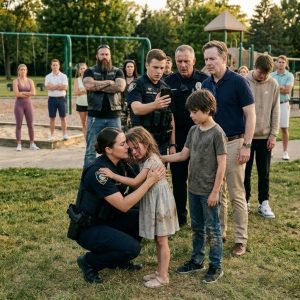
Oak Creek Park looked polished enough to be in a brochure. Clean swings. Soft ground. Parents in sunglasses pretending to relax. My sister Mia didn’t belong there, and everyone knew it the second they saw our clothes. But she was smiling for the first time in weeks, so I let myself believe we could borrow one good afternoon.

I left for water. Two minutes.
When I came back, Mia was on her knees in the sandbox, one braid hanging loose, cheeks wet with tears. Brent stood over her with a fistful of dirt, grinning like cruelty was a game.
Brent tilted her chin up. “Open your mouth.”
I ran at him with everything I had. He barely moved. One shove sent me skidding across the ground so hard the air vanished from my chest.
Kyle lifted his phone and laughed. “Look, the rat came back for his mouse.”
Mia tried to crawl away. Another boy stepped on her dress and pinned her there. Brent spat into the dirt in his hand and mixed it with his thumb.
“Now it’ll go down easier.”
I begged them to let us leave. I begged loud enough for every adult in that park to hear. A woman glanced over her book, then looked back down. A father turned away like the trees were suddenly fascinating. No one moved. No one wanted to touch the mess we represented.
That was the moment something inside me went cold.
I backed away while they laughed, then turned and ran. Past the flower beds. Past the Residents Only sign. Past every house with its perfect lawn and closed curtains. My lungs were tearing apart, but I already knew where I was going.
At the edge of town sat The Iron Sprocket—chrome bikes outside, leather vests in the shade, faces built from scars and silence. Men my mother told me to avoid my whole life.
Twenty of them stopped talking when I walked in.
A giant with a beard down to his chest looked at me over dark glasses. “You lost, kid?”
I couldn’t breathe. I couldn’t think. I just pointed back toward the park.
“My sister,” I said. “They’re making her eat dirt.”
The patio went still.
The giant removed his glasses slowly. Whatever lived in his eyes wasn’t kindness. It was worse for them.
He crushed his cigarette under his boot, reached for his helmet, and said one sentence that changed the air around me.
“Saddle up.”
PART 2: The engines answered before I could. One by one, then all at once, the parking lot erupted into thunder. Chrome shook in the sunlight. Conversations ended. Chairs scraped back. Men and women who had looked half-asleep a second ago were already reaching for gloves, helmets, keys.
Jax swung a leg over his bike and jerked his chin at the seat behind him. “Get on.”
My hands were still shaking when I climbed on. They stopped the second the machine moved. We tore out of the lot in a wall of sound, twenty bikes swallowing the road behind us. At every intersection, people stepped back. Windows opened. Heads turned. Nobody ignored us now.
I held tighter and stared ahead. The fear that had been choking me all afternoon was gone. In its place was something colder. Clearer. They had counted on silence. They had counted on no witnesses, no consequences, no one willing to cross the line for kids like us.
They were about to learn the difference between being feared and being untouchable.
Oak Creek Park came into view.
The engines cut at once.
And in the silence that followed, Brent finally looked up.
He was still standing over the sandbox with one hand on Mia’s shoulder and the other curled around that clump of spit-soaked dirt. For one stupid second, he wore the same smirk, like he thought the whole world was arranged for his entertainment. Then he saw the line of motorcycles spread along the curb and the wall of leather and steel stepping onto the grass.
The smirk vanished first. The color left his face second.
I slid off the back of Jax’s bike before it had fully settled and ran to Mia. She launched herself at me so hard I almost fell. Her body was trembling in small, violent bursts, the kind that made it hard to tell where the crying ended and the shock began. I wrapped both arms around her and felt the mud drying against her cheek, rough and gritty against my wrist.
“It’s okay,” I whispered, even though I had no idea what okay looked like anymore. “I’m here.”
Behind us, boots pressed into the soft green grass of Oak Creek Park. Not hurried. Not chaotic. Deliberate. A slow, measured rhythm that said something much worse than rage: control.
Jax stopped two feet from Brent.
Up close, Brent looked younger than he had when he was towering over Mia. Smaller too. He still had the expensive shoes, the pressed shorts, the haircut that probably cost more than our groceries that week, but now all of it looked fragile. Like costume jewelry left out in the rain.
Jax’s voice was quiet enough that people had to lean in to hear it.
“Is that the girl?”
“Yes,” I said, my own voice low now, emptied out by what had already happened.
Jax looked from Mia’s muddy face to the dirt in Brent’s hand. Then he looked at the rest of them—Kyle with his phone suddenly lowered to his chest, Justin stepping backward like maybe he could disappear if he did it carefully enough.
“You boys think this is funny?”
“We were just messing around,” Brent said quickly. “They shouldn’t even be here. This is for residents.”
No one behind Jax laughed. No one behind Brent moved.
A woman in white tennis clothes came hurrying across the grass, her visor crooked, pearls bright against her throat. Brent’s mother. I’d seen her before at the grocery store, the kind of woman who held her purse closer when my mom walked by in a waitress uniform.
“Brent,” she snapped, trying for authority and landing somewhere closer to panic. “What is going on?”
Raven, the biker woman with the scar across her cheek, stepped into her path without touching her.
“Stay right there,” Raven said.
That was all. Just four words. But Brent’s mother stopped like she’d hit a wall.
Jax crouched slightly so he was eye level with Brent, and somehow that made him look even more dangerous.
“You made a little girl kneel in the dirt,” Jax said. “You pinned her down. You put mud in your hand. You did all that in front of a park full of adults, and not one part of you thought maybe you should stop.”
“It was a joke,” Brent whispered.
Jax tilted his head once. “Then explain it to me.”
Brent opened his mouth and nothing came out.
Behind him, Kyle lifted his phone a little, maybe on instinct, maybe to make sure he still had the upper hand if this turned into a story later. Jax didn’t even look at him when he spoke.
“Delete it.”
Kyle froze. “What?”
“The video,” Jax said. “Delete it.”
Kyle’s fingers fumbled so badly he nearly dropped the phone. His face was white. He looked toward the benches, toward the adults, toward his father in golf clothes standing perfectly still beside a stroller. No help came from there either.
“I said delete it.”
Kyle stabbed at the screen. “Done.”
Raven extended her hand. “Give it here.”
He handed it over. She glanced at the display, checked the recently deleted folder too, then slipped the phone into her vest pocket.
“Now it’s done,” she said.
That was when the parents finally started moving. Not toward Mia. Not toward me. Toward the problem. Toward the optics. A few drifted closer with the strained expressions of people arriving late to a fire and hoping to look useful. One man started, “I’m sure this can be handled calmly—”
Jax turned his head and the man stopped speaking.
The silence stretched. Not empty silence. Charged silence. The kind that drags truth into the open whether people want it there or not.
Then Jax looked back at Brent’s hand.
“Drop it.”
Brent stared blankly.
“The dirt,” Jax said. “Drop it.”
Brent opened his fingers. The wet clump fell into the grass with a soft, ugly slap.
Jax stood back up to his full height. “Good. Now apologize.”
Brent swallowed. “Sorry.”
Jax didn’t move.
Brent’s throat worked. He looked at Mia and couldn’t quite hold her eyes. “I’m sorry, Mia.”
Mia pressed her face harder into my shirt.
Jax’s gaze shifted to Justin. “And you.”
Justin’s voice shook so hard it cracked. “I’m sorry.”
Kyle tried next. “I’m sorry.”
It should have felt like a victory. It didn’t. Not yet. The words came too fast, too easy, sliding over the surface of what they’d done without touching the rot underneath. Mia was still shaking. My tailbone still ached from where Brent had shoved me. The adults still wore the same guilty expressions they’d put on only after the cavalry arrived.
Jax seemed to know it too.
He turned away from the boys and faced the benches.
What happened next changed the neighborhood more than anything he said to Brent.
He looked at every mother and father one by one, not like a madman looking for a fight, but like a judge giving people one last chance to tell the truth on their own.
“You all saw this,” he said.
Nobody answered.
He gestured once toward the sandbox, the muddy dress, the tear-streaked face pressed to my chest.
“You watched a child get humiliated because it was easier than being uncomfortable.”
A man near the swings cleared his throat. “Now hold on, you don’t know what we saw.”
Jax took one step toward him. Only one.
“Then tell me what you saw.”
The man folded in on himself so quickly it almost looked painful. His mouth opened and shut.
Raven glanced around the crowd. “Anybody here call the police before the boy went for help?”
No one said a word.
“Anybody stand up?” she asked. “Anybody even tell them to stop?”
A woman with a stroller looked down at the ground.
Another man muttered, “We didn’t want to escalate it.”
I felt Jax go still in a way that was somehow louder than shouting.
“Escalate it,” he repeated. “A six-year-old girl was already on the ground.”
He didn’t say it like a question. He said it like an indictment.
And the thing was, everybody knew he was right. They knew it in the way their shoulders tightened, in the way eyes dropped, in the way Brent’s mother clutched at her necklace but still did not go to Mia, not once, not even then.
A siren wailed in the distance. Faint at first. Then closer.
That changed the air again.
The parents straightened as if returning officers would restore some natural order, as if uniforms could erase the last fifteen minutes and redraw the lines in the right places. Brent’s father appeared from somewhere near the parking lot, phone in hand, tie loosened, outrage already arranged on his face.
“What the hell is this?” he demanded.
He marched toward Jax like a man who had spent his life assuming the world would step aside for him. Tall, silver at the temples, expensive watch, courtroom voice. The kind of man who could turn facts into furniture and sit on them until they looked comfortable.
He stopped when he got close enough to really see Jax.
“Who are you people?” he said, but less loudly.
Jax didn’t answer the question. “You the boy’s father?”
Brent’s father drew himself up. “I am an attorney, and unless you want charges filed, I suggest you and your gang leave this property immediately.”
The word gang landed in the grass and stayed there.
Jax smiled then. Not warmly. Not even a little. It was the kind of smile that lets you know you’ve chosen the wrong weapon.
“Charges,” Jax said. “That’s interesting.”
Brent’s father glanced at me and Mia the way people glance at stains. “My son is a minor. Whatever happened here has clearly been exaggerated.”
I felt Mia tense in my arms. She was listening. Every kid knows when an adult is trying to erase them while they’re still standing there.
Before I could speak, Kyle made a tiny sound beside us.
Everyone turned.
He was looking at Raven.
Or more specifically, at the phone still in her hand.
Jax followed his gaze.
Then he slowly looked back at Brent’s father.
“You might want to rethink exaggerated.”
The attorney’s face changed by one degree. Not enough for the crowd maybe, but enough for me. Enough to show he understood there might be evidence after all. Enough to show that the clean version of reality he was already preparing in his head had just hit a complication.
Raven pulled the phone from her pocket but did not unlock it. She simply held it.
Kyle’s father stepped forward at once. “That device belongs to my son.”
Raven shrugged. “Then your son can explain to an officer why he recorded an assault instead of stopping it.”
Nobody spoke after that.
The sirens came closer. A patrol car rolled to the curb. Then another.
Two officers got out, hands near their belts, eyes moving quickly across the lineup of bikes, the cluster of parents, the crying little girl, the boys who had suddenly forgotten how to stand straight. One officer was older, thick around the middle, face already arranging itself into impatience. The other was younger, maybe new, maybe not yet fully trained in the local rules of who mattered more.
The older one took in the leather, the tattoos, the engines, and his shoulders set in the direction I expected.
“What’s going on here?”
Before anyone else could answer, Brent’s father stepped in.
“Officer, thank God. These bikers stormed into a family park and began threatening children.”
There it was. Quick. Smooth. Clean. A whole lie dressed in the language of concern.
The officer looked at Jax.
Jax folded his arms. “That your opening read on this?”
The younger officer’s eyes drifted to Mia and stayed there a second too long for him not to understand something was wrong.
I felt my chest tighten. Not from fear this time. From recognition. The same kind of helpless rage that had hit me when the parents looked away. The same sick knowledge that the wrong adult speaking first could tilt the whole world.
Brent’s father continued, louder now, performing for the crowd.
“My son and his friends were playing. These people arrived and intimidated everyone.”
Kyle made the mistake of looking at the ground.
Justin started crying quietly.
The younger officer noticed both.
“Sir,” he said to Brent’s father, “why don’t we slow down and get statements one at a time.”
But the older officer had already fixed on Jax. “I need you and your people to step back.”
Jax didn’t move.
I did.
Still holding Mia with one arm, I stepped forward with the other hand clenched at my side so hard my nails dug into my palm. My voice came out raw but steady.
“That’s not what happened.”
Every adult eye in the park turned to me.
I could feel Mia’s breath against my neck. Fast. Frightened. Waiting.
The older officer looked irritated. “Son—”
“They made her eat dirt,” I said.
Not loud. Not dramatic. Just flat enough that no one could mistake me.
The words spread through the air like gasoline.
The younger officer went still. Brent’s mother closed her eyes for one second. Kyle whispered, “Oh my God,” to no one at all.
Brent’s father snapped, “That is absurd.”
Raven lifted the phone.
“No,” she said. “What’s absurd is thinking you still control this.”
The younger officer held out his hand. “Can I see that?”
Raven looked at Jax. Jax nodded once.
She passed over the phone.
The younger officer unlocked it under Kyle’s trembling instructions and found the deleted clip. He watched five seconds. Then ten. Then his entire expression changed.
He handed the phone to his partner without a word.
The older officer watched too.
His jaw hardened. Then loosened. Then set again, but differently.
The park had gone so quiet that I could hear the wind rubbing leaves together above the swing set.
Brent’s father started to say something, but this time nobody was listening to him.
The younger officer looked at Mia, then at me.
“Did they touch her?” he asked, and now his voice was careful.
I looked down at the mud on her face, at the broken braid, at the hem of the dress still stretched out from where a shoe had pinned it.
“Yes,” I said. “They held her down.”
Mia made a tiny sound. Barely a whisper.
“He spit in it,” she said.
That was the first full sentence she’d managed since I got back to her.
It hit the crowd like another siren.
Brent started crying for real then. Not the scared-rich-boy tremble from before. Full, ugly panic. His father reached for him, but Brent flinched, and that was the moment I knew something had cracked permanently. Not in Brent’s conscience. I wasn’t giving him that much credit. In his certainty. In that smooth shell of protection he’d been raised inside.
The older officer exhaled slowly and clipped his notepad back into his pocket.
Then he turned to Brent’s father and said, “Sir, step back.”
For the first time all afternoon, the command landed in the right place.
Jax looked down at me once. His face gave away almost nothing, but the corner of his mouth moved like he approved of something—not the chaos, not the fear, just the fact that truth had finally found a spine.
Mia tightened her arms around my neck.
The younger officer called for juvenile units and requested medical to check the child. More cars were coming. More witnesses would be separated. Statements would be taken. Names written down. Timelines fixed before anyone with money could blur them.
The neighborhood’s perfect afternoon had split wide open.
And as Brent’s father stared at that phone in the officer’s hand like it was the first thing in his life he couldn’t talk his way around, I realized this wasn’t ending in the park.
It was only beginning.
Mom arrived five minutes later in her dented sedan, still in her diner apron, hair half-falling from the clip at the back of her head. She slammed the car door so hard it echoed across the grass and came running before the engine even died.
“Mia!”
My sister broke from me then and went to her. Mom dropped to her knees in the dirt without hesitation, gathering Mia up with both arms, one hand cradling the back of her head, the other checking her face, her shoulders, her hands, like she could inventory the damage by touch alone.
When she saw the mud, when she saw the braid, when she heard the words dirt and spit and held her down all in one broken explanation from me and one trembling whisper from Mia, something flashed across her face so sharp it almost frightened me.
Not weakness. Not hysteria.
The kind of fury that becomes very calm because it already knows exactly where to go.
She stood slowly, Mia on one hip, and looked at Brent’s father. Really looked at him. The man who’d tried to turn the story inside out before anyone could pin it down.
“You let this happen?” she asked the adults more than him, but he was the one who received it.
Nobody answered.
Mom shifted Mia gently and looked at the officers. “I want every name.”
The younger one nodded. “We’re taking statements now.”
“I want the video preserved.”
“It is.”
“I want copies.”
“You’ll get them.”
She looked at Jax then, at Raven, at the line of bikers and their silent machines. There was distrust there at first because that’s how she’d always taught us to survive. Don’t go near men like that. Don’t ask them for anything. Don’t owe them.
Then she looked back at Mia, clean bandana pressed to her cheek now, and some other understanding crossed her face.
“You brought him back,” she said to Jax.
Jax shrugged once. “Kid asked for help.”
Mom gave a tight nod. “Thank you.”
He dipped his chin. “Anytime.”
No grand speech. No cinematic handshake. Just that. And somehow it meant more.
The officers separated Brent, Kyle, and Justin from their parents. The boys looked stunned by the concept. Their mothers hovered at a distance, unable to fix it with tone or posture or expensive concern. Brent’s father made two attempts to insert himself into the process and was told twice to wait.
Every time he was cut off, I felt the world tilt another inch toward something fairer.
A paramedic dabbed at a scrape on Mia’s knee and told Mom the rest looked superficial, but she should watch for signs of shock. Superficial. I hated the word. There was nothing superficial about the way Mia clung to Mom’s shirt whenever anyone raised their voice nearby. Nothing superficial about how she wouldn’t look at the sandbox again.
When the first round of statements was done, the younger officer came over with a small notebook.
“I need yours too,” he said to me.
So I told him everything. The fountain. The dirt. The shove. The parents looking away. The run to The Iron Sprocket. Jax. The bikes. The park. The apology. The lies.
He didn’t interrupt except to ask for details: which hand Brent used, whether Justin stepped on the dress before or after the shove, whether anyone touched Kyle’s phone before it was deleted. Questions that sounded boring if you weren’t paying attention and life-changing if you were.
That was when I started to understand something adults never tell kids: justice, when it actually shows up, is less like lightning than paperwork. Less like revenge than record. Names. Times. Statements. Evidence saved before someone richer can make it evaporate.
Mom understood it too.
By the time the police finally started to disperse the crowd, she had already written the officers’ badge numbers on the back of an old receipt from the diner. She had the park address, the incident number, the paramedic unit, and the names of two parents who’d quietly agreed to admit they’d seen what happened. One of them was the woman with the Kindle, now crying into her palms because guilt had finally found her.
Mom didn’t comfort her.
Good.
The sun was lower by then, turning the polished houses gold in a way they didn’t deserve. One by one, the Warlords started their bikes.
Before Jax put on his helmet, he looked at me.
“You did right by your sister,” he said.
I nodded, because if I tried to talk I might cry, and I was done crying in front of these people.
Raven handed Kyle’s phone to the younger officer and then looked at Brent, Justin, and Kyle one last time.
“Next time you see someone smaller than you,” she said, “try leaving them alone.”
No one had an answer for that either.
Then the engines rolled out, deep and thunderous, and every face in Oak Creek Park followed them as if the neighborhood had just glimpsed a version of itself it could not control. They rode away without asking for credit, without waiting to be thanked properly, without collecting the moral applause people love to hand out once danger has passed.
The park was quieter after that, but it was not the same quiet.
It was the kind that settles after something sacred has been broken in public.
That night, Mia wouldn’t eat anything brown.
Mom made macaroni because it was pale and soft and cheap. Mia took three bites and then set the fork down and asked if dirt could stay inside you forever. Mom answered without blinking.
“No, baby. Not when I’m here.”
I watched her say it, and I believed her.
After Mia finally fell asleep, still clutching one of Mom’s old diner towels like it was a stuffed animal, Mom sat at our kitchen table with a yellow legal pad someone had left behind at the restaurant. The overhead light buzzed. A box fan rattled in the window. Outside, the factory loomed dark against the sky.
Mom drew a line down the center of the page.
On one side she wrote: WHAT HAPPENED.
On the other side she wrote: WHO SAW IT.
Then she started building our case with the same hands that poured coffee for men who never looked at her name tag.
I sat across from her, bruised and sore, and added everything I remembered. Exact phrases. Exact positions. The order of the boys’ voices. The moment the woman looked down at her Kindle. The way Brent said residents like it meant human.
Mom called the police precinct to confirm the report number. She called the paramedic unit. She called the diner manager and asked if she could come in late the next day because her daughter had been assaulted in a public park. When he hesitated, she said, “That wasn’t a request.”
Then she borrowed Mrs. Alvarez’s printer down the hall and made copies of the handwritten notes before midnight.
That was the part nobody in Oak Creek would have expected from us.
They expected tears, maybe anger, maybe gratitude that the matter had been “handled.”
They did not expect documentation.
They did not expect a waitress from the wrong side of town to walk into Monday with an incident report, witness names, medical notes, and a son who remembered everything in sequence.
By Tuesday, the school principal knew. By Wednesday, the parents association did too. By Thursday, Brent’s father was calling it a misunderstanding in controlled private conversations that somehow all sounded exactly the same. Kids are kids. Emotions ran high. No lasting harm. Nobody should ruin a boy’s future over a playground mistake.
But the story wouldn’t stay where he put it.
Because videos have a way of surviving deletion.
Because witnesses who stay silent once sometimes can’t bear doing it twice.
Because there were more cameras in Oak Creek than anyone admitted when they wanted poor kids invisible.
A traffic cam caught the bikes entering the park road. A security camera from a home across the street caught the crowd gathering before the police arrived. A woman who had pretended not to see finally admitted she’d started recording after the bikers showed up because she was afraid of them, and in the background of her shaky footage you could hear Brent say, “It’s our park,” and me saying, “Please let us go.”
The details accumulated. Ugly. Solid. Unromantic.
Real.
I learned then that a lie can be expensive and still be flimsy if enough truth keeps landing on it.
Mia stayed close to Mom for weeks. At school pickup, she scanned faces before she smiled. At the laundromat, she asked me to stand near the door. In the bath, she rubbed at her lips longer than necessary. Some nights I heard her crying quietly and pretending she wasn’t. I started sleeping lighter. Every sound in the hall made my body tense before my mind caught up.
But other things changed too.
Neighbors in our building, people we barely knew, started asking how she was. Mrs. Alvarez brought soup. Mr. Han from downstairs fixed our car mirror for free because he said little girls shouldn’t be scared to leave the house. My mom’s tips went up for a while because apparently the story had spread beyond Oak Creek and there are always a few people in every town who need public shame to discover their conscience.
I didn’t care why they showed up. I just noticed who did.
And in Oak Creek, the opposite was happening.
Parents who had spent years treating The Iron Sprocket like a disease suddenly stopped using words like trashy and dangerous so casually in public. The homeowners association president, who’d once called the bikers a blight at a city meeting, released a statement about “community accountability.” Brent was pulled from soccer “temporarily.” Kyle’s father hired someone to “advise” him on juvenile exposure. Justin’s mother began volunteering at a children’s charity so aggressively it bordered on self-parody.
The neighborhood had not become good.
It had become afraid of being seen clearly.
There’s a difference.
The final thing that changed happened on a Saturday, two weeks later, when Mom took Mia and me to a different park across town. Smaller. Older. Metal slide too hot in the sun. Paint peeling off the monkey bars.
Mia stood by the sandbox and didn’t move.
I crouched next to her. “We can leave.”
She looked down at the dirt. Real dirt this time. Honest dirt. Poor-kid dirt. No one pretending it was imported or exclusive or anything except ground.
Then she picked up a plastic shovel, walked into the sandbox, and started building a crooked little castle like she was reclaiming something one handful at a time.
Mom sat on the bench and cried where she thought we couldn’t see her.
I didn’t tell her I noticed.
Some victories are loud. Some are just a child deciding the world doesn’t get to keep one more piece of her.
Months later, people still talked about what happened at Oak Creek Park, but they always told it wrong at first. They’d start with the bikers. The noise. The leather. The spectacle of it. The intimidation.
They always wanted the story to begin where fear became visible.
But that wasn’t where it started.
It started with a little girl in pigtails wanting one good afternoon.
It started with a boy learning that adults in nice clothes can watch something monstrous and call it decorum.
It started with one run across a line of town that was supposed to stay uncrossed.
And if you ask me what I remember most, it isn’t even Brent’s face when the bikes rolled in. It isn’t Jax’s voice. It isn’t the officers finally believing us, or Brent’s father realizing evidence doesn’t care how much your watch costs.
It’s the moment after I said, “My sister. They’re making her eat dirt.”
That silence on the patio.
That instant when twenty people who looked like the town’s favorite nightmare decided a child mattered more than appearances, more than class lines, more than whatever rules polite people hide behind when courage becomes inconvenient.
Oak Creek called them outlaws.
Maybe they were.
But on the day my sister needed help, the only real law in that park came riding in on chrome and leather, and every respectable adult there had to stand still long enough to see exactly what that said about them.