“David, please understand that you must follow the court order. You may not enter the property unless the order permits it or an appropriate arrangement is made.”
“I understand.”
“And we need to discuss the documents you signed.”
“I’ll explain everything.”
“Good. Bring any copies you have, and do not sign anything else until you’ve reviewed it with independent counsel.”
“I won’t.”
Before the call ended, David spoke to me again.
“Mom?”
“Yes?”
“I’m sorry.”
I wanted to believe him.
I wanted to believe that the little boy who once ran across this living room, calling for me when he scraped his knee, was still somewhere inside the man who had allowed his wife to take control of my life.
But an apology, however sincere, could not erase four years of silence.
“We’ll talk when you get here,” I said.
Then I ended the call.
Sarah helped me gather the documents we had found and place them in a secure folder.
“We need to preserve everything exactly as it is,” she explained. “I’ll coordinate with the authorities and make sure the bank receives the relevant information.”
I nodded.
But my attention had returned to the notebook.
There was one final entry on the page we had photographed.
It was written in smaller handwriting, almost as though Chloe had wanted to keep the thought to herself.
Once the house is sold, there won’t be anything left for her to fight over.
I read it silently.
Then I looked at Sarah.
“She was never planning to help me find somewhere safer to live, was she?”
Sarah chose her words carefully.
“I can’t tell you everything Chloe intended based on a notebook alone. But the evidence raises enough concerns that we need to investigate her actions thoroughly.”
I folded my hands in my lap.
I didn’t cry.
Not then.
Because the worst part wasn’t the money.
It wasn’t the paperwork or the boxes or even the possibility that my son had been manipulated into signing something he didn’t understand.
The worst part was realizing that someone had looked at the home Arthur and I built together and seen nothing but an asset to be acquired.
And that someone had been eating breakfast at my kitchen table for four years.
The Son Who Finally Came Home
David arrived shortly after noon.
He parked on the street rather than pulling into the driveway.
When he stepped out of his car, he looked older than I remembered.
His shirt was wrinkled. His hair was disheveled. He held a manila envelope in one hand and his phone in the other.
He walked toward the porch, then stopped when he saw me sitting beside Sarah.
For several seconds, neither of us spoke.
Then he said, “Mom.”
I looked at my son.
“David.”
He glanced at the front door.
“Can I come inside?”
Sarah stood.
“The temporary order must be followed. We can speak here, and if access to the property is permitted under the order, we’ll arrange it properly.”
David nodded.
“Of course.”
He sat in the chair opposite me.
For a moment, he looked as though he wanted to reach across the small table and take my hand.
But he didn’t.
Instead, he placed the manila envelope on the table.
“I brought everything I could find.”
Sarah opened it carefully.
Inside were several photocopied documents, a stack of emails, and a handwritten note.
David looked at me.
“Chloe told me you needed help with your bills. She said your eyesight was getting worse and you were struggling to manage the paperwork.”
“I do struggle with fine print,” I said. “But that doesn’t mean I can’t make decisions.”
“I know that now.”
“Did you know it before?”
He looked down.
“No,” he admitted. “I think I just didn’t want to think about it.”
His answer hurt more than a denial would have.
He continued.
“Every time I called, Chloe told me everything was fine. She said you were getting more forgetful, that you were frustrated about needing help, and that you sometimes accused her of things she hadn’t done.”
“I was frustrated,” I replied. “Because she was doing things I hadn’t asked her to do.”
David nodded slowly.
“I should have asked you directly.”
“Yes.”
He swallowed.
“I thought I was making your life easier.”
“You were making hers easier.”
He flinched.
I hadn’t intended to sound cruel.
But it was true.
David had trusted his wife to manage every detail of the situation because doing so meant he didn’t have to confront the uncomfortable reality that his mother was aging.
It meant he could travel for work without worrying about whether I needed groceries or a ride to the doctor.
It meant he could tell himself that everything was under control.
And while he looked away, Chloe had gradually taken over decisions that were never hers to make.
Sarah interrupted gently.
“David, let’s examine the documents.”
She removed the first page from the envelope.
It was a statement David had signed.
He read it and immediately shook his head.
“This isn’t what I signed.”
Sarah laid the pages side by side.
“The signature appears to be yours, but the document contains statements you say you never reviewed.”
“I never saw this version.”
“What did Chloe tell you?”
“She said the bank needed confirmation that I could help Mom manage her utility payments if she became ill. It was one page. I signed it at the kitchen counter before leaving for the airport.”
“Did you read it?”
David looked ashamed.
“Not carefully.”
Sarah allowed the silence to settle before asking the next question.
“Did you sign any other documents relating to your mother’s finances or property?”
David hesitated.
Then he removed the handwritten note from the envelope.
“I found this in my briefcase yesterday. Chloe asked me to sign another packet before my next trip. I told her I’d review it later.”
He handed it to Sarah.
The note contained a short list of documents she wanted him to sign.
One item was labeled PROPERTY TRANSFER SUPPORTING DECLARATION.
Another was described as FAMILY CONSENT FOR TEMPORARY CARE PLACEMENT.
David rubbed his forehead.
“I didn’t sign these.”
Sarah studied the note.
“Do you know whether the documents were already prepared?”
“I don’t know. She said she was waiting for me.”
He looked at me.
“Mom, I swear I didn’t know she was trying to take your money.”
I believed that he might be telling the truth.
But I wasn’t ready to tell him that everything was forgiven.
“I believe you may not have understood what you signed,” I said. “But you didn’t have to understand everything to know that you should have asked me.”
His eyes filled with tears.
“You’re right.”
“I told you I was uncomfortable. I told you she was opening my mail. I told you she was speaking for me at appointments. Every time, you defended her.”
“I know.”
“You made me feel as though I was the problem.”
He wiped his eyes.
“I know, Mom.”
For the first time, he didn’t offer an excuse.
He didn’t blame Chloe’s stress or his work schedule.
He didn’t tell me I was overreacting.
He simply sat there and listened.
It was a small thing.
But it was the first time in years that I felt my son was actually hearing me.
Then Sarah turned to the emails.
“David, these messages may be important. Did you authorize Chloe to communicate with Maplewood on your mother’s behalf?”
“No. I knew she’d asked about the facility, but I thought she was gathering information. I didn’t know she’d paid a deposit.”
“Did you agree to sell your mother’s house?”
“No.”
“Did you sign a deed transferring ownership to yourself?”
“No!”
His voice rose sharply.
Sarah held up her hand.
“I understand. I’m asking because we need to establish a clear record.”
David took a breath and lowered his voice.
“Mom and Dad built that house. I grew up there. I would never take it from her.”
I looked at him.
“Then why did you sign the statement?”
He closed his eyes.
“Because I trusted Chloe to tell me the truth.”
“And you trusted me to forgive you without asking questions.”
He opened his eyes again.
I continued before he could respond.
“I love you, David. That hasn’t changed. But I cannot protect you from the consequences of your own decisions. You are a grown man. You have a responsibility to understand what you sign, especially when it concerns your mother’s home and money.”
He nodded.
“I understand.”
“I hope you do.”
Sarah placed the documents back inside the envelope.
“David, I recommend that you retain independent legal counsel. I represent your mother, and I cannot advise you on your own potential legal exposure. You should also preserve every communication you have with Chloe relating to these matters.”
David nodded.
“I will.”
Then he looked toward the driveway.
“Where is she?”
“I don’t know,” I said.
“She hasn’t answered my calls.”
I watched his face carefully.
“Are you worried about her?”
He looked startled by the question.
“She’s my wife.”
“I know.”
“I don’t know what happened to her.”
I considered that.
Whatever Chloe had done, David was entitled to feel conflicted.
He had built a life with her.
He had loved her.
He might still love her, even while beginning to understand the damage she had caused.
But his confusion could not become another excuse for inaction.
“David,” I said, “you don’t have to decide everything today. But you do have to stop pretending you don’t know what’s happening.”
He nodded slowly.
Then he reached into his pocket and took out a small brass key.
I recognized it immediately.
It belonged to the cedar chest in my bedroom.
Arthur had made the chest from cedar planks left over from a cabinet he built years ago. He had given me the key on our thirtieth wedding anniversary.
I had kept it on a small ring beside my bedside lamp.
“What is that doing with you?” I asked.
David looked down at the key.
“Chloe gave it to me.”
“When?”
“Last month. She said she was organizing the house and wanted me to keep a spare in case you lost yours.”
I stared at him.
“Did you know she had taken things from the chest?”
“No.”
“Did you open it?”
“No.”
He placed the key on the table.
“I should have asked you.”
I picked it up and held it in my palm.
It was cold.
For a moment, I remembered Arthur standing in the bedroom doorway, smiling as he handed me that key.
“Now you can keep your secrets safe,” he had joked.
At the time, I had laughed and told him I didn’t have any secrets.
He had kissed my forehead.
“Everyone deserves a little privacy, Ellie.”
I closed my fingers around the key.
He had been right.
Privacy wasn’t evidence of wrongdoing.
And needing help wasn’t permission for someone else to take control.
I slipped the key into my cardigan pocket.
Then I looked at my son.
“Thank you for bringing the documents.”
He nodded.
“Can I ask you something?”
“Of course.”
“Do you want me to come back tomorrow?”
I considered the question.
For four years, I had allowed David to come and go as though his marriage gave him automatic authority over my home.
Now, for the first time, he was asking permission.
“Yes,” I said. “You may come back tomorrow, provided we arrange it properly. But I want to speak with you alone, without Chloe answering for either of us.”
He nodded.
“I’d like that.”
“And David?”
He stopped as he began to stand.
“I am not moving to Maplewood.”
His eyes filled again.
“I understand, Mom.”
“No,” I said gently. “I need you to understand that this isn’t a decision you get to make for me. Neither does your wife.”
He lowered his head.
“You’re right.”
He left the envelope with Sarah, said goodbye, and walked back to his car.
I watched him drive away.
I loved my son.
I wanted him to find his way through the mess he had helped create.
But I had finally learned something that Arthur had tried to teach me many years ago.
Love can open the door to your home. It does not give someone the right to take away the key to your life.
That evening, Sarah arranged for the documents to be preserved and contacted the relevant investigators about the newly discovered material.
I ate soup for dinner, read a large-print mystery novel, and went to bed earlier than usual.
For the first time in months, no one entered my room without knocking.
No one rearranged my medication.
No one told me what I should be worried about.
The house was quiet.
But it no longer felt empty.
It felt like mine again.
I thought the worst of the confrontation might be over.
I was wrong.
Because the following morning, at 7:12 a.m., my phone rang.
It was Martha Jenkins.
And she had news about the property deed that neither Sarah nor I had expected.
The Call That Changed Everything
Martha had been my friend for more than fifty years.
We met when our children were young, back when neighborhood gatherings meant folding chairs on the lawn, homemade casseroles, and children running between houses until their mothers called them home.
Martha had always possessed a talent for noticing details other people overlooked.
As a paralegal, she could spot an inconsistency in a document the way Arthur could identify a faulty hinge by the sound it made.
When she called that morning, I could tell immediately that something was wrong.
“Eleanor,” she said, “I need you to listen carefully.”
I sat on the edge of my bed.
“What happened?”
“Do you remember the original deed to your house?”
“Of course.”
“Do you know where it is?”
“In the locked cabinet in the basement. At least, I believe that’s where it was the last time I checked.”
“Have you looked recently?”
“No.”
Martha took a breath.
“I think you should ask Sarah to arrange a proper inventory of your property documents.”
“Why?”
“Because yesterday, I remembered something about the papers you brought me months ago.”
I waited.
“Do you remember the draft deed Chloe showed you?”
“Yes.”
“At the time, I concentrated on the missing signature and the wording of the proposed transfer. But there was something else on the document that bothered me.”
“What?”
“The legal description of the property.”
I frowned.
“What about it?”
“It wasn’t the description from your original deed.”
I sat up straighter.
“What do you mean?”
“The street address was correct, but the parcel reference appeared to have been copied from a different record. I thought it might have been a clerical error.”
“Could it have been?”
“It could have. But I checked the county’s public records yesterday, and I found a filing associated with your property that I don’t remember seeing before.”
My mouth went dry.
“What kind of filing?”
“I don’t want to jump to conclusions. Sarah should examine it. But Eleanor, it may relate to a proposed lien or transfer involving your property.”
I gripped the phone.
“Are you saying someone has taken out a loan against my house?”
“I’m not saying that. I’m saying the record needs to be checked immediately.”
I thanked her and called Sarah.
Within an hour, we were in her office.
Sarah reviewed the information Martha had found and arranged for a formal title search through the appropriate channels.
She also contacted the county recorder’s office to verify whether any unauthorized instrument had been submitted.
By lunchtime, we had an answer.
There had been an inquiry involving my property.
But no valid transfer of ownership had been recorded.
And no completed lien had been established through the filing Martha had identified.
I released a breath.
“So the house is still mine?”
“Based on the records we’ve verified so far, yes,” Sarah said. “But we need to investigate the inquiry and determine who submitted the information.”
“Can they take the house from me?”
“Not simply because someone asks for information or prepares a document. Property rights are protected by formal legal requirements. The important thing is that we’ve identified the concern before any unauthorized transfer could be completed.”
I nodded.
Then Sarah turned her computer toward me.
“This is the part I want you to see.”
On the screen was a copy of the property inquiry.
It included my name, the address, and a contact email.
The email address belonged to Chloe.
I stared at it.
“She used her own email?”
“It appears so.”
“Why would she do that?”
Sarah leaned back in her chair.
“That is something the investigation will need to establish.”
I thought of the boxes.
The checklist.
The envelope from Maplewood.
The notebook entry about securing my signature.
Then I remembered the sentence Chloe had spoken to Rachel.
Once she’s permanently out of the house, everything gets so much easier.
The pieces were beginning to fit together.
But there was still one question I couldn’t answer.
Why had Chloe been in such a hurry?
Why pack the boxes that Sunday morning?
Why arrange a possible admission to Maplewood for the very next day?
And why had she been so desperate to get inside the house before David arrived?
Sarah seemed to read my thoughts.
“We need to know what she expected to find or remove,” she said. “The notebook suggests she was concerned about the documents, but we shouldn’t assume we know which ones.”
I thought about Arthur’s cedar chest.
The brass key in my pocket.
The original deed in the basement.
Then I remembered something I hadn’t considered for years.
When Arthur was diagnosed with heart disease, he had insisted that we meet with an estate-planning attorney.
He wanted to make sure that if anything happened to either of us, the other would be protected.
We had signed wills, updated our beneficiary designations, and placed our important records in a secure folder.
Arthur had also purchased a small safe-deposit box at our bank.
He kept the receipt in the cedar chest.
After he died, I had visited the bank once to check its contents.
Inside were several family documents, some old photographs, and a sealed envelope Arthur had asked me not to open until I was ready.
I had never thought much about it.
It had been years since I last visited that box.
“Sarah,” I said, “I need to tell you something about Arthur’s estate.”
She listened as I explained the safe-deposit box and the sealed envelope.
When I finished, she asked a simple question.
“Do you know whether Chloe has ever had access to that box?”
“No.”
“Has she ever had access to your bank’s safe-deposit records?”
“I don’t think so.”
“Then let’s make an appointment to review your records and confirm the box’s status.”
I agreed.
Before leaving her office, Sarah gave me a written list of steps we would take to protect my interests.
We would preserve the original documents, obtain certified copies where appropriate, continue monitoring the property records, and ensure that any future financial or property decisions required my explicit authorization.
It was practical advice.
It was also the first time in months that I felt I was moving forward rather than merely defending myself.
That afternoon, David called.
He said he had spoken to an attorney of his own.
He also said Chloe had finally answered his messages.
They had argued.
She had denied trying to take my money and insisted that the paperwork was intended to protect me.
David told her he wanted copies of every document she had prepared in his name.
According to him, she had refused.
Then she had told him something that made him call me immediately.
“Mom,” he said, “Chloe says you promised her the house.”
I went very still.
“What?”
“She claims you told her years ago that she and I would inherit the property and that you wanted her to handle everything in advance.”
I stared at the kitchen wall.
“That is a lie.”
“I know.”
“No, David. I need you to understand something. Your father and I never promised anyone this house. We discussed our estate plans privately, with an attorney. We never transferred ownership to you, and we never gave Chloe authority over my property.”
“I understand.”
“Do you?”
“Yes, Mom.”
He sounded exhausted.
Then he said, “She also claims the money she tried to transfer was meant to cover your future care.”
I closed my eyes.
“Forty-two thousand dollars?”
“She says it would have gone into a separate account for your expenses.”
“Did she show you any account documents?”
“No.”
“Did she ask me whether I wanted such an account?”
“No.”
“Then how could she possibly know what I wanted?”
He didn’t answer.
I softened my voice.
“David, I am not saying that planning for future care is wrong. I am saying that I have the right to participate in those decisions. If I need help, I can ask for it. If I want to move, I can choose to move. But nobody gets to decide that my money and my home belong to them because I am eighty-one.”
“I know, Mom.”
“Then please remember that.”
He promised he would.
When the call ended, I sat quietly for a long time.
I wasn’t ready to forgive Chloe.
I wasn’t even sure I wanted to speak to her again.
But I was beginning to understand that protecting myself would require more than changing locks and hiring an attorney.
It would require me to stop confusing peace with silence.
For years, I had kept quiet because I didn’t want to create trouble.
I had swallowed my objections because I didn’t want David caught between his wife and his mother.
I had accepted explanations that didn’t make sense because challenging them felt exhausting.
And every time I did that, Chloe gained a little more control.
I couldn’t change the past.
But I could decide what happened next.
The following morning, Sarah and I went to the bank to review the safe-deposit box records.
The bank manager verified my identity and confirmed that the box remained in my name.
No one else was authorized to access it.
I felt relieved.
Then he brought out the box.
Inside were Arthur’s documents, a few old photographs, and the sealed envelope I remembered.
The paper was yellowed around the edges.
Arthur had written my name on the front in his familiar handwriting.
For Eleanor, when the time is right.
I stared at it.
Sarah asked whether I wanted to open it privately.
I shook my head.
“No. I’d like you to stay.”
I carefully broke the seal.
Inside was a letter, several pages of legal documents, and a small photograph of Arthur and me standing in front of our house on the day we bought it.
We looked so young.
Arthur’s arm was around my shoulders.
I was laughing at something outside the frame.
I had forgotten that photograph existed.
I set it aside and unfolded the letter.
The first line brought tears to my eyes.
My darling Ellie, if you are reading this, then I am no longer beside you to remind you of something I should have told you more often.
You are stronger than you believe.
I paused.
Sarah quietly placed a tissue beside my hand.
I continued reading.
Arthur wrote about the years we had spent building our life together.
He wrote about David’s childhood, the sacrifices we had made, and the pride we felt when our son graduated from college.
Then he wrote about the house.
This home is not simply an asset. It is the place where we raised our son, where we celebrated our happiest days, and where we learned how to survive our saddest ones.
If you ever decide to sell it, do so because you want a new chapter, not because someone convinces you that you have outlived your right to choose.
I pressed the letter against my chest.
For a moment, I could almost hear his voice.
Then I continued.
I have arranged our estate documents so that you retain control of your property and finances during your lifetime. David is our son, and I love him dearly, but he must make his own life without depending on the house we worked so hard to build.
You owe nobody your home simply because they are family.
I stopped reading.
My hands were shaking.
Sarah waited until I was ready to continue.
The final paragraph was brief.
If anyone ever tells you that you are too old to make your own decisions, remember this: age may change the way you do things, but it does not erase who you are.
I love you, Ellie. Always.
I lowered the letter.
For several minutes, I couldn’t speak.
Arthur had been gone for years.
Yet somehow, he had found a way to remind me of exactly who I was.
Sarah examined the legal documents carefully.
They confirmed that Arthur and I had completed estate planning designed to protect my ownership and control of the property during my lifetime. She would need to review the original instruments in detail, but nothing in the papers suggested that Chloe had any authority to transfer my house.
I looked at the photograph again.
Then I put the letter back into its envelope.
For the first time since discovering Chloe’s plans, I felt something stronger than fear or anger.
I felt certain.
The house was mine.
My decisions were mine.
And whatever happened next, I would no longer let anyone persuade me that protecting those things made me selfish.
But when Sarah turned to the last page of the document packet, her expression changed.
There was a reference to an additional estate-planning instrument that Arthur and I had signed years earlier.
A document I barely remembered.
And it raised a question that would soon force David to confront something far more painful than his wife’s deception.
Because the next time my son came to see me, he would not be coming alone.
And the person standing beside him would be the last person I expected to see at my front door.
PART 4
The following afternoon, David arrived with Chloe.
But this time, she wasn’t wearing her usual confident smile.
She stood at the bottom of my porch steps, clutching a thick envelope against her chest. Her eyes were swollen, and for once, she didn’t tell me what I should do.
“Can we talk, Eleanor?” she asked quietly.
Sarah had already arranged the visit, so I nodded.
“You’re welcome to speak. But the truth must come first.”
Chloe looked down.
David explained that his attorney had reviewed the documents she had prepared. The evidence was serious, and the bank’s fraud investigation was continuing. Chloe could no longer pretend that everything had been a misunderstanding.
Then she placed the envelope on the table.
Inside were additional financial records, copies of the Maplewood paperwork, and a draft agreement concerning my house.
The agreement revealed what she had been trying to accomplish: she wanted me moved into assisted living, my property transferred out of my control, and my finances placed under someone else’s management.
She had told herself that everything would eventually belong to David anyway.
But she had forgotten one important thing.
An inheritance is not something you get to take while the owner is still alive.
“I thought I was protecting our future,” Chloe whispered.
“No,” I replied. “You were deciding my future without asking me.”
She began to cry.
She said she had been afraid of losing financial security. She said David’s job was stressful, their expenses were growing, and she believed the house could solve their problems.
I listened without interrupting.
Then I asked her one question.
“If you truly believed you were helping me, why did you need to hide everything from me?”
She had no answer.
David sat beside her, his face pale.
Finally, he turned to me.
“Mom, I’m sorry. I should have listened when you first told me something was wrong.”
I took his hand.
“I love you, David. But love doesn’t mean there are no consequences.”
He nodded, tears running down his cheeks.
Chloe eventually left the house with David. Their marriage would have its own difficult decisions to face, and the investigation would determine what legal consequences followed from her actions. I didn’t demand revenge, and I didn’t promise forgiveness.
I simply insisted that my home, my money, and my decisions remain mine.
With Sarah’s help, I strengthened my financial protections, secured my original documents, and made sure my estate plans reflected my own wishes.
A few weeks later, the bank confirmed that the attempted transfer had been stopped. The property records remained secure, and the authorities continued examining the disputed paperwork.
For the first time in four years, I could open my mail without wondering what someone else might be hiding from me.
I could make my own appointments.
I could sit in my favorite chair and remember Arthur without feeling that my memories were about to be packed into cardboard boxes.
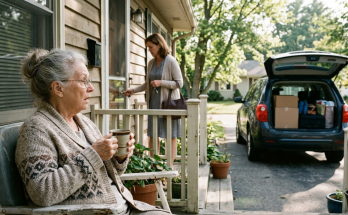
One Sunday morning, I sat on the porch with a cup of coffee.
The same porch.
The same house.
The same old wooden floor beneath my feet.
But I was no longer the woman who stayed silent to keep everyone else comfortable.
David began visiting regularly. He learned to ask instead of assume, and slowly, we started rebuilding our relationship. Forgiveness would take time, but at least we were finally speaking honestly.
As for Chloe, I left the final judgment to the proper authorities and to time.
I had spent enough of my life carrying burdens that were never mine to carry.
That morning, I looked toward Arthur’s old workshop and whispered, “I kept our home, sweetheart.”
Then I smiled.
At eighty-one, I had discovered something I wished I had understood much earlier.
Growing old does not mean surrendering your voice. Needing help does not mean surrendering your freedom. And being someone’s mother does not mean you must sacrifice your dignity to prove your love.
I took another sip of coffee and watched the sunlight spread across the driveway.
For four years, Chloe had lived under my roof and tried to convince me that I no longer belonged in my own life.
Changing the locks had been the beginning.
Learning that I never needed her permission to be myself was the real ending.
And for the first time in a very long time, I felt completely at home.
THE END
My Daughter-in-Law Tried to Steal My House at 81—But She Never Expected Me to Fight Back
Part 2 of 2