PART 3
I had spent fifteen years watching my older sister turn every uncomfortable situation into someone else’s mistake. If a family dinner went badly, I was too sensitive. If our parents disagreed with her, they had misunderstood her intentions. If I achieved something she hadn’t, I had somehow been lucky.
But this time, there were bank records sitting directly in front of us.
And for once, I wasn’t going to help her escape the truth.
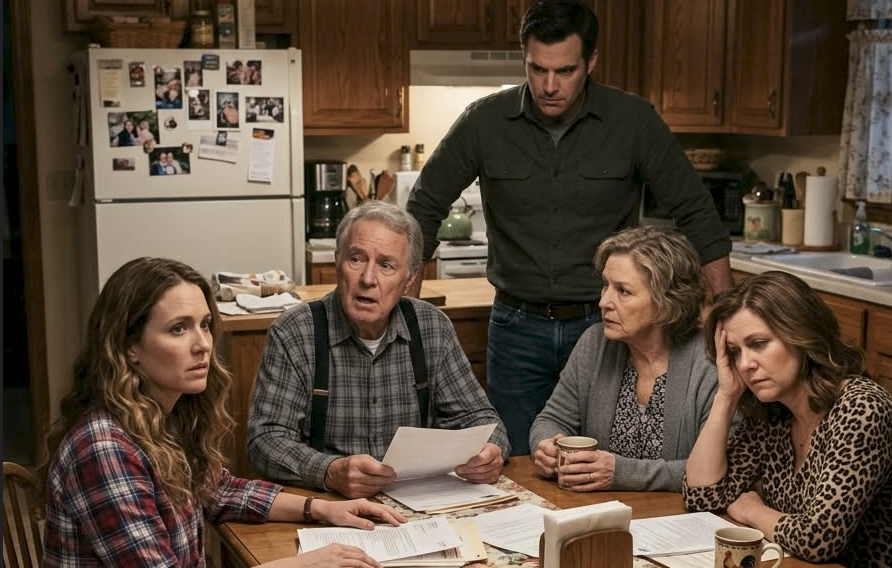
I opened the folder.
Inside were the documents from the sale of my farm, including the final closing statement showing the $39 million purchase price.
I placed the first page beside my father’s records.
Dad looked down.
His eyebrows drew together.
Then he picked up the paper and read it again.
“Thirty-nine million dollars?” he whispered.
Mom’s coffee mug slipped slightly in her hands.
Desmond, my sister’s husband, stepped away from the sink.
Ranata didn’t move.
I folded my hands on the table.
“The farm sale closed three days ago. The money is in my account. The attorneys have everything documented.”
My father looked from the paper to me.
“Your farm sold for thirty-nine million dollars?”
“Yes.”
“But you told us—” Mom stopped herself.
I waited.
She looked toward Ranata.
“You told us Fay was struggling to keep the farm.”
Ranata’s face reddened.
“She never told you about the offer, did she?” she said quickly. “You don’t know how difficult things were before that. She worked constantly. She drove that terrible truck. She never bought herself anything nice. I thought she needed help.”
I stared at her.
“You thought I needed help so much that you accepted money on my behalf without ever asking me?”
“That isn’t what happened!”
“Then tell me what happened.”
Her mouth opened, but no words came out.
Dad tapped the papers in front of him.
“Ranata, answer your sister.”
She looked at him with the wounded expression she had perfected over decades.
“Dad, I was trying to protect the family. Fay has always been private. You know that. She never tells anyone anything. I thought if I didn’t step in, you would worry about her.”
“I never asked you to step in,” I said.
“You didn’t have to!”
The words came out louder than she intended.
Everyone went silent.
Ranata took a breath and lowered her voice.
“I was trying to help. That’s all.”
I looked at the first transfer record.
Then at the second.
Then at the total printed at the bottom.
“Help me with what, exactly?”
Dad answered before she could.
“Over the past four years, we’ve transferred a total of $286,400 to Ranata. She told us you were behind on farm payments, struggling with equipment loans, and having trouble covering basic expenses.”
He paused, struggling to continue.
“Every time, she said you were too proud to ask us directly.”
I felt something cold settle in my chest.
Two hundred eighty-six thousand four hundred dollars.
That was more than many people earned in a lifetime.
It was enough to buy several farms like the one I’d started with. Enough to repair every fence, replace every piece of equipment, and pay the property taxes on my land for years.
And I had never seen a single dollar.
“Dad,” I said quietly, “I have never had an equipment loan that you paid. I have never been behind on my property taxes. I’ve never asked Ranata for money.”
“I believe you,” he said.
Those three words should have comforted me.
Instead, they hurt.
Because I wondered why it had taken fifteen years for someone in my family to ask me directly about my life.
Mom began crying.
“Oh, Fay. We thought we were helping you.”
I reached across the table and squeezed her hand.
“I know, Mom.”
And I did know.
My parents weren’t wealthy people. Dad had spent most of his life running a small agricultural supply business, and Mom had worked in the office until her retirement. They had saved carefully, lived modestly, and always told us that money should be earned honestly.
They weren’t people who could casually throw away $286,400.
They had given that money because they believed their daughter was in trouble.
And someone had used that love against them.
Dad turned to Ranata.
“Where did the money go?”
She stared at the table.
“Some of it went toward family expenses.”
“Whose family expenses?”
“Ours. Mine and Desmond’s.”
Desmond looked up sharply.
“Ranata.”
She ignored him.
“We had a difficult few years. The house needed repairs, and the children had expenses. I was trying to keep everything together.”
Dad’s face hardened.
“You told us the money was for Fay.”
“I intended to help her!”
“With what?” I asked again.
She turned toward me.
“You have no idea what it’s like being responsible for everyone. You disappear onto that farm and act as if nothing in the world matters except your work. Someone had to manage things.”
I almost smiled at the absurdity.
For fifteen years, I had managed eighty acres, equipment, crops, employees during harvest, contracts, and the endless list of problems that came with farming.
I had learned to repair machinery because I couldn’t always afford a mechanic. I had learned to negotiate contracts because every dollar mattered. I had spent winters working before dawn and summers finishing after sunset.
Meanwhile, my sister had been telling our parents that I couldn’t take care of myself.
“You’re right about one thing,” I said. “I did disappear onto my farm.”
She looked at me triumphantly, as though she had finally made a point.
Then I continued.
“Because I was busy building a life that didn’t require me to ask anyone for anything.”
Her expression changed.
“I never needed your money, Ranata. I needed you to stop telling people I was failing.”
She looked away.
For a moment, nobody spoke.
Then Desmond walked toward the table and picked up one of the bank statements.
His face changed as he read it.
“Ranata,” he said slowly, “what is this transfer?”
She reached for the paper.
“Give me that.”
He pulled it away.
“Forty-eight thousand dollars to a luxury travel company?”
“That was a business expense.”
“What business?”
She said nothing.
He looked at another page.
“Twenty-two thousand for jewelry?”
“Desmond, stop.”
“And thirty-five thousand toward the down payment on the lake house?”
My father stood up so abruptly that his chair scraped against the floor.
“The lake house?”
Mom covered her mouth.
I had heard about that property. Ranata had told everyone it was an investment she and Desmond had purchased after years of careful saving.
At family gatherings, she loved talking about its beautiful view, the expensive furniture, and the private dock.
She had once told me that hard work was important, but so was knowing how to make money work for you.
I had congratulated her.
I had no idea that our parents’ savings might have helped pay for it.
Desmond looked at her as though he were seeing a stranger.
“You told me that down payment came from your annual bonus.”
“I was going to replace the money.”
“With what?”
She had no answer.
I watched my sister sit there, surrounded by the consequences of her own decisions.
Part of me wanted to feel satisfied.
Instead, I felt tired.
This was my family. These were the people whose opinions I had carried with me long after I should have stopped caring about them.
I hadn’t come to my parents’ house that afternoon to expose anyone. I had simply wanted to deliver groceries.
Yet here we were, uncovering a lie that had been growing for years.
Dad slowly sat back down.
“How could you do this to your sister?”
Ranata’s eyes filled with tears.
“I didn’t think it would get this far.”
“That isn’t an answer,” Desmond said.
She looked at him desperately.
“You don’t understand. Everyone always talks about Fay like she’s some kind of saint because she works hard and never complains. Do you know what that’s like?”
I stared at her.
There it was.
Not an explanation.
Not even an apology.
Envy.
It had been there for years, hiding beneath her smiles and comments about my old truck.
She hated that I could be content without the things she used to measure success. She hated that our parents worried about me even when I never asked them to. And perhaps most of all, she hated that I had built something real without needing anyone to applaud me.
But I still couldn’t understand one thing.
“Ranata,” I asked, “why did you keep telling them I was struggling? You could have simply kept the money for yourself. Why invent an entire story about me?”
She looked at me for a long time.
Then she said something I would remember for the rest of my life.
“Because they would never have given me that much money if I’d asked for it for myself.”
The room became completely still.
She wiped her eyes.
“But they would give it to you. They always worried about you. They always believed you needed protecting.”
Dad shook his head.
“We believed you because you were our daughter.”
“I know!”
Her voice broke.
“And every time I asked for more, you gave it to me. It became easier to keep going than to admit what I’d done.”
I looked down at the documents.
For the first time, she had stopped pretending the money had been an accident.
But she still hadn’t explained everything.
Dad folded his hands.
“Did you intend to pay us back?”
Ranata hesitated.
“I thought I would.”
“From what?”
She stared at the table.
Desmond answered for her.
“She has been using money from our joint accounts to cover credit card bills. I’ve been wondering why our savings never seemed to grow, even when we were earning more.”
Ranata turned toward him.
“Please don’t do this here.”
“Where would you prefer we do it?” he asked. “After our children find out? After the bank calls? After your parents lose their retirement savings?”
Mom began sobbing again.
That was when I noticed something I hadn’t seen before.
My father wasn’t simply angry.
He looked frightened.
“Dad,” I said, “how much of your savings did you give her?”
He didn’t answer immediately.
Instead, he looked at Mom.
She nodded through her tears.
“Almost everything we had set aside for retirement.”
The words landed harder than any accusation.
Dad had spent decades working. Mom had spent years helping him. They had sacrificed vacations, delayed home renovations, and carefully planned for a time when they could finally stop worrying about money.
And they had handed much of that security to someone they believed was helping her sister survive.
I looked at Ranata.
“Did you know they were giving you their retirement money?”
She closed her eyes.
“Yes.”
For several seconds, I couldn’t speak.
Then I stood.
“Where are you going?” Mom asked.
“To make a phone call.”
“Fay, please,” Ranata whispered.
I turned toward her.
“I’m not leaving because I want revenge. I’m leaving because I need to think before I say something I’ll regret.”
I stepped onto the back porch and called my attorney.
I explained what had happened, including the transfers and the statements my parents had found.
He listened without interrupting.
When I finished, he said, “Don’t promise anyone money, don’t agree to settle anything tonight, and don’t move or destroy any records. Your parents should preserve every statement and communication. We need to understand exactly what happened before deciding what steps to take.”
“I understand.”
“And Fay?”
“Yes?”
“Your sister’s actions are separate from your land sale. Don’t let anyone pressure you into using your new wealth to make this disappear.”
I looked across the darkening yard.
That was exactly what I had been afraid of.
Because now that my family knew about the $39 million, everything could change.
I could already imagine the conversations.
The explanations.
The sudden concern about my well-being.
The possibility that the sister who had spent years describing me as a failure might now describe me as the person who could rescue everyone.
I returned to the kitchen.
Ranata looked up immediately.
“Fay, you have all that money now. You don’t need to make this worse.”
I stopped beside my chair.
“What does my money have to do with what you did?”
“You could help Mom and Dad recover some of it. You could make things right.”
Desmond stared at her.
“Are you seriously asking her for money?”
“I’m saying she can afford it!”
The words came out before she could stop herself.
I looked at my sister.
For fifteen years, she had told our parents that I couldn’t afford to support myself.
Now, after learning that I had sold my farm for $39 million, she was already deciding how much of it I could afford to give away.
I pulled out my chair and sat down.
“Listen carefully, Ranata. My money is not a replacement for the money you took. If Mom and Dad choose to pursue repayment, that is between them and you. I will support them in finding out what happened, but I will not pay you to make this problem disappear.”
Her face hardened.
“So you’re going to let our parents suffer?”
“No,” I replied. “I’m going to stop pretending that rescuing everyone from the consequences of their choices is the same as helping them.”
Dad lowered his head.
Mom reached for his hand.
For the first time that evening, nobody argued.
Then Desmond spoke.
“There’s something else you all need to know.”
Everyone turned toward him.
He looked exhausted.
“Last month, I found a letter from the bank. It was about the lake house.”
Ranata went pale.
“Desmond, don’t.”
He continued.
“The mortgage payments are behind. The credit cards are nearly maxed out. I thought it was a temporary problem, but now I understand why she kept asking me to sign documents without explaining them.”
He placed his phone on the table and opened a photograph of a letter.
“The bank has scheduled a meeting with us next week. I thought we were going to discuss refinancing.”
He looked at Ranata.
“Were you planning to tell me that you used your parents’ money to cover our expenses?”
She began crying again.
“I was going to fix everything.”
“How?”
She didn’t answer.
Then he asked the question that seemed to break whatever remained of her composure.
“Did you ever think about what would happen if Fay really had needed that money?”
Ranata stared at him.
“What?”
“What if she had been one bad harvest away from losing the farm? What if she had been sick, injured, or unable to work? You told her story so many times that you convinced everyone she was helpless. But you never once asked whether she actually needed help.”
He shook his head.
“You didn’t just take money. You made people believe they were saving someone while you were saving yourself.”
Ranata covered her face.
I looked at the bank statements again.
There was one transfer date that caught my attention.
It was from four years earlier, shortly after a terrible storm had damaged a section of my barn.
I remembered that week clearly. I had worked for days to repair the roof before another round of rain arrived. I had sold some equipment I no longer needed to cover the repairs, and I had spent months rebuilding the damaged storage area.
According to the record, my parents had sent Ranata $18,000 that same week for my emergency farm repairs.
I looked up.
“Did you tell them I had storm damage?”
Ranata nodded faintly.
“I thought you might.”
“But you never called me.”
“I knew you wouldn’t ask for help.”
I took a breath.
“I didn’t ask because I didn’t need to. I sold equipment, repaired the barn, and paid the bills myself.”
Dad closed his eyes.
That single detail seemed to hurt him more than the others.
He had imagined me struggling alone, and he had believed he was helping.
Meanwhile, I had been working through the problem without knowing he thought I was in trouble.
I could see the realization settling over him.
“Why didn’t you ever tell us about the farm?” he asked.
“I told you about it all the time. I told you when I repaired the barn. I told you when I bought the new irrigation system. I told you when I signed a contract with a regional supplier.”
I paused.
“You were usually asking Ranata about her house or her latest vacation when I talked.”
Mom looked at me with tears in her eyes.
“We didn’t realize.”
“I know.”
And that was the hardest part.
They hadn’t deliberately set out to ignore me. They had simply accepted the version of me that was easiest to believe.
The struggling daughter.
The stubborn daughter.
The daughter who needed help but was too proud to admit it.
They had stopped looking closely enough to notice the truth.
I gathered my documents and placed them back inside the brown folder.
“I think we should stop for tonight,” I said.
Dad nodded slowly.
“I suppose we should.”
Before I left, Mom followed me to the porch.
“Fay, will you come back tomorrow?”
I looked at her.
“Of course.”
She reached for my hand.
“I need you to know that we love you. We never meant to make you feel as though you weren’t important.”
I squeezed her fingers.
“I believe you, Mom.”
She looked toward the kitchen, where Ranata and Desmond were still arguing quietly.
“Will you ever forgive your sister?”
I considered the question.
“I don’t know yet.”
Mom nodded, accepting an answer she probably hadn’t wanted.
“That’s fair.”
I walked to my truck, climbed inside, and sat with my hands resting on the steering wheel.
The house glowed behind me.
I had arrived that afternoon carrying groceries.
I was leaving with a different understanding of my family.
The $39 million had changed nothing about the person I was. I was still the woman who preferred fixing an old machine to buying a new one, who liked quiet mornings, and who had built a life by doing one difficult thing after another.
But the money had exposed something that years of hard work never could.
It had revealed how easily people could confuse appearances with truth.
And it had shown me that the greatest danger wasn’t always someone who hated you.
Sometimes it was someone who knew exactly how much your family loved you—and knew how to use that love for herself.
I drove home beneath a darkening sky.
For the first time in years, I didn’t wonder what Ranata would say about me at the next family gathering.
I wondered what I would finally say for myself.
Because the next morning, I intended to ask my parents one question.
And the answer could change everything we thought we knew about the money.
The following morning, my father called before sunrise.
His voice was hoarse, as though he hadn’t slept.
“Fay, your mother and I have been going through the old files.”
I sat up in bed.
“What did you find?”
“A letter.”
“What kind of letter?”
He took a breath.
“It’s from your grandmother. She wrote it shortly before she died.”
I went completely still.
My grandmother had died eleven years earlier, when I was twenty-six and only beginning to understand what I wanted to do with my life. She had been the one person in the family who never seemed impressed by appearances.
She had visited my little farm during its first year, walked through the muddy fields in her good shoes, and told me that land could be worth more than money if you learned how to care for it.
I had loved her dearly.
“What does the letter say?” I asked.
“I haven’t read all of it yet,” Dad replied. “But there’s something in it about you and your sister. Something about money she set aside.”
I sat at the edge of the bed.
“Money?”
“Yes. Your grandmother left instructions in her estate documents. Your mother and I thought everything had been settled years ago, but this letter suggests there may have been another arrangement.”
I looked toward the window, where the first light of morning was beginning to appear.
“Dad, what are you telling me?”
He hesitated.
Then he said, “Your grandmother may have left you an inheritance that neither you nor your sister was ever told about.”
I stared at the wall.
An inheritance?
I had never expected one. My grandmother had always been careful with money, but she had never promised me anything beyond her love and her advice.
“Why wouldn’t I have been told?”
“I don’t know,” Dad said. “But your grandmother’s letter mentions a separate account, and it specifically says that the money was intended for you.”
My heart began to pound.
“Is Ranata named in the letter?”
Another silence.
“Yes.”
“What does it say about her?”
Dad’s voice dropped.
“Fay, I think you should come over. Your mother has found something else, and I don’t want to explain it over the phone.”
I looked at the brown folder on my desk, where the papers from the $39 million farm sale rested.
For years, I had believed the biggest story in my life was the one I had built with my own hands.
Now I was beginning to understand that there might have been another story unfolding quietly behind it.
One that began long before the sale.
Long before the money Ranata had taken.
And long before I realized that the people who claimed to know me best might never have known the whole truth.
PART 4
When I arrived at my parents’ house that morning, my mother was sitting at the kitchen table with an old wooden box in front of her.
My father stood beside the window, holding a letter so carefully that I could tell it meant something to him.
Ranata was already there.
She looked as though she hadn’t slept. Her eyes were swollen, and her expensive handbag sat on the floor beside her chair.
Nobody spoke when I entered.
I took off my coat and sat down.
“Show me the letter,” I said.
Dad placed it in front of me.
The paper had yellowed with age, and my grandmother’s handwriting slanted slightly to the right. I recognized it immediately. She used to write little notes and tuck them into the books she gave me.
I began reading.
To my beloved family,
If you are reading this, I hope you have remembered that money is not the measure of a person’s worth. I have watched my grandchildren grow, and I have learned that the person who speaks the loudest about success is not always the person who understands its meaning.
I paused.
Those words sounded exactly like her.
I continued.
I have made arrangements for Fay’s future. She has a quiet strength, and I believe she will build something meaningful if she is given the freedom to do so. I have established a separate investment account in her name, to be distributed according to the instructions held by my attorney.
My fingers tightened around the paper.
I had never heard of such an account.
The letter continued.
I have asked your father to keep these arrangements private until Fay reaches the age of thirty-five, when I believe she will be old enough to make her own decisions about the money.
I looked up.
“Dad, did you know about this?”
He shook his head slowly.
“Your grandmother told me she had arranged something for you, but she said the details were held by her attorney. I thought everything had been handled through the estate. I never received information about a separate account.”
Mom opened the wooden box.
Inside were old envelopes, photographs, insurance papers, and a sealed document bearing the name of a law firm that had since changed its name.
She handed me another page.
It was a letter from the attorney’s office, dated eleven years earlier.
The letter stated that certain assets had been placed into a separate trust and that the beneficiary would be contacted when the conditions of the trust were met.
But there was a problem.
The letter had been addressed to my parents.
At the bottom was a handwritten note.
Please ensure Fay receives the attached information when appropriate.
My mother pressed her hand to her mouth.
“I don’t remember seeing this before.”
Ranata suddenly spoke.
“Maybe Grandma changed her mind.”
I turned toward her.
“Why would you say that?”
“Because it doesn’t prove anything. It’s an old letter. Maybe the account was closed years ago.”
Dad frowned.
“Ranata, please. We don’t know what happened yet.”
She crossed her arms.
“I’m only being realistic.”
I returned my attention to the papers.
One thing was clear: I needed professional advice, not family speculation.
I called my attorney and explained what we had found. He recommended contacting the law firm named in the correspondence and obtaining a complete accounting of the trust before drawing any conclusions.
I made the call that afternoon.
Three business days later, I received an appointment.
And that appointment revealed something none of us had expected.
The attorney’s office was located in a quiet building downtown.
A woman named Ms. Whitmore greeted me and led me into a conference room. She had reviewed the old records before my arrival.
“I understand you’ve recently discovered correspondence relating to your grandmother’s estate,” she said.
“Yes. I was never told about the trust.”
She nodded.
“Your grandmother established an investment trust many years ago. The original documents identify you as the beneficiary.”
I leaned forward.
“Does the trust still exist?”
“It does.”
For a moment, I couldn’t find my voice.
Ms. Whitmore opened a folder.
“Your grandmother invested the original funds conservatively. Over time, the assets were managed according to the terms of the trust. The account was never transferred to your sister.”
She turned the statement toward me.
The balance was substantial.
Not $39 million. Not even close.
But it was enough to make my hands tremble.
The account contained approximately $1.8 million, subject to final reconciliation and the terms of the trust.
I stared at the number.
My grandmother had left me a financial foundation I had never known existed.
“Why wasn’t I contacted when I turned thirty-five?” I asked.
Ms. Whitmore reviewed the correspondence.
“According to these records, notices were sent to the address on file. Some were returned, and later correspondence appears to have gone through your parents’ address. I can’t tell you why you never received the information without investigating further.”
“Could someone have deliberately prevented me from finding out?”
“It’s possible that information wasn’t passed along, but we should establish the facts before drawing conclusions.”
I appreciated her honesty.
I didn’t want another family argument built on assumptions.
I wanted the truth.
Ms. Whitmore explained the next steps. The trust’s documents would be reviewed, the account reconciled, and the distribution process confirmed. Any questions about missing notices would be investigated.
Before I left, she handed me a copy of the original beneficiary designation.
My name was printed clearly.
Fay.
Not Ranata.
Not my parents.
Mine.
I sat in my truck afterward and read the document several times.
The farm sale had given me financial freedom.
The trust revealed that my grandmother had wanted me to have a safety net long before I ever owned that farm.
But the money wasn’t what moved me most.
It was the fact that someone had believed in me before the rest of the world had decided whether I was successful.
I called my mother.
“Grandma really did leave me something.”
She began crying.
“Oh, Fay. She always believed in you.”
“Then why didn’t I know?”
“I don’t know, sweetheart.”
I believed she didn’t know.
But I also understood that love alone couldn’t explain away years of silence.
I needed answers, and I wasn’t going to stop asking questions just because the answers might be uncomfortable.
When I returned to my parents’ house that evening, Ranata was waiting.
She had heard about the trust from Mom.
“How much is it?” she asked before I had even taken off my coat.
I looked at her.
“Why does that matter?”
“I’m just asking.”
“Approximately $1.8 million, according to the preliminary statement. The attorney is verifying everything.”
Her eyes widened.
“Almost two million dollars?”
“Yes.”
She sat down slowly.
For several seconds, she said nothing.
Then she began to cry.
“Fay, I know I’ve made mistakes. But you have to understand how difficult things have been for me.”
I sat across from her.
“Tell me.”
She wiped her face.
“I’ve spent years trying to maintain a certain standard of living. Desmond’s career hasn’t progressed the way we expected, the children attend expensive schools, and the house costs more than we can comfortably afford.”
I waited.
“I kept thinking that if I could get through one difficult month, everything would settle down. Then another bill arrived. Then another. And I kept asking Mom and Dad for help.”
“Under my name.”
She nodded.
“I thought I could replace the money before anyone found out.”
“But you didn’t.”
“No.”
“And when you learned about the farm sale, you immediately suggested I could solve the problem.”
She lowered her head.
“I was scared.”
I believed that, too.
Fear could explain a great deal about a person’s behavior.
It couldn’t excuse everything.
“Ranata, did you know about Grandma’s trust before today?”
She looked up quickly.
“No.”
Her answer came too fast.
I watched her face.
“Are you certain?”
She began twisting a ring around her finger.
“I knew Grandma had left some money in her estate, but I thought it had all been divided years ago.”
“That isn’t what I asked.”
Her eyes filled again.
“I didn’t know the details.”
I decided not to push her further that night. The attorney was investigating the records, and I had no intention of turning an uncertain suspicion into an accusation.
Instead, I told her what I needed her to understand.
“I won’t use my farm money to cover the transfers you took from Mom and Dad. I won’t give you my inheritance, either. But I will support them in getting proper legal and financial advice.”
She stared at me.
“You would let your own sister lose everything?”
“I won’t celebrate your suffering. But I can’t protect you from every consequence of your decisions.”
“What about the children?”
“I care about them. I hope you and Desmond find a way to protect their stability without continuing to hide the truth.”
She looked at me with an expression I couldn’t quite read.
For years, I had wanted her to respect me.
Now, I realized, respect wasn’t something I could force her to give.
All I could do was decide what I would accept.
“I hope you get help,” I told her. “I hope you tell the truth, repay what you can, and rebuild your life honestly. But you need to do those things because they’re right, not because you expect me to rescue you.”
She said nothing.
For once, I left without waiting for her approval.
Over the next several weeks, the investigation moved forward.
My parents hired an independent financial adviser and an attorney to review the transfers. Ranata agreed to provide records, although the process was difficult and emotional.
The review confirmed that the $286,400 had been transferred to accounts she controlled. Some had gone toward household expenses, some toward the lake house, and some toward purchases that had nothing to do with helping me.
The records also revealed that the money had been used to cover debts that had accumulated over several years.
Desmond began cooperating with the review. He had not known the full extent of what Ranata had done, although he acknowledged that he had ignored warning signs about their finances.
The lake house was eventually listed for sale.
They canceled several expensive subscriptions, sold a second vehicle, and worked with their creditors to establish a repayment plan.
My parents also sought advice about their own retirement.
The process wasn’t painless.
There were difficult conversations, legal fees, and months of uncertainty. Ranata had to accept that some of the money could not simply be recovered by asking everyone to forget what had happened.
But for the first time, she was dealing with the consequences directly.
I didn’t interfere with the legal arrangements.
I didn’t threaten her.
And I didn’t announce my wealth to anyone.
I simply refused to let my money become another excuse for avoiding responsibility.
Meanwhile, the attorney handling my grandmother’s trust completed the review.
The $1.8 million balance was verified, and the distribution was processed according to the trust’s terms.
I placed the money into a separate investment account and left it untouched while I considered what my grandmother would have wanted me to do with it.
I already had more money than I had ever imagined needing.
I didn’t need another house, another truck, or a collection of things to prove I had succeeded.
Instead, I used part of the trust to establish a small agricultural education fund for young farmers who wanted to learn modern soil management, irrigation, and sustainable farming practices.
I kept it modest at first.
I wanted it to help people who were willing to work but lacked access to training and resources.
I named it the Evelyn Bennett Agricultural Fund, after my grandmother.
The first time I signed a grant to help a young farmer repair an irrigation system, I thought about the muddy fields where my own journey had begun.
I remembered the years when one broken machine could threaten an entire season.
I remembered the mornings when I had wondered whether my little farm would ever become anything more than a place that consumed my time and savings.
And I remembered my grandmother telling me that land was valuable only when someone cared enough to cultivate it.
That was the kind of inheritance I wanted to preserve.
Not just money.
Opportunity.
ENDING: My Sister Stole $286,400 in My Name—
My Sister Stole $286,400 in My Name—Then I Sold My Farm for $39 Million and Exposed the Family Secret She Never Expected
Part 1 of 2