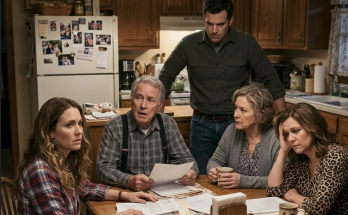
Six months after the conversation that had changed my family, I invited my parents to visit my farm one last time.
The property had officially transferred to the company that purchased it, and the transition was nearly complete. I had arranged to retain a small farmhouse nearby, where I planned to live while deciding what came next.
My father arrived in his sedan.
He stood beside the fence for several minutes, looking across the fields.
“It’s strange,” he said. “I’ve driven past this place hundreds of times, but I don’t think I ever truly understood what you were building.”
I leaned against the fence.
“You could have asked.”
He nodded.
“I should have.”
My mother joined us, carrying a small box.
Inside was a framed photograph of my grandmother standing in her garden.
“We thought you might like this,” she said.
I smiled.
“Thank you.”
Dad took a breath.
“Fay, your mother and I owe you an apology.”
I looked at him.
“We believed what we were told without checking with you. We let our concern become something that hurt you. And we didn’t pay enough attention to the life you were actually living.”
Mom took my hand.
“We should have asked how you were doing instead of assuming we already knew.”
For a moment, I couldn’t speak.
These were the words I had needed years earlier.
Not an explanation about how busy everyone had been.
Not a defense of why they had believed Ranata.
Just an acknowledgment that they had failed to see me.
“I accept your apology,” I finally said. “But I need us to do things differently from now on.”
“Tell us how,” Dad replied.
“Ask me directly. Don’t let anyone speak for me. And don’t measure my life by what I drive, what I wear, or how much money you think I have.”
Dad smiled sadly.
“That’s fair.”
I looked across the land.
For fifteen years, I had poured my life into those eighty acres. I had thought success would mean keeping them forever.
Instead, success had come in a form I hadn’t anticipated.
The sale had given me freedom to choose my next chapter.
It had also revealed who I was when nobody was watching.
I wasn’t the struggling daughter Ranata had described.
But I also wasn’t suddenly a better person because I had $39 million.
I was simply Fay.
A woman who had worked hard, made mistakes, learned to stand on her own, and finally understood that she didn’t need her family’s approval to give her life meaning.
Ranata’s life changed, too.
Selling the lake house forced her to confront the gap between the life she had presented to everyone and the life she could actually afford.
Her marriage went through a difficult period. Desmond insisted on financial transparency, and they began counseling to address the damage the deception had caused.
Repayment to my parents became part of a formal agreement, based on what could realistically be recovered and what Ranata could afford to repay over time.
She also had to accept that rebuilding trust would take much longer than signing a document.
For several months, we barely spoke.
Then, one afternoon, she sent me a message.
Can we meet? Just the two of us.
I considered ignoring it.
But I agreed to meet her at a small café near my new home.
She arrived without her usual designer handbag or carefully rehearsed smile.
She looked tired.
“Thank you for coming,” she said.
I sat across from her.
“What do you want to talk about?”
She stared at her hands.
“I owe you an apology.”
I waited.
“Not just for the money. For the way I talked about you. For making Mom and Dad believe you were incapable of taking care of yourself. For turning your life into a story that made me look better.”
Her voice trembled.
“I was jealous of you.”
I hadn’t expected her to say it so plainly.
“Why?”
“Because you never seemed to need anyone’s approval. You could work all day, come home covered in dirt, eat a simple dinner, and be happy. Meanwhile, I was constantly worried about what everyone thought of me.”
She looked up.
“I thought if I appeared successful enough, I’d finally feel successful. But every time I bought something expensive, I needed something else to prove I was still doing well.”
I listened quietly.
“I told myself I was borrowing the money temporarily. Then I convinced myself I was helping the family. Eventually, I started believing the lies I told.”
She swallowed.
“I know that doesn’t excuse what I did.”
“No,” I said. “It doesn’t.”
She nodded.
“I know.”
For the first time, she didn’t argue.
She didn’t blame Desmond.
She didn’t accuse our parents of favoring me.
She simply sat there and accepted what she had done.
“I don’t expect you to forgive me immediately,” she said. “And I don’t expect any money from you. I just wanted to tell you the truth.”
I looked at my sister.
For years, I had imagined that if she ever admitted what she had done, I would feel triumphant.
Instead, I felt a quiet sadness for both of us.
We had spent so much of our lives competing over things that had never truly mattered.
“I appreciate you telling me,” I said. “But rebuilding our relationship will take time.”
“I understand.”
“And I need you to keep your promises to Mom and Dad.”
“I will.”
“Not because I told you to. Because they trusted you.”
She wiped her eyes.
“I know.”
We didn’t hug that afternoon.
We didn’t suddenly become best friends.
We simply finished our coffee and agreed to speak again.
It wasn’t a perfect reconciliation.
It was a beginning.
And for the first time, a beginning felt more honest than a promise.
One year after I sold the farm, I returned to the area for the opening of the agricultural education center funded in part by my grandmother’s trust.
Young farmers stood in the training room, listening to an instructor explain irrigation systems. Outside, a demonstration plot showed how different soil treatments affected crop growth.
My parents attended the opening.
Dad stood near the entrance, speaking with one of the farmers whose training grant had helped him keep his small operation running.
Mom brought homemade cinnamon bread for everyone.
And Ranata came, too.
She stood quietly at the back of the room until the presentation ended.
Afterward, she approached me.
“I never understood why you kept that old truck,” she said.
I smiled.
“Because it worked.”
She nodded.
“I used to think you were afraid to spend money. Now I think you just knew what mattered to you.”
I looked at her for a moment.
“I’m still learning.”
She smiled faintly.
“So am I.”
There were no dramatic speeches.
No sudden declarations that everything had been forgotten.
But there was something new between us: the possibility of an honest relationship, built slowly instead of maintained through appearances.
Later that afternoon, I walked outside alone.
The wind moved across the demonstration fields, carrying the familiar smell of earth and growing crops.
I thought about the day I had sold the farm for $39 million.
I had believed the money would be the biggest surprise of my life.
I was wrong.
The real surprise had been discovering how little money could tell me about the people around me.
My sister had appeared wealthy while struggling beneath a mountain of debt.
My parents had appeared financially secure while quietly sacrificing their retirement to help a daughter they believed was in trouble.
And I had appeared unsuccessful because I chose an old truck, practical clothes, and a life that didn’t require me to impress anyone.
Appearances had concealed the truth for years.
But the truth had finally come out.
I hadn’t used my money to buy a better reputation or force my family to respect me.
I had used it to create choices.
Choices about where to live, what work to support, and which relationships I wanted to preserve.
The farm was gone, but what it had taught me remained.
Work mattered.
Honesty mattered.
Family mattered, too—but love without truth could become a dangerous thing.
As I returned to the building, I saw my father helping an elderly farmer carry a box of equipment manuals. My mother was laughing with two young women who had received scholarships. Ranata was speaking with Desmond near the parking lot, and for once, neither of them seemed concerned about who was watching.
I stopped for a moment and took it all in.
This wasn’t the perfect family I might once have imagined.
We still had difficult conversations ahead of us. Trust would take time to rebuild. Some wounds might never disappear completely.
But we were finally dealing with reality instead of pretending.
And that was enough.
That evening, I drove home in my old pickup.
The odometer had crossed another thousand miles, and the engine made the same familiar sound it had made for years.
I could have bought any vehicle I wanted.
I could have built a mansion and filled it with things that announced my success before I said a word.
But I didn’t need to.
I had a comfortable home, work that meant something to me, and the freedom to choose my own future.
Most importantly, I no longer needed anyone to believe I was successful.
I knew what I had built.
I knew what I had survived.
And I knew that the value of my life had never depended on the stories other people told about it.
Sometimes, the greatest victory isn’t making the people who underestimated you regret it.
It’s reaching a place where their opinions no longer decide how you see yourself.
My farm had sold for $39 million.
My grandmother’s trust had given me another unexpected gift.
But the most valuable thing I gained was something no bank could hold and no relative could take from me.
I finally learned that I didn’t have to prove my worth to the people who had failed to see it. I only had to live in a way that honored it.
And for the first time in fifteen years, I was completely at peace.
The End.
My Sister Stole $286,400 in My Name—Then I Sold My Farm for $39 Million and Exposed the Family Secret She Never Expected
Part 2 of 2