PART 3
Victor stared at his hands.
“When my wife died, Brady was twenty-four. He was angry with the world, and I thought giving him everything he wanted would help him through his grief. I paid his debts, helped him buy his first car, and gave him money whenever he asked.”
He paused to catch his breath.
“I thought I was being a good father. Instead, I taught him that somebody else would always clean up his messes.”
I said nothing.
“Elaine came into our lives a few years later. At first, she was pleasant enough. She brought groceries, helped me around the house, and insisted that I shouldn’t be living alone. After my cancer diagnosis, she offered to manage my appointments and prescriptions.”
“Did you ask her to?”
“I did. I trusted her.”
His voice cracked on the last word.
That hurt more than anything else he’d said.
Victor had served his country, raised a son, buried his wife, and fought a terrible illness. He had earned the right to spend his remaining years surrounded by dignity and kindness.
Instead, the people closest to him had treated his dependence as an opportunity.
“About six months ago,” he continued, “I began noticing that my financial statements weren’t adding up. There were withdrawals I didn’t remember authorizing and bills that had supposedly been paid but were still arriving.”
My stomach tightened.
“Did you confront them?”
“I confronted Brady. He told me I was becoming confused because of the medication. Elaine said I should let her handle everything.”
He looked at me.
“Then she suggested I sign a document giving her broader financial authority.”
“Did you sign it?”
“No.”
His answer came without hesitation.
“I told her I wanted my attorney to review it first. After that, things changed. She became impatient. Brady stopped visiting unless he wanted something. They started talking about how expensive my care had become.”
I remembered conversations from the previous year.
Brady had complained that his father was becoming a burden. Elaine had joked that nursing homes were cheaper than keeping somebody in a house.
I’d told my husband those comments were cruel.
He’d laughed and said I was taking everything too seriously.
Now I wondered how many other warnings I’d dismissed because accepting the truth would have meant questioning the man I’d married.
“Victor,” I asked carefully, “why didn’t you tell me?”
“Because I wasn’t sure what they were doing. And because I didn’t want you caught in the middle of a fight with your husband.”
He swallowed.
“I also wanted to know whether Brady would eventually do the right thing without being forced.”
His eyes turned toward the window.
“Thanksgiving answered that question.”
I took his hand.
“You don’t have to protect me from the truth anymore.”
“I know, sweetheart.”
Then he said something I would never forget.
“Your husband made one terrible mistake. He thought my weakness meant I had no power.”
Victor reached toward the bedside table, where his attorney had arranged for a folder to be delivered that morning.
Inside were copies of bank statements, correspondence, trust documents, and a list of dates.
It wasn’t a complete case against Brady and Elaine.
Not yet.
But it was a beginning.
And the deeper I read, the more disturbing the situation became.
By noon, Victor’s attorney, Margaret Collins, arrived at the hospital.
She was a woman in her late fifties with silver hair, a navy suit, and the calm expression of someone who had spent decades listening to people explain why they hadn’t done anything wrong.
She greeted Victor warmly before taking a seat beside me.
“I understand you’ve discovered some concerning circumstances,” she said.
“Concerning is one way to describe them,” I replied.
Margaret reviewed the documents.
She didn’t gasp or make dramatic accusations. Instead, she asked precise questions about the trust, Victor’s finances, his medication, and the circumstances in which we’d found him.
When I explained the freezing house and the condition of his father-in-law’s medication bottle, her expression hardened.
“First, we need to separate what we know from what we suspect,” she said. “We know Victor was left without appropriate care. We know there are financial transactions he disputes. We do not yet know whether anyone diverted medication or committed financial fraud.”
“I understand.”
“Good. That distinction will matter.”
She explained that Victor’s trust had been established years earlier and administered under formal legal documents. Its assets were not simply sitting in an account that Brady could claim because he was Victor’s son.
The three million dollars belonged to the trust, subject to its terms.
Victor remained the person entitled to the protections and benefits specified in those documents, and any changes would have to follow the proper procedures.
“Can Brady access it?” I asked.
“Not merely because he’s family. But I want to examine every account, every authorization, and every transaction.”
Victor nodded.
“That’s why I called you, Margaret.”
She turned to him.
“And the medical concerns?”
“I want the prescription records reviewed,” Victor replied. “I want to know whether I’ve been receiving the medication my doctor prescribed.”
Margaret wrote that down.
“We’ll coordinate with your physician, pharmacist, and the appropriate authorities. Nobody should handle or alter that bottle unnecessarily.”
I handed her my documentation, including the photographs I’d taken of the house and the note Brady had left.
Then she asked the question I had been avoiding.
“Jenna, do you understand that this investigation may affect your marriage?”
I looked at the folder.
“I understand that.”
“If the evidence points toward your husband, you may have to decide what you are willing to do.”
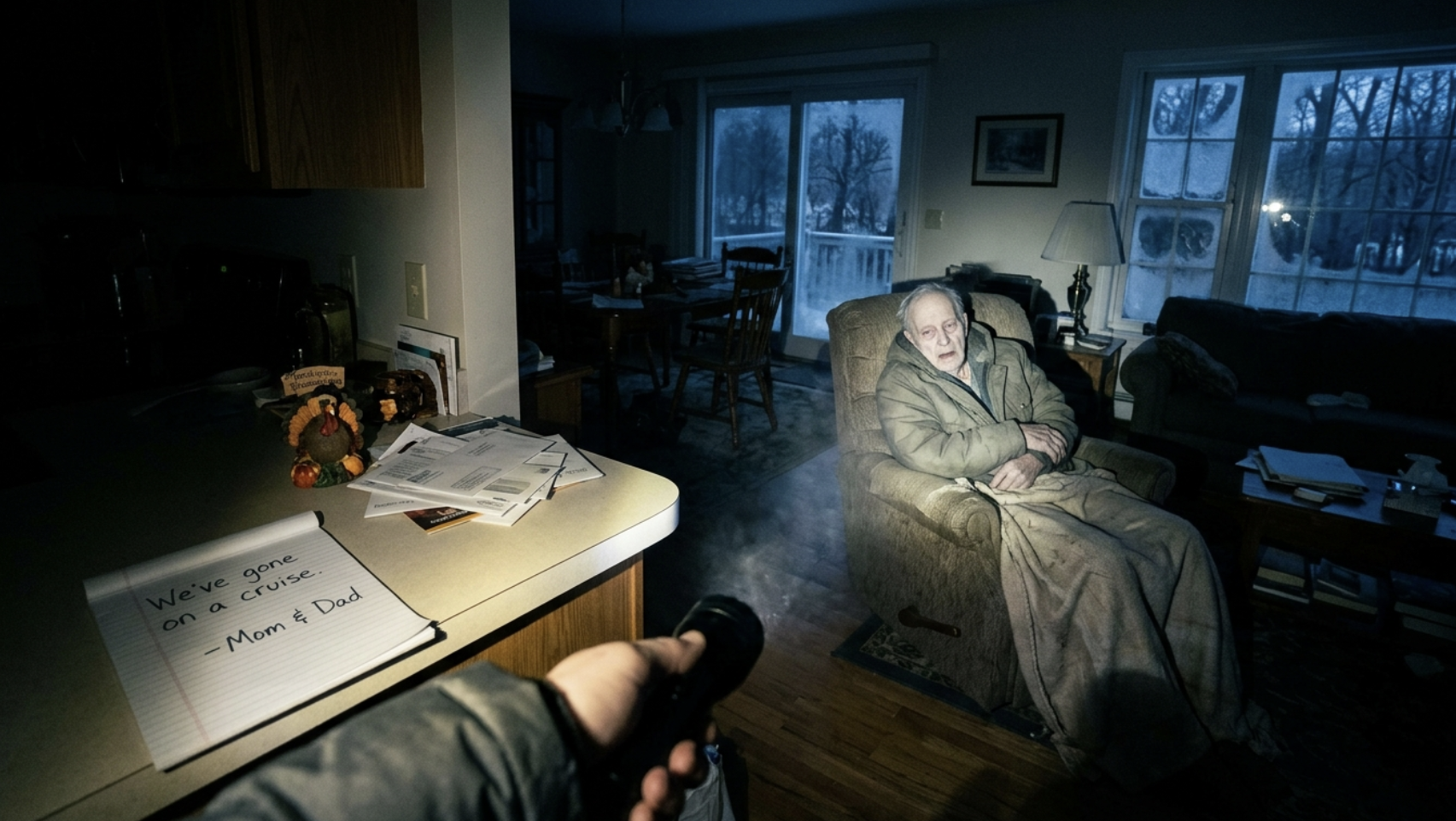
I thought of Brady laughing with his mother over a cruise itinerary while his father shivered in a freezing room.
“I already know what I’m willing to do,” I said. “I’m not going to lie for him.”
Victor reached across the bed and squeezed my hand.
For the first time that morning, Margaret smiled.
“Then let’s proceed carefully.”
The first unexpected discovery came that afternoon.
Margaret had requested a review of the trust’s recent activity. While we waited for the formal records, Victor remembered an email he’d received several weeks earlier.
“Elaine said it was a routine verification request,” he explained. “She told me I needed to approve something so the trust could continue paying my expenses.”
“Did you approve it?” Margaret asked.
“I clicked a link. But I never entered my password.”
Margaret asked him to forward the email to her secure address.
A few minutes later, she was examining the message on her laptop.
“This is not a standard communication from the trust administrator,” she said.
My pulse quickened.
“What is it?”
“A message that appears to have been designed to resemble one. I can’t determine its origin from this email alone, but we should preserve it and ask the administrator to investigate.”
Victor closed his eyes.
“I knew something was wrong.”
Margaret didn’t promise that we had caught anyone. She didn’t need to.
The possibility that somebody had attempted to gain access to Victor’s financial information was serious enough.
She immediately contacted the trust administrator through a verified channel and requested additional account security. Any questionable transaction would be reviewed, and no change to the trust’s authorized arrangements would be accepted without proper verification.
Then she turned to me.
“Jenna, do not confront them yet. Do not threaten them. And do not try to access any account that isn’t yours.”
“I won’t.”
“Good. Let them return from their vacation. We need records, not a shouting match.”
That evening, I returned to the house to collect Victor’s belongings and prepare it for his eventual return.
The heating system was running.
The kitchen was clean.
The note remained exactly where I’d found it, inside a protective document sleeve.
I walked through the living room and stopped beside Victor’s rocking chair.
The thin blanket was still draped across the back.
I picked it up.
For several seconds, I simply stood there, holding the fabric against my chest.
I thought about my own father, who had taught me that a person’s character was revealed by how they treated those who could do nothing for them.
I thought about the uniform hanging in my closet.
And I thought about the man who had once promised to stand beside me through every difficult season of life.
I had never imagined that one day I would need to protect my father-in-law from my own husband.
My phone vibrated.
A message from Brady appeared.
Brady: How’s Dad? Mom says you’re probably overreacting again. Make sure he’s comfortable. We’ll be home Monday.
I read it twice.
Not one question about whether his father was safe.
Not one apology.
Not even an acknowledgment that he’d left a seventy-two-year-old cancer patient alone without proper care.
I typed a response.
Me: Victor is receiving medical attention. We need to discuss what happened when you return.
The reply came almost immediately.
Brady: Don’t start drama while we’re away, Jenna. This was supposed to be a relaxing trip for everyone.
I stared at the screen.
Then I put my phone away.
He had just given me another piece of evidence, not because he knew what he was doing, but because he still believed I would eventually surrender.
He believed I would become emotional, apologize for upsetting him, and allow everything to return to normal.
He didn’t understand that normal was precisely what I was no longer willing to accept.
On Friday morning, Victor asked me to bring his old military footlocker from the house.
It was a battered green box he’d kept for decades, containing photographs, medals, letters, and personal documents from his service.
When I placed it beside his hospital bed, he asked me to open it.
I expected to find military records.
Instead, beneath a folded American flag and a stack of old photographs, I found a sealed envelope bearing my name.
Jenna Flores — To Be Opened When I Can No Longer Speak for Myself.
I looked at Victor.
“What is this?”
“Something I wrote when I first learned about my cancer.”
“You’ve been keeping this for how long?”
“Almost two years.”
I broke the seal carefully.
Inside was a handwritten letter.
Dear Jenna,
If you’re reading this, I suspect the people I trusted most have disappointed you in ways I hoped you would never experience.
I want you to know something before you make any decisions.
You were never responsible for keeping my family together. You were never required to sacrifice your peace to protect my son’s reputation. And you were never obligated to accept cruelty simply because it came from someone you loved.
I have watched you care for people who could offer you nothing in return. I’ve watched you work long hours, come home exhausted, and still ask whether I needed groceries or help with an appointment.
You never treated me like a burden.
Whatever happens to my money, remember that money is not the measure of a life.
If my son chooses greed over compassion, let him live with the consequences of his own choices.
If you choose to walk away from him, do not feel guilty.
You have already given this family more than enough.
With love and gratitude,
Victor.
I couldn’t finish reading without stopping.
The room blurred.
Victor watched me quietly.
“I didn’t write that because I wanted you to leave Brady,” he said. “I wrote it because I wanted you to know that you had a choice.”
I wiped my eyes.
“Why didn’t you tell me about the letter?”
“Because I hoped you would never need it.”
He looked down at his hands.
“I love my son, Jenna. That won’t change. But loving him doesn’t mean protecting him from the consequences of what he does.”
Those words settled into my heart with the weight of a truth I’d been avoiding for years.
I had spent much of my marriage trying to be understanding.
When Brady lost money, I helped him recover.
When Elaine made cruel remarks, I kept quiet to preserve family peace.
When my husband dismissed my concerns, I convinced myself that every marriage had difficult seasons.
But peace built on one person’s silence was never really peace.
It was merely a place where the truth had been forbidden to speak.
And I was finished keeping it quiet.
By Saturday, Victor’s condition had improved enough for his medical team to discuss his next stage of care.
His physician emphasized that his cancer remained serious and that he would need ongoing support, appropriate medication management, and a safe living environment.
Victor listened carefully.
Then he made his decision.
“I don’t want to return to that house while Brady and Elaine still believe they can do whatever they want,” he said.
Margaret arranged for him to receive appropriate support while his home situation was evaluated. We also discussed options for ongoing care that would respect his wishes and preserve his independence as much as possible.
Meanwhile, the financial review continued.
The trust administrator confirmed that the trust existed and that its assets were substantial. However, the review of the disputed transactions was still underway, and no one was prepared to declare that money had been stolen.
That was important.
I didn’t want revenge built on assumptions.
I wanted the truth, whatever it turned out to be.
Margaret also advised Victor to revoke any questionable financial authorizations that he had the legal right to revoke, strengthen his account security, and ensure that future medical and financial decisions were handled by people he genuinely trusted.
Victor signed the necessary documents after receiving independent advice.
Then he asked Margaret to prepare a formal notice to Brady.
It wasn’t a threat.
It was a notice stating that Victor’s financial affairs were under review, that no one had permission to act on his behalf without proper authorization, and that any disputed transactions would be investigated.
Margaret sent it through the appropriate channels.
Brady responded within an hour.
Brady: What is this supposed to mean? Dad has been confused lately. Jenna, what have you told the lawyer?
I didn’t answer.
A second message arrived.
Brady: Call me now.
Then another.
Brady: You’re turning my father against me.
I handed the phone to Victor.
He read the messages without speaking.
Finally, he returned it.
“Eleven years ago,” he said, “I would have called him immediately and tried to make him feel better.”
“What would you do now?”
Victor’s expression became calm.
“Now I’d ask him why he hasn’t called to find out whether I’m alive.”
Neither of us spoke for a moment.
Then Victor leaned back against his pillow.
“Monday will be interesting.”
Sunday brought the first real sign that Brady was becoming worried.
Elaine posted a photograph from the cruise ship.
She stood beside a sparkling swimming pool in oversized sunglasses, holding a colorful cocktail. Brady stood behind her with one arm around her shoulders.
The caption read:
Sometimes you have to leave your problems behind and enjoy life. Family drama can wait!
I looked at the photograph for a long time.
The comment section was full of smiling faces and cheerful messages.
Nobody knew what had happened in that freezing house.
Nobody knew Victor had been found soaked, shivering, and barely conscious.
Nobody knew that his daughter-in-law had spent Thanksgiving arranging medical care instead of sitting down to a peaceful dinner.
I didn’t post the photographs I’d taken.
I didn’t write an angry comment.
I simply saved the public post and its date as part of the timeline.
Then I turned off my phone.
I had no interest in humiliating them on the internet.
If Brady and Elaine had done nothing wrong beyond making a terrible decision, the facts would show it.
If they had committed something more serious, the evidence would show that too.
Either way, I wasn’t going to turn Victor’s suffering into entertainment.
That afternoon, Margaret called.
“There’s an update,” she said.
My heart tightened.
“What happened?”
“The trust administrator has identified transactions that require further explanation. Some appear to involve expenses that Victor does not recognize. We are requesting supporting records and checking who authorized them.”
“Does that mean someone stole the money?”
“Not yet. It means we have questions that deserve answers.”
I appreciated her honesty.
Then she added, “There is another issue. Victor’s care arrangements may have been misrepresented to at least one service provider. We need to establish exactly what was promised, who made those promises, and what services were actually provided.”
I thought of the empty kitchen.
The absent medication.
The cold floor.
The note.
“Whatever you need from me,” I said, “I’ll provide it.”
“Good. And Jenna?”
“Yes?”
“Do not let them draw you into an argument before we have completed the review.”
I looked at Victor, who was sitting beside the window in his hospital room.
“They won’t,” I replied.
For the first time since Thanksgiving, I felt something other than anger.
I felt prepared.
Monday morning arrived with gray skies and a bitter wind.
Brady and Elaine were scheduled to return that afternoon.
Victor had one final request before they arrived.
“Bring my uniform photograph,” he said.
I knew exactly which one he meant.
It was an old photograph of him as a young Marine, standing beside two fellow servicemen. His posture was straight, his face serious, and his eyes full of the confidence of a man who believed that duty meant something.
I placed it on the table beside his chair at the temporary residence where he was receiving support.
He studied it for a long time.
“I wasn’t a perfect father,” he said. “I made mistakes. I gave Brady too much money and too many chances. But I never taught him that the vulnerable should be abandoned.”
“You didn’t fail him by trusting him,” I said.
Victor shook his head.
“Perhaps not. But I failed myself when I kept making excuses for him.”
I sat beside him.
“What do you want to happen today?”
He took a slow breath.
“I want him to look me in the eyes and explain why he thought I deserved that Thanksgiving.”
He turned toward me.
“And after that, I want to know whether my son is still capable of being a decent man.”
There was no hatred in his voice.
That made his words more powerful.
He wasn’t planning to destroy Brady.
He was giving him one final opportunity to face what he’d done.
Margaret had arranged to be available if the discussion raised legal or financial issues. The relevant documents were preserved, and any further questions about the disputed transactions would be handled through the proper process.
I had also made a decision about my marriage.
I would not threaten Brady with divorce to frighten him.
I would not use Victor’s money as leverage.
And I would not pretend that a few apologies could erase what had happened.
If our marriage had any future, it would have to begin with honesty.
Not excuses.
Not blame.
Not another promise that everything would be different next time.
Honesty.
At 3:42 p.m., my phone rang.
It was Brady.
“Jenna, where are you?” he demanded.
“With Victor.”
A pause.
“Why isn’t Dad at home?”
“Because he needs proper care, and we’re making arrangements for him.”
“What do you mean, proper care? I told you to look after him!”
I closed my eyes briefly.
There it was.
Not Is he all right?
Not I’m sorry.
Just another demand that I accept responsibility for the decision he had made.
“Brady,” I said quietly, “you need to come and speak to your father.”
“We’re standing outside the house, and the door is locked!”
“Then wait until we arrive.”
“Jenna, what is going on?”
I looked at Victor.
He nodded once.
“Your father has some questions for you,” I replied. “And you have some explaining to do.”
I ended the call.
For several seconds, the room was silent.
Then Victor reached for his cane.
“Let’s go home, Sergeant.”
I helped him stand.
And as we walked toward the door, I realized that the most important thing waiting for Brady and Elaine wasn’t the three-million-dollar trust.
It wasn’t even the financial investigation.
It was the sight of the man they had left behind, standing upright, looking them in the eyes, and refusing to be treated as though his life no longer mattered.
Because when they walked through that door, they would finally have to face the one thing their expensive cruise had allowed them to avoid.
The truth.
And neither of them was prepared for what Victor was about to ask.
PART 4
When Brady opened the door, he was still wearing his expensive cruise shirt and designer sunglasses. Elaine stood behind him, dragging two suitcases across the floor.
“What is going on here?” Brady demanded. “Why is Dad not home?”
Then he saw Victor standing beside me.
His expression changed.
“Dad? You look… better.”
Victor looked at him quietly.
“I’m alive, Brady. Apparently, that surprised you.”
Elaine immediately stepped forward.
“Oh, Victor, sweetheart! We’ve been so worried about you!” She reached toward him, but Victor lifted one hand, stopping her.
“Don’t.”
One word.
That was all it took to silence her.
I had never seen Elaine look so uncertain.
Brady glanced at me. “What have you been telling him?”
“The truth,” I answered.
CONTINUE READ MORE HERE…
They Abandoned My Dying Father-in-Law on Thanksgiving for a Cruise—But They Never Expected His $3 Million Secret
Part 1 of 2