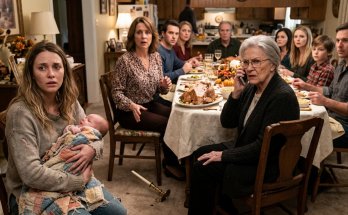
PART 1: The Christmas Gift That Changed Everything
Christmas at my mother-in-law Sharon’s house was supposed to be another uncomfortable holiday gathering.
Nothing unusual.
Nothing surprising.
At least, that’s what I thought when we pulled into the driveway that afternoon.
Looking back now, I should have known better.
The warning signs had been there for years.
I just kept convincing myself they weren’t.
The house looked exactly the way Sharon liked it every Christmas—overdecorated, overly cheerful, and somehow exhausting before you even walked through the front door.
The massive tree in the living room glittered beneath hundreds of white lights. Cinnamon candles filled the air. Christmas music played softly from hidden speakers. Wrapped presents were stacked beneath the tree in neat towers.
Everything looked perfect.
At least from the outside.
Inside, it was the same family dynamic I’d been dealing with since the day I met my husband.
Sharon played favorites.
And everyone knew it.
The gathering started normally enough.
My sister-in-law Melanie was already there with her daughter Bella.
Bella was almost the same age as my children and had been Sharon’s favorite grandchild since the day she was born.
Not that Sharon ever admitted it.
She didn’t have to.
Her actions did all the talking.
We settled into the living room while the adults chatted and the kids bounced around waiting for presents.
My son Noah sat beside me on the couch.
My daughter Mia leaned against my shoulder.
Six years old.
Sweet.
Sensitive.
The kind of little girl who still believed every person deserved kindness.
The kind of child who cried when cartoon characters got their feelings hurt.
The kind of child who spent days making handmade gifts because she genuinely thought effort mattered more than money.
That Christmas, she had spent nearly a week working on a drawing for Sharon.
Every evening after school she sat at the kitchen table coloring carefully.
“Do you think Grandma Sharon will like it?” she asked me at least twenty times.
“Of course she will,” I told her.
At the time, I honestly believed it.
Or maybe I just wanted Mia to believe it.
Eventually, Sharon announced it was time to open gifts.
The children immediately rushed toward the tree.
And right on schedule, Bella went first.
Bella proudly handed Sharon a ceramic mug she had painted at school.
The thing was covered in glitter, uneven colors, and enough glue to survive a hurricane.
Sharon reacted like she’d just been handed a priceless family heirloom.
“Oh my goodness!”
She practically shrieked.
“This is beautiful, sweetheart!”
She pulled Bella into a dramatic hug while my father-in-law Lawrence applauded enthusiastically from his recliner.
“You are so talented,” Sharon gushed.
Bella smiled proudly.
Then Sharon handed her an expensive gift bag loaded with toys and candy.
Bella squealed.
Everyone laughed.
A few minutes later it was Noah’s turn.
My son handed Sharon a drawing of the two of them sledding together.
The reaction was almost identical.
“Oh, Noah.”
Sharon placed a hand over her chest dramatically.
“This is absolutely wonderful.”
She ruffled his hair.
Praised his artistic talent.
Told everyone how thoughtful he was.
Then she handed him a giant gift box nearly as big as he was.
Noah tore it open.
Inside was an expensive remote-control car with flashing lights, oversized tires, and enough features to keep an eight-year-old entertained for months.
His eyes lit up immediately.
“Thanks, Grandma!”
Sharon smiled proudly.
My stomach tightened.
Because I already knew what was coming next.
Not the disaster.
Not yet.
Just the difference.
The difference that always existed.
The difference everyone pretended not to notice.
Then Sharon looked toward Mia.
“Your turn, sweetheart.”
Mia jumped to her feet.
She was excited.
Far too excited.
She held her handmade drawing carefully with both hands.
I watched her practically bounce across the room.
Her blonde curls moved with every step.
Her face glowed with anticipation.
She couldn’t wait to give Sharon her gift.
Couldn’t wait to make her grandmother happy.
Couldn’t wait to hear the same praise Bella and Noah had received.
She handed over the picture proudly.
“I made it for you.”
For a moment Sharon simply stared at it.
Then she looked at Mia.
Then at me.
Something changed in her expression.
A subtle shift.
Small enough that nobody else seemed to notice.
But I noticed.
Because I had spent years learning how to read Sharon.
And suddenly every nerve in my body went on alert.
Sharon’s smile tightened.
Her eyes narrowed almost imperceptibly.
Then she looked back at Mia.
The room remained cheerful.
The Christmas music continued playing softly.
Nobody had any idea what was about to happen.
Then Sharon spoke.
And in a single sentence, she destroyed the entire afternoon.
“Well, honey,” she said sweetly, “children connected to Mommy’s little secrets don’t get to call me Grandma.”
The room went completely silent.
Not quiet.
Silent.
The kind of silence that feels heavy.
The kind that makes every person suddenly aware of their own breathing.
For a second, I genuinely thought I’d heard her wrong.
Surely she hadn’t just said that.
Surely even Sharon wouldn’t say something like that to a six-year-old child.
But the expressions around the room told me otherwise.
Lawrence froze.
Melanie looked down immediately.
Thomas looked like someone had dumped a bucket of ice water over his head.
And Mia…
My sweet little girl didn’t fully understand the accusation.
But she understood enough.
Children always do.
She understood rejection.
She understood that someone she loved had just pushed her away.
Her smile disappeared.
Her eyes widened.
Her lower lip trembled.
And then tears slowly filled her eyes.
The first tear rolled down her cheek.
Slow.
Heavy.
Confused.
The kind of tear a child cries when the world suddenly stops making sense.
I felt something inside me snap.
Years.
Years of comments.
Years of subtle insults.
Years of favoritism.
Years of watching Sharon treat Noah one way and Mia another.
Every memory came rushing back at once.
The birthday parties where Noah received expensive gifts while Mia got obvious afterthoughts.
The family outings where Noah was always invited first.
The little comments.
The whispered jokes.
The constant suggestions that Mia somehow didn’t belong.
The jokes had started shortly after Mia was born.
Unlike Noah, who looked exactly like Thomas, Mia had inherited features from my side of the family.
Particularly my grandmother.
The resemblance had always been obvious to me.
The same eyes.
The same smile.
The same gentle expression.
But Sharon never cared about that.
All she saw was a child who didn’t look exactly like Thomas.
And over the years, the jokes became less subtle.
“She doesn’t look like Noah.”
“Interesting.”
“Are you sure?”
“We’re only teasing.”
“It’s just a joke.”
Again.
And again.
And again.
Every holiday.
Every birthday.
Every family dinner.
Always disguised as humor.
Always followed by laughter.
Always just serious enough to leave a bruise.
I had confronted Thomas about it countless times.
“They don’t mean anything by it,” he always said.
“It’s just how they are.”
Maybe.
But intent didn’t matter.
Because the damage was real.
Mia noticed.
Children always notice.
One birthday still haunted me.
Noah had received a giant superhero-themed cupcake loaded with decorations and frosting.
Mia received a plain cupcake with half the toppings.
Nobody said anything.
Nobody acknowledged it.
But Noah noticed.
He always noticed.
Without hesitation, he scraped half his frosting onto Mia’s cupcake and handed her the superhero decoration.
“There.”
He smiled.
“Now they’re the same.”
I had looked away and pretended to check my phone because I refused to cry in front of everyone.
That was Noah.
Protective.
Kind.
The best big brother any little girl could ever have.
And now, standing in Sharon’s living room, I saw the exact moment he realized what had just happened.
His face changed.
The excitement disappeared.
His eyes moved from Mia…
To Sharon…
Then back to Mia.
I felt rage building inside me.
Hot.
Sharp.
Dangerous.
Every muscle in my body tightened.
I wanted to say something.
Wanted to demand an explanation.
Wanted to finally unleash years of frustration.
But before I could open my mouth—
A chair scraped loudly across the hardwood floor.
Everyone jumped.
Every head turned.
Noah had just stood up.
My eight-year-old son.
Sharon’s favorite grandchild.
The child she adored.
The child she bragged about constantly.
His small hands were shaking.
His jaw was clenched.
And there was something in his eyes I had never seen before.
Something fierce.
Something determined.
Without saying a word, Noah walked directly toward Sharon.
The room watched in complete silence.
Nobody moved.
Nobody spoke.
Noah reached down and picked up the expensive remote-control car she had given him earlier.
The gift every child in the room wanted.
The gift he’d been excited about just minutes before.
Then he carefully placed it back at Sharon’s feet.
A collective gasp moved through the room.
Even Melanie looked stunned.
Sharon blinked.
Confused.
“Sweetheart?” she said.
But Noah wasn’t finished.
He stepped closer.
Reached out.
And took back the drawing he had given her earlier.
The one she’d praised.
The one she’d claimed to love.
He held it tightly against his chest.
Then he looked directly at Sharon.
His voice trembled slightly.
But his words were perfectly clear.
And what he said next would leave everyone in that room speechless…
PART 2: The Night Thomas Finally Cut the Cord
“If Mia can’t call you Grandma,” Noah said, his small voice trembling but clear, “then neither can I.”
The entire room froze.
For a few seconds, nobody even seemed to breathe.
Bella stared at him with wide eyes, still clutching her own Christmas gift. Melanie’s mouth parted slightly, as if she wanted to say something but couldn’t find the right words fast enough. Lawrence shifted in his recliner, uncomfortable and silent, like he had been doing for years. And Sharon looked completely stunned.
Not embarrassed.
Not sorry.
Stunned.
Because Noah was her favorite.
Noah was the grandchild she praised, spoiled, and showed off. Noah was the one she always claimed looked exactly like Thomas. Noah was the child she had assumed would always belong to her side of the family.
And now, that same child was standing in front of her, returning her expensive gift as if it meant nothing.
Noah held his drawing against his chest and took one step back.
“Mia is my sister,” he said, stronger this time. “If you don’t want her, you don’t get me either.”
Mia stood beside me with tears on her cheeks, looking at him like he had just built a wall between her and the rest of the world.
I wanted to cry.
I wanted to scream.
I wanted to pull both of my children into my arms and never let anyone in that house near them again.
But before I could move, Noah turned around, walked straight to Mia, and gently took her hand.
Then he looked up at me.
“Mom,” he said quietly, “can we go home?”
It wasn’t really a question.
It was a verdict.
I looked at Sharon one last time.
Her face had gone pale, but there was still no apology in her eyes.
Just anger.
Cold, offended anger.
As if she was the one who had been wronged.
“Yes,” I said. “We’re leaving.”
Thomas stood beside me.
Slowly.
For the first time that night, I saw something shift in his expression.
He had spent years explaining his family away. Years telling himself they didn’t mean it. Years trying to keep peace while I swallowed my pain and Mia absorbed every little slight they threw at her.
But now there was no way to soften what had happened.
No way to call it teasing.
No way to pretend it was harmless.
His mother had said it directly to our daughter’s face.
And our eight-year-old son had been the first person brave enough to answer her.
Nobody stopped us.
Nobody apologized.
Nobody reached for Mia.
We walked toward the front door together, the four of us, holding on to one another like we were crossing through smoke after a fire.
Mia’s small hand stayed locked in Noah’s.
My hand rested on Mia’s shoulder.
Thomas walked beside us, silent and stiff, his face unreadable.
Just before we stepped outside, I looked back.
Sharon was staring at us with a look I knew too well.
The shock was fading.
The anger was taking over.
And in that moment, I knew this was not finished.
This was only the first crack.
The cold December air hit us the second we stepped onto the porch.
Behind us, the front door closed with a hard, final sound.
No one spoke on the way to the car.
Mia climbed into her seat without a word. Noah sat beside her and immediately reached for her hand again. She leaned against him, exhausted from crying.
Thomas started the engine, but for a moment he didn’t drive.
His hands gripped the steering wheel so tightly his knuckles turned white.
Then Noah asked the question that broke whatever silence remained.
“Dad,” he said softly, “why does Grandma Sharon always treat Mia like that?”
Thomas didn’t answer.
Because there was no easy answer.
There was no answer that wouldn’t make him look at himself too.
The ride home was quiet except for the sound of Mia sniffling in the back seat. Halfway home, she fell asleep against Noah’s shoulder. Noah stayed awake, staring out the window at the passing Christmas lights like he was trying to understand something no child should have to understand.
When we finally reached home, I carried Mia inside.
Noah followed close behind.
Neither child wanted to sleep alone that night, so I tucked them both into our bed with extra blankets and put on a movie low enough that it felt more like background comfort than entertainment.
Mia curled into Noah’s side.
Noah kept one arm around her.
I stood in the doorway for a moment, watching them, and felt my chest tighten.
My children deserved better than this.
Mia deserved better.
Noah deserved better.
And honestly, so did Thomas.
A few minutes later, I went looking for my husband.
I expected to find him pacing in the hallway.
Maybe sitting in the dark.
Maybe trying to process the fact that his mother had finally crossed a line too visible to ignore.
Instead, I found him in his office.
Still wearing his coat.
Still in his dress shoes.
Sitting at his desk in front of the computer.
The room was dim except for the cold light from the monitor.
And he was clicking.
Again.
And again.
And again.
“Thomas?” I said carefully. “What are you doing?”
He didn’t look back.
“Fixing something.”
His voice was flat.
Too calm.
The kind of calm that comes right before someone does something they can never take back.
I stepped closer.
Then I saw the screen.
His bank account was open.
At first, my eyes only caught pieces.
Recurring payment.
Monthly transfer.
Mortgage contribution.
Melanie support.
Bella program fee.
Utility payment.
My stomach dropped.
I had known Thomas helped his family.
Of course I had.
It had been a problem between us for years.
But seeing it all laid out in front of me, line after line, was different.
It wasn’t occasional help.
It wasn’t a temporary emergency.
It was a system.
A system built around Thomas quietly funding the very people who had spent years disrespecting our family.
Next to each payment was a button.
Cancel.
Remove.
Delete.
And Thomas was pressing them one by one.
“Wait,” I whispered. “Are you canceling everything?”
“Yes.”
One word.
No hesitation.
No explanation.
Just yes.
I stared at him.
“This includes your parents’ mortgage?”
“Yes.”
“And Melanie?”
“Yes.”
“And Bella’s classes?”
“Yes.”
He clicked again.
Another payment disappeared.
For a second, I didn’t recognize him.
This was Thomas, the man who apologized to servers when they brought him the wrong order.
Thomas, who once thanked a telemarketer for calling before hanging up.
Thomas, who avoided conflict so carefully that conflict practically had to chase him down and tackle him.
And now he was sitting in front of me, cutting off his family’s financial lifeline with the focus of a man dismantling a trap.
“This is sudden,” I said quietly.
He let out a sharp breath and leaned back in his chair.
“No,” he said. “It’s late.”
That landed heavily between us.
He finally turned to look at me.
His eyes were red.
Not just from anger.
From shame.
“You know what hit me tonight?” he asked.
I didn’t answer.
“My eight-year-old son did what I should have done years ago.”
His voice cracked on the last words.
“He stood up for Mia before I did.”
My throat tightened.
“Thomas…”
“No,” he said, shaking his head. “Don’t make it easier for me. I let this happen. I let them make little comments. I let them joke about you. I let them treat Mia differently. I told myself it was just my mother being difficult. I told myself it wasn’t serious enough to start a war over.”
He looked back at the screen.
“But tonight, she said it to Mia’s face.”
He clicked another button.
“And I froze.”
The room went quiet.
I wanted to comfort him.
But part of me also knew he needed to sit with that truth.
Because I had been carrying it alone for years.
“Noah shouldn’t have had to be the brave one,” Thomas said. “He’s eight. He should have been thinking about Christmas gifts, not protecting his sister from his own grandmother.”
Another payment disappeared.
“They never appreciated the money,” he continued. “They expected it. They acted like I owed them. My parents, Melanie, all of them. And I kept telling myself I was helping family.”
He laughed once.
No humor in it.
Just bitterness.
“But they don’t see us as family. Not you. Not Mia. Maybe not even Noah unless he behaves the way they want.”
He clicked the final confirmation button.
The page refreshed.
Just like that, years of automatic support vanished from the screen.
I sat on the edge of his desk because my legs suddenly felt weak.
“They’re going to lose their minds,” I said.
“Let them.”
I looked at him.
He didn’t look afraid.
He looked finished.
“They’ve been taking from us for years,” he said. “Money. Peace. Time. Dignity. Tonight they tried to take my daughter’s place in this family.”
His voice hardened.
“I’m done.”
Right then, his phone buzzed.
Both of us looked down.
The screen lit up.
MOM CALLING.
Of course.
Somewhere across town, Sharon had received a notification.
Somewhere across town, she had realized the money was gone.
Thomas stared at the phone for a long second.
Then he picked it up, answered, and put it on speaker.
“Thomas!” Sharon’s voice blasted through the room. “What is going on? We just got a notice that the mortgage payment method was removed. Did the bank make some kind of mistake?”
“No,” Thomas said calmly. “I removed it.”
Silence.
Then Sharon’s voice sharpened.
“What do you mean you removed it?”
“I mean you’ll need to pay your mortgage yourselves from now on.”
For one glorious second, she had no response.
Then she exploded.
“You can’t just do that! Your father is panicking. We rely on that payment.”
“I know,” Thomas said. “That’s the problem.”
“The problem?” Sharon snapped. “After everything we’ve done for you?”
I nearly laughed.
Everything they had done for him.
As if Thomas hadn’t spent years carrying expenses that were never his responsibility.
As if we hadn’t quietly cut corners while his mother accepted help with one hand and insulted our daughter with the other.
“I have my own family to support,” Thomas said.
“We are your family,” Sharon shrieked.
Thomas closed his eyes briefly.
“No,” he said. “You are my parents. Emily, Noah, and Mia are my family.”
There was another silence.
This one colder.
Then Sharon said exactly what I expected her to say.
“This is because of Emily, isn’t it? She’s turning you against us.”
Thomas’s eyes opened.
His expression changed.
“No,” he said. “This is because of you.”
Sharon scoffed loudly.
“Oh, please. You’re being dramatic. It was one comment.”
“You told my six-year-old daughter she didn’t get to call you Grandma because of a rumor you invented.”
“She’s six,” Sharon said. “She won’t even remember.”
Thomas’s jaw tightened.
“Maybe she won’t remember every word. But Noah will. Emily will. And I will.”
Sharon’s voice rose again.
“You’re destroying this family.”
Thomas leaned forward slightly.
“No,” he said. “You did that. You just didn’t think I would finally notice.”
Then he hung up.
He actually hung up.
I stared at him.
This was the same man who once listened to Sharon complain for forty-five minutes about a grocery store cashier and still ended the call with, “Love you, Mom.”
Now he had ended the conversation like he was closing a door.
For a moment, he just sat there.
His hands were shaking.
His shoulders were stiff.
I could see the cost of it on his face.
Standing up to Sharon was not easy for him.
It went against years of training.
Years of guilt.
Years of being told that being a good son meant giving more, accepting more, and asking for nothing.
I moved toward him.
But before I could reach him, the phone buzzed again.
This time the screen showed Melanie’s name.
I sighed.
“Round two.”
Thomas answered.
“What the hell, Thomas?” Melanie snapped before he could speak. “Mom just called me crying. You cut them off? And you cut me off too?”
“Yes,” Thomas said.
“How am I supposed to pay for Bella’s classes?”
“That’s not my responsibility.”
Melanie laughed in disbelief.
“Are you serious? You’ve helped for years.”
“And I’m done.”
“All because Mom made a little joke?”
Thomas’s face went still.
“It wasn’t a joke.”
“Oh, come on,” Melanie said. “Everyone has wondered about Mia. Mom just said what people were thinking.”
My entire body went cold.
Thomas’s voice dropped.
“Don’t.”
But Melanie didn’t stop.
She never knew when to stop.
“She doesn’t look like you, Thomas. Noah does. Bella does. Mia doesn’t. You can pretend all you want, but you don’t even know if she’s—”
“Enough.”
The word cracked through the room.
Melanie went silent.
Thomas stood slowly.
His phone was still in his hand, but his eyes were fixed on the wall like he was trying not to break something.
“You are talking about my daughter,” he said.
“Thomas—”
“No,” he cut in. “You don’t get to say her name again. You don’t get to ask about her. You don’t get access to my children after tonight.”
“You’re choosing Emily over your own blood?” Melanie shouted.
Thomas gave a short, bitter laugh.
“I’m choosing my wife and my children over people who think money gives them permission to mistreat them.”
Melanie’s voice turned sharp.
“You’ll regret this.”
“No,” Thomas said. “I already regret waiting this long.”
Then he hung up on her too.
The office went silent.
This time, the silence felt different.
Not peaceful.
Not yet.
But clean.
Like something rotten had finally been cut open and exposed to air.
Thomas placed his phone on the desk.
Then he covered his face with both hands and let out a breath that sounded like years of guilt leaving his body all at once.
I stepped forward and wrapped my arms around him.
For a second, he stayed stiff.
Then he leaned into me.
“I’m sorry,” he whispered.
I held him tighter.
“I know.”
“I should have stopped it earlier.”
“Yes,” I said softly. “You should have.”
He flinched slightly, but I didn’t take it back.
Because love doesn’t always mean making the truth painless.
Sometimes love means finally saying the thing both people already know.
“But you stopped it tonight,” I added. “And the kids saw that.”
He nodded against my shoulder.
From down the hall, I could hear the soft sound of the movie still playing in our bedroom.
Mia’s tiny laugh drifted through the house for half a second.
Then Noah said something too quiet to hear.
Thomas lifted his head.
His eyes were wet.
“She deserves better,” he said.
“They both do.”
He nodded again.
“We’re done with them,” he said. “No visits. No holidays. No more excuses. Not unless they admit what they did and change completely.”
I didn’t answer right away.
Because deep down, I knew Sharon would never simply apologize.
People like Sharon didn’t sit with shame.
They turned it into a weapon.
They didn’t reflect.
They retaliated.
And as I stood there in Thomas’s office, surrounded by the quiet aftermath of canceled payments and severed obligations, I felt a strange certainty settle over me.
This was not over.
Not even close.
Sharon had lost control of her son.
She had lost access to our children.
And worst of all, she had lost the money she thought would always be there.
A woman like Sharon would not let that happen quietly.
I looked at Thomas’s phone sitting dark on the desk.
For the first time that night, it was silent.
But I knew the silence wouldn’t last.
Because by morning, Sharon would stop calling.
And she would start telling everyone her version of the story.

PART 3: The Truth Finally Comes Out
If there’s one thing I’ve learned about people like Sharon, it’s this:
They don’t admit they were wrong.
They recruit an audience.
Less than forty-eight hours after Christmas, the retaliation began.
I was making breakfast when my phone buzzed.
The message came from a cousin I hadn’t spoken to in almost two years.
Hey… are you okay?
That was never a good way to start a conversation.
Before I could answer, another message arrived.
Have you seen what Sharon posted?
My stomach dropped.
I opened Facebook.
And there it was.
A lengthy post written by Sharon.
A dramatic photo of her holding baby Thomas years earlier sat at the top.
Underneath was a carefully crafted story about a heartbroken mother who had supposedly lost her son.
According to Sharon, she had been pushed out of her son’s life by a manipulative wife.
She claimed she had been unfairly cut off financially.
She implied that Noah was being kept away from her.
And then came the part that made my blood run cold.
She wrote that the family had only ever expressed concern because Mia looked nothing like Thomas.
That they had merely been trying to protect him.
That they were being punished for asking reasonable questions.
Within minutes, Melanie appeared in the comments.
Like always.
Backing Sharon up.
Agreeing with every word.
Adding details.
Making things worse.
Screenshots appeared.
Photos of Noah and Mia side by side.
People began comparing their faces.
Speculating.
Guessing.
Judging.
As though my six-year-old daughter was some kind of public discussion topic.
I stared at the screen in disbelief.
Thomas walked into the kitchen.
One look at my face and he immediately knew something was wrong.
“What happened?”
I handed him my phone.
He read the post.
Then the comments.
Then the screenshots.
His face turned pale.
“They’re telling people you cheated.”
“Yes.”
“They’re using photos of our children.”
“Yes.”
For a long moment he simply stared.
Then he slowly placed the phone on the counter.
The anger in his eyes was unlike anything I had ever seen.
“Tell me what you want to do.”
I looked at him.
“DNA test.”
He nodded immediately.
“No arguments.”
“No arguments,” I agreed.
The test happened three days later.
Mia thought it was a science experiment.
Thomas explained it as a simple cheek swab.
Noah wanted one too.
We promised we’d do one another time.
Then we waited.
And waiting turned out to be the hardest part.
Not because I doubted.
I never doubted.
But because I knew exactly what would happen when the truth finally arrived.
The truth would destroy the narrative Sharon had spent years building.
While we waited, I dug out old family photo albums from my mother’s attic.
I hadn’t looked through them in years.
As I flipped through the pages, I stopped over and over again.
My grandmother.
The resemblance was undeniable.
The eyes.
The smile.
The shape of her face.
Even the way she tilted her head in photographs.
The older Mia got, the more she looked like her.
It wasn’t subtle.
It wasn’t vague.
It was obvious.
Anyone who had ever bothered to know my family could see it immediately.
But Sharon had never cared about knowing my family.
It was easier for her to invent a story.
Five days later, the results arrived.
Thomas and I sat together on the couch.
My heart was pounding.
I opened the email.
Then I read the results.
Probability of paternity: 99.999%.
I exhaled so hard I almost laughed.
Thomas leaned back.
“Well,” he said dryly, “good news. Apparently I’m the father of my own daughter.”
For the first time in days, I smiled.
But we weren’t interested in arguing.
We weren’t interested in defending ourselves.
We were interested in ending it.
Once.
And for all.
That night, we made our own post.
No insults.
No attacks.
No drama.
Just facts.
We shared photos of Mia.
Photos of Thomas holding her as a baby.
Photos of my grandmother.
Side-by-side comparisons showing the obvious resemblance.
Then we explained exactly what had happened.
We explained that Mia was Thomas’s biological daughter.
We attached the DNA results.
We explained that a six-year-old child had been told she didn’t deserve to call someone Grandma.
We explained that this was why contact had ended.
We explained that this was why financial support had ended.
And finally, Thomas added something I never expected.
The numbers.
Real numbers.
He listed years of financial support.
Mortgage payments.
Monthly transfers.
Emergency expenses.
School programs.
Bills.
Repairs.
Everything.
When he finally added it together, the total exceeded eighty thousand dollars.
More than eighty thousand dollars.
Money that had quietly flowed from our household into theirs.
Money they now acted entitled to.
Then we hit Post.
And waited.
At first…
Nothing.
Then everything.
The comments exploded.
People who had supported Sharon suddenly changed their tone.
I had no idea she said that to a child.
This changes everything.
The resemblance to your grandmother is incredible.
I’m so sorry your family went through this.
Good for you both for setting boundaries.
Private messages began arriving.
Cousins.
Aunts.
Family friends.
One after another.
Most of them saying the same thing.
They hadn’t known the full story.
They hadn’t known what Sharon said.
They hadn’t known about the money.
They hadn’t known about Mia.
The narrative Sharon had carefully built for years started collapsing in real time.
And then something unexpected happened.
Her upcoming birthday party fell apart.
For months, Sharon had been planning a huge celebration.
Invitations had already been sent.
Decorations ordered.
Reservations made.
One by one, people began canceling.
Sorry, can’t make it.
Not comfortable attending anymore.
Maybe another time.
The guest list shrank.
And shrank.
And shrank.
Until hardly anyone remained.
I won’t pretend I felt bad.
I didn’t.
But what happened next surprised even me.
A few days later, I received a phone call from a number I didn’t recognize.
“Hello?”
“Emily?”
The voice sounded older.
Confident.
Calm.
“Yes?”
“This is Virginia.”
I immediately sat upright.
Virginia was Sharon’s older sister.
We had only met a handful of times.
Unlike Sharon, she was respected by nearly everyone in the family.
“I saw everything,” she said.
My stomach tightened.
“Oh.”
There was a pause.
Then she asked a simple question.
“Did Sharon really say that to Mia?”
“Yes.”
“Directly?”
“Yes.”
Another pause.
Longer this time.
Then Virginia sighed.
“And the financial support?”
“Everything Thomas posted is accurate.”
The silence that followed felt significant.
Finally, Virginia spoke again.
“Well.”
Her tone changed.
Sharper.
More decisive.
“I’ve made a decision.”
I exchanged a glance with Thomas.
“What kind of decision?”
“The kind that requires attorneys.”
I blinked.
“Excuse me?”
“My husband spent decades building a successful business,” she said. “After he passed away, I intended to leave most of my estate to Sharon.”
I felt my heart skip.
Virginia continued.
“Not anymore.”
The kitchen suddenly felt very quiet.
“I removed Sharon from the will.”
Neither Thomas nor I spoke.
“Wealth should reward character,” Virginia continued. “Not cruelty.”
I could barely process what I was hearing.
“Virginia, that’s not necessary—”
“Yes, it is.”
Her voice softened slightly.
“Your children deserve better than what they’ve been given from that side of the family.”
Then she delivered the final surprise.
A trust fund.
Already established.
Already funded.
For Noah and Mia.
Additional financial support for Thomas and me.
Not as charity.
Not as pity.
As a deliberate decision.
As a consequence of Sharon’s own actions.
When the call ended, I simply sat there staring at the wall.
Thomas looked equally stunned.
Neither of us had expected any of it.
Not the support.
Not the trust.
Not the will.
Most of all, we hadn’t expected someone from Sharon’s own family to finally say the words we’d waited years to hear.
Enough is enough.
Six months later, life looked very different.
The silence from Sharon remained.
The occasional angry message still appeared through distant relatives, but we ignored them.
Without Thomas’s financial support, Sharon and Lawrence were forced to make major changes.
Their house was eventually sold.
Expenses were cut.
Reality finally arrived.
Meanwhile, our own lives became calmer than they had been in years.
Noah was thriving.
Mia smiled more.
The trust fund guaranteed opportunities we could never have imagined for them before.
And for the first time since I met Thomas, our family wasn’t spending energy managing someone else’s expectations.
One evening, I watched Noah helping Mia with a puzzle at the kitchen table.
She laughed.
He laughed.
The same way they always had.
Then Mia looked up and asked a question.
“Mom?”
“Yes, sweetheart?”
“Do you think Grandma Sharon misses us?”
The room went quiet.
Thomas looked over from the couch.
For a moment, neither of us knew how to answer.
Then I looked at my daughter.
The little girl who had spent years wondering why she was treated differently.
The little girl who had never stopped trying to love people who didn’t always deserve it.
And finally, I smiled.
“I think that’s a question only Grandma Sharon can answer.”
Mia thought about that.
Then nodded.
And went back to her puzzle.
Because unlike the adults who had spent years creating unnecessary drama, she had already moved on.
And maybe that was the greatest victory of all.
THE END