PART 1: The Dinner That Changed Everything
The bathroom door shook under another hard pull from the outside.
I froze.
So did my son.
Eleven-year-old Ethan Parker pressed himself closer against me on the cold tile floor, his small body trembling uncontrollably. Sweat dampened his hairline, and his breathing came in shallow, uneven bursts. I wrapped one arm around him while gripping my phone with the other. The 911 operator was still on the line.
“They’re almost there,” she said calmly. “Whatever happens, do not open that door.”
I swallowed hard and nodded, even though she couldn’t see me.
Then I heard footsteps.
Not one person.
Two.
The sound traveled slowly through our house in suburban Columbus, Ohio.
The first set belonged to my husband.
I would have recognized Michael Parker’s footsteps anywhere. Confident. Controlled. Purposeful. The same walk he used whenever he thought he had everything under control.
The second belonged to a woman.
The sharp click of her heels echoed across the hardwood floor.
Every step felt like a countdown.
“They aren’t here,” she whispered nervously.
A suitcase dropped onto the floor.
“What do you mean they’re not here?” Michael snapped.
Cabinet doors opened.
Drawers slammed.
Objects shifted.
He was searching.
Looking for us.
My heart pounded so hard I could hear it in my ears.
Beside me, Ethan squeezed my wrist.
I forced myself to stroke his hair.
“It’s okay,” I whispered.
But it wasn’t okay.
Nothing about tonight was okay.
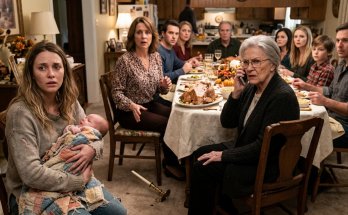
Only two hours earlier, we had been sitting around the dinner table.
Just another family dinner.
Or so I thought.
Michael had cooked chicken covered in a green herb sauce. He seemed unusually cheerful that evening. Relaxed. Attentive. Almost affectionate.
I should have recognized it as a warning.
Halfway through dinner, Ethan complained that he felt dizzy.
A few minutes later, I felt it too.
My vision blurred.
My arms became heavy.
The room started spinning.
Michael watched us carefully.
Too carefully.
Then he smiled.
At the time, I didn’t understand why.
Now I did.
The bathroom handle suddenly jerked.
I nearly screamed.
“Lily.”
Michael’s voice came through the door.
Soft.
Controlled.
Fake.
“Open the door.”
I didn’t answer.
The handle rattled again.
Harder.
“I know you’re in there.”
The woman spoke next.
“Michael, maybe we should leave.”
“Stay out of it.”
His palm struck the door.
Once.
Twice.
A third time.
The impact made Ethan flinch.
“Listen to me,” Michael said. “Things got out of hand. Open the door and let’s talk.”
My stomach twisted.
For ten years I had trusted this man.
For ten years I had shared a home, a life, and a child with him.
Now I was hiding from him.
I leaned toward the phone.
“He’s here,” I whispered to the operator. “He’s trying to get inside.”
The response came immediately.
“Officers are already outside.”
Then everything exploded into motion.
Sirens wailed.
Blue and red lights flashed through the front windows.
A thunderous knock rattled the house.
“Police Department! Open the door!”
The woman gasped.
Michael cursed.
Footsteps rushed away from the bathroom.
Voices shouted.
A struggle erupted near the front entrance.
Then silence.
For several seconds, nobody moved.
Nobody spoke.
Finally, I unlocked the bathroom door.
Ethan could barely stand.
I helped him into the hallway just as two police officers entered with their weapons lowered but ready.
Michael was standing near the living room with both hands raised.
The transformation was astonishing.
The man who had been pounding on the bathroom door moments earlier was gone.
Now he looked like a concerned husband.
A worried father.
A victim.
“Thank God you’re here,” he said dramatically. “My wife is having some kind of emotional episode. My son got sick and now she’s making all kinds of accusations.”
I stared at him.
For a moment, I couldn’t believe what I was hearing.
Then something inside me snapped.
“He did this!” I shouted.
My voice cracked.
But every word was clear.
“He did something to us!”
The room went completely silent.
One officer looked at me.
Then at Ethan.
Then at the dining table still covered with half-finished plates.
The overturned chair.
The suitcase near the doorway.
The frightened woman standing beside the kitchen island.
Suddenly, Michael’s story didn’t seem very convincing anymore.
Within minutes, paramedics arrived.
Cold night air hit my face as they guided Ethan and me toward the ambulance.
I refused to let go of my son’s hand.
As the vehicle doors closed, Ethan suddenly lurched forward.
The paramedics rushed toward him.
And for the first time that night, real fear appeared on their faces.
Because whatever had happened at that dinner table was far more serious than anyone had initially believed.
And by sunrise, doctors would uncover a discovery that would change everything.
PART 2: The Evidence They Couldn’t Explain Away
The hospital lights never dimmed.
Neither did my fear.
For most of the night, I sat alone in a small observation room, staring at the clock while doctors moved in and out of Ethan’s room. Every minute felt longer than the last.
When a physician finally walked in shortly before dawn, his expression told me this wasn’t going to be a simple explanation.
He closed the door behind him.
Then he sat down.
“We ran additional tests,” he said carefully.
My heart dropped.
“What did you find?”
The doctor folded his hands together.
“There were powerful sedative compounds in both of your systems.”
I stared at him.
“What does that mean?”
“It means neither of you became ill naturally.”
The room felt suddenly smaller.
The doctor continued.
“The substances appear to have been mixed into food or drink. In adults, they can cause extreme drowsiness and loss of consciousness. In children, the effects can be significantly more dangerous.”
I couldn’t breathe.
For a second, all I could think about was Ethan sitting across from his father at the dinner table.
Smiling.
Laughing.
Trusting him.
“Is my son going to be okay?”
The doctor hesitated.
That pause terrified me more than any answer could have.
“He’s responding well to treatment,” he finally said. “That’s a very positive sign.”
Positive.
Not certain.
Not guaranteed.
Just positive.
I spent the rest of the morning holding on to those words.
Around sunrise, a detective arrived.
Detective Marcus Reed.
Gray suit.
Tired eyes.
The kind of face that suggested he’d spent years seeing people at their absolute worst.
But unlike many officers I’d met before, he listened more than he spoke.
He asked about dinner.
About Michael.
About our marriage.
About everything that happened before we called 911.
I told him all of it.
The strange taste in the food.
The dizziness.
The bathroom.
The woman.
The suitcase.
And finally, the phone call.
The whispered conversation I overheard while lying on the floor.
Detective Reed wrote quietly in his notebook.
Then I remembered something.
I grabbed my phone.
“There was a text message.”
His eyes lifted immediately.
“What kind of message?”
I opened my screen and handed it to him.
The message had arrived only minutes before I called for help.
DON’T EAT ANY MORE. SOMETHING IS WRONG. CALL 911 NOW.
The detective studied it carefully.
“Do you know who sent this?”
“No.”
“But whoever did may have saved our lives.”
He nodded.
Then he said something that made my stomach tighten.
“We found evidence inside your kitchen trash.”
I looked up sharply.
“What kind of evidence?”
“An empty vial. Disposable gloves. Packaging materials. Fresh fingerprints.”
My blood ran cold.
Detective Reed flipped a page in his notebook.
“We believe Michael returned to the house because he realized he left something behind.”
For several seconds, neither of us spoke.
Everything suddenly made sense.
The suitcase.
The panic.
The desperate search through the kitchen.
He wasn’t looking for us.
Not at first.
He was looking for the evidence.
The evidence he failed to remove.
The next day, my younger sister, Emma Bennett, arrived at the hospital.
The moment she saw me, she wrapped her arms around me.
Neither of us said anything.
Words weren’t necessary.
Ethan was still weak.
Still exhausted.
But he was awake.
And he was alive.
That alone felt like a miracle.
Later that afternoon, Detective Reed returned.
This time he wasn’t alone.
A woman entered behind him.
Short brown hair.
Nervous smile.
Hands twisting together.
At first, I couldn’t place her.
Then recognition hit me.
“Carol?”
She nodded.
Carol Simmons had lived across the street from us for nearly six years.
She had accepted packages when we were away.
Fed our cat during vacations.
Even driven Ethan to school once when my car broke down.
“I sent the text message,” she said quietly.
For a moment, I couldn’t speak.
“You?”
She nodded again.
Then she told us everything.
The previous evening, she had seen Michael leave the house carrying a small bag.
That alone wasn’t unusual.
What caught her attention was what happened next.
He tossed something into the kitchen trash before driving away.
Carol immediately found it strange.
Nobody in our neighborhood took garbage out late at night.
Not without a reason.
Hours passed.
The lights inside our house stayed on.
Yet there was no movement.
No television.
No voices.
Nothing.
The silence bothered her.
Eventually, she walked across the street.
She never entered the house.
But she looked through the kitchen window.
The dining table was still set.
One chair had fallen over.
A shoe lay abandoned near the hallway.
And inside the trash container, she noticed a broken vial.
Something felt wrong.
Very wrong.
“I didn’t know exactly what was happening,” Carol said, tears forming in her eyes. “But I knew I couldn’t ignore it.”
I felt my own tears falling.
“You saved us.”
She shook her head.
“I just followed my instincts.”
“No,” I whispered.
“You saved us.”
The investigation accelerated quickly after that.
Within days, detectives uncovered the identity of the woman who had been with Michael that night.
Her name was Brittany Monroe.
And she wasn’t some recent acquaintance.
She had been involved with him for almost a year.
At first, Brittany insisted she believed Michael only intended to leave town.
She claimed she knew nothing else.
Then investigators recovered deleted messages.
Hundreds of them.
One conversation changed everything.
Detective Reed showed me a printed copy several days later.
I wish he hadn’t.
One message from Brittany read:
What about Ethan?
Michael’s response contained only four words.
No loose ends left.
I stared at the page.
Unable to move.
Unable to speak.
Unable to look away.
In that moment, the final pieces fell into place.
This wasn’t impulsive.
This wasn’t reckless.
This wasn’t some terrible misunderstanding.
It had been planned.
Carefully.
Deliberately.
Patiently.
And as detectives dug deeper into Michael’s finances, the motive became impossible to ignore.
By the end of the week, they uncovered a secret he had hidden from everyone.
Including me.
A secret that explained exactly why he was willing to destroy his own family.
And when Detective Reed finally showed me the financial records, I realized my husband had never been the man I thought he was.
PART 3: The Truth Behind the Smile
By the time Ethan and I were released from the hospital, I no longer recognized my own life.
Nothing felt familiar anymore.
Not my marriage.
Not my home.
Not even my memories.
For years, I had believed Michael Parker was a dependable husband and a devoted father. Looking back, I realized I had spent a decade loving a version of him that never truly existed.
A week after the incident, Detective Reed called and asked me to come to the station.
His voice sounded different.
More serious.
More certain.
When I arrived, he led me into a conference room and placed a thick file on the table.
“You’re going to want to see this.”
Inside were bank statements.
Credit reports.
Loan records.
Collection notices.
Pages and pages of financial documents.
The deeper I looked, the worse it became.
Michael wasn’t simply struggling financially.
He was drowning.
Over the previous three years, he had accumulated enormous debt through gambling, personal loans, and multiple credit cards. Some accounts were already in collections. Others were months behind.
The total amount was far higher than I could have imagined.
And somehow, he had hidden all of it from me.
I felt sick.
“How long has this been going on?”
Detective Reed slid another document across the table.
“Long enough to become desperate.”
I looked down.
My name was printed across the page.
It was an insurance policy.
My insurance policy.
The coverage amount had nearly doubled just weeks before the dinner.
My hands started shaking.
“He increased it?”
Detective Reed nodded.
“Without discussing it with you.”
Then he showed me something even worse.
Internet search records.
Dozens of them.
Insurance claim procedures.
Settlement timelines.
Financial payout calculations.
Methods of disguising toxic exposure.
Every page felt like another punch to the chest.
The man I married hadn’t made one terrible decision.
He had spent months preparing for one.
And according to investigators, Ethan and I were simply obstacles standing between him and a financial escape.
That realization hurt more than anything else.
Not because of what happened to me.
Because of Ethan.
My son had adored his father.
Saturday baseball games.
Camping trips.
Movie nights.
For years, Ethan followed Michael everywhere.
And Michael knew that.
He knew his son trusted him completely.
Yet he still sat across from him at that dinner table and smiled.
A few days later, detectives recovered additional deleted messages between Michael and Brittany Monroe.
Those messages destroyed the last remaining doubts.
The two of them had discussed moving away together.
Starting over.
Leaving their old lives behind.
One exchange mentioned insurance money.
Another referenced debts being “finally solved.”
The evidence continued piling up.
Eventually, Brittany stopped cooperating with Michael entirely.
Faced with overwhelming proof, she began speaking to investigators.
Her statements helped confirm timelines.
Planning.
Meetings.
Conversations.
Everything.
For the first time since that horrible night, I felt something unexpected.
Not relief.
Not happiness.
Clarity.
The lies were over.
The truth was finally visible.
Meanwhile, Ethan focused on healing.
Children carry pain differently than adults.
Some days he seemed almost normal.
Other days he became quiet for hours.
One evening, while we were staying at my sister Emma’s house, he sat beside me on the couch.
The television was on.
Neither of us was watching it.
“Mom?”
I looked over.
“Yeah, buddy?”
He hesitated.
Then asked the question I had been dreading.
“Did Dad really know what would happen?”
My throat tightened.
I could have avoided it.
I could have softened the truth.
But I remembered how many lies had already damaged our lives.
So I answered honestly.
“Yes.”
Ethan stared at the floor.
For a long time, he didn’t speak.
Finally, he nodded.
Then he whispered:
“I don’t think I want to see him again.”
My heart broke.
But I understood.
I wrapped my arm around him.
“You don’t have to.”
A few weeks later, officers escorted me back to the house so I could collect personal belongings.
Walking through the front door felt surreal.
Everything looked the same.
Yet nothing felt the same.
The dining table still stood where it always had.
The kitchen looked normal.
The living room looked untouched.
Anyone visiting for the first time would never know what had happened there.
But I knew.
Every room carried a memory.
Every corner reminded me of that night.
As I packed boxes, I noticed something attached to the refrigerator.
A drawing.
Ethan’s drawing.
Three stick figures standing together.
A mother.
A father.
A son.
All smiling.
Across the top, written in uneven handwriting, were two simple words:
Family Night.
I stared at it for several seconds.
Then carefully removed it and folded it into my bag.
Not because I wanted to remember Michael.
Because I wanted to remember Ethan.
The version of him who still believed the world was safe.
The version of him who deserved better.
Today, Michael remains in custody awaiting trial.
Brittany faces charges of her own.
There are attorneys now.
Court hearings.
Evidence reviews.
Witness statements.
The legal process moves slowly.
But it moves.
Carol still visits every Sunday.
She never arrives with dramatic speeches or emotional advice.
Instead, she brings groceries.
Fresh bread.
Household supplies.
The kind of support that quietly keeps people standing when they’re exhausted.
Emma continues helping us rebuild.
And little by little, Ethan and I are finding our footing again.
Recovery isn’t dramatic.
It happens in small moments.
A full night’s sleep.
A laugh that feels genuine.
An afternoon without fear.
A future that finally seems possible.
Sometimes I still wake up in the middle of the night.
Sometimes Ethan still leaves a lamp on while he sleeps.
I never tell him to turn it off.
Healing takes time.
Trust takes even longer.
But one thing is absolutely certain.
The next time I see Michael Parker, it won’t be in a family kitchen.
It won’t be across a dinner table.
And it won’t be as the woman who once trusted him.
It will be across a courtroom.
Where, for the first time, he won’t control the story anymore.
Because this time, the ending belongs to the people who survived.
THE END