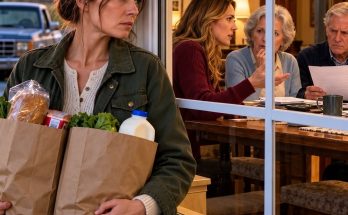
The bus came down Linwood at forty.
The brakes were gone. The driver — a man named Calvin Boyd, fifty-four, ten years on the Marysville route — was leaning on his air horn and pumping a pedal that wasn’t catching. He told me later it felt like stepping on a wet sponge. No resistance. Nothing.
The Number 12 cleared the intersection at Linwood and Main without stopping. It clipped the curb. It came in sideways.
It hit the bus stop.
I want you to picture this. The metal-and-glass shelter where she had been standing forty seconds before — where her boy had been holding her thigh and asking for animal crackers — that whole structure caved in like tinfoil. The bench bent in half. The advertising panel exploded into pebbles of safety glass. A trash can flew thirty feet down the sidewalk and bounced off a parked Honda. The bus came to rest with its front wheels up on the curb and its right side wedged into what used to be the shelter.
She turned around to look.
She had her fist drawn back for a fourth swing. And she turned, and she saw it.
I will never forget the sound that came out of her.
It wasn’t a scream. It wasn’t a word. It was something lower than that. Something a body makes when the mind hasn’t caught up yet.
She dropped to her knees on the sidewalk. Right there. In front of my store.
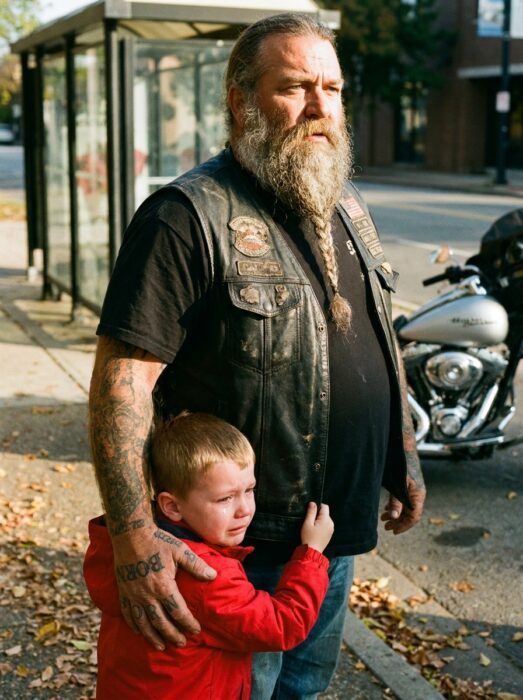
Her boy ran to her — the biker had set him down gently and stepped back two paces — and she grabbed him so hard I thought she might break a rib. She was making this sound. This long, broken sound.
And then she reached out with her other arm. The arm that had hit him.
She grabbed the biker by his cut. By the leather. And she pulled him down into the same hug.
The three of them — the mother, the boy, this enormous tattooed stranger — knelt on the concrete for what felt like ten minutes. The bus was still hissing. Calvin was climbing out of the driver’s seat shaking so bad he had to hold the door. Two people were running across the street with their phones out, not filming this time. Coming to help.
She was sobbing into the biker’s beard.
He had one big hand on the back of the boy’s head. The other on her shoulder. He wasn’t saying a word.
Here is what I learned about the biker over the next six hours, because I was the witness statement the police took first, and the EMTs ended up using my store as a triage spot because we had outlets and clean towels.
His name was Wendell Cross. Fifty-eight years old. From a town called Logansport, Indiana, three hours west. He was passing through Beckford on his way to a memorial ride for his older brother — a man named Caleb Cross who had died in a logging accident in 1998. Wendell did the ride every October. Twenty-six years running. He pulled into Beckford to get gas and a coffee. That’s why he was on Main Street that morning. That’s the only reason.
He was a retired sheet-metal worker. Two kids of his own — both grown. Three grandchildren. A wife named Marlena who he called four times a day on the road. He’d been riding Harleys for forty-one years. He’d been in one bar fight in his life, and he’d lost it on purpose because the guy was drunk and looking to get arrested.
He had been sitting on his bike across the street, lighting a cigarette, when he looked up Linwood and saw a city bus coming down the hill with no brake lights and a driver standing on his horn.
He told the cops he had maybe four seconds to act.
He told the cops he didn’t have time to yell.
He told the cops he figured if he just grabbed the kid and ran, the mother would follow — and he was right, she did follow, just not the way he hoped.
He took three punches for it. He didn’t press charges. He didn’t even mention them.
She found out his name from the cops about an hour after the bus came to rest.
By that time the EMTs had her boy checked out — not a scratch, not even a bruise where the biker had grabbed him — and Calvin Boyd was sitting on my front step with his face in his hands, saying I couldn’t stop it, I couldn’t stop it, over and over while one of the medics rubbed his back. The brakes had failed catastrophically. A hydraulic line. Not Calvin’s fault. The shop that serviced the bus three weeks earlier would end up paying a settlement that’s still in court.
She came into my store looking for Wendell.
He was sitting at one of the two folding tables I keep by the coffee machine. Hands wrapped around a paper cup. Three of my regulars were sitting with him. Nobody was talking.
She walked up to the table. She was still wearing the green parka. There was coffee dried on the sleeve. Her boy was holding her hand.
She did not say a single word.
She just walked around the table and put her arms around his shoulders and pressed her face into his neck.
I watched a six-foot-three man with knuckles that said BORN and LOST close his eyes and not move.
She held him for a long time. Her son stood next to her chair and held the biker’s other hand. Wendell’s hand was twice the size of his.
When she let go, she said: I’m Hannah. This is Theo. I am so sorry.
He shook his head. Just once. He said: Ma’am, you saw a stranger grab your child. You did exactly what you were supposed to do.
She started to cry again. He stood up. He put one hand on her shoulder.
Then he asked if he could finish his coffee, because his hands were still shaking.
That was the only thing he said about being scared.
He left Beckford that afternoon. He didn’t give her his number. He didn’t take hers. She offered. He said no — gently, but he said no.
Some of the regulars asked me later why he wouldn’t take her information. I have a theory. I think Wendell Cross had been carrying something heavy his whole life — something to do with his brother Caleb, something about the kind of man who shows up every October to ride the same road for twenty-six years — and I think he didn’t want to be thanked. I think he didn’t think he deserved to be thanked.
I think that’s why he rode out of town without leaving a name.
Hannah posted on Facebook that night.
The post went semi-viral around Ohio. Looking for the biker who saved my son in Beckford on October 4th. She had no photo. She didn’t know his name. She wrote down everything she could remember — the long grey beard, the Road King, the tattoos. She said: I hit you. I am sorry. Please let me thank you.
The post got shared six thousand times. Nobody came forward.
I knew who he was. I had given my statement. I had his name in a police report. But Wendell had asked me — quietly, on his way out the door — please don’t.
I respected that.
I respected it for one full year.
She came back to Beckford every few months. Always with Theo. Always stopped at my store. Bought him animal crackers — the same kind they had been walking to get when the bus came down the hill. Sat at my folding table for a half hour. Never asked me a thing. I think she just needed to be in the room where it ended.
Theo started kindergarten that fall.
He drew a picture of a motorcycle and a man with a long grey beard and gave it to his mother to keep on the refrigerator.
She kept it.
The charity ride was the next October. First weekend of the month. Annual fundraiser for the Beckford Volunteer Fire Department — a hundred bikes, sometimes more, rolling through town for a barbecue at the fairgrounds.
Hannah came. She brought Theo. She wasn’t looking for anyone. She told me later she had just wanted Theo to see motorcycles in a happy setting — to undo the memory a little.
I was working the grill.
I looked up from a tray of brats and I saw the man with the long grey beard standing in line for a hot dog.
He was wearing the same cut. The same boots. Marlena was on his arm — small woman, red hair, kind face.
I didn’t say anything. I didn’t have to.
Hannah was thirty feet away with Theo on her hip. She turned her head. She froze.
She walked over. Slow.
She did not say a single word.
She set Theo down. She put her arms around Wendell Cross. And she held him for five minutes. I counted because I was watching the brats burn and not caring.
He held her back. One big hand on her shoulder blade. The other on the top of Theo’s head.
After five minutes, he looked down at her and said the only thing he said the whole time.
I recognize you. Is the little man okay?
She nodded.
She could not speak.
Wendell still does the memorial ride every October.
He still pulls into Beckford for gas and a coffee. Stops at my store. Sits at the folding table. Doesn’t say much. He’s sixty now. The beard is whiter. The hands shake a little more than they used to.
Hannah brings Theo every year on the same first weekend. They drive over from Columbus. Theo is six now. He calls Wendell Mister Cross. Wendell calls him little man.
Last October, Theo climbed onto the seat of the Road King for a photo. Hannah took it. Wendell stood next to the bike with his arms crossed and a small, tight smile that almost nobody else has ever seen on his face.
She has the photo on her refrigerator.
Next to the drawing.
If this one stayed with you, follow the page. There are more like it. Real people. Real roads. Real reasons we don’t judge a man by his beard.