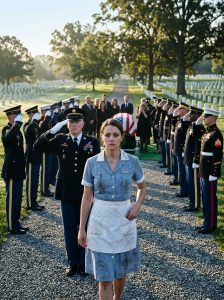
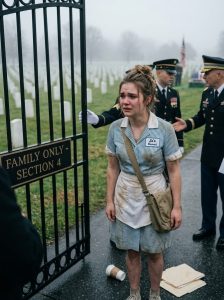
More boots crunched on the gravel. A sergeant arrived, then a first sergeant. I saw the flicker of contempt in their eyes as they scanned my apron. I was a stain on their perfect formation. I was a problem to be solved. The first sergeant pointed at the worn, dirty patch on my bag, his voice dripping with the specific arrogance of a man misquoting a regulation he barely remembered.
“Unauthorized insignia. Turn around.”
I reached into my apron pocket. My fingers brushed past my order pad and found the cold, smooth edge of metal. I pulled out my challenge coin. It was worn down, the edges smooth from seven years of me rubbing my thumb across it in the dark. I placed it in his hand without a word. He looked at it, turned it over, and shrugged.
“This doesn’t authorize your presence here.”
A hot flush of shame burned up my neck, but I stood rooted to the spot. I had absorbed harder shocks than this. I had survived the bloody chaos of Operation Sentinel Ridge. I just kept looking past them, toward the casket of the man who had sent me into that nightmare. I owed him this.
The commotion stirred the crowd. Heads turned. And then, a sudden movement parted the sea of uniforms. A U.S.M.C. Captain was walking straight toward us. His face was tight, his eyes locked on me. He didn’t see the apron. He didn’t see the guards. He saw me.
The folder in his hand slipped and papers scattered across the grass. He didn’t notice. He stopped inches from me, ignoring the First Sergeant as if he were a piece of furniture that had no business being there. His voice was quiet, but it cut through the morning air with the sharpness of a blade. His eyes were wide with a shock that made my stomach drop.
“Ma’am. Is your name Olivia Reeves?”
“Yes,” I whispered.
He nodded once, a man confirming a ghost story he’d just realized was true. He turned to the guards, his voice cracking not with volume, but with a dangerous, quiet fury that turned the First Sergeant’s face ashen.
“She was the combat medic on Sentinel Ridge. She kept 11 Marines alive during a 9-hour firefight with her bare hands.”
He paused, his glare burning into the man who had tried to throw me out.
“And you told her she doesn’t belong?”
The silence that followed was absolute. The shame I’d felt shifted violently, twisting into a heavy, suffocating dread in my chest. They were looking at me, but I was just looking at the casket. I shouldn’t be here. I didn’t belong here, not for the reasons they thought. The General had recommended me for the Navy Cross, but he never knew the truth. He never knew about the shot I fired in the dark, the one that ended my career. The one I couldn’t take back.
But then, the General’s widow appeared. Her eyes were wet, but her hand was steady as she reached into her coat. She pulled out a white envelope, softened by years of being handled, and held it out to me.
My name was written on the front in his handwriting.
“He talked about you until the very end,” she said softly. “He never stopped looking for you.”
**Part 2**
My trembling fingers took the envelope from the widow’s hand. The paper was heavy, the ink slightly faded, as if it had sat in a desk drawer for years waiting for a ghost to finally materialize.
The silence in the cemetery was absolute. The First Sergeant, who just moments ago had looked at me like I was trash blown in off the street, was now standing at rigid attention, his face pale and eyes locked straight ahead. The Captain stood beside me, a silent guardian offering a perimeter of respect I hadn’t felt in seven years.
I looked down at my name—*Olivia*—written in General Harris’s unmistakable, sharp scrawl.
I tore the seal. Inside was a single, folded piece of heavy cardstock. As I unfolded it, the damp morning air seemed to vanish, replaced by the suffocating, sulfur-choked heat of Sentinel Ridge.
There were eleven Marines who came off that ridge alive. But there had been twelve in the squad.
For seven years, the military history books recorded that Private First Class Thomas Miller had died from enemy fire during the ambush. Only I knew the truth. When the enemy had pinned us down in a collapsing ravine, Miller was trapped beneath a shattered concrete pillar. His legs were crushed, his lungs filling with dust and blood. And he was screaming.
His screams were echoing up the canyon walls, a massive auditory beacon drawing an entire enemy battalion directly toward the shallow cave where I was frantically bandaging the other eleven wounded men. We were out of ammo. We were out of time.
I didn’t shoot an enemy that night. I didn’t fire in self-defense. I crawled out into the crossfire, held my sidearm to the chest of a boy I had trained with, a boy who looked up at me with terrified, understanding eyes, and I pulled the trigger. I silenced him to save the rest. It was a choice that shattered my soul, a choice that forced me to strip off my uniform the moment I returned stateside, vanishing into diners and night shifts to hide from the ghosts.
I looked down at the letter in my hands. The General’s words stared back at me.
> **Olivia,**
> **If you are reading this, it means you finally stopped running. It also means I am gone, and I am deeply sorry I couldn’t tell you this to your face.**
> **You always thought you fooled us. You thought I recommended you for the Navy Cross blindly, dazzled by the eleven men who came home. But I read the classified autopsy report on PFC Miller. I saw the caliber. I saw the powder burns. I knew exactly what happened in that ravine.**
> **You broke the most sacred rule of our medical corps, and in doing so, you bore the ultimate weight of command. You didn’t just sacrifice your career on Sentinel Ridge; you sacrificed your own conscience so that eleven young men could go home and have children, wives, and futures.**
> **I never stopped looking for you because I needed you to know one thing: Thomas Miller’s mother came to my office three years ago. She knew he was trapped. She knew the enemy that was approaching. And she asked me to thank whoever gave her son a quick, merciful end rather than letting him fall into their hands.**
> **You are not a murderer, Olivia. You are a lifesaver who had to pay a price no one else was strong enough to pay. Stand tall today. You belong here more than anyone.**
> **— Harris**
>
**Part 3**
A tear broke free, cutting a hot, stinging path through the diner grease on my cheek. It dropped onto the heavy cardstock, blurring the ink of the General’s signature.
The crushing, suffocating dread that had sat on my chest for seven years didn’t vanish completely, but it fractured. A sliver of light broke through the dark. I wasn’t a monster. The General knew. Miller’s mother knew.
“Ma’am?” the Captain’s voice was gentle, completely devoid of the sharp command it had held moments before.
I looked up. The crowd of high-ranking officers, grieving family members, and honor guards were all looking at me. They didn’t see the wrinkled waitress uniform. They didn’t see the stained white apron. Thanks to the Captain’s booming voice, they saw the combat medic of Sentinel Ridge.
I carefully folded the letter and slipped it into my apron pocket, right next to my worn challenge coin.
I turned to the First Sergeant. He swallowed hard, his eyes dropping briefly in deep, profound shame. He stepped back, clearing the path, and snapped off a razor-sharp salute.
“Permission to approach, First Sergeant?” I asked, my voice finally steady.
“Granted, Doc,” he choked out, holding the salute. “With the utmost respect.”
I walked down the gravel path, the crunch of my cheap, slip-resistant work shoes echoing in the quiet cemetery. I stopped at the edge of the grave, looking at the polished wood and the vibrant red, white, and blue of the flag draping the General’s casket.
I didn’t offer a prayer, and I didn’t cry anymore. I just raised my hand, fingers pressed tightly together, and touched the brim of an invisible cover. I held the salute long and hard, feeling the morning sun finally begin to warm the freezing air of Arlington.
I had come here to hide in the back, to pay a guilty tribute to a man I thought I had deceived. Instead, I left my ghosts buried in the dirt beside him.
When I finally turned to walk away, no one stopped me. The sea of uniforms parted. I walked out the gates of Arlington, still wearing my waitress dress and my white apron, stepping into the morning light as a Marine who had finally come home.