
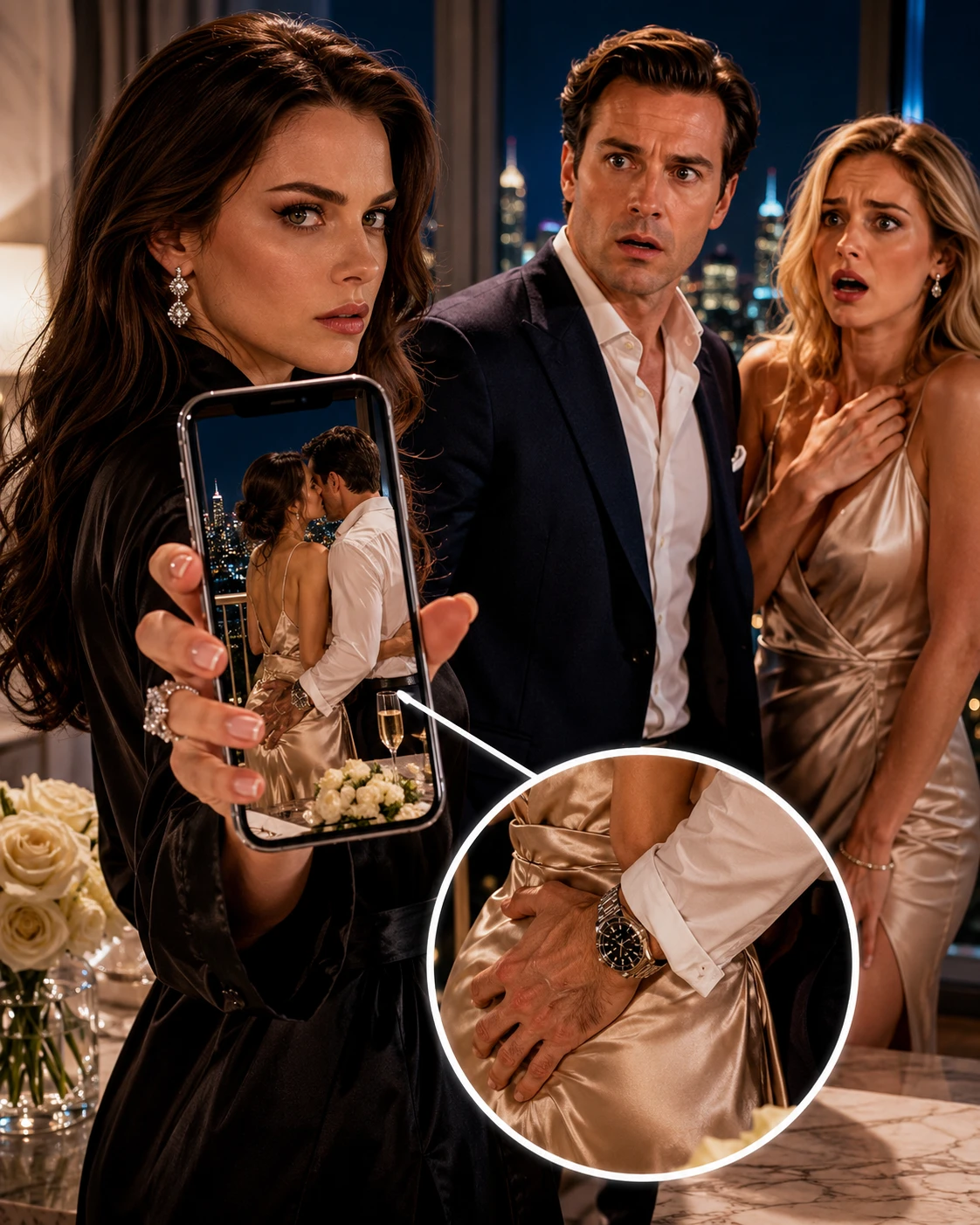
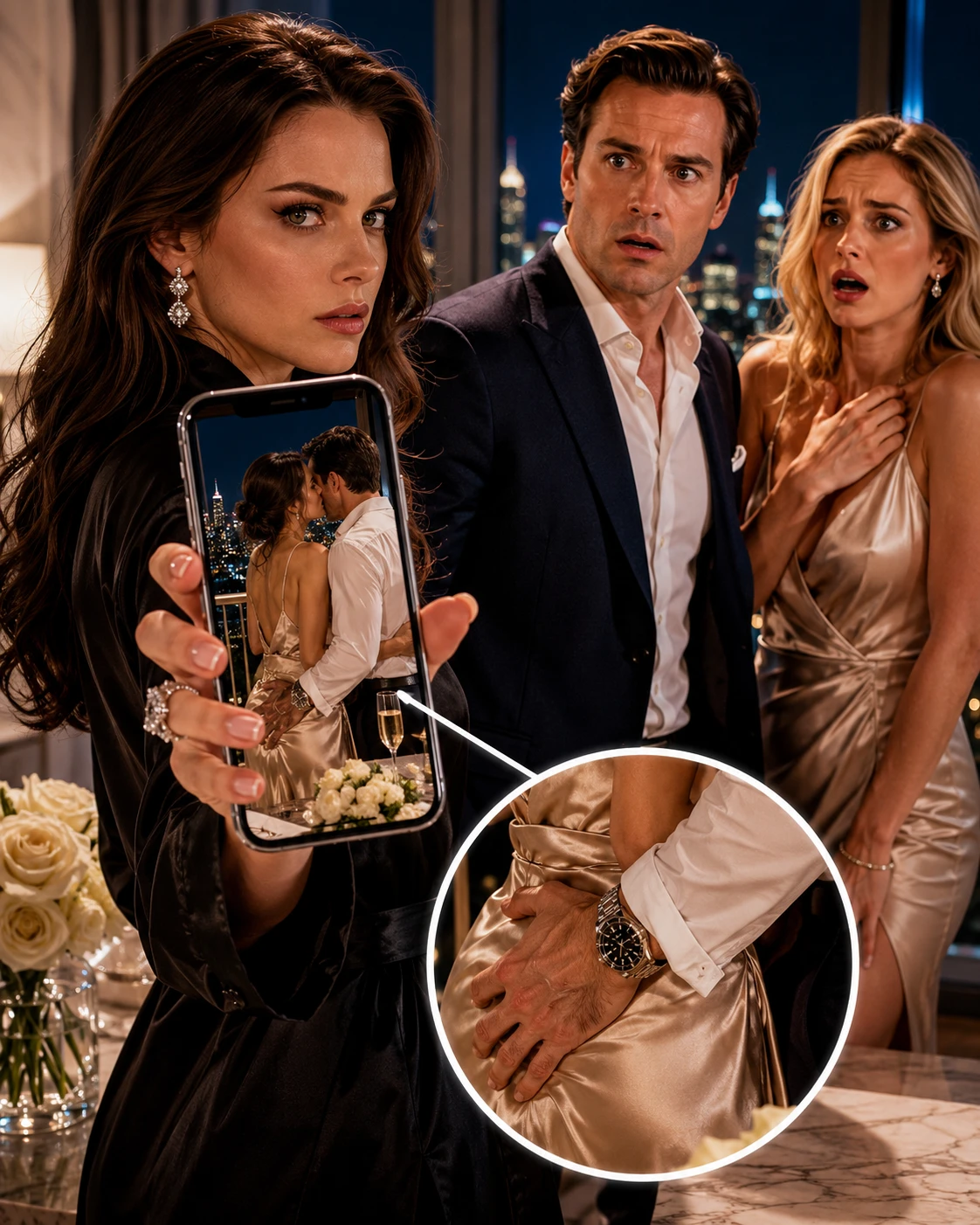
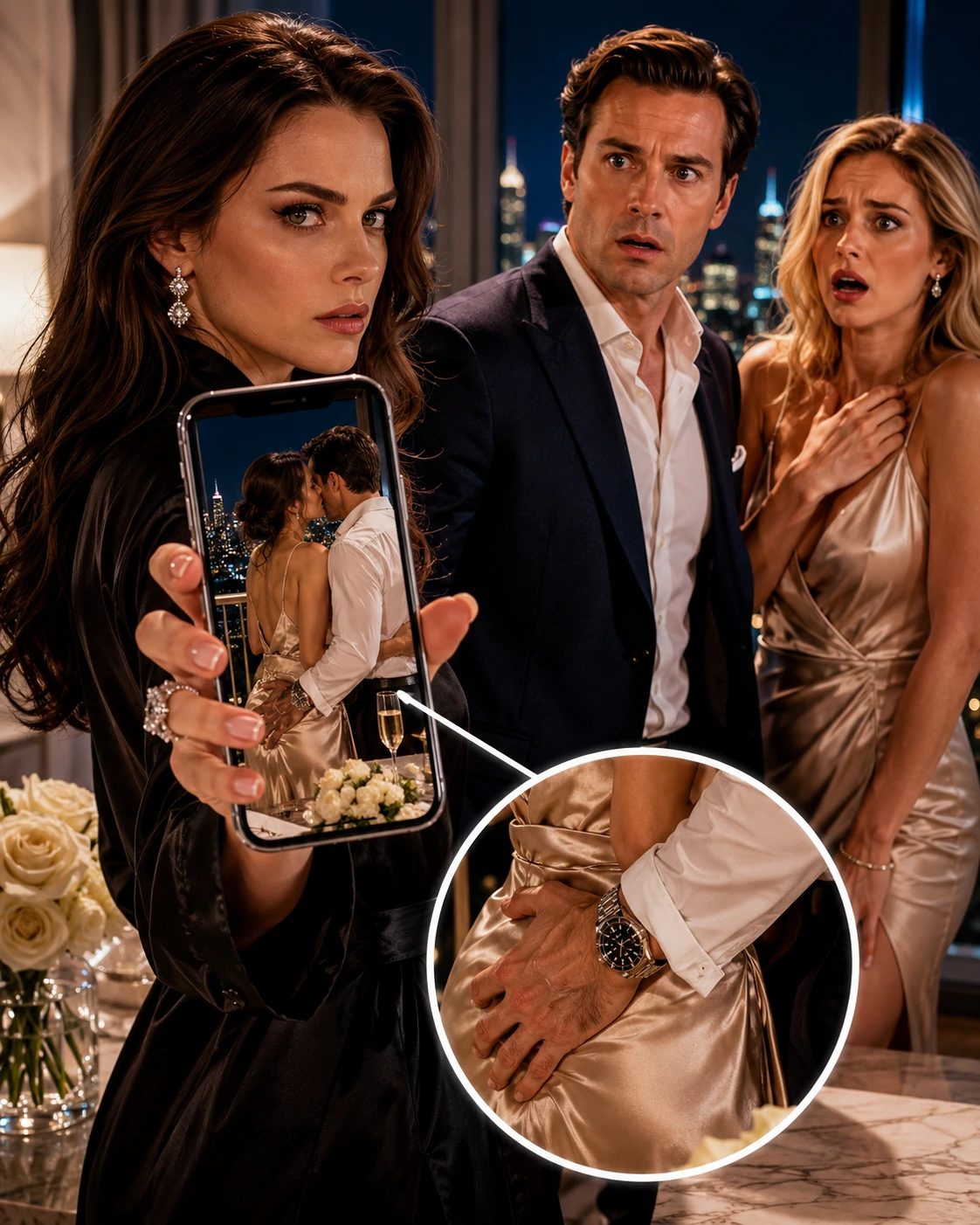
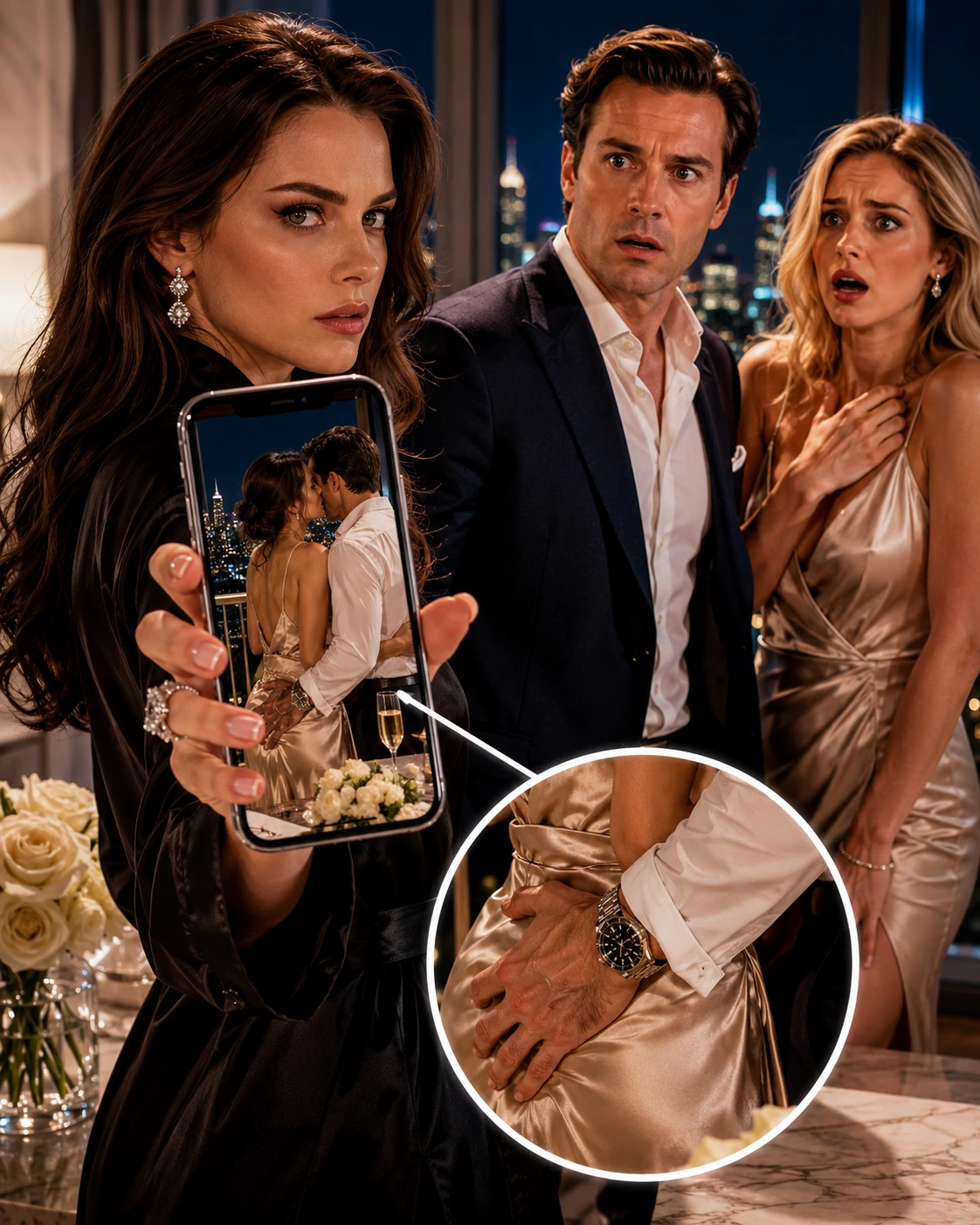
His mistress posted “one year with my love” on my wedding anniversary.
Not the week after. Not the day before. The exact date.
The date matched.
The man matched.
The betrayal matched.
My husband had spent our anniversary last year telling me he was stuck in traffic on the FDR, trapped behind a jackknifed truck, apologizing with that soft, tired voice he used when he wanted me to feel guilty for needing him.
I remembered sitting alone at a corner table in a candlelit restaurant in Midtown, watching the ice melt in two untouched martinis while the waiter kept pretending not to pity me.
And there it was now, twelve months later, glowing on my phone like a lit match in a room full of gasoline.
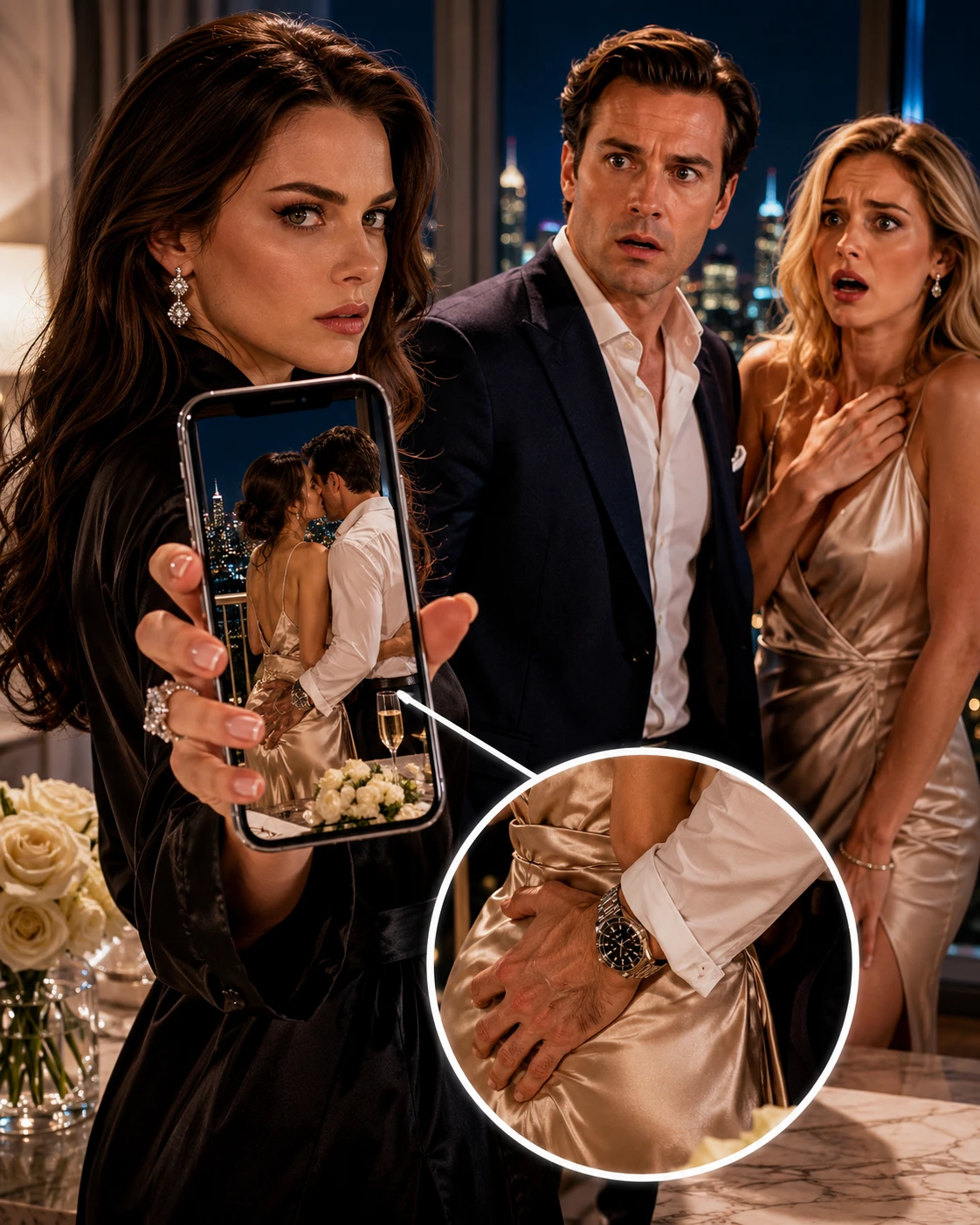
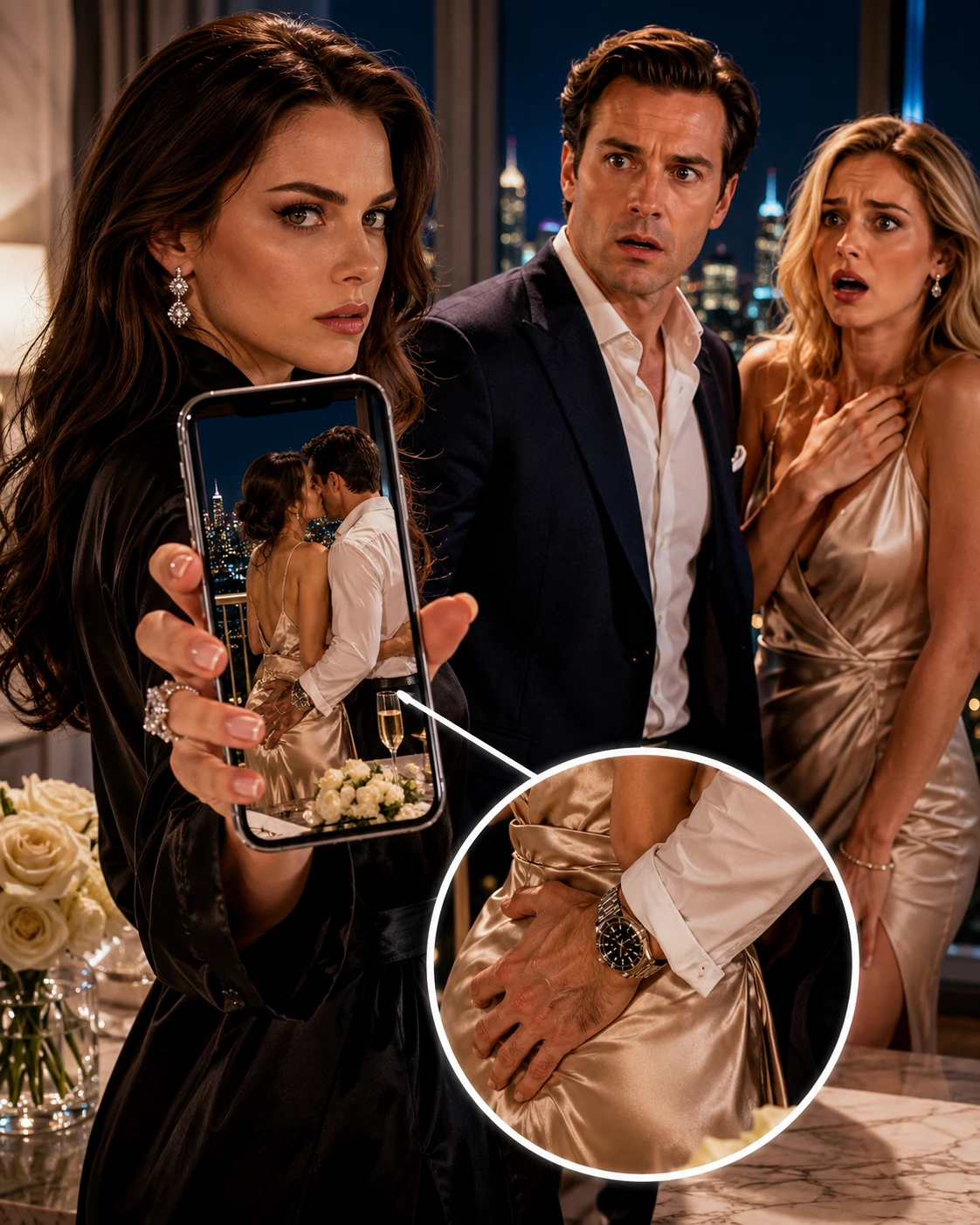
A photo of Sienna Blake in a champagne-colored silk dress, sitting on the balcony of a hotel suite I recognized immediately. Her red-soled heels rested on the lap of a man whose face was partly turned away.
But I knew that jaw.
I knew that watch.
I knew the scar across his thumb, the one he got opening a bottle of Bordeaux on our honeymoon in Napa.
The caption said:
“One year with my love. Some nights are too beautiful to share with the world, but too perfect to keep secret.”
I stared at the post until my hands stopped shaking.
Then I commented, “Happy anniversary to all three of us.”
CHAPTER 1: THE BALCONY PHOTO
For thirteen seconds, nothing happened.
The comment sat beneath Sienna’s post like a diamond dropped into a glass of poison.
Then the likes began.
One.
Five.
Twenty-seven.
A little red heart from my husband’s cousin in Connecticut.
A shocked-face emoji from someone named Brittany who sold luxury candles and had once called me “such an inspiration” at a charity luncheon.
Then came the first reply.
“Wait. Isn’t this Mrs. Whitaker?”
The second followed instantly.
“GIRL WHAT?”
The third: “Not on the WEDDING ANNIVERSARY.”
I set the phone down on the marble island and looked around my kitchen as if I had woken inside a stranger’s life.
Everything in our penthouse was perfect because perfection was the language Graham Whitaker understood. White orchids. Black granite. A Wolf range he had never used. Windows that looked down over Central Park as if the city existed only to decorate our loneliness.
Our marriage had been built like that kitchen: expensive, silent, and designed for people to admire from a distance.
Across the room, my anniversary roses sat in a crystal vase.
Three dozen white roses.
His assistant had chosen them. She always chose them. I knew because Graham had misspelled my name on the card once, and his assistant, Margaret, never made the same mistake twice.
To my darling Evelyn,
Five unforgettable years.
Forever yours,
G.
Forever.
Men like Graham loved words that cost nothing.
My phone vibrated again. And again. And again.
Sienna had deleted my comment.
I laughed.
Not loudly. Not hysterically. Just one small, cold laugh that sounded nothing like me.
Then she blocked me.
That was her second mistake.
Her first mistake had been posting from the balcony of Suite 1701 at The Marlowe Hotel.
My hotel.
Well, technically, the hotel belonged to Marlowe House International, a private hospitality group with luxury properties in New York, Aspen, Miami, Napa, and Palm Beach. On paper, I was not the owner. On paper, the controlling shares were held by Bellwether Holdings, a quiet investment entity with no social media presence, no glossy interviews, and no need to explain itself.
But Bellwether was mine.
It had been mine since I was twenty-seven and my mother, Beatrice Marlowe, decided I was old enough to inherit power but still young enough to learn what men did when they believed you had none.
Graham knew I came from money. Everyone in our circle knew that. But he thought my mother’s empire was locked away in trusts, guarded by lawyers, and mostly irrelevant to him.
He thought I was decorative old money.
A name.
A wife.
A woman who knew which fork to use and when to smile for a camera.
He did not know I had bought the debt on his company two years ago when Whitaker & Co. was one bad quarter away from collapse.
He did not know his biggest “anonymous investor” was the woman he came home to at night and lied to with Merlot on his breath.
He did not know the hotel suite where his mistress had posed in silk was under my private management account.
And he definitely did not know that the anniversary dinner he missed last year had not been the night I began to suspect him.
It had been the night I began to investigate.
My phone rang.
Graham.
I watched his name pulse across the screen.
Then I let it go to voicemail.
A text arrived immediately.
Evelyn. Call me.
Then another.
It is not what it looks like.
I picked up the phone and typed:
It looks like Suite 1701.
Three dots appeared.
Disappeared.
Appeared again.
Finally, he wrote:
Where are you?
That was such a Graham question. Not “Are you okay?” Not “I’m sorry.” Not even “Let me explain.”
Where are you?
Translation: How much control have I lost?
I carried my phone to the window and looked down at Fifth Avenue, where headlights slid through the winter rain like gold threads pulled through black velvet.
I typed:
Home. For now.
Then I opened my laptop.
My mother used to say a woman should never make a scene when she can make a record.
So I made a record.
First, I saved the screenshot of Sienna’s post.
Then I retrieved the suite booking from the Marlowe internal system. Suite 1701 had been reserved exactly one year ago under the name “G. Whitaker.” Payment method: Graham’s corporate card. Special request: champagne, gardenias, no staff entry after 8 p.m.
Gardenias.
My wedding flowers.
I sat very still.
There are betrayals that hurt because they are messy, impulsive, human.
And then there are betrayals that have been arranged.
Curated.
Lit from the perfect angle.
Graham had not simply forgotten our anniversary.
He had spent it recreating parts of our wedding night for another woman in one of my hotels.
My stomach turned, but my hands were steady now.
I opened a folder on my desktop labeled “Tax Documents.”
Inside was another folder labeled “Archive.”
Inside that was the truth.
Photos. Receipts. Flight records. Private dining invoices. Jewelry purchases. A Paris hotel charge during a “Boston investor summit.” A necklace from Cartier I had never seen, bought three days after Graham told me we needed to be “more mindful about liquidity.”
There was also a video from a security camera at The Marlowe’s private elevator bank.
Graham and Sienna, laughing.
His hand on the small of her back.
Her head tipped against his shoulder.
The timestamp: June 18, 10:43 p.m.
Our anniversary.
I watched it once.
Only once.
Then I closed the laptop and poured the untouched anniversary champagne down the sink.
The door opened at 11:17 p.m.
Graham walked in wearing his navy Tom Ford coat, his hair damp from rain, his expression arranged into concern. He had always been handsome in a dangerous way, all clean lines and dark eyes and that particular American confidence that gets mistaken for intelligence in boardrooms.
“Evelyn,” he said softly.
I looked at him over the rim of my empty glass.
He removed his gloves slowly. “You embarrassed me tonight.”
That was when I knew.
Not when I saw the post.
Not when I recognized the suite.
Not when I found the receipts.
I knew when the first thing my husband felt was not shame.
It was inconvenience.
“I embarrassed you?” I asked.
His jaw tightened. “You made a private matter public.”
“Sienna made it public.”
“She is young.”
“She is thirty-one.”
“She made a mistake.”
“So did you.”
He stepped toward me. “I can fix this.”
I almost smiled. “Can you?”
“Yes. But you need to stop reacting emotionally.”
There it was.
The oldest script in the world.
A man burns your house down, then tells you not to cough from the smoke.
I set the glass on the counter. “Tell me, Graham. Was traffic bad last year?”
A flicker crossed his face.
Tiny. Almost invisible.
But I had been married to him for five years. I knew the weather patterns of his lies.
“Evelyn—”
“Was the FDR backed up all the way to Suite 1701?”
He looked away.
That small movement felt better than a confession.
I walked past him toward the bedroom.
He followed. “Don’t do this.”
I stopped at the doorway. “Do what?”
“Become your mother.”
For the first time all night, he managed to wound me.
My mother was feared. Not loved. Admired. Not held. She built hotels that smelled like white lilies and money, but she had died in a hospital room with only me and a lawyer outside the door.
Graham knew I had spent my entire adult life trying not to become her.
He knew because I had trusted him with that fear.
Slowly, I turned around.
“Graham,” I said, “you should have been more afraid of me becoming myself.”
Then I locked the bedroom door.
CHAPTER 2: THE WOMAN IN THE MIRROR
By morning, the internet had done what the internet does best.
It had taken one spark and built a cathedral of fire.
Sienna’s deleted post had been screenshotted by at least fifty people. My comment had been cropped, enlarged, reposted, stitched, narrated over, and turned into a ten-second morality play with dramatic piano music.
TikTok found it.
Instagram found it.
Facebook found it and gave it a caption in all caps.
HIS MISTRESS POSTED THEIR ANNIVERSARY. THE WIFE’S COMMENT ENDED THEM.
By 9 a.m., a lifestyle blog had called me “the calmest wife in Manhattan.”
By 10 a.m., someone had identified Graham from the watch.
By 11 a.m., Sienna had unblocked me.
Her message was three lines.
You don’t know the whole story.
He said you were separated.
Please don’t ruin my life.
I stared at the words.
There was a time when I might have hated her cleanly.
It would have been easier.
But betrayal rarely comes with one villain. It comes with a cast of cowards, each one holding a candle and pretending they did not help start the fire.
I replied:
Then you should tell the truth before someone else does.
She did not answer.
At noon, Graham’s PR consultant called me.
I let it ring.
At 12:07, his attorney called.
I let it ring.
At 12:11, my attorney called.
I answered.
Julian Cross had been my lawyer for eight years and my friend for longer than either of us admitted out loud. He had silver threaded through black hair now, a voice like old whiskey, and the unfortunate habit of knowing what I needed before I said it.
“I saw it,” he said.
“Everyone saw it.”
“I’m sorry.”
“I don’t want sorry.”
“I know.”
He paused.
In that pause lived years of careful distance.
Julian had been there before Graham. Before the penthouse. Before the wedding announcement in Town & Country. He had been the first person to tell me that marrying Graham without a tighter infidelity clause was like leaving a Van Gogh in a frat house.
I had told him love required trust.
He had said, “No. Love requires honesty. Trust is what comes after.”
I hated how often he was right.
“Are you safe?” he asked.
“Yes.”
“Do you want the quiet route or the public route?”
I looked at the screenshots spread across my laptop screen.
A younger version of me would have chosen quiet.
Quiet was graceful. Quiet was respectable. Quiet preserved the illusion.
But quiet had been my prison for five years.
“I want the elegant route,” I said.
Julian exhaled. “That is the most terrifying sentence you’ve ever said to me.”
“Good.”
That afternoon, I dressed like a woman attending her own resurrection.
Black wool dress. Diamond studs. Hair pinned low. Red lipstick, not because I felt brave, but because sometimes the body must teach the soul how to stand.
When I entered the lobby of The Marlowe Hotel, conversation thinned around me.
The Marlowe was my mother’s masterpiece: a Beaux-Arts palace on Madison Avenue with gilded ceilings, hand-painted murals, and a chandelier rumored to have belonged to a railroad heiress who poisoned her second husband. The lobby smelled of bergamot, cedar, and money too old to explain itself.
Staff members straightened as I passed.
“Good afternoon, Ms. Marlowe,” said Daniel at the front desk.
Not Mrs. Whitaker.
Ms. Marlowe.
The name landed on me like armor.
I took the private elevator to the top floor, where Julian waited in the executive lounge with a leather folio and two coffees.
“You look dangerous,” he said.
“You look pleased.”
“I have always enjoyed competent revenge.”
“This is not revenge.”
“No?”
I sat across from him. “Revenge is emotional. This is housekeeping.”
For the first time in two days, Julian smiled.
We spent three hours going through the documents.
The prenuptial agreement.
The corporate investment agreements.
The Marlowe Hotel security logs.
The Whitaker & Co. debt restructuring.
The morality clause Graham had insisted on adding to our marriage contract because he believed a Marlowe scandal could damage his reputation.
Julian had laughed when Graham demanded it.
I had been insulted.
Now I understood the universe has a sense of humor. It just takes her time delivering the punchline.
“If we trigger the clause,” Julian said, “you walk away with the penthouse, your original assets, the voting shares, and damages.”
“What about his company?”
“You already control the debt.”
“I know that.”
“You can call it.”
“I know that too.”
Julian studied me. “That would destroy him.”
“No,” I said. “His choices destroyed him. I would just be notifying the bank.”
Outside, the sky over Manhattan bruised purple.
Julian closed the folio. “There’s another complication.”
I looked up.
“Sienna Blake is on the guest list for the Marlowe Foundation gala tomorrow night.”
My laugh this time was genuine.
“Of course she is.”
“She’s attending as Graham’s plus-one.”
There are moments so absurd they become holy.
I leaned back in my chair and looked at the ceiling, where gold leaf vines curled around painted angels.
“He is bringing his mistress to my mother’s foundation gala?”
“Yes.”
“After yesterday?”
“Apparently, his team thinks appearing confident will control the narrative.”
I pressed my fingers to my lips.
Graham was not stupid. That was what had made him dangerous. But he was arrogant, and arrogance is stupidity wearing a better suit.
“What is the gala theme?” I asked.
Julian’s eyes narrowed. “Evelyn.”
“The theme.”
“Legacy in Light.”
“Perfect.”
“No.”
“Yes.”
“You are thinking something theatrical.”
“I am thinking something truthful.”
“Those are often the same thing with you.”
I stood and walked to the window.
Below, the city shimmered in the winter dark. Somewhere down there, Sienna Blake was probably deciding whether to wear cream or gold. Graham was probably being told by three men in expensive watches that this would blow over.
They all thought a wife’s humiliation was an event.
They forgot humiliation could become evidence.
I turned back to Julian.
“Tomorrow night,” I said, “we let him arrive exactly as he planned.”
Julian’s expression shifted.
Lawyer to strategist.
Friend to something more dangerous.
“And then?”
“And then we remind everyone whose house they’re standing in.”
CHAPTER 3: THE GALA OF GLASS AND KNIVES
The Marlowe Foundation gala was the kind of night where women wore diamonds inherited from grandmothers who hated them, and men laughed too loudly beside ice sculptures shaped like swans.
Outside, photographers crowded beneath the hotel awning. Rain misted the red carpet, turning the pavement into black glass. Every flash made the night look briefly electric.
I watched from the mezzanine as guests arrived.
Senators.
Media heirs.
Wall Street men with second wives and first-wife money.
Influencers who had learned to say “philanthropy” with a straight face.
And then Graham stepped out of a black Escalade.
He looked perfect.
That was the cruelest part.
Navy tuxedo. White pocket square. Hair swept back. His wedding ring still on his finger, catching the flash like a tiny, shameless moon.
Sienna emerged beside him in a pale gold gown with a neckline too daring for a charity event and too deliberate to be accidental.
Around her throat was a Cartier necklace.
My breath stopped.
Not because I wanted it.
Because I recognized the design from the receipt in my archive.
Gardenia petals in diamonds.
He had bought his mistress jewelry shaped like my wedding flowers.
For a moment, the room went silent inside me.
Then Julian appeared at my side.
“Breathe,” he said quietly.
“I am.”
“No. You are preparing to commit murder with your eyes.”
“She’s wearing the necklace.”
“I know.”
“You knew?”
“I suspected.”
“And you didn’t warn me?”
“You needed your face when you saw it.”
I turned to him.
He looked entirely unapologetic.
“Remind me why I keep you around,” I said.
“Because I am useful in emergencies and tolerable in candlelight.”
Despite everything, something warm moved through me.
Below, Graham guided Sienna into the ballroom with a hand on her back.
Our guests noticed. Of course they did. Manhattan society could miss a tax shelter, but never a scandal in silk.
Whispers moved like wind through tall grass.
I descended the staircase slowly.
Not dramatically.
Not because I wanted all eyes on me.
Because in my mother’s hotel, the staircase had been designed for women to make entrances men would remember.
I wore black velvet, fitted at the waist, with long sleeves and no jewelry except my wedding ring. My hair fell loose over one shoulder. My lipstick was the color of a secret.
At the foot of the stairs, Graham saw me.
For one second, he forgot how to pretend.
His eyes widened.
Then he recovered and walked toward me, smiling the smile he used for investors.
“Evelyn.”
“Graham.”
He leaned in as if to kiss my cheek.
I turned my face slightly, offering him air.
The photographers caught it.
Sienna stood behind him, her smile fixed and glittering.
“Lovely necklace,” I said to her.
Her fingers flew to her throat.
“Thank you.”
“Gardenias suit you.”
Her face went pale beneath the contour.
Graham touched my elbow. “Can we speak privately?”
“No.”
His smile hardened. “Evelyn.”
“The silent-wife act worked better when I was silent.”
A nearby donor coughed into his champagne.
Sienna lifted her chin. “I think this is really between you and Graham.”
I looked at her then.
Really looked.
She was beautiful in the way expensive things are beautiful when someone else is paying. Smooth skin, honey hair, a mouth trained for cameras. But her eyes were frightened.
Not of me.
Of losing.
“No,” I said gently. “You made it between all three of us when you posted from my balcony.”
Her lips parted.
Around us, the room sharpened.
Graham lowered his voice. “Enough.”
That word.
Enough.
How many women had been trained to obey it?
Enough crying.
Enough questions.
Enough suspicion.
Enough making men uncomfortable with the consequences of their own behavior.
I smiled.
“You’re right,” I said. “It is enough.”
Dinner began at eight.
The ballroom glowed beneath a thousand candles. White roses climbed the columns. Crystal glasses caught the light and broke it into stars. At each place setting sat a card embossed with the Marlowe crest: a silver key beneath a crown.
Legacy in Light.
Graham and Sienna had been seated at Table Four.
Visible.
Respectable.
Strategic.
I had moved them to Table One.
Beside me.
When Graham saw the seating arrangement, his face tightened so quickly I nearly laughed.
“Evelyn,” he murmured, “what are you doing?”
“Hosting.”
Sienna sat down with the careful posture of a woman who knew every phone in the room might be pointed at her.
Throughout the first course, people pretended not to stare.
During the second, Sienna knocked over her water glass.
During the third, Graham drank too much Scotch.
By dessert, the ballroom had become a theater waiting for the curtain to rise.
I stood when the foundation chair announced my name.
Applause filled the room.
Warm. Polite. Curious.
I walked to the podium beneath the chandelier my mother had imported from Venice after outbidding a Saudi prince and a divorced movie star.
“Good evening,” I said.
The room settled.
“Every year, the Marlowe Foundation gathers to honor legacy. Usually, when we say legacy, we mean buildings. Institutions. Names carved into stone.”
I looked out at the sea of faces.
Graham sat motionless.
Sienna’s hand was wrapped around the stem of her wineglass.
“But legacy is not what we inherit,” I continued. “It is what we reveal under pressure.”
Phones lifted now.
I saw them.
Tiny black rectangles catching my reflection.
“My mother built this hotel after being told no bank would finance a woman with too much ambition and not enough husband. She opened these doors anyway. She taught me that elegance is not silence. Elegance is control.”
A murmur passed through the room.
I turned one page, though I did not need the notes.
“Tonight, before we announce our largest foundation gift in history, I want to correct a misunderstanding that has been circulating online.”
Graham’s face had gone gray.
Sienna whispered something to him.
He did not answer.
“Yesterday, a woman posted a photograph celebrating one year with my husband on the date of my wedding anniversary. Some of you saw my comment.”
Soft laughter. Nervous. Hungry.
“I wrote, ‘Happy anniversary to all three of us.’”
The room erupted.
Not loudly.
Society never roars at first. It gasps in diamonds.
I lifted one hand, and the room quieted.
“I was angry when I wrote it. I was humiliated. But I was also grateful.”
That confused them.
Good.
“Because the post reminded me of something I had forgotten. Truth does not need permission to enter a room. It only needs a door left carelessly open.”
Behind me, the screen lit up.
Not with the photo.
Not yet.
First came a slide showing the Marlowe Foundation’s new initiative: twenty-five million dollars toward housing for women rebuilding after financial abuse, coercive marriages, and public shaming.
The applause began slowly, then grew.
I waited.
“And tonight,” I said, “that gift will be made in my mother’s name.”
The slide changed again.
BEATRICE MARLOWE LEGACY FUND
Presented by Bellwether Holdings
A ripple moved through the room.
Everyone knew Bellwether.
No one knew Bellwether.
It was the ghost behind half the quiet acquisitions in New York hospitality and boutique retail. It appeared in business pages as “private capital.” It never gave interviews.
Graham looked up at me.
For the first time that evening, I saw true fear.
I smiled at him from the podium.
“For those who have asked,” I said, “Bellwether Holdings is not an institution. It is not a board of elderly men in navy suits. It is not a foreign fund.”
I paused.
“It is me.”
The room exploded.
Not with applause.
With shock.
With whispers.
With the sound of powerful people recalculating everything they thought they knew.
Graham stood halfway, then sat back down.
Sienna’s mouth opened.
The necklace at her throat trembled.
I continued, my voice calm.
“And as of this morning, Bellwether Holdings has exercised its rights regarding Whitaker & Co.’s outstanding debt obligations. A restructuring announcement will be made Monday.”
Graham’s chair scraped the floor.
“Evelyn,” he said loudly.
Every head turned.
He had broken the spell.
I tilted my head. “Yes, Graham?”
His face was flushed now. “This is not the place.”
I looked around the ballroom.
At the donors.
At the cameras.
At the mistress in diamonds bought with corporate funds.
At the husband who had mistaken my quiet for weakness.
“You’re standing in my hotel,” I said. “Wearing a tuxedo paid for by a company I saved. Beside a woman wearing jewelry charged to that same company while you told your wife you were trapped in traffic.”
Silence.
Pure.
Perfect.
Deadly.
Then someone at the back whispered, “Oh my God.”
The screen changed one final time.
A security still.
Graham and Sienna entering Suite 1701.
Timestamp: June 18, 10:43 p.m.
The ballroom inhaled as one body.
Sienna made a sound like glass cracking.
Graham stared at the image, then at me.
“You had me followed?”
“No,” I said. “You checked into my hotel.”
A laugh burst from somewhere near Table Seven and was quickly swallowed.
I looked at Sienna.
“This is not a punishment for loving the wrong man,” I said. “Women do that every day and survive. This is a consequence for helping him humiliate another woman and then asking me not to ruin your life after you helped decorate the lie.”
Her eyes filled.
For a second, I saw the girl beneath the gloss.
And because I refused to let Graham make me cruel, I added, “You should leave before the press reaches the lobby.”
She stood so quickly her chair nearly fell.
Graham reached for her wrist.
She pulled away.
That was the first honest thing she had done all night.
Then she walked out, one hand at her throat, the gardenia necklace burning under the chandeliers.
Graham remained.
Of course he did.
Men like him always think the room can still be won.
He buttoned his jacket and turned toward the guests.
“My wife is emotional,” he said.
Julian, seated near the front, closed his eyes as if in prayer.
I almost felt sorry for Graham then.
Almost.
The ballroom changed.
Not loudly.
Not visibly.
But the women felt it first.
The sentence was too familiar.
My wife is emotional.
A lifetime of dismissals packed into four words.
I leaned into the microphone.
“My husband is correct,” I said. “I am emotional. I loved him. I defended him. I protected his reputation while he spent our anniversary with another woman in a suite named after my mother.”
I removed my wedding ring.
The room went still.
“But I am also documented, liquid, and extremely well represented.”
Applause detonated.
This time, society forgot its manners.
Women stood first.
Then men whose wives were watching them.
Then everyone.
The sound rose to the painted ceiling, bright and violent and freeing.
Graham stood in the center of it like a man watching his own portrait being taken off a wall.
I placed the ring on the podium.
“Enjoy the dessert,” I said. “It’s gardenia cream.”
CHAPTER 4: THE MAN WHO THOUGHT HE OWNED THE ROOM
The video went viral before midnight.
Not a clip.
Not a rumor.
The whole speech.
Someone uploaded it with the caption:
SHE LET HIM BRING THE MISTRESS TO HER HOTEL AND THEN ENDED HIM IN FRONT OF EVERYBODY.
By morning, it had twelve million views.
By noon, twenty-three.
Women stitched it while putting on mascara. Men debated it on podcasts they swore were about finance. Facebook pages turned my ring on the podium into a meme. Reels used the line “documented, liquid, and extremely well represented” over videos of women walking away from bad dates, bad jobs, bad marriages, bad haircuts, bad everything.
I did not watch most of them.
The world’s applause is not the same as healing.
Still, I would be lying if I said it did not help.
Graham tried to come home the next day.
He found the locks changed, his belongings packed in custom garment boxes, and two security guards waiting beside the elevator.
I watched from the living room camera as he stared at the boxes.
His face looked older.
Not broken.
Exposed.
He called me seventeen times.
On the eighteenth, I answered.
“You can’t do this,” he said.
“I did.”
“This is my home.”
“No, Graham. It was our home. You made it evidence.”
He went quiet.
Then, softer, “I made mistakes.”
I closed my eyes.
There it was. The rebrand.
Not betrayal. Mistakes.
Not calculation. Confusion.
Not cruelty. Weakness.
“You recreated our wedding night with her,” I said.
His silence was the only honest answer he had left.
“Why?” I asked.
I had not planned to ask that question. It escaped before pride could stop it.
When he finally spoke, his voice was low.
“Because with her, I didn’t feel judged.”
I opened my eyes.
Outside, snow had begun falling over Central Park, softening the city’s hard edges.
“I never judged you for failing,” I said. “I judged you for lying.”
“You never needed me,” he said.
The old wound opened.
There it was, underneath all of it.
Not love.
Not lust.
Resentment.
Graham had not cheated because Sienna was irresistible. He had cheated because my strength made him feel small, and instead of growing, he found someone who would kneel beside his ego and call it a throne.
“I wanted you,” I said. “That was more intimate than needing you.”
He breathed into the phone.
For a moment, I remembered him in Napa, laughing with wine on his shirt. I remembered the man who kissed my wrist during our first dance and whispered, “I can’t believe you’re real.”
Maybe he had meant it then.
Maybe that was the saddest part.
“Evelyn,” he said, “please. We can rebuild.”
“No.”
“One word?”
“That’s all a locked door needs.”
I hung up.
The divorce filing landed Monday morning.
So did the restructuring announcement.
Whitaker & Co. did not collapse. That would have hurt too many employees who had done nothing wrong except trust the wrong man’s signature.
Instead, Bellwether converted debt to equity, removed Graham as CEO, appointed an interim board, and preserved the company under new leadership.
That was the difference between revenge and power.
Revenge burns the house down.
Power changes the locks, audits the books, and keeps the staff paid.
Sienna returned the necklace through a courier.
No note.
Just the Cartier box, the diamonds arranged like frozen flowers.
I donated it to the foundation auction.
It sold for three times its estimate to a woman from Dallas who had divorced an oil executive and said, “Honey, I’m buying this for the symbolism.”
Two weeks later, I received a message from Sienna.
I almost deleted it.
Then I opened it.
I’m sorry.
He told me you were cold. That you had an arrangement. That you cared more about status than him.
I wanted to believe him because it made me feel chosen.
I know that doesn’t excuse anything.
I’m leaving New York for a while.
For what it’s worth, your speech made me look at my life.
I don’t want to be someone’s secret anymore.
I read it twice.
Then I wrote back:
Then don’t be.
It was not forgiveness.
Not yet.
But it was a door neither of us had to walk through.
A month after the gala, Julian took me to dinner at a small Italian restaurant in the West Village where the tables were too close together and the pasta was better than anything served beneath a chandelier.
I arrived late because a foundation meeting ran over.
He stood when I entered.
No one had stood for me in a way that felt sincere in years.
“You don’t have to do that,” I said.
“I know.”
He pulled out my chair anyway.
We ordered red wine and cacio e pepe. Outside, the city moved in wet silver and taxi-light gold. Inside, candlelight softened his face.
For a while, we spoke of safe things.
Work.
The foundation.
A ridiculous article that described me as “America’s most elegant avenger.”
Then the silence changed.
Not awkward.
Aware.
Julian set down his glass. “I need to tell you something before the world tells you for me.”
My body went cold out of habit.
“What?”
“The night before your wedding, your mother asked me to stop it.”
I stared at him.
“What?”
“She knew Graham was wrong for you.”
“My mother thought everyone was wrong for me.”
“She thought he wanted proximity to power more than partnership.”
“Why didn’t you tell me?”
“I did. Not in those words. You didn’t want to hear it.”
That was true.
Painful, but true.
I had been in love with the idea of being loved without being managed, advised, protected, or studied like a fragile acquisition.
“And you?” I asked.
He looked at me then, directly.
“I loved you enough to let you choose.”
The restaurant noise faded.
There are confessions that demand immediate answers.
This one did not.
This one sat between us like a candle.
Dangerous. Warm. Alive.
“Julian,” I said softly.
“I’m not asking for anything tonight,” he said. “I’m not Graham. I don’t want to be another man standing in the middle of your life with a claim.”
My throat tightened.
“What do you want?”
He smiled, but there was sadness in it.
“To sit across from you while you become happy without needing permission.”
It was unfair, how much that undid me.
I looked down at my hands.
No wedding ring.
No pale line anymore.
Just skin.
Just me.
“Then sit,” I said.
And he did.
CHAPTER 5: THE WIFE WHO WALKED OUT WITH THE KEYS
Spring came late that year.
New York thawed reluctantly, as if the city did not trust warmth.
By April, the trees along Fifth Avenue were flowering, and The Marlowe’s lobby smelled like lilacs instead of cedar. The foundation offices moved into the hotel’s old private club, a room my mother had once reserved for billionaires who disliked being overheard.
Now it held women with legal folders, toddlers, bruised credit scores, new jobs, old fears, and the kind of courage that does not photograph well because it happens in small rooms under fluorescent lights.
I spent more time there than anywhere else.
Not because I was noble.
Because I understood the cost of silence now.
One afternoon, a woman named Marisol sat across from me with a paper cup of coffee trembling in her hands.
“He never hit me,” she said, as if apologizing for needing help. “He just controlled everything. The cards. The car. My phone. My clothes. He made everyone think I was crazy.”
I thought of Graham saying, My wife is emotional.
I thought of all the rooms where women had been rewritten by men who feared the first draft.
“You don’t have to prove the wound is deep enough,” I told her. “You only have to decide you’re done bleeding.”
She cried then.
So did I, later, in the elevator.
Healing, I learned, was not a dramatic staircase entrance.
It was not applause.
It was not a viral clip.
Healing was taking the same story that once humiliated you and using it to build a door for someone else.
Graham’s downfall was quieter than people expected.
That disappointed the internet.
They wanted ruin with thunder.
But real consequences are often administrative.
He lost the company board. Then the penthouse. Then the circles where his charm had once passed for currency. Men who had toasted him stopped returning calls. Women who had smiled through dinner beside him stopped pretending not to know.
His final settlement was generous enough to keep him comfortable and strict enough to keep him irrelevant.
He moved to Miami.
Then, reportedly, Austin.
Then someone saw him at a restaurant in Scottsdale with a woman young enough to believe his version of events.
I wished her clarity.
That was all.
Sienna resurfaced six months later with brown hair, a new last name in her bio, and a job at a nonprofit in Chicago. She never mentioned Graham publicly. She never mentioned me. Once, she donated anonymously to the foundation.
I knew because the amount was $1,701.
Suite 1701.
I did not contact her.
But I kept the donation.
Julian and I moved slowly.
So slowly that my friends complained.
So slowly that gossip accounts lost interest.
So slowly that when he first kissed me, it was not beneath a chandelier or in a dramatic rainstorm, but outside a bookstore on Bleecker Street after I had spent twenty minutes arguing that no one needed six editions of the same Joan Didion book.
He kissed me like a question.
I answered like a woman who had finally learned she did not owe certainty to anyone.
We did not become a headline.
We became dinner on Thursdays.
Walks without photographers.
Coffee gone cold because we talked too long.
His hand on my back, never steering, only there.
Once, months later, he brought me gardenias.
He realized the mistake the second I opened the door.
His face changed. “Damn it. I’m sorry.”
I looked at the flowers.
White petals.
Soft scent.
A memory Graham had tried to steal.
I took them from Julian’s hands and placed them in water.
“No,” I said. “I’m taking them back.”
That night, I posted a photo for the first time since the gala.
Not of Julian.
Not of diamonds.
Not of revenge.
A simple vase of gardenias on my kitchen table, morning light touching the petals.
The caption read:
Some flowers survive the wrong hands.
It went viral too.
But this time, I did not read the comments.
I was too busy living.
CONCLUSION: WHAT THE TRUTH LEFT BEHIND
People still ask me what it felt like to humiliate my husband in front of everyone.
They expect me to say it felt powerful.
It did, for a moment.
Power can be intoxicating when you have spent years swallowing your own voice.
But the truth is, public revenge is only the doorway.
The real victory happens afterward, in the quiet.
It happens when you wake up alone and the silence feels peaceful instead of abandoned.
It happens when you sign your own name and remember it was always enough.
It happens when the restaurant hostess says “table for one?” and you smile because one is not a tragedy.
It happens when you stop asking why he chose her and start asking why you tolerated so little.
I used to think betrayal destroyed the woman who discovered it.
I was wrong.
Betrayal destroys the illusion.
And sometimes, beneath the illusion, there is a woman waiting with keys in her hand.
A woman with her mother’s courage, her own money, a better lawyer, and a heart still soft enough to love again.
Sienna posted the date.
I posted the truth.
But the truth did more than expose my husband.
It introduced me to myself.
And that was the anniversary worth celebrating.