
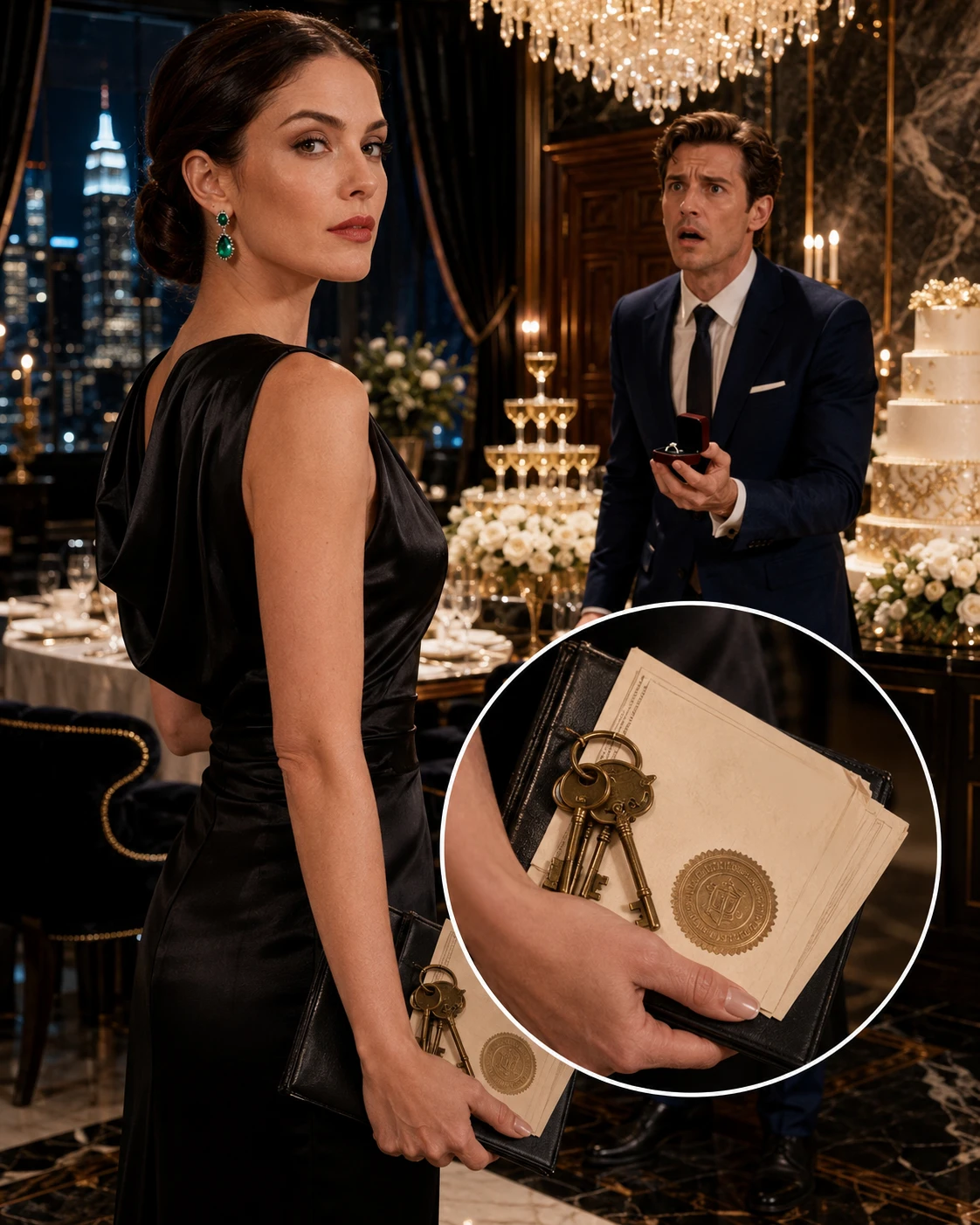
My husband threw his mistress’s birthday party at the restaurant I owned.
Not the restaurant I liked. Not the restaurant I had once mentioned over coffee. The restaurant I owned—every marble table, every black velvet booth, every brass sconce glowing like melted gold against the walls.
Preston thought I was just an investor.
A quiet one. A decorative one. A wife with a trust fund and a signature he could borrow when it made him look richer.
He didn’t know that at 9:14 that morning, the final transfer had cleared. The last shares, the liquor license, the kitchen equipment, the reservation system, the deed to the old limestone building on West 21st Street—all of it had moved into my name.
By noon, Aurelia was mine.
By seven, my husband arrived with Savannah Blake on his arm.
She wore silver satin, a diamond bracelet I recognized because the receipt was sitting in my divorce folder, and the kind of smile women wear when they think another woman’s life is already ruined.
She ordered champagne, flowers, and a cake bigger than her shame.
I watched from the manager’s office until they sang.
And when Preston lifted his glass and called her “the future Mrs. Hayes,” I finally stepped out from behind the glass.
Then I walked out and canceled the private room.
Chapter 1: The Reservation Under His Name
The reservation came in three weeks before the party, under my husband’s name.
PRESTON HAYES. PARTY OF 22. PRIVATE SALON. 7:30 P.M. SPECIAL REQUESTS: BLACK ROSES, WHITE PEONIES, CHAMPAGNE TOWER, CUSTOM CAKE. MAKE IT UNFORGETTABLE.
Aurelia’s reservation manager, Tessa, printed it out and brought it to my office with both hands, as if she were carrying a sleeping animal that might wake up and bite.
“Mara,” she said carefully, “you should see this.”
At the time, I was sitting behind a walnut desk that had belonged to the restaurant’s original owner, a woman named Francesca Bellini who had built Aurelia in the eighties when women still had to laugh politely at men who asked if they were there to meet the real boss. The office had no windows, only a wall of security monitors, shelves of old wine ledgers, and one small lamp with a green glass shade that made everything look like a secret.
I took the paper from Tessa.
The first thing I noticed was Preston’s name.
The second thing I noticed was the deposit. Ten thousand dollars, paid from Hayes Development Group.
The third thing I noticed was the cake inscription.
HAPPY BIRTHDAY, SAVANNAH.
TO THE WOMAN WHO MADE ME BELIEVE IN FOREVER.
For a moment, all I heard was the low hum of the monitor wall and the muffled rhythm of knives on cutting boards from the kitchen beyond the hall.
Tessa stood perfectly still.
I had trained my staff well. They knew when to be invisible, when to be gracious, and when to keep their faces blank even if the Titanic sailed directly into the dining room wearing a tuxedo.
I read the reservation twice.
Then I folded it once, very slowly, and placed it on my desk.
“Approve it,” I said.
Tessa’s eyes widened.
“Mara.”
“I said approve it.”
Her mouth opened, then closed. She looked at me the way a loyal person looks at someone walking toward a cliff.
“Are you sure?”
I smiled then, but there was no warmth in it.
“Very.”
That was the first time I understood revenge did not always arrive as fire.
Sometimes it wore pearl earrings, signed documents before breakfast, and let a man humiliate himself under a chandelier he did not own.
I had known about Savannah for four months.
Not because Preston confessed. Men like Preston did not confess. They curated reality. They edited themselves until the truth looked like an inconvenience other people had invented.
I found out because of a hotel receipt tucked into the inside pocket of a charcoal Tom Ford suit he had asked me to send to the cleaners.
The hotel was in Miami.
Preston told me he had been in Dallas.
The room had been booked for two. Champagne. Spa services. Breakfast on the balcony. A late checkout. A private car to the airport.
There was also a charge from a boutique called Maribel & Co.
$18,600.
Diamond tennis bracelet.
I knew immediately it wasn’t mine because Preston had stopped buying me jewelry two years into our marriage. At first, he said I was “too practical for sparkle.” Later, when he got crueler, he said I didn’t “carry luxury naturally.”
That was one of Preston’s favorite little knives.
He never screamed. He rarely cursed. He preferred smaller injuries.
A glance at my shoes before a charity gala.
A joke at dinner about how I “still thought a good night meant takeout and a spreadsheet.”
A hand on my lower back in public that looked tender but pressed just hard enough to steer me out of conversations with important people.
“You don’t need to bother with them, Mara,” he would murmur, smiling for everyone else. “They’re talking business.”
Business.
As if I had not doubled the operating profit of his company during the first three years of our marriage by rebuilding the mess he called a finance department.
As if my grandmother had not taught me to read balance sheets before most girls were allowed to wear mascara.
As if Aurelia itself had not survived because I quietly paid vendors, replaced bad managers, and convinced Francesca Bellini not to sell to a hotel chain that wanted to gut the place and turn it into a lobby bar with overpriced olives.
For years, Preston told people I “helped out” at the restaurant.
He liked the story that way. It made him sound generous.
“My wife has a little hospitality hobby,” he once said at a dinner in Tribeca, his hand resting on my shoulder like I was a vase he had purchased. “Keeps her busy.”
Everyone laughed.
I did too.
That was the part I regretted most.
Not the marriage. Not even the betrayal.
The laughter.
The way I had trained my own mouth to make other people comfortable while my pride sat bleeding in my lap.
But by the time Savannah’s birthday reservation appeared in my office, I was no longer that woman.
I had hired Claire Donovan, the most terrifying divorce attorney on Park Avenue.
I had hired a forensic accountant in Boston who spoke softly and found hidden money like a bloodhound.
I had contacted Francesca’s estate attorney and pushed forward the ownership transfer Preston thought would take another quarter to settle.
And I had stopped asking myself why he had done it.
That question is a trap.
People can only disrespect you as deeply as they believe you will remain.
Preston believed I would remain forever.
That was his mistake.
Chapter 2: Champagne, Roses, and a Woman Who Thought She Won
The night of Savannah Blake’s birthday, New York was wet and glittering.
Rain slid down the windows of Aurelia in silver threads, turning West 21st Street into a black mirror of headlights and umbrellas. Inside, the restaurant glowed like a jewel box built for dangerous conversations.
Aurelia was not loud luxury. It did not shout.
It whispered.
The dining room was all shadowed velvet, smoked mirrors, old Italian marble, and candles reflected in polished brass. The ceiling was hand-painted with dark blue clouds and tiny gold stars, a secret sky above people who came to spend too much money pretending they had not lost anything important.
The private salon sat behind a pair of carved walnut doors at the back of the restaurant. It had its own bar, its own fireplace, its own courtyard entrance for guests who liked to arrive unseen.
Preston loved that room.
He had taken investors there. Politicians. Men whose names appeared in Forbes and court documents with equal frequency.
He used to tell me, “A place like Aurelia makes people feel richer than they are. That’s power.”
He was right.
He just didn’t know whose power it was.
At 7:22, he arrived.
I watched him on the security monitor from the manager’s office, one hand wrapped around a glass of water I had not touched.
Preston Hayes looked expensive in the way some men look expensive because they have spent years treating other people as accessories.
Navy suit. White shirt. No tie. Hair dark and brushed back. A watch worth more than Tessa’s annual salary. He walked into Aurelia like the room had been waiting to belong to him.
Savannah Blake entered beside him.
She was twenty-seven, blonde in the deliberate way of money, with soft waves falling over bare shoulders and a silver satin dress that caught the light like a blade. Her lips were glossy. Her smile was practiced. She held Preston’s arm with both hands, not like a lover, but like a woman gripping a trophy before someone could take it back.
Behind them came their guests.
Influencers. Brokers. Two of Preston’s partners. A lifestyle photographer. Savannah’s sister. A man I recognized from Hayes Development’s legal team. Three women in tiny black dresses who immediately began filming the champagne tower near the bar.
Savannah gasped when she saw the flowers.
“Oh my God, Preston.”
Her voice floated through the office speaker, sweet and sharp.
The private salon had been dressed exactly as requested. Black roses in low crystal bowls. White peonies spilling from tall vases. Candles everywhere. Gold-rimmed plates. Menus printed on thick cream paper with Savannah’s name at the top in calligraphy.
Preston kissed her temple.
“Only the best for you.”
I almost laughed.
Only the best, paid for with a corporate card, inside his wife’s restaurant, under a roof his wife now owned.
The staff moved around them with flawless grace.
Marcus Reed, Aurelia’s general manager, wore a black suit and an expression carved from stone. He had been with the restaurant for twelve years and had seen enough bad husbands to qualify as an anthropologist.
He stepped into the salon and greeted Preston.
“Mr. Hayes. Welcome back.”
Preston barely looked at him.
“Marcus. Everything ready?”
“Of course.”
Savannah lifted her chin.
“The cake is coming later, right? I don’t want it brought out too early. And the champagne should be poured when I give you the signal.”
“Certainly, Ms. Blake.”
She smiled like a queen addressing a footman.
“And make sure the lighting stays low. I look better in warm light.”
From the office, Tessa muttered, “You look better with a filter and a soul.”
I turned and looked at her.
She straightened. “Sorry.”
“No,” I said. “You’re not.”
By eight o’clock, the party was roaring.
Not loudly enough to disturb the main dining room, because Aurelia’s walls were thick and its staff skilled, but enough that the microphones picked up laughter, glasses clinking, Savannah squealing every time another gift appeared.
A Cartier box.
A Hermès bag.
A pair of diamond earrings from Preston’s partner, who looked like he would rather be audited than attend the party.
Then the bracelet appeared.
The Miami bracelet.
Preston lifted it from a velvet case while everyone leaned in.
Savannah covered her mouth.
“Oh, baby.”
Baby.
My husband, who had not called me anything but “Mara” for three years unless people were watching.
He fastened the bracelet around her wrist. The diamonds flashed under the chandelier.
“Perfect,” he said.
Savannah turned her hand this way and that. “It’s even prettier than the one you said she never wore.”
The room laughed.
My stomach went cold.
Preston’s smile twitched, just slightly. Not guilt. Irritation. He did not like when women spoke lines he had not approved.
Savannah did not notice.
She leaned back in her chair, drunk on attention.
“I’m sorry,” she said, lifting her champagne. “I know I shouldn’t say this, but some women get everything and still don’t know what to do with it.”
One of her friends giggled. “Sav.”
“No, really.” Savannah’s voice grew brighter, crueler. “Imagine being married to Preston Hayes and spending your nights counting restaurant receipts.”
More laughter.
I looked down at my hands.
They were steady.
That surprised me.
There had been a time when that sentence would have broken something inside me. I would have gone home, locked myself in a bathroom, and stared at my reflection wondering what I lacked.
Beauty? Softness? Glamour? The ability to be adored without needing to be respected?
But grief has a temperature, and mine had cooled into something harder.
On the monitor, Preston reached for his glass.
“Let’s not talk about Mara tonight.”
For one ridiculous second, I thought he might defend me.
Then he smiled at Savannah.
“This is your night.”
That was all.
Not “Don’t disrespect my wife.”
Not “Enough.”
Just this is your night.
The words settled over me like the final signature on a contract.
At 8:47, Claire Donovan texted me.
TRANSFER RECORDED. YOU ARE THE SOLE OWNER. DEED FILED. LIQUOR LICENSE UPDATE CONFIRMED. RESTAURANT, BRAND, AND BUILDING ARE CLEAN.
A second text followed.
DIVORCE PETITION READY WHEN YOU ARE.
I stared at the screen.
Clean.
Such a small word for so much blood.
I looked back at the monitor just as Savannah stood, waving at someone near the doors.
“Is it time?”
Preston checked his watch and nodded at Marcus.
“Bring out the cake.”
Tessa glanced at me.
I rose from my chair.
Chapter 3: The Birthday Toast That Buried Him
The cake was obscene.
There was no better word for it.
Three tiers of champagne sponge, strawberry cream, edible gold leaf, and sugar flowers so realistic they looked stolen from a garden in heaven. It rolled into the private salon on a brass cart, pushed by two servers whose faces revealed nothing.
Across the front, written in black icing on a white fondant ribbon, were the words Savannah had requested.
HAPPY BIRTHDAY TO THE FUTURE MRS. HAYES.
For the first time all night, Preston looked uneasy.
Good.
He had ordered the sentiment, but seeing it written in icing made the lie harder to hide from himself.
The guests erupted.
Phones went up.
Savannah pressed both hands to her chest and turned toward the cameras as if she had rehearsed the moment in a mirror.
“Oh my God,” she whispered.
Preston stood beside her.
The candles glowed. The diamonds flashed. The champagne tower sparkled in the corner like a monument to bad decisions.
Then everyone began to sing.
Happy birthday to you.
Happy birthday to you.
Happy birthday, dear Savannah.
Happy birthday to you.
I stood in the hallway outside the private salon, one hand resting on the carved walnut door.
Marcus stood beside me.
“You don’t have to do this in front of them,” he said quietly.
I looked at him.
Marcus had seen me cry once, two years ago, in the walk-in refrigerator after Preston forgot our anniversary and then accused me of being “emotionally dramatic” because I had already booked a table for two at our own restaurant.
Marcus had found me between crates of lemons and a case of Burgundy, mascara running down my face, trying to breathe quietly so the line cooks wouldn’t hear.
He had not touched me. He had not pitied me.
He had simply said, “You are allowed to want tenderness.”
I had hated him for that, briefly.
Only because it was true.
Now his face was calm, but his jaw was tight.
“I know,” I said.
“You could send security.”
“I could.”
“You could let Claire handle it tomorrow.”
“I could.”
Savannah blew out her candles.
The room cheered.
Preston lifted a hand for silence.
My fingers tightened on the door.
“No,” I said softly. “He chose the room. He chose the audience. He chose the cake.”
Marcus nodded once.
Preston began his toast.
“Savannah,” he said, voice rich and warm, the voice that had convinced banks to extend credit and women to ignore instinct, “you came into my life when I had forgotten what it felt like to be alive.”
Someone sighed.
I felt nothing.
That was how I knew I was free.
“You saw me,” he continued, “not as a name, not as a paycheck, not as someone trapped in obligations, but as a man.”
A man.
Men like Preston always became poets when they needed an excuse for selfishness.
Savannah wiped a tear from beneath one eye, careful not to disturb her makeup.
Preston reached into his jacket.
The room held its breath.
He pulled out a small blue velvet box.
My heart did not break.
It yawned.
“Savannah Blake,” he said, “this city has watched me build towers, close deals, and make promises. But tonight, in front of the people who matter to us, I want to make the only promise that matters.”
He opened the box.
A ring caught the candlelight.
A ring I had never seen before.
Large. Oval. Cold as ice.
Someone whispered, “Oh my God.”
Savannah began to cry in earnest.
Preston smiled.
“I know there are details to handle,” he said, and the room laughed because rich people loved calling destruction “details.” “But my marriage has been over for a long time.”
That was news to me.
Legally, emotionally, financially—Preston and I had been married that morning.
He continued.
“And when the dust settles, I want you beside me. Not hidden. Not waiting. Not apologizing.”
Savannah nodded, trembling.
“And as part of your birthday,” he added, turning slightly toward the cake, toward the cameras, toward everyone watching, “I have one more surprise. I know how much you love this restaurant.”
A strange silence fell in the office hallway.
Marcus looked at me.
My blood slowed.
Preston smiled wider.
“So I made an offer.”
Savannah froze.
He laughed softly, pleased with himself.
“Not just for dinner. Not just for tonight. I’m buying Aurelia.”
A gasp moved through the room like wind.
Savannah clapped both hands over her mouth.
“What?”
“I wanted you to have a place of your own,” Preston said. “Something beautiful. Something worthy of you.”
I almost admired the performance.
Almost.
Because there it was.
The final arrogance.
He had not only brought his mistress into my restaurant. He had not only let her mock me beneath my own roof. He had planned to present my life’s work as a birthday gift.
Not because he owned it.
Because he assumed he could.
Savannah threw her arms around him.
The guests exploded.
Phones rose higher.
Someone shouted, “Power couple!”
Someone else said, “Mrs. Hayes is going to die.”
And that, more than the ring, more than the cake, more than the bracelet, opened the last locked door inside me.
Because I realized they were not embarrassed for me.
They were excited to watch.
Preston kissed Savannah in front of the cake that called her his future wife.
The room applauded.
And I opened the doors.
Chapter 4: When the Owner Walked In
The sound changed first.
That is what I remember most.
Not the faces. Not Savannah’s hand still resting on Preston’s chest. Not the ring box in his palm.
The sound.
Applause thinning into confusion. Laughter dying one voice at a time. Phones turning slowly in my direction. The small hush of people recognizing a woman before they understood what she represented.
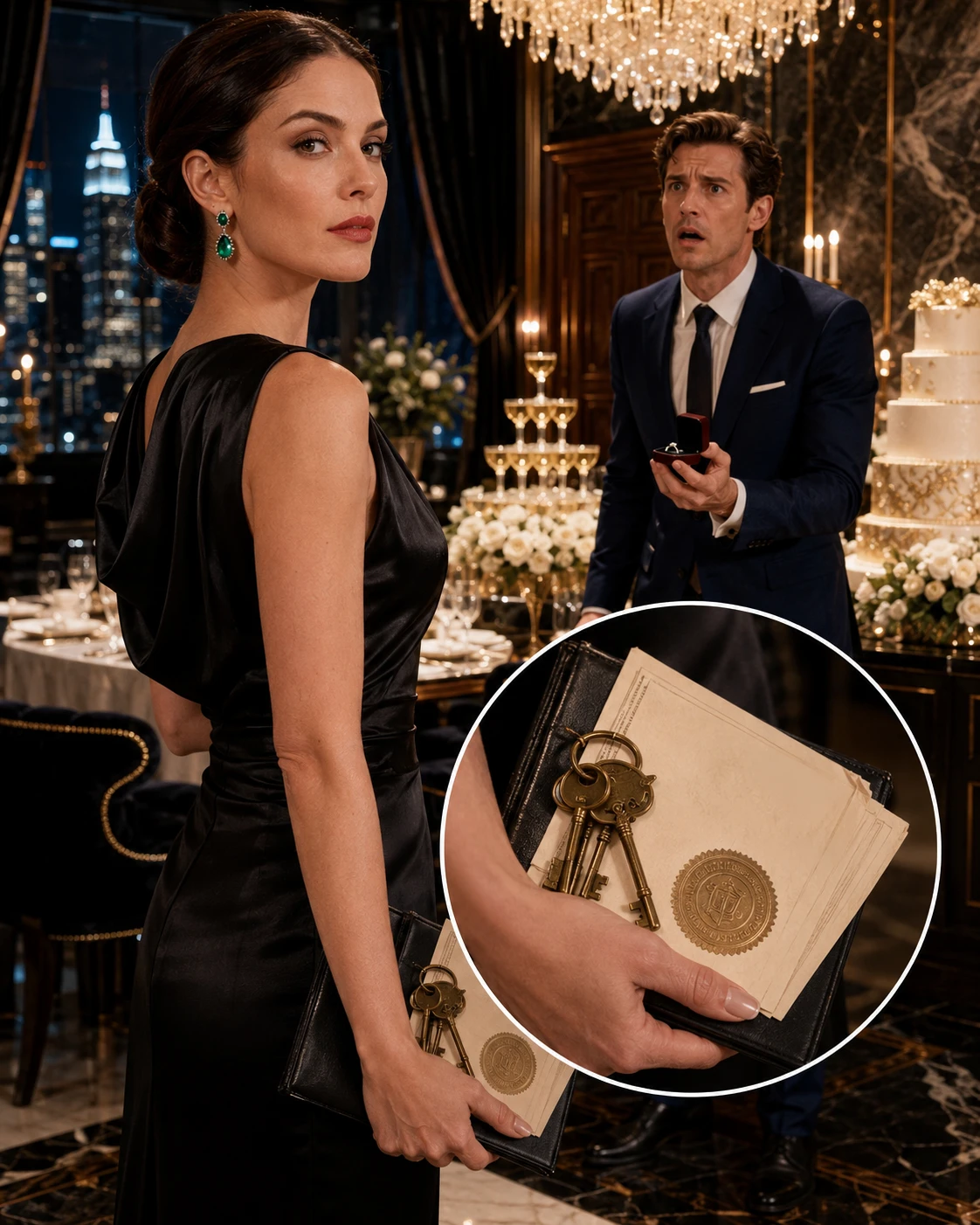
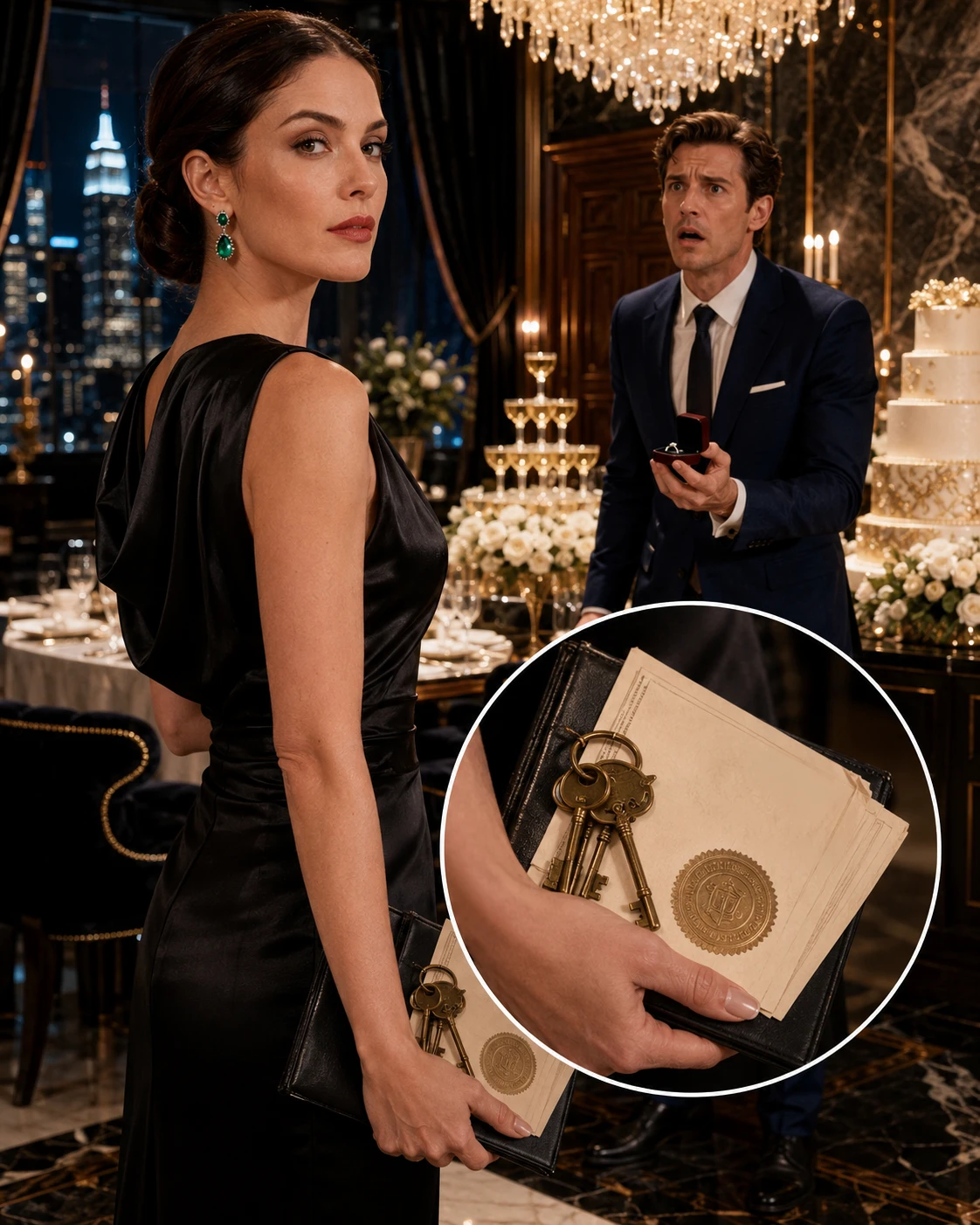
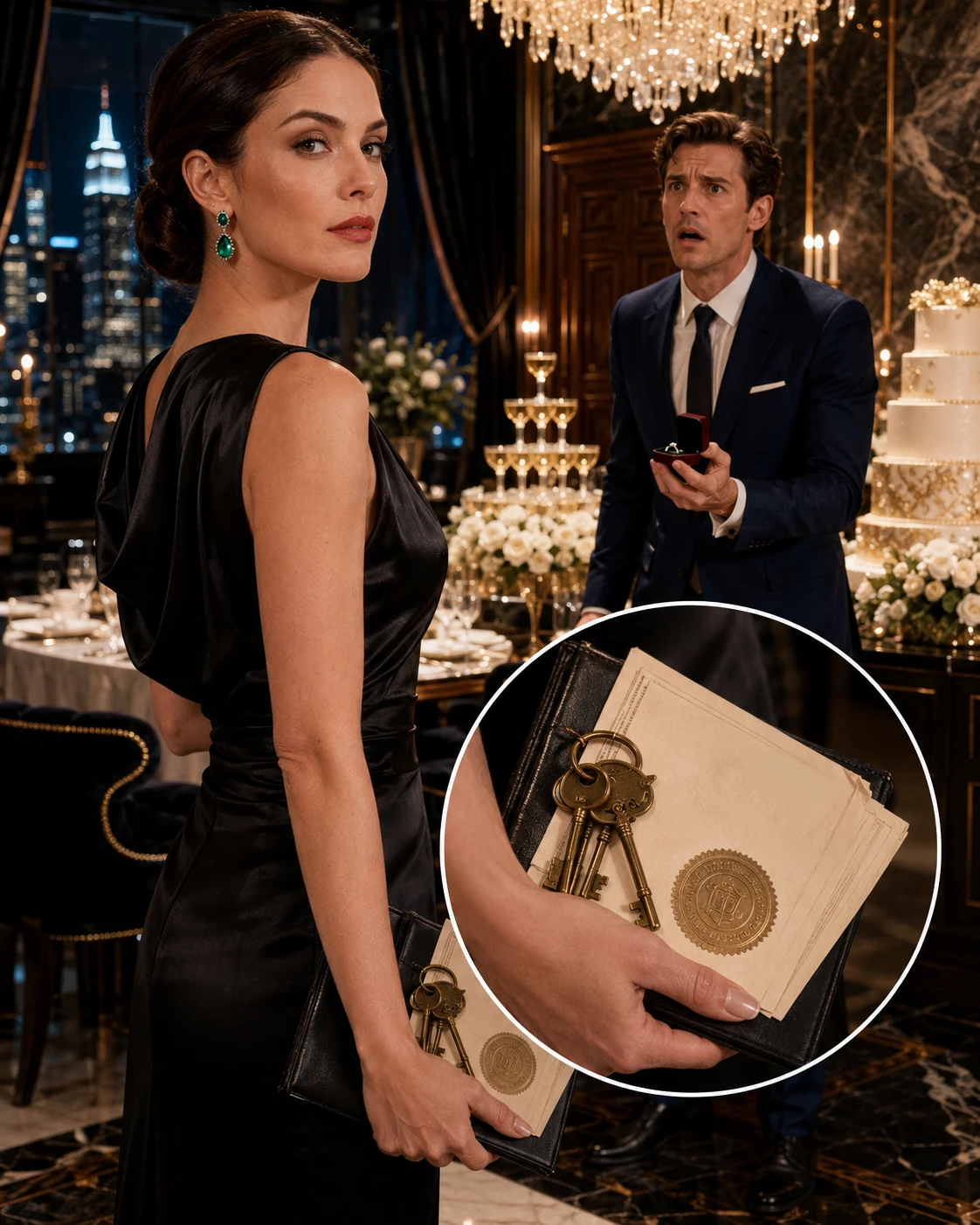
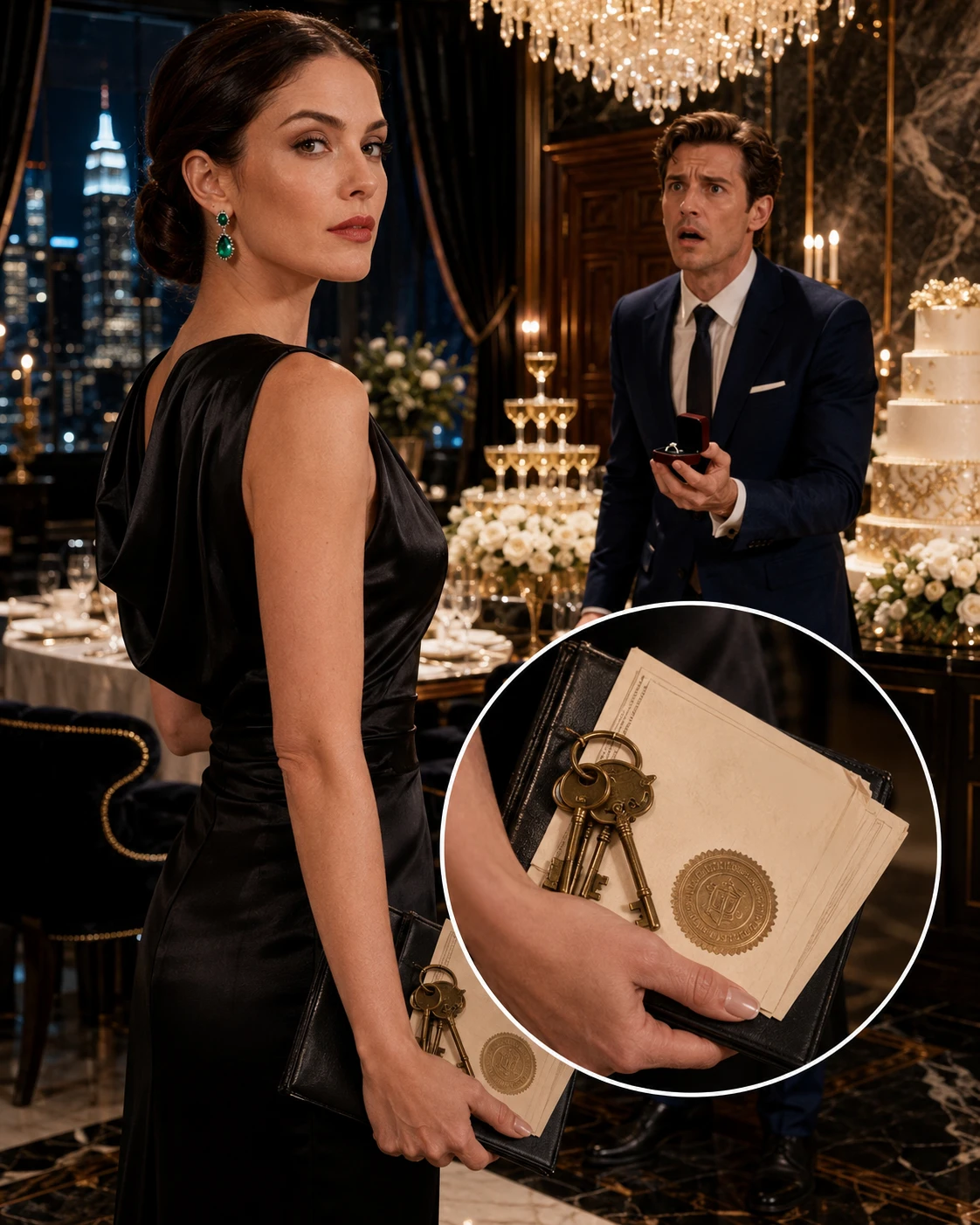
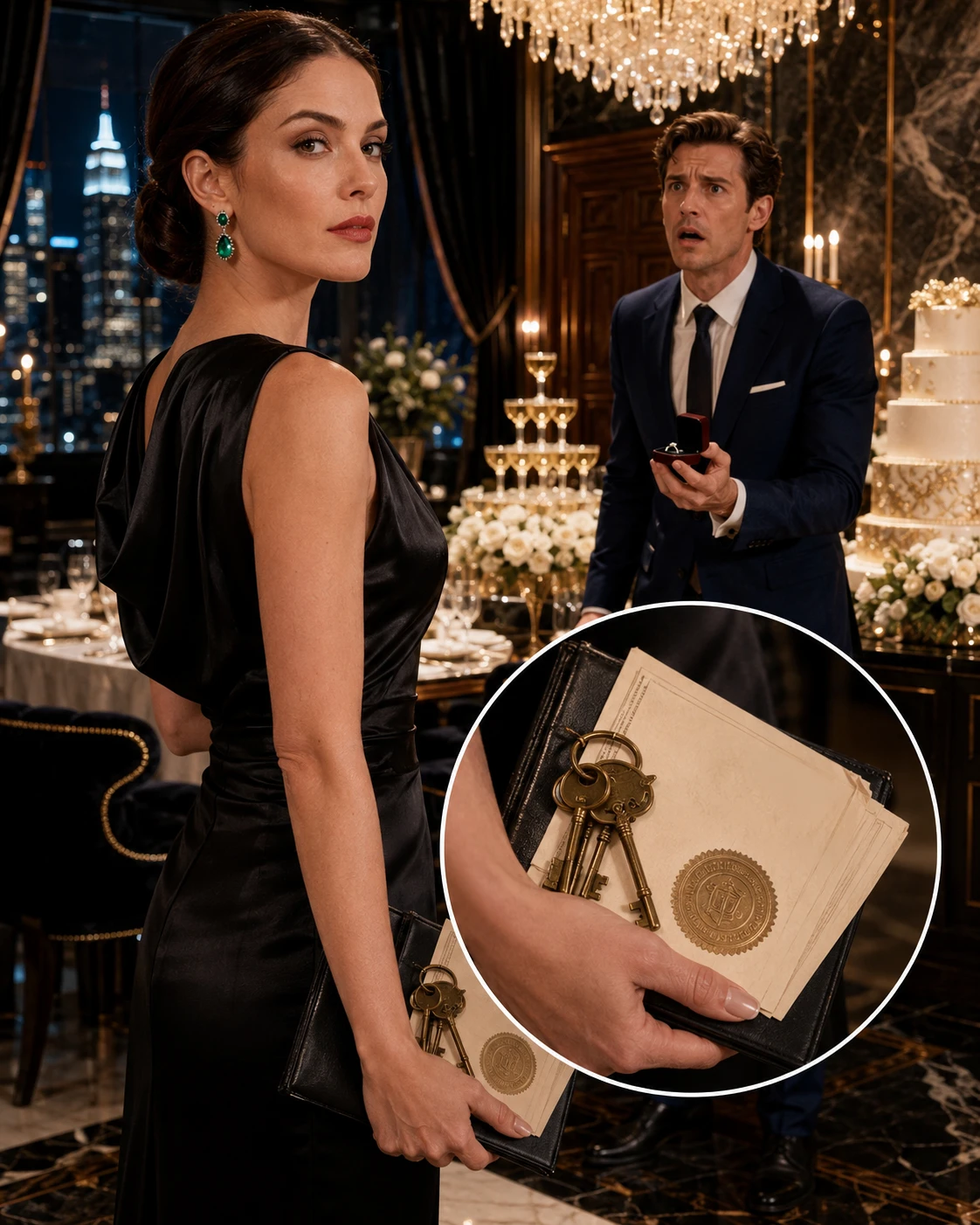
I walked into the private salon in a black silk dress, my hair pinned low, my grandmother’s emerald earrings at my ears.
Not diamonds.
Emeralds.
Old money never needs to sparkle loudly.
Preston’s expression shifted through three emotions in less than a second.
Surprise.
Annoyance.
Fear.
He hid the last one poorly.
“Mara,” he said.
Savannah turned.
Her mouth opened a little, then curved.
Of course she smiled.
She thought my presence was proof that she had won.
“Well,” she said lightly, too drunk on attention to notice the room had stopped breathing. “This is awkward.”
I looked at her.
“Happy birthday, Savannah.”
Her smile faltered.
My voice was calm. That unsettled her more than rage would have.
Preston stepped away from her.
“What are you doing here?”
I let the question hang for a moment.
Then I turned and looked around the room.
At the guests.
At the phones.
At the cake.
At the ring.
At the bracelet that had cost my marriage less than a used Mercedes.
“I work here,” I said.
A few people laughed nervously.
Preston exhaled as if I had embarrassed myself.
“Mara, this isn’t the time.”
“No,” I said. “It’s exactly the time.”
He lowered his voice.
“You need to leave.”
There it was.
The old command.
The invisible leash.
You need to leave.
For nine years, I had mistaken his confidence for strength. I had built rooms for him, softened conversations for him, remembered birthdays for people he needed, and stayed silent when his jokes sliced too close to bone.
I had left rooms before.
This time, I owned the room.
I looked at Marcus, standing in the doorway.
He gave a slight nod.
The music stopped.
The lights rose.
Not bright. Aurelia would never be vulgar. Just enough for everyone’s faces to become honest.
Savannah blinked.
Preston’s jaw tightened.
“Mara,” he warned.
I lifted one hand.
“Good evening, everyone. My name is Mara Monroe.”
That was the first crack.
Not Hayes.
Monroe.
My maiden name moved through the room like a match dropped onto silk.
“My husband invited you here tonight under the impression that Aurelia was available for his private celebration.”
Preston’s face darkened.
“Mara, stop.”
I continued.
“Unfortunately, Mr. Hayes has violated the terms of our private-event agreement in several ways.”
Savannah let out a short laugh.
“Our agreement?”
I turned to her.
“Yes. Our agreement.”
Her cheeks flushed.
“The reservation was made through Aurelia’s system and approved by management. Like all private events, it remained subject to the owner’s discretion.”
Preston stared at me.
Something in his eyes was shifting. His mind was moving, counting, remembering.
He had never asked me enough questions.
That was another kind of insult.
He had known I invested in Aurelia years earlier. He had known I spent long hours here. He had known I cared about the payroll, the staff, the menu, the wine program, the old building with its cracked cornices and stubborn pipes.
But he had never cared enough to know why.
I reached into the folder Marcus handed me.
Inside were three documents.
I held up the first.
“As of this morning, the final transfer was recorded. I am the sole owner of Aurelia.”
The room went still.
Savannah’s mouth fell open.
Preston’s face emptied.
It was almost beautiful.
A man watching a stage collapse beneath his feet.
I held up the second document.
“And I am also the owner of the Monroe Building, including the private salon, the courtyard entrance, the wine cellar, and every chair currently occupied by people who have been filming my humiliation for entertainment.”
No one moved.
A phone lowered.
Then another.
One of Preston’s partners whispered, “Jesus.”
Savannah looked at Preston.
“You said you were buying it.”
Preston did not answer.
He was staring at me.
“Mara,” he said, but my name came out different now.
Not as an order.
As a plea wearing a suit.
I looked at the cake.
“The inscription is inaccurate. The proposal is legally premature. The use of Hayes Development funds for this event is, I imagine, something your board will enjoy discussing.”
His legal counsel, seated near the fireplace, went pale.
Preston took a step toward me.
“Do not do this.”
I smiled.
“That sentence has carried our marriage for years. Do not speak. Do not react. Do not embarrass me. Do not make a scene.”
His eyes flashed.
“You’re making one now.”
“No, Preston. You made it. I’m simply turning up the lights.”
Savannah’s sister muttered, “Oh my God, are people still live?”
A woman near the bar fumbled with her phone.
I did not care.
For once, let the world watch the right person bleed.
Preston’s voice dropped.
“We can talk privately.”
“We could have,” I said. “Four months ago. Or last year. Or the first time you told a table of strangers that I was too plain to understand ambition.”
Savannah flinched.
Good.
Some insults sound different when repeated by the woman they were meant to diminish.
I turned back to the room.
“Your dinners will be boxed. Your cars will be called. The champagne already opened will be charged to the card on file. The remaining bottles will return to inventory.”
Preston’s face reddened.
“You can’t throw out my guests.”
I tilted my head.
“No. I can cancel a private room in my restaurant due to breach of contract and misuse of the venue. Which I am doing now.”
Marcus stepped forward.
Two security staff appeared quietly near the door.
Not threatening. Just present.
Elegant revenge does not slam doors.
It opens them and lets people walk through their consequences.
Savannah stood frozen beside the cake, ringless hand pressed against her stomach.
The diamond bracelet glimmered on her wrist.
I looked at it once.
Then at Preston.
“You charged that to the company card too?”
The legal counsel closed his eyes.
Preston hissed, “Enough.”
But the word had no power left.
I held up the third document.
“This is a copy of the divorce petition being filed tomorrow morning. You’ll receive the full packet from Claire Donovan.”
That name landed harder than the ownership papers.
Everyone in Manhattan who had money and secrets knew Claire Donovan.
Preston swallowed.
“You hired Claire?”
“I did.”
“Mara—”
“And before you ask, yes, she knows about Miami. The bracelet. The apartment in SoHo. The wire transfers to Savannah’s LLC. The payments labeled consulting. The corporate card charges. The offer you claimed you made for Aurelia using collateral that was never yours to pledge.”
Savannah stepped back as if he had become contagious.
“Preston?”
He turned on her. “Not now.”
That was the moment she understood she was not a queen.
She was a receipt.
Her eyes filled with humiliation, but I felt no triumph in that. Savannah had been cruel, yes. She had enjoyed the view from another woman’s ruin. But Preston had built the balcony.
I would not confuse the instrument with the architect.
Still, she had chosen the song.
So she could dance to the end of it.
I looked at her.
“Savannah, your cake will be packaged if you want it.”
She stared at me, tears slipping down her cheeks now.
“I didn’t know,” she whispered.
The lie was soft.
Almost pretty.
I let silence answer it.
Because women always know enough.
Maybe not everything. Maybe not the whole legal shape of the wound. But enough.
Enough when a man never takes your calls after ten. Enough when holidays are complicated. Enough when his wife is reduced to a joke before dessert.
Savannah looked away first.
Preston tried one last time.
“You’re enjoying this,” he said.
The room waited.
I thought about that.
Was I enjoying it?
The shock on his face. The whispered panic. The collapse of his beautiful lie.
No.
Enjoyment was too small a word.
What I felt was oxygen.
“No,” I said. “I’m ending it.”
Then I turned to Marcus.
“Please cancel the private room.”
Marcus opened the walnut doors wide.
“Of course, Ms. Monroe.”
And just like that, the party was over.
Chapter 5: The Woman Behind the Velvet Curtain
People do not leave humiliation gracefully.
They gather their coats too quickly. They pretend to check messages. They avoid eye contact with the woman they had been laughing at ten minutes earlier.
Savannah’s friends slipped out first, their heels clicking against the marble like nervous insects. One of them tried to take a centerpiece. Tessa appeared beside her with a smile sharp enough to cut glass.
“Those stay with the restaurant.”
The woman put it back.
Preston’s partners left next. One murmured, “We’ll talk Monday,” in the tone men use when Monday means lawyers.
The lifestyle photographer deleted nothing. I watched her tuck her camera into its bag with trembling hands, and I knew the story would be online before the last champagne flute was cleared.
Good.
Let the captions write themselves.
He booked the venue.
She owned the building.
Savannah remained near the cake, mascara gathering beneath her eyes, the diamond bracelet still on her wrist like evidence.
Preston stood in the middle of the room, no longer proposing, no longer charming, no longer able to decide which mask fit the disaster.
“Mara,” he said again.
How strange, that after nine years, my name in his mouth could still sound like something he expected to own.
I moved toward the fireplace and sat in the chair at the head of the table.
Not because I needed to sit.
Because it was my chair.
“Take the ring,” I said.
He looked down as if surprised to find the box still in his hand.
His fingers closed around it.
Savannah wiped her face.
“Preston, did you use my company for payments?”
“My company,” he snapped.
She recoiled.
I almost smiled.
There he was.
Not the lover. Not the savior. The man.
He turned back to me, lowering his voice.
“You have no idea what you’re doing.”
“I know exactly what I’m doing.”
“You’re angry.”
“Yes.”
“You’re emotional.”
“I’m precise.”
His lips pressed together.
That was another thing he hated. Precision. It made manipulation harder.
He came closer, stopping on the other side of the table.
“Think about this. Think about what you’re risking. My company affects your lifestyle.”
I looked around the private salon.
The candles. The wine. The staff moving with quiet competence beyond the open doors.
“My lifestyle?”
His face tightened.
For years, Preston had believed my life was something he provided.
The penthouse on Madison. The charity boards. The Hamptons weekends. The winter trips to Aspen where he skied with investors while I arranged dinners for wives who pretended not to hate each other.
He never understood that none of it had ever made me feel rich.
Rich was my grandmother teaching me to make soup from scratch in a kitchen that smelled like rosemary.
Rich was Francesca Bellini handing me the original Aurelia keys and saying, “Women like us don’t retire. We become legends quietly.”
Rich was my staff staying late, unpaid, until I found out and changed the payroll system so no one would ever have to choose between loyalty and rent.
I leaned back.
“Preston, the Madison penthouse is mine. It was purchased by the Monroe Trust before our marriage. The Nantucket house is mine too. So is the art you’ve been telling people you selected.”
His eyes flickered.
Savannah looked at him, stunned.
“But there is something of yours,” I said gently.
For a second, hope crossed his face.
“Your clothes,” I finished. “They’ll be delivered to your office by Friday.”
Someone near the door coughed to cover a laugh.
Preston’s face went scarlet.
“You think this makes you powerful?”
“No,” I said. “Powerful was signing the transfer this morning and still letting you eat dinner.”
That landed.
He stared at me as if seeing a stranger.
Maybe he was.
Maybe marriage does that when it dies slowly. One person keeps speaking to the ghost they trained, never noticing the living woman who has walked out of the grave.
Savannah removed the bracelet.
Her hands shook as she placed it on the table.
“I don’t want this.”
Preston looked at her with disgust.
“Oh, please.”
She flinched.
I almost felt sorry for her.
Almost.
But then I remembered the cake.
The future Mrs. Hayes.
The laughter.
Some lessons should be expensive.
“Keep it,” I said.
Savannah looked at me.
“It was bought with money that will be traced and dealt with. Wearing it may be inconvenient, but that’s between you, Preston, and whoever subpoenas the receipts.”
She went pale.
Preston slammed his hand on the table.
“Enough!”
The sound cracked through the salon.
For the first time all night, I saw the predator beneath the polish.
Security stepped closer.
I did not move.
“Lower your voice,” I said.
He stared at me, breathing hard.
There were two Prestons.
The public one, who knew wine pairings and kissed cheeks at museum galas.
And the private one, who made a woman feel small in rooms no one else entered.
For nine years, I had feared the private one.
That night, under my own chandelier, I watched him realize he no longer had a private room to hide in.
The transformation was not loud.
It was simple.
His shoulders dropped.
His anger turned desperate.
“Mara,” he said, softer now. “Please. Don’t destroy me.”
There it was.
Not “I’m sorry.”
Not “I hurt you.”
Not “How do I repair what I broke?”
Just don’t destroy me.
Men like Preston think exposure is destruction because secrecy is where they keep their power.
I stood.
“I’m not destroying you. I’m returning you to yourself.”
Then I picked up the folder and walked toward the door.
At the threshold, I paused and looked back.
Savannah was crying quietly beside a cake no one had cut.
Preston stood alone beneath the chandelier, holding a ring meant for a future that had just been canceled.
The room smelled like roses, sugar, and smoke.
It should have felt like victory.
Instead, it felt like a door closing.
Necessary.
Heavy.
Final.
“Good night,” I said.
Then I walked out.
Behind me, Marcus began giving instructions in a calm, professional voice.
The private salon was cleared within twelve minutes.
The cake was boxed.
The flowers were removed.
The champagne tower came down glass by glass.
By 10:15, the room looked as if the party had never happened.
Except for one thing.
On the table, someone had left a single black rose.
I took it upstairs to my office, pressed it between two pages of the old wine ledger, and wrote the date beside it.
Not because I wanted to remember Preston.
Because I wanted to remember the night I stopped disappearing.
Conclusion: A Table Near the Window
The video went viral before sunrise.
Not because I posted it.
I did not have to.
Savannah’s friends had filmed the cake, the ring, the toast, the reveal, the moment I said, “I’m simply turning up the lights.” By breakfast, the clips were everywhere.
TikTok.
Instagram.
Facebook reels with dramatic captions and piano music.
WIFE OWNS RESTAURANT WHERE HUSBAND PROPOSES TO MISTRESS.
HE BOOKED THE VENUE. SHE OWNED THE BUILDING.
DON’T HUMILIATE A WOMAN IN HER OWN HOUSE.
People argued in comment sections for days.
Some called me cold.
Some called me iconic.
Some called it staged because the truth, when dressed well, often looks too perfect to be real.
Preston called forty-three times.
I answered none of them.
Claire answered everything else.
The divorce was not quick, because men who love control do not release it politely. But it was clean. Cleaner than he deserved.
Hayes Development suffered what the newspapers called “a confidence issue.” Investors withdrew. The board investigated. His partners became former partners with impressive speed.
Savannah disappeared for six weeks, then returned online with softer hair, smaller jewelry, and a video about “healing from narcissistic dynamics.” I wished her enough growth to stop mistaking another woman’s pain for proof of love.
As for Aurelia, it became impossible to book.
For months, people came because of the scandal.
Then they returned because of the food.
Because that was the part the internet did not understand. Revenge may open the door, but excellence keeps the room full.
I promoted Tessa to director of guest experience.
I gave Marcus equity.
I renamed the private salon The Bellini Room, after Francesca, and had the cake inscription framed in the staff hallway under a small brass plaque that read:
ALWAYS READ THE ROOM.
THEN OWN IT.
Six months later, on a warm September evening, I stood in the dining room before service and watched candlelight bloom across the tables.
The city outside was loud and restless. Inside, Aurelia breathed.
Marcus approached with two menus in his hand.
“You have a reservation tonight,” he said.
I raised an eyebrow.
“I own the reservation system.”
“Yes,” he said. “That made it difficult to surprise you.”
I looked past him to a table near the window.
It was set for two.
No black roses. No spectacle. No cake with a cruel inscription.
Just white linen, fresh bread, two glasses, and a small vase of yellow ranunculus, my favorite flower.
I turned back to Marcus.
For years, he had been my witness. Not my rescuer. Not my replacement for a man I had lost. Just a steady presence in a world that had tilted too often.
His expression was careful.
Tender, but not asking for more than I was ready to give.
“Dinner?” he said.
I looked at the table.
At the room I had saved.
At the life I had reclaimed.
At the woman reflected in the smoked mirror across the bar.
She looked different now.
Not harder.
Clearer.
I smiled.
“Only if we start with champagne.”
Marcus laughed softly.
“The good one?”
I glanced toward The Bellini Room, where a couple celebrating their fiftieth anniversary had just been seated beneath the chandelier.
“The best one,” I said.
And for the first time in a long time, the word forever did not sound like a trap.
It sounded like a door opening.
Not to Preston.
Not to revenge.
Not to the woman I had been before the humiliation, or the woman the internet thought it knew.
To myself.
To a restaurant glowing gold in the rain.
To a table near the window.
To a future no one else would ever be allowed to gift, borrow, or steal from me again.