PART 1 — The Phone Call That Changed Everything
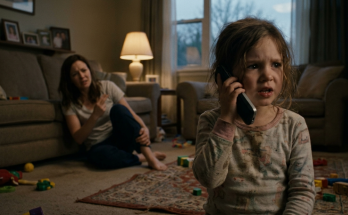
People always say life changes in an instant, but that’s not how it happened for me. My life changed while I was standing in my tiny laundry room folding clothes that still carried the sharp scent of discount detergent. Even now, I remember every meaningless detail as if my mind refused to let them disappear. Emma’s pink sock was turned completely inside out. A dried pasta stain sat on the sleeve of my favorite gray T-shirt. My cellphone vibrated across the countertop, flashing an unfamiliar number, and before I answered, an uneasy feeling settled in my chest.
“Mom?”
The voice was barely louder than a breath.
I froze.
Seven-year-old Emma never whispered unless she believed someone wasn’t supposed to hear her.
“Honey? What’s wrong?”
A few seconds passed before she answered.
“I’m hiding.”
My heartbeat instantly doubled.
“Where are you?”
“In Grandma Linda’s bathroom.”
I grabbed my purse before she even finished speaking.
“Did you and Grandma have an argument?”
“No…”
Another long pause.
“Please don’t get mad.”
Whenever a child begins a sentence that way, every parent knows something is terribly wrong.
“I won’t. Just tell me.”
“I got hungry.”
My fingers tightened around my keys.
“There wasn’t lunch yet… so I took one piece of bread.”
She stopped again, breathing unevenly.
“Grandma said I was stealing.”
I hurried toward my apartment door, already unlocking my car remotely.
“What happened after that?”
Emma’s next words were so quiet I almost missed them.
“She said thieves have to remember the pain.”
My entire body went cold.
“What do you mean?”
Another silence.
Then she whispered the sentence that would stay with me forever.
“Grandma made me hold the hot baking pan.”
For a moment I couldn’t breathe.
I stopped walking in the middle of the parking lot as the world around me seemed to disappear beneath a dull ringing in my ears.
“Emma… sweetheart… where are your hands now?”
“They hurt.”
Her breathing became shaky.
“I tried not to cry because Grandma said crying makes bad kids weaker.”
I climbed into my car so fast I nearly dropped the phone.
“Listen to me very carefully. Stay where you are. Lock the bathroom door if you can.”
“I already did.”
“Good girl.”
“Mom…”
“Yes?”
“Please don’t yell at Grandma.”
Those words hurt almost as much as everything else she’d told me.
Children should never feel responsible for protecting the adults who frighten them.
Emma had been spending the weekend with my husband, Daniel’s parents. Daniel insisted his childhood home was the perfect environment for her—peaceful, structured, respectful. According to him, his mother represented everything modern families had forgotten about raising children.
We had argued about it before he drove Emma there two days earlier.
“You let her get away with everything,” he’d complained while loading her overnight bag into the SUV.
“I teach her kindness.”
“You teach her excuses.”
That conversation echoed inside my head as I sped onto the highway.
Without taking my eyes off the road, I used the hands-free system to call 911.
“My seven-year-old daughter may have serious burns,” I told the dispatcher, forcing my voice to stay steady. “She’s at her grandmother’s house, and I believe someone intentionally hurt her. I’m on my way there now.”
The dispatcher immediately asked for the address and assured me officers and paramedics were already being sent.
Every red light felt unbearable.
Every passing minute felt like a betrayal.
I kept talking to Emma through Bluetooth, asking her simple questions just to keep her calm.
“Are you alone?”
“Yes.”
“Can anyone get into the bathroom?”
“I locked it.”
“Can you see your hands?”
“They’re really red.”
“Are they bleeding?”
“No… but they feel funny.”
“You did exactly the right thing by calling me.”
Another pause.
Then came the question that shattered whatever strength I had left.
“Mom…”
“I’m here.”
“Am I a bad kid because I ate the bread?”
I felt tears blur the road ahead.
“No.”
I answered without hesitation.
“You were hungry. That’s all.”
“But Grandma said good children ask first.”
“Honey, eating because you’re hungry doesn’t make you bad.”
She sniffled quietly.
“I didn’t want anyone to be mad.”
“They won’t be.”
I swallowed hard.
“And no one is ever allowed to make you afraid for being hungry.”
The familiar neighborhood finally appeared ahead.
As I turned onto the quiet tree-lined street, flashing red and blue lights came into view at the far end of the block.
My heart dropped.
The police had already arrived.
And for the first time since Emma called me, I realized I wasn’t just rushing toward a family argument anymore.
I was driving straight into the moment that would expose everything hidden behind Daniel’s family’s picture-perfect life.
PART 2 — The Perfect Family Finally Cracked
By the time I pulled into the driveway, two patrol cars and an ambulance were already parked outside the immaculate colonial house Daniel had always called “the safest place Emma could ever be.”
The front lawn looked perfect. Fresh flowers lined the walkway. Every window sparkled. From the outside, it looked like the kind of home neighbors admired.
Inside, everything was about to change.
Before anyone could stop me, I rushed through the open front door.
Linda stood calmly in the foyer wearing a neatly pressed cardigan, one hand still resting on the doorknob as though she’d simply been expecting visitors.
“There you are,” she said evenly. “You’re making this much bigger than it needs to be.”
I didn’t answer.
My eyes searched the hallway until I heard a tiny sob.
Emma was sitting on the bathroom floor with her knees pulled tightly against her chest. She still wore the unicorn pajamas I’d packed two nights earlier. Her cheeks were streaked with dried tears, and both hands were held awkwardly in front of her body, as if even the slightest movement caused discomfort.
The moment she saw me, she burst into tears.
“Mommy…”
I dropped beside her and carefully examined her hands.
The skin across both palms was bright red and badly swollen. Small blisters had already begun forming along several fingers.
Every instinct inside me screamed the same thing.
This wasn’t a simple kitchen mishap.
I wrapped my arms around Emma as gently as I could.
“It’s okay,” I whispered. “I’m here now.”
She buried her face against my shoulder and started shaking.
One of the paramedics hurried inside with a medical kit while the responding officers secured the room. As they began checking Emma’s injuries, one officer asked softly, “Sweetheart, can you tell us what happened?”
Emma looked at me first.
I nodded.
“You can tell the truth.”
She swallowed hard before pointing toward Linda.
“Grandma.”
The entire room became silent.
The officer turned toward Linda.
“Ma’am?”
To my astonishment, she didn’t appear nervous.
She folded her arms neatly and answered in the same calm tone she’d used to greet me.
“I disciplined her.”
No apology.
No hesitation.
No attempt to deny it.
“She took food without permission before dinner,” Linda continued. “Children need to understand that actions have consequences. A brief lesson now prevents much bigger problems later.”
One of the paramedics looked up in disbelief.
“You intentionally made her touch something hot?”
Linda sighed as though everyone else was being unreasonable.
“I didn’t hurt her.”
She paused.
“I simply wanted her to remember.”
I stared at her, struggling to understand how someone could say those words without the slightest hint of regret.
“You call this teaching?” I asked quietly.
“I call it parenting.”
Just then, the front door opened again.
Daniel hurried inside after receiving my frantic messages.
His face immediately changed when he saw Emma.
“What happened?”
I stepped aside so he could see her hands.
His expression tightened.
For one brief second, I believed he finally understood.
Instead, he rubbed both hands over his face and muttered, “This… this got out of control.”
I waited for him to comfort his daughter.
To ask if she was okay.
To demand an explanation from his mother.
He did none of those things.
Instead, he walked toward Linda.
“Mom…”
She looked at him confidently.
“I only corrected bad behavior.”
Daniel glanced around at the officers standing inside his childhood home before lowering his voice.
“Maybe… maybe we shouldn’t make assumptions until everyone calms down.”
I couldn’t believe what I was hearing.
“Our daughter is hurt.”
“I know.”
“Look at her hands.”
“I am.”
“And you’re worried about everyone calming down?”
He exhaled heavily.
“My mom would never intentionally—”
“She literally admitted it.”
“I think you’re misunderstanding what she meant.”
“No, Daniel.”
I felt something inside me finally break.
“You’re the one refusing to understand.”
Emma slowly reached for my sleeve.
In the smallest voice imaginable, she asked, “Daddy… are you mad because I ate the bread?”
Daniel looked down at her.
He opened his mouth.
Nothing came out.
That silence said more than any answer ever could.
One of the officers quietly asked Linda to step into the dining room while another continued speaking with Emma. The paramedics finished dressing her hands before preparing to transport her to the hospital for additional treatment.
As they helped Emma onto the stretcher, she suddenly clutched my wrist.
“Mom…”
“I’m right here.”
“Will Grandma be angry if I tell the doctor?”
My chest tightened.
“No, sweetheart.”
I brushed a strand of hair away from her face.
“You never have to hide the truth.”
She nodded weakly.
At the hospital, specialists carefully examined both hands. After several photographs and detailed notes, the attending physician spoke with the investigating officer outside the treatment room.
Although they kept their voices low, I caught one sentence clearly.
“The injury pattern is consistent with prolonged contact against a heated surface.”
Not an accident.
Not a splash.
Not a moment of bad luck.
Exactly what Emma had described.
Later that evening, a child forensic interviewer met with Emma in a quiet room designed to help young children feel safe. I wasn’t allowed to answer for her or interrupt. She told the same story from beginning to end.
Every detail matched.
Every timeline stayed consistent.
Every question received the same answer.
When the interview ended, the investigator walked over to me.
“Children sometimes become confused after stressful events,” she said softly. “Your daughter hasn’t changed a single detail.”
That night, after Emma had finally fallen asleep in the hospital bed, a nurse brought her a small dinner tray.
There was a warm bread roll beside the soup.
Emma stared at it for several seconds.
Then she quietly pushed the plate away.
“I’m not hungry.”
I knew she was.
She hadn’t eaten since breakfast.
I broke off a tiny piece and placed it gently into her hand.
“You don’t have to ask permission.”
She looked at the bread as though it had become something dangerous.
Almost in tears, she whispered,
“I promise I won’t take food again.”
I wrapped both arms around her and held her as carefully as I could.
At that moment, I stopped wondering whether our family could ever go back to the way it had been.
Because I had already made my decision.
The next morning, I walked into a family law office carrying hospital records, photographs, Emma’s recorded phone call… and every ounce of determination I had left.
By the end of that meeting, the first emergency court filings had already begun.
And Daniel still had no idea how much his silence was about to cost him.

PART 3 — The Truth Finally Had Its Day
Less than twenty-four hours after leaving the law office, my attorney filed an emergency petition for temporary sole custody along with a request for a protective order. The evidence spoke long before anyone stepped into a courtroom. Emma’s medical records, the photographs taken at the hospital, the 911 recording, and her carefully documented interview all pointed to the same conclusion.
Daniel insisted there had been a misunderstanding.
Linda insisted she had been teaching “respect.”
Neither explanation matched the facts.
Over the next several days, investigators interviewed everyone who had been inside the house that weekend. Every timeline was examined. Every statement was compared. While Daniel tried to describe the incident as an unfortunate disciplinary mistake, Linda never truly backed away from what she had done.
“If children never experience consequences,” she calmly explained during one interview, “they grow into adults who believe rules don’t matter.”
She still believed she had done the right thing.
That confidence disappeared the morning we walked into family court.
The courtroom was quiet as the judge reviewed the photographs, medical reports, and witness statements. Then the recording of Emma’s phone call was played.
Her tiny voice filled the room.
“Grandma said pain helps thieves remember.”
No one spoke.
The silence that followed seemed to last forever.
The judge turned toward Linda.
“Did you say those words?”
She adjusted her jacket before answering.
“I was trying to teach responsibility.”
“You instructed a seven-year-old child to hold a hot baking pan?”
“I believed the lesson would stay with her.”
“It certainly did,” the judge replied.
The room fell completely silent again.
Daniel’s attorney attempted to argue that emotions had escalated the situation and that the family deserved an opportunity to resolve matters privately. But every time the discussion returned to Emma’s injuries, the evidence remained impossible to explain away.
Then it was Daniel’s turn to testify.
He admitted seeing Emma’s hands shortly after I arrived.
“And what was your first response?” my attorney asked.
Daniel lowered his eyes.
“I thought everyone should calm down.”
“You didn’t immediately seek medical attention?”
“I… believed it wasn’t as serious as it looked.”
My attorney paused.
“Looking back today, do you still believe that?”
Daniel’s voice cracked for the first time.
“No.”
It was the only completely honest answer he gave that day.
By the end of the hearing, the judge issued an immediate temporary order granting me sole physical and legal custody. Daniel’s parenting time would continue only under professional supervision until further evaluation. Linda was prohibited from contacting Emma in any form while the investigation continued.
Outside the courthouse, reporters weren’t waiting.
Neighbors weren’t gathered.
There was no dramatic public scene.
Real life rarely unfolds that way.
Instead, the truth spread quietly through the people who had defended Linda for years. Friends who had always described her as the perfect grandmother gradually learned what had happened through official court records and conversations within the community. Invitations became less frequent. Volunteer positions quietly disappeared. The carefully polished image she had spent decades building began fading on its own—not because anyone started a campaign against her, but because people reached their own conclusions once the facts became known.
Months later, the legal process finally came to an end.
The family court awarded me permanent sole custody.
Daniel completed parenting education, counseling, and every program required by the court. He wrote letters expressing regret, admitting that his greatest mistake wasn’t trusting his mother—it was failing to protect his daughter when she needed him most.
Some apologies arrive sincerely.
Some simply arrive too late.
Emma chose the pace of their relationship herself, and every future visit remained structured around what made her feel safe.
As for Linda, the consequences followed their own legal course. I didn’t celebrate them.
Nothing about that process gave Emma back the fear she had lived through.
What mattered most was making sure she never had to experience it again.
Healing wasn’t measured in court dates.
It appeared in ordinary moments.
The first time Emma stopped hiding food in her bedroom.
The first grocery trip where she reached for a loaf of bread without looking over her shoulder.
The first family dinner where she accepted a second helping without quietly asking whether she was “allowed.”
Her therapist helped us understand that recovery would happen through consistency, patience, and predictable routines rather than dramatic breakthroughs.
So we built new traditions.
Every Saturday morning became baking day.
At first, Emma refused to stand near the oven. Even seeing the warm trays made her step backward.
We never rushed her.
The first week, she only stirred the flour.
The second week, she measured the sugar.
A month later, she smiled while shaping the dough with tiny hands that had grown stronger every week.
When she finally felt ready to place a baking tray into the oven beside me, I showed her exactly how oven mitts worked, how heat could be respected instead of feared, and how kitchens were places where families cared for one another—not places where children learned to be afraid.
When the bread finished baking, the entire house filled with its warm, familiar smell.
Emma looked at the golden loaf sitting on the cooling rack.
“Can I have the first slice?”
I smiled.
“It was always yours.”
Nearly a year passed before I noticed something I had quietly hoped for.
One bright Sunday morning, Emma wandered into the kitchen while I was making breakfast. Sunlight poured through the windows as she reached into the bread basket, tore off a piece, spread butter across it, and kept chatting about a school art project without stopping to think.
No hesitation.
No fear.
No apology.
Just a little girl eating because she was hungry.
I looked down at the faint marks still visible across her palms.
The scars hadn’t disappeared completely.
Perhaps they never would.
But they no longer represented fear.
They represented survival.
Emma caught me smiling.
“What?”
“Nothing,” I said, sliding the jam toward her.
“You don’t have to ask for food in this house.”
She grinned, reached for another slice, and laughed.
Watching her laugh was the moment I finally understood something that no courtroom could ever deliver.
Justice isn’t only found in legal decisions.
Sometimes it’s found in watching a child feel safe enough to simply be a child again.
And in our home, that would always be the lesson worth protecting.
THE END