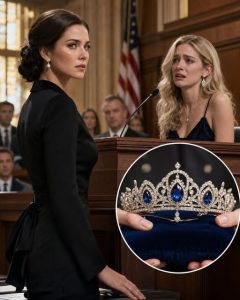
His mistress wore my wedding tiara in their engagement photos.
Not a replica. Not a “similar piece.” Not some rhinestone tragedy ordered overnight from a bridal boutique in Jersey.
Mine.
A platinum Edwardian tiara set with old-mine diamonds and three pear-shaped sapphires, wrapped in tissue the color of storm clouds and locked for decades inside my family vault at Whitmore House in Newport. It had sat on my grandmother’s silver hair when she married a railroad heir in 1958. It had sat on my mother’s dark curls in a candlelit chapel during a hurricane in 1982. It had sat on my head when I married Grant Holloway at the New York Public Library under a ceiling of painted clouds and a thousand white orchids.
And then it sat on Sloane Avery’s head while she leaned into my husband’s chest on the balcony of The Alden Hotel, smiling like a woman who had mistaken theft for victory.
The photo appeared first on BookTok.
The caption read: “When he upgrades the crown.”
By breakfast, millions had seen it.
By lunch, every woman in Manhattan with a phone, a divorce attorney, or a memory of being underestimated had zoomed in on the sapphires.
By dinner, Sloane had posted a follow-up video in a silk robe, touching the tiara with one manicured finger and whispering, “Some men know what a queen deserves.”
She had no idea what she had done.
That tiara was a registered heirloom, documented in my family estate, insured separately, photographed annually, and never gifted to my husband.
My attorney, Sylvia James, watched the video once in silence.
Then she smiled.
“Vivienne,” she said, “I love viral evidence.”
CHAPTER 1: THE WOMAN THEY LAUGHED AT IN DIAMONDS
The first time Grant humiliated me in public, he did it beneath a chandelier worth more than most people’s homes.
It was the Holloway Children’s Foundation winter gala, held in the ballroom of The Alden Hotel on Fifth Avenue, where the marble floors reflected women in black satin and men with expensive watches pretending to be generous. Cameras flashed. Champagne drifted past on silver trays. Everyone looked beautiful in the polished, predatory way New York loves.
I wore an ivory column gown and my grandmother’s pearl earrings. Grant wore Tom Ford and the expression of a man who believed consequences were for employees.
He was standing near the auction display with Sloane Avery.
At the time, she was his “brand consultant.”
Twenty-six. Blonde. Smooth as lacquer. Famous for turning unremarkable men into lifestyle content and calling it strategy. She had a voice like sugar sprinkled over broken glass and a talent for looking innocent exactly when a room needed someone to blame.
Grant saw me approach and did not step away from her.
That was the first cut.
The second came when a donor’s wife, Mrs. Harlow, touched my arm and asked, too brightly, “Vivienne, darling, are you still involved with the foundation?”
Before I could answer, Grant laughed.
“Vivienne prefers quieter rooms,” he said. “Numbers, old paintings, family paperwork. She’s never loved the spotlight.”
Sloane smiled into her champagne.
The women around us made the polite little sound people make when they want cruelty to pass as charm.
I looked at my husband of eight years and waited for him to correct himself.
He did not.
Instead, he slid his hand to the small of Sloane’s back with the lazy entitlement of a man who had forgotten I was the reason he had that ballroom at all.
The Alden had once belonged to my grandfather.
So did the land under it.
So did, technically, almost everything Grant touched and renamed after himself.
But I had learned early in my marriage that power is safest when it is quiet.
Grant had learned the opposite.
He believed power needed a camera.
After the gala, he did not come home.
The next morning, his assistant sent flowers to our townhouse on East 73rd Street. White roses. No card. The kind of apology a man delegates when he cannot remember what he did wrong.
I placed them in the blue room beside the wedding portrait he still had not asked to remove.
In that portrait, I was twenty-nine and glowing under the Whitmore sapphire tiara. Grant stood beside me, one hand over mine, handsome enough to make strangers forgive him in advance. He had cried during his vows. Real tears, I think. Back then, he wanted to be better than the men he admired.
Ambition ruined him slowly, then all at once.
For eight years, I played the role expected of me.
I smiled at galas. I hosted dinners. I saved his company twice without letting the press know. I took meetings with bankers who called him brilliant while reading financial structures I had built. I forgave late nights, cold mornings, lipstick on invoices, and the sharp new habit he had of calling me “delicate” whenever I disagreed with him.
Women like me are often mistaken for decorative.
It is an old American habit. Put a woman in diamonds, and people assume she does not know where the diamonds came from.
But I knew every stone, every account, every trust, every document.
My father had taught me wealth was not money.
“Wealth,” he said, “is proof.”
Proof of ownership. Proof of transfer. Proof of intention. Proof of betrayal, if you are patient enough to let arrogant people write it down.
Grant wrote everything down.
He loved signatures. Loved digital trails. Loved giving instructions to assistants at midnight because it made him feel imperial. He loved hiding assets in ways that were only clever to men who confused secrecy with complexity.
When he began moving money, I noticed.
When he opened a Delaware LLC under the name Crownline Hospitality Ventures, I noticed.
When Sloane’s consulting invoices tripled, I noticed.
And when my grandmother’s tiara disappeared from the Newport vault two weeks before Sloane posted her engagement photos, I did not scream.
I called the estate manager.
I called the insurance underwriter.
Then I called Sylvia James.
Sylvia had handled three hostile divorces for women whose husbands used yachts as hiding places. She was fifty-eight, immaculate, and terrifyingly calm. She wore charcoal suits, red lipstick, and no jewelry except a thin gold wedding band from a husband she described as “useful and quiet.”
When I told her the tiara was missing, she asked one question.
“Does Grant know you know?”
“No.”
“Good,” she said. “Do nothing emotional.”
That was Sylvia’s religion.
Do nothing emotional.
So I did nothing emotional.
I attended a museum benefit two nights later in midnight velvet. I smiled for Page Six beside Grant while he kept his phone face down. I let him kiss my cheek in front of photographers. I let Sloane post a cryptic video from a hotel suite with the caption, “Soft launch soon.”
And when Grant finally came home smelling of cedar, champagne, and another woman’s perfume, I was sitting in the library with a cup of tea and a book I was not reading.
He loosened his tie.
“You’re awake.”
“So are you.”
He looked around the room as if expecting an argument to rise from the walls.
I gave him none.
That annoyed him more than anger would have.
“I have meetings early,” he said.
“Of course.”
https://nextchapternow5.cafex.biz/blog/she-sent-me-the-invoice-i-sent-him-to-court
He studied me, uncertain.
Grant had always been most dangerous when he felt admired. But he was clumsy when he felt unseen.
“You’ve been quiet lately,” he said.
“I’ve been thinking.”
“About what?”
I looked up at him.
“Value.”
He laughed, relieved. “Always the Whitmore girl.”
“Yes,” I said softly. “Always.”
He went upstairs.
I sat in the library until dawn, watching pale winter light touch the spines of books bought by dead men who believed women did not inherit sharp minds.
By then, I had already sent Sylvia the vault access logs.
Grant’s name was not on them.
His assistant’s was.
That was the thing about betrayal.
Men always think the mistress is the risk.
It is never the mistress.
It is the paperwork.
CHAPTER 2: WHEN HE UPGRADES THE CROWN
The BookTok photo landed on a Tuesday morning while I was in the back seat of a black car crossing the Brooklyn Bridge.
My phone vibrated once.
Then again.
Then twenty-seven times in under a minute.
My cousin Margot sent the first message.
Tell me that is not your tiara.
Then my aunt Caroline.
Vivienne. Call me.
Then an old boarding school friend I had not spoken to since the Obama administration.
Girl.
I opened the link.
Sloane Avery filled my screen.
She stood on the balcony of The Alden in a white feathered mini dress, one hand lifted to the tiara on her head, the other hand showing off a pear-shaped diamond engagement ring large enough to require its own security detail. Grant stood behind her in a tuxedo, his face half turned toward her, his mouth at her temple.
The video cut between still photos and slow-motion clips.
Sloane laughing.
Sloane holding roses.
Sloane kissing Grant beneath the city lights.
Sloane turning her head just enough to make the sapphires flash.
Text floated over the screen in pink letters.
HE SAID HIS EX NEVER KNEW HOW TO WEAR IT.
Then the caption.
When he upgrades the crown.
For ten seconds, I felt nothing.
Not rage.
Not grief.
Not even shock.
Only a clear, cold opening inside me, as if someone had unlocked a door in a house I had never explored.
The driver glanced at me in the mirror.
“Mrs. Holloway?”
“Take me to Sylvia James,” I said.
Sylvia’s office was on the forty-second floor of a building in Midtown with windows so clean the city looked fictional. She watched the video twice. Once as a woman. Once as a lawyer.
As a woman, she said, “Trash.”
As a lawyer, she said, “Beautiful.”
I sat across from her, coat still on.
“Can we get it back?”
“We can get more than that back.”
Sylvia tapped the screen, freezing the image on Sloane’s smile.
“Registered heirloom?”
“Yes.”
“Insurance schedule?”
“Yes.”
“Estate documentation?”
“Yes.”
“Any written gift to Grant?”
“No.”
“Any written permission for Sloane Avery to possess or wear it?”
“No.”
“Marital property?”
“No. It predates the marriage and is held by the Whitmore Family Preservation Trust.”
Sylvia leaned back.
“Then she just gave us timestamped, public, self-authenticating possession evidence in high definition.”
“She thinks she won.”
“She thinks views are currency.” Sylvia’s smile sharpened. “Courts prefer provenance.”
By noon, Sylvia’s team had preserved the video, downloaded every comment, captured metadata, requested platform records, and sent litigation holds to Grant, Sloane, The Alden, Crownline Hospitality Ventures, Holloway Holdings, and three assistants who were about to discover that loyalty is not a legal defense.
By three, the internet had chosen teams.
Some people called me pathetic.
Some called Sloane iconic.
Some called Grant “the blueprint,” which told me everything I needed to know about the state of civilization.
But the comments that mattered came from women.
That’s the Whitmore tiara. I saw it in Town & Country.
Isn’t he still married?
Wait. His wife owns The Alden, right?
Not him proposing at her hotel with her crown.
Sloane responded to one of them.
Jealousy is so loud when you’re losing.
Sylvia printed that comment and placed it in a folder.
“Character,” she said pleasantly.
That evening, Grant called me fifteen times.
I answered on the sixteenth.
His voice was tight.
“Vivienne, we need to talk.”
“Do we?”
“Don’t play games.”
I was in the dining room, where our table was set for twelve though I was eating alone. The staff had served halibut with lemon butter, roasted fennel, and a white Burgundy Grant loved. I had not touched the wine.
“This has gotten out of hand,” he said.
“What has?”
“You know what.”
“I saw Sloane’s video.”
Silence.
Then: “I was going to tell you.”
“That she was wearing my tiara, or that you proposed to her while still married to me?”
His breath sharpened.
“It’s complicated.”
“No, Grant. Complicated is estate tax law. This is vulgar.”
That wounded him. Grant could survive being called cruel. He could survive being called unfaithful. But vulgarity was the one sin old money had taught him to fear.
“Listen to me,” he said. “You and I have been over for a long time.”
“Have we?”
“You know we have. You live in your little museum. You barely look at me. Sloane understands who I am now.”
I looked at the portrait of my grandmother above the fireplace, painted in pearls with one hand resting on a greyhound’s head.
“And who are you now?”
“A man who is done apologizing for wanting a life.”
“With my property?”
He exhaled hard.
“It’s a tiara, Vivienne.”
“No,” I said. “It is evidence.”
Another silence.
This one tasted like fear.
“You wouldn’t,” he said.
I almost laughed.
He still thought of me as a woman asking for love.
Not a woman preparing an inventory.
“You brought another woman into my hotel,” I said. “Put my family’s crown on her head. Let her mock me to millions of people. Then you called me to ask for mercy without using the word.”
“Vivienne—”
“Sylvia will speak to your attorney.”
I hung up.
My hands did not shake until after I set the phone down.
Then, suddenly, I was back in the library on my wedding morning, my mother fastening the tiara into my hair with trembling fingers.
“Your grandmother wore this through three scandals and a Senate investigation,” she had whispered. “So wear it like you know who you are.”
I had known then.
I had forgotten for a while.
Marriage can do that to a woman when she spends years making herself softer around a man’s sharp edges.
I finished dinner alone.
Then I went upstairs, removed my earrings, and opened the safe behind the blue silk panel in my dressing room.
Inside were documents Grant did not know existed.
The original Alden land lease.
The Holloway Holdings seed investment agreement.
The Whitmore Trust capital structure.
A signed postnuptial amendment from year three of our marriage, when Grant had needed my family’s help to avoid bankruptcy after a failed Miami resort deal.
He had cried when he signed it.
He had called me his salvation.
He had not read the morality clause.
Most men do not read the parts they assume will only punish women.
https://nextchapternow5.cafex.biz/blog/she-sent-me-the-invoice-i-sent-him-to-court
CHAPTER 3: THE SILENCE BEFORE THE AUCTION
Three days after Sloane’s viral post, Grant made his first real mistake.
He went on a podcast.
It was called Men of Scale, hosted by a venture capitalist with veneers, a microphone, and the emotional depth of a parking ticket. Grant appeared in a navy cashmere sweater and spoke about “building with authenticity.”
I watched from Sylvia’s conference room while paralegals ate salads around me.
The host leaned forward.
“So the internet is calling this the most savage engagement reveal of the year.”
Grant gave a modest smile.
“You can’t control narratives.”
“No, but you can own them.”
Grant laughed.
There he was. My husband. Handsome. Polished. Dead already, though no one could see it.
The host asked about me.
Grant looked directly into the camera.
“Vivienne and I had a beautiful chapter. But some people are born into legacy and confuse preservation with purpose. Sloane is forward motion. She sees me.”
Sylvia paused the video.
“Oh,” she said. “He’s stupid.”
I stared at Grant’s frozen face.
For years, I had protected him from sentences like that.
Not anymore.
The podcast clip went viral within an hour.
Sloane stitched it with a video of herself in an emerald gown.
Text on screen: Imagine fumbling a man because you wanted to be a ghost in pearls.
She blew a kiss to the camera.
I watched it once.
Then I turned off my phone.
That weekend, I drove to Newport.
Whitmore House sat above the Atlantic like a secret too large to keep. Grey stone, black shutters, winter roses clawing at the walls. The kind of house tourists photographed from the gates and called a mansion because they did not know the difference between money and history.
Inside, the air smelled of beeswax, salt, and old wood. My mother met me in the drawing room wearing a cream sweater and trousers, her silver hair twisted low.
She had seen everything.
Of course she had.
She poured tea from a Georgian silver pot and said, “Your grandmother would have had him shot socially by now.”
“I’m working on it.”
Mother nodded.
“Good.”
That was the Whitmore way.
Emotion later.
Strategy first.
We went down to the archive room after lunch. The estate manager, Mr. Bell, had laid out the tiara’s documentation: photographs, appraisals, trust records, insurance certificates, restoration notes, and the original 1904 receipt from a jeweler on Madison Avenue. There was also a handwritten letter from my grandmother to my mother.
The tiara is not to be sold, gifted, loaned, pledged, or worn outside family occasions without written trustee approval.
My name was on the trustee line now.
Grant’s was nowhere.
I touched the paper gently.
“He knew it mattered,” my mother said.
“Yes.”
“That is why he chose it.”
I closed the folder.
That was the part that finally hurt.
Not the affair. Affairs are common. Ordinary. Almost boring in their repetition.
But the tiara was intimate.
Grant had watched me place it back in the vault after our wedding. He had held my hand when I cried that night because my father was not alive to see me married. He knew the tiara was not decoration. It was lineage. It was grief. It was the weight of women who had endured public men and private humiliations without letting either define them.
He had not stolen a jewel.
He had stolen a memory and used it as a prop.
That night, I slept in my childhood bedroom with the ocean beating itself against the cliffs. At 2:14 a.m., my phone lit up.
A text from Sloane.
Unknown number.
Vivienne, I think this has gone far enough. Grant says you’re making things difficult. I know you’re hurt, but dragging this out won’t make him love you again. The tiara was a gift. You should let go gracefully.
I read it twice.
Then I sent it to Sylvia.
She replied in less than a minute.
Christmas.
The next morning, a temporary restraining order was filed.
The tiara was to be returned immediately.
Grant and Sloane were prohibited from transferring, concealing, damaging, selling, photographing, monetizing, or wearing it.
The court order was dry.
The internet was not.
Influencers dissected the filing like it was a season finale. Estate lawyers made reaction videos. Former brides posted their own heirloom horror stories. TikTok historians appeared with timelines of the Whitmore family jewels. Someone made a dramatic slideshow set to Lana Del Rey and titled it The Crown Was Never His.
Sloane stopped posting for six hours.
Then she posted a crying video.
No makeup. Oversized sweater. Diamond ring still visible, naturally.
“I never wanted to hurt anyone,” she whispered. “I was told everything was handled. It’s hard when powerful women use the system to attack younger women instead of accepting that relationships end.”
Sylvia watched it while eating an almond croissant.
“She’s good,” she said.
“She is.”
“Not good enough.”
Because Sloane had made another mistake.
In the crying video, behind her left shoulder, reflected faintly in a mirror, was the tiara box.
Grey velvet.
Whitmore crest.
Still in her apartment.
After the restraining order.
Sylvia sent the clip to the court before the comments reached ten thousand.
By Monday morning, Sloane’s apartment had been searched under court supervision. The tiara was recovered from a walk-in closet, wrapped in a silk scarf, tucked behind a row of designer boots.
There was minor damage to one sapphire setting.
That mattered.
Damage meant valuation.
Valuation meant experts.
Experts meant discovery.
Discovery meant doors opening.
And behind every door, Grant had left fingerprints.
CHAPTER 4: THE BEAUTIFUL VIOLENCE OF PAPER
Legal revenge is not loud.
It does not throw wine.
It does not slap anyone at brunch.
It arrives in envelopes thick enough to ruin a morning.
Grant received his first set of discovery requests at 8:03 a.m. on a Thursday. By noon, his attorney had requested an extension. By dinner, two board members of Holloway Holdings had called me privately to ask whether things could be resolved “discreetly.”
“Discretion,” I told one of them, “was available before the podcast.”
The board began to panic when Sylvia filed the amended petition.
It included the tiara.
It included adultery.
It included misappropriation of trust property.
It included improper use of company funds.
It included reputational harm to The Alden Hotel, which, as it turned out, had been used without authorization as the location of a monetized engagement shoot featuring stolen trust property.
Sloane had tagged The Alden in every post.
She had even thanked the hotel for “hosting our fairytale.”
The Alden’s general manager, a man named Peter Walsh who had worked for my family since I was in college, sent me the security footage with a note.
Mrs. Holloway, I am sorry. I believed Mr. Holloway had your approval.
The footage showed Grant entering the hotel through the private residence elevator with Sloane, two photographers, a stylist, and my tiara box.
It also showed him signing the suite authorization under “owner approval.”
Owner.
That one word became a blade.
Because Grant did not own The Alden.
Crownline Hospitality Ventures managed some operations. Holloway Holdings held branding rights. But the land, building, and controlling interest belonged to the Whitmore Family Preservation Trust.
To me.
When I showed my mother the footage, she did not blink.
“Your father always said Grant was handsome enough to be dangerous and insecure enough to be expensive.”
“Father said that?”
“Many times.”
I laughed for the first time in weeks.
It startled me.
Grief had made my body feel like a museum after closing hours: beautiful, dim, and empty. The laugh cracked a window.
Then the forensic accountants arrived.
They were not glamorous people. They wore sensible shoes and carried laptops that could destroy dynasties. They followed wires, invoices, reimbursements, “consulting fees,” travel expenses, and a suspiciously large “digital growth retainer” paid monthly to Sloane Avery Media LLC.
Over eighteen months, Grant had funneled $1.7 million in company funds to Sloane.
Not all at once.
Men like Grant rarely steal in dramatic gestures. They skim comfort. They expense desire. They bury lust inside line items.
A weekend in Aspen became “investor relations.”
A villa in St. Barts became “creative strategy retreat.”
A diamond bracelet became “campaign asset.”
The engagement ring was purchased through a corporate account, then reclassified as “brand partnership collateral.”
Sylvia looked almost fond of him when she saw that.
“Grant has the criminal imagination of a golden retriever,” she said.
But the real secret was not what Grant had hidden.
It was what I had.
Three years into our marriage, Holloway Holdings had nearly collapsed after Grant overleveraged himself on a luxury resort project outside Miami. He came to me at midnight, tie loosened, eyes red, pride broken open.
“I need help,” he said.
I gave it.
https://nextchapternow5.cafex.biz/blog/she-sent-me-the-invoice-i-sent-him-to-court
Not because I was naive.
Because I was in love.
But love, in my family, did not mean stupidity.
The Whitmore Trust injected capital through a preferred equity structure. In exchange, if Grant violated certain clauses—fraud, public misconduct, misuse of assets, reputational harm, or marital abandonment tied to financial impropriety—the trust could convert its position into controlling voting shares.
Grant called it “legal paranoia” when the lawyers explained it.
I called it family tradition.
He signed.
Then he forgot.
I did not.
On a grey Monday morning, Sylvia notified Holloway Holdings that the Whitmore Trust was exercising conversion rights.
By lunch, Grant was no longer controlling shareholder of the company bearing his name.
By three, his office access was suspended pending investigation.
By five, Sloane deleted her BookTok account.
The internet noticed.
Of course it did.
Screenshots became scripture.
Commentators who had mocked me two weeks earlier now called me “the silent wife who owned the building.” Women stitched videos of themselves drinking coffee with captions like: Never fight a woman with estate documents.
Grant showed up at the townhouse that night.
I had already changed the locks.
He stood on the stoop in the rain, pounding the brass knocker like a man in a Victorian novel who had misplaced his inheritance.
I watched him through the security monitor in the library.
He looked smaller without a lobby full of employees afraid to disappoint him.
“Vivienne,” he shouted. “Open the door.”
I pressed the intercom.
“This is not a good time.”
His face jerked toward the camera.
“You’re enjoying this.”
“No.”
“You’re destroying me.”
“You did that. I’m documenting it.”
Rain ran down his jaw.
“For God’s sake, I made a mistake.”
I thought of Sloane in my tiara.
I thought of him on that podcast, calling her forward motion and me preservation as though preservation had not saved him.
“No, Grant,” I said. “You made a presentation.”
He stared at the camera, breathing hard.
Then his voice changed.
Softened.
The old voice.
The one that once read poetry badly because he knew I loved it. The one that whispered my name into my hair on our honeymoon in Maine. The one that had made me believe a man could be ambitious and still gentle.
“Vivi,” he said. “I loved you.”
That hurt.
Not because I believed him.
Because part of me still wanted to.
That is the humiliating thing about betrayal. The heart does not update as quickly as the evidence.
I closed my eyes.
“I know,” I said. “That’s what makes this unforgivable.”
Then I turned off the intercom.
He stayed in the rain for twenty-three minutes.
I know because Sylvia asked for the footage.
CHAPTER 5: THE LAST TWIST AT THE ALDEN
The hearing took place in Manhattan Supreme Court on a morning so cold the city looked carved from steel.
I wore black.
Not mourning black. Not widow black. Something quieter. Sharper. A silk dress beneath a wool coat, my hair pinned low, my grandmother’s pearl earrings at my ears.
No tiara.
That would have been too easy.
Grant arrived with his attorney and the ruin of a man trying to look unruined. Sloane came ten minutes later in a camel coat, oversized sunglasses, and the pale, delicate expression of someone who had recently discovered that followers do not testify under oath.
The hallway filled with whispers.
A court officer told a woman to stop filming.
She pretended she had not been.
Sylvia stood beside me, reviewing notes.
“You ready?”
“No.”
“Good. Ready people improvise. Prepared people proceed.”
Inside, everything was less cinematic than people imagine.
No one shouted.
No one gasped at the perfect moment.
The judge was patient, bored, and unimpressed by fame. The attorneys spoke in measured tones. Exhibits were entered. Timelines were established. The tiara’s provenance was confirmed. The restraining order violation was addressed. The financial irregularities were summarized with the kind of calm that makes rich men sweat.
Grant’s attorney tried to argue misunderstanding.
Sylvia replied with emails.
He tried to argue implied permission.
Sylvia replied with trust documents.
He tried to argue emotional context.
Sylvia replied, “Your Honor, emotional context does not transfer title.”
I loved her a little.
Then came Sloane.
She took the stand with trembling hands and a face arranged for sympathy.
She said Grant told her the tiara was his.
She said she did not know he was still legally married in any meaningful sense.
She said she believed the engagement was private until the content “unexpectedly gained traction.”
Sylvia stood.
“Ms. Avery, you are a professional content strategist, correct?”
“Yes.”
“You understand captions?”
“Yes.”
“You understand audience engagement?”
“Yes.”
“You understand that tagging locations increases visibility?”
Sloane swallowed.
“Yes.”
Sylvia displayed the engagement post on a monitor.
The courtroom saw Sloane in my tiara, glowing over the caption that had launched a thousand stitches.
When he upgrades the crown.
Sylvia let the silence breathe.
“Who wrote that caption, Ms. Avery?”
Sloane’s mouth opened.
Closed.
“I did.”
“And when you wrote ‘upgrades,’ who were you referring to?”
Grant looked at the table.
Sloane’s eyes glistened.
“I didn’t mean—”
“Who were you referring to?”
Sloane whispered, “Vivienne.”
My name sounded strange in her mouth. Smaller than it was.
Sylvia nodded.
“No further questions on that point.”
But she was not finished.
She turned to another exhibit.
A contract.
Sloane Avery Media LLC had signed a monetization agreement with a production company two days before the engagement post. The project title: Crowned: Leaving the Legacy Wife.
The room changed.
Even the judge looked up.
I felt Grant turn toward Sloane.
For the first time, he looked betrayed.
It was almost funny.
Sloane had not merely posted a spontaneous engagement reveal. She had planned a content series around humiliating me. She had pitched episodes. She had estimated revenue. She had listed potential sponsors: bridal fashion, luxury skincare, champagne alternatives, destination hotels.
One slide described me as “cold old-money wife archetype.”
Another described Grant as “self-made luxury king choosing passion over pedigree.”
Self-made.
I nearly smiled.
Sylvia introduced the final page.
A projected valuation deck estimating that the first episode could reach eight million views if it included “recognizable heirloom jewelry to symbolize transfer of status.”
Transfer of status.
There it was.
https://nextchapternow5.cafex.biz/blog/she-sent-me-the-invoice-i-sent-him-to-court
The whole disease of it.
Sloane had not wanted Grant.
Not really.
She wanted the image of taking something.
My husband. My hotel. My crown. My place in a story she could sell.
And Grant, vain enough to mistake being used for being adored, had handed her props.
His face had gone grey.
The judge ordered the tiara returned to the Whitmore Trust permanently, with damages pending expert valuation and restoration. The restraining order remained in place. The financial claims would proceed. The corporate investigation would continue. Grant’s control of Holloway Holdings would not be restored.
It was, in legal terms, a very bad morning for romance.
Outside the courthouse, reporters waited.
Someone shouted, “Mrs. Holloway, how do you feel?”
I kept walking.
Another voice: “Vivienne, did you know about the content deal?”
I did not answer.
Then Sloane emerged behind us.
She had removed her sunglasses. Her face was wet with tears, but she still knew where the cameras were.
“Vivienne,” she called.
I stopped.
That was my final mistake.
Or maybe my final mercy.
She stepped closer, shaking.
“I’m sorry,” she said, loudly enough for the microphones. “I really am. I made bad choices, but Grant lied to me too.”
Grant, behind her, looked like a man watching the lifeboat pull away.
Sloane continued. “I never would have worn it if I knew what it meant.”
I looked at her for a long moment.
She was young.
Not innocent. Not helpless. But young enough that someday, when the glow of attention had burned her hollow, she might understand what she had traded for it.
“You knew it meant something,” I said. “That was why you wore it.”
Her face crumpled.
The clip went everywhere.
By evening, the internet had named it The Crown Case.
By the following week, Sloane’s sponsorships were gone. Her agency dropped her with language about “values alignment.” Grant resigned from the foundation. Holloway Holdings issued a statement about new leadership, governance reform, and a renewed commitment to ethical stewardship.
I did not write the statement.
But I enjoyed it.
The tiara returned to Newport in a black security case on a rainy Friday afternoon.
Mr. Bell carried it into the archive room. My mother and I stood side by side as he opened the box.
There it was.
Dimmed slightly by fingerprints, one sapphire loosened, but still itself.
That was the thing about real things.
They survived being mishandled.
The restoration expert, Mrs. Nakamura, examined it under a lamp. She was a small woman with silver-rimmed glasses and the reverence of a surgeon.
“It can be repaired,” she said.
My mother exhaled.
Then Mrs. Nakamura frowned.
“There is something here.”
She adjusted the lamp and pointed to the inner band, beneath the central sapphire setting. A small compartment, nearly invisible, had shifted open when the stone loosened.
Inside was a folded strip of paper darkened with age.
No one moved.
Mrs. Nakamura lifted it with tweezers and placed it on velvet.
My mother covered her mouth.
The handwriting belonged to my grandmother.
Not the elegant public script from her letters.
This was hurried. Private. Alive.
To the woman who opens this after a man has mistaken our jewels for his power:
Remember that crowns are not proof of worth. They are reminders of duty. If he used this against you, take back more than the crown. Take back the room, the name, and the future.
Below the note was a list.
Account numbers.
Trust references.
An offshore custodial relationship in Bermuda that had been established in the 1970s and apparently forgotten by everyone except the dead woman who had hidden it beneath a sapphire.
Sylvia called three historians, two trust attorneys, and one banking specialist before allowing herself to say what it was.
A dormant Whitmore women’s fund.
Created by my grandmother for “female descendants in circumstances of marital coercion, abandonment, reputational harm, or strategic necessity.”
Strategic necessity.
My grandmother had been terrifying.
The fund had grown quietly for decades.
Untouched.
Unclaimed.
Worth more than Grant’s entire company.
When I told Sylvia, she went silent for the first time since I had known her.
Then she said, “Vivienne, your grandmother just entered the chat.”
The final twist did not go online immediately.
Some victories are too sacred for strangers.
But I used the fund.
Not for revenge. Revenge had already done its elegant work.
I used it to create the Whitmore House Fellowship for women leaving high-control marriages, financial abuse, and reputational blackmail. Legal retainers. Emergency housing. Forensic accounting support. Childcare. Therapy. Quiet exits for women who could not afford spectacle.
My mother cried at the signing ceremony.
I almost did.
The first recipient was a woman from Dallas whose husband had hidden three businesses and convinced everyone she was unstable. The second was a nurse from Ohio whose fiancé had drained her savings before the wedding. The third was a fashion student in Brooklyn whose influencer boyfriend had posted private videos when she tried to leave.
I read every file.
I approved every grant.
The tiara stayed in Newport, repaired and locked away, but not forgotten.
Grant settled before trial.
He lost voting control, two properties, most of his liquid assets, and the right to use the Holloway name in any future hospitality venture connected to The Alden. The divorce decree was signed in a conference room with good coffee and no drama.
When it was over, he looked at me across the table.
“You became someone else,” he said.
“No,” I told him. “I stopped editing myself for you.”
He nodded as if he understood.
He did not.
But understanding was no longer my problem.
CONCLUSION: A SOFTER CROWN
Spring came gently that year.
New York thawed into tulips, wet pavement, and women laughing too loudly at sidewalk tables because the sun had returned and men were, briefly, less interesting than weather.
I moved back into the East 73rd Street townhouse, but I changed everything.
The blue room became a reading room for fellowship recipients. The dining room hosted lawyers, therapists, accountants, and women who arrived with careful smiles and left with folders full of options. I replaced Grant’s favorite Burgundy with tea, coffee, and a locked cabinet of very good Scotch for nights when truth required warmth.
The wedding portrait came down.
In its place, I hung a black-and-white photograph of my grandmother on the steps of Whitmore House, one hand raised against the wind, her face turned toward something beyond the frame.
I kept my married name until the paperwork allowed me not to.
Then I became Vivienne Whitmore again.
One evening in May, my niece Lucy visited from Boston. She was sixteen, all elbows and opinions, wearing combat boots with a floral dress. She stood in the archive room at Newport and stared at the tiara in its glass case.
“Would you ever wear it again?” she asked.
I considered lying.
Then I told her the truth.
https://nextchapternow5.cafex.biz/blog/she-sent-me-the-invoice-i-sent-him-to-court
“Yes. But not to prove I was chosen.”
She looked at me.
“Then why?”
I smiled.
“To remember I can choose.”
Outside, the ocean struck the cliffs with its old, faithful violence. Inside, the house glowed gold around us. Not cold. Not empty. Alive with women’s voices, old letters, repaired stones, and futures no man had permission to spend.
Lucy leaned closer to the glass.
“It’s beautiful,” she whispered.
“It is.”
“But it looks heavy.”
I thought of my grandmother. My mother. Myself in the library, learning that silence could be strategy. I thought of Sloane’s smile beneath stolen sapphires, Grant’s voice in the rain, Sylvia’s red lipstick curving into a smile as the evidence stacked itself into justice.
“Yes,” I said. “Beautiful things often are.”
That night, after Lucy went upstairs, I stood alone by the window and opened my phone.
The internet had moved on, as it always does. New scandals. New villains. New women being told their pain was content until they found a way to make it evidence.
But every so often, someone still reposted the old caption.
The mistress went viral. The wife went legal.
I did not correct them.
It was close enough.
Still, privately, I knew the truer version.
Sloane had wanted a crown because she thought it made her valuable.
Grant had wanted a queen he could display without respecting the kingdom she came from.
And I had wanted none of what they thought I wanted.
Not applause.
Not pity.
Not even revenge, in the end.
I wanted the inventory. The documents. The signatures. The appraisal of what had been taken and the legal language to make the world admit it.
I wanted every woman who had ever been laughed at in a beautiful room to know that humiliation is not an ending.
Sometimes, it is an opening statement.
And sometimes, the woman they call delicate has already read the contract.
She wanted views. I wanted valuation.