
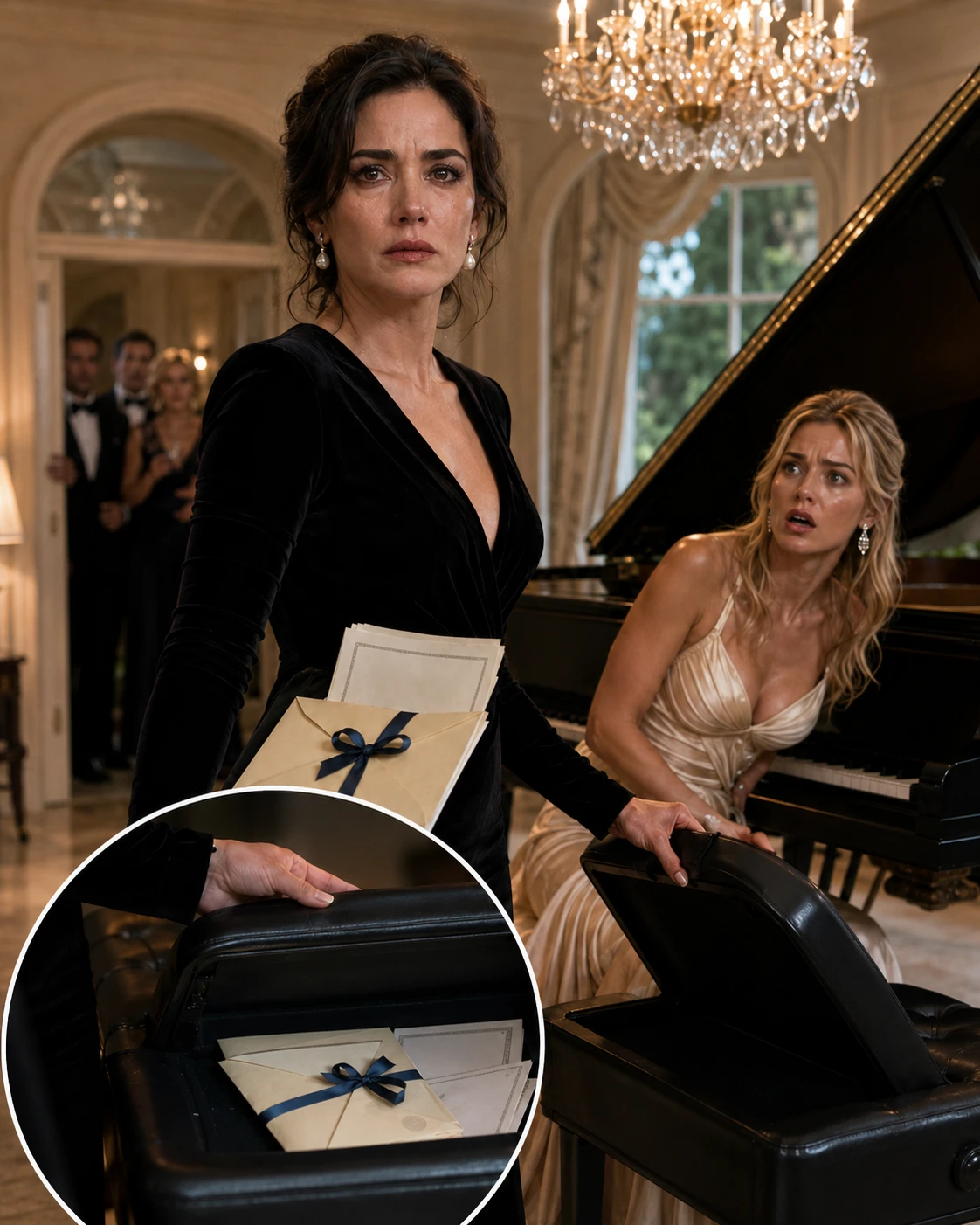
My husband let his mistress sit at my mother’s piano.
Not just any piano.
A midnight-black Steinway grand, polished so deeply it reflected chandeliers like trapped stars, sitting beneath the arched windows of my mother’s music room in our Greenwich estate. The same piano my mother had touched every morning for thirty years. The same piano she played when I was seven and had nightmares, when I was seventeen and thought heartbreak would kill me, when I was thirty-two and signed a marriage license beside a man who smiled like salvation and lied like breathing.
My mother had been dead for nineteen days.
And Celeste Monroe was playing her piano badly.
Her diamond bracelets clicked against the keys. Her red nails flashed. The melody came out crooked and childish, but she smiled at me over the polished wood as if she had just conquered a throne.
Behind her, my husband lifted a glass of champagne.
“Let someone bring music back into this house,” Grayson said.
The room went silent.
Not from shock. From anticipation.
Because everyone in that room knew.
The board members knew. The wives knew. The investors from Manhattan knew. Even the caterers knew. Celeste was not his consultant. She was not his “brand strategist.” She was the woman who wore my husband’s shirts in hotel elevators and tagged the skyline from his private penthouse at two in the morning.
And now she was sitting where my mother used to sit.
Grayson expected me to cry. Celeste expected me to shatter. The room expected a wife to beg for dignity in a house already dressed for her humiliation.
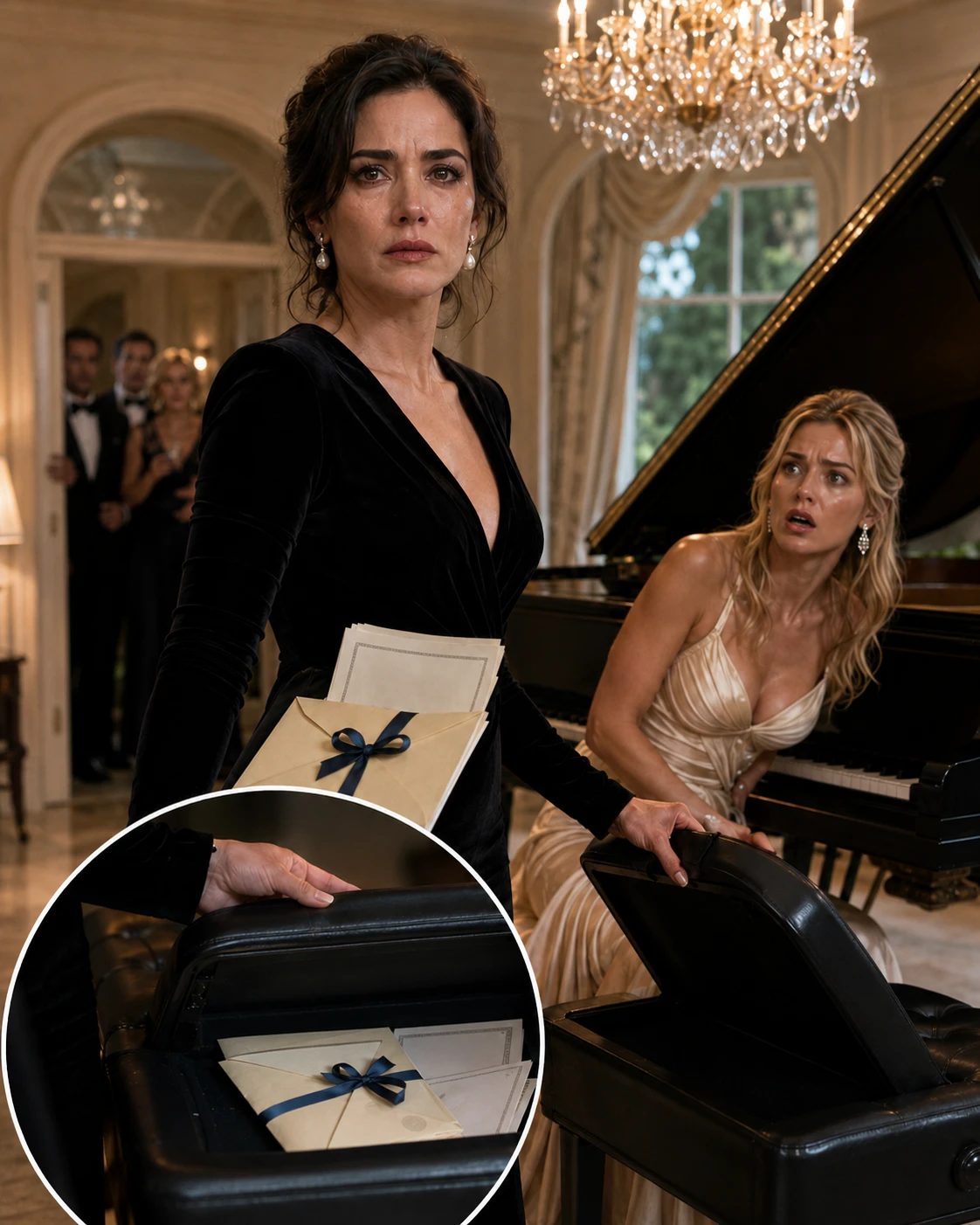
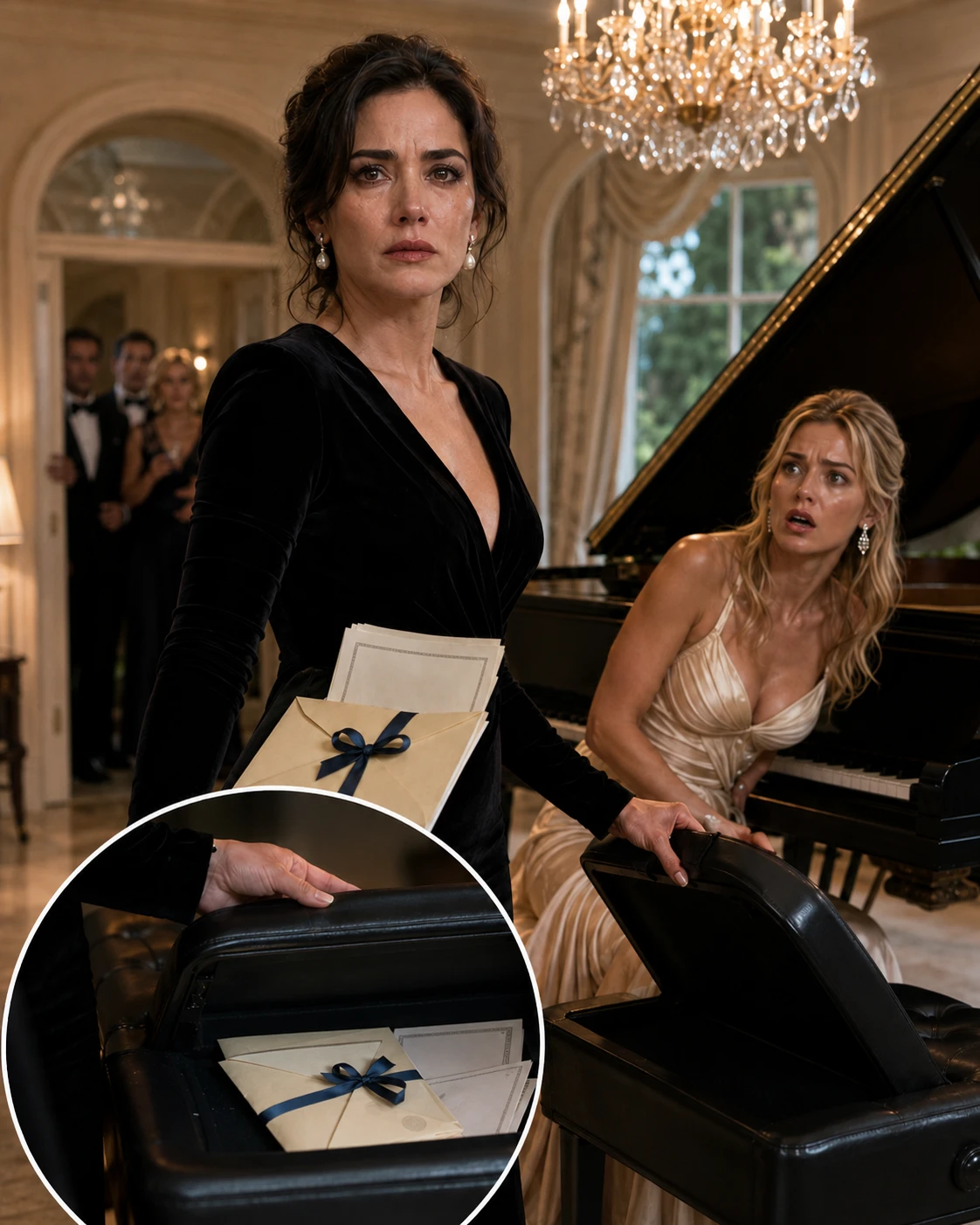
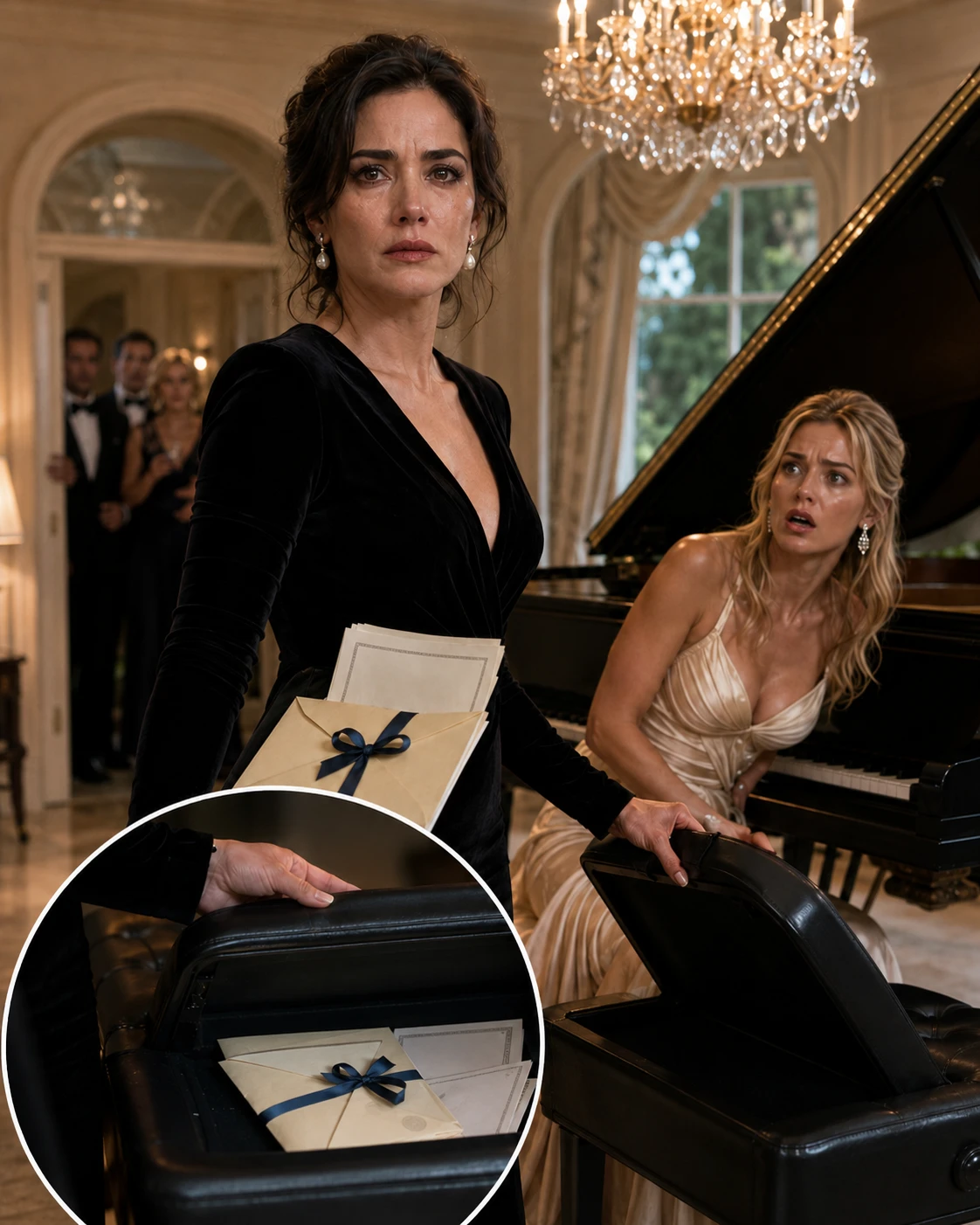
Instead, I walked to the piano.
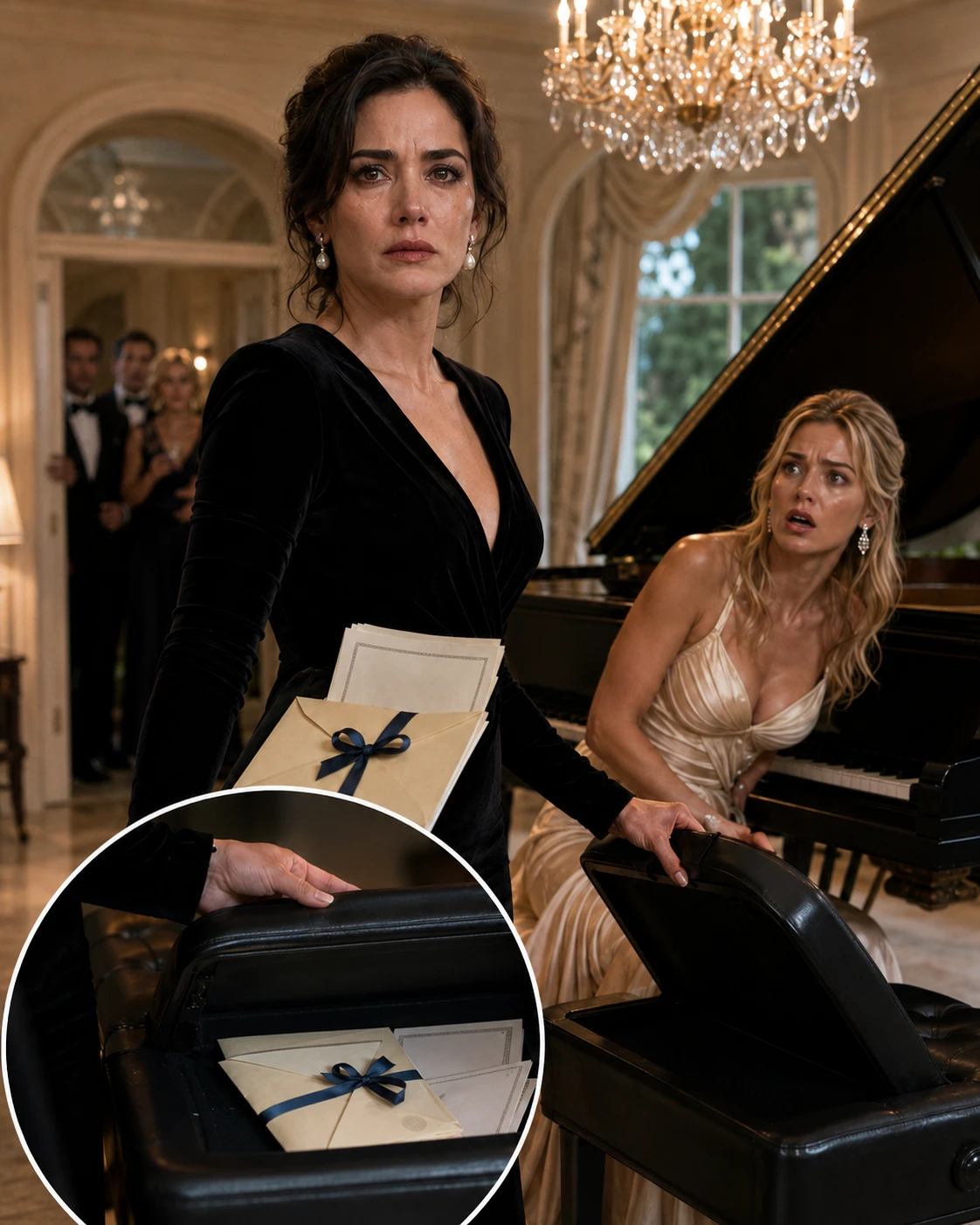
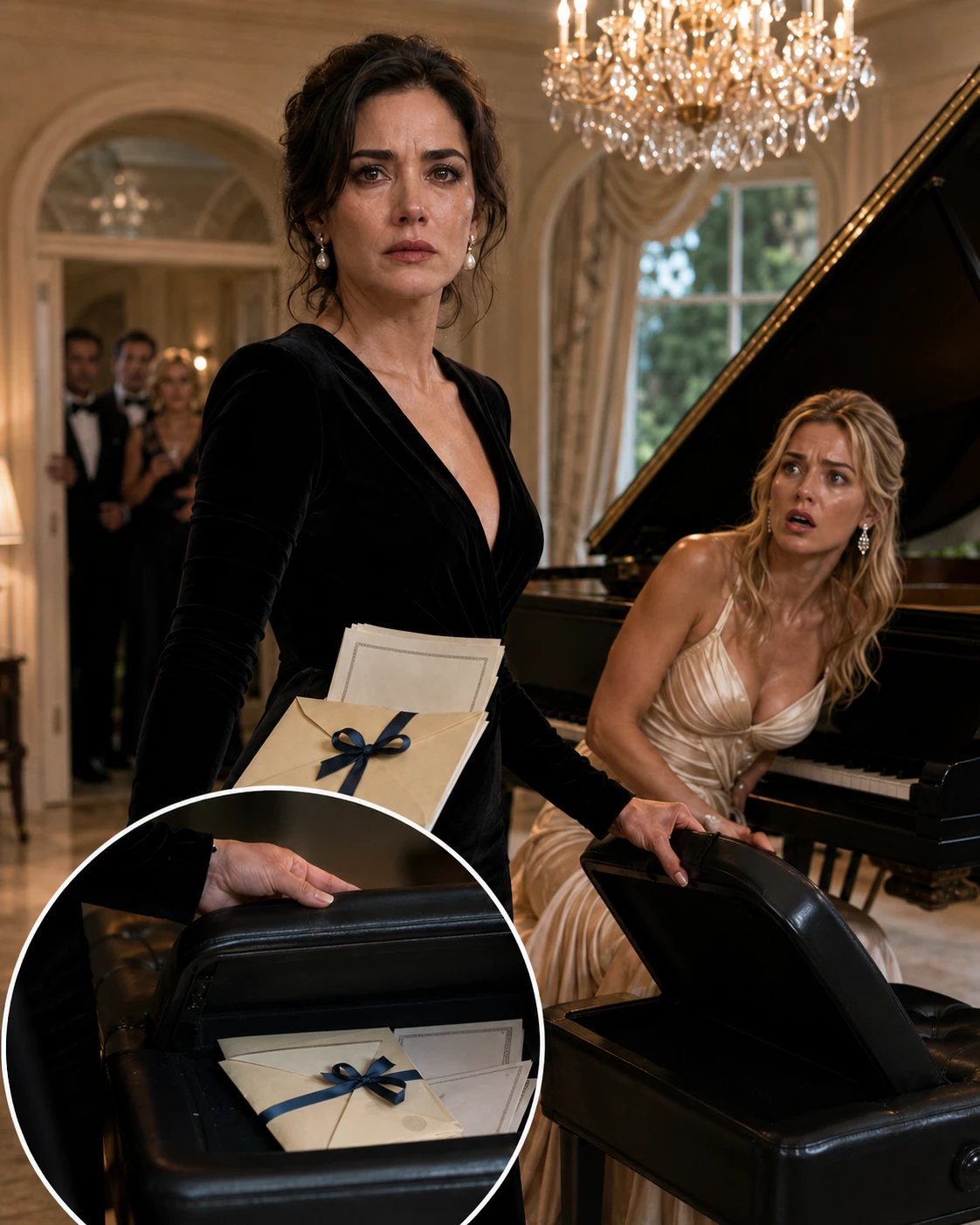
I lifted the bench.
Inside, beneath a stack of yellowed sheet music, was a cream envelope tied with blue ribbon. My mother’s handwriting curved across it in black ink.
ORIGINAL PURCHASE PAPERS — STEINWAY & SONS, 1993.
TRUST SCHEDULE A.
DO NOT REMOVE.
I took out the documents, turned to my husband, and smiled for the first time all evening.
Then I showed him the clause in my mother’s trust.
Nothing in that house belonged to him.
Not the piano.
Not the paintings.
Not the wine cellar.
Not the marble staircase he loved to descend like a king.
Not even the silence.
Chapter 1: The Night She Played My Grief
Three weeks before Celeste touched the piano, my mother died under a white cashmere blanket with my hand in hers and Chopin playing softly from the old record player.
Marjorie Whitaker had not been an easy woman to love from a distance. She was too elegant, too private, too sharp. She wore pearls to breakfast and read legal contracts the way other women read novels. She never raised her voice. She never repeated herself. She could ruin a man’s confidence with one eyebrow.
But up close, she was warmth.
She smelled like bergamot and old books. She called me Nora-bird when no one was listening. She kept every drawing I had ever made in labeled boxes, even the terrible ones with suns in the corner and dogs shaped like potatoes.
She taught me three things.
Never mistake volume for power.
Never marry a man who hates your quiet.
And never sign anything without reading the footnotes.
I failed her on the second one.
Grayson Vail was beautiful in the way expensive disasters are beautiful. Tall, silver at the temples before forty, with pale blue eyes and a voice that made bankers lean forward. He built luxury condominiums in New York, Miami, Aspen. He knew how to enter a room slowly enough for people to notice.
When I married him, he told everyone he had found his anchor.
What he meant was: he had found a harbor.
My name opened doors his ambition could not. My mother’s reputation steadied investors who distrusted his appetite. Our Greenwich estate gave him somewhere to entertain senators, venture capitalists, art collectors, men with watches worth more than childhood homes.
The house had belonged to the Whitaker women for generations. Gray stone, ivy, black shutters, a long drive lined with winter-bare sycamores. My mother named it Bellweather, though Grayson preferred “the Vail estate.”
I corrected him the first time.
He laughed.
By the third year of our marriage, I stopped correcting him in public.
That is how a woman disappears. Not all at once. Not screaming. She disappears by letting small falsehoods pass because dinner is starting, because guests are watching, because correcting him makes him cold in the car.
By the sixth year, Grayson was introducing me as “the quiet force behind everything,” which was a handsome way of saying I had become useful furniture.
Then my mother got sick.
Cancer has a cruel talent for making rich rooms feel poor. The imported marble, the French linens, the silver tea service—none of it mattered when my mother’s hands became fragile beneath mine.
Grayson was attentive for exactly twelve days.
He brought flowers. He kissed my forehead in hallways. He told my mother she was “a legend.” Then the doctors stopped using hopeful words, and his patience began to rot.
He had meetings.
He had flights.
He had late dinners in Manhattan.
He had Celeste.
I found out the way wives usually find out. Not from one dramatic lipstick stain, but from a thousand small insults. A receipt for two at Bemelmans Bar. A hotel charge in SoHo when he told me he was in Boston. A photo Celeste posted of a man’s hand around a glass, his wedding ring cropped badly but not badly enough.
When I showed him, he smiled with pity.
“Nora,” he said, standing in our bedroom while my mother coughed down the hall. “You are grieving. Don’t make yourself ugly with paranoia.”
Ugly.
That was the word that woke something in me.
Not loud. Not explosive.
Something cold and clean.
My mother died on a Tuesday at 4:13 in the morning.
Grayson cried at the funeral.
He cried beautifully.
The photographs were everywhere the next day. Grayson Vail, devastated son-in-law, arm wrapped around his fragile wife. Grayson Vail, pillar of strength. Grayson Vail, honoring the Whitaker legacy.
Nineteen days later, he hosted a private dinner at Bellweather.
I told him it was too soon.
He told me grief was not a lifestyle.
“It’s just twenty people,” he said, adjusting his cufflinks in my mother’s mirror. “Investors. Friends. People who loved your mother.”
“My mother never met half of them.”
“Then let them honor what she built.”
I wore black silk. No jewelry except my wedding ring and my mother’s small pearl earrings. I stood at the top of the staircase while guests filled her house with perfume, bourbon, laughter, and lies.
Celeste arrived at nine.
She wore ivory.
Not cream. Not champagne. Ivory. A soft, bridal, deliberate color that made every woman in the room glance at me and then quickly away.
She was twenty-seven, famous enough online to be dangerous, beautiful in the glossy way people are beautiful when they have never been told no by anyone they needed. Honey-blonde hair, delicate bones, a mouth trained for cameras.
“Nora,” she said, touching my arm as if we were close. “I’m so sorry about your mother. This house must feel so empty now.”
I looked at her fingers on my sleeve.
Then I looked at Grayson.
He did not move.
That was his first mistake.
His second was letting her wander into the music room after dessert.
His third was letting her sit down.
The music room had been my mother’s sanctuary. Floor-to-ceiling windows overlooked the frozen gardens. The shelves held leather-bound scores, first editions, framed photographs of my mother at twenty beside the piano the day it arrived.
Celeste placed her champagne on the Steinway.
A wet ring bloomed on the black lacquer.
Something inside my chest went silent.
She began to play.
Badly.
A few stumbling notes. A wrong chord. A laugh.
“Oh God, I’m rusty,” she said. “Grayson, don’t judge me.”
“I could never,” he said.
The guests gathered at the doorway. Some amused. Some horrified. Some hungry.
Celeste looked over the keys at me.
“Your mother must have been incredible,” she said. “I hope she’d be happy someone is finally playing again.”
Finally.
As though grief had an expiration date.
As though my mother’s absence had become an opening.
That was when Grayson raised his glass.
“Let someone bring music back into this house.”
It was such a small sentence.
Only nine words.
But it stripped me naked in front of everyone.
I saw the future he wanted: Celeste at my mother’s piano, Celeste descending my staircase, Celeste wearing ivory in rooms built by Whitaker women, while I became a sad footnote everyone avoided mentioning.
I walked across the room.
My heels made no sound on the antique rug.
“Move,” I said.
Celeste blinked. “Excuse me?”
“From the bench.”
Grayson’s expression hardened.
“Nora,” he warned softly.
There it was. The husband’s leash, disguised as concern.
I opened the bench myself. Celeste had to lift her hands quickly or I would have caught her fingers beneath the lid.
Inside were my mother’s things. Chopin nocturnes. A silk scarf. A fountain pen. The cream envelope.
I untied the ribbon.
Grayson laughed once, quietly, for the room.
“My wife has always had a flair for theater.”
“No,” I said. “My mother did.”
I unfolded the original purchase papers first.
Then the trust schedule.
Then the clause.
My mother had underlined it in blue ink.
All instruments, artworks, furnishings, fixtures, silver, jewelry, books, wines, vehicles, and real property known as Bellweather Estate are held solely and irrevocably by the Marjorie Whitaker Family Trust for the benefit of Eleanor Marjorie Vail, née Whitaker. No spouse, partner, creditor, guest, or occupant shall acquire ownership, equity, control, use-right, lien, claim, or possessory interest by marriage, residence, contribution, maintenance, improvement, display, hosting, publicity, or representation.
I handed it to Grayson.
His face changed before he could stop it.
Just a flicker.
A little death behind the eyes.
I leaned close enough that only he and Celeste could hear me.
“You built your kingdom in my mother’s house,” I said. “You forgot to check the foundation.”
Chapter 2: The Woman Who Learned to Sign in Silence
Grayson did not shout that night.
Men like him never shout when witnesses are useful.
He smiled, folded the papers, and handed them back as if I had shown him a charming family relic.
“Of course,” he said to the room. “Marjorie was meticulous. We all knew that.”
We all knew that.
The lie was elegant. Almost worthy of him.
Celeste stood from the piano bench, cheeks flushed beneath her makeup. For one second, I saw fear in her. Not guilt. Fear. There is a difference.
Guilt looks inward.
Fear checks who owns the exits.
The dinner ended early.
Guests murmured condolences. Women squeezed my hands too hard. Men avoided Grayson’s eyes. Celeste disappeared into the powder room, then out through the side entrance.
At midnight, Grayson found me in my mother’s study.
I had placed the documents on her desk beneath the green banker’s lamp. The room still smelled like her: paper, bergamot, wood smoke.
He closed the door.
“Do you have any idea what you did?” he asked.
I looked up. “Yes.”
“You embarrassed me in front of investors.”
“You embarrassed me in front of my dead mother’s piano.”
His jaw tightened.
“You think a trust clause makes you powerful?”
“No,” I said. “I think your reaction does.”
He stared at me for a long moment, then smiled.
That smile used to make me feel chosen.
Now it looked like a knife deciding where to enter.
“You’ve had a hard month,” he said. “I’m going to forgive this.”
“How generous.”
“But don’t confuse grief with leverage, Nora. You don’t understand my world.”
There it was again.
My world.
As though I had not spent eight years standing beside him while he performed intelligence borrowed from other people’s money.
He walked toward the desk, picked up the trust schedule, and glanced over it.
“You know,” he said, “houses are expensive to maintain. Staff, taxes, insurance. Your mother’s old money romance doesn’t run itself.”
“The trust does.”
His eyes lifted.
For the first time that night, he looked uncertain.
Just a fraction.
I held onto it like a match in the dark.
After he left, I sat in my mother’s chair until dawn.
At six in the morning, while the sky over Greenwich turned the color of pewter, I called the number my mother had written on the back of the envelope.
Elias Hart answered on the second ring.
“Nora,” he said, voice low and careful. “I wondered when you’d find it.”
Elias had been my mother’s trust attorney for twelve years. He was forty-one, composed, and almost offensively calm. The kind of man who wore charcoal suits without looking like the suit owned him. He had dark hair, tired eyes, and the inconvenient habit of telling the truth even when comfort would have been kinder.
I had not seen him since the reading of my mother’s will.
At the funeral, he had stood in the back of the church, hands folded, watching Grayson with an expression I did not understand then.
Now I did.
“What else is in the trust?” I asked.
A pause.
“Come to my office.”
“Tell me.”
“Nora.”
“Tell me enough.”
He exhaled.
“Your mother protected more than the house.”
By nine, I was in Manhattan.
Elias’s office overlooked Bryant Park, all glass and dark walnut. He did not offer condolences again. I was grateful. Condolences had become a kind of social currency people spent to feel generous.
He placed a leather folder on the table.
“My mother knew?” I asked.
“She suspected.”
“About Celeste?”
“About Grayson.”
The folder contained copies of documents I had never seen. Loan agreements. Private investment memoranda. Property transfers. Board minutes. A postnuptial confirmation agreement with my signature and his.
I remembered signing it two years earlier in Palm Beach after Grayson insisted it was a “tax housekeeping issue.”
My mother had insisted her lawyer review it.
I had been annoyed then.
I wanted to apologize to a dead woman.
Elias tapped one document.
“Grayson borrowed against projected revenue from three developments. When traditional lenders hesitated, he used reputation as collateral.”
“My reputation.”
“Your mother’s.”
The room sharpened.
“How much?”
“Enough to make a proud man desperate.”
He slid another paper forward.
“Your mother quietly purchased a controlling portion of the debt through a holding company.”
I stared at him.
“What holding company?”
“Blue Heron Capital.”
The name meant nothing to me.
“It’s yours now,” he said.
The words did not land all at once.
They fell slowly, like black snow.
“My mother owned his debt?”
“Not all of it. The worst of it.”
“And Grayson knows?”
“No.”
I laughed once.
It sounded unlike me.
Elias watched me carefully. “There’s more.”
Of course there was. My mother had never brought a knife when she could bring a cathedral full of hidden blades.
He opened a second folder.
“The trust contains a conduct trigger. Not morality, exactly. Your mother knew courts dislike emotion. So she used money.”
“Explain.”
“Any attempt by Grayson to represent trust assets as his own for financing, publicity, investor confidence, collateral, sale, or personal advancement triggers an audit and immediate revocation of his residential license.”
“He’s been calling Bellweather the Vail estate for years.”
“Publicly?”
I thought of interviews, magazine spreads, investor decks, fundraisers, charity galas.
“Yes.”
“Good.”
The word should have disturbed me.
Instead, it warmed me.
Elias continued.
“If he used the estate, art, furnishings, or Whitaker name to secure financing, and especially if he misrepresented ownership, we can demand records. If we find fraud, we can move fast.”
“How fast?”
His eyes met mine.
“As fast as you are willing to stop being polite.”
That sentence changed my life.
Not because it gave me permission.
Because it reminded me I had never needed it.
For the next six weeks, I became the easiest wife in Connecticut.
I smiled at breakfast.
I wore navy to investor lunches.
I let Grayson believe the piano incident had embarrassed me into obedience.
Celeste returned slowly at first. A comment on his posts. A photograph from the same restaurant. Then boldly: seated beside him at a charity auction in Tribeca, wearing emerald earrings he had not bought with his money.
He wanted me to react.
I did not.
I learned silence from my mother, but I perfected it in marriage.
Every morning, I went through documents with Elias and his forensic accountant, Tessa Grant, a woman with silver braids and the cheerful ruthlessness of a surgeon.
Every afternoon, I visited storage rooms my mother had cataloged better than museums. Paintings insured separately. Wine acquired before Grayson knew Bordeaux from Burgundy. Antique silver. First editions. Jewelry. Land parcels in Vermont. Mineral rights in Pennsylvania. A forgotten brownstone in Brooklyn Heights.
Hidden assets, people call them.
But my mother had not hidden them.
She had simply placed them where greedy men never look: in women’s names, in footnotes, in plain sight behind things they assume are decorative.
The piano bench held the first envelope.
The second was behind my mother’s portrait.
The third was in the false bottom of a silver chest.
Each one gave me another piece of the map.
Grayson, meanwhile, planned his masterpiece of cruelty.
A spring gala at Bellweather.
Two hundred guests.
Investors, donors, influencers, press.
The announcement of his newest luxury development: The Marjorie, a glass tower on the Hudson named, without my permission, after my mother.
“It honors her,” he said when I confronted him.
“It exploits her.”
“It saves us.”
Us.
He only remembered the word when debt entered the room.
The invitation featured a photograph of my mother’s piano.
Celeste posted it first.
So honored to bring music back to Bellweather this spring.
That caption went viral in our small, poisonous world.
Society pages called it “a touching tribute.”
Influencers called it “romantic.”
One anonymous comment said: Isn’t that his wife’s dead mom’s piano?
Celeste replied with a white heart.
That night, I stood alone in the music room and placed my hand on the Steinway.
For the first time since my mother died, I pressed a key.
Middle C.
One note.
Clear. Patient. Unforgiving.
Chapter 3: Silk Gloves, Steel Evidence
The week before the gala, Grayson gave me a necklace.
Diamonds, obviously.
Men who lack imagination always apologize with stones.
The necklace came in a blue velvet box, delivered to my dressing room by a maid who could not meet my eyes. I opened it and found a cascade of pear-shaped diamonds designed to sit at the throat like frozen tears.
A note lay beneath.
For my graceful wife. Let’s begin again. — G.
I photographed the necklace, the box, the invoice tucked inside by mistake, and sent everything to Tessa.
Her reply arrived three minutes later.
Company account. Not personal. He’s using investor funds for gifts now. Keep smiling.
So I did.
That evening, Grayson fastened the necklace around my neck himself.
His fingers brushed my skin.
Once, that touch would have made me lean back into him.
Now it felt like being handled by a man appraising a vase.
He met my eyes in the mirror.
“You look like yourself again,” he said.
“I was wondering where I’d gone.”
He laughed, not hearing me.
“You’re going to be wonderful at the gala.”
“Am I?”
“You always are when you remember what matters.”
“What matters, Grayson?”
“Our future.”
He kissed my shoulder.
Behind us, in the reflection, I watched his phone light up.
Celeste.
Can’t wait for our night.
Our night.
I smiled.
The next morning, Elias filed the first notice.
Not publicly. Not yet.
A private demand for records sent to Grayson’s corporate counsel concerning the use of Whitaker Trust assets in financing materials. At the same time, Tessa traced payments to Celeste through three shell vendors.
Monroe Media Strategy.
CM Creative.
White Key Events.
White Key.
Even her fake company mocked my mother’s piano.
The payments totaled $740,000 over eighteen months.
Consulting fees, Grayson called them.
Hotel rooms, couture, travel, jewelry, and a leased Bentley, the bank records replied.
There was more.
Grayson had used photographs of Bellweather in investor decks, calling it a “Vail family asset.” He listed the estate as “available for hospitality, donor cultivation, and collateral support.” He included the art collection in a private net-worth statement.
He had offered what was not his.
Worse, he had offered what was mine.
The final evidence came from Celeste herself.
People who perform intimacy for strangers eventually forget the camera is not their friend.
Three days before the gala, she posted a reel from inside the music room. She wore a silk robe I recognized.
Mine.
She whispered to her followers, “Sometimes you don’t steal a life. Sometimes you step into the one you were meant for.”
Then she turned the camera toward the piano.
On top of it sat a stack of papers.
The gala program.
A seating chart.
And behind it, reflected in the lacquer, Grayson kissing her neck.
The internet noticed.
By noon, the clip had been shared across gossip accounts.
By two, Grayson’s office issued a statement claiming it was “misinterpreted promotional content.”
By four, my phone had 173 unread messages.
I answered none of them.
At six, Grayson came home furious.
He found me in the greenhouse cutting white roses for the gala centerpieces.
“You knew,” he said.
I clipped a stem.
“About what?”
“Don’t do that.”
“Do what?”
“Act stupid. It doesn’t suit you.”
I smiled faintly. “Finally. A compliment.”
His face darkened.
“You let this happen.”
“I didn’t film you.”
“You could have shut it down.”
“I’m not your publicist.”
“You’re my wife.”
The roses smelled sweet and bruised.
“For now,” I said.
He stepped close enough that his shadow fell over my hands.
“You think you’re winning because people feel sorry for you online? Sympathy is cheap, Nora. Power is expensive.”
I placed the scissors on the table.
“You would know. You’ve been buying yours with my mother’s name.”
For a moment, he looked like he might break something.
Then his phone rang.
He checked the screen.
His face went pale.
It was his lawyer.
I knew because mine had just pressed the first blade.
Grayson left the greenhouse without another word.
The gala was not canceled.
Men like Grayson cannot retreat from stages. They confuse applause with oxygen.
Instead, he doubled down.
He gave interviews.
He called The Marjorie “a tribute to the women who shaped me.”
He described Bellweather as “our family home.”
He announced a surprise performance by Celeste Monroe, “a dear friend of the foundation.”
A dear friend.
Of the foundation.
My mother would have laughed until her pearls shook.
On the morning of the gala, Elias arrived at Bellweather with two associates and a sealed black portfolio.
He found me in the music room.
I was wearing a gown my mother had bought in Paris and never worn. Black velvet, long sleeves, no sparkle except the diamond necklace Grayson had purchased with stolen funds.
Elias stopped in the doorway.
For one unguarded second, he looked not like a lawyer, but like a man.
“You look dangerous,” he said.
“I look inherited.”
“That too.”
His eyes moved to the piano.
“Are you ready?”
I looked at the keys.
My mother’s hands had been slender, veined, strong. I used to watch them move and think music lived under her skin.
“No,” I said. “But I am prepared.”
He handed me the portfolio.
“The revocation notice. The debt position. The injunction draft. The forensic summary. Copies of the misrepresentation exhibits. Everything you need.”
“Everything?”
“Almost.”
I looked up.
“There is one document your mother instructed me not to give you unless Grayson crossed a particular line.”
“What line?”
Elias’s expression softened.
“The piano.”
My throat closed.
He removed a sealed envelope from inside his coat.
My name was written on it in my mother’s hand.
I did not open it.
Not yet.
Some weapons deserve ceremony.
Chapter 4: The Gala of Beautiful Ruins
By eight o’clock, Bellweather glittered like a jewel box held over a grave.
Black cars lined the drive. Valets moved through mist. Women in satin climbed the steps beneath gas lanterns. Men laughed too loudly in the foyer, relieved that scandal had become entertainment instead of danger.
The house had been transformed.
White roses everywhere.
Champagne towers.
Gold-rimmed glasses.
A string quartet beneath the balcony.
Photographers near the marble staircase.
And in the music room, my mother’s piano stood under a single crystal chandelier, waiting.
Grayson was magnificent that night.
I will give him that.
He wore a black tuxedo and the expression of a man who had survived rumors by refusing to look ashamed. He held court beside a scale model of The Marjorie, all glass and ambition, while investors nodded and pretended not to wonder whether his wife would throw wine in public.
Celeste arrived at nine.
Gold dress.
No shame.
Around her neck, she wore my mother’s emerald pendant.
The one missing from the safe.
For the first time all evening, my hand trembled.
Elias saw.
He stepped beside me without touching me.
“Breathe,” he said.
“She’s wearing my mother’s necklace.”
“I know.”
I looked at him.
His voice was very quiet.
“We documented it when she entered.”
A laugh rose in my chest. Not happy. Not sane. But real.
Of course.
Documented.
My new favorite love language.
Grayson approached with Celeste on his arm.
There are moments when humiliation becomes so complete it turns almost holy. The room saw them coming. Saw me standing alone beneath my ancestors’ portraits. Saw the wife. The mistress. The husband who thought proximity could rewrite ownership.
“Nora,” Celeste said, touching the emerald at her throat. “I hope tonight can be healing.”
“Healing for whom?”
Her smile flickered.
Grayson lowered his voice.
“Do not start.”
I looked at the pendant.
“Did he tell you that belonged to my mother?”
Celeste lifted her chin.
“He said she would have wanted beauty to be worn, not locked away.”
The audacity was almost art.
“My mother locked things away,” I said, “when they were valuable.”
Grayson’s hand tightened on Celeste’s waist.
“Enough.”
I looked at him then.
Really looked.
Eight years of marriage. Eight years of dinners, flights, charity photographs, cold mornings, warmer lies. I searched for the man I thought I married and found only the man my mother had warned me about.
“Not yet,” I said.
At ten, Grayson took the stage in the ballroom.
The guests gathered with champagne. Cameras lifted. Celeste stood near the piano, glowing under attention.
I stood beside Elias at the edge of the room.
Grayson began with grief.
“My late mother-in-law, Marjorie Whitaker, believed beauty was a responsibility,” he said.
My fingers curled around the black portfolio.
“She taught us that legacy is not what we keep, but what we build.”
He gestured to the model of his tower.
“Tonight, I am proud to announce The Marjorie, a residence that will carry her spirit into the skyline of New York.”
Applause.
Soft, uncertain, expensive applause.
“And now,” he continued, “someone very special will honor Marjorie in the room she loved most.”
Celeste walked to the piano.
She sat.
The same bench.
The same smile.
My mother’s emerald at her throat.
Her hands hovered over the keys.
I stepped forward.
“Before she plays,” I said, “I’d like to say something.”
The room turned.
Grayson’s smile froze.
“Nora,” he said into the microphone, charming and warning at once, “of course.”
I walked to the stage.
He did not give me the microphone.
So Elias did.
That was when the room understood something had shifted.
Not loudly.
Power rarely enters shouting.
It enters with paperwork and a man in a dark suit who knows where the bodies are buried.
I faced the guests.
“Thank you for coming to Bellweather,” I said. “My mother loved this house. She loved music. She loved beauty. But more than anything, she loved precision.”
A few polite laughs.
I held up the first document.
“This is the trust schedule proving that Bellweather Estate, including the piano in the next room, belongs solely to the Marjorie Whitaker Family Trust.”
Grayson moved toward me.
Elias stepped between us.
The room inhaled.
“This is not a marital asset,” I continued. “It is not a Vail property. It is not available for collateral, branding, investor hospitality, or emotional theater.”
A murmur moved through the ballroom.
I held up the second document.
“This is a record of investor materials in which my husband represented trust property as his own.”
Grayson’s face hardened.
“Nora, stop.”
I looked at him.
“You asked someone to bring music back into this house. I’m introducing the sheet music.”
A ripple went through the crowd.
Phones lifted higher.
I opened the portfolio.
“These are payments totaling seven hundred and forty thousand dollars made from corporate accounts to companies controlled by Celeste Monroe.”
Celeste stood so quickly the piano bench scraped the floor.
“That’s a lie.”
“It’s an exhibit.”
Tessa, stationed near the side doors in a silver suit, smiled as if she had been waiting her whole life for that sentence.
I held up another page.
“These are invoices for personal travel, luxury goods, hotel stays, and jewelry.”
Celeste touched the emerald unconsciously.
“Speaking of jewelry,” I said, turning to her, “that pendant belongs to the trust. Security will collect it before you leave.”
The ballroom erupted.
Not loudly at first. A gasp here. A curse there. A laugh from someone who had hated Grayson longer than I had known him.
Grayson reached for the microphone.
I let him take it.
A desperate man should always be allowed to speak.
“My wife,” he said, voice smooth but thin, “is grieving. This is a private marital matter, and I apologize to all of you for—”
“No,” I said.
Just that.
No.
It landed harder than a scream.
“This stopped being private when you placed my mother’s name on a tower, my mother’s piano on an invitation, my mother’s necklace on your mistress, and my mother’s house in your debt documents.”
The cameras were everywhere now.
Good.
Let them have it.
Let the world watch a quiet woman become inconvenient.
Elias took the microphone from Grayson’s hand.
“As counsel for the Marjorie Whitaker Family Trust,” he said, “I have served notice revoking Mr. Vail’s license to reside at Bellweather Estate, effective immediately. We have also notified relevant lenders and regulatory counsel of potential misrepresentations in financing materials.”
Grayson stared at him.
“You can’t do this.”
Elias’s expression did not change.
“We already did.”
Then came the part Grayson did not expect.
I turned to the investors.
“Blue Heron Capital now controls the senior debt on three Vail developments, including The Marjorie.”
Silence.
Pure. White. Absolute.
Grayson’s mouth opened.
Nothing came out.
I smiled then.
Not wide.
Just enough.
“My mother purchased the position before she died. I inherited it. As of this afternoon, after default notices your office ignored, Blue Heron has exercised its rights.”
One of the investors whispered, “Jesus Christ.”
I looked at the model of The Marjorie.
“The tower will not be called The Marjorie. My mother’s name will not be used to sell apartments to men who think women are foundations they can pour concrete over.”
Grayson recovered enough to laugh.
It was ugly.
“You think you can run a development portfolio?”
“No,” I said. “I think I can hire people who don’t steal from it.”
That got the first real sound from the crowd.
A laugh.
Then another.
Then a wave of them.
Not at me.
At him.
Public humiliation is a blade men enjoy holding until they realize it has two edges.
Celeste began crying.
Beautifully, of course. She had talent after all.
“I didn’t know,” she said, looking at the cameras instead of me. “I swear I didn’t know about the money.”
I looked at her.
“You knew the piano wasn’t yours.”
Her tears stopped.
That was all I needed.
Security entered quietly. Two women in black suits, one man behind them. Celeste clutched the emerald pendant.
“This is insane,” she said.
“It is insured,” I replied. “There’s a difference.”
Grayson stepped off the stage and came close enough that I could smell his cologne.
For once, there was no audience in his eyes.
Only hatred.
“You’ll regret this,” he said.
I leaned in.
“No, Grayson. I regretted you. This is what comes after.”
Chapter 5: The Final Clause
The video hit ten million views before sunrise.
By breakfast, I was no longer “the grieving wife.”
I was “the piano wife.”
By lunch, I was a meme, a headline, a warning, a fantasy, a debate topic, and according to one finance podcast, “the most elegant hostile takeover of the year.”
Celeste posted a tearful apology from an undisclosed location.
Comments were not kind.
Grayson’s board issued a statement distancing itself from “individual conduct inconsistent with company values,” which is corporate language for lighting the lifeboats on fire before pretending the ship sank itself.
By evening, two lenders called Blue Heron.
By midnight, Grayson’s attorney requested mediation.
I slept for nine hours in my mother’s room.
For the first time since she died, I dreamed of music.
Not the piano. My mother humming in the kitchen, barefoot, making coffee badly because she believed talent in one room excused failure in another.
The next morning, Elias came to Bellweather.
The staff had already removed Grayson’s belongings from the primary suite and packed them into monogrammed trunks he had purchased with my credit line.
They looked smaller in the foyer.
Pathetic, almost.
A life reduced to luggage.
Elias found me in the music room with the sealed envelope my mother had left.
I had waited.
Not because I was afraid.
Because I knew opening it would make her dead again in a new way.
“Do you want privacy?” he asked.
“No.”
He sat beside me on the piano bench.
Not too close.
Close enough.
I opened the envelope.
Inside was a letter, two pages, and a final legal addendum.
My daughter,
If you are reading this, then he touched the piano.
Not physically, perhaps. Men like Grayson often make others do the desecration. But if this envelope is in your hands, he has mistaken your grief for weakness and my house for inheritance.
Forgive yourself first.
I know you will blame yourself for loving him. Do not. Love is not foolish because someone else used it badly.
But listen to me now.
A man who humiliates you in rooms you helped build is not asking for forgiveness. He is checking the locks.
Change them.
I cried then.
Quietly.
Elias turned his face toward the windows and let me.
I kept reading.
There is a final clause attached. I wrote it because your father once told me I was too sentimental about beautiful things. He was wrong. Beautiful things are how women hide knives from men who only inventory weapons.
The Steinway is not valuable because it is rare.
It is valuable because I bought it the morning after your father left me.
You were six months old. I had twenty-one dollars in my handbag, a crying baby, and a family full of men explaining what I could not do alone.
So I sold a necklace I hated, bought the piano on credit, and taught lessons in our parlor until I owned every note of it.
That piano fed us before the trust did.
It is not furniture.
It is proof.
Proof that women survive. Proof that money can be rebuilt. Proof that elegance is not softness.
If Grayson ever lets another woman perform in your grief, do not fight for the room.
Own the house.
The legal addendum trembled in my hands.
Elias read it with me.
The final clause was simple.
If any spouse of Eleanor Marjorie Whitaker Vail publicly represented, exploited, damaged, transferred, encumbered, or permitted unauthorized ceremonial use of the Steinway grand piano for the purpose of humiliating, replacing, coercing, or commercially benefiting from Eleanor during a period of bereavement, then the trustee was directed to release all remaining restricted assets to me immediately.
Remaining restricted assets.
I looked at Elias.
“How much?”
He took a breath.
“Enough.”
“That’s not a number.”
“No,” he said gently. “It is not.”
I stared at him.
He smiled for the first time since I had known him.
“The brownstone. Two investment accounts. The Vermont land. A private art fund. And your mother’s personal shares in Whitaker Lane, which Grayson believed were dissolved in the nineties.”
Whitaker Lane.
The old family company.
The one Grayson had tried to revive through licensing deals.
“My mother still owned it?”
“Your mother owned the name.”
I laughed through tears.
Of course she did.
Of course my mother had kept the one thing no man in America seems able to resist.
A name.
“What does that mean for Grayson?”
Elias folded the addendum neatly.
“It means every project, pitch deck, donor event, investor dinner, media appearance, and luxury proposal using the Whitaker name without authorization becomes actionable.”
I looked toward the piano.
Sunlight moved across the black lacquer.
For one breath, I could almost see my mother there.
Pearls. Sharp eyes. Warm hands.
“I thought the gala was the end,” I said.
“No,” Elias replied. “It was notice.”
The lawsuits took months.
The divorce took eleven.
Grayson fought everything.
Then he settled everything.
That is what men like him do when discovery becomes a locked room and the key is held by a woman they underestimated.
Celeste sold interviews until the public grew bored of her tears. The emerald pendant returned to the safe. The Steinway was professionally restored where her champagne glass had scarred the finish. The mark disappeared.
I did not.
Blue Heron Capital survived. Then it grew.
I hired Tessa as chief financial officer because any woman who can make fraud look embarrassed deserves equity.
The Marjorie became The Whitaker House, but not a luxury tower. We converted the project into residences for women leaving abusive marriages, with legal aid offices on the second floor and a childcare center named after my mother on the third.
The investors hated it until the tax credits arrived.
Then they called it visionary.
Men are often moral after the numbers improve.
As for Bellweather, I opened the music room every Sunday afternoon.
Not for society.
For girls from public schools in Bridgeport and New Haven, for widows who had stopped singing, for women who wanted to sit in a beautiful room without being asked what they brought to it.
Sometimes I played.
Badly, at first.
Then less badly.
Elias came often, always standing in the back with coffee and legal pads he pretended to read. He never rushed my grief. Never tried to turn my survival into romance before I had learned to belong to myself again.
One winter evening, almost a year after the gala, he found me at the piano after everyone had left.
Snow fell beyond the windows.
The house was quiet, but not empty.
“You’re getting better,” he said.
“You’re getting worse at lying.”
“I’m a lawyer. That would be concerning.”
I smiled.
He came closer.
On the music stand lay my mother’s favorite Chopin nocturne, still too difficult for me, still waiting.
“Do you miss him?” Elias asked.
The question did not hurt.
That surprised me.
“I miss who I was when I believed him,” I said. “But I don’t miss being her.”
He nodded, as if that made perfect sense.
Perhaps it did.
I looked around the room.
At the restored piano.
At the portraits.
At the place where Celeste had smiled at me over my mother’s keys.
Memory no longer felt like a knife there.
It felt like architecture.
Something I could walk through without bleeding.
“My mother said beautiful things are how women hide knives,” I told him.
Elias looked at the piano.
“She was right.”
“No,” I said, placing my hands on the keys. “She was incomplete.”
He glanced at me.
I played one note.
Then another.
Then a third.
Not well enough to impress anyone.
Well enough to begin.
“Beautiful things are also how women heal.”
Conclusion: What Remained After the Fire
People still ask me why I did it so publicly.
Why not settle quietly?
Why not protect the family name?
Why not spare myself the spectacle?
The answer is simple.
Humiliation is never private when it is designed for an audience.
So neither should recovery be.
Grayson wanted witnesses when he replaced me.
I wanted witnesses when I remembered myself.
There is a particular kind of freedom that arrives after the worst thing you feared has already happened. After they laugh. After they whisper. After the photographs circulate. After your pain becomes content for people eating breakfast in other cities.
You discover shame has a ceiling.
And above it, there is air.
I do not believe revenge healed me.
Revenge is only the door.
Justice is the hallway.
Peace is the room you build afterward.
My mother’s piano still sits beneath the arched windows at Bellweather. Children touch its keys now. Women play songs they thought they had forgotten. Sometimes, on quiet mornings, sunlight spills across the lacquer, and I see not the night Celeste played badly, but the morning my mother bought it with borrowed courage and a baby waiting at home.
Grayson once told me power was expensive.
He was wrong.
Power is inherited in strange ways.
Sometimes through money.
Sometimes through documents.
Sometimes through a mother who knows the man you married will mistake silence for surrender and leaves you a clause sharp enough to cut your life open.
Sometimes power is a black piano, a blue ribbon, a trust schedule, and a daughter finally willing to read every footnote.
The mistress performed in the wife’s grief.
The wife performed the final clause.
“She touched the piano. I played the will.”