Part 2
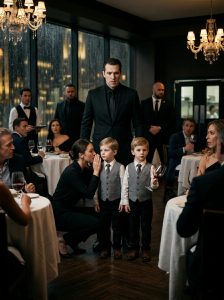
The gun appeared first.
A small black mouth between the swinging kitchen doors, pointed directly at Marcus DeLuca’s heart.
For one impossible second, nobody moved.
The restaurant held its breath. The storm pressed its wet hands against the windows. Somewhere near the bar, a woman made a tiny sound and then covered her mouth as if fear itself could betray her.
Marcus did not duck.
That was the thing about men like him. They believed death would announce itself properly. They believed danger owed them respect.
But six-year-old Luke heard what the rest of us could not.
The shooter’s finger tightening.
The leather glove creaking.
The faint click inside the gun.
Luke screamed, “Down!”
I grabbed both boys by their jackets and threw myself beneath the table.
The first shot shattered the wine bottle in front of Marcus.
Glass exploded like red rain.
Marcus’s bodyguards lunged. One slammed into him, knocking him sideways behind the heavy velvet booth. The other drew his weapon so fast I barely saw his hand move.
People screamed.
Chairs fell.
Silverware scattered across marble.
The kitchen doors burst fully open, and the man in the black coat fired again.
This time the bullet struck the chandelier above Table One.
Crystal rained down.
Matthew curled against me, shaking hard enough that I felt it in my ribs. Luke was not crying. His eyes, pale and unfocused, were wide open, fixed on nothing, listening to everything.
“There’s another one,” he whispered.
My blood turned cold.
“What?”
Luke’s small hand gripped my sleeve.
“Not him. Another man. By the piano. He stopped breathing when the gun fired.”
I looked.
Near the baby grand piano, a middle-aged man in a navy suit crouched with the other terrified diners. His face was turned downward. His hands were hidden beneath his jacket.
I saw the outline then.
A second weapon.
“Marcus!” I shouted.
He turned his head toward me, fury and disbelief cutting through the chaos.
“Piano!”
Marcus’s eyes moved.
His bodyguard moved faster.
The second man rose with a silenced pistol in his hand, but the bodyguard fired first. The shot cracked through the restaurant, deafening and final. The man collapsed against the piano keys, and a violent, ugly chord filled the room.
Matthew whimpered.
Luke pressed both palms to his ears.
The first shooter cursed in Italian and backed toward the kitchen.
Marcus came out from behind the booth like something carved from darkness.
“Alive,” he ordered.
His men surged forward.
The gunman turned to run.
And then Matthew spoke.
“He’s not running away,” the boy said. “He’s counting.”
No one understood.
I did.
I heard it then too.
Not with the precision the twins had, but enough.
A beep.
Soft. Mechanical. Buried somewhere beneath the storm, beneath the screams, beneath the ringing in my skull.
Beep.
Beep.
Beep.
“Bomb,” I breathed.
Marcus froze.
The word moved through the restaurant like poison dropped into water.
The gunman smiled.
His mouth was bloody from where someone had struck him, but he smiled as if he had already won.
“Too late,” he said.
I looked at Matthew. His small face had gone perfectly still.
“Where?” I asked him.
Marcus rounded on me. “What the hell are you doing?”
But I did not look away from the child.
“Matthew. Listen. Where is it?”
His lips parted. His head tilted slowly, painfully, as if the whole room had become a map made of noise.
The rain. The cooling vents. Crying. The ticking from a hundred expensive watches. The low hum of refrigerators beyond the kitchen. The bodyguard’s breath. Marcus’s heartbeat, maybe. Mine.
Matthew lifted one trembling finger.
“Under us.”
Every person near Table One scrambled backward.
But Luke shook his head.
“No,” he said. “Not under us. Under him.”
He pointed at Marcus.
Marcus looked down.
Beneath his chair, taped to the underside of the carved wooden frame, was a black rectangular device with a blinking red light.
For the first time since he had entered Il Destino, Marcus DeLuca looked afraid.
Not for himself.
For his sons.
“Move,” one of the bodyguards snapped.
“No!” Matthew cried. “Don’t drag the chair. It changes when it moves.”
The bodyguard stopped.
Marcus’s gaze snapped to me.
“Can he hear the trigger?”
I swallowed.
“He might.”
“Might?”
“He’s six.”
That hit Marcus harder than the gunshots had.
For one second, all the power drained from his face, and underneath it was not a mafia boss, not a king in a black suit, but a father realizing he had spent years misunderstanding the only miracle in his house.
I slid out from beneath the table.
Sal Russo grabbed my arm. “Ellen, are you insane?”
“Yes,” I said, and pulled free.
I crawled toward Marcus’s chair.
The device blinked beneath it. The beep was soft, steady, patient.
I had studied hearing. I had studied adaptation. I had not studied bombs.
“Don’t touch it,” Marcus said.
“I wasn’t planning to.”
The gunman laughed from where the bodyguards had forced him to his knees.
“You should listen to the girl,” he said. “The old man was very specific. Pressure release, motion sensitive, and timed. You stand, you die. You sit, you die. Either way, DeLuca, the twins watch you burn.”
Marcus’s expression changed.
Old man.
The words meant something to him.
His voice dropped. “Who sent you?”
The gunman’s smile widened.
“Ask your sons.”
Luke made a sound so small I almost missed it.
Matthew turned his face toward his brother.
“What is it?” I whispered.
Luke’s mouth trembled.
“He smells like roses.”
That meant nothing to me.
But Marcus went white.
Not pale.
White.
The kind of white that belongs to ghosts.
“No,” he said.
The gunman leaned forward despite the pistol pressed to the back of his head.
“She said they’d remember.”
Marcus crossed the distance so fast I barely saw him move. His fist struck the gunman’s face once, and the man fell sideways onto the marble.
“Who?” Marcus roared.
But I already knew, from the way the twins had gone silent.
They were not listening to the bomb anymore.
They were listening to a memory.
Luke whispered, “Mama.”
The room seemed to fall away.
Marcus stood frozen above the bleeding gunman. The bodyguards looked at one another. Sal made the sign of the cross.
I stared at the boys.
Their mother was dead. Everyone in New York knew that story, or thought they did. Isabella DeLuca, beautiful wife of Marcus DeLuca, killed in a car explosion three years earlier. The tragedy had been in every paper. There had been black-and-white photographs of Marcus at the funeral, holding two toddlers in his arms, his face unreadable behind dark glasses.
But Luke had said Mama as if she were not a grave.
As if she were a door opening somewhere in the dark.
The bomb beeped faster.
“Ellen,” Marcus said.
It was the first time he said my name.
Not waitress.
Not girl.
My name.
I turned back to Matthew. “I need you to help me.”
His blind eyes filled with tears. “I can’t.”
“Yes, you can.”
“Papa gets angry when we listen.”
Marcus flinched.
That tiny sentence did more damage than any bullet.
“I was wrong,” he said.
Matthew’s chin trembled.
“I was wrong,” Marcus repeated, louder. “Listen, Matthew.”
The boy’s breathing broke into little pieces.
Luke reached across the carpet until he found his brother’s hand.
Together, their fingers locked.
Matthew turned his face toward the chair.
“What do you hear?” I asked.
“Fast beeps.”
“What else?”
He swallowed.
“A tiny click after every third beep.”
I moved closer without touching the chair.
“Can you count it?”
He nodded.
“One… two… three… click. One… two… three… click.”
The gunman laughed through broken teeth. “You can count all night. It won’t save him.”
Marcus did not look at him.
His eyes stayed on his sons.
“What do we do?” Marcus asked me.
There it was.
The most dangerous man in New York, asking a waitress for permission to survive.
I took a slow breath.
“Everyone out.”
“No,” he said.
“Yes. Clear the restaurant. Slowly. No running near the chair.”
His jaw tightened.
“My sons leave first.”
“No,” Luke said.
Marcus turned to him.
Luke lifted his face. “We have to stay. We can hear it.”
The conflict in Marcus’s face was terrible.
He wanted to command them, carry them, lock them away from the world. But the world had already found them. It had entered with a gun and hidden beneath his chair.
“They stay with me,” I said. “Three feet back. No closer.”
Marcus looked like he might kill me for suggesting it.
Then the bomb beeped again.
Faster.
“Do it,” he ordered.
His men began moving diners out through the front and side exits. The room filled with sobbing, whispered prayers, the hush of expensive shoes over marble. Nobody shoved. Nobody dared.
Sal helped an elderly woman from under a table. Jack, apparently healed from his sudden sickness, crawled from behind the bar and fled without looking at me.
Within two minutes, Il Destino was empty except for Marcus, the twins, me, two bodyguards, Sal, and the gunman on the floor.
The storm grew louder.
The bomb beeped faster.
Matthew counted.
Luke listened.
Then Luke said, “The click changed.”
My spine stiffened.
“How?”
“It’s… double now.”
Beep. Beep. Beep. Click-click.
The red light blinked.
Marcus’s hand rested on the table. Not shaking. Never shaking. But his knuckles had gone pale.
The gunman began laughing again.
“What does double mean?” Sal whispered.
“It means we’re out of time,” I said.
I studied the device. There were wires, but no clear panel. Nothing obvious. Of course nothing obvious. Whoever had built it knew Marcus DeLuca would have men trained to handle threats. This bomb had not been designed merely to kill him.
It had been designed to make his children listen.
I looked at the boys.
“Can either of you hear inside it?”
Matthew shook his head, crying silently.
Luke leaned forward.
Marcus said, “No.”
Luke ignored him.
For once, the child ignored everyone.
He crawled closer, palms moving over the carpet, stopping exactly at the safe line I had marked with my hand.
His head tilted.
His lips parted.
“There’s a loose thing,” he whispered. “Very tiny. It swings when the thunder hits the window.”
Thunder rolled over the city.
The beep stuttered.
Luke gasped.
“There. It moved.”
A vibration sensor.
The storm itself could trigger it.
“Everyone stop breathing,” Sal whispered, which would have been funny if we were not all about to die.
I looked around the room, desperate for anything. A kitchen knife. Ice tongs. Wine key. My mind raced and found nothing useful.
Then Matthew said, “The table talks.”
I blinked. “What?”
“The table,” he whispered. “It talks back.”
I understood.
The wood.
The chair and table were carved from dense old walnut. Sound traveled through them. If the bomb was attached to the chair, and the chair leg touched the floor, every vibration gave Matthew a shadow of its shape.
“Tap the table,” I said.
Marcus stared at me.
“Gently,” I added.
He lifted one finger and tapped once.
Matthew closed his eyes.
“Again.”
Tap.
Matthew’s brow tightened.
“There’s a hollow space. Under the blinking.”
“Can you tell if something opens?”
Another tap.
Luke said, “There’s a seam on the left.”
I reached into my apron and pulled out my wine key.
Marcus caught my wrist.
“If you are wrong—”
“If I’m wrong, we won’t have time to argue about it.”
His grip loosened.
I slid flat onto my stomach and inched under the edge of the table. The device hung inches from Marcus’s knee. I could smell adhesive, metal, and the sharp electric tang of overheated circuits.
“Left side,” Luke whispered.
My fingers moved blindly along the casing.
Nothing.
“There,” Matthew said. “Lower.”
I lowered my hand.
A seam.
Barely raised.
I slipped the tip of the wine key into it.
The beeping became frantic.
Marcus said my name once.
“Ellen.”
Not a warning.
A plea.
I twisted.
The casing popped open.
Inside were wires, a timer, and a small glass vial filled with something silver.
Mercury switch.
Movement would complete the circuit.
My throat closed.
“I can’t disarm this.”
The words seemed to empty the room.
The gunman coughed and smiled. “No. You can’t.”
Matthew suddenly lifted his head.
“He’s lying.”
Everyone looked at him.
The boy pointed toward the gunman.
“His heart jumped when she opened it.”
The gunman stopped smiling.
Marcus knelt in front of him slowly.
“What did she do?” Marcus asked.
The gunman spat blood.
Marcus leaned closer. His voice dropped into something almost gentle.
“You came into my restaurant. You aimed a gun at me. You put a bomb under my chair. That was business. But you made my sons afraid.”
The gunman’s face changed.
“Tell me how to stop it,” Marcus said.
The man laughed weakly. “Ask Isabella.”
Marcus went still.
Luke whispered, “He has something in his tooth.”
Marcus turned.
“What?”
Luke pointed. “It clicks when he talks.”
Marcus grabbed the gunman’s jaw. The bodyguards forced his mouth open. In the back molar, shining under blood and saliva, was a tiny black capsule.
Not poison.
A transmitter.
The gunman had not been sent to escape.
He had been sent to broadcast.
Somewhere, someone was listening.
Marcus ripped the capsule free and crushed it beneath his shoe.
The beeping stopped.
Silence slammed into the restaurant.
For three long seconds, nobody moved.
Then the timer screen went black.
Sal sagged against the wall.
One of the bodyguards cursed softly.
I let my forehead drop to the carpet and breathed for what felt like the first time in my life.
Marcus reached down and lifted me to my feet with surprising care.
“You saved my sons,” he said.
“No,” I replied, looking at Matthew and Luke. “They saved all of us.”
The boys stood close together, holding hands.
Marcus crouched before them.
It looked unnatural, seeing a man like him on his knees.
“I didn’t know,” he said.
Matthew’s face twisted. “You didn’t ask.”
The sentence struck harder than any accusation.
Marcus lowered his head.
“No,” he said. “I didn’t.”
Luke reached out slowly, searching the air.
Marcus caught his hand and pressed it against his cheek.
For a moment, the storm was the only sound.
Then the gunman began to laugh again.
Softly this time.
Brokenly.
Marcus turned.
The man’s eyes were fixed on the windows.
“She said you would kneel tonight,” he whispered. “She said the girl would make it happen.”
My skin went cold.
“The girl?” I asked.
He smiled at me.
“You still don’t know why you were hired.”
Sal made a choking sound.
I turned to him.
“What does he mean?”
Sal’s face had gone gray.
“Ellen—”
Marcus rose slowly.
“Sal.”
The maître d’ backed away.
“I didn’t know it was a bomb,” Sal said. “I swear on my mother, I didn’t know.”
Marcus’s voice was quiet. “What did you know?”
Sal looked at me with desperate eyes.
“They asked for her. Specifically her. Four weeks ago. They said Table One needed a new waitress. Someone with experience in auditory cognition. Someone who had worked with blind children.”
The room tilted.
My old life crashed into my new one.
Columbia. The lab. The grant that disappeared. The anonymous complaint that ruined my career. The locked filing cabinet. The missing research files.
And the woman who visited once, wearing dark glasses and smelling faintly of roses.
I had forgotten the smell until Luke said it.
Roses.
I stepped back.
“No.”
Marcus stared at me. “Who contacted you before you came here?”
“No one. I applied through an agency.”
“Name.”
I shook my head. “I don’t remember. It was online.”
“You will remember.”
His command should have angered me.
Instead, it terrified me because I was already remembering.
The email had come late at night.
A private hospitality placement.
Excellent pay.
No questions.
And at the bottom, a line I had thought was a glitch in the formatting.
For those who hear what others miss.
Matthew suddenly covered his ears.
Luke did the same.
Both boys turned toward the back hallway.
“What is it?” Marcus asked.
Matthew whispered, “Music.”
I heard nothing.
Luke’s lips parted.
“Mama’s music.”
Marcus ran past us toward the private corridor behind the dining room.
His bodyguards followed.
I stayed with the boys, but Luke tugged my hand.
“No,” he said. “You too.”
We moved down the hallway together.
Past the wine cellar.
Past the private office.
Past framed photographs of politicians, actors, judges, and men who smiled like wolves.
At the very end of the corridor was a door I had never noticed before.
Marcus stood before it.
The keypad beside the handle glowed red.
His face was unreadable.
“This room has been locked for three years,” he said.
Matthew stepped forward.
“Not locked,” he whispered. “Sleeping.”
The keypad beeped once.
Then the door opened.
Inside was not a storage room.
It was a nursery.
Two small beds. A rocking chair. Shelves filled with picture books printed in Braille. Wind chimes hanging from the ceiling. A music box on a white dresser, turning slowly by itself.
And on the wall, written in fresh black paint, were four words.
Not the words I had whispered.
Different words.
Words meant for Marcus.
THEY WERE NEVER YOURS.
Luke began to cry.
Matthew backed into me.
Marcus stared at the message as if it had reached inside his chest and closed a fist around his heart.
Then the music box stopped.
A hidden screen above the dresser flickered to life.
A woman appeared.
Beautiful. Pale. Dark-haired.
Isabella DeLuca.
Dead for three years.
Smiling at us from the other side of the grave.
“Hello, Marcus,” she said. “Did you finally hear them?”
The screen went black.
And somewhere deep beneath Il Destino, a child began to laugh.
…If you want to know what happened next, please type “YES” and like for more.