
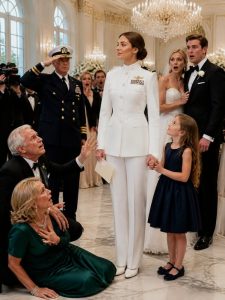
My sister’s wedding was supposed to be her big day, but my father chose that exact moment to humiliate me. In front of 200 guests, he handed me an ivory envelope and said, “You’re no longer part of this family.” With cameras pointed at my face waiting for a meltdown, I slowly read the letter, folded it twice, and flashed a smile. They thought they were exiling me, but they had just handed me the key to everything.
Part 1: The Envelope at the Harbor Wedding
The ivory envelope was thick and elegant, the kind of thing my father had always used to make cruelty look respectable.
Walter Bennett stood beside my table in the ballroom of the Harborview Belmont Hotel in Newport, Rhode Island, wearing a black tuxedo and the expression of a man who believed the evening belonged to him almost as much as it belonged to my younger sister. Behind him, the band played softly, waiters carried silver trays, and beyond the tall windows, the Atlantic had turned steel gray beneath summer rain.
Nearly two hundred guests sat around us.
Three cameras were aimed in our direction.
My sister Lauren stood a few feet behind him in a pearl-covered wedding gown, one manicured hand resting on a chair. Her mouth had already formed the beginning of a sympathetic smile—the kind people wear when they know someone is about to be humiliated and want the photos to make them look kind.
My father held out the envelope.
“This is from the family,” he said.
The room became so quiet I could hear a champagne glass being set down near the dance floor.
I looked at him, then at Lauren, then at the cameras she had arranged so carefully. She expected tears. I could see it clearly. For most of my life, my family had mistaken silence for surrender, and Lauren had chosen her wedding reception to prove, in front of everyone who mattered to her, that I could still be pushed until I broke.
I took the envelope.
My hand did not shake.
I opened it, read all three pages, folded them once, then again, slipped them into the small leather bag beside my chair, and smiled.
Not dramatically.
That was what unsettled them.
My father’s confidence shifted first.
Lauren’s followed a second later.
Neither of them knew I had spent six years preparing for the day they might finally put their rejection in writing.
And now, they had.

Part 2: The Daughter in Uniform
I had arrived in Newport that afternoon after nearly nine hours of travel from Seattle, where I served as a senior aviation commander in the United States Coast Guard. I was forty-three, with more than two decades of coordinating rescue operations and large-scale emergency responses behind me. I had learned to stay calm while other people panicked.
That skill had helped during storms, command centers, and dark stretches of ocean.
It had helped even more with my family.
The driver who picked me up from the airport kept glancing at my formal white dress uniform in the mirror. Maybe he wondered why a woman traveling alone to a wedding looked ready for an official ceremony. The answer was simple: Lauren’s invitation said black tie, my schedule required me to come directly from a Coast Guard event, and formal service dress was appropriate.
I also knew my father would hate it.
Walter Bennett built his reputation through luxury coastal development companies, and he had spent my childhood teaching Lauren and me that appearances were sacred. In his view, a successful daughter married well, dressed beautifully, stayed nearby, and reflected the family’s social standing.
I had done none of that.
I left Rhode Island at twenty-one, built a career he never understood, and learned to measure people by whether they showed up when life became difficult.
Lauren stayed close.
She became an event designer, though my father quietly paid for her studio, waterfront condo, and black Range Rover she called a business necessity. In family photos, she stood beside him. At charity dinners, she introduced him. When local magazines wrote about the Bennetts, Lauren was usually pictured.
I was mentioned as “the daughter in federal service,” if I was mentioned at all.
When I entered the hotel, the lobby glittered with chandeliers, polished brass, and huge white hydrangeas. Near the ballroom doors, I heard a woman whisper to her husband, “That must be Lauren’s Coast Guard sister.”
Not Meredith.
Not the older daughter.
Just a category.
I had barely reached the reception foyer when I saw my father beside the bar. At seventy-one, he still carried himself like a man who expected rooms to rearrange around him.
His eyes found mine.
For half a second, I wondered whether time had softened anything between us.
Then he looked down at my uniform.
“You wore that?”
I stopped in front of him.
“Hello to you too, Dad.”
“You knew this was a wedding.”
“I did. That is usually why people send invitations.”
His jaw tightened.
“You could have changed into a proper gown.”
“This is formal dress,” I said. “It meets the invitation.”
“It draws attention.”
There it was.
Not inappropriate.
Not disrespectful.
It drew attention away from the picture he wanted.
Before I could answer, Lauren appeared in a cloud of white silk and expensive perfume, followed by a photographer pretending not to follow her.
“Meredith!” she cried, kissing the air near my cheek. “You made it.”
“Congratulations, Lauren. You look beautiful.”
She looked me over carefully.
“Everyone will definitely remember the uniform.”
“That’s the good thing about uniforms. They’re hard to mistake for table linens.”
Her smile tightened.
Then she told me I was seated at Table Eighteen.
I knew what that meant.
The seating chart near the entrance showed Table Eighteen behind a decorative column beside the service corridor, farther from the bridal table than my father’s golf friends and one couple Lauren had met at a charity auction six months earlier.
“Hope that’s okay,” she said.
“Perfectly.”
She blinked.
Lauren was always most irritated when I refused to perform the reaction she had prepared.
As she walked away, I checked the seating chart again.
My place card read:
MEREDITH CALLOWAY.
Not Bennett.
The mistake was almost clever.
I stood there for a moment, then laughed softly to myself.
There comes a point when repeated humiliation loses its force. After enough years, you begin to see the machinery behind it—the tiny calculations, rehearsed slights, and desperate need to provoke a visible wound.
And once you see the machinery, it becomes difficult to fear it.

Part 3: What They Never Counted On
The ceremony was flawless.
Lauren married Andrew Pierce, a reserved architect from Connecticut who looked genuinely moved when she walked down the aisle. I had met him only twice and liked him both times, which made me wonder how much he truly knew about the family he had joined.
During dinner, I watched my father.
Command work had taught me to notice patterns: who avoided eye contact, who whispered before announcements, who checked exits, who seemed to be waiting for a cue.
My aunt never came to my table.
Two cousins who once called regularly when they needed money suddenly found the floral centerpieces fascinating.
Lauren spoke privately with the videographer.
My father checked the inside pocket of his tuxedo three times.
By dessert, I knew something was coming.
What they did not know was that I had come prepared too.
For nearly fifteen years, my family had treated my distance as an obligation. When Lauren’s studio nearly closed, I sent money. When my father claimed one of his companies had a cash-flow issue, I transferred money. When an aunt needed help with her mortgage, I helped. I covered bills, emergencies, legal fees, and tuition while living modestly myself.
I never expected praise.
I did expect honesty.
Six years earlier, during a routine background review connected to my security responsibilities, I discovered three credit accounts I did not recognize.
The first was small.
The second was not.
The third was tied to a private lending company and carried my personal information, a signature resembling mine, and an address connected to one of my father’s businesses.
I confronted him privately.
He called it an accounting misunderstanding.
Then Lauren called and said I was paranoid.
Within four months, another account appeared.
That was when I stopped arguing and started documenting.
I hired an attorney.
Then a forensic accountant.
Then a handwriting specialist.
I saved emails, transfers, loan applications, corporate records, and every message where my father told me to “stop making trouble over paperwork.”
I learned that money borrowed under my identity had moved through business accounts before paying for expenses that included Lauren’s design studio, her condo deposit, and part of the wedding reception happening around me.
Still, I waited.
Part of me hated myself for it.
Another part clung to the childish hope that my father would eventually sit across from me and tell the truth.
He never did.
Instead, halfway through dessert, he stood and tapped a spoon against his glass.
The band stopped.
“Before we continue,” he announced, “there is a private family matter that, after many years, needs to be settled clearly.”
Private.
I almost admired the word.
He walked toward Table Eighteen while the cameras followed.
That was when I understood the purpose of my seat.
They had placed me in the corner so the whole room could watch my isolation.
My father stopped beside me and removed the ivory envelope.
“This is from the family.”
I opened it.
The letter said that because of my “years of distance, hostility, and disregard for family unity,” the Bennetts had chosen to sever their relationship with me. I was instructed not to contact my father, my sister, or several extended relatives. It also declared I had no further family obligations and should expect none from them.
At the bottom were seven signatures.
I recognized every one.
Some belonged to people whose rent, tuition, legal fees, and medical bills I had helped cover.
I folded the pages carefully.
Then I stood.
“Thank you.”
My father frowned.
“Excuse me?”
“I said thank you.”
A murmur moved through the ballroom.
I looked toward Lauren. Her smile had vanished.
“It’s helpful to have this in writing.”
My father lowered his voice.
“Meredith, sit down.”
“No.”
For the first time that night, uncertainty crossed his face.
I turned slightly toward the nearest camera.
“Since this was apparently meant to be a public family discussion, clarity should work both ways.”
Lauren moved quickly toward us.
“Don’t ruin my wedding.”
Her voice was low, but the videographer’s microphone caught it.
I looked at her.
“I didn’t bring seven signatures and hand someone a rejection letter during dessert.”
Andrew had risen from the bridal table.
“Lauren,” he said slowly, “what is happening?”
She ignored him.
My father reached for my arm, but I stepped back before he touched me.
Then I opened my leather bag and removed a slim navy folder.
The room changed.
He recognized it.
“Put that away,” he said.
“Why?”
“This is not the place.”
For the first time all evening, I laughed.
“You chose the place.”
Part 4: Six Years of Paper
I opened the folder.
“Andrew,” I said, looking at my new brother-in-law, “did Lauren ever tell you that several personal loans were opened using my identity while I was stationed on the West Coast?”
He stared at me.
Then at his wife.
“What loans?”
Lauren’s face went still.
My father spoke immediately.
“This is nonsense.”
“No,” I said. “Nonsense is misspelling my name on a seating card and pretending it was accidental. These are authenticated records.”
I removed one document.
“This report compares my verified signature with signatures used on four lending applications.”
Then another.
“These are transfer records tracing part of the borrowed funds through Bennett Coastal Development.”
Then another.
“And these show payments from those accounts toward Lauren’s studio lease, her condominium deposit, and vendors working this wedding.”
Andrew looked at his bride.
“Lauren?”
“She’s twisting everything,” Lauren said quickly. “Meredith has always hated this family. She left. She barely comes home.”
“Leaving Rhode Island is not permission to use my identity.”
My father stepped closer.
“Enough.”
“I agree.”
I closed the folder.
“That’s why I stopped handling it privately.”
Something in his expression changed.
Very slightly.
But I saw it.
“What does that mean?” he asked.
I placed a second, smaller envelope on the table.
“It means my attorney submitted the full file months ago. Financial investigators have already reviewed much of it. Additional records were delivered this morning.”
My father went pale.
Lauren looked at him.
“Dad?”
I continued, because after six years, truth no longer needed anger.
“The offshore accounts were especially interesting.”
The ballroom erupted in whispers.
My father stared at me as if the daughter he knew had disappeared and someone unfamiliar stood in her place.
“You had no right,” he said.
That sentence told me more than any confession could have.
Andrew stepped away from Lauren.
“Offshore accounts?”
She reached for him.
“Andrew, please. You don’t understand.”
He looked at her hand on his sleeve.
“Then explain it.”
She could not.
At that moment, the ballroom doors opened.
Two men and one woman entered with the hotel’s general manager. All three wore dark conservative suits. I recognized one from a meeting with my attorney.
No dramatic rush.
No raised voices.
Real authority rarely needs theater.
The older man approached my father and showed identification.
“Mr. Bennett, we need to speak with you regarding financial records connected to several lending applications and business accounts. We would prefer to do that privately.”
My father looked at me.
For seventy-one years, Walter Bennett had believed control naturally belonged to him. He controlled employees, family photos, dinner conversations, inheritance expectations, and the emotional temperature of every room he entered.
Now he looked smaller than I had ever seen him.
Not because anyone raised a hand.
Not because anyone humiliated him.
Because documents existed.
Lauren turned toward me with tears gathering in her eyes.
“How could you do this tonight?”
I looked around the ballroom—the cameras, the guests, the ivory envelope beside my plate.
“I could ask you the same thing.”
Then I picked up my bag and walked out.
Part 5: The Call Under the Portico
Rain had begun falling over Newport Harbor, tapping softly against the hotel steps and turning the driveway lights into blurred gold.
I stood beneath the portico and breathed.
Behind me, through the glass doors, guests were standing. Andrew was several feet away from Lauren. My father was speaking with investigators beside the ballroom entrance.
I should have felt triumphant.
Instead, I felt tired.
For years, I imagined truth as bright and cleansing. Real truth is quieter. Sometimes it arrives after the damage is done and simply confirms what your heart tried not to know.
My phone rang.
It was my attorney, Thomas Avery.
“Tell me you’re somewhere private,” he said.
“I’m outside.”
“Good. Meredith, something came in this afternoon from the trust company in Boston.”
I closed my eyes.
“What trust company?”
“One your mother used.”
The rain seemed louder.
My mother, Eleanor, had been gone for sixteen years. She had been the only person in our house who never treated my independence as a personal insult. When I told them at twenty-one I was joining the Coast Guard, my father refused to speak to me for a week.
My mother quietly bought me a better suitcase.
“Thomas,” I said, “what are you talking about?”
“Your mother created a protected secondary trust shortly before the family finances were reorganized. Your father was never a beneficiary and had no authority over it.”
“Why am I only hearing this now?”
“Because it had a release condition.”
My stomach tightened.
“What condition?”
Thomas took a breath.
“A documented act of formal family separation initiated by your father or your sister.”
I said nothing.
For a moment, I heard only rain and harbor traffic.
“The letter,” I whispered.
“Yes.”
I turned and looked through the hotel doors.
The ivory envelope was still visible on my table.
Thomas continued.
“Your mother seems to have anticipated that, sooner or later, they might push you out formally. She designed the trust so that if they did, the assets would move beyond your father’s reach.”
My knees felt unsteady for the first time that night.
Not because of the money.
Because I could suddenly see my mother sitting at a desk sixteen years earlier, signing papers in silence, trying to protect a daughter she knew she might not always be able to stand beside.
“What assets?” I asked.
“A property in Vermont called Pinewater House. Thirty acres, a lake cabin, and several investment accounts. The financial value is significant.”
Pinewater.
I knew the name.
It belonged to my mother’s family, a quiet place near Lake Champlain where Lauren and I had spent summers as children. My father disliked it because the house was old and the nearest country club was nearly an hour away.
I loved it because my mother laughed there.
“There’s something else,” Thomas said. “A sealed letter addressed to you.”
I covered my mouth with one hand.
Behind me, the wedding continued falling apart.
Ahead of me, across sixteen years, my mother had left a door open.
Part 6: Pinewater
Seven weeks later, I sat on the porch of a cedar-sided house in northern Vermont, watching maple leaves drift across a lake so still it seemed to hold the sky.
The investigations into my father’s companies continued. Several properties were under financial review, and creditors were examining years of transactions. I did not follow every update.
Lauren’s marriage ended quietly before she and Andrew ever took their planned trip to Italy. I heard she had moved out of the condo and into a modest rental outside Providence.
Most relatives who signed the letter never contacted me.
Two did.
Both apologized.
I had not decided what forgiveness would look like. For the first time in my life, I understood I was allowed to take my time.
On the small wooden table beside me lay my mother’s letter.
I had read it eleven times.
The paper had softened at the folds.
My darling Meredith,
If this letter has reached you, then the day I feared has finally come, and I am sorry you had to stand through it without me.
Your father has always believed love can be measured by loyalty to his wishes, and Lauren has spent much of her life learning from him. I hope I am wrong, but I fear there may come a time when they mistake your independence for betrayal and your patience for weakness.
Let them misunderstand you.
You have spent too much of your life proving that you deserve a place you should never have been asked to earn.
If they formally send you away, this house and everything attached to the trust will become yours. Not because I want you to win against them, but because I want you to stop needing anything from people who make affection conditional.
Build a life here, sell it, or give it away. The choice is yours. That is the point.
Please remember what I should have told you more often: you were never difficult to love. You were simply difficult to control.
I am proud of you. Always.
Mom
I lowered the pages and looked across the lake.
For more than twenty years, I thought strength meant enduring whatever came without showing the cost. I stood through storms, emergencies, family insults, lonely holidays, and phone calls that always began with someone needing money.
But at Pinewater, I began to understand something different.
Sometimes strength is not staying.
Sometimes it is no longer explaining.
Sometimes it is taking a three-page letter meant to shrink you in front of a ballroom full of people, folding it carefully, and realizing that the people rejecting you have accidentally opened the door you were too loyal to open yourself.
My family expected me to collapse at Lauren’s wedding.
Instead, they gave me the one thing my mother had waited sixteen years for them to provide.
Proof.
I placed her letter back on the table and wrapped both hands around my coffee cup. The morning smelled of cedar and lake water, and somewhere beyond the trees, a small boat moved slowly in the distance.
I still carried sadness.
I probably always would.
You do not spend half a lifetime wanting your father’s approval and simply wake up grateful that he withheld it. You do not stop loving a sister just because she chose an audience for your rejection. Hearts are rarely that neat.
But sadness was no longer captivity.
That was the difference.
For the first time, I was not Walter Bennett’s disappointing daughter.
I was not Lauren’s embarrassing older sister.
I was not the relative everyone called when invoices arrived and forgot when photos were taken.
I was Meredith.
As the lake caught the first clear light of morning, I realized my mother had been right about one final thing.
Freedom does ask you to leave something behind.
But sometimes what you leave behind is only the exhausting belief that love must be earned from people determined not to give it.
I had spent years trying to come home to a family that kept moving the door.
At Pinewater, I finally stopped knocking.