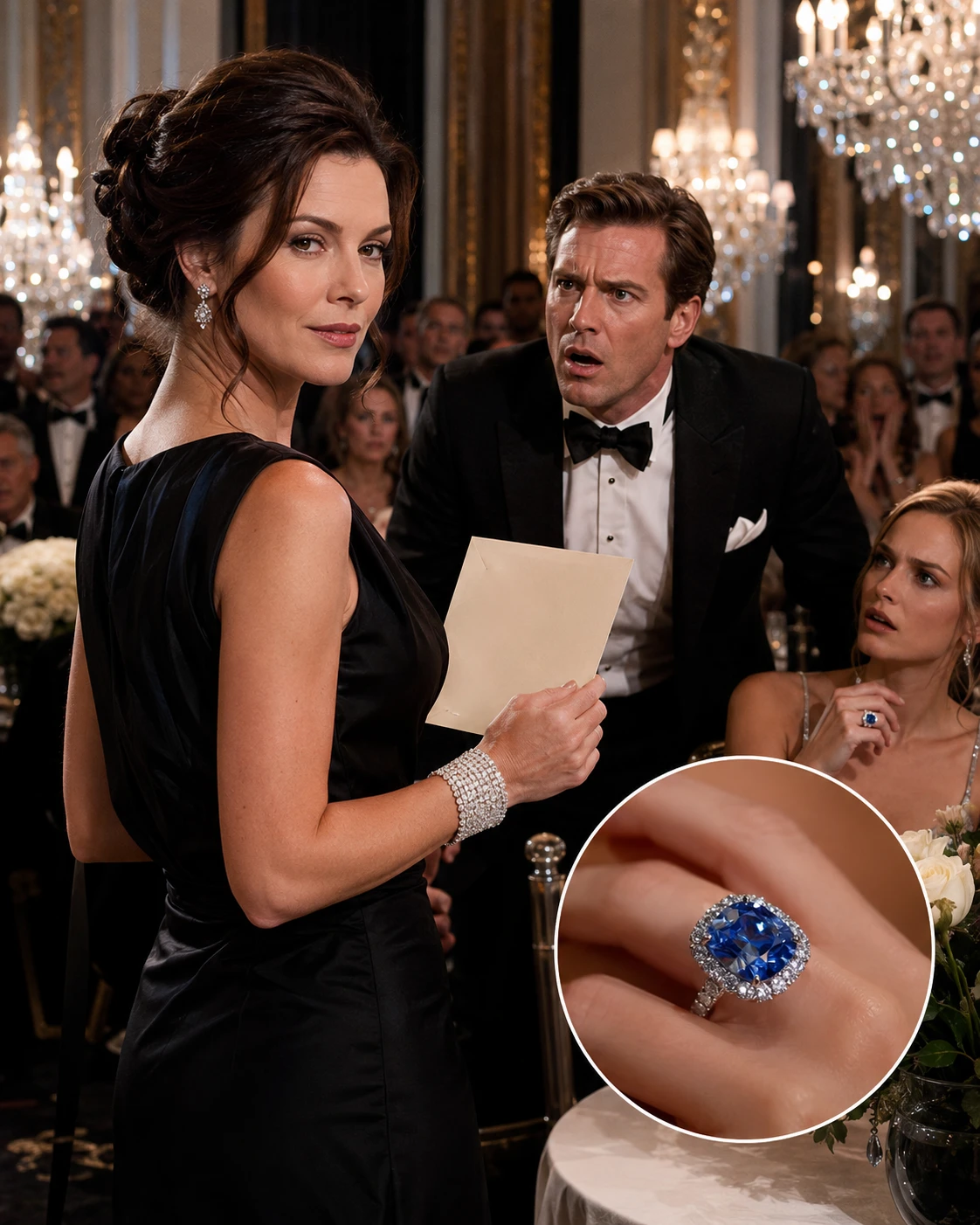
His mistress wore my engagement ring to a charity auction I hosted.
Not a similar ring. Not a tasteful imitation bought by some woman trying to climb her way through Manhattan by copying wives with better tailors and older money.
Mine.
The twelve-carat Ashford blue diamond, set in a platinum crown of knife-thin baguettes, cut in London, insured in Zurich, photographed by Vogue the winter Calloway Ashford slid it onto my finger and promised me, in front of both our families, that he would never make me feel small.
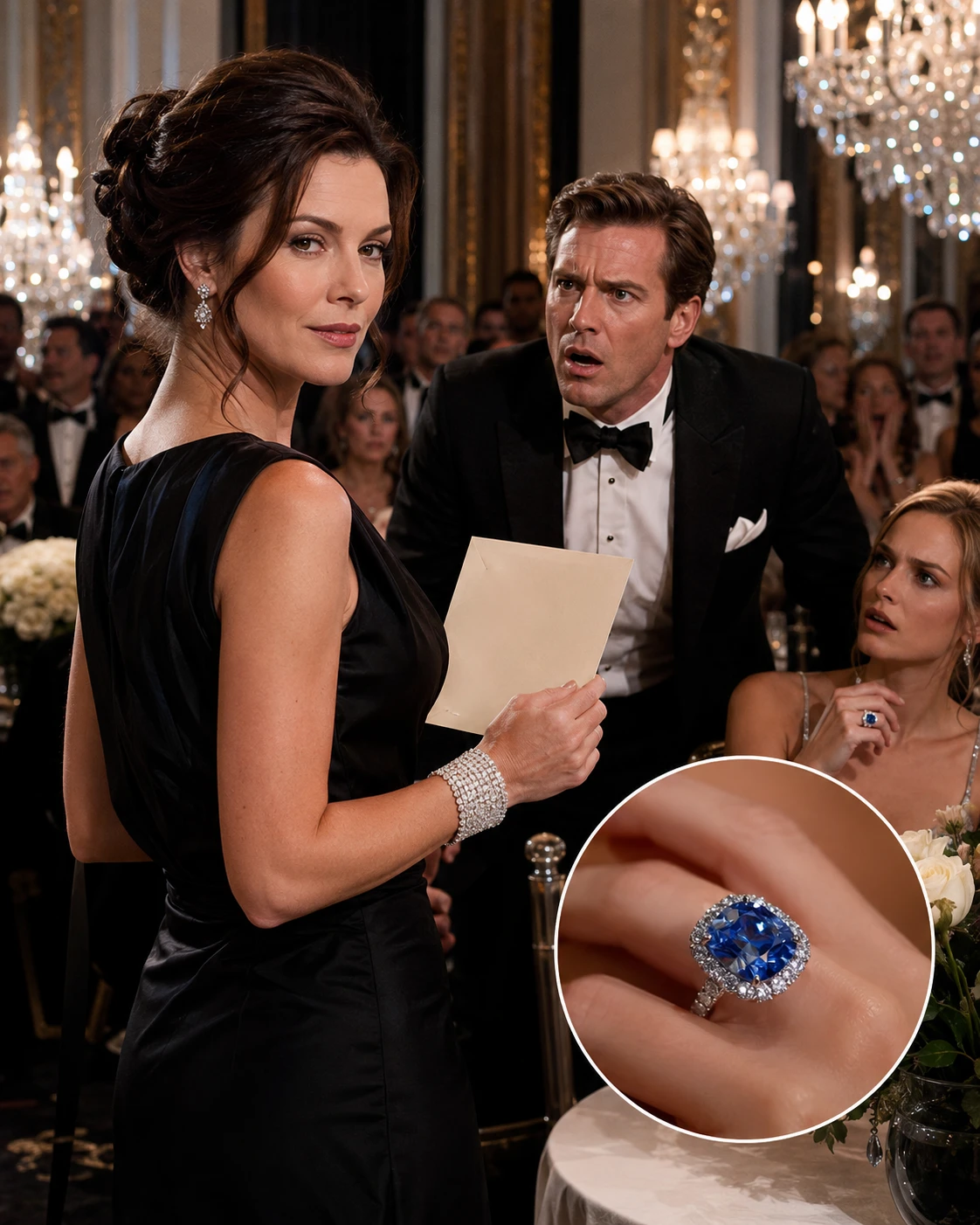
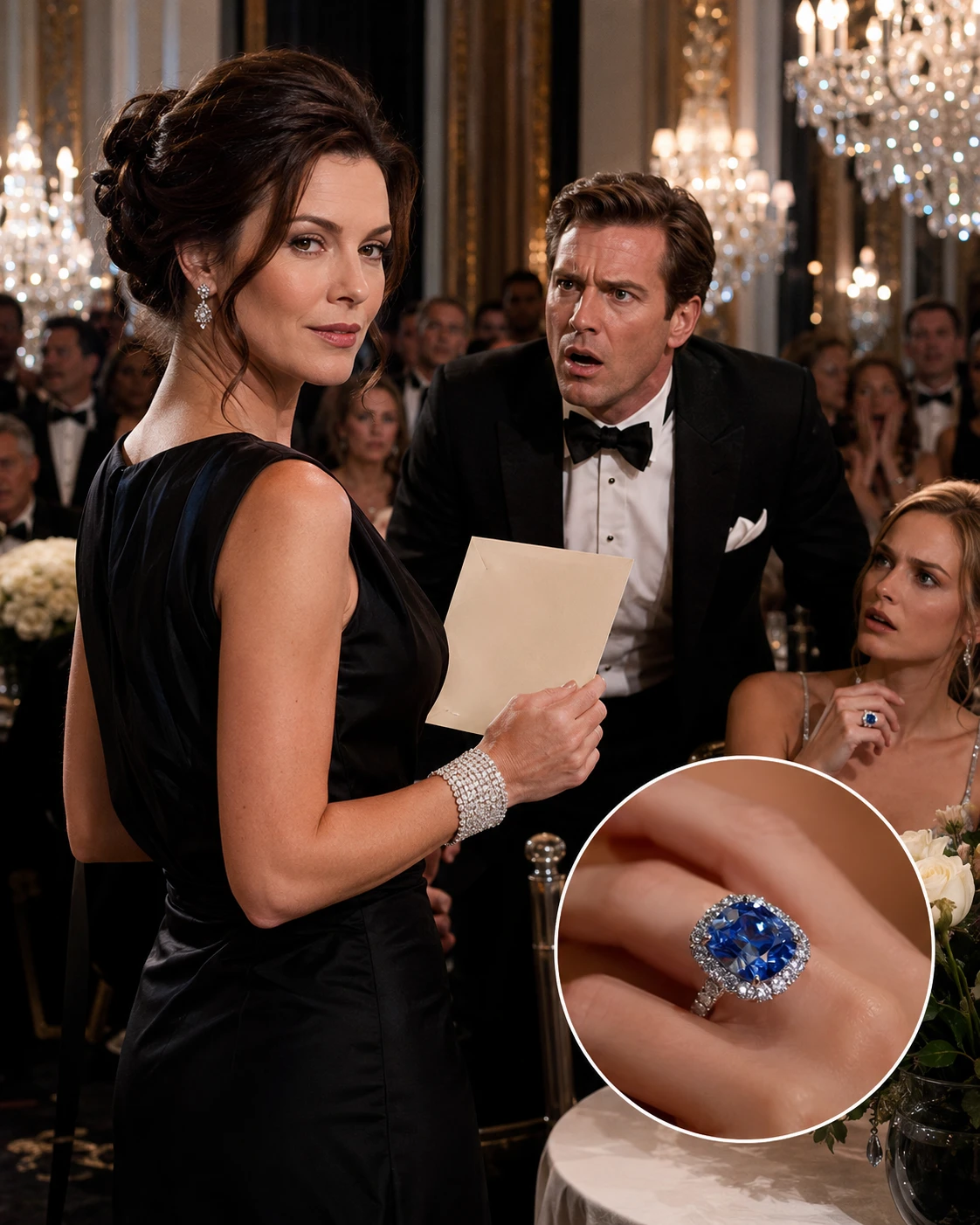
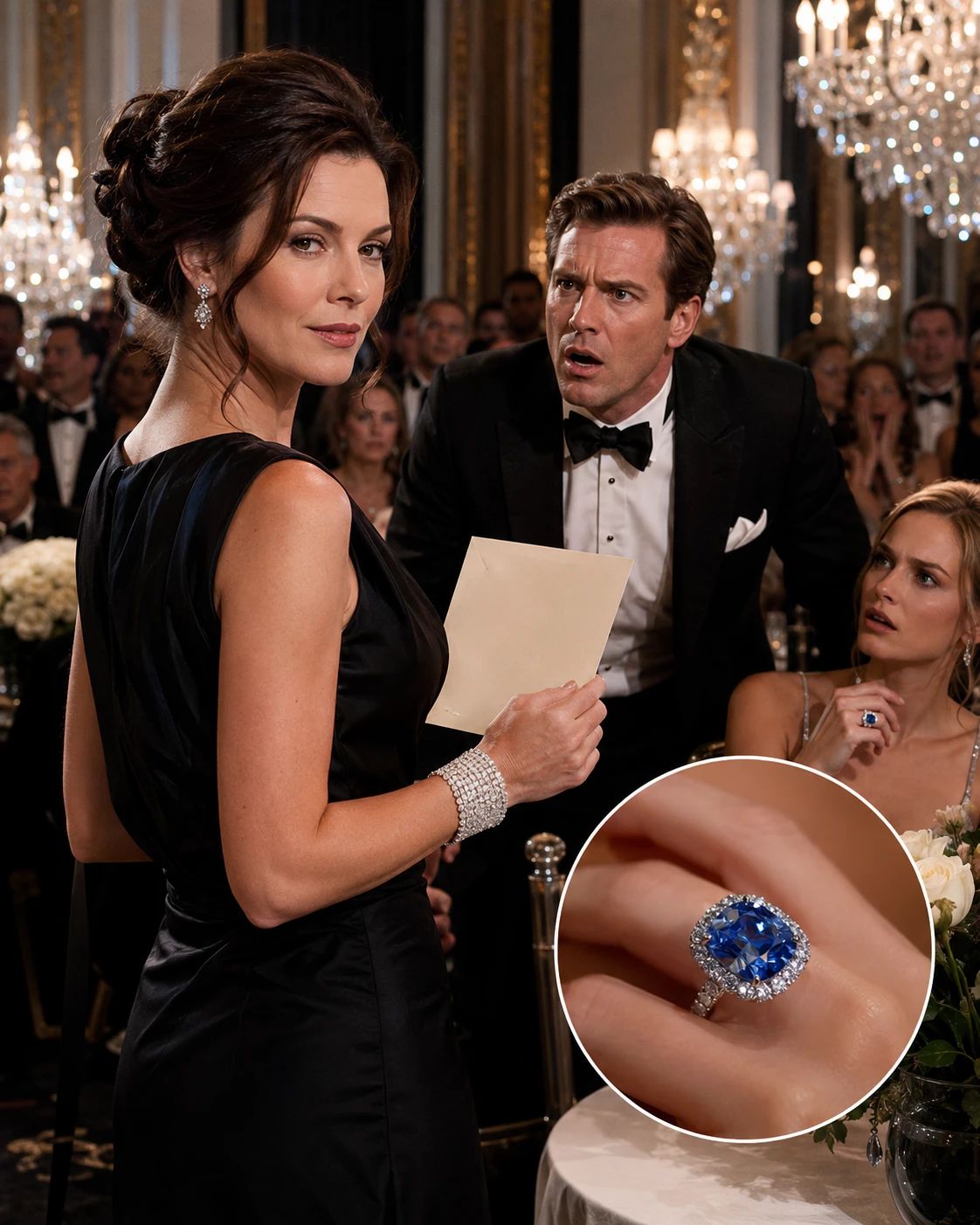
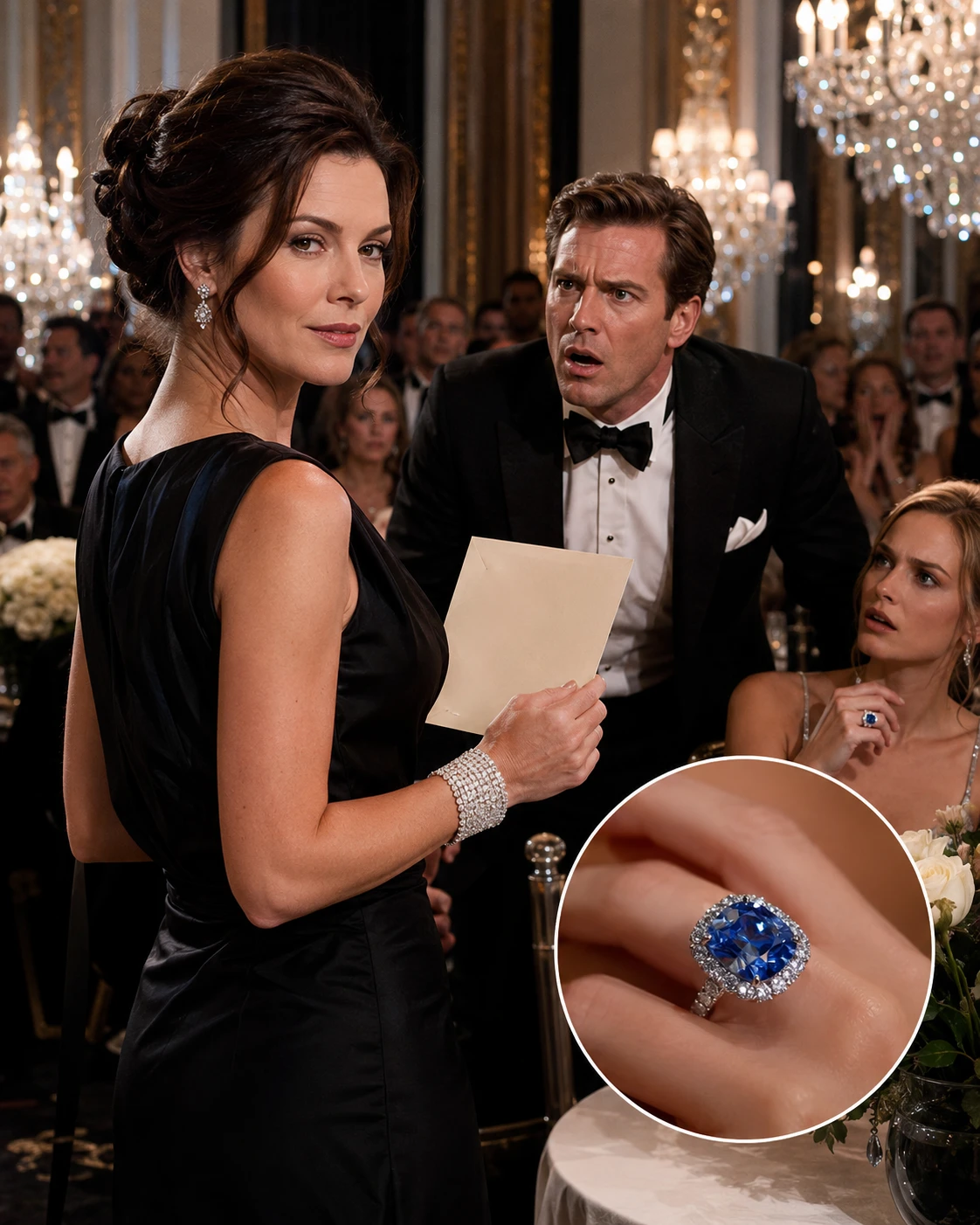
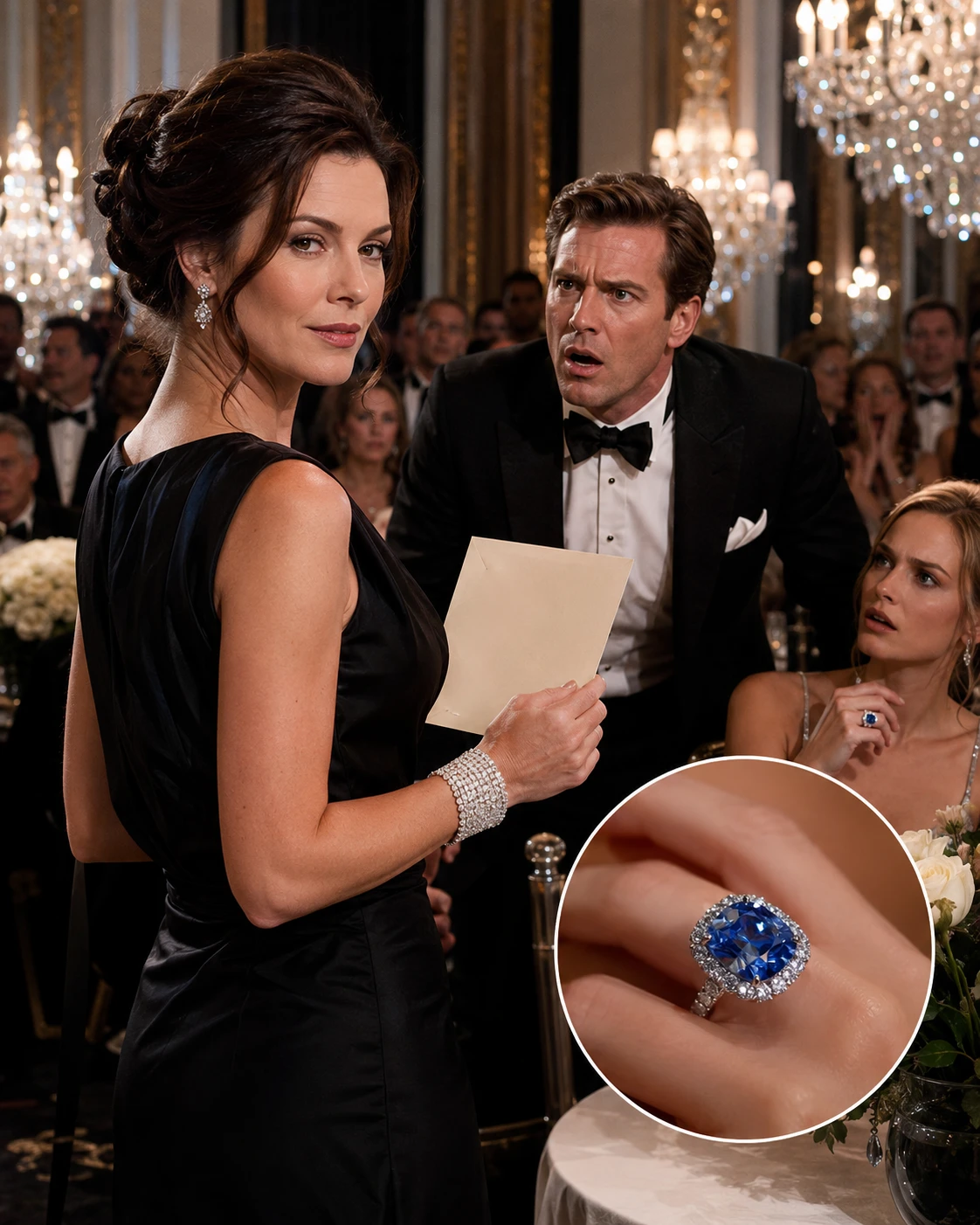
That night, under the crystal chandeliers of the Beaumont Hotel, his twenty-six-year-old mistress lifted her bidding paddle with my diamond flashing beneath the lights.
The ballroom saw it.
The donors saw it.
The board members of my foundation saw it.
My husband smiled like he wanted everyone to notice.
I did not gasp. I did not cry. I did not slap anyone, though the room was so hungry for scandal I could almost hear five hundred phones begging to be raised.
I only adjusted the diamond cuff on my wrist, took one sip of champagne, and let the silence become expensive.
Brooke Delaney turned her face toward me, wearing the soft, stunned smile of a woman who thought she had just won.
Her paddle was still in the air when the auctioneer cleared his throat.
“Ladies and gentlemen,” he said, reading from the card I had personally placed in his hand thirty seconds earlier, “our next item is rather unusual. Lot Seventeen: a private legal audit of misused foundation funds, conducted by Kline, Mercer & Vale.”
My husband’s face changed before the bidding began.
That was when I finally smiled.
CHAPTER 1
THE WOMAN WHO DID NOT FLINCH
There is a particular kind of humiliation that only happens in rooms where the flowers cost more than most people’s rent.
It is quiet.
No one screams. No one throws wine. No one admits they are watching a woman’s marriage bleed out on white linen.
Instead, a banker from Greenwich lowers his voice. A gallery owner touches her pearls. A senator’s wife stares into her salad as if it has just revealed state secrets.
And everyone waits to see whether the wife will shatter.
That night, I gave them nothing.
The Beaumont Grand Ballroom had been dressed for winter in silver branches, black orchids, and thousands of white roses flown in from Ecuador. Beyond the arched windows, Manhattan glittered like a field of knives. Inside, the country’s wealthiest sinners gathered to purchase innocence in public.
They came for my foundation.
The Hartwell Children’s Trust had been my mother’s dream before it became my name, my burden, and eventually, my weapon. Every year, we hosted the Silver Halo Auction, a benefit for children in foster care who needed legal advocates, emergency housing, therapy, tutors, medical care, and someone in the world rich enough to be angry on their behalf.
I had built it from grief.
After my mother died, I turned her small scholarship fund into a national foundation with offices in New York, Chicago, Dallas, and Los Angeles. We funded court-appointed advocates. We sued negligent agencies. We quietly bought winter coats, braces, textbooks, and beds.
Calloway had loved that about me at first.
Or at least he loved how it looked beside him.
Calloway Ashford was born into the kind of money that never needed to introduce itself. His family owned hotels, private clinics, media shares, equestrian estates, and half the marina in Newport. He had the smooth, golden confidence of a man who had never been told no by anyone not being paid to flirt.
When we married, the newspapers called us “Manhattan’s most polished power couple.”
They did not know polish is often just pressure in a pretty form.
For eight years, I was the wife beside him in photographs. The woman in ivory silk at hospital wings. The calm hand on his sleeve when he drank too much at donor dinners. The one who remembered birthdays, softened insults, wrote checks, and turned his family’s cold fortune into something resembling a conscience.
I was also the one who learned very early that Calloway’s charm had rooms inside it.
Locked rooms.
Rooms with burner phones and hotel key cards. Rooms with debts hidden under shell companies. Rooms with women who were always younger, louder, more impressed.
Brooke Delaney was only the latest.
She had been a development consultant for one of our Los Angeles partners, hired for three months to “refresh youth outreach strategy.” She had a college degree from somewhere in Florida, a voice like honey poured over broken glass, and the nervous confidence of someone who had learned luxury by watching women like me from across restaurants.
I had met her once before.
Six months earlier, at the Ashford Club in Palm Beach, she touched my husband’s elbow too long and called me “inspiring” with the exact brightness women use when they want you to know they have been discussed in private.
Calloway told me I was imagining things.
Men like Calloway always begin betrayal by asking you to mistrust your own intelligence.
So I stopped asking.
I started documenting.
By the night of the auction, I knew enough to ruin him three different ways before coffee.
But I had waited.
Not because I was weak.
Because revenge, if done properly, should mature like Bordeaux in a locked cellar.
At Table One, Calloway sat between Brooke and his mother, Eleanor Ashford, a woman with cheekbones sharp enough to sign contracts. Eleanor wore black velvet and a single strand of South Sea pearls. Her eyes had passed over Brooke’s ring once, then moved away.
That told me everything.
She knew.
They all knew.
My sister-in-law, Celine, looked sick. The Ashford family attorney, Miles Rennick, had gone pale around the mouth. A few seats down, Senator Wade laughed too loudly at nothing, unwilling to be caught watching.
Brooke lifted her paddle again for a weekend at a vineyard in Napa.
The blue diamond burned on her hand.
A collective murmur moved through the ballroom, delicate and poisonous.
My assistant, Nora Chen, appeared at my side with an auction clipboard and murder in her eyes.
“Vivienne,” she whispered, “do you want me to call security?”
“No.”
“Do you want me to spill red wine on her?”
I almost laughed.
Nora was twenty-nine, brilliant, loyal, and one of the few people alive who knew my silence was not surrender. She had been with me for four years, long enough to understand that I did not raise my voice unless I had already called a lawyer.
“Let her enjoy it,” I said.
Nora’s jaw tightened. “She is wearing your ring.”
“I know.”
“Calloway is smiling.”
“I know.”
“Vivienne.”
I placed my champagne flute on the tray of a passing waiter. “Bring me Lot Seventeen.”
Nora’s expression changed.
Not surprise. Recognition.
The moment had come.
She handed me a cream envelope sealed with black wax. Inside was a card printed in the same elegant font as the evening’s program. To anyone else, it looked like a last-minute addition to the auction lineup.
To Calloway, it would look like the beginning of the end.
I crossed the ballroom slowly.
That is another rule women learn too late: never hurry when they expect you to collapse. Moving slowly forces the guilty to watch.
The auctioneer, Philip Crane, smiled when I approached. He was an old family friend with silver hair, a famous voice, and the moral flexibility required to host charity events for billionaires.
“Mrs. Ashford,” he said softly, “is everything all right?”
“Perfectly.”
I handed him the card.
He read it once.
Then again.
His brows rose just enough for me to see.
“Are you certain?” he asked.
“Completely.”
“Does Mr. Ashford know?”
“He will.”
Philip looked toward Table One, where Calloway was leaning toward Brooke, whispering something that made her laugh.
Then his gaze dropped to the ring.
For a moment, pity moved across his face.
I hated pity more than betrayal.
“Announce it after the Napa lot,” I said.
Philip gave the smallest nod. “As you wish.”
I returned to my place at the head table just as Brooke won the vineyard weekend for twenty-eight thousand dollars, using money that had probably come from my husband and, if my audit was correct, indirectly from my foundation.
Applause spread like thin ice.
Brooke beamed. Calloway clapped. His mother touched her pearls again.
Then Philip tapped the microphone.
“Ladies and gentlemen, before we proceed to our collection of rare watches, Mrs. Ashford has added a special item to tonight’s auction.”
Every head turned.
I stood.
The room quieted so completely I could hear ice settle in glasses.
Philip continued, “Lot Seventeen: a private legal audit of misused foundation funds, conducted by Kline, Mercer & Vale, with full forensic accounting, donor compliance review, board disclosure package, and sealed court-ready findings.”
Brooke blinked.
Calloway stopped clapping.
His smile, that polished Ashford instrument, remained on his mouth for half a second after his eyes understood.
Then it died.
I looked directly at him.
Not at Brooke. Never at Brooke.
Mistresses often mistake themselves for the crime. They are usually only the receipt.
Calloway leaned toward me, his voice low. “Vivienne.”
I tilted my head as if listening to a toast.
He stood halfway. “What is this?”
“A charitable donation opportunity,” I said.
A ripple of laughter moved through the room, uncertain and delighted.
Philip, recovering his stage presence, smiled into the microphone. “We will open the bidding at fifty thousand dollars.”
Calloway’s hand tightened around his paddle.
Brooke whispered, “Cal?”
I saw the exact moment she realized she had been brought to a chessboard wearing a crown from someone else’s kingdom.
“Fifty thousand,” said a voice from the back.
The room turned.
Adrian Vale stood near the rear entrance, wearing a charcoal tuxedo and the expression of a man who had never needed to raise his voice to be dangerous.
I had not seen him in five years.
Not since he left New York for D.C. to take a federal fraud case that made his name and ruined three governors.
Adrian Vale had been my law school rival, my almost-lover, and the only man who once told me I was more terrifying when I was quiet.
Now he was a partner at Kline, Mercer & Vale.
And his firm’s name was on Lot Seventeen.
Calloway saw him and understood even more.
“Seventy-five,” said Miranda Frost, a media heiress from Table Four, practically glowing.
“One hundred thousand,” Adrian replied.
The ballroom inhaled.
Calloway stood fully now. “This is inappropriate.”
I smiled. “For a charity auction?”
“For public spectacle.”
“You brought one.”
His eyes flashed.
Brooke’s face went crimson.
Eleanor Ashford finally looked at me. Her expression was cold enough to frost the silverware.
“Vivienne,” she said, not into the microphone but loud enough for nearby tables to hear, “family matters should remain private.”
I turned to her.
“That is what families say when evidence is inconvenient.”
People began whispering again, but the whispers had changed. They were not wondering whether I would break. They were wondering what I had.
Philip cleared his throat. “We have one hundred thousand dollars. Do I hear one twenty-five?”
“One twenty-five,” Miranda sang.
“One fifty,” Adrian said.
Calloway stepped toward me. “Stop this.”
His voice was low, but not low enough.
I let the silence hold.
Then I said, “Take your seat, Calloway. You’re blocking a donor.”
A gasp. Then laughter. Real this time. Sharp, bright, hungry laughter.
Calloway’s face hardened.
For the first time in our marriage, he looked at me as if I were not furniture in his life but weather coming for his roof.
Brooke reached for his sleeve with the ringed hand.
My ring.
He shook her off too quickly.
She noticed.
So did everyone else.
Adrian bid two hundred thousand dollars and won the audit.
Philip’s gavel fell.
“Sold,” he said, “to Mr. Adrian Vale.”
The applause was thunderous because wealthy people love justice most when it comes with plausible deniability.
I sat down.
Across the room, Adrian inclined his head toward me. Not a smile. A promise.
Calloway leaned close enough for only me to hear.
“You have no idea what you’re doing.”
I looked at the diamond on Brooke’s finger, then at my husband.
“Oh, darling,” I said softly, “you were always my slowest mistake.”
CHAPTER 2
THE DIAMOND WAS ONLY BAIT
By midnight, the video had reached three million views.
By breakfast, it had been clipped, captioned, reposted, slowed down, zoomed in, and set to music by women who could smell blood through a screen.
The most viral version began with Brooke lifting her paddle, my blue diamond catching chandelier light like a tiny captured storm. Then it cut to me standing in black satin at the podium, calm as a widow at a funeral she had secretly arranged.
Text appeared across the screen:
HIS MISTRESS WORE HER RING TO HER OWN CHARITY AUCTION.
Then my voice, clear as winter glass:
“Take your seat, Calloway. You’re blocking a donor.”
The internet lost its mind.
By 9:00 a.m., every tabloid in America had a headline.
ASHFORD HEIRESS HUMILIATED AT OWN GALA—THEN DROPS AUDIT BOMB.
MISTRESS WEARS WIFE’S $4.8M ENGAGEMENT RING.
CHARITY AUCTION OR PUBLIC EXECUTION?
Calloway called me sixteen times.
I did not answer.
Brooke posted an Instagram Story at 8:12 a.m. from the Ashford penthouse terrace, wearing sunglasses, wrapped in a cashmere throw that was also mine. She wrote:
There are always two sides. Choose kindness.
By 8:20, someone had commented:
Girl, choose a lawyer.
I read it while sitting barefoot in the library of my townhouse on East Seventy-Fourth Street, drinking black coffee from my mother’s china.
Nora sat across from me with her laptop open and three phones lined up on the table like surgical instruments.
“Brooke has disabled comments,” she said.
“Already?”
“Apparently kindness has limits.”
I turned a page in the file on my lap.
The file was not new. It was six months of bank records, hotel receipts, foundation transfers, private emails, offshore filings, board minutes, corrected board minutes, security logs, donor restrictions, and one damning photograph of Calloway leaving a Key Biscayne villa purchased through an LLC called Blue Harbor Holdings.
Blue Harbor Holdings was supposed to be dormant.
It was not.
It owned the villa.
A boat.
Two luxury apartments in Miami.
And, according to the transfer history, several assets bought with funds that had passed through consulting contracts billed to the Hartwell Children’s Trust.
I had discovered it by accident.
Or rather, I had discovered the first loose thread by accident.
Three months earlier, I was reviewing quarterly grants when I noticed a payment to a vendor called Delaney Strategic Outreach. The invoice said “regional youth digital engagement pilot.” The amount was eighty-five thousand dollars. The deliverables were vague enough to be fog.
Delaney.
Brooke’s last name.
I asked Calloway about it over dinner at Le Bernardin.
He smiled, touched my wrist, and said, “You worry too much, Viv.”
That night, I went home and worried professionally.
Within two weeks, Nora and I found five more payments. Then seven. Then a consulting contract signed with an electronic signature that looked like mine but had been executed while I was in Aspen without my laptop.
That was when I called Adrian Vale.
I did not call him because of what he had once been to me.
I called him because he was the best.
He answered on the third ring.
“Vivienne Hartwell,” he said, using my maiden name as if the past had been waiting in his phone.
“Are you still good at destroying men who hide behind foundations?”
A pause.
Then: “Depends. Are you still good at pretending you don’t want them destroyed?”
I should have hung up.
Instead, I said, “I have documents.”
“I’ll send a secure link.”
“No,” I said. “I’ll bring them in person.”
“Then I’ll clear my afternoon.”
That was how it began.
Not with jealousy.
Not with heartbreak.
With a forged signature and an eighty-five-thousand-dollar lie.
Now the morning after the auction, Adrian’s firm had the full file, the board had emergency notice, and Calloway Ashford had something he had never had before.
Consequences.
The doorbell rang at 9:42.
Nora checked the security camera. “It’s him.”
“Calloway?”
“Yes. And he looks expensive and insane.”
“Let him in.”
Nora stared at me.
I closed the file and stood. “He’ll enjoy the locked door too much. Men like him need to enter a room before they realize they’ve lost it.”
Calloway came in wearing last night’s tuxedo shirt under a camel coat. His hair was damp, his jaw unshaven, his eyes bright with sleepless fury.
Even ruined, he was beautiful.
That was the ugliest thing about him.
He had the kind of beauty that made people forgive the first lie because they wanted to keep looking at him. Gold-brown hair, aristocratic nose, mouth made for promises. At thirty-nine, he still looked like every boarding school mother’s favorite bad idea.
He stopped in the doorway of the library.
His gaze moved over Nora, the files, the laptop, me.
“Leave,” he said to Nora.
Nora lifted one eyebrow.
“She works for me,” I said.
“She works for the foundation.”
“I am the chair of the foundation.”
“Not for long.”
There it was.
I almost admired the speed.
I walked to the window. The street below was gray and wet, lined with black SUVs and bare sycamore trees.
“Is that what Eleanor told you? That the board will remove me before the audit proceeds?”
Calloway’s silence was answer enough.
I turned back. “You should have worn a cleaner shirt to threaten me.”
His mouth tightened. “You made us look ridiculous.”
“No. Brooke did that when she wore my ring.”
“She didn’t know.”
I laughed once.
He flinched, perhaps because I rarely laughed at him. With him, yes. Around him, often. But not at him.
“She didn’t know the ring belonged to your wife?”
“I told her we were separated.”
“How generous. You gave her my marriage and my jewelry.”
“You refused to wear it.”
“I stopped wearing it after I found lipstick on the insurance appraisal.”
A flash of annoyance crossed his face, not shame. Annoyance. As if my memory were poor etiquette.
He moved closer. “The ring is an Ashford heirloom.”
“No, Calloway. Your grandmother’s ring is in the safe at Newport. That ring was bought with my mother’s trust money after you overdrew your personal account trying to rescue your brother’s failed crypto fund.”
His expression went still.
I watched the realization settle into him.
I knew.
I knew more than he thought.
Nora looked down at her laptop to hide her smile.
Calloway lowered his voice. “This is between us.”
“It stopped being between us when you used my foundation.”
“I never touched your foundation.”
“That’s what the audit will determine.”
“You think Adrian Vale is going to save you?”
There it was again, the old male instinct to locate another man behind a woman’s power.
“No,” I said. “I hired him to save the children’s money from you.”
“You always were dramatic.”
“And you always confused restraint with ignorance.”
He laughed then, but it was thin. “What do you want?”
I folded my arms. “The ring returned. A signed separation agreement. Your resignation from every Hartwell board seat by noon. Full cooperation with the audit. And you will move out of the penthouse today.”
His eyes sharpened. “The penthouse is mine.”
“The penthouse is held by Hartwell Residential Trust. My father bought it before we married. You have been living in it because I allowed you to.”
Calloway stared at me.
This was the part men like him never expected.
They believe wives are emotional historians, collecting wounds and anniversaries. They forget wives also read contracts.
“Fine,” he said. “You want war?”
“No. War is loud. I want compliance.”
“You’ll get neither.”
He reached into his coat and placed a velvet ring box on the table.
For one foolish heartbeat, I thought he had brought it back.
But when Nora opened the box, it was empty.
Calloway smiled.
“Brooke lost the ring,” he said.
The room seemed to narrow.
Nora whispered, “What?”
He looked at me with the satisfaction of a boy breaking a vase and daring his mother to cry.
“Apparently somewhere between the Beaumont and the after-party. Terrible timing.”
I knew immediately that it was a lie.
Not because he was bad at lying. Calloway was excellent.
But because he enjoyed that one too much.
I walked to the table, picked up the empty box, and closed it with a soft click.
“Thank you.”
“For what?”
“For converting marital misconduct into theft.”
A muscle jumped in his cheek.
I leaned closer.
“You still don’t understand what kind of wife you married.”
He said nothing.
I straightened. “Nora, please note the time Mr. Ashford reported the disappearance of the ring.”
Nora typed. “9:51 a.m.”
Calloway looked between us. “You can’t prove I took it.”
“No,” I said. “But I can prove it was insured. I can prove Brooke wore it publicly. I can prove you admitted it was no longer in her possession. And I can prove the policy requires law enforcement notice within twenty-four hours.”
His smile vanished.
“Would you like to call the police,” I asked, “or shall I?”
He left without another word.
The front door slammed hard enough to rattle my mother’s portrait in the hall.
Nora exhaled. “That was terrifying.”
“Yes.”
“You seemed very calm.”
“I was thinking about stabbing him with a letter opener.”
“That helps.”
I looked at the empty ring box.
For the first time since the auction, anger rose in me hot enough to blur the room.
Not grief.
Not jealousy.
Anger.
I had loved Calloway once with the full, humiliating innocence of a woman who thought she had chosen a partner. I had given him holidays, passwords, my body, my grief, the best chair in my father’s library, and the benefit of the doubt long after doubt had become evidence.
But the ring was different.
Not because it meant marriage.
Because it was bought with money my mother left me.
A woman’s last gift, placed on the hand of a girl who posted about kindness from my terrace.
Nora’s phone buzzed.
She looked down, then up at me. “Adrian is downstairs.”
I closed my eyes briefly.
Of course he was.
“Send him up.”
Adrian entered without the frantic energy Calloway had carried in like smoke. He wore a navy overcoat, no scarf, black leather gloves in one hand. There was snow in his dark hair, though the forecast had only promised rain.
At forty, Adrian Vale had become more severe than handsome, which made him far more dangerous. His face was lean, his eyes gray, his mouth restrained. He had the air of a man who could cross-examine a corpse into confessing.
His gaze moved over me with careful precision.
Not pity.
Never pity.
“What did he do?” Adrian asked.
I held up the empty box.
“He says Brooke lost the ring.”
Adrian’s eyes went cold.
“Did he put that in writing?”
“No.”
“Did anyone hear him?”
“Nora.”
Nora raised a hand. “Unfortunately alive and furious.”
Adrian looked at her. “Good.”
He opened his briefcase and removed a folder. “The audit has already found something.”
“So soon?”
“This was low-hanging fruit. I had my team run emergency checks last night after the auction. Blue Harbor Holdings received three transfers from a vendor connected to the foundation. That vendor is registered to a P.O. box in Delaware.”
“I know.”
“You don’t know the rest.”
My heart shifted.
Adrian handed me the folder.
Inside was a corporate filing.
Blue Harbor Holdings LLC.
Registered agent: Aster Compliance Services.
Beneficial owner: Redacted.
Attached was a bank authorization form. I scanned the names.
Calloway Ashford.
Brooke Delaney.
And one more.
Eleanor Ashford.
The library went very quiet.
Nora whispered a word I pretended not to hear.
I looked at Adrian. “His mother?”
“She signed as a controlling party two years ago.”
“Before Brooke.”
“Yes.”
I sat down slowly.
This was not a husband’s affair spilling into foundation money.
This was a family operation.
Adrian took the chair opposite mine. “Vivienne, I need you to listen carefully. There may be criminal exposure here beyond embezzlement. Wire fraud. Charitable solicitation violations. Tax issues. Possibly money laundering, depending on the transfer chain.”
“My foundation?”
“Your foundation appears to be the victim.”
“Appears?”
“I don’t use absolutes until subpoenas arrive.”
I stared at Eleanor’s signature.
The handwriting was elegant. Of course it was.
Eleanor Ashford had once told me over tea that women from good families never reveal how much they know. I had thought it was advice.
Now I understood it was a warning.
“What do they think they were funding?” I asked.
“Private expenses. Political donations. Real estate. Brooke’s consulting fees. Some transfers are still moving.”
“Still?”
Adrian’s jaw tightened. “Someone wired two hundred thousand dollars out of a foundation-linked account at 3:17 this morning.”
Nora sat up. “After the auction?”
“Yes.”
I felt something in me go still.
Not numb.
Focused.
“Where did it go?”
“An account at Atlantic Meridian Bank under the name Laurel Education Initiative.”
“I’ve never heard of it.”
“You weren’t meant to.”
Adrian placed another paper in front of me.
Laurel Education Initiative had one listed director.
Brooke Delaney.
My husband’s mistress had not just worn my ring.
She had her fingers in my children’s money.
I looked at Adrian. “Freeze it.”
“We need a court order.”
“Get one.”
“I already filed emergency papers.”
My chest tightened.
He said it as if it were nothing.
As if he had not spent the entire night building a legal wall around the part of my life that mattered most.
“Thank you,” I said.
His eyes held mine. “Don’t thank me yet.”
“Why?”
“Because there is one more thing.”
He slid a final document across the table.
It was a copy of a prenuptial agreement.
Mine.
But not mine.
The first page looked familiar. The signatures looked familiar. The date was two days before my wedding.
Then I saw the clause highlighted in yellow.
In the event of reputational harm caused by either spouse that materially impacts Ashford Holdings or associated charitable entities, the injured spouse may be compelled to waive claim to marital assets in exchange for confidentiality and non-disparagement.
I read it twice.
My mouth went dry.
“That clause wasn’t in the prenup I signed.”
“I know,” Adrian said.
“How do you know?”
He reached into his briefcase and removed another document, older, slightly creased, marked with a blue tab.
“Because five years ago, when you and Calloway refinanced the Newport property, your estate attorney sent me a copy of the original prenup for review on a separate trust issue. I kept it in archived files.”
I looked at the original.
The clause was not there.
“They altered it,” Nora said.
Adrian nodded. “Most likely after the fact.”
I felt the room tilt, not from fear but from the scale of their arrogance.
The ring.
The mistress.
The money.
The forged signature.
The altered prenup.
They had not betrayed me in a moment of weakness. They had built an architecture for my ruin and expected me to admire the marble.
Adrian leaned forward. “Vivienne, I need to ask you something.”
“What?”
“How far are you willing to go?”
I looked out the window at Manhattan, bright and brutal beneath the snow.
Then I looked at my mother’s portrait above the fireplace.
Margaret Hartwell had raised me alone after my father died, teaching me that elegance was not softness and kindness was not surrender. She used to say, “Never enter a room without knowing where the exits are, darling. And never marry a man who thinks your silence is permission.”
I had forgotten the second part.
Now I remembered.
I turned back to Adrian.
“All the way.”
CHAPTER 3
THE HOUSE ALWAYS REMEMBERS
The Ashford penthouse occupied the top three floors of a limestone building overlooking Central Park, though it belonged to my family trust and always had.
Calloway moved into it after our honeymoon with twenty-seven suits, a wine collection, and the confidence of a man who believed occupancy was ownership.
For eight years, I let him believe it.
That was another mistake I corrected on Thursday.
At noon, while the city fed on auction clips and Brooke’s name became a cautionary hashtag, I arrived at the penthouse with Nora, two trust attorneys, a locksmith, a private security team, and a court-appointed inventory officer.
Calloway was not there.
Brooke was.
She opened the door barefoot in my white silk robe.
Sometimes life has no imagination.
For a moment, she looked almost young enough for mercy.
Her hair was loose, her makeup smudged, her eyes swollen from crying or champagne. Then she saw the attorneys behind me and lifted her chin.
“You can’t come in here,” she said.
I looked past her into the entry hall.
My entry hall.
There were lilies on the console. My lilies. A gold lipstick tube on the marble tray. My marble tray. A pair of silver heels abandoned beneath my mother’s Venetian mirror.
I stepped inside.
Brooke blocked me with one hand.
I glanced down.
The ring was not on her finger.
“Where is it?” I asked.
She crossed her arms. “Where is what?”
I gave her the look I usually reserved for board members who used the word “synergy.”
Her face flushed.
“You don’t scare me,” she said.
“No. That seems to be a pattern in your life.”
Her mouth opened.
Nora made a small noise that might have been a cough or joy.
The lead attorney, Celeste Ward, stepped forward. “Miss Delaney, this residence is owned by Hartwell Residential Trust. Mrs. Ashford has legal access. You do not. You are being asked to leave voluntarily.”
Brooke laughed. “Cal said—”
“Yes,” I said. “That appears to be the root of many problems.”
She looked behind us as if expecting him to appear. He did not.
Men like Calloway are always late to the consequences they create for women.
“I live here,” she said.
“No,” Celeste replied. “You have been staying here without the owner’s consent.”
“I’m his fiancée.”
The word floated between us.
Fiancée.
Nora stopped typing.
One of the security guards looked at the ceiling.
I studied Brooke’s face.
There it was. Not a slip. A performance. She wanted the word to wound me, to puncture the cold restraint and make the wife react like a woman in a supermarket video.
Instead, I felt a door close inside me.
“How interesting,” I said.
Brooke’s smile faltered.
“When did he propose?”
Her eyes moved left.
“Recently.”
“With my ring?”
“It’s not your ring.”
“It is insured in my name, purchased from my trust distribution, stored in my safe, and engraved with my initials beneath the setting.”
That last part surprised her.
Good.
She looked at her bare hand.
“Brooke,” I said softly, “where is my diamond?”
For one second, something like fear crossed her face.
Then she hardened.
“I don’t know. Maybe ask your husband.”
“My husband says you lost it.”
She scoffed. “Of course he does.”
The room changed.
Every attorney heard it.
Nora’s fingers froze above her keyboard.
I let the silence stretch.
Brooke realized too late that anger had made her honest.
I stepped closer. “What did Calloway do with the ring?”
“I didn’t say he did anything.”
“You implied it.”
“I implied he lies.”
“We agree.”
Her eyes were bright now, wet and furious. “You think you’re so much better than me.”
“No. I think I am better prepared.”
She laughed, but her voice broke. “You had everything.”
I looked around the penthouse.
The lacquered walls. The marble floors. The view of the park. The art my father collected. The grand piano no one played. The framed wedding photograph Calloway had not even removed before bringing her here.
“Everything?” I repeated.
“You had the name. The money. The respect. He said you didn’t even love him.”
That landed somewhere old.
Not deep. Just old.
“He said you were cold,” she continued, growing crueler because she sensed she had found blood. “He said touching you felt like begging a statue for warmth.”
Nora inhaled sharply.
I did not move.
Years ago, those words would have destroyed me. I would have carried them into the mirror and searched my face for proof.
Now I only wondered how many times Calloway had rehearsed that line.
“Did he also say I was unstable?” I asked.
Brooke blinked.
“That I cared more about the foundation than my marriage? That I used grief to control him? That I refused to give him children because I was afraid of becoming my mother?”
Her mouth opened, then closed.
I smiled faintly.
“Brooke, men who betray women rarely write new scripts. They just change the actress.”
For the first time, she looked less like my enemy and more like a woman standing barefoot in wreckage, holding someone else’s match.
Then her phone rang.
Calloway.
His name lit the screen.
No one moved.
I said, “Answer it.”
She shook her head.
“Answer it on speaker,” Celeste said, crisp and professional. “Or we will note your refusal.”
Brooke looked trapped. Then she answered.
“Cal?”
His voice filled the room, sharp and low. “Where are you?”
“At the penthouse.”
“Leave. Now.”
“She’s here,” Brooke whispered.
A pause.
Then Calloway said, “Don’t say anything.”
Brooke’s face crumpled. “They’re asking about the ring.”
“Brooke.”
“What did you do with it?”
Silence.
The kind that ruins men.
Calloway spoke carefully. “I told you not to discuss this.”
“Oh my God,” Brooke whispered. “You took it.”
“I secured an asset.”
Celeste’s pen moved.
Adrian would have smiled.
I did not.
Calloway continued, “Listen to me. Get your passport from the bedroom safe and leave through the service elevator. My car is downstairs.”
Passport.
Bedroom safe.
My bedroom safe.
Brooke looked at me, eyes wide.
I held out my hand for the phone.
She did not give it to me.
So I stepped closer and spoke clearly.
“Hello, Calloway.”
Another silence.
Then: “Vivienne.”
“Thank you for confirming possession of the ring.”
“You’re recording this illegally.”
“New York is a one-party consent state, darling. And Brooke is the party.”
Brooke looked at me as if I had slapped her with a law degree.
Calloway’s breathing changed.
“You don’t know what you’re doing,” he said again.
“Actually,” I said, “I am standing in my penthouse with counsel, security, an inventory officer, your mistress, and a recorded admission that you removed a multimillion-dollar insured diamond after it was displayed publicly on another woman’s hand.”
His voice went cold. “You will regret this.”
“No,” I said. “I regret the wedding. This is simply administration.”
He hung up.
Brooke stared at the dead phone.
Then she began to shake.
Not dramatically. Quietly, the way bodies do when pride loses its job.
Celeste asked security to escort her to collect her personal belongings. Brooke did not argue. She walked toward the primary bedroom as if the floor might open under her.
I followed.
Not because I wanted to watch her suffer.
Because I wanted to see the safe.
The bedroom smelled like perfume I did not wear.
On the dresser lay a pair of diamond earrings from my anniversary set. A lipstick stain marked one of my crystal tumblers. A champagne bottle sat empty beside a stack of documents.
Documents.
Nora saw them too.
Brooke moved toward the closet, but I lifted a hand.
“Wait.”
Celeste joined me at the dresser. “Do not touch anything yet.”
The inventory officer photographed the stack.
The top page was a printout from Ashford Holdings legal department.
Subject: Emergency Reputation Strategy.
Below it: Proposed action items.
1. Remove V.A. from foundation chair position pending mental health evaluation.
2. Assert financial mismanagement by V.A. related to discretionary grantmaking.
3. Enforce amended prenuptial confidentiality clause.
4. Position B.D. as whistleblower if necessary.
5. Relocate sensitive assets prior to injunction.
For a moment, the room disappeared.
Not from shock.
From clarity.
They had planned to call me unstable.
They had planned to accuse me of the theft they committed.
They had planned to use Brooke as a whistleblower.
And Brooke, reading the document over my shoulder, seemed to realize something at the same time I did.
She was not the future Mrs. Ashford.
She was the disposable witness.
Her face went gray.
“What is this?” she whispered.
I looked at her.
There are moments in revenge when you must decide whether to become the thing that hurt you.
I could have let Brooke drown. I could have smiled while she discovered that Calloway had used her youth, her ambition, and her insecurity as packaging for fraud.
But my foundation existed because children are not the only people who get trapped by powerful men.
“Brooke,” I said quietly, “did you sign anything for Laurel Education Initiative?”
She stared at me.
“Answer carefully,” Celeste said.
“I signed incorporation papers,” Brooke whispered. “Cal said it was for a scholarship program. He said Vivienne was too slow, too old-fashioned. He said we could help kids faster.”
“Did you control the bank account?”
“No. I mean, my name was on it, but he handled it.”
“Who else?”
“His mother.”
Celeste and Nora exchanged a look.
I asked, “Did Eleanor meet with you?”
Brooke swallowed. “Yes.”
“When?”
“Last month. At the Carlyle.”
“What did she say?”
Brooke looked down.
“She said if I wanted to be part of the family, I had to prove I was useful.”
The cruelty of it was so elegant I almost recognized Eleanor’s perfume in the words.
Brooke wiped her face with the sleeve of my robe, then seemed to realize whose robe it was and pulled it away.
“Am I going to prison?” she asked.
The room softened by half a degree.
“That depends,” Celeste said, “on what you did and what you disclose.”
Brooke looked at me then. Really looked.
Without the ring. Without Calloway. Without the performance.
“I’m sorry,” she said.
The apology was too small for the damage, but it was the first honest thing she had given me.
I nodded once. “Get dressed.”
As she disappeared into the closet, Nora whispered, “Are we helping her?”
“We are helping the evidence.”
“And maybe her?”
I looked toward the dresser where Calloway’s plan sat in black and white.
“Maybe.”
The bedroom safe was behind a mirrored panel in the closet. It opened with a code Calloway had always believed I did not know.
My wedding date.
Men are sentimental when it makes them lazy.
Inside were passports, cash, a flash drive, two watches, a velvet pouch, and my ring.
The blue diamond sat in darkness as if it had been waiting for me to stop being polite.
I picked it up.
For one moment, my throat tightened.
Not because I wanted the marriage back.
Because I remembered the woman who had worn it first. Twenty-nine years old. Laughing beneath snow outside St. Bartholomew’s. Believing love could be certified by witnesses and champagne.
I wanted to reach across time and forgive her.
Not for being foolish.
For being hopeful.
Nora touched my arm. “Vivienne?”
I placed the ring in the evidence bag Celeste held open.
“Inventory it,” I said.
Brooke emerged in jeans and a sweater, carrying a duffel bag. Her face changed when she saw the ring.
“Cal told me you gave it back,” she whispered.
“I didn’t.”
“I know that now.”
She looked younger again. Not innocent. Just young.
Celeste handed her a card. “You need independent counsel. Not Ashford counsel. Not Calloway’s people. Do not speak to anyone until you have representation.”
Brooke took the card with shaking fingers.
At the door, she turned back to me.
“I thought he loved me,” she said.
The sentence had no defense in it.
Only grief.
For the first time all day, I felt tired.
“Brooke,” I said, “he loved being seen with you. That is not the same thing.”
She nodded, and security escorted her out.
The locksmith changed the codes. The attorneys sealed the documents. The inventory officer photographed everything from the safe.
By three o’clock, the penthouse belonged to me again.
But ownership is not the same as peace.
I stood alone in the bedroom after everyone left, staring at the indentation on the pillow where my husband had slept beside another woman.
Adrian arrived at dusk.
I found him in the living room, looking at the skyline through the glass.
“How did you get in?” I asked.
“Nora.”
“I should fire her.”
“You won’t.”
“No.”
He turned. “We got the emergency freeze.”
I exhaled. “The Laurel account?”
“Frozen. Blue Harbor too.”
“And Calloway?”
“His attorneys are making noise. Eleanor’s are making better noise.”
That almost made me smile.
“Brooke may cooperate,” I said.
“I heard.”
“From Nora?”
“From the legal filing. And from Nora.”
“I’m definitely not firing her.”
Adrian’s gaze softened, but only slightly. With him, softness felt more intimate than touch.
“You found the ring,” he said.
“Yes.”
“Are you all right?”
The question should have been easy.
I had the ring, the documents, the audit, the apartment, the law, the truth gathering itself around me like a dark crown.
But when Adrian asked, the answer lodged in my chest.
“No,” I said.
He did not move toward me.
That was why I trusted him.
He did not mistake pain for invitation.
“I loved him,” I said, and hated the tremor in my voice. “Not the man he turned out to be. The man I thought I knew. I loved him enough to make a home out of warnings.”
Adrian was quiet.
“I feel ashamed of that,” I admitted.
“You shouldn’t.”
“Of course I should. I saw things.”
“You saw what he allowed you to see while hiding the rest.”
“I’m not stupid.”
“No,” Adrian said. “That’s why he worked so hard.”
The sentence broke something open.
Not loudly. Just enough.
I sat on the edge of the sofa and covered my face with my hands.
I did not sob. I had not sobbed in years. But tears came anyway, hot and humiliating, sliding past the architecture I had built inside myself.
Adrian sat in the chair across from me.
Still not touching me.
Still staying.
After a while, I said, “This is not very elegant.”
“Elegance is overrated.”
“Says the man in a three-thousand-dollar coat.”
“Four.”
I laughed through tears.
He smiled then, small and devastating.
For one second, the room held a different life. One where I had chosen differently. One where I had answered Adrian’s call five years ago, when he asked me to dinner after a conference and I said no because married women do not meet old almost-lovers in hotel bars.
He had respected it.
That respect had lingered longer than some men’s love.
Adrian stood. “You need sleep.”
“I need war.”
“You need both.”
“I don’t sleep during war.”
“Then learn.”
At the door, he paused.
“Vivienne.”
I looked up.
“Tomorrow, the Ashfords will try to make you look unstable. They’ll leak. They’ll threaten. They’ll drag your mother, your marriage, maybe even the foundation’s children into the mud.”
“I know.”
“Good. Because the strongest evidence is not the documents.”
“What is?”
He looked at me with those gray, unflinching eyes.
“You. Calm. Clear. Unbreakable in public. Let them become what they accuse you of being.”
After he left, I went to the safe.
My ring sat in its evidence bag, locked away.
I did not put it on.
Some diamonds are not jewelry anymore.
Some become witnesses.
CHAPTER 4
THE ASHFORDS BLEED SILVER
The Ashfords declared war the way old money always does: through lawyers, whispers, and concern.
By Friday morning, Page Six had a source claiming I had been “emotionally fragile for years.” By lunch, a business outlet reported that “questions had emerged” about my leadership of the Hartwell Children’s Trust. By dinner, a lifestyle influencer with suspiciously good lighting posted a tearful video defending Brooke Delaney as “a young woman manipulated by a cruel system.”
Cruel system was apparently me.
Calloway released a statement through Ashford Holdings:
My wife and I are navigating a private marital matter. I ask for compassion as Vivienne receives the support she needs.
It was a masterpiece of violence in cashmere.
He did not call me unstable.
He made everyone imagine it.
Nora read the statement aloud in my office while eating almonds aggressively.
“Receives the support she needs,” she repeated. “I want to hit him with a printer.”
“Use the old one.”
“We recycled it.”
“Shame.”
Across the conference table, Adrian reviewed injunction drafts with Celeste and two forensic accountants. The office had become a legal war room, though we kept fresh flowers on the credenza because I refused to let fraud ruin my standards.
Adrian looked up from the statement.
“This is good.”
Nora stared at him. “For whom?”
“For us. He’s escalating without evidence.”
“He has tabloids.”
“We have bank records.”
“He has his mother.”
“We have Brooke.”
That was true.
By Saturday, Brooke Delaney had retained a criminal defense attorney and signed a proffer agreement. She turned over texts, emails, calendar invites, voice notes, and one particularly useful video recorded in the back of an Ashford town car.
In it, Eleanor Ashford sat beside Brooke wearing cream wool and a diamond brooch shaped like a dagger.
Her voice was calm.
“Vivienne is sentimental about the foundation. That makes her vulnerable. We are not stealing from children, Miss Delaney. We are reallocating inefficient capital before she wastes it on lawsuits no one can win.”
Brooke asked, “What if she finds out?”
Eleanor smiled faintly.
“Then she will learn, as all women do eventually, that ownership without control is theater.”
The video ended there.
When I watched it, I did not feel vindicated.
I felt educated.
Eleanor had been telling me who she was for eight years. At charity luncheons. At Thanksgiving in Newport. At fittings for gowns she said were “too severe” on me. She had smiled at my foundation the way a wolf smiles at a nursery door.
Adrian paused the video. “This is strong.”
“It’s not enough.”
“No. But it opens doors.”
The doors opened fast.
The emergency audit found that over eighteen months, nearly nine million dollars had been diverted through consulting arrangements, inflated vendor contracts, and fake program grants. Some money went to Blue Harbor Holdings. Some funded political contributions through a nonprofit affiliated with Senator Wade. Some paid for Brooke’s apartment in Tribeca, a black Amex, and “brand consulting” that appeared to include shopping at Bergdorf Goodman.
But the largest amount had gone elsewhere.
To a private investment vehicle called Halcyon West.
Halcyon West had no website, no employees, and no obvious business purpose.
It had received $4.2 million from accounts connected to Ashford-controlled vendors.
Then Halcyon West purchased distressed shares of Ashford Holdings through offshore intermediaries.
When the accountants explained it, the conference room went silent.
Calloway and Eleanor had been using stolen foundation-adjacent money to buy back control of their own company.
Their empire was eating charity funds to keep its crown polished.
That was bad.
The hidden assets were worse.
“Blue Harbor owns real estate,” one accountant said. “Halcyon West owns equity. Laurel Education Initiative was a pass-through. But there’s another entity: Marigold Trust.”
I looked up.
“My mother’s name was Margaret.”
Adrian’s eyes narrowed. “What?”
“Her friends called her Marigold.”
No one spoke.
The accountant turned his laptop toward me.
Marigold Trust had been created in South Dakota, a state beloved by people who prefer their money invisible and their morals optional. It held assets under layers of privacy: bonds, private equity positions, art, mineral rights, and a thirty-one percent stake in a family office fund tied to Ashford Holdings.
Initial funding source: Hartwell Legacy Trust.
My mother’s trust.
I felt my pulse slow.
“When?” I asked.
“Four years ago.”
Four years ago, I had been in Boston for three weeks, sitting beside my aunt while she died of ovarian cancer. Calloway had flown in once, kissed my forehead in a hospital hallway, and said he wished he could stay but his mother needed him for a liquidity meeting.
A liquidity meeting.
I wanted to laugh until the glass broke.
“Who authorized it?” I asked.
The accountant hesitated.
Adrian’s face told me before the answer came.
“There is a trustee consent form,” the accountant said. “Signed by you.”
“No.”
“We believe it’s forged.”
Nora muttered, “Again.”
Celeste leaned forward. “What assets are currently in Marigold Trust?”
The accountant clicked to another page.
A number appeared on the screen.
$312,684,090.
Nora stopped breathing.
Celeste whispered, “My God.”
Adrian looked at me carefully.
The room waited for the wife to shatter again.
But this time, something different happened.
I began to smile.
Not because three hundred million dollars had been stolen or hidden or moved behind my back.
Because I finally understood the shape of the trap.
Calloway had not wanted only Brooke.
Eleanor had not wanted only my foundation.
They had wanted my inheritance.
They had wanted my mother’s money, my father’s properties, my name, my credibility, and the legal power to discard me once they had transferred enough control into Ashford hands.
The affair was not the scandal.
It was the distraction.
Brooke wearing my ring had not been a mistake.
It was a message.
They wanted me emotional. Erratic. Publicly humiliated. Reactive enough to make the amended prenup look necessary. Unstable enough to remove from the foundation. Ashamed enough to sign a quiet settlement.
But they had forgotten one thing.
I was raised by a woman who read every trust document before breakfast.
“Who controls Marigold Trust?” I asked.
“On paper, an independent trustee. But distribution authority is tied to a protector.”
“Name?”
The accountant swallowed.
“Eleanor Ashford.”
Adrian swore softly.
I stood and walked to the window.
Below, Fifth Avenue flowed with black cars and winter coats. Somewhere in the city, Calloway was planning my collapse. Eleanor was adjusting pearls in a room where servants knew not to meet her eyes. Brooke was giving her attorney everything because fear had finally become useful.
Behind me, the people who still believed in the law waited.
I turned back.
“How do we take it?”
Adrian’s eyes sharpened. “Carefully.”
“I didn’t ask for the adverb.”
That almost earned me a smile.
“We file in Surrogate’s Court and federal court. Freeze the trust. Challenge the protector authority. Tie it to the forgery, the foundation diversion, and the altered prenup. But they’ll fight jurisdiction.”
“Let them.”
“They’ll also argue you benefited from Ashford management.”
“Then we show the original asset trail.”
“They’ll attack your capacity.”
“Then I’ll take a psychiatric evaluation and publish the results next to Calloway’s bar tabs.”
Nora looked inspired.
Adrian leaned back. “There is another route.”
“What route?”
He hesitated.
That was unusual.
“Tell me,” I said.
“Marigold Trust holds Ashford Holdings shares indirectly. Enough, when combined with your existing marital and trust positions, to create leverage over the company. If we can prove the trust was funded by stolen Hartwell assets, we can seek temporary control or force a sale.”
Celeste nodded slowly. “A court-supervised asset preservation order.”
“And if Ashford Holdings stock drops?” Nora asked.
“It will,” Adrian said.
“Because of the scandal?”
“Because of the fraud.”
I looked at the number on the screen.
Three hundred twelve million dollars.
My mother used to wear drugstore lipstick and save receipts in envelopes. She built wealth with discipline, taste, and a terrifying ability to tell men no. She had left that money to me so I could never be trapped.
Calloway had used it to build my cage.
I sat down.
“Call a board meeting.”
“The foundation board?” Nora asked.
“No. Ashford Holdings.”
Adrian’s gaze lifted.
“I don’t sit on that board,” I said, “but I own enough voting shares through Hartwell Legacy Trust to demand answers. And if Marigold is frozen, Eleanor’s control becomes legally radioactive.”
Celeste smiled for the first time all week. “That is beautifully unpleasant.”
“I want it streamed.”
Everyone stared.
I looked at Nora. “Not publicly. Secure link. Major shareholders. Independent directors. Counsel present. Transcript preserved.”
Adrian’s expression changed into something close to admiration.
“You’re going to make them perform innocence under oath-adjacent conditions.”
“No,” I said. “I’m going to make them lie in high definition.”
The board meeting took place Monday at 10:00 a.m.
By then, the internet had moved from gossip to obsession.
Women were making reaction videos titled “How to Be Vivienne-Level Calm.” Lawyers on TikTok were breaking down one-party consent laws. Someone made a meme of Brooke’s ring hand and my audit card with the caption:
DIAMONDS ARE TEMPORARY. FORENSIC ACCOUNTING IS FOREVER.
I hated that I laughed.
The Ashford Holdings boardroom occupied the forty-third floor of a glass tower on Park Avenue. The table was black walnut. The walls were gray silk. The art was abstract enough to hide panic.
Calloway arrived with Miles Rennick and three litigation attorneys.
Eleanor arrived last.
She wore winter white.
Of course she did.
I wore black.
Not mourning.
Branding.
The independent directors appeared on screen from Palm Beach, Dallas, London, and Jackson Hole. Adrian sat to my right. Celeste to my left. Nora behind me with a laptop and the expression of a woman one coffee away from sainthood.
Calloway avoided looking at me.
Eleanor did not.
“Vivienne,” she said smoothly, “this is an unfortunate escalation.”
“Good morning, Eleanor.”
“Whatever grievances exist in your marriage should not endanger a multigenerational company.”
“Then it is fortunate we are here to discuss fraud, not marriage.”
One director coughed.
Miles Rennick leaned forward. “Mrs. Ashford, we object to that characterization.”
“Noted,” Adrian said. “Proceed.”
Eleanor’s gaze moved to him. “Mr. Vale. Still collecting wounded women and calling it justice?”
The room chilled.
Adrian did not react.
I did.
“Careful, Eleanor,” I said. “Your misogyny is showing through the couture.”
Nora’s typing became more aggressive.
Calloway finally looked at me. “Can we stop with the theatrics?”
“Yes.” I opened the folder in front of me. “Question one: did Ashford Holdings, its officers, or affiliated entities receive funds originating from the Hartwell Children’s Trust or Hartwell Legacy Trust through Blue Harbor Holdings, Laurel Education Initiative, Halcyon West, or Marigold Trust?”
Silence.
The first rule of boardrooms is that no one wants to be the first person recorded being stupid.
Miles said, “We need to review the underlying documents.”
Adrian slid copies across the table. “You have them.”
Miles looked down.
Calloway’s jaw tightened.
Eleanor smiled faintly. “Vivienne, you’re emotional.”
There it was.
The oldest knife.
I leaned back.
“Thank you. I wondered how long it would take.”
“Your behavior at the auction—”
“Was controlled, documented, and profitable. We raised twelve million dollars.”
One director on screen said, “Actually, fourteen point six after post-event donations.”
I turned to the screen. “Thank you, Robert.”
Eleanor’s eyes hardened.
I continued. “Question two: who authorized the creation of Marigold Trust?”
Miles began, “Again, we need—”
“I did,” Eleanor said.
The room went still.
Calloway turned toward his mother.
Miles closed his eyes.
Eleanor sat as calmly as a queen signing a death warrant.
“Marigold Trust was created as a protective vehicle,” she said. “Vivienne was overwhelmed. We believed it prudent to shield certain assets from mismanagement.”
Adrian spoke for the first time. “Who is ‘we’?”
Eleanor looked at him.
He waited.
She said, “Family counsel.”
“Which counsel?”
“Miles can clarify.”
Miles looked like he wanted the floor to develop compassion and swallow him.
I asked, “Did I consent?”
“Your signature appears on the consent.”
“My forged signature.”
“That is your allegation.”
“No,” I said. “That is the preliminary finding of a forensic document examiner retained this weekend.”
Eleanor’s smile thinned.
Calloway whispered, “Mother.”
She ignored him.
I placed another document on the table. “Question three: why did Marigold Trust acquire indirect voting control tied to Ashford Holdings?”
Eleanor said nothing.
“Question four: why did foundation-linked vendor funds pass through Halcyon West into Ashford equity purchases?”
Still nothing.
“Question five,” I said, turning to Calloway, “why did you tell Brooke Delaney to retrieve her passport from my bedroom safe and leave the country?”
The directors erupted.
Miles stood. “This meeting is over.”
“No,” said Robert from the screen. “It is not.”
He was eighty-two, bald, old Texas oil money, and had spent his career smiling while gutting men across conference tables.
He looked at Calloway. “Did you do that?”
Calloway said, “This is being taken out of context.”
“Did you advise a material witness to leave the jurisdiction?”
Calloway looked at his lawyers.
No one saved him.
Eleanor finally moved.
She placed one hand over her son’s wrist.
It looked maternal.
It was command.
“Calloway was protecting a vulnerable young woman from Vivienne’s intimidation.”
The lie was clean.
Too clean.
I almost admired it.
Then Adrian opened his laptop.
“Let’s play the recording.”
Calloway went white.
Eleanor’s hand froze.
The audio filled the boardroom.
Calloway’s voice: “Get your passport from the bedroom safe and leave through the service elevator. My car is downstairs.”
Then mine: “Hello, Calloway.”
When it ended, the silence was no longer elegant.
It was damage.
Robert spoke first. “I move to place Calloway Ashford on immediate administrative leave pending independent investigation.”
A London director seconded.
Eleanor’s face did not change, but her eyes became ancient and furious.
“You are making a grave mistake,” she said.
“No,” Robert replied. “I think we made it eight years ago when we let your family treat governance like furniture.”
The vote passed.
Calloway was removed as CEO within twenty-two minutes.
Outside, cameras waited.
Of course they did.
Someone had tipped them off.
Not me.
Nora, perhaps.
Or justice, finally developing a media strategy.
Calloway tried to leave through the private garage, but a reporter caught him near the elevator bank.
“Mr. Ashford, did you steal your wife’s ring?”
He shoved past without answering.
Another shouted, “Are you under federal investigation?”
No answer.
Then Brooke appeared.
I did not expect her.
She stood beside her attorney at the far end of the lobby, pale but composed in a navy coat. Every camera turned.
Her attorney read a brief statement.
“Miss Delaney is cooperating fully with authorities regarding financial misconduct connected to Ashford-affiliated entities. She regrets her involvement and has provided evidence to assist in recovering misappropriated charitable assets.”
Brooke did not cry.
Good for her.
Calloway saw her and realized she had become evidence.
His face twisted.
“You stupid girl,” he said.
The lobby microphones caught it.
That clip went viral faster than the ring.
By evening, Ashford Holdings stock had dropped seventeen percent. Federal investigators had requested documents. The state attorney general announced a review of charitable funds. Donors sent messages of support. Women sent flowers. One foster youth, now in college because of our foundation, emailed me one sentence:
Mrs. Ashford, thank you for fighting like we mattered.
That one made me cry.
At 9:00 p.m., I went to my office balcony despite the cold.
Manhattan below was all headlights and hunger.
Adrian joined me with two cups of coffee.
“I thought lawyers preferred whiskey,” I said.
“Only in movies.”
“Disappointing.”
He handed me a cup.
For a while, we stood without speaking.
Then he said, “You were extraordinary today.”
I looked at the city.
“I was angry.”
“Same thing, when properly dressed.”
I smiled despite myself.
“Do you think they’ll be charged?”
“Yes.”
“Calloway?”
“Yes.”
“Eleanor?”
A pause.
“That will be harder.”
I turned. “Why?”
“She insulated herself better. But not perfectly.”
“Can we get her?”
Adrian studied my face.
Not the question.
The need beneath it.
“Vivienne,” he said, “we can win legally and still not get every pound of flesh.”
“I don’t want flesh.”
“What do you want?”
I looked through the glass into my office, where files covered the table and my mother’s framed photograph sat beside a vase of white roses.
“I want her to know she failed to make me small.”
Adrian’s expression softened.
“She already knows.”
The wind lifted my hair. His hand moved slightly, as if he might brush it back, then stopped.
Again, that restraint.
I wished suddenly, dangerously, that he would stop being careful.
But I was still married. Still bleeding. Still standing in the ruins of one life while another waited like a door I had not earned the courage to open.
So I said, “Thank you for the coffee.”
And he said, “Anytime.”
Nothing happened.
Which somehow made it matter more.
CHAPTER 5
THE FINAL LOT
The final twist arrived on a Thursday, wrapped in red wax and my mother’s handwriting.
Not actual handwriting, of course.
My mother had been dead nine years.
But the envelope waiting in my lawyer’s vault bore the notation she had written before her death:
To be opened only if Vivienne Hartwell Ashford faces marital coercion, contested trust control, or credible threat to Hartwell charitable assets.
My estate attorney, Judith Bell, called me personally.
Judith was seventy-six, wore men’s watches, and had terrified three generations of New York husbands by knowing exactly where their money was buried.
“Your mother was a suspicious woman,” she said when I arrived at her office.
“She called it realistic.”
“She was right.”
Adrian came with me, not as my savior but as counsel. Nora came because she would have broken into the vault otherwise.
Judith placed the envelope on a polished mahogany table.
I stared at my mother’s writing.
Vivienne.
Even seeing my name in her hand felt like being touched through time.
Judith broke the seal.
Inside were three documents, a letter, and a small brass key.
I unfolded the letter first.
My darling Vivienne,
If you are reading this, then someone has mistaken your grace for weakness. I am sorry. That error is common among people who inherit rooms but not wisdom.
I built protections you may someday resent me for hiding. Forgive me. Mothers are sometimes forced to become architects in the dark.
Trust your instincts. Trust documents more. Love is beautiful, but paper survives mood.
If the Ashfords are involved, remember: they do not marry women. They acquire leverage.
Take back what is yours.
Then use it for someone who has less.
All my love,
Mother
I sat very still.
Nora sniffed.
Adrian looked away, giving me privacy in a room full of witnesses.
Judith cleared her throat. “Your mother created a dormant instrument before her death. The Hartwell Reversion Clause.”
“I’ve never heard of it.”
“No one was meant to unless triggered.”
She handed me the first document.
In dense legal language, my mother had created a protective mechanism tied to the Hartwell Legacy Trust, my foundation, and any marital agreements I entered after her death. If any spouse, spouse’s family member, or affiliated entity attempted to seize, redirect, encumber, or fraudulently influence Hartwell charitable or legacy assets, the clause would automatically trigger a reversion of certain transferred rights and a forced divestment provision.
Adrian read over my shoulder.
Then he went completely still.
“What?” I asked.
He looked at Judith. “Is this enforceable?”
Judith smiled like a blade leaving velvet.
“I wrote it.”
Nora whispered, “That means yes, right?”
“It means,” Judith said, “that when Vivienne married Calloway, any Ashford access to Hartwell-controlled assets was conditional. If fraud is established or credibly alleged with supporting evidence, all assets transferred into Ashford-influenced structures revert to Vivienne’s independent control pending judicial review.”
“That includes Marigold Trust?” I asked.
“That includes any instrument funded by Hartwell assets.”
Adrian turned another page.
His eyes lifted to mine.
“And Ashford Holdings shares purchased through Halcyon West using those funds.”
Judith nodded. “Yes.”
I understood then.
Not fully at first.
Then all at once.
The stolen money had been used to buy Ashford power.
But because the money was mine, and because my mother had hidden a legal trap beneath every bridge they crossed, that power could revert to me.
“How much of Ashford Holdings?” I asked.
Judith checked the schedule.
“Combined with your existing shares, beneficial marital interest, and recoverable Halcyon West positions? Forty-one percent voting influence immediately subject to injunction. Potentially fifty-three percent after full clawback.”
Nora sat down.
Adrian laughed once under his breath.
Judith looked pleased with herself.
I looked at my mother’s letter until the words blurred.
Mothers are sometimes forced to become architects in the dark.
Calloway had thought he was stealing my inheritance.
He had been buying me his family’s empire.
The brass key opened a safe deposit box at a private bank on Madison Avenue.
Inside was a flash drive, a stack of original trust schedules, and one photograph of my mother and Eleanor Ashford at a luncheon in 1998.
On the back, my mother had written:
Never trust a woman who smiles with only her pearls.
Nora took a picture of the back and made it her phone wallpaper.
The next forty-eight hours moved like a storm in a ball gown.
Adrian filed the Reversion Clause under seal with supporting evidence. Judith executed emergency notices. Celeste notified Ashford Holdings directors that disputed shares were subject to immediate legal control restrictions. Federal investigators expanded their requests. The attorney general’s office moved from review to formal investigation.
Calloway sent me one text:
You think you’ve won. You have no idea what my mother is capable of.
I replied:
Neither did you.
Then I blocked him.
The final confrontation took place not in court, but at the second auction.
That was my decision.
The Silver Halo Auction had been interrupted by scandal. Donations had poured in afterward, but I refused to let the story end with a mistress, a ring, and a man’s fraud. The children deserved better than being background to adult corruption.
So, three weeks later, I hosted a smaller event at the Morgan Library.
No press inside. No influencers. No spectacle without purpose.
Just donors, board members, advocates, alumni of our programs, attorneys, and a few very nervous billionaires who had suddenly remembered charity was supposed to have rules.
The room glowed with amber light and old books. White roses lined the tables. A string quartet played something low and aching.
I wore a midnight-blue gown with long sleeves and no jewelry except my mother’s gold watch.
My engagement ring remained in evidence.
Brooke attended.
That surprised people.
It did not surprise me.
She arrived quietly with her attorney, wearing a simple black dress and no diamonds. Her hair was pinned back. Her face was pale but steady.
When she saw me, she approached as if expecting security to stop her.
No one did.
“Mrs. Ashford,” she said.
“Vivienne.”
Her eyes widened slightly.
I did not forgive her. Not yet. Maybe not ever in the way people want forgiveness to mean forgetting.
But she had cooperated. She had returned documents. She had testified truthfully in preliminary proceedings. She had become, painfully and publicly, useful to the truth.
That mattered.
“I wanted to thank you,” she said.
“For what?”
“For telling my lawyer to ask about immunity.”
“I told Celeste to make sure you had options. That’s not the same.”
“It still helped.”
I looked at her.
She was not wearing much makeup. Without the armor of glamour, she looked like someone who had survived an expensive fire.
“What will you do now?” I asked.
“I’m moving back to Tampa for a while. My mom’s there. She’s furious, but she answers the phone.”
“Good.”
“I’m going to pay back what I can.”
“That may take a while.”
She nodded. “I know.”
A silence passed between us.
Then she said, “He told me you were empty.”
I looked at her.
Brooke swallowed.
“He was wrong.”
I did not know what to say to that.
So I said, “Yes.”
She gave a small, broken smile and walked away.
Adrian found me near the rare manuscript display.
“You’re kind to her,” he said.
“No. I’m precise.”
“Is that what we’re calling it?”
“It sounds better than emotionally complicated.”
“It does.”
He stood beside me, looking unbearably good in a black tuxedo.
“You didn’t have to come tonight,” I said.
“Yes, I did.”
“As my lawyer?”
He looked at me.
“As the man who wanted to see you take back the room.”
My breath caught.
Only slightly.
But enough.
Before I could answer, the room shifted.
Eleanor Ashford had arrived.
No invitation. No escort. No shame.
She entered in silver silk with diamonds at her throat, walking through the room as if she still owned every gaze that turned toward her.
Calloway was not with her.
He had become legally radioactive, socially inconvenient, and, according to one source Nora definitely should not have had, drunk in a suite at the Lowell Hotel.
But Eleanor came armored.
People moved away from her without seeming to move. That is what true power does when it begins to rot. It still creates space, but no warmth.
She stopped in front of me.
“Vivienne.”
“Eleanor.”
Adrian’s posture changed. Not aggressive. Ready.
Eleanor noticed and smiled. “Mr. Vale. How loyal.”
“How observant,” he replied.
Her eyes returned to me. “You are enjoying this.”
“No.”
“Don’t lie. It cheapens you.”
I considered that.
Then I said, “I am enjoying clarity.”
Her smile thinned. “You think those documents make you untouchable?”
“No. They make you predictable.”
“Your mother was always paranoid.”
“My mother was accurate.”
Something ugly flashed in her face. There she was, finally. Not the matriarch. Not the pearl-wrapped strategist. Just an aging woman furious that a dead rival had outplayed her.
“She never belonged in our world,” Eleanor said.
I stepped closer.
“My mother built half the rooms your family begged to enter.”
Her hand tightened around her clutch.
Around us, conversation faded. Not fully. Just enough.
Eleanor lowered her voice. “You will find controlling an empire is different from inheriting a foundation.”
“I don’t intend to control it.”
For the first time, she looked uncertain.
“What?”
I smiled.
This was the twist I had saved.
Not for Calloway.
Not for the board.
For her.
“The recovered Ashford shares will be placed into a court-supervised charitable restitution trust,” I said. “Once converted, the proceeds will fund independent legal advocacy for foster children in all fifty states.”
Her face went blank.
Adrian’s eyes turned toward me.
I had not told him everything.
Not because I distrusted him.
Because some choices must belong only to the woman paying for them.
Eleanor whispered, “You would break up Ashford Holdings?”
“No. You did that when you used stolen money to protect it.”
“You can’t.”
“I can. And I will.”
“You would throw away that kind of power?”
I looked around the room.
At the advocates who had spent their careers begging courts to listen. At the donors who had rediscovered accountability. At Brooke standing near the back, watching with haunted eyes. At Nora, who was openly recording because subtlety had never been her finest gift. At Adrian, whose expression had softened into something I was not ready to name.
Then I looked back at Eleanor.
“This is the difference between us,” I said. “You collect power because you’re terrified of becoming ordinary. I use it because some children never get to be safe.”
For the first time in all the years I had known her, Eleanor Ashford had no answer.
The auction began ten minutes later.
Philip Crane returned as auctioneer, perhaps because redemption also enjoys a good microphone. He was visibly nervous when he announced the final item.
“Ladies and gentlemen,” he said, “our last lot this evening is not an object. It is a commitment. The Hartwell Children’s Trust is establishing the Marigold Advocacy Fund, seeded by recovered assets and dedicated to emergency legal representation for children in crisis.”
Applause began softly.
Then grew.
I stood and walked to the podium.
The room rose with me.
Not everyone. Not at first.
Then Robert stood. Judith stood. Nora stood. Brooke stood.
Adrian stood last, his eyes never leaving mine.
Soon the entire room was on its feet.
I placed both hands on the podium and waited.
When the applause faded, I spoke.
“My mother once told me that wealth is only moral when it has a job. For too long, certain people believed money could hide harm. Tonight, we give money a different assignment.”
A few people laughed softly.
I continued, “The Marigold Advocacy Fund will begin with assets recovered through ongoing legal action. Every dollar will be traceable. Every grant will be public. Every child served will have a lawyer, a bed, a meal, and a human being paid to answer when they call.”
My voice trembled once.
I let it.
Strength does not always mean hiding the wound. Sometimes it means refusing to let the wound speak alone.
“This fund is for every child who was told to be quiet because powerful people were in the room. Tonight, the room is theirs.”
The applause came again.
This time, I did not look for Eleanor.
I did not look for Calloway.
I looked at the young people from our programs seated near the front, some crying, some smiling, some staring as if they had never seen adults fight cleanly for them before.
That was when I understood something revenge had not taught me.
Winning is not the same as healing.
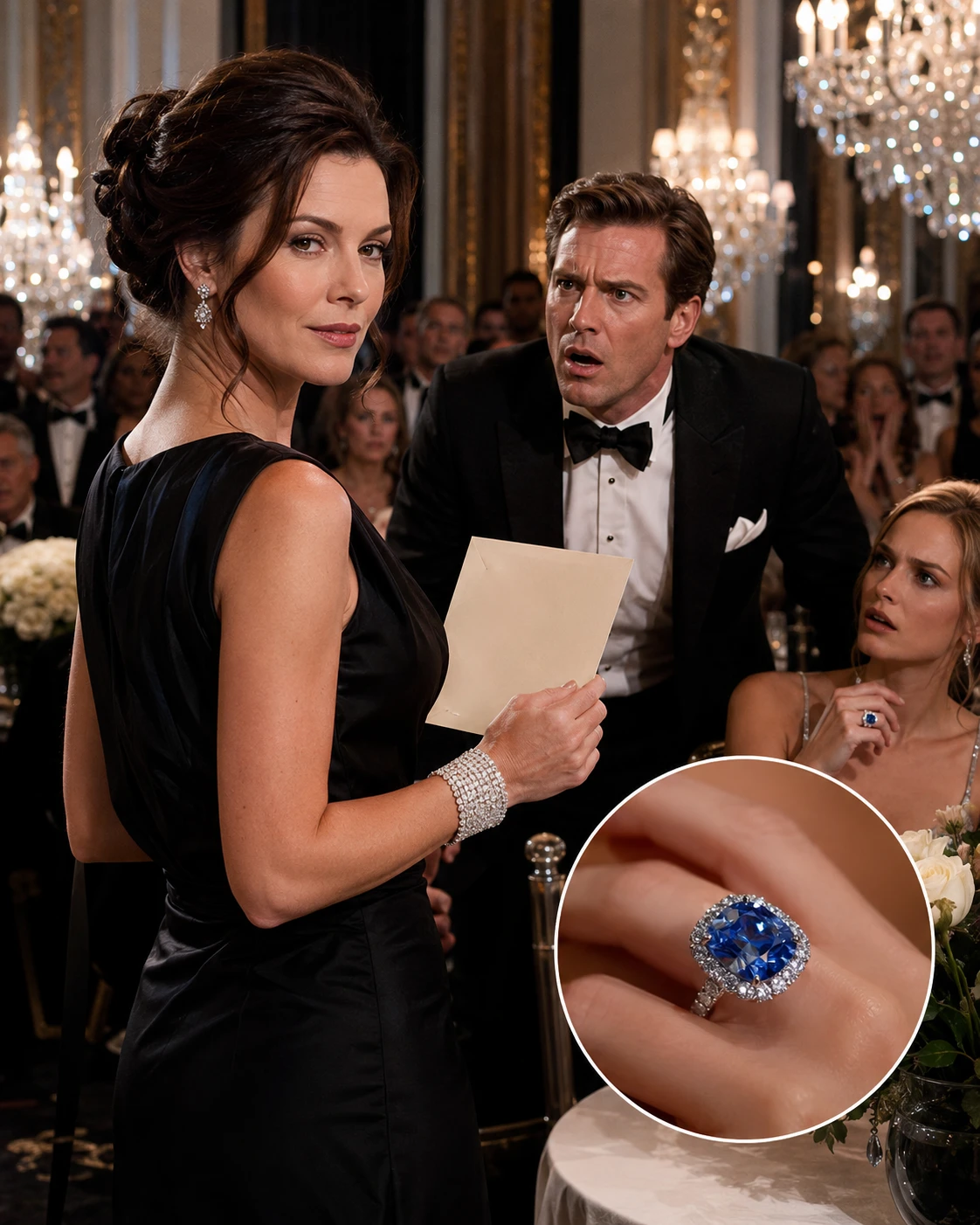
But it can open the door.
After the event, I found Adrian outside in the library courtyard.
Snow was falling lightly, turning the city soft for once.
“You didn’t tell me about converting the shares,” he said.
“No.”
“Was that your plan all along?”
“Not all along.”
“When did you decide?”
I looked up at the snow.
“When I read my mother’s letter.”
He nodded slowly.
“Ashford Holdings will fight.”
“I know.”
“Eleanor will fight harder.”
“I know.”
“You may lose some value in the conversion.”
“I know.”
He stepped closer. “You’re sure?”
I turned to him.
For years, men had asked me that question as a challenge. Are you sure you understand? Are you sure you can handle this? Are you sure you want to make trouble?
From Adrian, it sounded like respect.
“Yes,” I said.
He smiled.
The snow caught in his hair again.
This time, I reached up and brushed it away.
He went still.
So did I.
The city seemed to hold its breath.
“I’m still married,” I whispered.
“I know.”
“I’m not ready.”
“I know.”
“This could become complicated.”
“Vivienne,” he said softly, “everything about you has been complicated since the day you beat me in Contracts and apologized to my professor for his grading standards.”
I laughed.
It came out warmer than I expected.
Adrian’s hand lifted, stopping just short of my cheek.
“May I?” he asked.
Not because he lacked courage.
Because he had manners where my life had taught me to expect hunger.
I nodded.
His fingers touched my face lightly, a question more than a claim.
No kiss.
Not yet.
Just warmth in the snow. Just the possibility that love, the real kind, might arrive without theft, performance, or borrowed diamonds.
Inside, the auction continued. Money was raised. Documents waited. Cases would unfold. Calloway would rage. Eleanor would plot. The tabloids would feast until the next beautiful disaster appeared.
But for one quiet moment, I was not a headline, not a wife, not a wounded woman made useful by betrayal.
I was Vivienne Hartwell.
My mother’s daughter.
My own.
CONCLUSION
WHAT REMAINED AFTER THE FIRE
Six months later, the divorce became final on a clear April morning.
Calloway pleaded to lesser financial charges after months of pressure, testimony, and documents he could no longer bury. Eleanor fought longer, colder, and with more expensive lawyers, but even she could not charm a signature into authenticity once three experts called it forged.
Ashford Holdings survived, but not untouched.
Its board was restructured. Its charitable partnerships were audited. Several executives resigned with the kind of statements that mention family time when they mean subpoenas.
The Marigold Advocacy Fund launched in June.
By autumn, it had helped more than twelve hundred children secure emergency legal representation.
The first thank-you note came from a fifteen-year-old girl in Ohio who had been sleeping in a caseworker’s office for three nights before a Marigold-funded attorney forced the county to find placement.
She wrote:
I didn’t know rich people could be mad for me.
I framed it.
Not in the public office. In my bedroom.
The penthouse sold. I never slept there again.
I kept my townhouse, my mother’s china, my father’s books, and the gold watch that still ticked like a small, stubborn heart.
The blue diamond was returned to me after evidence processing.
I did not sell it.
I did not wear it.
I had it unset and placed the stone in the center of a new brooch shaped like a marigold. Around it, a jeweler set small white diamonds from pieces my mother had left me.
The first time I wore it was not to a gala.
It was to the opening of a children’s legal clinic in Detroit.
A little boy in a navy blazer pointed at it and asked, “Is that flower magic?”
I touched the blue stone.
“Yes,” I told him. “But only because it survived.”
Brooke sent one letter from Tampa.
She was working for a nonprofit, answering phones, taking community college classes in accounting, and living with her mother. She did not ask for forgiveness. She only wrote what she was doing to become someone who would not repeat what she had done.
I respected that more than an apology.
Nora became executive director of national operations and immediately banned vague consulting invoices with the passion of a woman who had seen evil wear a vendor code.
Judith Bell retired for exactly eleven days before returning as “special counsel emerita,” which meant she came in twice a week to terrify men for sport.
Adrian waited.
Not passively. Not dramatically.
He simply remained present without trying to become the center of my recovery.
There were dinners that were not dates until they were. Walks that ended at my door with no expectation. Calls about legal filings that became conversations about books, then grief, then what kind of life I wanted when I stopped measuring safety by the locks on doors.
A year after the auction, he kissed me in the Morgan Library courtyard while snow fell again.
This time, I was ready.
Love after betrayal does not feel like fireworks.
It feels like someone turning on a lamp in a house you thought had burned down.
Warm. Steady. Almost unbelievable.
I still have enemies.
Any woman who takes back power will.
Eleanor Ashford sends Christmas cards with no message, only her name engraved beneath a silver crest. I keep none of them.
Calloway married no one. Men like him prefer mirrors to witnesses.
Sometimes, strangers recognize me in restaurants. They whisper. They ask for selfies. They tell me they watched the auction clip after a breakup, after a divorce, after discovering a lie in a phone at 2:00 a.m.
They always ask how I stayed so calm.
I usually smile and say, “Good tailoring.”
But the truth is less glamorous.
I stayed calm because my mother taught me to read documents.
Because my assistant believed rage could be organized.
Because one good lawyer knew silence was not emptiness.
Because a foolish girl wore the wrong ring in the right room.
Because my husband thought public humiliation would make me smaller.
He forgot that diamonds are made by pressure.
And audits are made by paper.
She raised my ring. I raised the audit.