
PART 3
The sound felt painfully out of place.
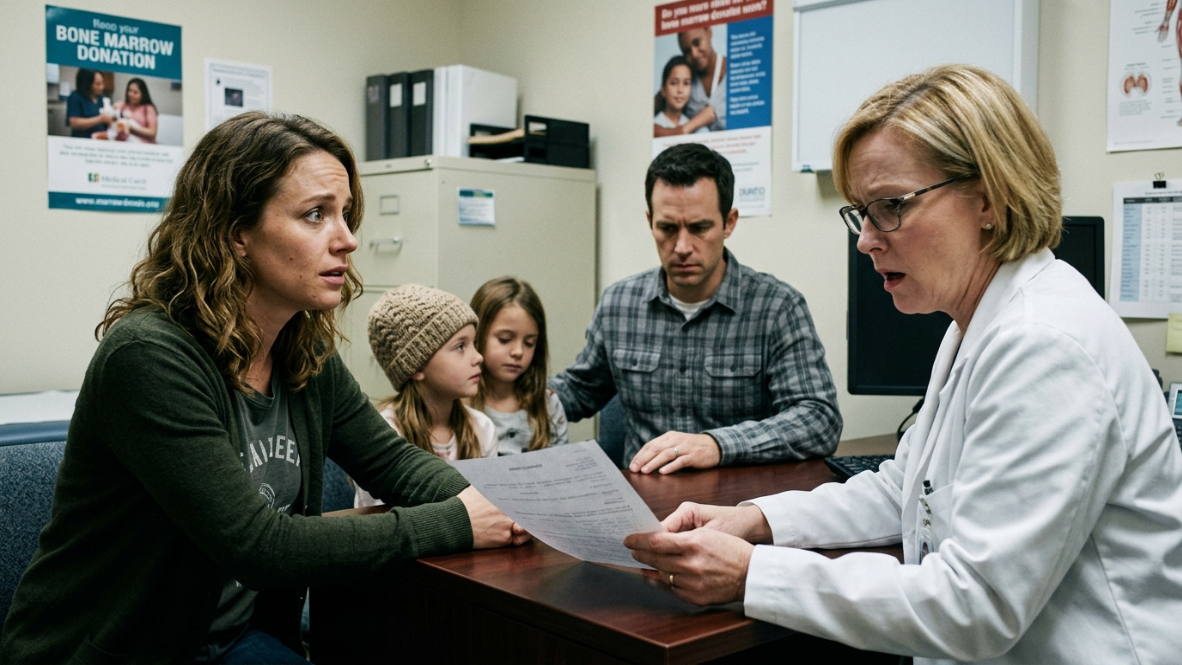
Dr. Whitman looked from Graham to me.
“I need to ask both of you a few questions.”
Neither of us answered.
“Mr. Collins, were the twins conceived naturally?”
His eyes narrowed.
“Why does that matter?”
“It matters because the genetic markers we’re seeing are… highly unusual.”
“We used IVF,” he admitted after a long pause.
I blinked.
IVF?
He had never told me that.
During our marriage, we had struggled to conceive for almost four years.
We’d visited fertility clinics.
Taken medications.
Endured endless blood tests.
Then, one day, Graham came home smiling.
“It’s finally working,” he’d told me.
“The doctor adjusted the treatment.”
I’d believed him.
I believed everything back then.
Dr. Whitman nodded slowly.
“Which clinic?”
Graham hesitated.
“Northwest Fertility.”
“Approximately eleven years ago?”
“Yes.”
One of the genetic specialists quietly wrote something on a tablet.
Dr. Whitman continued.
“Were donor embryos used?”
“No.”
“Were donor eggs used?”
“No.”
“Donor sperm?”
His answer came too quickly.
“No.”
The doctor looked at him for several seconds.
“The laboratory records we’re seeing don’t support that.”
The room froze.
I stared at Graham.
“What records?”
Dr. Whitman took a careful breath.
“As part of preparing for a bone marrow transplant, we requested archived reproductive records from the fertility clinic. This is standard whenever conception involved assisted reproductive technology.”
I frowned.
“I didn’t even know you could do that.”
“Usually there’s no reason to.”
She placed the folder on the table.
“But Sophie’s genetic profile raised questions.”
She opened another page.
“The DNA markers confirm that you, Ms. Hayes, are Sophie’s biological mother.”
Relief flooded through me.
For one terrifying second, I’d feared something had happened to my daughters.
Then she continued.
“But the paternal markers do not match Mr. Collins.”
The air disappeared from the room.
Graham didn’t breathe.
Neither did I.
“What?”
The word barely escaped my lips.
“The probability that Mr. Collins is Sophie’s biological father is effectively zero.”
My knees weakened.
I grabbed the edge of the table before I collapsed.
“No…”
I looked at Graham.
“Tell her she’s wrong.”
He didn’t move.
“Tell her.”
Still nothing.
His face had become completely colorless.
The genetic specialist slid another report toward Dr. Whitman.
“We repeated the analysis independently.”
Dr. Whitman nodded.
“Three times.”
I shook my head.
“There has to be a mistake.”
“There almost never is.”
I stared at the numbers.
They meant nothing to me.
Percentages.
Markers.
Alleles.
Medical language that somehow carried enough weight to destroy an entire life.
Ruby…
Sophie…
The twins.
If Graham wasn’t their father…
Then who was?
My thoughts spiraled wildly.
Had I…
No.
Never.
I had never been with another man.
Not before Graham.
Not during our marriage.
Not after.
I knew that with absolute certainty.
Which meant…
I slowly looked back toward the doctor.
“The clinic…”
Dr. Whitman met my eyes.
“We believe there may have been an error during the IVF procedure.”
The words landed like an earthquake.
An embryo mix-up.
A sperm mix-up.
Something impossible.
Something that happened only in headlines.
“I carried those girls for nine months.”
Tears burned my eyes.
“I gave birth to them.”
“You are unquestionably their mother.”
“But…”
My voice cracked.
“Who is their father?”
No one answered.
Because no one knew.
The consultation room door suddenly burst open.
A woman in dark-blue scrubs hurried inside carrying another folder.
“I’m sorry to interrupt.”
She stopped when she saw all of us.
“I just received archived files from Northwest Fertility.”
Dr. Whitman accepted the envelope.
The papers inside were yellowed.
Printed more than a decade earlier.
Some pages had handwritten notes.
Others carried signatures.
As she turned the first sheet, her expression changed again.
This time…
She looked horrified.
“What is it?” I whispered.
She didn’t answer.
Instead she flipped to another page.
Then another.
Finally she looked directly at Graham.
“When exactly did you first see these records?”
“I…”
“You’ve seen them before.”
“I don’t know what you’re talking about.”
“Mr. Collins.”
Her voice became firmer.
“These documents were accessed electronically almost three years ago.”
My heartbeat accelerated.
Three years.
Exactly one year before Graham filed for divorce.
Exactly one year before he accused me of being mentally unstable.
Exactly one year before he somehow walked into court carrying a psychiatrist’s report that had destroyed my life.
Dr. Whitman slowly placed one page in front of him.
“The login credentials used belonged to your personal patient portal.”
Graham swallowed.
“You already knew there had been a fertility laboratory error.”
His silence answered for him.
I felt something inside me shatter.
“You knew?”
Still nothing.
“You knew they might not be your biological daughters…”
My voice rose.
“…and you still took them away from me?”
His lips finally moved.
“It wasn’t supposed to happen like this.”
Those seven words were worse than any confession.
The room erupted.
“You lied!” I shouted.
“You stood in court and called me mentally unstable!”
“You told the judge I was dangerous!”
“You made my daughters believe I abandoned them!”
His eyes remained fixed on the table.
“I couldn’t lose them.”
“So you decided I had to lose them instead?”
No answer.
Only silence.
Then another voice broke through from the doorway.
Small.
Weak.
Confused.
“Daddy?”
Every adult turned.
Sophie stood there in oversized hospital pajamas.
Her bald head had only begun to thin from chemotherapy, but the illness had already stolen the brightness from her face.
An IV pole rolled beside her.
She looked between Graham…
…and me.
Then her eyes stopped.
They stayed on my face.
For several long seconds she simply stared.
Almost as if she were trying to remember something buried very deep.
Finally, in a tiny uncertain voice, she whispered…
“Mom?”
PART 4
For a single heartbeat, no one moved.
The room seemed to forget how to breathe.
Sophie’s tiny voice—weak from weeks of illness yet somehow strong enough to cut through years of lies—hung in the air.
“Mom?”
I looked at her.
She looked so much smaller than I remembered.
The last time I had seen her, she had been racing her sister through a park in Portland, her ponytail bouncing behind her as she laughed because Ruby insisted squirrels were secretly spies.
Now the ponytail was gone.
Her cheeks were pale.
Dark circles rested beneath eyes that should have been full of mischief instead of exhaustion.
An oversized hospital bracelet slid loosely around her wrist.
My heart broke all over again.
I wanted to run to her.
I wanted to hold her.
But after two years of being told I wasn’t allowed near my own daughters, fear stopped my feet.
What if she didn’t really remember me?
What if she’d only recognized my face from old photographs?
What if Graham had poisoned every memory she had?
Before I could decide, Sophie took one slow step toward me.
Then another.
The IV pole squeaked beside her.
“Daddy…”
she whispered without taking her eyes off me.
“Is… is that really Mom?”
Graham opened his mouth.
No words came out.
For once in his life, he had no story prepared.
No explanation polished enough to survive the truth.
Dr. Whitman knelt beside Sophie.
“You should be resting, sweetheart.”
“I heard yelling.”
Her eyes remained fixed on me.
“I know her.”
She frowned.
“I… I dream about her.”
Every word squeezed tighter around my heart.
“I have dreams where somebody sings to me.”
She looked confused.
“The same song every time.”
My hands began trembling.
There had been only one lullaby I ever sang to the twins.
Not one Graham knew.
Not one anyone else knew.
It was something my grandmother had sung in the tiny farmhouse where I grew up.
I hadn’t heard it since the day custody was taken away.
Without thinking, I quietly began humming.
Very softly.
Barely louder than a whisper.
Sophie’s eyes widened.
Tears immediately filled them.
“That’s it.”
She looked stunned.
“That’s the song.”
She let go of the IV pole.
Slowly.
Carefully.
Then she crossed the room.
Each step seemed to take forever.
When she finally stood in front of me, she looked up with uncertain eyes.
“Can…”
Her voice shook.
“…can I hug you?”
The question shattered what little strength I had left.
I dropped to my knees.
“You never have to ask me that.”
She threw her arms around my neck.
She felt frighteningly light.
Too light.
I held her so carefully, terrified that if I squeezed too hard she might break.
She buried her face against my shoulder.
“You smell the same.”
I started crying.
“So do you.”
“I thought I forgot.”
“You never forgot.”
“I almost did.”
Those four words hurt more than anything Graham had ever said to me.
Almost.
Two years.
Seven hundred and thirty-two days of carefully replacing me with silence.
Almost enough.
Almost.
Behind us, no one spoke.
Even the nurses wiped tears from their eyes.
The only person who couldn’t look at us was Graham.
An hour later, Sophie had finally fallen asleep.
The excitement had exhausted her.
The oncology nurses gently wheeled her back to her room while promising she’d see me again as soon as she woke.
I watched until the doors closed.
Only then did I remember another child.
Ruby.
“Where’s Ruby?”
Dr. Whitman answered quietly.
“She’s here.”
My pulse quickened.
“Is she sick too?”
“No.”
Relief flooded through me.
“She came with her father this morning.”
“Can I see her?”
Dr. Whitman hesitated.
“That may be difficult.”
“Why?”
“Graham requested that she not be involved in today’s discussions.”
I looked toward him.
He still hadn’t said a single word.
He stood by the window staring into the parking lot.
His reflection looked older.
Smaller.
As though years had suddenly caught up with him.
“You don’t get to decide that anymore,” I said.
He closed his eyes.
“I know.”
“They’re my daughters.”
“I know.”
“You told them I abandoned them.”
Silence.
“You told them I didn’t love them.”
Still nothing.
Finally he whispered,
“I told myself I was protecting them.”
I laughed bitterly.
“No.”
I stepped closer.
“You were protecting yourself.”
His shoulders sagged.
The confidence that had impressed judges and attorneys was gone.
“I loved them.”
“So did I.”
“You were falling apart after the custody hearings.”
“I was falling apart because you took my children.”
“You stopped eating.”
“You hired experts to call me insane.”
“You missed work.”
“You forged evidence.”
“I was afraid.”
“For yourself.”
“No.”
He looked at me for the first time.
“For them.”
I stared at him.
“What are you talking about?”
He rubbed both hands over his face.
“You don’t understand.”
“Then explain.”
His eyes drifted toward the consultation room where the fertility records still lay scattered across the table.
“I found out.”
His voice barely carried across the room.
“I found out they weren’t biologically mine.”
“I know.”
“No.”
He shook his head.
“You don’t know everything.”
My stomach tightened.
“What else is there?”
He looked toward the ceiling.
“I found out almost four years ago.”
“What?”
“Before I filed for divorce.”
I froze.
“You knew that long?”
He nodded.
“I hired a private investigator.”
“Why?”
“Because someone mailed me anonymous DNA results.”
The room became silent again.
“I thought you had cheated.”
“I never cheated.”
“I know that now.”
His voice cracked.
“But I didn’t then.”
He swallowed hard.
“The investigator eventually discovered we’d used the wrong sperm sample.”
I couldn’t speak.
“He also discovered the fertility clinic had quietly settled another lawsuit involving embryo mix-ups.”
Dr. Whitman exchanged glances with the genetic specialist.
Neither interrupted.
“I confronted the clinic.”
“What did they say?”
“They begged me not to go public.”
My heartbeat accelerated.
“They admitted there had been… irregularities.”
“Who is their father?”
“We never found out.”
“And instead of telling me…”
My voice rose.
“…you destroyed my life?”
His head dropped.
“I couldn’t look at you without wondering.”
“Wondering what?”
“If you knew.”
I felt physically sick.
“You actually believed I’d carry another man’s babies for nine months and somehow never notice?”
“I wasn’t thinking clearly.”
“No.”
I took another step closer.
“You were thinking exactly like the man you’ve always been.”
His jaw tightened.
“You always needed control.”
“You controlled the money.”
“You controlled the house.”
“You controlled every vacation.”
“You even chose what color I painted my own office.”
“You couldn’t control biology.”
“So you controlled the only thing left.”
I pointed toward Sophie’s room.
“The girls.”
His eyes filled with tears.
“I loved them.”
“So much that you erased their mother?”
“I thought it would be easier.”
“For who?”
He didn’t answer.
Because there wasn’t one.
That evening, a social worker arrived.
Then another.
Hospital policy required family meetings whenever legal guardians disagreed during critical medical decisions.
By six o’clock, the conference room was crowded.
Doctors.
Nurses.
The hospital’s legal counsel.
A pediatric psychologist.
A transplant coordinator.
And finally…
Ruby.
She walked in holding a stuffed fox that looked as worn as it had the day I’d given it to her on her sixth birthday.
She’d named it Cinnamon.
I remembered sewing its left ear back on after the family dog had chewed it.
She was taller now.
Her hair reached her shoulders.
She looked so much like Sophie that seeing her stole the air from my lungs.
She noticed me immediately.
Then looked at Graham.
“Dad?”
He couldn’t meet her eyes.
“Who’s she?”
The psychologist gently smiled.
“Ruby…”
She spoke carefully.
“There are some important things your family needs to discuss.”
Ruby looked confused.
“I know.”
She pointed at me.
“She’s the lady from the pictures.”
Pictures?
“What pictures?”
Ruby looked surprised.
“The ones Dad keeps in his office.”
Everyone slowly turned toward Graham.
His face drained of color.
“You kept my pictures?”
He whispered,
“I couldn’t throw them away.”
Ruby frowned.
“I thought she died.”
Every adult in the room froze.
The silence became unbearable.
“What did you say?”
Ruby looked from one face to another.
“Dad said…”
She hesitated.
“…he said my mom got very sick.”
My heart stopped.
“He said talking about her made everyone sad.”
Tears welled in Graham’s eyes.
“He said…”
Ruby’s voice became almost inaudible.
“…she loved us very much before she died.”
No one moved.
No one breathed.
Then Ruby looked directly at me.
Very quietly…
She asked the question that none of us were prepared to answer.
“If you’re alive…”
“…who have I been crying for every Mother’s Day?”
PART 5
Ruby’s question settled over the room like a weight no one could lift.
“If you’re alive… who have I been crying for every Mother’s Day?”
No doctor reached for a clipboard.
No nurse adjusted an IV.
Even the steady hum of the hospital ventilation seemed to disappear.
I looked at my little girl—the daughter who had once refused to sleep unless I checked her closet for imaginary dragons—and realized she had spent two years mourning a mother who had never died.
I couldn’t look at Graham.
If I did, I wasn’t sure I could stop myself from screaming.
The pediatric psychologist, Dr. Evelyn Carter, slowly moved her chair closer to Ruby.
“Sweetheart,” she said gently, “sometimes adults make very serious mistakes.”
Ruby frowned.
“But Dad doesn’t lie.”
Nobody answered.
She looked at Graham.
“Dad?”
He remained silent.
His hands trembled so violently that the paper coffee cup he was holding slipped from his fingers.
Coffee spilled across the conference table.
He didn’t even notice.
Ruby tried again.
“Dad…”
His lips parted.
“I’m…”
His voice broke.
“I’m sorry.”
Ruby blinked.
“For what?”
He closed his eyes.
“For everything.”
Children have a remarkable way of sensing truth before they fully understand it.
I watched confusion slowly transform into fear across Ruby’s face.
She looked from Graham…
to me…
to the doctors…
back to Graham.
“Did you…”
Her voice became tiny.
“…did you tell me Mom was dead?”
He couldn’t say yes.
He couldn’t say no.
His silence answered for him.
Ruby’s stuffed fox slipped from her hands and landed softly on the carpet.
“You lied?”
Tears rolled down his cheeks.
“I thought…”
“No!”
Ruby shouted for the first time.
“You lied!”
She backed away from him.
“You said she left us because she was sick!”
“You said she loved us too much to let us watch her die!”
“You said…”
Her breathing became uneven.
“…you said she wrote us letters.”
Every muscle in my body tightened.
Letters?
“What letters?” I whispered.
Ruby ran from the room before anyone could stop her.
Twenty minutes later, a nurse found her sitting alone in the hospital chapel.
I approached slowly.
She sat on the front pew, clutching Cinnamon tightly against her chest.
Without turning around, she spoke.
“I remember you.”
The words almost knocked the breath out of me.
“You do?”
“Not everything.”
She stared at the stained-glass window.
“I remember pancakes shaped like stars.”
I smiled through tears.
“You always wanted extra blueberries.”
She nodded.
“I remember yellow rain boots.”
“You refused to wear any other shoes.”
“I remember…”
She hesitated.
“…you built me a cardboard castle.”
I laughed softly.
“It collapsed in twenty minutes.”
“You said real castles fall too.”
I sat beside her.
Neither of us spoke for a while.
Finally she asked,
“Why didn’t you come find us?”
The question I’d dreaded for two years.
“I tried.”
“You did?”
“I came to your school.”
“You weren’t there.”
“Your father transferred you.”
“I mailed birthday presents.”
“I never got them.”
“I wrote letters.”
Her head turned sharply.
“You wrote me?”
“Every birthday.”
“Every Christmas.”
“Every first day of school.”
“I never saw any.”
My chest tightened.
“I know.”
She looked down.
“I thought…”
She swallowed.
“…I thought you stopped loving us.”
I reached out carefully.
“Ruby.”
She looked at me.
“There has never been one single day…”
I brushed a tear from her cheek.
“…when I didn’t love you.”
She burst into tears.
This time she was the one who hugged me.
Unlike Sophie, Ruby held on with desperate strength, almost as though she feared someone would pull us apart again.
“I’m sorry,” she sobbed.
“I forgot your voice.”
“You don’t have to apologize.”
“I forgot your laugh.”
“You’ll remember.”
“I forgot…”
Her crying made the words almost impossible to hear.
“…your face.”
I kissed the top of her head.
“I’m here now.”
The next morning, Seattle Children’s Hospital became much busier than usual.
Not because of Sophie’s treatment.
Because attorneys had begun arriving.
Hospital legal counsel.
A representative from Child Protective Services.
A family court investigator.
And two detectives from the Seattle Police Department.
Dr. Whitman had fulfilled her legal obligation after reviewing the fertility records.
Questions surrounding the custody proceedings had become impossible to ignore.
Especially after Ruby disclosed something unexpected during her counseling session.
Detective Laura Hernandez sat across from Graham in a private consultation room.
“We’re trying to establish a timeline.”
Graham stared at the table.
“When did you first tell the girls their mother was dead?”
His lawyer placed a hand on his arm.
“My client isn’t obligated—”
“He is,” Detective Hernandez interrupted calmly.
“This concerns potential custodial interference and evidence presented during family court proceedings.”
The attorney fell silent.
Graham answered without looking up.
“The day after the custody order.”
“And why?”
“I didn’t want them waiting.”
“Waiting for what?”
“For her.”
Detective Hernandez leaned forward.
“So instead, you convinced two eight-year-old children that their mother had died.”
He nodded once.
“So they could grieve.”
“So they would stop asking.”
“So they wouldn’t hate me.”
The detective quietly wrote something in her notebook.
“What about the letters?”
He covered his face.
“I burned them.”
The room became silent.
“Every one?”
“Yes.”
“The birthday gifts?”
“I donated them.”
“The photographs?”
“I kept those.”
“Why?”
His answer came after nearly a minute.
“Because I couldn’t throw away the woman I used to love.”
Meanwhile, another mystery had begun unfolding.
Northwest Fertility Clinic had finally responded to Dr. Whitman’s request for archived files.
Only…
something wasn’t right.
The records weren’t complete.
Several electronic files had been deleted.
Entire weeks of laboratory logs were missing.
The clinic claimed it was due to a server failure nearly eleven years earlier.
The hospital’s transplant coordinator didn’t believe them.
Neither did Detective Hernandez.
She requested a court order.
Within forty-eight hours, investigators seized decades of archived records from the fertility clinic.
What they discovered shocked everyone.
Sophie’s case wasn’t unique.
There had been multiple undocumented laboratory errors over a three-year period.
Several families had quietly accepted confidential settlements.
Others had never been notified.
Some still had no idea their children weren’t biologically related to the parents who believed they were.
The investigation quickly became national news.
Television crews surrounded the clinic.
Former employees came forward anonymously.
One retired embryologist admitted management had pressured staff to remain silent after discovering labeling failures inside the laboratory.
Every revelation answered one question…
and created three more.
Most importantly—
Who was the twins’ biological father?
The answer mattered medically.
If Sophie needed additional treatment, doctors required a complete family medical history.
Without it, they were working in the dark.
Three days later, another breakthrough arrived.
A genetic genealogy laboratory agreed to perform an emergency search using anonymous DNA databases, with court approval and strict privacy protections.
The process could take weeks.
Maybe months.
Time Sophie didn’t have.
But then, late on Friday afternoon, Dr. Whitman’s office phone rang.
She listened quietly.
Asked only three questions.
Hung up.
Then immediately sent someone to find me.
When I entered her office, she was standing by the window.
There was a file in her hands.
“We’ve identified someone,” she said softly.
My heart pounded.
“The biological father?”
She nodded.
“But before I tell you his name…”
She looked directly into my eyes.
“…there’s something you need to know.”
I felt my stomach tighten.
“What?”
Dr. Whitman took a slow breath.
“He has no idea your daughters exist.”
She opened the folder.
The photograph on the first page showed a man in his early forties.
The moment I saw his face…
I gasped.
Because I knew him.
Not well.
Not personally.
But well enough to realize that if he learned the truth…
everything our family had just begun rebuilding was about to change forever.
PART 6
I stared at the photograph in Dr. Whitman’s hand.
For several seconds, my mind refused to understand what my eyes were seeing.
The man looking back at me was someone I had not thought about in more than a decade.
Someone whose name belonged to another lifetime.
Someone who had been nothing more than a forgotten chapter.
My voice barely came out.
“That can’t be him.”
Dr. Whitman lowered the file slightly.
“You recognize him?”
I nodded slowly.
“His name is Daniel Mercer.”
The room went completely quiet.
“How do you know him?” she asked.
I sat down because suddenly my legs couldn’t support me.
“Daniel was a friend of Graham’s.”
The words felt impossible.
“A close friend.”
Dr. Whitman looked down at the report.
“The genetic match is extremely strong. There is a 99.999% probability that Daniel Mercer is Sophie’s biological father.”
I closed my eyes.
The memories came rushing back.
The fertility clinic.
The years of disappointment.
The endless appointments.
The day Graham had told me everything was finally fixed.
But there was something else.
A conversation I had completely forgotten.
A conversation between Graham and Daniel.
Four years before our divorce, before the custody battle, before my entire life collapsed, Graham and I had been desperate to have children.
We had tried everything.
Every medication.
Every procedure.
Every promise that “next time will work.”
Nothing happened.
Then Graham suggested we try a different fertility clinic.
He said a friend recommended it.
That friend was Daniel.
At the time, I thought it was strange.
Why would Graham’s friend know so much about fertility clinics?
But I was exhausted.
I wanted a baby.
I trusted my husband.
I trusted the man who slept beside me every night.
The IVF procedure worked.
Nine months later, I gave birth to Sophie and Ruby.
The happiest day of my life.
The day I became a mother.
But now…
I understood something.
Graham had known more than he admitted.
Maybe from the beginning.
“Where is Daniel now?” I asked.
Dr. Whitman hesitated.
“He lives in California.”
“Does he know?”
“No.”
My heart sank.
“How could he not know?”
“Because according to the clinic records, the error was never disclosed.”
I stared at the floor.
A man somewhere had two daughters.
Two beautiful girls.
And he had no idea they existed.
But then another thought came.
“What about Ruby?”
Dr. Whitman looked down.
“The genetic profile confirms both twins share the same biological father.”
I closed my eyes.
Both my daughters.
Both connected to a man who didn’t know they were alive.
Daniel arrived at Seattle Children’s Hospital two days later.
I watched him through the window of the waiting area.
He looked nervous.
Confused.
Older than the man I remembered from years ago.
He had gray in his hair now.
The same gentle eyes.
The same quiet expression.
When he saw me, he stopped.
“Isabelle?”
Hearing my name from his mouth felt like opening a door to the past.
“Hello, Daniel.”
He looked between me and Dr. Whitman.
“I was told this was urgent.”
“It is.”
Nobody knew how to begin.
How do you tell someone they have two daughters?
How do you explain eleven years of a life they never knew existed?
Finally, Dr. Whitman spoke.
“Mr. Mercer, we conducted genetic testing related to a medical emergency.”
Daniel listened carefully.
“You are the biological father of two ten-year-old girls.”
His face changed.
Not dramatically.
Not like Graham’s.
Instead, he looked completely lost.
“I’m sorry…”
He gave a nervous laugh.
“I think there must be a mistake.”
“There isn’t.”
The room became silent.
“You have daughters.”
Daniel sat down.
The color drained from his face.
“Two?”
I nodded.
“Sophie and Ruby.”
He covered his mouth with his hand.
For several minutes, he couldn’t speak.
Then he whispered:
“Are they okay?”
That question told me everything.
He didn’t ask how this happened.
He didn’t ask who was responsible.
His first thought was them.
The girls.
“Their lives have been complicated,” I said softly.
His eyes filled with tears.
“Can I meet them?”
Meeting Daniel changed everything.
Not immediately.
Not magically.
There was no instant replacement for eleven years.
A person cannot walk into a hospital room and become a father overnight.
But children have a way of opening doors adults are afraid to touch.
Sophie was cautious at first.
Ruby was angry.
Especially at Graham.
But Daniel didn’t push.
He sat with them.
He listened.
He answered every question honestly.
When Sophie asked:
“Why didn’t you find us?”
He said:
“Because I didn’t know I had to look.”
When Ruby asked:
“Do you love us?”
He cried.
“I have loved you since the moment I learned you existed.”
Slowly…
very slowly…
the girls began to trust him.
Three weeks later, Sophie received her bone marrow transplant.
The donor?
Me.
The woman Graham had spent two years trying to erase.
The doctors said my cells matched almost perfectly.
The procedure was difficult.
The recovery was painful.
There were terrifying nights when we weren’t sure if her body would accept the transplant.
But Sophie fought.
She fought harder than anyone expected.
One night, while she was resting after treatment, she grabbed my hand.
“Mom?”
“Yes, sweetheart?”
“Did you really come as soon as they called you?”
I smiled sadly.
“Of course.”
“Even after everything Dad did?”
I looked at my daughter.
“Nothing your father did could ever stop me from coming to you.”
She squeezed my hand.
“I knew you would.”
Those words healed something inside me that two years of court battles never could.
Six months later, the custody hearing reopened.
This time, the courtroom was different.
The judge wasn’t hearing accusations.
He was hearing evidence.
The false psychiatric report.
The hidden medical information.
The destroyed letters.
The lies told to two children.
Everything came into the light.
Graham sat quietly throughout the hearing.
He did not fight.
Not like before.
When the judge asked if he wanted to make a statement, he stood.
“I spent two years proving Isabelle wasn’t a good mother.”
He looked toward me.
“But the truth is…”
His voice broke.
“I was the one who failed them.”
The courtroom was silent.
“I thought if I controlled everything, I could protect my daughters.”
He swallowed.
“I was wrong.”
The judge removed Graham as sole custodian.
But instead of completely taking him away from the girls, the court created a carefully supervised arrangement.
Because despite everything…
he was still their father in the only way that mattered to children.
He was the person they had known.
And the court believed children deserved healing, not another loss.
A year later, our family looked nothing like it had before.
It was different.
Not perfect.
Never perfect.
But honest.
Sophie was cancer-free.
The doctors called her recovery extraordinary.
Ruby joined a soccer team and became obsessed with scoring goals.
Daniel became a part of their lives slowly, respectfully, patiently.
And me?
I rebuilt my life.
My architecture firm recovered.
The Morrison Tower project was eventually completed.
The building became one of Portland’s most recognized designs.
But when people asked me what my greatest accomplishment was…
I never mentioned the building.
I never mentioned the awards.
I always said the same thing.
“Finding my daughters again.”
Two years after Sophie’s transplant, I received a letter.
It was from Graham.
I almost threw it away.
But I opened it.
Inside was a single page.
No excuses.
No blame.
Just the truth.
Isabelle,
I spent years trying to convince everyone that you were the problem because admitting my own mistakes was too painful.
I took away the one thing you loved most because I was afraid of losing it.
I don’t expect forgiveness.
I don’t deserve it.
But I want you to know something.
The girls talk about you every day.
They talk about how you drove through the night when Sophie got sick.
They talk about how you never stopped loving them.
I spent years trying to erase you.
And all I did was prove how impossible you are to erase.
I folded the letter carefully.
Then placed it away.
Not because I forgave him completely.
Forgiveness is not forgetting.
It is not pretending something didn’t hurt.
It is simply deciding that someone else’s choices will no longer control your future.
Five years later, Sophie stood on a stage holding her high school graduation diploma.
Ruby stood beside her.
Twins.
Different personalities.
Different dreams.
But still holding hands like they did when they were eight years old.
After the ceremony, Sophie hugged me.
“Mom?”
“Yes?”
“Do you ever think about what would have happened if you didn’t answer that phone call?”
I looked at my daughters.
The two people I had fought the universe to find again.
“I don’t know.”
She smiled.
“But you answered.”
I nodded.
“Yes.”
“I answered.”
And that was the truth.
The courtroom took two years from me.
The lies took even longer.
But love has a strange way of surviving things that were meant to destroy it.
Because a mother can be pushed away.
A mother can be silenced.
A mother can be forgotten for a while.
But a mother’s love…
is something no one can ever erase.