
PART 2:
The cop took the document from the woman in the navy blazer. I watched his eyes move down the page. His partner shifted his weight, scanning the crowd. The father was still yelling something about his rights, but the sound had turned tinny, hollowed out by the sudden tension.
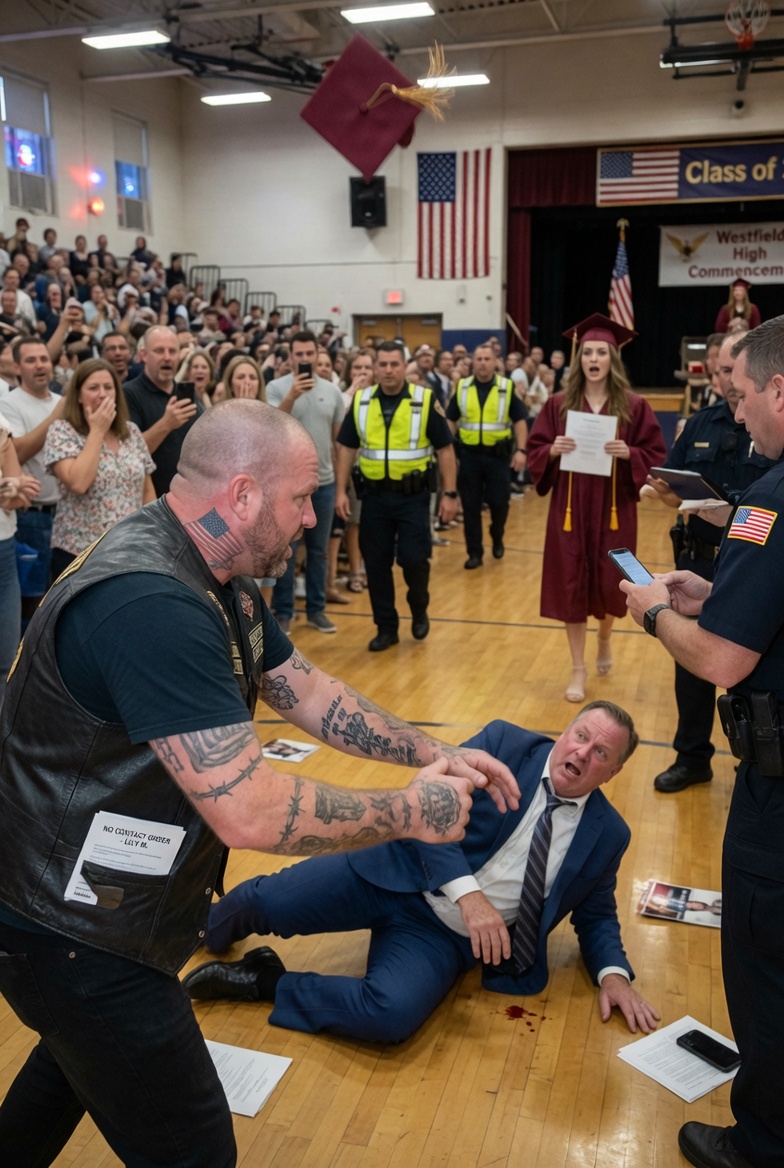
— What is that? Huh? Some kind of joke?
The woman didn’t answer. She just folded her hands in front of her and waited, the leather folder now tucked under her arm. I recognized her face from the courthouse hallway. She was the victim advocate assigned to Lily’s case. Her name was Ms. Delgado. She’d sat with Lily’s mother through three separate hearings, and I’d stood outside each one, waiting for the judge to decide whether a piece of paper could keep a monster at bay.
The officer finished reading and handed the document back. His throat bobbed as he swallowed.
— Sir, there is an active restraining order prohibiting you from being within five hundred feet of Lily Harper. You’re in violation.
The father laughed, but it came out jagged, a glass edge on gravel.
— That’s temporary. My attorney is appealing it. You can’t enforce something that’s being challenged.
Ms. Delgado spoke for the first time, her voice soft as crushed velvet.
— The order remains in effect until the court rules on the appeal. You were informed of that, Mr. Harper. Twice. By certified mail and in person at the last hearing. You signed the acknowledgment.
I watched his face change. The mask of the proud father slipped for just a fraction of a second, and underneath it I saw something raw and feral. I’d seen that look before. It was the look of a man who believed he owned people, and who had just realized someone was trying to repossess his property.
— This is my daughter’s graduation, he hissed. — I have every right.
— No, sir, the officer said, stepping forward. — You don’t. Not today. Not according to this. I need you to come with me.
The crowd had gone silent. Not the quiet of confusion anymore, but the heavy stillness of people who suddenly understood they had been watching the wrong movie. Phones were still up, but now they were recording something different. Not an assault, but an arrest.
The father didn’t move. He looked past the officers, past me, and fixed his eyes on the stage. On Lily. She hadn’t moved. Her diploma was clutched against her chest like a shield, and her knuckles were white. The girl standing next to her, a friend with a glittering mortarboard, had her arm around Lily’s shoulders.
— Lily! he called out. — Sweetheart, tell them. Tell them you want me here.
Her lips parted. I could see her chest rising and falling too fast, the shallow breaths of someone trying not to drown. Her guidance counselor stepped closer and whispered something in her ear. Lily shook her head, a tiny, almost invisible motion.
That’s when I understood something about courage. It doesn’t always roar. Sometimes it’s just a seventeen-year-old girl shaking her head no while every eye in the world watches.
The father saw it too. His face crumpled, then reformed into something harder.
— You did this, he said, turning to me. — You poisoned her against me.
I didn’t answer. I’d learned a long time ago that some arguments were just traps. You stepped into them and they closed around your leg like a bear trap, and the only way to win was to never engage.
The officers each took one of his arms. He didn’t fight them physically, but his mouth kept running.
— This isn’t over. You hear me? This is far from over. I’ll be out by tonight, and then we’ll see who’s laughing.
They walked him down the aisle. The crowd parted like water around a stone. People avoided his eyes. The same people who had been screaming for my blood five minutes earlier now couldn’t look at him. I understood that, too. It’s hard to admit you were wrong. It’s easier to just look away.
When the gym doors finally closed behind him, the air in the room changed. It felt like a fever breaking. Shoulders dropped. Breaths were exhaled. Someone coughed.
The principal walked to the microphone on stage, his footsteps echoing. He cleared his throat.
— I apologize for the disruption. We will now continue with the ceremony. Lily, whenever you’re ready.
She stood there for a long moment. The silence stretched, uncomfortable and fragile. Then she walked to the podium. Her hands were still shaking, but her chin was up. She accepted her diploma from the principal, and this time the applause wasn’t cautious. It was loud and fierce and full of something that felt a lot like apology.
I stayed where I was, near the aisle, no longer the wall but still the watchtower. I watched her cross the stage, watched her friends gather around her, watched her mother rush down from the bleachers with tears streaming down her face. The mother, Elaine, caught my eye as she passed. She mouthed two words.
Thank you.

I gave her the same small nod I’d given Lily. Then I stepped back, fading into the background the way I’d been trained to do. My job wasn’t to be the hero. My job was to make sure the hero got to cross the stage without looking over her shoulder.
The ceremony ended forty minutes later. I stood by the exit as families flooded out into the late afternoon sunshine, the sound of laughter and camera shutters filling the parking lot. I scanned the crowd out of habit, checking faces, watching hands. Old instincts die hard.

Ms. Delgado approached me.
— That was a close call, Mr. Grant.
— Closer than I’d like.
— The school board will need a statement. And there will probably be press. The videos are already circulating.
I rubbed the back of my neck.
— I figured.
— You’ll need to be careful what you say. The legal situation is delicate. The appeal hearing is next month.
— I know the drill.
She studied me for a moment, her dark eyes unreadable.
— Why do you do this work? If you don’t mind me asking.
I hesitated. It was a question I usually deflected, but something about the day had worn down my defenses.
— I had a sister once.
I didn’t say anything else. I didn’t need to. Ms. Delgado’s face softened, and she nodded as if I’d told her the whole story.
— I’m sorry, she said.
— Yeah. Me too.
She handed me a business card.
— If you ever want to talk. We need more people like you in the system.
I took the card, not because I planned to call, but because it seemed rude to refuse. She walked away, her navy blazer blending into the crowd of caps and gowns.
A few parents who had shouted at me earlier approached hesitantly. One man, a stocky guy with a graying beard, stopped a few feet away.
— Hey, uh… I said some things back there. Didn’t know the situation. I’m sorry.
I shrugged.
— You didn’t know.
— Still. I shouldn’t have jumped to conclusions. I called you a thug.
— I’ve been called worse.
He looked like he wanted to say more, but the words weren’t coming. He just shook his head, muttered another apology, and walked away. I didn’t hold it against him. He’d done what most people do. He’d looked at the surface and believed it.

We’re all guilty of that sometimes.
Lily found me by my motorcycle an hour later. The parking lot had mostly emptied out, just a few stragglers taking photos by the school sign. She’d changed out of her gown, now wearing jeans and a simple white blouse. Her mother stood a few paces behind, giving us space.
— You’re leaving? Lily asked.
— Job’s done.
— I wanted to say thank you. Properly. I didn’t get to earlier.
She looked younger without the cap, more like the kid she still was. It was easy to forget that she was only seventeen. She’d had to grow up fast, the way kids do when the people who are supposed to protect them become the thing they need protecting from.
— You don’t have to thank me, I said. — It’s what I do.
— It’s more than that. You could have just stood there. You could have waited for security. But you didn’t. You stepped in. You put yourself between me and him.
— I pushed him. That wasn’t gentle.
— I know. She looked down at her hands, twisting a silver ring on her finger. — But he would have made it to the stage. He would have grabbed me. He would have smiled for the cameras and everyone would have thought he was such a great dad. And I would have frozen. I wouldn’t have been able to move.
Her voice cracked on the last word. Her mother stepped forward, but Lily held up a hand.
— No, Mom. It’s okay. I need to say this.
She looked back at me, eyes wet but determined.
— When he used to come home at night, when I was little, I would hide in my closet. I had a little blanket in there and a flashlight. I’d read books until I heard his bedroom door close. Sometimes that was hours. I never told anyone because I thought it was normal. I thought every kid had a closet they disappeared into.
I didn’t say anything. I just let her talk. Sometimes people need to tell their story without anyone interrupting.
— When my mom finally left him, he said he would change. He went to the classes, said all the right things. The judge gave him supervised visitation. And for a while, it was okay. But then he started showing up at my school. At my dance recitals. Places he wasn’t supposed to be. Sending me messages from different numbers. Telling me my mom was brainwashing me.
She paused, wiping her eyes with the back of her hand.
— The last time I saw him before today, he showed up at my friend’s house. Just appeared on the doorstep. Smiled like nothing was wrong. My friend’s parents didn’t know. They invited him in for coffee. I locked myself in the bathroom and called my mom, and I couldn’t even speak. I just sat on the floor shaking.
Her mother walked up beside her and put an arm around her shoulders.
— That’s when we filed for the restraining order, Elaine said quietly. — The judge granted it after hearing Lily’s testimony. But there’s an appeal. He has money. He has lawyers. He knows how to work the system.
I’d seen it before. The abusers who knew exactly how far they could push, who could weaponize charm and tears and legal technicalities. They were the hardest ones to stop, because the world wanted to believe in redemption stories. The world wanted to believe that fathers loved their daughters.
Sometimes they did. And sometimes love was just another word for control.
— The appeal hearing is next month, Lily said. — I have to testify again. They’re going to ask me questions, try to make me look like a liar. Like I’m just a kid who’s angry at her dad for normal things.
— You’ll have your advocate with you, I said. — Ms. Delgado. She’s good.
— I know. It’s just… She looked at me, and I saw something I recognized. It was the same look my sister had, once. A long time ago. — I’m tired. I’m so tired of being afraid.
Those words hit me square in the chest. I’d said the same thing once. Different circumstances, different decade, but the same weight.
— Fear isn’t weakness, I said. — It’s information. It tells you what you value. You value your safety. You value your peace. There’s nothing wrong with that.
— But I don’t want to live in the closet anymore. I don’t want to hide.
— You didn’t hide today. You walked across that stage. You shook your head when he called your name. That wasn’t hiding. That was standing in the light and telling the truth without saying a word.
She was quiet for a moment. Then she did something I didn’t expect. She stepped forward and hugged me. It was quick, awkward, the kind of hug you give someone you don’t know very well but feel grateful toward. I stood there stiffly, not sure what to do with my hands, until she pulled back.
— Will you be at the hearing? she asked.
— If they need me to testify about today, I will.
— Good.
She smiled, a real smile this time. It was small and fragile and still a little scared, but it was real. Her mother squeezed her shoulder.
— We should go home, she said. — It’s been a long day.
They walked toward their car, a blue sedan parked near the edge of the lot. Lily paused before getting in and looked back at me.
— My mom said your name is Grant. Is that your first name or last name?
— Last name. First name’s Marcus. But nobody calls me that.
— Marcus Grant. She tested the name out loud. — It sounds like a superhero.
I laughed, the first time I’d laughed all day.
— Not even close.
— Well, you’re my superhero. For today, at least.
She got in the car. The engine started, and they pulled away, disappearing around the corner. I stood there for a long time, the sun warm on my face, the sound of the motorcycle engine still silent at my back.
I didn’t go home right away. I drove to a diner on the edge of town, the kind of place with cracked vinyl booths and coffee that tasted like it had been sitting on the burner since the morning rush. It was my usual spot, the place I went when I needed to think.
Marlene, the waitress, poured me a cup without asking.
— You look like you’ve had a day, she said.
— You could say that.
— Want to talk about it?
— Not really.
She left me alone after that, which was one of the reasons I liked the place. That and the pie was decent.
I sat in the corner booth with my back to the wall, nursing the coffee, replaying the day in my head. The sound of the father’s body hitting the floor. The look on Lily’s face. The crowd’s anger curdling into shame. The way the officers’ hands tightened on his arms.
It never got easier. You’d think it would, after enough years in the work, but it didn’t. Every case dug up the old ghosts.
My sister’s name was Clara. She was two years younger than me. For seven years, she was married to a man named Richard who had a smile like a toothpaste commercial and hands that bruised in places nobody could see. I didn’t know. That’s the thing I still can’t forgive myself for. I didn’t know. I was off being a Marine, then a private security contractor, then a drifter doing odd jobs in places where nobody asked questions. I sent postcards. I called on holidays. And I never once asked the right questions.
Clara was good at hiding. She’d learned from the best. Richard was a master of making her doubt her own reality. He’d tell her she was crazy, that she imagined things, that she was lucky he put up with her. He isolated her from her friends, then her family. By the time I came home for good, she was a shadow of the girl I’d grown up with.
I found out the truth on a Tuesday. She showed up at my apartment with a split lip and a story that spilled out of her in fragments, like she was pulling shards of glass from a wound. I held her while she cried. Then I got in my truck and drove to Richard’s house.
I didn’t have a plan. I just had rage.
When I got there, he answered the door with that same toothpaste smile. I remember the way it faded when he saw my face. I remember the satisfaction I felt when his eyes widened. And I remember what happened next.
I beat him. Badly. Badly enough that he spent three weeks in the hospital and I spent six months in county jail for aggravated assault. It was worth it, I told myself at the time. Every broken knuckle was worth it.
But here’s what nobody tells you about vigilante justice: it doesn’t fix anything. Clara still had nightmares. Richard still got custody of their kids, because the judge said my actions proved the family was “high-conflict” and both parents needed to be evaluated. My sister blamed herself for my arrest. She spent years apologizing for something that was never her fault.
And I learned that violence, even justified violence, has a way of splashing back on the people you’re trying to protect.
So when I got out, I made a choice. I would never again let my anger dictate my actions. I would find a way to protect people that didn’t leave collateral damage. I got certified as a court-appointed security liaison. I took classes on de-escalation, trauma-informed care, legal procedure. I learned to be a shield instead of a sword.
Most of the time, it worked. Most of the time, I could stand in the gap and nobody had to get hurt.
But today, I’d pushed a man to the ground. Hard. In front of hundreds of people. And even though it was the right call—even though I’d stopped him from reaching the stage—I could still feel the echo of that impact in my bones. I could still hear the crack of his body on the floor.
Marlene came back to refill my coffee.
— You sure you don’t want to talk?
I looked out the window. The sun was setting, painting the sky in shades of orange and pink.
— You ever do something that was right and wrong at the same time?
She considered the question.
— Every time I give my ex-husband a second chance.
— Did it work out?
— No. But I don’t regret it. Regret isn’t about whether something worked out. It’s about whether you did the best you could with what you knew at the time.
— I pushed a man down today. In front of his daughter. At her graduation.
Marlene’s eyebrows went up.
— Did he deserve it?
— He had a restraining order against him. He was five hundred feet closer than he was supposed to be. He was walking toward a girl who had testified in court that she was afraid of him.
— Then why are you sitting here looking like you swallowed a lemon?
— Because I don’t know if I did it for the right reasons. I don’t know if I was protecting her, or if I was just… reacting. To old ghosts.
Marlene put the coffee pot down and slid into the booth across from me. She was in her sixties, with gray-streaked hair and eyes that had seen a lot of living.
— Let me tell you something, Marcus. I’ve been doing this job for forty years. I’ve seen people at their best and their worst. And the ones who worry about whether they did the right thing? They’re usually the ones who did. The monsters don’t sit in diners questioning themselves. They just go home and sleep like babies.
— Maybe.
— No maybe about it. You said the girl was afraid. You said he was violating a court order. You stopped him. End of story. You’re not your past, honey. You’re just a man trying to do better.
I stared at my coffee for a long moment.
— My sister used to call me her superhero. Before. When we were kids. I had a cape and everything. A towel from the bathroom. I’d tie it around my neck and run around the yard saving her from imaginary villains.
— What happened?
I closed my eyes.
— The villains turned out to be real. And the cape wasn’t enough.
Marlene reached across the table and patted my hand. Her skin was warm and rough.
— Capes are overrated anyway. Real heroes don’t wear them.
— What do they wear?
— Leather vests, apparently.
I laughed, a real laugh this time, and it felt good. It felt like releasing a breath I’d been holding for years.
I got home around nine. My apartment was small, a one-bedroom above a hardware store on Main Street. It wasn’t much, but it was mine. I’d decorated it sparsely: a couch, a coffee table, a bookshelf full of paperbacks. No photos on the walls. No reminders of the past.
I poured myself a glass of water and sat on the couch, staring at the ceiling. My phone buzzed. It was a text from Elaine, Lily’s mother.
Lily’s asleep. She wanted me to tell you thank you again. I wanted to tell you that I’ve never seen her stand so straight. Whatever you did today, it meant something.
I typed back a short reply.
Glad she’s safe. Let me know if you need anything for the hearing.
Then I put the phone down and closed my eyes. Tomorrow, there would be paperwork. Statements for the police. Probably calls from reporters who’d seen the videos. The school board would want to know why I’d used physical force in front of students. The court-appointed liaison office would want a report. There would be questions, scrutiny, second-guessing.
But right now, there was just the quiet. The hum of the refrigerator. The distant sound of traffic. The slow, steady rhythm of my own breathing.
I thought about Lily, standing on that stage with her diploma shaking in her hands. I thought about the way she’d shaken her head when her father called her name. That tiny motion. That enormous act of defiance.
And I thought about Clara.
I hadn’t talked to my sister in three years. Not because anything had happened, but because nothing had. We’d just drifted. She’d remarried, moved to Oregon, started a new life. I’d stayed here, doing this work, chasing ghosts. Every time I picked up the phone to call her, I put it back down. I didn’t know what to say.
Maybe it was time to figure it out.
I picked up the phone again. Scrolled to her contact. Stared at it for a long time.
Then I dialed.
It rang four times. I almost hung up. Then:
— Marcus?
Her voice was older than I remembered. Tired, but warm.
— Hey, Clara.
A pause.
— Is everything okay?
— Yeah. Everything’s fine. I just… wanted to hear your voice.
Another pause. Longer this time.
— It’s been a while.
— I know. I’m sorry.
— Don’t apologize. Just… it’s good to hear from you. Are you okay? You sound different.
I looked out the window at the darkening sky.
— I did something today. Something I’m not sure was right.
— What happened?
So I told her. I told her about the graduation, the father, the push. I told her about Lily’s trembling hands and the crowd’s anger and the quiet moment when the truth came out. I told her about the diner and Marlene and the questions I couldn’t answer.
When I finished, Clara was quiet for a long time.
— You remember the night I came to your apartment? she finally said. — With my lip split open. You wanted to go after Richard. I begged you not to. And you listened. You held me all night instead. That’s what I remember. Not the violence. Not later. That. The holding.
— I still went after him eventually.
— Yeah. And I know why. You felt helpless. You felt like you should have protected me sooner. But Marcus, I never blamed you. Not for any of it. Not the years you were away, not the fight with Richard, not the jail time. None of it.
— I blamed myself.
— I know. I wish you wouldn’t.
I listened to her breathe on the other end of the line. It was a familiar sound, a sound from childhood, from all the nights we’d shared a room in a cramped apartment while our parents fought downstairs.
— Today, with this girl, she said. — You pushed a man to the ground. And you’re worried it was the wrong thing to do.
— Yeah.
— Did he hurt her?
— Not today. He didn’t get the chance.
— Then you did the right thing. The alternative was letting him get to her. The alternative was her freezing up on stage, her diploma forgotten, her graduation ruined, her fear confirmed. You gave her something else. You gave her a different ending.
— I could have de-escalated. I could have talked to him.
— Maybe. Or maybe he would have pushed past you and grabbed her while you were talking. You don’t know. You made a call in the moment. That’s all any of us can do.
I didn’t say anything. I just listened.
— You’re not a monster, Marcus. You never were. You’re just a man who cares too much and carries too much. You’ve been carrying me for thirty years. Maybe it’s time to put that down.
— I don’t know how.
— Start by forgiving yourself. Start by believing that you’re allowed to make mistakes. Start by calling your sister more than once every three years.
I laughed, a wet sound that caught in my throat.
— I can do that.
— Good. Now tell me about this Lily. Is she going to be okay?
— I think so. She’s strong. Stronger than she knows.
— She sounds like someone I used to know.
— Who?
— Me, you idiot. Before I figured out how to be strong for myself.
We talked for another hour, about nothing and everything. About her new husband, her garden, her job at the library. About my cases, the diner, the bike I was restoring. It was easy, the way it used to be before we let the past build a wall between us.
When I finally hung up, the apartment didn’t feel so empty.
The next morning, my phone lit up with notifications. The videos from the graduation had spread. Local news sites had picked up the story, and the headlines were a mixed bag. Some still framed it as “Biker Attacks Father at Graduation.” Others, after getting the full story, had shifted to “Court-Appointed Security Stops Man Violating Restraining Order at Daughter’s Ceremony.”
I scrolled through the comments. They were the usual mess of internet outrage and half-informed opinions. People calling me a hero. People calling me a thug. People arguing about whether I’d used excessive force. People demanding to know why the school hadn’t done more. People questioning whether restraining orders even worked.
I turned off my phone and got dressed.
The court liaison office called at ten. My supervisor, a woman named Janet who had been doing this work for twenty years, asked me to come in for a meeting. I expected a reprimand. What I got was different.
— The school board called, Janet said, sitting behind her cluttered desk. — They reviewed the security footage. They also reviewed the footage from the parents’ phones. Every angle shows the same thing. Harper was moving toward the stage. You intercepted. He resisted. You contained.
— I pushed him.
— You used reasonable force to prevent a violation of a court order and to protect a minor who had expressed credible fear of harm. You didn’t strike him. You didn’t continue the use of force after he was on the ground. You maintained a defensive posture throughout. The police report supports your actions. The school is not pressing charges. In fact, they’ve asked if you’d be willing to consult on their security protocols for future events.
I blinked.
— They want my help?
— Apparently, you made an impression. The principal said he’s never seen anyone de-escalate a situation while being screamed at by three hundred angry parents. He wants to know how you do it.
— Years of practice.
Janet smiled. It was a rare expression on her face.
— Harper’s lawyer called too. They’re threatening a civil suit. Excessive force, emotional distress, the usual. But our legal team says it won’t go anywhere. The video evidence is too strong. And frankly, juries don’t love men who violate restraining orders to crash their daughter’s graduation.
— What about the appeal hearing?
— That’s next month. Ms. Delgado wants you to testify about what happened. Your testimony could help establish a pattern of violation. Harper’s argument is that the restraining order is overly broad and that he’s not a threat. Your testimony, combined with the video, makes that a much harder sell.
— I’ll be there.
— I thought you would. She shuffled some papers on her desk. — You know, Marcus, most people in this line of work burn out after a few years. The secondary trauma is too much. They can’t handle watching the same cycles repeat over and over. But you’ve been doing this for almost a decade. What keeps you going?
I thought about Lily’s face when she shook her head no. I thought about Clara’s voice on the phone. I thought about all the closets with blankets and flashlights, all the kids reading books while they waited for the danger to pass.
— Someone has to stand in the gap, I said.
— That’s not really an answer.
— It’s the only one I have.
Janet nodded, as if that made perfect sense.
— Get some rest. The hearing is going to be draining. And Marcus?
— Yeah?
— I’m proud of you.
I didn’t know what to say to that. So I just nodded and walked out, the words sitting in my chest like a warm stone.
The weeks leading up to the hearing passed in a blur of preparation. I met with Ms. Delgado three times to go over my testimony. She walked me through the questions Harper’s lawyer would likely ask, the traps he might set, the ways he would try to paint me as a violent, biased actor who had prejudiced the court against his client.
— He’ll ask about your criminal record, she said. — The assault conviction from twelve years ago. He’ll try to use it to undermine your credibility.
— It’s part of my file. I’m not ashamed of it.
— You shouldn’t be. But you need to be prepared for the way he’ll spin it. He’ll say you’re a vigilante. He’ll say you targeted Mr. Harper because of your own history, not because of any real threat.
— I didn’t even know who Harper was until the court assigned me to the case.
— I know. The court knows. But the lawyer’s job is to create doubt. Don’t let him rattle you.
— I’ve been rattled by worse.
She gave me a long look.
— You’re very calm, Mr. Grant. It’s a little unnerving.
— I’ve learned that anger doesn’t help. It just gives the other person something to use against you.
— Who taught you that?
— A cellmate. A long time ago. He said, “The man who controls your emotions controls you.” I decided I didn’t want anyone controlling me ever again.
Ms. Delgado wrote something in her notes. When she looked up, her expression was thoughtful.
— You’re an interesting man, Marcus.
— I’m just a guy doing a job.
— Sure you are.
The day of the hearing arrived gray and drizzly. The courthouse was an old building with marble floors and high ceilings, the kind of place that felt heavy with history. I wore my one good suit, the one I kept for court appearances, and waited in the hallway outside the courtroom.
Lily arrived with her mother. She was wearing a simple blue dress and clutching a small purse with both hands. Her face was pale, but her jaw was set.
— You came, she said.
— I said I would.
— I’m nervous.
— That’s okay. Nerves mean you care.
— What if they believe him? What if they lift the order?
— Then we figure out the next step. But that’s not today. Today, you just tell the truth. That’s all anyone can ask.
She nodded, her knuckles white on her purse.
Elaine touched my arm.
— Thank you for being here. It means a lot.
— I’m just doing my job.
— No. She smiled, a sad, knowing smile. — You’re doing more than that.
The courtroom doors opened. We filed in. Harper was already there, sitting at the defendant’s table with his lawyer, a sleek man in an expensive suit who radiated confidence. Harper looked smaller than he had at the graduation. Less imposing. In the harsh fluorescent light of the courtroom, the charm he’d weaponized for so long seemed faded, like a photograph left in the sun.
He turned as we entered. His eyes met Lily’s. She flinched, but didn’t look away.
I sat in the gallery behind Elaine and waited.
The proceedings began. Harper’s lawyer argued that the restraining order was overly broad, that it had been granted based on the exaggerated testimony of a teenager who was caught in the middle of a contentious divorce. He painted Harper as a devoted father who had been unfairly separated from his daughter by a vindictive ex-wife.
Then Lily took the stand.
Her voice was quiet at first, barely audible. But as she spoke, it grew stronger. She talked about the closet with the blanket and the flashlight. She talked about the nights she’d lain awake listening to her parents fight, the sound of breaking glass, the silences that were somehow worse. She talked about the messages from unknown numbers, the appearances at her school, the feeling of being watched. She talked about the day at her friend’s house, locking herself in the bathroom, the terror of hearing his voice through the door.
— He always smiles, she said. — That’s what makes it so confusing. He smiles and says all the right things, but underneath it, there’s something else. Something cold.
Harper’s lawyer cross-examined her. He asked if she’d ever been physically harmed by her father. She hesitated.
— Not in a way that left marks.
— So there’s no medical evidence? No photographs? No witnesses?
— I didn’t tell anyone. I was afraid.
— So it’s your word against his.
Lily looked at the judge, then at her father, then back at the lawyer.
— Yes.
The lawyer pounced.
— And isn’t it true that you’ve been influenced by your mother, who has made no secret of her desire to turn you against your father?
— My mother just wants me to be safe.
— But she’s told you what to say, hasn’t she? She’s coached you.
— No.
— She’s never suggested that your father is dangerous? She’s never asked you to exaggerate your fear?
— I don’t exaggerate. I just tell the truth.
The lawyer kept pushing, but Lily held steady. I watched her shoulders, the way they wanted to curl inward but didn’t. I watched her hands, the way they gripped the edge of the witness stand. She was scared, but she was still there. Still speaking. Still standing in the light.
When she finally stepped down, I wanted to applaud.
Then it was my turn.
I took the stand and stated my name. I described my role as a court-appointed security liaison. I explained the training I’d received, the cases I’d worked, the protocols I followed.
Ms. Delgado asked me to describe the events at the graduation. I did, in as much detail as I could remember. The crowd. The father’s approach. The decision to intercept. The push.
— Why did you use physical force instead of verbal de-escalation? she asked.
— Because I judged that there wasn’t time. He was moving fast. His body language was aggressive. He had a history of ignoring boundaries. If he’d reached the stage, he would have had physical access to Lily. In that moment, containment was the priority.
— And after you contained him?
— I maintained a defensive position. I didn’t strike him. I didn’t continue the force. I waited for security and law enforcement to arrive.
— Thank you, Mr. Grant.
Then it was Harper’s lawyer’s turn. He stood up slowly, buttoning his jacket, and approached the stand with a smile that reminded me of someone I didn’t want to remember.
— Mr. Grant, you have a criminal record, isn’t that correct?
— Yes.
— Aggravated assault, twelve years ago. You beat a man so severely he was hospitalized for three weeks. Is that also correct?
— Yes.
— And that man was your sister’s husband at the time.
— Yes.
— So we have a pattern here. You have a history of inserting yourself into family situations and using violence under the guise of protection. Would you agree?
— No.
— No? He raised an eyebrow. — You don’t see a pattern?
— I see two different situations twelve years apart. In the first, I was a civilian who acted out of anger and was convicted for it. In the second, I was a court-appointed professional who followed protocol to prevent a court order from being violated.
— But both involved fathers trying to see their children.
— Both involved men who had been credibly accused of abuse and who were ignoring legal boundaries.
The lawyer’s smile flickered.
— You’re not a therapist, Mr. Grant. You’re not a social worker. You’re a security contractor with a violent past. How do we know you didn’t misinterpret Mr. Harper’s intentions? How do we know you didn’t see an opportunity to act out your own vendetta?
— You’d have to ask the three hundred witnesses who saw him walking toward the stage. You’d have to ask the police officers who reviewed the footage. You’d have to ask the judge who signed the restraining order. They all saw the same thing.
— And what did you see?
— I saw a man who’d been told by a court to stay away from his daughter. I saw him walking toward her anyway. And I saw the look on her face when she saw him coming.
I paused. The courtroom was silent.
— What look? the lawyer asked.
— Fear, I said. — Pure, absolute fear. The kind that makes a kid hide in a closet with a flashlight. The kind that makes your hands shake so hard you can’t hold a diploma. I know that look. I’ve seen it before. And when I see it, I act.
The lawyer stared at me. I stared back.
— No further questions, he said quietly.
I stepped down from the stand. As I walked back to the gallery, I caught Lily’s eye. She was crying, but she was smiling.
The judge took three days to issue her ruling. Three long days of waiting, of replaying the testimony in my head, of wondering if I’d said the right things or given Harper’s lawyer the ammunition he needed.
On the fourth day, I got the call from Ms. Delgado.
— The order is extended, she said. — Full term. Five years. Harper’s appeal was denied. The judge cited the graduation incident as evidence of a continued pattern of boundary violations. She also cited Lily’s testimony as “credible and compelling.”
I exhaled.
— How is Lily?
— Relieved. Exhausted. She asked about you.
— What did she say?
— She said to tell you that she’s not going to hide in the closet anymore. And that she’s thinking about studying law. She wants to help other kids who are going through what she went through.
I smiled, the first genuine smile I’d felt in days.
— Tell her she’ll be good at it.
— I will. And Marcus?
— Yeah?
— You did good work. The kind that matters.
I hung up and sat on my couch, staring at the ceiling. Outside, the sun was finally breaking through the clouds.
A month later, I got an invitation in the mail. It was a handwritten card on lavender paper, addressed to Marcus Grant.
Dear Mr. Grant,
I’m having a small party for my 18th birthday next Saturday. It’s just going to be some friends and family at my mom’s house. Nothing fancy. But I wanted to invite you. You don’t have to bring a gift. I just want to say thank you in person, without all the courthouse stuff.
You told me once that fear is information. I’ve been thinking about that a lot. I think I used to let my fear control me. Now I’m trying to let it teach me. It’s still hard. But it’s getting easier.
Anyway, I hope you can come.
Your friend,
Lily
I read the card three times. Then I put it on the coffee table and stared at it for a long time.
I didn’t go to parties. I didn’t do social gatherings. I was more comfortable in the shadows, watching from the edges. The idea of walking into a room full of teenagers and small talk made me want to crawl out of my skin.
But Lily had called me her friend.
Nobody had called me that in a long time.
I went to the party. I wore a clean shirt and brought a small gift—a journal with a leather cover, because she’d said she wanted to be a lawyer and lawyers needed to write things down. When I arrived, she ran up to me and hugged me without hesitation.
— You came!
— I said I would.
— I know, but I didn’t believe you. She laughed. — Come meet my friends.
I spent the afternoon in a backyard decorated with fairy lights and paper flowers. I met Lily’s friends, who looked at me with a mixture of curiosity and awe. I ate cake and made awkward small talk and watched Lily laugh in a way I’d never seen before. It was a free laugh, an unburdened laugh.
At the end of the party, she walked me to my motorcycle.
— Thank you for coming, she said. — I know this isn’t your thing.
— It was nice.
— You’re a terrible liar.
— Okay, it was slightly outside my comfort zone. But I’m glad I came.
She smiled, then looked at the ground.
— I’m going to college next year. I got into State. They have a good pre-law program.
— That’s great.
— I’m still scared sometimes. At night, especially. I still check the locks twice. I still have nightmares.
— That’s normal. It takes time.
— Does it ever go away? The fear?
I thought about Clara. About the years of therapy, the slow rebuilding of trust, the scars that never quite faded.
— It changes, I said. — It stops being the loudest voice in the room. It becomes something you carry instead of something that carries you.
She nodded slowly.
— I think I understand.
— You will. Just keep going.
— I will.
She hugged me one more time, then ran back to her party. I got on my bike and rode away into the twilight, the fairy lights shrinking in my rearview mirror.
That night, I called Clara.
— I went to a birthday party today, I said.
— You? A party? Are you feeling okay?
— It was for the girl. Lily. The one from the graduation.
— Oh, Marcus. She’s okay?
— She’s going to be. She’s going to college. She wants to be a lawyer.
— She sounds amazing.
— She is.
A pause.
— You sound different, Clara said.
— Different how?
— I don’t know. Lighter, maybe. Like you’ve put something down.
— Maybe I have.
— Good. You’ve carried it long enough.
We talked until the moon was high and my voice was hoarse. When I finally said goodnight, I looked out the window at the stars and thought about all the closets with blankets and flashlights. All the kids waiting for the danger to pass. All the people who needed someone to stand in the gap.
I couldn’t save everyone. I knew that now. But I could save some. And maybe that was enough.
The next morning, I put on my leather vest and went back to work. There would be more cases, more hearings, more terrified kids who needed someone to believe them. It wasn’t glamorous work. It wasn’t the kind of work that got you parades or medals. It was just showing up, day after day, and doing the hard thing.
It was just standing in the gap.
And I was good at it.
Six months later, I got another letter. This one was from Lily, written on college letterhead.
Dear Marcus,
*I’m writing this from my dorm room. It’s 2 a.m. and I can’t sleep, but not because of nightmares. Because I’m excited. I just finished my first semester, and I got an A in my Intro to Law class. My professor said I have a natural instinct for cross-examination. I told her I learned from watching my own father’s lawyer try to tear me apart and deciding I wanted to be better than that.*
I also started a support group on campus for students who grew up in abusive homes. There are more of us than I expected. We meet on Thursdays in the basement of the student center. It’s not fancy, but it’s something. I told them about you. About how sometimes protection doesn’t look gentle. About how you pushed my father to the ground and everyone called you a monster, but you were the only one who saw what was really happening.
One of the girls in the group, her name is Emily, she said she wished someone had pushed her father. She said nobody ever did. Everyone just looked the other way.
I thought about what you told me once. That you had a sister. I never asked what happened, and you don’t have to tell me. But whatever it was, I think she must be proud of you. I know I am.
Anyway, I just wanted to say hi. And thank you. Again. For everything.
Your friend always,
Lily
I put the letter down and pressed the heels of my hands against my eyes. I didn’t cry. I wasn’t that kind of man. But something inside me cracked open, just a little, and let the light in.
I picked up the phone and called Clara.
— I got a letter today, I said.
— From who?
— The girl. Lily. She’s in college now. She started a support group.
— That’s wonderful.
— She said she thinks my sister must be proud of me.
Clara was quiet for a moment.
— She’s right, you know. I am.
— I love you, Clara.
— I love you too, Marcus. Always have.
We talked until dawn crept through the windows, pale and tentative. And for the first time in years, I felt something I’d almost forgotten.
Hope.
Years passed. I kept working. Kept standing in the gap. The cases blurred together—faces, courtrooms, restraining orders, moments of crisis and calm. Some ended well. Some didn’t. You learned to live with the ones that didn’t. You learned to carry them without letting them crush you.
Lily graduated from college, then law school. She sent me an invitation to her graduation, and I went, sitting in the back of the auditorium in my one good suit. When she walked across the stage to accept her diploma, I thought about another graduation, years earlier, when her hands had trembled and her father had tried to steal her moment.
This time, nobody tried to stop her. This time, she walked with her head high and her shoulders straight, and when she smiled at the crowd, it was the smile of someone who had faced the darkness and won.
After the ceremony, she found me in the parking lot.
— You came, she said.
— I said I would.
— You always do. She hugged me, and this time I hugged her back without hesitation. — I’m going to be a family lawyer. I’m going to help kids like me. Kids who need someone to believe them.
— You’ll be great at it.
— I had a good teacher.
— Who?
— You, silly. You taught me that protection doesn’t always look gentle. And you taught me that courage isn’t the absence of fear. It’s shaking your head no when everyone is telling you to say yes.
I looked at her, this young woman who had once hidden in a closet with a blanket and a flashlight. She wasn’t hiding anymore. She was standing in the light, and she was pulling others into it with her.
— I’m proud of you, Lily.
— I know. She grinned. — Now come on. My mom’s taking us to dinner. You’re not allowed to say no.
I didn’t say no.
I got on my motorcycle and followed their car through the streets of a city that felt different than it had years ago. Lighter. Freer. Full of second chances.
And I thought about the biker who had knocked a father to the ground at graduation, and the crowd that had gone silent, and the truth that had finally caught up.
Sometimes the loudest outrage in a room is just misunderstanding waiting for the truth to arrive.
Sometimes the people who look like monsters are the ones who save you.
Sometimes all it takes is one person willing to stand in the gap.
And sometimes, if you’re lucky, you get to see the girl you protected grow up to become someone else’s hero.
The road stretched out ahead of me, long and open, and I rode toward the horizon with the sun warm on my face and the wind at my back.
Finally, after all these years, I was free.
—
My phone buzzed again as I pulled into the restaurant parking lot. I glanced at the screen. It was a text from an unknown number. Probably spam. I almost deleted it without reading. But something made me open it.
Mr. Grant. My name is Emily. I was in Lily’s support group in college. She told me about you. I never had anyone stand in the gap for me. I just wanted you to know that because of your example, I became a CASA volunteer. I stand in the gap now too. Thank you for showing us what’s possible.
I stared at the message for a long time. The engine rumbled beneath me, steady and familiar. Inside the restaurant, I could see Lily and Elaine through the window, laughing at something on the menu, their faces lit up with joy.
I typed a reply.
Keep going. The world needs more people like you.
Then I killed the engine, swung my leg off the bike, and walked inside. The door chimed as I entered. Lily looked up and waved.
— Marcus! Over here!
I walked toward them, my boots quiet on the tile floor, and I realized something I hadn’t felt in decades.
I was exactly where I was supposed to be.
Sometimes the longest road leads you home. Sometimes the people you save end up saving you right back.
And sometimes, in the quiet after the storm, you realize that all the broken pieces of your past have come together to form something whole.
I sat down at the table. Lily handed me a menu. Elaine smiled. Outside, the sun set in shades of gold and rose, and for the first time in my life, I wasn’t looking over my shoulder.
I was looking forward.