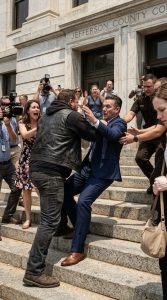
PART 2:
Claire lifted her eyes from the ground, and for one raw second, I saw the sister I grew up with—the one who used to climb the old oak in our backyard just to prove she could, who once stood between me and a neighborhood bully twice her size. She’d shrunk in the three years since the trial began, shoulders curved inward like she was trying to protect a heart that kept breaking. Now, with seventy motorcycles humming their last vibrations into the hot June air, she straightened.
The tall biker, the one who’d spoken to the deputy, stepped closer to her, not crowding, just present. His name, I’d learn later, was Marcus. Former Marine, father of four daughters, the kind of man who had seen too many children swallowed by systems meant to protect them. He didn’t reach out to touch her. He just stood there, a wall of calm in a morning that had been nothing but chaos.
— “Ma’am,” he said, voice low and even, “we’re not here to make trouble. We’re here to make sure nobody forgets. Not the court. Not the cameras. Not him.” He didn’t look at Daniel. He didn’t need to.
Claire’s lips parted, but no words came. She’d been silenced for so long—by lawyers, by procedural rulings, by the simple exhaustion of being the mother of a child nobody wanted to believe—that speech felt foreign. I watched her throat move, swallowing, trying. Then she turned to me, my cuffs still on, the deputies still holding my arms, and her voice cracked open.
— “Is she going to see this? On the news?”
I hadn’t thought about that. My niece, Lily, was at school. Seventh grade. She should’ve been worrying about math tests and friendship bracelets, not about whether her uncle was going to jail. My stomach dropped.
— “We’ll handle it,” I said, trying to sound steadier than I felt. “I’ll talk to her.”
One of the officers, a younger guy with a nameplate reading Officer Delgado, looked at Marcus and the line of riders, then back at me. His face was hard to read—not hostile, but cautious, the way cops get when a situation doesn’t fit any manual. He’d seen plenty of scuffles on these steps. Drunk defendants, angry families, protesters with signs. But seventy bikers appearing out of nowhere, standing in formation like an honor guard without a coffin, was new.
— “You the one who sent the text?” Delgado asked me.
— “Yes.”
— “You planned this?”
I shook my head. “I planned to be here alone. I sent the message when I realized I might need someone to tell the truth if I got locked up.”
He studied me. My leather vest, the tattoos on my forearms—one for each of the kids we’d lost on the road, one for our father who died believing silence was strength. I wasn’t a stranger to being judged by my ink. But Delgado’s gaze wasn’t contempt. It was something closer to curiosity.
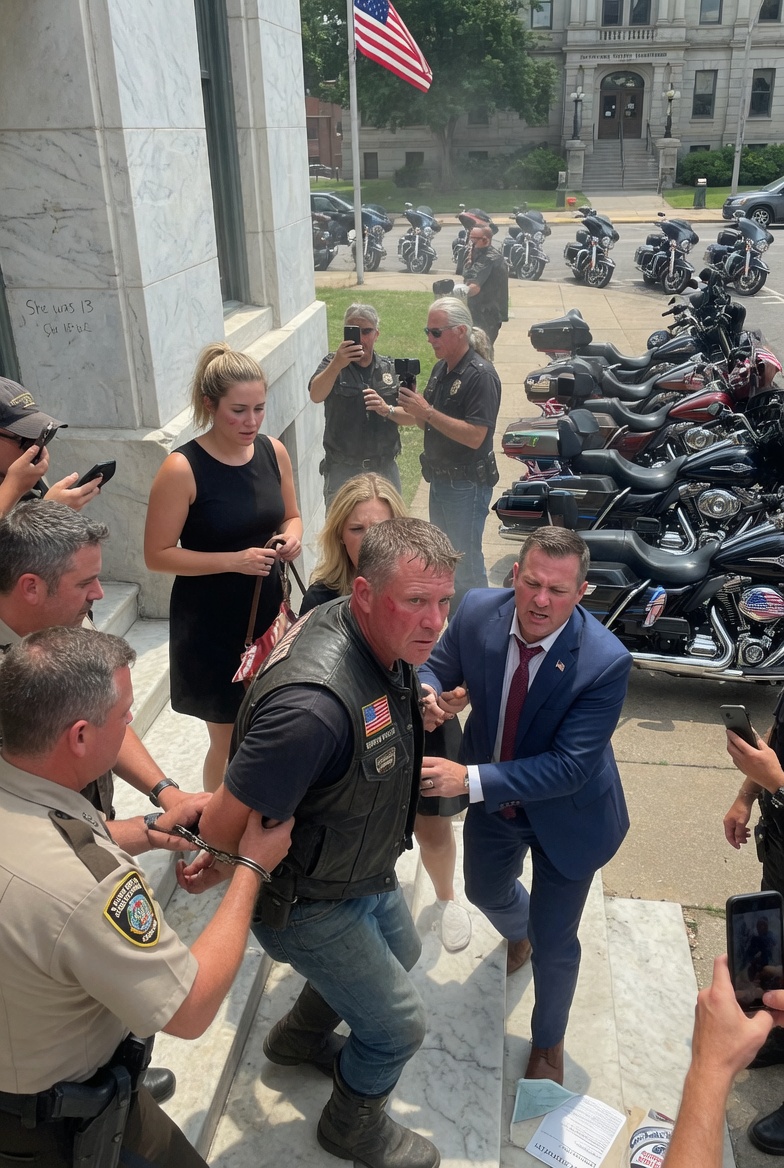
— “I’m going to take the cuffs off,” he said, “and I’m going to issue you a citation for disorderly conduct. You contest it later if you want. But you pull anything else, and it’s a different conversation. Understood?”
I nodded. “Understood.”
The cuffs clicked loose, and blood rushed back into my wrists, sharp and stinging. I didn’t rub them. I just let my arms fall, and I didn’t move toward Daniel. Didn’t even look at him. Instead, I looked at Marcus, who gave me the smallest nod, the kind soldiers exchange after a mission that hasn’t gone sideways yet.
Daniel’s brother-in-law, a stocky man in a too-tight blazer, took a step forward, jabbing a finger in my direction. — “You think you can just walk away? After assaulting him? We’ll sue. We’ll press charges. This isn’t over.”
Marcus didn’t flinch. He turned his head slowly, as if noticing the man for the first time, and said, — “It never is. That’s the point.”
The brother-in-law’s mouth opened, then shut. There was no threat in Marcus’s voice, just a weary certainty that chilled the air more than any shout could. Because he was right. For families like mine, for girls like Lily, it was never over. The verdict wasn’t a finish line; it was a door that slammed shut, leaving you alone in a dark room with memories that wouldn’t stop knocking.
Reporters had been filming the whole time. A woman from the local NBC affiliate, mic in hand, hesitated at the edge of the scene, clearly unsure whether to approach the bikers or the victim. She chose me. Cameras swung.
— “Sir, can you tell us why you did it? Why now, after the verdict?”
I faced her, the lens a black hole waiting to swallow my answer. I thought about Lily. About the way she’d whispered her testimony, fingers twisting the hem of her sweater, eyes never once meeting Daniel’s. The judge had ruled parts of her statement inadmissible—too emotional, they said, too vague about dates. A thirteen-year-old’s trauma, reduced to a procedural footnote.
— “Because someone had to do something,” I said. “She told the truth, and nobody listened. Today, I just wanted to make sure they’d see his face when they heard it again.”
The reporter pressed. — “Do you believe he’s guilty?”
I looked past her, past the crowd, straight at Daniel. He was pale now, the confidence drained, his wife pulling at his arm, whispering urgently. He looked like a man who’d realized his acquittal wasn’t armor—it was just a piece of paper.
— “I believe my niece,” I said. “That’s all that matters.”
The reporter opened her mouth for another question, but Marcus stepped in smoothly, not blocking the camera, just adding his presence. — “We’ll be releasing a statement through the Victims’ Advocate Network this afternoon. No further questions for now.”
The network. I hadn’t even known they’d organized that fast. But that was Marcus—always three moves ahead. I’d met him two years ago at a support group for families navigating the justice system. We’d both lost faith in institutions, but he’d found a way to channel that anger into something constructive: a network of riders who showed up when courts failed. Not vigilantes. Witnesses. Protectors of memory. They didn’t break laws; they simply refused to let pain be invisible.
Claire had drifted toward me while the cameras focused elsewhere. She stood close enough that our shoulders almost touched, and when she spoke, her voice was steadier.
— “You could’ve been arrested for real.”
— “I know.”
— “Lily needs you. I need you. Don’t do that again.”
I closed my eyes for a second. — “I won’t. I promise.”
I didn’t know if that was a lie. The anger that had driven me up those steps was still there, coiled in my chest like a snake digesting a stone. But looking at Claire, at the lines that hadn’t been there before the trial, I knew she was right. My disappearing into a jail cell wouldn’t help Lily. It would just be another man failing her.
Daniel and his family were retreating now, escorted by a couple of deputies toward a side street where their car waited. The crowd parted reluctantly, a mix of silent stares and a few muttered insults. He didn’t look back. His wife held her head high, but her grip on his sleeve was desperate, the kind of grip that knows something is slipping.
The plaza began to empty. Reporters packed their vans. The riders, at some unspoken signal, started returning to their bikes, engines coughing back to life one by one. I stayed rooted to the steps, Claire beside me, watching Daniel’s car pull away. It was a black sedan, unremarkable, the kind of car you’d never notice in a parking lot. Which was probably the point.
Marcus approached, helmet in hand. — “We’ll follow him. Not to his house, just to make sure he doesn’t try to disappear before the review.”
Review. The officer had mentioned something about documentation being re-examined. A procedural opening, maybe. It wasn’t a retrial, but it was something—a crack in the wall. I didn’t dare hope.
— “Thank you,” Claire said, her voice small but certain. “For all of this. I don’t even know who you are.”
— “I’m someone who believes kids,” Marcus said simply. “And I’ve got a daughter who told me once that if grown-ups don’t listen the first time, you bring more grown-ups. So I did.”
Claire’s eyes welled, but she didn’t cry. She’d cried enough in depositions, in therapists’ offices, in the dark of her bedroom when she thought Lily couldn’t hear. She nodded, and that nod carried more gratitude than any tear could.
I looked at my phone. A message from my wife, Angela, back home. “Saw the news. Are you okay? Call me.” Another from my boss at the auto shop, a terse “Take the day.” I’d deal with that later. Right now, there was only one person whose voice I needed to hear.
I dialed the school, asked to speak to the counselor. Mrs. Everett had been Lily’s anchor since the trial started, the one adult in the building who didn’t treat her like a fragile vase or a liar. She came on the line after a minute.
— “Mr. Callahan. I saw what happened. Is everyone safe?”
— “Safe enough. Lily?”
— “She doesn’t know yet. We’re keeping phones off in class. But it’s all over social media. She’ll find out.”
I closed my eyes. — “Can you pull her out? I’ll come get her. We need to tell her ourselves.”
— “Of course. I’ll have her waiting in my office.”
The ride to the school was twenty minutes of silence, broken only by the hum of the engine and the buzz of my phone vibrating with notifications I ignored. Claire sat in the passenger seat, staring out the window at the blur of strip malls and oak trees. I could feel her thoughts spinning, the same loop I was caught in: How do you tell a child that the man who hurt her walked free, and the only resistance was her uncle getting cuffed on TV?
We pulled into the school parking lot just as the lunch bell rang. Kids spilled onto the playground, shrieking and laughing, a jarring contrast to the weight pressing on my chest. Inside, the hallways smelled like floor wax and pencil shavings, a smell that should’ve been nostalgic but now just felt like another place where innocence had been stolen.
Mrs. Everett’s office was small, cluttered with inspirational posters and a wilting peace lily. Lily sat in a corner chair, her backpack hugged to her chest, her dark hair falling over her face. She was small for thirteen, still carrying the round cheeks of childhood, but her eyes were old. They’d been old since the night she first told her mother what happened.
She looked up when we walked in, and I saw the flicker of hope die. She knew. Someone must have shown her a phone, or maybe she just read our faces. She’d gotten too good at reading faces.
— “Is he in jail?” she asked, and her voice was the same one I’d heard on the stand: flat, rehearsed, the voice of a child who’d learned that emotion was a liability.
Claire knelt in front of her, taking her hands. — “No, baby. The jury said not guilty. But there’s going to be a review, and some very kind people are helping us.”
Lily pulled her hands away, not angry, just withdrawing into a place none of us could reach. — “It doesn’t matter. He’ll just lie again. Everyone believes him.”
I crouched down beside Claire. — “Seventy people showed up today just to stand for you. They don’t even know you, but they believe you. I believe you. Mom believes you.”
She looked at me then, and for a second, the mask cracked. — “You got arrested because of me.”
— “No. I got a citation because I made a choice. That’s on me. Not you. Never you.”
The tears came then, silent, sliding down her cheeks without fanfare. She didn’t sob. She’d forgotten how to cry loudly. Too many nights trying not to wake her mom. I pulled her into a hug, and she buried her face in my vest, the leather creaking under her grip.
Mrs. Everett offered us the room for as long as we needed. We stayed there, the three of us, until the afternoon announcements crackled over the intercom. I told Lily about Marcus, about the riders, about the women who’d handed over the victim impact statement that had never been presented. I told her the truth: that the system had failed, but that didn’t mean the story was over. It just meant we had to write a different ending.
She listened, not convinced but not rejecting it either. That was progress. After everything she’d endured, guarded hope was the bravest thing she could offer.
By the time we left the school, the sun had dropped lower, slanting through the pines that lined the road. My phone buzzed again. This time I checked it—Marcus.
“Meet at the church on Pine Street. 6 p.m. There’s something you need to hear.”
The church was a squat brick building with a peeling sign that read “Grace Fellowship,” though nobody had worshipped there in a decade. The bikers had rented it for a dollar a year from a sympathetic city councilman, turning it into a makeshift headquarters for the Victims’ Advocate Network. Inside, the pews had been pushed aside, replaced by folding tables and mismatched chairs. The walls were covered with photographs—children, mostly, some smiling, some in hospital beds, some with dates written beneath them in Sharpie. A memorial to the ones the system forgot.
Marcus was waiting near the altar, talking quietly with the two women who’d handed over the impact statement. I recognized one of them now: Darlene, a retired social worker who’d spent thirty years documenting abuse cases only to watch them crumble under legal technicalities. The other woman, thin with silver-streaked braids, was introduced to me as Naomi, a former prosecutor who’d walked away from the job after a similar case broke her faith in the process.
Claire and Lily stayed by the door. Lily’s eyes moved over the photographs, and I saw her mouth form a silent “oh.” She wasn’t alone. That wall of faces proved it.
— “We got a call,” Marcus began, gesturing for us to sit. “The officer who handled the citation—Delgado—he’s been assigned to review the case file. Apparently, the commotion today triggered an internal audit of evidentiary rulings. Standard protocol when there’s public scrutiny. They’re looking at whether the judge improperly excluded testimony.”
Naomi leaned forward, her eyes sharp. — “I read the transcript. Lily’s therapist notes, the timeline, the behavioral changes—it should have been admitted under the state’s tender years statute. The judge made a reversible error, and today gave us the leverage to push for a formal inquiry.”
My heart hammered. — “What does that mean, practically?”
— “It means the DA’s office might be forced to reopen the case,” Darlene said. “Not a retrial—double jeopardy applies. But a review could lead to a declaration of factual innocence for Lily, which would clear her name in the eyes of the law, even if he can’t be tried again. It also opens the door for civil remedies, protective orders, and it puts his face on a list he really doesn’t want to be on.”
Claire stepped forward, her voice breaking. — “But he walks free? That’s it? A declaration?”
Naomi’s expression softened, but her tone was firm. — “He walks free from criminal punishment, yes. But he doesn’t walk free from being known. In a town like St. Charles, that’s its own kind of sentence. And if we can get the review to include his professional license—he’s a teacher, right?”
I nodded. Daniel taught middle school history. The irony was so sharp it cut.
— “Then we can pursue administrative revocation. He’ll never work with kids again.”
The hope that filled the room was fragile, but it was there. Lily hadn’t said a word, but she was listening, her small frame pressed against Claire’s side. I watched her absorb the possibility that someone in power might finally say the word “truth” without qualifying it.
Over the next few days, the story spread beyond St. Charles. Local news led with the courthouse confrontation, but national outlets picked up the angle of a biker network stepping in where the system had failed. The Victims’ Advocate Network, once a quiet group known only in circles of grief, found itself fielding calls from families across the country. Marcus handled the attention with the same calm he brought to everything, redirecting focus to the kids.
Daniel, meanwhile, went underground. His house on Elm Street sat dark, curtains drawn, a single car in the driveway that never seemed to move. Neighbors who’d once waved hello now crossed the street. His wife was spotted at the grocery store, head down, buying boxes of macaroni and cheese like a woman preparing for a siege. The brother-in-law’s lawsuit threats never materialized, probably because their lawyer realized a civil suit would open them to discovery that could be far more damaging than a citation.
Lily returned to school, but it was a different school now—the same building, the same kids, but a charged atmosphere. Some parents had rallied around Daniel, convinced the “biker gang” was a menace. Others, who’d kept quiet during the trial, started approaching Claire in the parking lot with hesitant words of support. One mother, a woman named Sandra who’d served on the PTA with Claire, stopped her outside the gymnasium.
— “I didn’t want to believe it,” Sandra said, her voice thick. “My son had him for history last year. I told myself it couldn’t be true. But after seeing what those bikers did… I went back and talked to my boy. He said some things. I’m sorry. I’m so sorry.”
Claire didn’t know what to do with the apology. Anger and gratitude fought in her chest. She settled for a nod, a quiet “thank you,” and walked away feeling like the ground was shifting under her feet. For years, she’d been a pariah, the mother who dared accuse a respected teacher. Now, the cracks in that respect were showing, and the truth was seeping through.
I spent my evenings at the garage, trying to lose myself in oil changes and brake pads. The work was meditative, the clank of tools drowning out the noise of the news cycle. My boss, Don, was a gruff man in his sixties who’d never asked about the trial, never commented on my tattoos. But that week, he appeared in the bay doorway with two cups of coffee and a look I couldn’t decipher.
— “Take a break, Callahan.”
I wiped my hands on a rag and joined him on the plastic chairs outside, the hum of traffic filling the silence.
— “I saw the footage,” Don said finally. “My daughter was… hurt, years ago. Someone she trusted. I didn’t handle it the way you did. I did nothing. Thought it was her word against his, no point. She’s forty now, and we still don’t talk about it.”
I stared at the coffee in my hands. — “I almost did nothing too. I sat through that whole trial, biting my tongue, believing the system would work. And then it didn’t.”
— “You snapped.”
— “I snapped.”
He nodded slowly, the way men do when they recognize a breaking point they’d narrowly avoided themselves. — “If you need time, take it. The shop’ll survive.”
I thanked him, and we sat there until the coffee went cold, two fathers bound by silence and regret, finally letting some of it leak out.
A week later, the review bore its first fruit. Officer Delgado called me directly, his voice professional but carrying an edge of something that sounded like vindication.
— “Mr. Callahan, the evidentiary review has been completed. The judge’s exclusion of the therapist’s testimony and the victim impact statement has been flagged as a procedural error. The DA’s office is issuing a public clarification that Miss Lily Callahan’s allegations were never disproven—they were simply not allowed to be fully heard. Additionally, the State Board of Education is opening an independent inquiry into Mr. Rourke’s teaching license.”
I was in the garage, the phone pressed to my ear, grease still under my fingernails. I closed my eyes and breathed. — “What does that mean for my niece?”
— “It means the official record will reflect that her testimony was credible, and the exclusion was wrongful. It doesn’t reverse the verdict, but it’s a statement. He’ll be flagged in any future background check involving children. And frankly, the media attention will make him unemployable. It’s not perfect, but it’s something.”
It was something. I relayed the news to Claire, who fell against the kitchen counter and let out a sound I’d never heard her make—a sob and a laugh twisted together, relief and grief wrestling for dominance. Lily stood in the doorway, listening, her expression unreadable. When Claire finally caught her breath and explained, Lily just nodded. Then she went to her room, closed the door, and for the first time in three years, she didn’t come out for hours. Not out of fear, but out of a need to process that someone had finally said she wasn’t a liar.
That night, the Network gathered at the old church. The mood wasn’t celebratory—too many ghosts for that—but it was lighter, the air less thick. Marcus stood near the altar, addressing the group in his quiet way.
— “We didn’t change the verdict. But we changed the conversation. That’s what we do. We don’t storm courtrooms; we stand on steps. We don’t scream; we show up. And tonight, a thirteen-year-old girl can sleep knowing the official record doesn’t call her a liar. That’s a victory.”
A murmur of agreement rippled through the room. I saw Darlene wiping her eyes, Naomi nodding with a tight-lipped satisfaction. The photographs on the wall felt less like accusations and more like company.
Claire stood up, tentative at first, then steadier. She cleared her throat, and the room quieted.
— “I want to say something,” she began, voice trembling. “Three years ago, I walked out of that courthouse feeling like I’d failed my daughter. Like the world had decided she didn’t matter. I started to believe it myself. I stopped talking to friends. I stopped going to church. I stopped… hoping.” She paused, looking at Marcus, then at me. “But you showed up. All of you. Strangers on motorcycles, with your leather and your loud engines, and you did what I couldn’t. You made them see her. Not the case file. Not the defendant. Her. A child.”
Lily was sitting in a pew near the back, and when her mother said that, she stood up too. She walked slowly to the front, her footsteps echoing on the wooden floor. She faced the group, seventy bikers who’d become her unlikely army, and she spoke in the same quiet, measured voice she’d used on the stand, but this time, it was different. This time, she wasn’t afraid of being dismissed.
— “I used to think nobody believed me. That I was just a kid, and kids don’t get to be right. But you believed me. You didn’t even know me, and you came anyway. So… thank you. For being louder than the lies.”
The room erupted—not in cheers, but in a soft rumble of approval, the sound of people who understood the weight of those words. One of the riders, a woman named Tess with a skull tattoo and a heart of gold, walked up and handed Lily a small patch. It was simple: a silhouette of a child holding a lantern, with the words “Truth Bearer” stitched beneath.
— “You’re one of us now,” Tess said. “Not a rider, but a truth bearer. You carry the light when the world goes dark. That’s your job.”
Lily took the patch and clutched it to her chest. And for the first time since the trial began, she smiled. Not a big smile, not a carefree one—but a real smile, the kind that comes from feeling seen.
The weeks that followed were a slow rebuilding. The State Board’s inquiry moved forward, and while it couldn’t strip Daniel of his freedom, it did strip him of his license. The school district issued a statement, carefully worded, expressing regret that “procedural limitations” had prevented a full hearing of the evidence, and affirming their commitment to student safety. It was bureaucratic language, but underneath it was an admission: they’d failed. And they knew the public was watching.
Daniel moved away. Not immediately—the house on Elm Street sat vacant for a month before a For Sale sign appeared. Neighbors reported seeing a moving truck in the dead of night, no goodbye, no forwarding address. He’d become a ghost, haunting his own life. His wife, according to rumors, filed for separation. The brother-in-law, once so loud, went quiet. The town slowly started to forget them, but it never forgot what happened on the courthouse steps.
The Network continued its work. Marcus got calls from families in six different states, each with a similar story: a child silenced, a court case lost, a community that moved on too fast. He and Naomi started a legal advocacy branch, training volunteers to attend hearings, to document proceedings, to be the eyes and ears that would make it harder for truth to be buried. They didn’t have law degrees, most of them, but they had presence. They had engines. And they had the one thing the system often lacked: patience.
I went back to the garage, back to the rhythm of wrenches and engines. Don never mentioned the case again, but he started taking his lunch break with me, talking about his daughter, about the years he’d lost to silence. One Friday, he invited me to his place for dinner. I met his wife, his grandkids. And in their living room, surrounded by photos of a family that had mended, I saw what could be possible for Lily. Not forgetting, but integrating. Living with the scar, not hiding it.
Claire started going to therapy herself. She’d spent so long focused on Lily that she’d ignored her own wounds. The therapist helped her untangle the guilt, the anger, the resentment that had calcified into depression. She started painting again—a hobby she’d abandoned in college—and her canvases, full of dark hues and fractured images, slowly gave way to lighter shades, to landscapes, to portraits of Lily smiling.
Lily joined a support group for survivors. It met in the basement of the public library, a circle of folding chairs and tremulous voices. At first, she just listened. Then, one evening, she shared her story. Not the sanitized version she’d been coached to give in court, but the raw, messy truth. And when she was done, a girl a few years older reached over and held her hand. No words. Just a squeeze. That squeeze said everything the legal system hadn’t.
On the anniversary of the courthouse confrontation, Marcus organized a ride. Not a protest, not a rally—a memorial and a celebration. Bikers from across the country converged on St. Charles, hundreds of engines rumbling through the streets, this time with police escorts. Officer Delgado, now a sergeant, coordinated the route. The town, which had once whispered about vigilantes, now lined the sidewalks with signs reading “We Believe Children” and “Protect the Innocent.”
We gathered on the courthouse steps, the same granite where I’d shoved Daniel Rourke a year earlier. It felt like a different world. The sky was overcast, the air cool, a relief from the oppressive heat of that June day. Claire stood at a microphone, Lily beside her, the patch Tess had given her sewn onto her jacket. She looked older now, taller, but the hollows under her eyes had filled in.
— “A year ago,” Claire said, “my brother stood on these steps and made a choice. Not the best choice, maybe. But a choice born out of love. And because of that choice, because of the people who stood with him, my daughter found her voice again. We didn’t win in court. But we won something bigger. We won the right to be heard. And I am here to tell every family out there: your pain is real. Your child’s story matters. And even when the system fails, you are not alone.”
The applause was long and loud, but it wasn’t triumphal. It was the sound of a community exhaling.
Lily took the mic next. Her voice was clear, steady.
— “I used to think courage meant not being scared. But I learned that courage is being scared and doing it anyway. I’m still scared. Some nights, the nightmares come back. But now I know there are people who will wake up with me. People who will ride across state lines just to say, ‘We hear you.’ That’s my family. That’s my army. And to anyone out there who’s still waiting to be believed—hold on. Your army is coming.”
The riders revved their engines in response, a rolling thunder that echoed off the courthouse walls. I stood at the edge of the crowd, watching my niece become a leader, and I felt something I hadn’t felt in years: hope. Not the fragile hope that shatters at the first setback, but a tempered hope, forged in pain and strengthened by community.
After the rally, we gathered at the old church. The photographs on the wall had multiplied—new faces, new stories—but the message remained the same. Marcus pulled me aside, away from the crowd, and handed me a folded piece of paper.
— “What’s this?”
— “An application. The Network is expanding. We’re opening chapters in every state, and we need coordinators. People who understand what it means to stand up when the system sits down. I want you to head the Missouri chapter.”
I stared at the paper, the words blurring. Me? I was a mechanic with a temper and a record, not a leader. But Marcus just smiled.
— “You didn’t plan to shove a man on camera. But you did it because you couldn’t watch another child be erased. That’s exactly the kind of person we need. Someone who acts, not because they want to be a hero, but because they can’t be a bystander.”
I thought about Lily. About Claire. About the parents who’d called the Network in the past months, desperate and exhausted. I thought about Don, who’d carried his guilt for forty years. And I thought about my father, who’d taught me that silence was strength, and how wrong he’d been.
— “Okay,” I said. “I’m in.”
The church erupted in cheers when Marcus announced it. Lily ran over and hugged me so hard I nearly lost my balance. Claire, tears streaming, just nodded, the way she’d done on the courthouse steps a year ago. That nod carried everything.
That night, I went home and sat on my porch, the cicadas humming in the darkness. The sky was clear, stars scattered like shards of light. My phone buzzed with messages—congratulations, questions, interview requests. I ignored them all and called Angela, who’d been my rock through everything.
— “You’re really doing this?” she asked, her voice warm.
— “I have to. Someone has to.”
She was quiet for a moment. Then she said, — “I’m proud of you. Your dad would be too, even if he’d never admit it.”
I laughed, a broken thing, but real. — “Yeah. Maybe.”
The road ahead was long. There would be more Daniel Rourkes, more verdicts that defied logic, more nights when the nightmares came back. But there would also be more riders, more witnesses, more people refusing to look away. The system was flawed, but it wasn’t immovable. It could be bent by presence, by persistence, by the simple act of showing up.
A few months into my role as coordinator, we got a case that tested everything we’d built. A six-year-old boy in rural Arkansas, abused by a relative with a clean record and a good lawyer. The mother had been fighting for two years, losing motions, losing hope. She called the Network on a Tuesday, her voice so hollow it hurt to listen.
We rode out that Saturday—forty bikers, some from as far as Colorado. We stood outside the courthouse during the preliminary hearing, not saying a word, just present. The local paper called us “guardians,” not “gang.” The judge, a no-nonsense woman with sharp eyes, took note. She ruled to admit previously excluded evidence. The case was still ongoing, but the mother called me that night, crying.
— “He saw you all standing there, and for the first time, he looked scared. My son saw it too. He said, ‘Mom, they came for me.’ Thank you. Thank you.”
That’s why we did it. Not for the legal victories—those were rare, always hard-fought, often partial. But for the moment a child realized they weren’t alone. For the moment a parent felt the weight shift, even slightly, from guilt to solidarity. The system could tie itself in knots, but it couldn’t erase the image of seventy motorcycles lining up for a six-year-old they’d never met.
Over the years, the Network grew beyond anything Marcus had imagined. We developed training programs, partnered with trauma-informed therapists, lobbied for legislative changes. Naomi went back to law school, became a judge herself, and started a specialty court for child abuse cases that prioritized testimony from young victims. Darlene opened a crisis center. Tess started a motorcycle club for survivors, teaching them to ride, giving them back a sense of control over their bodies and their lives.
Lily graduated high school with honors, her name cleared in the official record, her patch still on her jacket. She gave a speech at graduation, not about pain, but about purpose. She talked about the power of being believed, and the responsibility of those who had been believed to believe others. She was going to college to study psychology, to become a therapist for children. “I want to be the person I needed,” she said.
Claire’s paintings started selling in a local gallery, her work now a testament to resilience. She and I still had hard days—anniversaries of the trial, triggers we couldn’t anticipate—but we’d learned to ride them out together. We’d learned that trauma wasn’t a thing to be defeated, but a landscape to be navigated, with maps drawn by those who’d walked it before.
And me? I still worked at the garage, still got grease under my nails, but my real job was the Network. I spent my weekends riding to courthouses, meeting families, coordinating volunteers. I’d traded my silent rage for a quieter, more enduring purpose. The tattoos on my arms had new meaning now—not just memorials to loss, but markers of a mission.
One afternoon, years after the shove, I found myself back on the Jefferson County Courthouse steps. I was there to support a family whose case was being heard that day—a little girl with pigtails and a lisp, clutching a stuffed unicorn. I stood in the same spot where I’d stood when my boot struck forward, but I wasn’t the same man. The anger was still there, but it had been forged into something else: a steady, unshakeable resolve.
The girl’s mother approached me, nervous and grateful. — “I don’t know how to thank you. I never thought anyone would care.”
I looked at her, at the child clinging to her leg, and I remembered Claire’s words on the steps a year ago. — “You don’t have to thank us. Just promise me one thing.”
— “What?”
— “When this is over, when you’ve found your footing, turn around and help someone else. That’s how we change things. One story at a time.”
She promised, and I believed her. Because that was the truth Marcus had taught me: healing wasn’t a solo journey. It was a relay race, each survivor passing the baton to the next, the weight of the world lightened by many hands.
The courthouse doors opened, and we went inside. The hearing was long, the outcome uncertain. But the little girl with the unicorn looked at the line of bikers in the gallery, and she smiled. And that smile, I knew, was the beginning of something far more lasting than any verdict. It was the beginning of belief.
As I sat in that courtroom, waiting for the gavel, I thought about Daniel Rourke. I didn’t hate him anymore. Hate was too heavy, too consuming. I pitied him. He’d thought he’d escaped judgment, but he’d only escaped a legal ruling. The true judgment had been rendered in the court of community, in the eyes of neighbors who crossed the street, in the silence of a town that no longer welcomed him. He’d lost his license, his marriage, his place in the world. And while that didn’t bring back the childhood he’d stolen from Lily, it was a reminder that even when the law falters, consequences have a way of finding their mark.
Lily once asked me if I regretted shoving him. I thought about it for a long time before answering.
— “I regret that I let my anger take over. But I don’t regret the outcome. Sometimes a crack in the wall is all you need to let the light in.”
She smiled at that. She’d gotten good at smiling again. It had taken years, but the light had returned to her eyes. And every time I saw it, I knew the shove had been worth it. Not because it was right, but because it was a spark that ignited a fire. A fire that burned away the silence, that illuminated the truth, that warmed the cold places where fear had lived.
The biker network kept riding. The engines kept rumbling. And across the country, in small towns and big cities, children who’d been told no one would listen started to hear a different sound in the distance. The sound of an army coming. The sound of witnesses. The sound of hope on two wheels.
And me? I kept my boots polished and my tank full. Because the road was long, and there were still so many stories waiting to be heard. This was my life now—not a tragedy, not a redemption arc, just a quiet, determined journey toward a world where a child’s “no” was always enough.
That’s the story I’ll tell when I’m old, sitting on a porch somewhere, the scars faded but the memories vivid. I’ll tell them about a hot June morning, a shove that changed everything, and the seventy engines that roared in answer. I’ll tell them about a girl who found her voice, a mother who found her strength, and a biker who found his purpose. And I’ll end with the only truth that ever mattered: When you stand up for one child, you stand up for all of them. That’s the legacy. That’s the ride.