
“Why didn’t you tell me?”
Eleanor’s face changed as if the question had struck something old and carefully buried.
For three years, Maxwell had imagined a thousand possible reunions with her. In some, she was angry. In others, cold. Sometimes, in the private hours between midnight and dawn, he imagined her saying she had made a mistake. That she had missed him. That she had thought of him too.
But he had never imagined this.
A sick child in her arms.
His child.
Their child.
Standing in the rain outside a narrow brick building above a laundromat, with buses hissing by and strangers passing under umbrellas, Maxwell Callahan felt poorer than he had ever felt in his life.
Eleanor held Sophie tighter, not as a shield exactly, but as if the little girl’s small body was the only thing anchoring her to the earth.
“Because I couldn’t,” she said.
“That isn’t an answer.”
“It’s the only one I have right now.”
Maxwell’s jaw tightened. In boardrooms, silence was a weapon. He had used it to make billion-dollar opponents reveal their weaknesses. But standing before Eleanor, silence only made him aware of the rain slipping beneath his collar and the child’s feverish cheek resting against her mother’s shoulder.
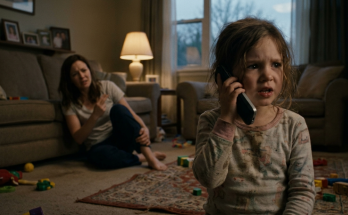
Sophie stirred.
“Mommy,” she mumbled, “my head feels buzzy.”
Eleanor’s anger vanished instantly. “I know, sweet pea. We’re going upstairs.”
Maxwell stepped forward. “Let me call a doctor.”
“She has a doctor.”
“Then let me call him.”
“No.”
“Eleanor—”
“No, Max.” Her voice cracked around his name. “You don’t get to appear after three years and start giving orders.”
The words landed harder because they were true.
He looked at Sophie’s pink rain boots, at the ducks painted on the toes, bright and cheerful despite the wet pavement. He had missed the first time she wore shoes. The first time she smiled. The first time she said “Mommy.” He had missed nights of fever and mornings of laughter. He had missed almost three years of a life that belonged partly to him.
“I’m not giving orders,” he said. “I’m asking.”
Eleanor looked toward the street, then back at him. Her expression was torn between exhaustion and caution. “She needs rest.”
“Then I’ll leave,” he said, though every part of him resisted it. “But give me ten minutes. Just tell me enough so I don’t lose my mind.”
A tired laugh escaped her, humorless and small. “Ten minutes won’t cover it.”
“Then give me five.”
Sophie lifted her head and blinked at him through damp lashes. “Are you sad too?”
The question tore through him.
Maxwell had negotiated with prime ministers, testified before committees, and watched competitors beg for mercy across polished tables. Yet he did not know how to answer a two-year-old who had inherited his eyes.
“Yes,” he said softly. “A little.”
Sophie considered this. “Mommy says breathing helps.”
Despite herself, Eleanor closed her eyes.
Maxwell nodded solemnly. “Your mommy is very smart.”
“She is,” Sophie whispered, then leaned against Eleanor again.
The storm deepened, drumming against the awning over the apartment door. Eleanor shifted Sophie’s weight, and Maxwell saw how tired she was. Not tired from one long day. Tired in the bones. Tired from being the only adult in the room for too many rooms.
Something in him changed then. The anger did not disappear, but it moved aside.
“Please let me help carry the bags,” he said.
Eleanor looked down as if only then remembering the pharmacy bag hooked around her wrist and the canvas tote slipping from her shoulder. For a moment, pride held her upright. Then Sophie coughed, a small rough sound, and Eleanor’s resistance loosened by a fraction.
“Fine,” she said. “The bag. Nothing else.”
Maxwell took the tote carefully, as if it were more fragile than any contract he had ever signed.
They climbed three flights of narrow stairs smelling faintly of detergent, old wood, and someone’s dinner warming behind a closed door. Maxwell noticed the peeling paint on the railing, the dim bulb flickering between floors, the way Eleanor’s breath grew short by the second landing though she tried to hide it.
Her apartment was at the end of the hall.
It was small. Clean. Warm in the way only a place loved by necessity could be warm. A row of children’s drawings had been taped along one wall, crooked suns and purple cats and stick figures holding hands. A stack of library books sat beside a worn blue couch. Near the window, a tiny table held two mismatched chairs, one adult-sized and one painted yellow.
Maxwell stepped inside and felt the unbearable intimacy of everything he had not known.
Sophie’s red cup on the counter.
A small sweater drying over a chair.
A pair of mittens shaped like rabbits.
Evidence of a life.
His daughter’s life.
Eleanor set Sophie down on the couch and removed her wet boots. “Let’s get your medicine first, okay?”
“I don’t like it.”
“I know.”
“It tastes like bad strawberries.”
Maxwell almost smiled, but it hurt too much.
Eleanor measured the antibiotic with practiced care. Sophie made a face but swallowed, then accepted a sip of water and a kiss on the forehead.
“You’re very brave,” Eleanor murmured.
Sophie looked at Maxwell, as if waiting to see whether he agreed.
“The bravest,” he said.
That seemed to satisfy her. Within minutes, wrapped in a blanket printed with faded stars, she was half asleep on the couch, one small hand curled beneath her cheek.
Eleanor stood over her for a moment longer than necessary, then turned toward the kitchen. “We can talk quietly.”
Maxwell followed her, leaving the tote near the door.
The kitchen was hardly a kitchen at all, just a narrow strip with an old stove, a sink, and cabinets painted white long ago. Eleanor filled a kettle and put it on the burner, though her hands trembled slightly.
“You still make tea when you’re upset,” Maxwell said.
She did not look at him. “And you still notice things too late.”
He accepted that without defense.
For a moment, only the hiss of the gas flame spoke between them.
Then he said, “When did you find out?”
Her shoulders stiffened.
“After I left.”
“How long after?”
“Six weeks.”
Six weeks.
He remembered those weeks with a clarity that made him ashamed. He had buried himself in work, told his assistant to remove every photograph of Eleanor from his office, attended meetings in Singapore and Zurich, drank too much Scotch alone in hotel rooms, and told himself she had chosen freedom over their marriage.
While she had been alone, carrying his child.
“You should have called me.”
Her laugh was quiet but sharp. “I tried.”
He went still. “What?”
Eleanor turned then.
The kettle began to whistle, thin and rising, but neither of them moved.
“I called your office,” she said. “Three times. I left messages.”
“With whom?”
“Marjorie first. Then someone else. A man. I don’t remember his name.”
Maxwell stared at her. “I never got any messages.”
“I know.”
“You know?”
“Because the fourth time I called, I reached your mother.”
The room seemed to narrow.
Maxwell felt a coldness enter him that had nothing to do with rain.
“My mother?”
Eleanor turned off the burner. The kettle’s scream died into silence.
“She said you were unavailable. I told her it was personal. Important. She asked if it was about money.”
Maxwell’s hands curled slowly at his sides.
Eleanor’s voice remained careful, but underneath it lived a pain that had aged in silence. “I told her I was pregnant.”
For several seconds, Maxwell heard nothing.
Not the rain.
Not Sophie breathing in the other room.
Not the traffic below.
Only that sentence.
I told her I was pregnant.
“What did she say?” he asked.
Eleanor’s eyes glistened, but no tears fell. “She said she would inform you when the time was appropriate.”
“She didn’t.”
“No.”
“Why didn’t you try me directly?”
“I did.”
“My personal number never changed.”
“You blocked mine.”
He opened his mouth.
Closed it.
Then he remembered.
The night she left, he had been half-mad with hurt and pride. He had told his security team to prevent her from accessing the house. He had told his assistant not to forward anything from her attorney unless it concerned the divorce. And yes, in one bitter moment he could barely stand to revisit, he had blocked her number.
Because he had wanted to stop waiting for a call.
Because every time the phone lit up, he hoped it was her.
Because hope had humiliated him.
He looked away.
Eleanor took two mugs from the cabinet. One had a chip near the rim. The other said BEST MOM in uneven letters, clearly painted by a child’s hand.
Sophie could not have painted it herself yet. Someone else had helped her.
Another thing he had missed.
“I wrote a letter,” Eleanor said. “I sent it to the house.”
“I never saw it.”
“I expected that after the calls.”
“Ellie—”
“Don’t.” The nickname struck too close. “Please don’t call me that like nothing happened.”
He nodded once, swallowing everything he had no right to say.
She poured hot water over tea bags and pushed one mug toward him. He did not drink.
“What did my mother tell you?” he asked.
Eleanor looked toward Sophie. The child slept, her lips parted slightly, the flush of fever still visible in her cheeks.
“She told me you had moved on. That the divorce settlement was final. That if I tried to involve you, your attorneys would respond. She said you were under enormous pressure and that a pregnancy announcement at that stage would look like manipulation.”
Maxwell’s face hardened.
“I didn’t believe all of it,” Eleanor continued. “Not at first. But then I received a document.”
“What document?”
“A confidentiality agreement. It came through a private courier. No letterhead, but your mother’s name was on the instruction page. It offered me money to stay away.”
His voice dropped. “You signed it?”
Her eyes flashed. “No.”
He deserved that look.
“I tore it up,” she said. “Then I moved.”
“Why?”
“Because I was scared.” The words came out before she could dress them in pride. “I was pregnant, alone, and your family had more power than anyone I knew. I had already spent two years inside a marriage where every argument somehow became a negotiation with people who were not us. Your mother. Your board. Your advisers. Your schedule. Your name.” She drew a breath. “I could not raise a baby in the shadow of all that.”
Maxwell leaned back against the counter as if his body needed support.
He had spent three years believing Eleanor had left because she no longer loved him. He had told himself love could not survive incompatible worlds. He had repeated that phrase so often it became polished and meaningless.
Incompatible worlds.
But now he saw something else.
A woman calling and not being answered.
A mother deciding fear was safer than trust.
A child growing up above a laundromat while he spent nights in rooms with silk walls and no warmth.
“I didn’t know,” he said.
“I believe you.”
The words should have brought relief.
They did not.
“But you also made it possible not to know,” she added.
That was the truth, and it cut cleanly.
He looked toward Sophie. “Does she know anything about me?”
Eleanor’s expression softened with guilt. “Not much. She asks sometimes why other kids have dads at preschool pickup.”
Preschool.
Another word he had no memories for.
“What do you tell her?”
“That families look different. That she is loved.”
“She is.”
Eleanor looked at him then, guarded again. “By me.”
“Yes,” he said. “By you.”
The tea steamed between them.
Maxwell’s phone buzzed again. He took it out, saw his mother’s name on the screen, and felt something almost like fate moving in the small kitchen.
He declined the call.
Eleanor noticed.
“She’ll keep calling,” she said.
“Let her.”
“That used to be impossible for you.”
“I know.”
Outside, a siren wailed past and faded down the avenue.
Sophie coughed in her sleep. Eleanor crossed the room immediately and touched her forehead. Maxwell remained where he was, afraid to step too close, afraid not to.
“Her fever’s still high,” Eleanor murmured.
“Does she need urgent care?”
“She was seen this morning. Ear infection. The doctor said the antibiotic should help within a day or two.”
“Which doctor?”
Eleanor’s hesitation returned.
“Not because I’m taking over,” Maxwell said carefully. “Because I want to know who cares for my daughter.”
The words changed the air.
My daughter.
Eleanor looked down at Sophie’s sleeping face. “Dr. Anika Rao. She’s kind. Sophie likes her because she gives out dinosaur stickers.”
“Does Sophie like dinosaurs?”
“Only the purple ones.”
A fragile silence followed. For the first time, it did not feel entirely hostile.
Maxwell lowered himself onto the edge of the yellow chair near the child’s table. It was too small for him, absurdly so, but he did not notice. He was studying a drawing taped to the wall. Three figures under a crooked rainbow. One tall with yellow hair. One small with dark hair. One gray shape off to the side, not quite a person, not quite a cloud.
“Who is that?” he asked softly.
Eleanor followed his gaze.
Her expression shifted.
“She said it was the man from her dreams.”
Maxwell looked at her.
“She has dreams about me?”
“She’s a child, Max. She dreams about dragons and talking pancakes too.”
But her voice lacked conviction.
Sophie stirred again, blinking herself awake. “Mommy?”
“I’m here.”
The little girl’s gaze moved to Maxwell, and she did not seem surprised that he was still there. “You’re too big for my chair.”
For the first time all night, Maxwell laughed softly.
“I think you’re right.”
“That chair is for tea parties.”
“My mistake.”
Sophie studied him with fever-bright seriousness. “You can come to one, but you have to use a tiny cup.”
Eleanor went very still.
Maxwell understood the invitation for what it was, innocent and enormous.
“I would like that,” he said. “Very much.”
Sophie nodded as if granting a formal appointment. Then she yawned.
Eleanor carried her to the bedroom. Maxwell stayed in the living room, looking at the drawings, the books, the little shoes by the radiator. He heard Eleanor murmur a lullaby in the next room. Not one he recognized. Something soft and old-sounding, words half-hummed, half-breathed.
He wondered who had sung to Eleanor when she was small.
He wondered how many nights she had sung alone while he sat in a glass tower convincing himself loneliness was discipline.
When Eleanor returned, she left the bedroom door slightly open.
“She’ll sleep for a bit,” she said.
“I should go.”
She looked surprised.
He stood. “I don’t want to make tonight harder.”
Something unreadable crossed her face. Perhaps she had expected demands. Lawyers. Accusations. A fight over custody delivered in the voice he used for acquisitions.
He deserved that expectation too.
“What do you want?” she asked.
The question was simple.
His answer was not.
“I want to know my daughter,” he said. “I want to help. I want to understand what happened. And I want…” He stopped.
Eleanor folded her arms. “What?”
He looked at her fully. “I want to apologize, but I don’t know how to make it big enough.”
Her lips parted slightly.
The old Maxwell would have added something persuasive. A plan. A solution. A promise wrapped like a contract.
This Maxwell said nothing more.
Eleanor looked tired again, but not untouched.
“Start by not disappearing,” she said.
“I won’t.”
“And don’t send people.”
“I won’t.”
“And don’t let your mother near Sophie.”
His expression darkened. “She won’t be.”
Eleanor nodded, though uncertainty remained. “I mean it, Max. Sophie is not a Callahan asset. She is not a headline, not a legacy project, not a mistake to be managed.”
“I know.”
“Do you?”
He deserved that too.
“I’m beginning to,” he said.
For a long moment, they stood in the small living room, surrounded by proof of everything Eleanor had built without him. Then a knock came at the apartment door.
Eleanor startled.
Maxwell turned.
The knock came again, firmer this time.
“Are you expecting someone?” he asked.
“No.”
Fear crossed her face before she could hide it, and Maxwell saw how quickly she moved toward the bedroom door, placing herself between the knock and Sophie.
He went to the door.
“Max,” Eleanor whispered. “Don’t just open it.”
He looked through the peephole.
A woman stood in the hallway, silver hair immaculate despite the rain, cream coat buttoned to the throat, pearl earrings glowing softly beneath the dim hall light.
Maxwell stepped back.
His mother.
Victoria Callahan knocked once more.
“Maxwell,” she called through the door. “I know you’re in there.”
Eleanor’s face went pale.
“How did she find us?” she whispered.
Maxwell did not answer because the possibilities were already arranging themselves in his mind, each one uglier than the last.
His driver.
His phone.
A private security detail he had never questioned.
His mother had spent a lifetime turning information into control.
“Stay with Sophie,” he said quietly.
Eleanor shook her head. “No. This is my home.”
Before he could stop her, she moved beside him. Not behind him. Beside him.
That, more than anything, reminded him of the woman he had married.
Maxwell opened the door only as far as the chain allowed.
Victoria Callahan looked at her son first, then past him to Eleanor. Her expression barely changed, but Maxwell had been raised by that face. He knew the tightening at the corners of her mouth. He knew displeasure when it wore diamonds.
“So it’s true,” Victoria said.
Maxwell’s voice was cold. “You need to leave.”
“Don’t be dramatic. I came because your behavior concerned me.”
“My behavior?”
“You ignored my calls, dismissed your driver, and entered this building without security clearance.”
Eleanor gave a small, disbelieving laugh. “Security clearance? It’s an apartment building.”
Victoria’s eyes moved to her. “Eleanor.”
“Victoria.”
The two names met in the narrow doorway like blades laid carefully on a table.
Maxwell kept his hand on the door. “You knew.”
Victoria did not pretend to misunderstand. “This is not a conversation for a hallway.”
“It’s the only conversation you’re getting.”
His mother’s gaze sharpened. “Lower your voice.”
“No.”
For the first time in his life, Maxwell saw something like shock flicker across Victoria Callahan’s face.
He felt no satisfaction. Only grief.
“You knew Eleanor was pregnant,” he said.
Victoria sighed faintly, as if disappointed by poor manners. “I knew she claimed to be.”
Eleanor stiffened.
Maxwell’s voice turned dangerous in its quietness. “Choose your next words carefully.”
Victoria looked at him, assessing. Perhaps she expected anger to make him careless. Perhaps she expected him to become the boy who once mistook obedience for love.
Instead, Maxwell waited.
“Yes,” Victoria said at last. “She contacted me.”
“And you kept it from me.”
“I protected you.”
Eleanor’s hands closed into fists at her sides.
“From my child?” Maxwell asked.
“From uncertainty. From scandal. From emotional manipulation at a vulnerable moment.”
The apartment behind them was silent except for Sophie’s soft breathing.
Maxwell opened the door wider but remained in the threshold. “Her name is Sophie.”
Victoria’s face shifted again.
There it was.
Not surprise.
Recognition.
Eleanor saw it too.
“You knew her name,” Eleanor whispered.
Victoria looked at her then, and something passed between them that Maxwell did not understand.
“I make it my business to know many things,” Victoria said.
Maxwell felt the last fragile bridge inside him burn.
“You’ve been watching them.”
“Monitoring,” Victoria corrected. “Discreetly.”
Eleanor stepped forward. “You had no right.”
“I had every responsibility. That child is a Callahan.”
“She is my daughter,” Eleanor said.
“And my granddaughter.”
The word hung there, chilling in its claim.
From the bedroom came a small cough.
All three adults went silent.
Victoria’s gaze moved toward the sound, and for the first time that night, her composure softened by a fraction. Curiosity, perhaps. Or something older. Something human struggling beneath polish.
Maxwell blocked her view.
“No,” he said.
Victoria looked back at him.
“You will not see her tonight,” he said. “You will not contact Eleanor. You will not send anyone. You will not monitor them. Tomorrow morning, I will have my attorneys review every action you took.”
Victoria’s face hardened. “Be careful.”
“I am being careful for the first time in years.”
His mother’s eyes narrowed. “You think this is simple because you are moved by a sick child and an old romance. But there are matters you do not understand.”
“Then explain.”
“Not here.”
“Here.”
Victoria glanced toward Eleanor. “Ask her why she really left.”
Eleanor went still.
Maxwell felt it immediately.
A shift.
A hidden door opening somewhere in the past.
Eleanor’s voice was low. “Don’t.”
Victoria smiled faintly, not with warmth. “You never told him, did you?”
Maxwell turned to Eleanor. “Told me what?”
Eleanor looked stricken.
For the first time since he had found her in the CVS, she looked not angry, not guarded, not exhausted.
She looked afraid.
Victoria adjusted her gloves. “You blame me because it is convenient. But your marriage did not end because of my interference alone. Eleanor made a choice long before she knew she was pregnant.”
“Stop,” Eleanor said.
Maxwell’s heart began to pound.
“What choice?” he asked.
Eleanor shook her head once, almost imperceptibly.
Victoria looked between them. “Very well. Since everyone is determined to perform honesty tonight, perhaps we should include all of it.”
Maxwell opened the door fully now, stepping into the hall and forcing his mother back with nothing but his presence.
“You don’t get to use secrets like weapons anymore,” he said. “Leave.”
Victoria’s expression chilled. “You always were sentimental beneath the armor. Your father warned me it would ruin you.”
At the mention of his father, Maxwell went rigid.
His father had been dead seven years. A heart attack at sixty-two, sudden and public, collapsing at a charity dinner while cameras flashed and Victoria calmly instructed guests to move back.
“What does he have to do with this?” Maxwell asked.
Victoria’s gaze flicked to Eleanor again.
Eleanor’s face had lost all color.
“Ask your ex-wife,” Victoria said softly. “Ask her about the night before she left. Ask her what she found in your father’s study.”
Maxwell turned slowly.
Eleanor did not meet his eyes.
The hallway seemed to tilt the way the world had tilted when he learned Sophie’s age.
“What is she talking about?” he asked.
Eleanor’s lips trembled, but no words came.
Victoria stepped back, satisfied with the damage. “Good night, Maxwell.”
She walked down the hall with the same controlled grace she carried through gala ballrooms and funeral churches, leaving behind the faint scent of expensive perfume and ruin.
Maxwell shut the door.
The click of the lock sounded too loud.
For several seconds, neither he nor Eleanor moved.
Then Sophie called weakly from the bedroom, “Mommy?”
Eleanor reacted instantly, wiping her face before turning away. “I’m here, baby.”
Maxwell stood alone in the living room.
His pulse beat in his throat.
The night had already given him a daughter, a betrayal, and a mother he no longer recognized. Now it offered one more thing: a secret Eleanor had carried from the final night of their marriage.
He followed her to the bedroom doorway but did not enter.
Sophie was sitting up, hair mussed, cheeks flushed. Eleanor sat beside her and lifted a cup to her lips.
“The loud lady woke me,” Sophie whispered.
“I’m sorry, sweet pea.”
“Was she mad?”
Eleanor smoothed her hair. “A little.”
Sophie looked past her to Maxwell. “Are you leaving?”
He hesitated.
Eleanor did not turn around.
“I should,” he said.
Sophie frowned. “But you didn’t have tea party.”
Something fragile moved across Eleanor’s face.
Maxwell crouched near the doorway, keeping his distance. “Can I come another day?”
Sophie considered this, then nodded. “Tomorrow?”
The word struck both adults.
Tomorrow was not a small promise.
Tomorrow meant continuity. It meant showing up. It meant explaining him to a child who had no reason to understand adult fear.
Maxwell looked at Eleanor.
Her eyes were wet now.
Not with surrender.
With terror and hope, the most dangerous combination.
“We’ll see,” she said gently.
Sophie accepted this because children often accept uncertainty when spoken softly enough. She lay back down, clutching a stuffed rabbit with one missing button eye.
Eleanor stayed with her until her breathing evened out again.
When she returned to the living room, Maxwell was holding one of Sophie’s drawings. The gray figure stood beside the rainbow, unfinished.
“She said this was the man from her dreams,” he said.
Eleanor took the paper from him carefully. “She drew it after seeing your picture once.”
“My picture?”
“At the library. There was a magazine someone left on a table. You were on the cover.”
He almost laughed at the absurdity of it, then could not.
“Eleanor,” he said. “What did you find in my father’s study?”
She closed her eyes.
“Not tonight.”
“I need to know.”
“I know.” She opened her eyes again. “But Sophie is sick, your mother just found my apartment, and I have spent three years trying to keep the past from swallowing my daughter whole. I cannot open that door tonight and still be the mother she needs by morning.”
His first instinct was to press. To demand. To chase the answer until it broke free.
But he looked toward the bedroom and stopped himself.
That instinct had cost him too much already.
“Tomorrow,” he said.
She exhaled shakily. “Maybe.”
“No. Tomorrow I’ll come back. Not with lawyers. Not with security. Just me. We’ll talk about Sophie first. Then the rest.”
Eleanor studied him. “You make it sound simple.”
“It won’t be.”
“No,” she said. “It won’t.”
He moved toward the door, then paused. “Do you need anything tonight?”
She looked like she wanted to say no.
Then Sophie coughed again.
Eleanor’s pride battled motherhood and lost.
“If her fever spikes, I may need a ride to urgent care,” she said.
“You have my number?”
A faint, sad smile touched her mouth. “I used to.”
He took a small card from his wallet, then stopped. It was embossed, formal, ridiculous. A billionaire’s card in a kitchen with chipped mugs and a child’s thermometer on the counter.
Instead, he found a pen near Sophie’s drawings and wrote his personal number on the back of a grocery receipt.
“This one,” he said. “No assistant. No office. No one between.”
Eleanor took it.
Their fingers brushed.
It was nothing.
It was everything.
Maxwell opened the door and stepped into the hallway. Before he left, Eleanor spoke.
“Max.”
He turned.
“I didn’t keep Sophie from you because I hated you.”
His throat tightened.
“I know,” he said.
But he did not know everything.
Not yet.
Downstairs, the rain had softened to a mist. Maxwell stepped onto the sidewalk and found his driver waiting beside the black town car, worry etched across his face.
“Mr. Callahan—”
“Who told my mother where I was?”
The driver paled. “Sir?”
Maxwell held his gaze.
The man looked down. “Your location service is linked to the family security office. Mrs. Callahan has access.”
“Not anymore.”
“Yes, sir.”
Maxwell got into the car but did not tell him to drive.
Through the rain-streaked window, he looked up at Eleanor’s apartment. One warm square of light glowed on the third floor. A small silhouette crossed the curtain, then disappeared.
For nearly three years, his daughter had lived beneath that light.
He had been ten minutes away.
The phone buzzed again.
This time, it was not his mother.
It was an unknown number.
Maxwell almost ignored it. Then he saw the message preview.
Do not trust Victoria. Eleanor didn’t find your father’s papers by accident.
His blood went cold.
A second message appeared.
And Sophie is not the only child hidden from the Callahan family.
Maxwell stared at the screen, the mist turning the city lights into blurred gold beyond the glass.
Then a photo came through.
It was old, slightly grainy, taken outside what looked like a hospital nursery window. Eleanor stood in the background, younger, pale and exhausted, one hand resting protectively over her pregnant belly.
Beside her stood Maxwell’s father.
Alive.
Smiling.
And holding a newborn baby wrapped in a blue blanket.
FULL STORY: The billionaire saw his ex-wife crying in a CVS—then a little girl whispered, “mommy, don’t cry, i can stop being sick” 5009
My Husband Said Our Newborn Twins Were “Driving Him Crazy, #14
Part 2 of 4