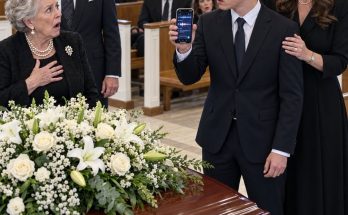
Maxwell stared at the photograph until the glass of his phone blurred beneath his thumb.
For one suspended moment, the world outside the car seemed to move without sound. The town car idled at the curb. Rain slipped down the windows in silver threads. Across the street, Eleanor’s apartment glowed softly above the laundromat, ordinary and impossible at once.
His father stood in the photograph.
Not in a portrait. Not in a memory.
Standing.
Smiling.
Holding a newborn.
And behind him, Eleanor—pale, younger, one hand on the swell of her pregnant belly—looked not frightened, but stunned, as if someone had just handed her the missing piece of a life she had not known was incomplete.
Maxwell zoomed in with trembling fingers.
The image became grainy, then sharper around the edges of familiar things. His father’s old signet ring. The blue blanket. The hospital nursery window. Eleanor’s face.
His heart pounded once, hard.
The date printed in the corner of the photograph was four months before Sophie’s birth.
Four months.
His father had been dead for seven years.
Maxwell read the message again.
Do not trust Victoria. Eleanor didn’t find your father’s papers by accident.
And Sophie is not the only child hidden from the Callahan family.
“Sir?” the driver asked quietly from the front seat.
Maxwell locked the phone screen.
For the first time in his adult life, he understood that wealth did not make a man powerful when everyone around him had learned to arrange the truth before it reached him.
“Drive,” he said.
“Home?”
Maxwell looked once more at the warm third-floor window.
“No,” he said. “To my father’s house.”
The driver hesitated.
“The old house, sir?”
“Yes.”
The house had stood empty since William Callahan’s death, preserved less like a home than a sealed argument. Maxwell had not crossed its threshold in years. Victoria kept staff there twice a month to dust, polish, and ensure the past remained arranged exactly as she preferred it.
Tonight, he wanted dust. Disorder. Answers that had escaped polish.
By the time they reached the old Callahan estate, the rain had stopped. The great stone house rose behind iron gates, windows dark except for a weak security light near the servants’ entrance. When Maxwell stepped out of the car, wet gravel crunched beneath his shoes.
He remembered being eight years old and racing across that same drive with a paper kite his father had made from newspaper and wooden skewers. He remembered Victoria scolding them both for bringing mud into the foyer. He remembered his father laughing, low and warm, then whispering, “Some things are worth a little mess.”
Maxwell had forgotten that voice.
Or maybe he had buried it because remembering it made the silence after death too large.
Inside, the house smelled of lemon oil, cold stone, and flowers that had been replaced regularly for a woman who never visited unless guests were watching.
He went straight to his father’s study.
The room was locked.
Of course it was.
Maxwell stood before the carved walnut door, then took the old key ring from the drawer in the hall table. Victoria had once told him his father kept nothing sentimental in that room.
Now he wondered why she had needed him to believe that.
The fourth key turned.
The study opened with a soft groan.
Moonlight fell across shelves of law books, framed photographs, a globe beside the window, and the broad desk where William Callahan had once taught his son to sign his name without pressing too hard.
Maxwell turned on the lamp.
Nothing seemed disturbed. That was what made it suspicious. Every book lined perfectly. Every drawer closed. Every surface clean enough to deny memory.
He searched the desk first. Contracts. Old stationery. Receipts from charities. A dried fountain pen. Nothing.
Then he noticed the globe.
It faced the wrong direction.
His father had always turned it so the Atlantic lay centered beneath the brass meridian. “Because every Callahan thinks he owns one side of the ocean,” he used to say, “until the ocean reminds him he is small.”
Tonight, Asia faced forward.
Maxwell touched it. The globe shifted slightly under his hand. He turned it, slowly, and heard a click inside the pedestal.
A narrow drawer slid open.
Inside lay a bundle of envelopes tied with faded green ribbon, a small brass key, and an old photograph.
Maxwell picked up the photograph first.
Two boys sat on the steps of a summer house, identical in face but different in posture. One looked straight at the camera with careful confidence. The other leaned sideways, laughing at something beyond the frame.
On the back, written in his father’s hand:
William and Thomas, age 9. Before Mother decided one heir was simpler than two.
Maxwell sat down hard in the desk chair.
Thomas.
He had never heard that name.
A twin.
His father had had a twin.
The brass key trembled in his hand as he opened the first envelope.
My dear Maxwell,
If you are reading this, then either I failed to tell you the truth while I had time, or someone prevented it from reaching you. I hope it is the first. I fear it is the second.
There are parts of our family history that were hidden in the name of order. Your grandmother believed a family fortune could not survive divided affection. My brother Thomas was sent away when we were children. Not formally disowned. Nothing so honest. He was simply erased from rooms, portraits, and eventually conversations.
I found him again when we were grown.
He had built a life smaller than mine and, in many ways, far richer.
Maxwell stopped reading. The room felt colder now, but not emptier. It felt crowded with all the people who had been pushed out of the Callahan story so that one version could stand straight on a mantel.
He opened the next letter.
Thomas had a daughter.
Her name is Eleanor.
Maxwell’s breath left him.
For a second, the words refused to arrange themselves into meaning.
Thomas had a daughter.
Her name is Eleanor.
He read on.
She does not know the connection. Thomas died before he could tell her. I learned of her by accident through a scholarship file and then through a letter he left with an old friend. By then, she was engaged to you.
I should have told you both. I delayed because the truth was complicated, and because I had spent a lifetime being trained to believe complicated truths were dangerous.
That delay is one of my great regrets.
No.
Maxwell stood so abruptly the chair rolled back.
No.
Eleanor was his cousin?
His mind raced toward Sophie and slammed against panic so sharp it almost took his knees.
Then he saw the next page, folded separately, marked in red.
Not blood relation by birth.
Thomas adopted Eleanor when she was four months old.
Maxwell gripped the desk.
Adopted.
The room came back in pieces.
The lamp. The books. The rain tapping from gutters outside.
He kept reading.
Eleanor was born to a young woman named Clara Whitcomb, who placed her safely with Thomas and his wife, Beatrice. Thomas adored that child with the whole of himself. After Beatrice died and then Thomas followed, Eleanor entered the world alone, believing she had no family left.
She has more family than she knows.
She has you, if you are wise enough not to lose her.
Maxwell sank back into the chair, the letter shaking in his hand.
His father had known.
His father had known Eleanor was connected to the Callahan family—not by blood, but by love, by adoption, by a man erased from their family history.
No wonder Victoria had feared her.
Eleanor had not merely married into the Callahan legacy. She unknowingly belonged to the part of it Victoria had spent decades burying.
The final envelope contained a legal document.
A trust.
Not for Maxwell.
Not for Victoria.
For Eleanor Thomasine Hale, adopted daughter of Thomas Callahan Hale.
Hale.
Eleanor’s maiden name.
Maxwell remembered her once telling him she had chosen not to use her full middle name because it sounded old-fashioned. Thomasine. He had smiled and kissed her shoulder and asked what it meant.
She had said, “I don’t know. My father liked it.”
Her father.
Thomas.
The hidden twin.
His phone buzzed again.
Unknown number.
There is a box in the nursery closet. Ask Eleanor about the silver rattle.
Maxwell stared at the words.
Then another message appeared.
Victoria knows about the trust. She does not know about the letter your father gave me.
Who are you? Maxwell typed.
The reply came after a long pause.
Someone who promised William I would wait until you were ready. I waited too long.
Maxwell closed his eyes.
He thought of Eleanor’s pale face when Victoria had mentioned the study. He thought of Sophie asleep with fever-pink cheeks. He thought of a silver-haired woman at an apartment door claiming blood like ownership.
Then he gathered the letters and left the study with the brass key in his hand.
Morning came soft and gray.
Eleanor woke to the sound of Sophie humming.
Not crying.
Humming.
For three days, the fever had stolen Sophie’s usual music—the nonsense songs about purple dinosaurs, moon pancakes, and socks that refused to stay on feet. Now, from the bedroom, came a small, scratchy tune.
Eleanor opened her eyes and saw sunlight resting on the floorboards.
For a moment, she forgot everything.
Then the night returned.
Maxwell at her door.
Victoria in the hallway.
The secret from the study.
Her heart tightened.
She found Sophie sitting upright in bed, hair wild, stuffed rabbit under one arm.
“Mommy,” Sophie said solemnly, “my ear is still grumpy, but my head is less buzzy.”
Eleanor crossed the room and pressed her lips to Sophie’s forehead.
Cooler.
She nearly cried from relief.
“That is the best news I’ve heard all year.”
“Better than pancakes?”
“Even better than pancakes.”
Sophie considered this incredible claim, then whispered, “Can the tall man come to tea party?”
Eleanor sat on the edge of the bed.
The tall man.
Maxwell.
Sophie’s father.
There were words a mother practiced in her head for years, only to find them too small when the moment arrived. Eleanor had imagined explaining Maxwell as a person far away. A man who did not know. A man she had loved once. A man with a complicated life.
But Sophie was not asking for history.
She was asking whether someone who had appeared in the rain would come back.
“I think,” Eleanor said carefully, “he wants to.”
Sophie rubbed one eye. “Is he my daddy?”
Eleanor went still.
Children sometimes arrived at the truth by the shortest path.
“Yes,” she whispered. “He is.”
Sophie looked down at her rabbit, then back up. “Did he get lost?”
Eleanor’s breath trembled.
In a way, the answer was yes.
In more ways than one.
“He did,” she said. “But he found us now.”
Sophie accepted that with the solemn generosity of the very young. “Then he needs a map.”
Eleanor pulled her close and held her until Sophie squirmed.
“Mommy, you’re squeezing my soup.”
“You are not soup.”
“I feel like soup.”
Eleanor laughed through the ache in her throat.
A knock came at the door just after ten.
This time, Eleanor looked through the peephole before unlocking it.
Maxwell stood in the hallway holding a paper bag, his coat damp from mist, his face shadowed by a sleepless night. He looked less like the man whose photograph appeared on magazines and more like someone who had spent the dark hours becoming honest with himself.
“No driver?” she asked.
“No driver.”
“No security?”
“No.”
“No mother hiding behind the stairs?”
A faint, tired smile touched his mouth. “No mother.”
Eleanor opened the door.
Sophie ran from the bedroom in mismatched socks and stopped several feet away, suddenly shy.
Maxwell crouched at once, lowering himself to her world.
“Good morning, Sophie.”
She studied the bag. “Did you bring tea party snacks?”
“I brought three kinds,” he said. “Because I didn’t know the rules.”
Sophie’s eyes widened.
Eleanor raised an eyebrow. “Three kinds?”
“I panicked.”
Sophie nodded gravely. “Tea parties are serious.”
“They seem to be.”
Within minutes, Maxwell Callahan, whose company had acquired hotels, shipping firms, and entire blocks of Manhattan, sat on the floor beside a yellow child’s table holding a cup no larger than an egg.
Sophie poured imaginary tea with great ceremony.
“You have to say thank you to Princess Rabbit,” she instructed.
Maxwell turned to the stuffed rabbit with one missing button eye. “Thank you, Princess Rabbit.”
Sophie frowned. “She likes voices.”
Maxwell looked at Eleanor.
Eleanor folded her arms, waiting.
Maxwell cleared his throat and, in a surprisingly dignified high voice, said, “You are most welcome, tall guest.”
Sophie burst into giggles.
The sound filled the apartment so completely that Eleanor had to look away.
It was not forgiveness. Not yet.
But it was a beginning.
After tea, Sophie curled on the couch with a blanket and a picture book while the antibiotic did its work. Maxwell washed the tiny cups without being asked. Eleanor watched him from the kitchen doorway, noticing the awkward care in his hands, as if every chipped plate mattered because it belonged to a life he was being trusted to approach.
When he finished, he dried his hands on a towel and turned.
“I went to my father’s study last night.”
Eleanor’s face changed.
“I found the letters,” he said. “And the trust.”
Her hand moved to the counter.
He stepped closer, then stopped, respecting the distance.
“Why didn’t you tell me?” he asked quietly.
She gave a small laugh without humor. “That seems to be our family question.”
“Our family,” he repeated.
The words hung differently now.
Eleanor looked toward Sophie. “The night before I left, I was looking for you. You had missed dinner again. Your mother said there was a board emergency, but I knew she was lying. I went to the old house because your father’s study was the only place you used to go when you were overwhelmed.”
“I wasn’t there.”
“No.” Eleanor swallowed. “But the door was open. There were papers on the desk. My name was on one of them.”
“The trust.”
“Yes. I thought at first it was about me as your wife. Then I saw my father’s name.”
“Thomas.”
She closed her eyes at the sound of it.
“All my life, I thought Thomas Hale was just Thomas Hale,” she said. “A quiet man who fixed clocks, made terrible soup, and let me sleep in his workshop when thunderstorms scared me. I didn’t know he had been born Thomas Callahan. I didn’t know he had changed his name to keep peace with a family that had erased him.”
Maxwell felt the old shame rise again, not personal exactly, but inherited.
“What did Victoria say when she found you?”
Eleanor’s face tightened.
“She said I had been clever.”
“Clever?”
“She thought I’d known all along. She accused me of marrying you to get back into the family. To claim money. To expose some old scandal.” Eleanor looked down. “I was twenty-six, Max. I had just learned my father’s entire history had been cut out of your family like a stain. And your mother stood in that doorway telling me I was a threat to everything you had built.”
“I would never have believed that.”
“You believed smaller things.”
He could not deny it.
“She told me that if I loved you, I would leave before the truth ruined you. Before the board questioned your judgment. Before the press turned our marriage into a story about inheritance and deception.”
Maxwell looked at Sophie, who was turning pages upside down and murmuring to herself.
“She used love against you.”
Eleanor’s eyes filled. “She knew exactly where to press.”
“And when you found out you were pregnant…”
“I thought going back would look like what she had accused me of all along.” Eleanor’s voice broke softly. “A claim. A trap. A way in.”
Maxwell stepped toward her then, unable to remain still.
“You were my wife.”
“I was also terrified.”
He stopped.
She wiped her cheek quickly, almost angrily.
“I should have found another way,” she said. “I know that. I have lived with it every day. Every birthday candle. Every question from Sophie. Every time she drew a tall man standing under a rainbow. I told myself I was protecting her, but sometimes protection looks too much like hiding.”
Maxwell looked down at his hands.
“We both hid,” he said. “You from power. Me from pain.”
The honesty settled between them, fragile and clean.
Then Sophie looked up from the couch. “Are you sad again?”
Both adults turned.
Maxwell crouched beside the couch. “A little.”
Sophie patted the blanket near her. “You can sit. Mommy says sad is smaller when it has company.”
Eleanor pressed a hand to her mouth.
Maxwell sat carefully on the floor beside the couch.
Sophie leaned over and placed Princess Rabbit on his knee.
“For company,” she explained.
He bowed his head.
“Thank you.”
That afternoon, they called Dr. Anika Rao for a follow-up.
Eleanor expected the usual cheerful voice, the gentle doctor who remembered Sophie’s favorite sticker and never rushed a worried mother through questions. Instead, when Anika answered and heard Maxwell’s name in the background, she went silent.
“Eleanor,” she said slowly, “is he there with you?”
“Yes.”
Another pause.
Then Anika exhaled.
“I think it’s time I came over.”
Maxwell and Eleanor looked at each other.
One hour later, Dr. Anika Rao stood in Eleanor’s apartment doorway holding a worn leather folder against her chest.
She was in her early forties, with dark hair pulled into a loose knot and eyes that had always seemed kind to Eleanor. Today, those eyes carried worry.
Sophie brightened from the couch. “Dr. Dinosaur!”
Anika smiled warmly. “Hello, my brave purple-dinosaur expert.”
“You came to my house.”
“I did. Very special visit.”
After checking Sophie’s ears and temperature, Anika declared the fever was improving and accepted a sticker from Sophie in return. Then she looked at the adults.
“We should talk.”
They moved into the kitchen.
Anika placed the leather folder on the table.
“My full name,” she said, “is Anika Rao Whitcomb.”
Eleanor’s breath caught.
“Whitcomb?” she whispered.
Anika nodded. “Clara Whitcomb was my mother.”
Maxwell remembered the name from his father’s letter. Eleanor’s birth mother.
Eleanor gripped the back of the chair.
Anika’s voice softened. “And yours.”
The apartment went utterly still.
Eleanor sat down as if her legs had lost strength.
“My mother,” she said.
“Our mother,” Anika corrected gently.
Maxwell looked from one woman to the other. Different coloring. Different features. But something in their expressions matched—the same guarded tenderness, the same habit of preparing for loss before it arrived.
Anika opened the folder.
Inside were photographs, letters, and a hospital bracelet so old its ink had faded to gray.
“I was born first,” Anika said. “Clara was young and alone. She kept me for three years, then became ill and placed me with relatives in Queens. Later, when Eleanor was born, she chose adoption from the start. Thomas and Beatrice Hale were kind, stable, and desperate for a child.” Anika’s voice trembled. “Clara wrote letters to both of us. She asked that we be told when we were old enough. But people made choices for us.”
“Victoria,” Maxwell said.
Anika looked at him. “Victoria intercepted some of the correspondence after William began searching for Thomas’s family. She feared any connection to Thomas would reopen old inheritance issues.”
Eleanor touched one of the photographs with shaking fingers.
It showed a young woman with laughing eyes holding a toddler on one hip.
Anika.
Beside her, in a small cradle, slept an infant wrapped in white.
Eleanor.
“I don’t understand,” Eleanor whispered. “How did you become Sophie’s doctor?”
Anika looked ashamed.
“Not by accident,” she said. “William found me years ago. He told me about Thomas, about you, about the Callahans. He asked me to keep an eye on you—not to interfere, not to reveal anything before you were ready. Just to be nearby if you ever needed help.”
Eleanor stared at her.
“You knew who I was?”
“Yes.”
“All this time?”
Anika’s eyes filled. “Yes.”
Hurt flashed across Eleanor’s face.
Maxwell recognized it because he felt its echo in himself.
“Why didn’t anyone trust me with my own life?” Eleanor asked.
Anika lowered her head. “Because we mistook caution for kindness.”
Sophie coughed softly from the living room.
The sound pulled all three adults back from the edge of old grief.
Anika looked toward her. “When you brought Sophie to my clinic as a newborn, I almost told you. You looked so tired. So alone. I thought the truth might break whatever strength you were standing on.” She swallowed. “So I did the easy thing. I helped in the ways I could. I adjusted bills. I made after-hours calls. I told myself support was enough.”
Eleanor’s eyes widened.
“The reduced bills,” she said.
Anika nodded.
“The anonymous grocery cards?”
“Some were me. Some were William’s fund.”
Maxwell frowned. “William’s fund?”
Anika looked at him then. “Your father created a private family fund before he died. Not for the Callahan name. For the people the Callahan name had failed.”
Maxwell felt the words move through him like a door opening.
Anika reached into the folder and removed a sealed envelope.
“He gave me this before his heart surgery.”
“Surgery?” Maxwell repeated.
“After the charity dinner,” she said gently. “He didn’t die at the event. He collapsed there. Victoria announced his death later, after he passed privately at the hospital. William had regained consciousness for only a few hours. Long enough to give me this. Long enough to ask me to wait until the truth would protect more than it harmed.”
Maxwell took the envelope.
His name was on it.
Inside, his father’s handwriting slanted across thick paper.
My son,
I taught you how to win, but not how to listen. That failure belongs to me.
If the truth reaches you through pain, do not waste time blaming the pain. Ask what it has come to show you.
Thomas was my brother. Eleanor is his daughter in every way that matters. Anika is her sister by birth. Clara Whitcomb loved both girls and wanted them found by one another. I delayed. Victoria resisted. You inherited a house full of locked doors.
Open them.
And when you do, do not become another locked door to the people who love you.
Maxwell read the last line twice.
Then he folded the letter carefully and pressed it to his chest.
That evening, Maxwell called his mother.
Not from his office. Not with attorneys listening. From Eleanor’s kitchen, while Sophie slept and Eleanor stood beside him.
Victoria answered on the second ring.
“Have you come to your senses?” she asked.
“No,” Maxwell said. “I’ve come to my conscience.”
Silence.
“I found the letters. I know about Thomas. I know about the trust. I know about Anika. I know you kept Eleanor’s pregnancy from me.”
Victoria’s breathing shifted.
When she spoke again, her voice was quieter. “You have no idea what that history nearly did to this family.”
“No. I know what hiding it did.”
“You think truth solves everything?”
“No,” Maxwell said. “But lies keep charging interest.”
Eleanor looked at him then.
Victoria gave a small bitter laugh. “Your father used to say things like that near the end.”
“Maybe I should have listened sooner.”
“You were a boy.”
“I’m not now.”
There was a pause long enough that Maxwell imagined his mother standing in one of her perfect rooms, surrounded by flowers no one had chosen with love.
“I kept order,” Victoria said. “That is what no one thanks me for. I kept the company stable after your father died. I kept scandal from devouring you. I kept every greedy cousin, every reporter, every opportunist away from our door.”
“You also kept my daughter away.”
That ended the argument.
When Victoria spoke again, the steel had thinned. “I did not know what to do with the child.”
“Her name is Sophie.”
“Yes,” Victoria said after a moment. “Sophie.”
“She will not be managed.”
“I understand.”
“I don’t think you do. So hear me clearly. Eleanor will receive the trust exactly as my father intended. Anika will receive every file connected to Clara and Thomas. Our attorneys will document what was done and correct it through proper channels. No threats. No private security. No pressure.”
“And me?” Victoria asked.
Maxwell looked at Eleanor before answering.
“That depends on whether you can learn to be a grandmother without being an owner.”
A long silence followed.
Then Victoria said something Maxwell had never heard from her.
“I don’t know how.”
The admission was small. Almost invisible.
But real.
Maxwell’s throat tightened despite himself. “Then start by apologizing. Not to me first.”
He ended the call.
Eleanor was quiet.
“Do you believe her?” she asked.
“I believe she is afraid of a world she can’t control.”
“That’s not the same as change.”
“No,” he said. “It isn’t.”
But it was the first honest thing Victoria had given them.
Weeks passed, not easily, but steadily.
Maxwell did not move into Eleanor’s life like a storm. He entered by small permissions.
He came for Saturday breakfasts and burned the first batch of pancakes so badly Sophie named them “dragon rocks.” He learned which stuffed animals could be placed in the washing machine and which required “emotional supervision.” He discovered that Sophie hated peas unless they were called moon buttons, and that Eleanor hummed when she was trying not to cry.
He attended pediatric appointments. He signed nothing without Eleanor reading it first. He told his assistant that every afternoon from four to seven was unavailable unless the building was literally on fire, and even then someone else could find water.
At first, Sophie called him “Tall Max.”
Then “Max-Daddy,” as if testing whether the word fit.
The first time she simply said “Daddy,” she was half asleep in his arms after a museum trip, her cheek warm against his shoulder.
Maxwell froze in the middle of the sidewalk.
Eleanor saw.
Neither of them spoke until Sophie sighed and tucked one hand into his coat.
Then Eleanor whispered, “Breathe.”
So he did.
Anika became Aunt Anika by Sophie’s immediate decree. Eleanor needed longer. Trust did not bloom simply because blood had been discovered. It arrived through repeated proof: Anika showing up with soup, answering hard questions without defensiveness, crying openly when Eleanor showed her Thomas’s old clock tools, laughing when Sophie put dinosaur stickers on her medical bag.
One Sunday, Anika brought a box of Clara Whitcomb’s letters.
Eleanor read them slowly over many nights.
Clara was not the ghost Eleanor had imagined. She was funny. Messy. Tender. Afraid of thunderstorms. Fond of cheap strawberry candy. She had written both daughters the same sentence in separate letters years apart.
I hope you find each other in a kinder season.
Eleanor cried over that line for a long time.
Maxwell sat beside her on the floor of the small apartment, close enough to offer warmth, not so close as to demand anything.
Eventually, she leaned into him.
Not as a wife returning.
Not as a woman forgetting.
As someone tired of holding every broken piece alone.
Victoria’s apology came in writing first.
It was formal, restrained, and clearly rewritten many times.
Eleanor read it twice, then put it in a drawer.
The second apology came in person, three months later, in a family counselor’s office with pale blue walls and a bowl of peppermints on the table.
Victoria wore navy instead of cream. No pearls.
She looked older.
“I believed control was protection,” she said, hands folded tightly in her lap. “That belief harmed you. It harmed Maxwell. It harmed Sophie before she was even born. I am sorry.”
Eleanor watched her for a long time.
Then she said, “I don’t forgive you today.”
Victoria bowed her head. “I understand.”
“But I accept that you came.”
For Victoria Callahan, who had once treated concession like defeat, it was perhaps the first step across a bridge she had never expected to need.
The legal corrections took nearly a year.
The trust was restored. Thomas Callahan Hale’s name returned to the family records. His photograph was hung in the old house beside William’s—not hidden in a drawer, not footnoted, not explained away.
Maxwell resigned from two boards and restructured the family foundation into something his father might have recognized. The first initiative funded family legal aid, adoption record access, and support for single parents navigating medical and childcare costs.
At the opening ceremony, reporters asked him why the issue mattered.
Maxwell glanced toward Eleanor, who stood with Sophie on one side and Anika on the other.
“Because families are not preserved by silence,” he said. “They are healed by courage.”
Eleanor did not take his hand in front of the cameras.
But later, behind the building, while Sophie chased pigeons in a blue dress and Anika warned her not to negotiate with birds, Eleanor slipped her fingers through his.
Maxwell looked down.
She pretended not to notice his expression.
“Don’t make a speech,” she said.
“I wasn’t going to.”
“You were thinking one.”
“I was thinking five.”
She laughed then, and the sound undid him more gently than grief ever had.
The final unexpected truth arrived on Sophie’s fourth birthday.
By then, Eleanor had moved—not into Maxwell’s penthouse, and not back into the Callahan estate, but into a sunlit brownstone halfway between his world and hers. It had a small garden, creaky stairs, and enough space for Sophie to run without neighbors tapping the ceiling.
Maxwell had his own key.
He did not use it without knocking.
The birthday party was chaos in its purest form: purple balloons, dinosaur cupcakes, paper crowns, children shrieking in delight, and Maxwell sitting at a tiny craft table with glitter on his sleeve while helping a boy named Milo glue feathers to a stegosaurus.
Victoria arrived late.
She stood at the garden gate holding a wrapped gift and looking as uncertain as Sophie had once looked at the apartment doorway.
Eleanor saw her first.
For a moment, the old fear stirred.
Then Sophie spotted her.
“Grandmother V!” she shouted.
Victoria’s face changed.
Not dramatically. Not like a movie villain redeemed by one hug. More like ice cracking in spring—quiet, irreversible.
Sophie ran to her and seized her hand. “You can’t wear fancy shoes in the mud. Mommy says mud eats heels.”
Victoria looked down at her shoes, then at Eleanor.
Eleanor folded her arms. “Mud does eat heels.”
For the first time anyone could remember, Victoria Callahan removed her expensive shoes and walked barefoot across the grass.
The children cheered as if she had performed magic.
Later, after cake, Anika found a small envelope tucked inside Victoria’s gift. It was addressed to Eleanor.
Inside was a key and a note.
Your father’s workshop still exists.
I bought the building years ago to prevent it from being demolished. I told myself preservation was enough. It was not.
It belongs to you now.
Eleanor read the note twice.
Then she sat down on the garden bench and cried.
The workshop was in a narrow lane behind an old clock repair shop two towns away. Thomas Hale’s tools remained there, carefully packed. His workbench still bore scratches from decades of patient labor. On a shelf near the window sat a small wooden box Eleanor remembered from childhood.
Inside was a silver rattle.
And beneath it, wrapped in soft cloth, was a tiny clockwork bird.
Maxwell turned the brass key.
The bird lifted its head, opened its wings, and sang a delicate chiming melody.
Eleanor covered her mouth.
“I know that song,” she whispered.
Anika, standing beside her, began to hum.
It was the lullaby Eleanor sang to Sophie.
The one neither woman knew had come from Clara.
In the bottom of the box lay a note from Thomas.
For my daughters, should they ever stand together.
Eleanor looked at Anika.
For a heartbeat, neither moved.
Then the sisters reached for each other.
Maxwell stepped back, holding Sophie against his side, giving them the room the past had denied them.
Sophie whispered, “Are they happy sad?”
“Yes,” Maxwell said, kissing her hair. “The best kind.”
That winter, the old workshop reopened—not as a museum, but as a community space where clocks were repaired, children learned to build small wooden toys, and families searched old records with help from volunteers funded by the foundation.
Above the door hung a simple sign:
THE THOMAS HALE ROOM
For the stories that waited to come home.
On opening day, Eleanor stood before a crowd much smaller than the ones Maxwell was used to addressing, but far more important.
She held Sophie’s hand.
Anika stood on her other side.
Maxwell stood in the back, because this moment was not his to own.
Eleanor looked at the room—at Thomas’s tools, Clara’s letters in a glass case, William’s final note framed beside them, Victoria seated quietly in the second row with her hands folded around Sophie’s purple dinosaur sticker.
“My father fixed clocks,” Eleanor said. “He used to tell me that broken things were not useless. They were simply waiting for someone patient enough to understand how they had stopped.”
She paused, smiling through tears.
“For a long time, I thought families broke because love failed. Now I think sometimes love is still there, trapped behind fear, pride, silence, and old mistakes. It takes courage to open the casing. It takes care to touch the small pieces. And it takes all of us to make time move again.”
Sophie tugged her sleeve. “Mommy, say the bird part.”
Everyone laughed softly.
Eleanor lifted Sophie into her arms.
“And sometimes,” she added, “when the clock starts again, it sings.”
At the back of the room, Maxwell lowered his head.
He felt his father there. Not as a ghost, not as grief, but as a hand on his shoulder guiding him toward the life he had almost missed.
After the ceremony, Eleanor found him outside beneath a bare maple tree.
Snow had begun to fall, light as breath.
“You stood in the back,” she said.
“I’m learning.”
She smiled. “You are.”
He looked through the window, where Sophie was showing Victoria how to make a paper crown. Victoria wore it with solemn dignity while Anika took a photograph.
“Do you ever wonder,” Maxwell said, “what would have happened if we had known everything sooner?”
Eleanor watched the snow gather on the windowsill.
“Yes,” she said. “But not as much as I used to.”
He turned to her.
She slipped her hand into his.
“I don’t want to live inside the years we lost,” she said. “I want to build something worthy of the ones we found.”
Maxwell’s eyes stung.
“I love you,” he said.
She looked at him for a long moment, not surprised, not frightened.
“I know,” she whispered.
Then, after a pause soft enough to hold all the pain and patience between them, she added, “I love you too. Differently now. Maybe better. Because this time, we’re awake.”
Inside, Sophie pressed her face to the window.
“Daddy!” she shouted through the glass. “Mommy! The clock bird is singing again!”
Eleanor laughed, wiping her cheeks.
Maxwell opened the door, and warmth rushed out to meet them—voices, light, the delicate chime of Thomas’s clockwork bird, and Sophie’s delighted singing rising above it all.
They stepped inside together.
Not into the past repaired perfectly.
Not into a future without difficulty.
But into a family no longer hidden, no longer owned by silence, no longer afraid of the truth.
And for the first time in many years, every clock in the room seemed to be keeping the right time.
THE END