
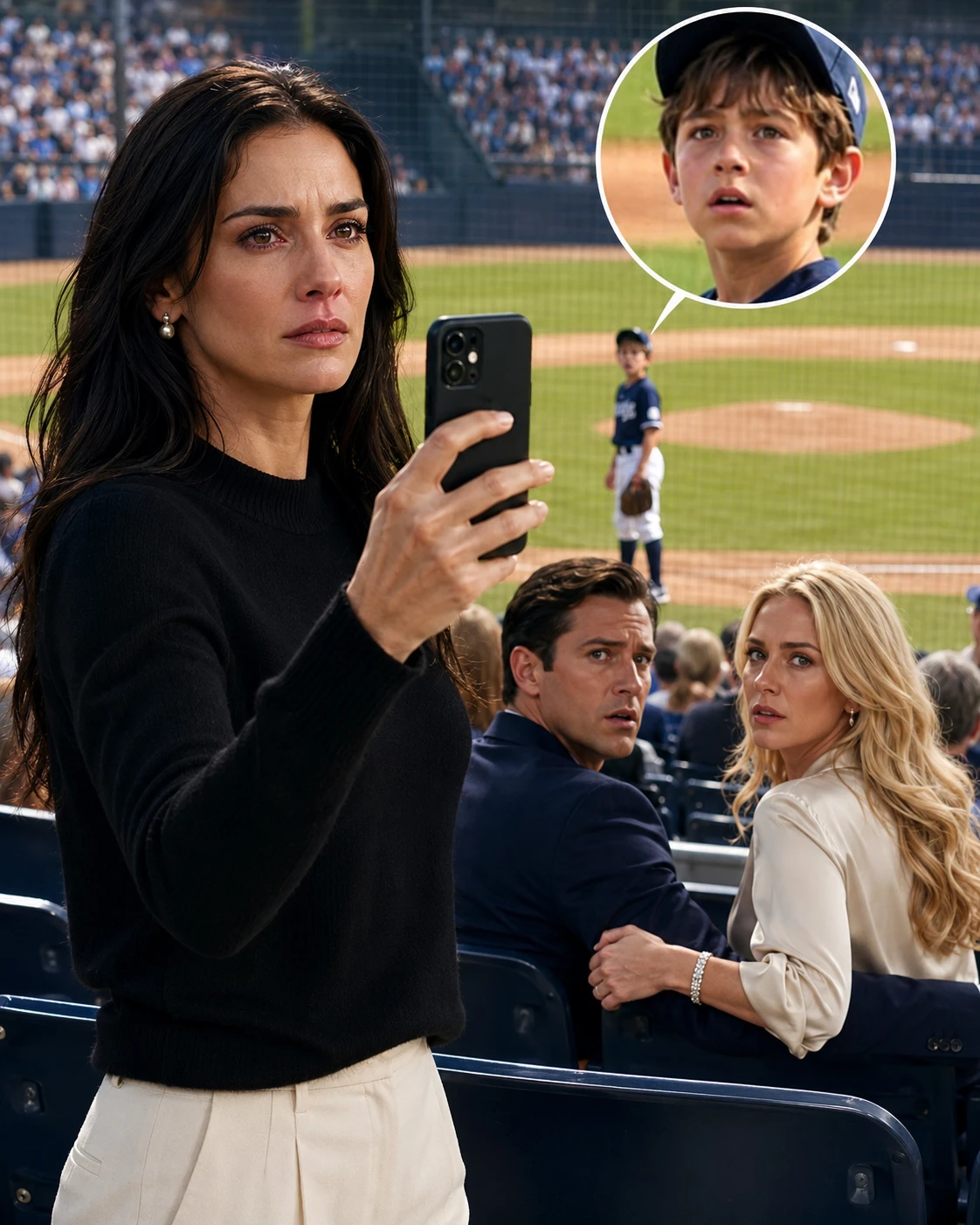
My husband let his mistress sit in my seat at our son’s championship game.
Not just any seat.
My seat.
Front row, behind home plate, marked with a white card in navy ink: **VIVIAN PIERCE — PARENT**.
The kind of seat you earn by standing in freezing March rain during tryouts, by washing grass stains out of white baseball pants at midnight, by cutting orange slices for boys who forget to say thank you, by learning the difference between a curveball and a slider because your child’s whole face lights up when you get it right.
I saw her before I saw him.
Sloane Archer was hard to miss. She had the kind of beauty that made people look twice and the kind of confidence that made them regret the second look. Cream silk blouse. Diamond tennis bracelet. Honey-blonde hair curled like she had never had to rush out of a house with cleats in one hand and a forgotten water bottle in the other.
She sat beside my husband, Nathan Pierce, at Harbor Light Stadium in Westport, Connecticut, with one slim leg crossed over the other.
In my seat.
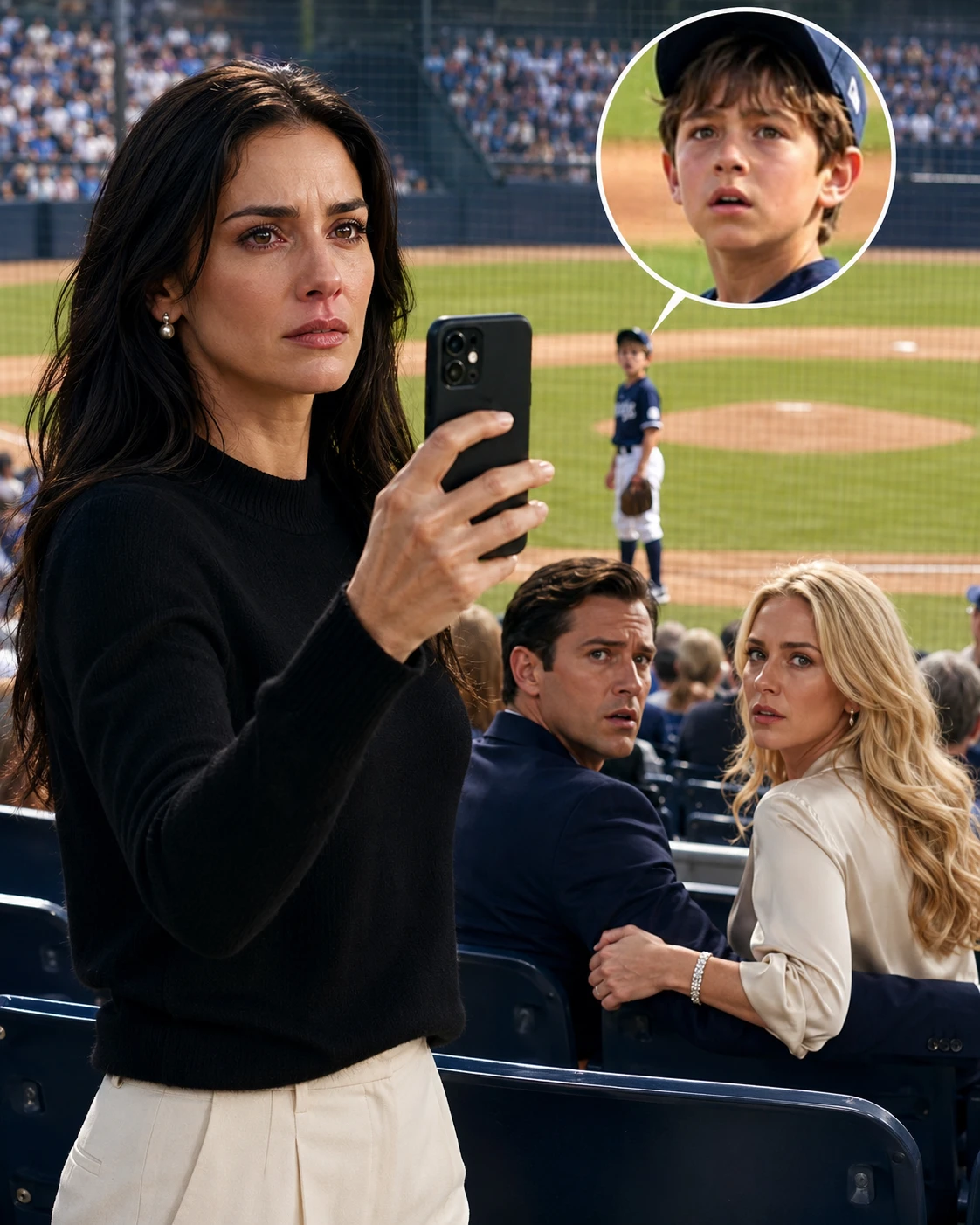
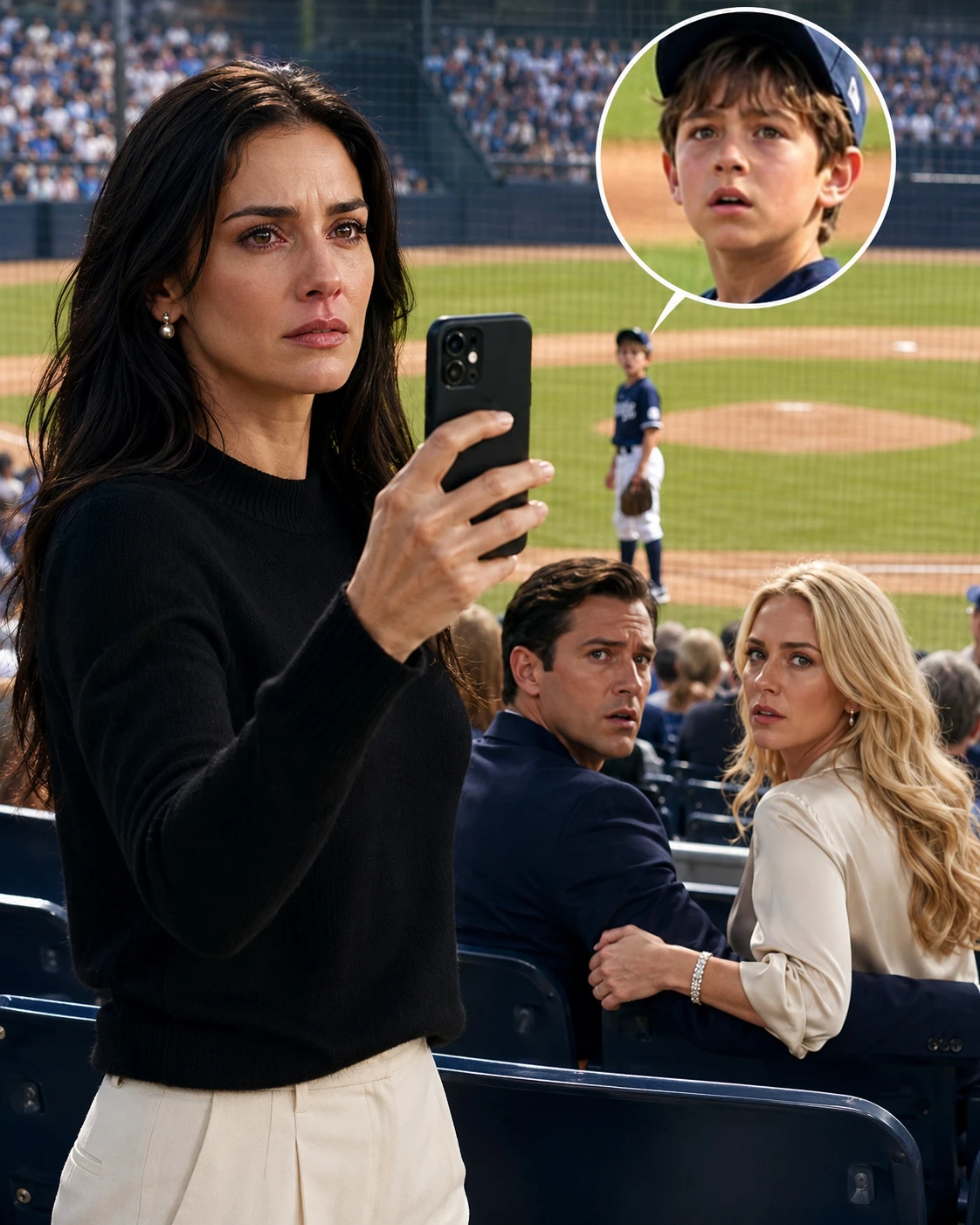
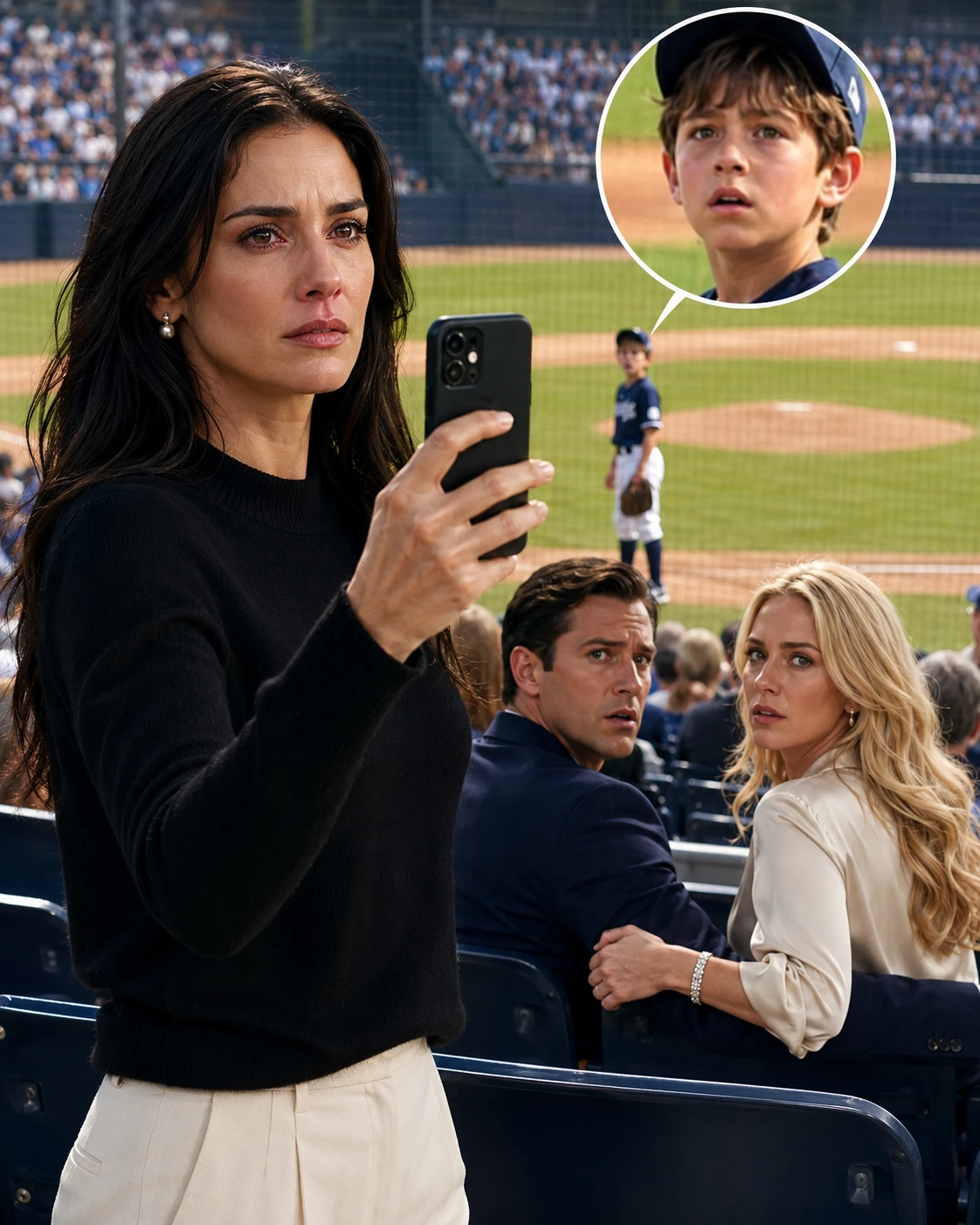
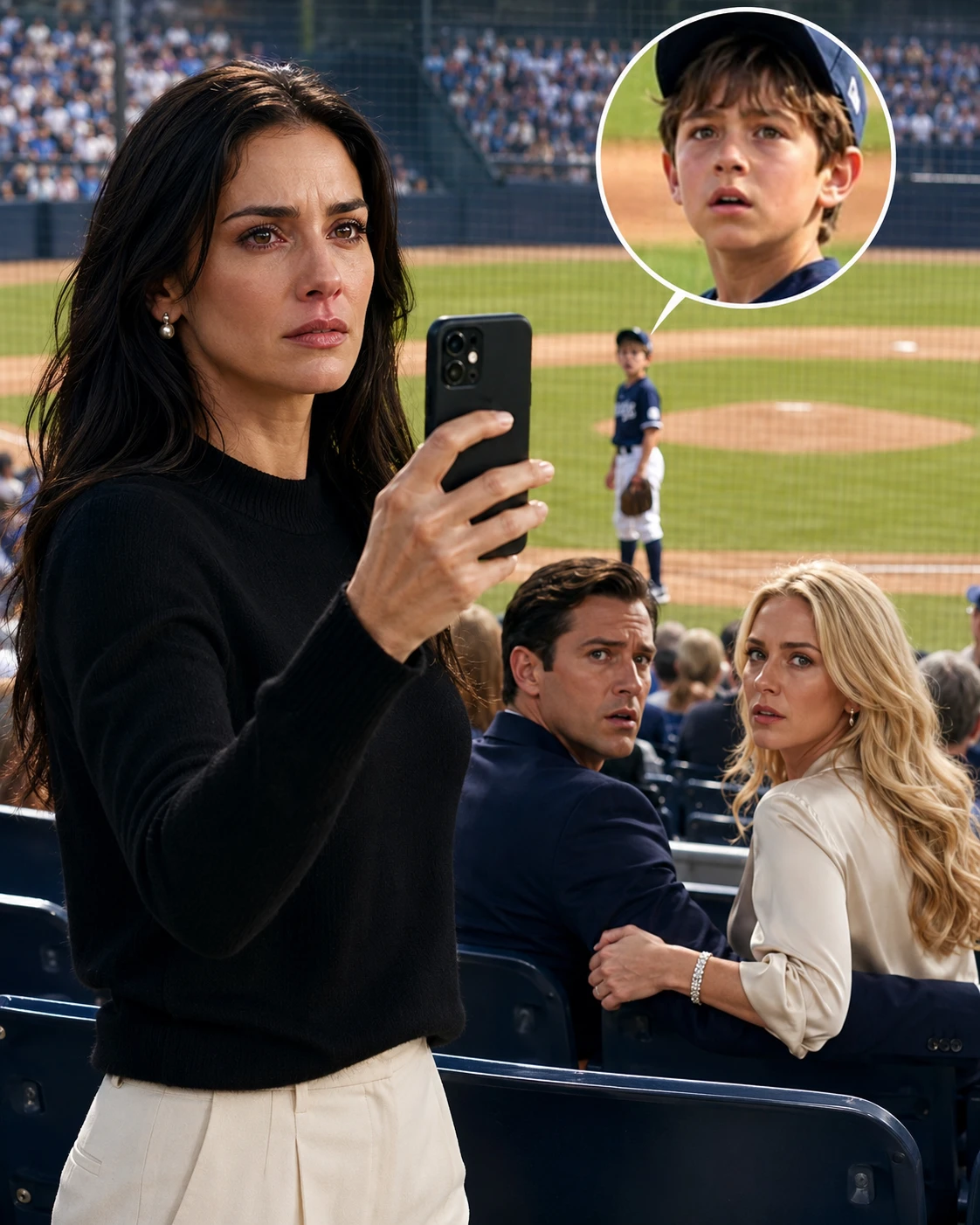
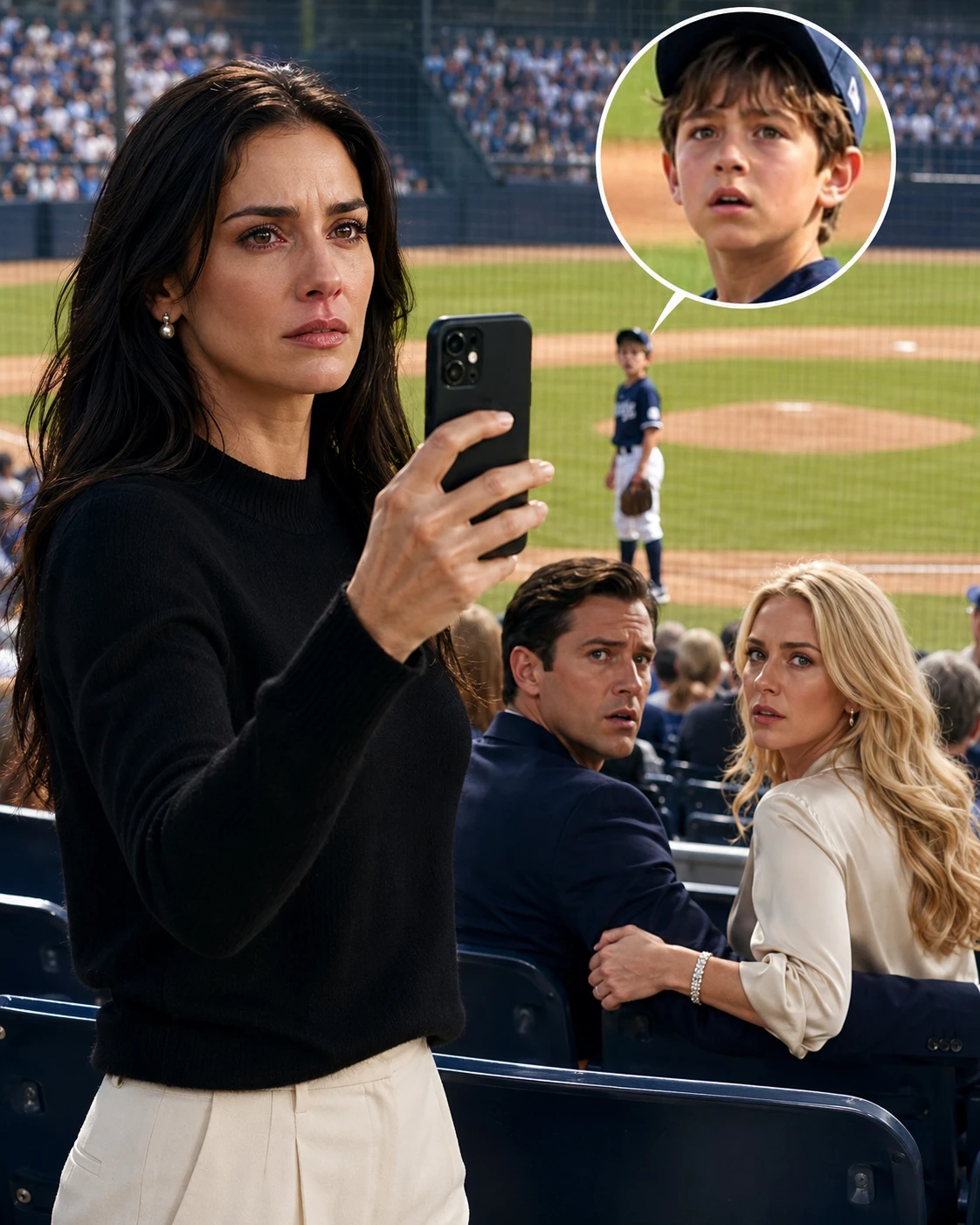
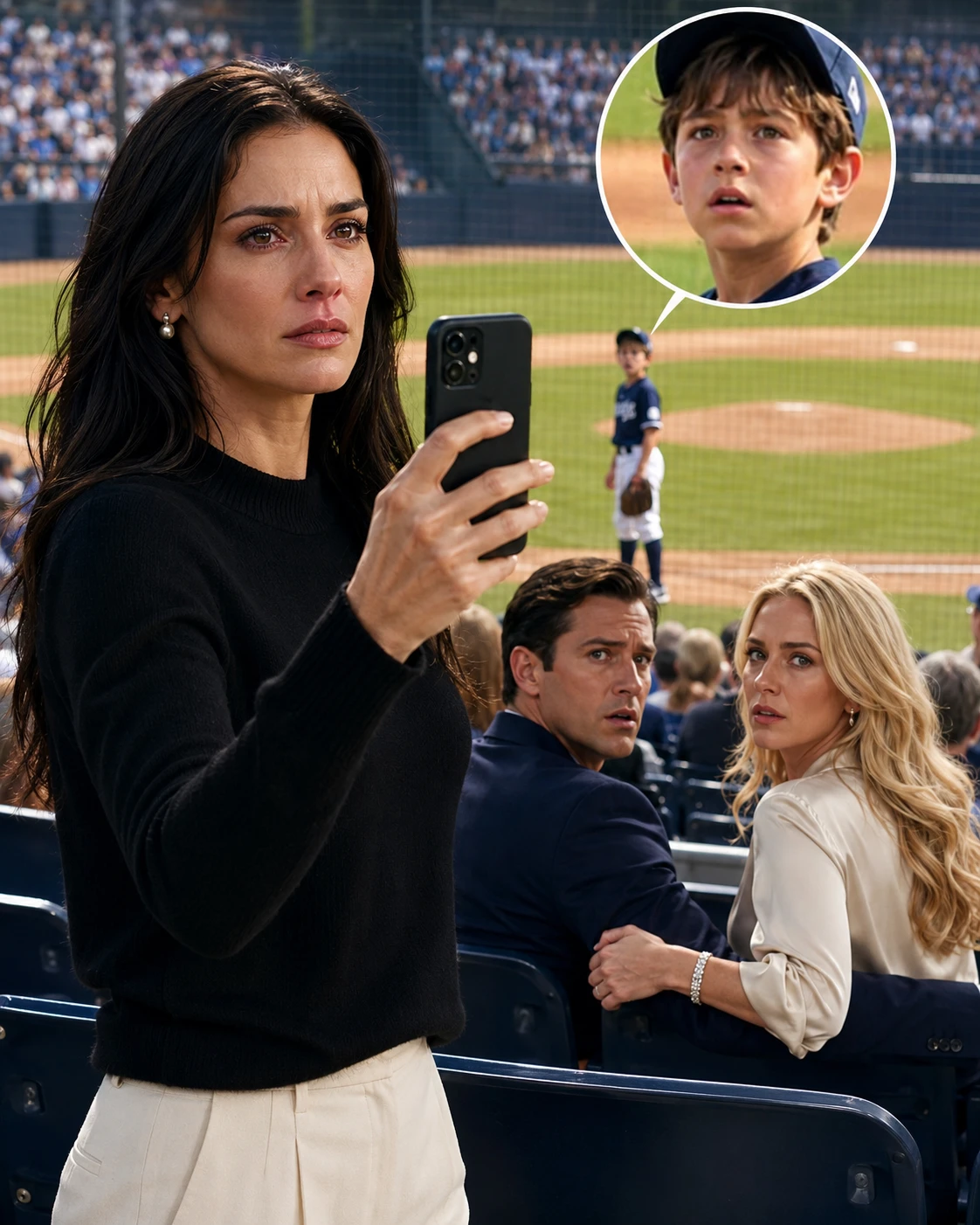
My son, Asher, walked onto the pitcher’s mound in his navy-and-white uniform, looked up into the stands for me, and found her instead.
For one terrible second, he stopped being a pitcher.
He became an eleven-year-old boy trying to understand why his father’s girlfriend was sitting where his mother always sat.
The first pitch left his hand too late.
The batter hit it clean into left field.
The crowd roared.
My phone buzzed.
Nathan: **Don’t start drama here.**
I looked at the message. Then I looked at my son, whose shoulders had gone tight beneath his jersey.
I did not start drama.
I took a photo.
Then another.
Then I smiled politely at the stadium attendant and asked for his name.
By the time the game ended, I had the names of three witnesses, two timestamped videos, one security contact, and my husband’s text admitting he knew exactly what he was doing.
Nathan thought humiliation was a sport.
Unfortunately for him, I had spent ten years keeping score.
And on Monday morning, the custody judge was going to see what drama actually looked like.
—
## Chapter 1: The Seat With My Name on It
The morning of the championship game smelled like lemon polish, storm clouds, and expensive betrayal.
I remember that because I had learned, over the last year, that the body records what the heart is too proud to say out loud.
The lemon polish came from Rosa, our housekeeper, who still cleaned the foyer of our Greenwich home as if anyone inside it deserved marble floors. The storm clouds rolled in from Long Island Sound, turning the sky the color of pewter. And the betrayal came from the empty side of my bed, where Nathan had not slept for the third night in a row.
He had texted at 6:12 a.m.
**Big meeting in the city. I’ll meet you at the stadium.**
No good luck to Asher.
No asking whether his uniform was clean.
No reminder to bring the blue compression sleeve Asher believed was lucky.
Just a lie wrapped in corporate language.
I stood in my dressing room beneath a crystal chandelier Nathan had once called “too feminine” and chose my outfit carefully.
Not for him.
Never again for him.
I chose a black cashmere sweater, ivory trousers, and loafers soft enough to walk across a battlefield without making noise. I pinned my dark hair at the nape of my neck. I wore pearl earrings my grandmother had given me when I graduated from Columbia Law, before I traded courtroom mornings for school drop-offs and partnership tracks for parent-teacher conferences.
Then I opened the safe behind the velvet-lined jewelry drawer.
Inside, beneath my passport and a stack of old letters tied with ribbon, sat a navy folder labeled:
**PIERCE CUSTODY — TEMPORARY ORDERS**
I read the third page again, not because I needed to, but because I liked the calmness of black ink.
**Neither parent shall introduce, include, invite, or permit the presence of a romantic partner at minor child’s school, athletic, medical, or extracurricular events without written consent of the other parent or further order of the Court.**
Nathan had signed it.
So had I.
So had Judge Elena Morrison.
I slid the order back into the folder, placed the folder in my leather tote, and walked downstairs.
Asher stood in the kitchen in his uniform, eating cereal like it was a legal obligation. He was tall for eleven, all elbows and earnestness, with Nathan’s gray eyes and my stubborn chin. His cap sat backward on his head.
“Mom,” he said without looking up, “what if I throw too high?”
“Then you throw the next one lower.”
“What if I walk someone?”
“Then you breathe.”
“What if Dad forgets?”
That one landed differently.
I poured coffee into a porcelain cup and kept my face even.
“He won’t forget.”
Asher stirred his cereal into mush.
“He said he’d sit with us today.”
“I know.”
“He promised.”
There are moments when motherhood feels like standing between your child and a storm with nothing but your own body for shelter.
I wanted to tell him that grown men who break vows to their wives do not suddenly become reliable because Little League has a trophy. I wanted to tell him that promises are cheap when they cost only someone else’s hope.
Instead, I set my coffee down and fixed the collar of his jersey.
“Your job is not to watch the stands,” I said. “Your job is to watch the catcher’s glove.”
He looked at me.
“But you’ll be there?”
“Always.”
He nodded once, like that was enough to build a world on.
At the stadium, every parking lot was full. Harbor Light had been built for minor league games, charity events, summer concerts, and the kind of Fairfield County childhoods that looked perfect on Christmas cards. Brick arches. Navy awnings. White railings. A view of the water beyond right field.
Nathan’s real estate firm had sponsored the renovation two years earlier, or at least that was how he told the story at fundraisers.
The truth was more complicated.
Truth usually is.
Inside the gates, parents carried coolers, flowers, blankets, and unspoken family politics. Mothers in linen. Fathers in Patagonia vests. Grandparents with folding chairs and iPads ready to record everything except the actual moment that mattered.
I paused near the entrance to the reserved section.
There it was.
Row A.
Seat 14.
My seat.
And in it sat Sloane Archer.
She laughed at something Nathan said, tilting her head toward him as if she belonged in the light that used to fall on me.
My husband looked relaxed. Not guilty. Not nervous. Relaxed.
Charcoal jacket. Open collar. Silver watch. Wedding ring gone.
A small, perfect cruelty.
Sloane saw me first.
Her smile did not disappear. It sharpened.
“Vivian,” she said, as though we were meeting at a luncheon instead of the public execution of my dignity. “I didn’t know you were coming.”
I looked at the white card still tucked against the back of her chair.
“That makes one of us.”
Nathan’s jaw tightened. “Viv.”
I hated that nickname from his mouth now. It sounded like theft.
Sloane glanced at the card and gave a soft, breathy laugh. “Oh. Is this assigned? Nate said family could sit here.”
Family.
The word moved through me like a blade sliding cleanly between ribs.
Around us, conversation lowered. Not stopped. Lowered. Wealthy people do not stare openly at disaster. They sip iced coffee and listen sideways.
Nathan stood halfway, enough to signal authority without actually giving up anything.
“Let’s not do this,” he said.
I smiled.
“Do what?”
His eyes flicked to my phone.
“You know what.”
I did know.
He wanted me to become what he had spent months calling me in private.
Difficult.
Unstable.
Bitter.
The angry wife.
The woman who could not accept that her marriage was over.
All I had to do was raise my voice in public, and he would have the story he wanted.
Sloane would widen her eyes. Nathan would put one protective hand on her shoulder. Someone would record me. By dinner, half of Greenwich would have a version of my pain they could forward with wine.
So I did not raise my voice.
I stepped back, lifted my phone, and took a clear photograph.
Sloane’s smile faltered.
Nathan’s face darkened.
“Vivian,” he warned.
Click.
The white card with my name.
Click.
Sloane’s body in the seat.
Click.
Nathan beside her.
Click.
The scoreboard in the background: **10:03 A.M.**
My phone buzzed in my hand.
Nathan: **Don’t start drama here.**
I looked up at him and felt something inside me become very still.
Not numb.
Still.
Numbness is what happens when pain wins.
Stillness is what happens when the pain finds discipline.
“I won’t,” I said.
Then I turned to the stadium attendant standing near the aisle, a college-aged young man with a laminated badge that read **TYLER**.
“Tyler,” I said softly, “would you please tell me your last name?”
His face went pale. “Ma’am?”
“Your last name. And your supervisor’s name, if you don’t mind.”
Nathan stepped into the aisle. “For God’s sake.”
I did not look at him.
Tyler swallowed. “Tyler Beck. Supervisor is Marlene Ortiz.”
“Thank you, Tyler.”
I typed it into my notes app.
Then I walked away from the seat I had earned.
That was when Asher looked up.
He stood on the mound, tugging at the brim of his cap. Searching. First behind home plate, because that was where I always sat. Then the aisle. Then the section beside the dugout.
His eyes found Sloane.
Then Nathan.
Then me, standing alone near the stairs.
Confusion crossed his face so openly that I felt everyone should have looked away.
The catcher signaled.
Asher did not move.
The umpire called, “Play ball!”
The first pitch left Asher’s hand like an apology.
Too high.
Too late.
The bat cracked.
The crowd exploded.
And my son flinched as the runner rounded first.
I sat in an empty seat near the third-base line and folded my hands in my lap.
A mother beside me whispered, “Vivian, are you all right?”
Her name was April Donnelly. Her son played shortstop. She had brought brownies to every team party and once cried in a Panera because her husband forgot their anniversary.
I turned to her.
“April,” I said, “did you see who was in my assigned seat when I arrived?”
Her mouth opened.
Then she looked toward Nathan. Toward Sloane. Toward my son.
Something maternal and ancient hardened in her eyes.
“Yes,” she said. “I did.”
“Would you be willing to write that down later?”
She nodded.
Behind us, the game continued.
Asher gave up two runs in the first inning.
Nathan never moved.
Sloane clapped at the wrong moments.
I watched my son’s breathing turn shallow. I watched him look up less and less. I watched him become a boy trying not to cry in front of a crowd that wanted a championship.
At the top of the second, I stood and walked toward the fence near the dugout.
“Asher,” I called.
He looked over.
I placed two fingers over my heart.
Our signal.
Breathe. Reset. I’m here.
His shoulders lowered a fraction.
He nodded.
After that, he found the glove.
Pitch by pitch, he returned to himself.
By the fourth inning, Harbor Light had become loud enough to shake the railing. The Hawks tied the game. Then took the lead. Asher struck out two batters in a row and walked off the mound to a roar.
He did not look at Nathan.
He looked at me.
I smiled like my chest was not full of broken glass.
The Hawks won 5–3.
Parents surged toward the field. Boys threw caps. Someone opened a cooler of juice boxes like champagne.
Asher ran to me first.
I held him tight, feeling his heart pound against my ribs.
“You did it,” I whispered.
His voice was muffled against my sweater.
“She was in your seat.”
There it was.
No adult spin. No custody language. No strategy.
Just the wound.
I pulled back enough to see his face.
“I know.”
“Dad said she’s his friend.”
“I know.”
“She’s not.”
“No,” I said. “She’s not.”
His eyes filled. “Why did he do that?”
Because he wanted to punish me.
Because he wanted to test whether I would bleed in public.
Because he forgot children are not props in adult revenge.
But I said, “That is a question your dad needs to answer.”
Nathan approached then, Sloane gliding beside him like a perfume ad nobody asked to see.
“Great game, buddy,” Nathan said.
Asher stiffened.
Sloane smiled brightly. “You were amazing, Ash.”
Asher’s face closed.
“My name is Asher.”
The silence that followed was small but perfect.
Nathan’s expression flashed with irritation.
“Don’t be rude.”
I stepped slightly in front of my son.
“He’s allowed to prefer his name.”
Sloane’s cheeks pinked. “I was just being nice.”
No one who says that is ever just being nice.
The team photographer called for family pictures.
Nathan reached for Asher’s shoulder.
“Come on. Let’s get one.”
Asher looked at Sloane, then at me.
“With Mom,” he said.
Nathan’s smile froze.
“We can all—”
“With Mom,” Asher repeated.
I felt Nathan’s anger like heat off pavement.
The photographer, bless him, pretended not to notice.
Asher and I stood together beneath the scoreboard. I kept one arm around his shoulders. He held the trophy. His smile was tired but real.
In the corner of my eye, I saw Sloane lift her phone.
Recording.
Of course she was.
I turned my face toward the camera and smiled wider.
Let her record.
Some women cry when they are humiliated.
Some women scream.
Some women beg.
I had been all of those women in private.
But in public, with my son’s hand gripping mine, I became the woman my grandmother had raised.
Quiet.
Elegant.
Precise.
When we got home, Asher placed his trophy on the kitchen island and went upstairs without asking for lunch.
I stood alone in the marble kitchen and opened my phone.
One photo.
Two videos.
Four witness names.
Nathan’s text.
A screenshot of Sloane’s Instagram story posted twelve minutes after the game.
It showed her sunglasses, the field, and Nathan’s hand resting on her knee.
Caption: **Some wins are bigger than baseball.**
I saved it.
Then I sent everything to Diana Walsh, my custody attorney.
Her response came seven minutes later.
**Do not respond to him. Do not post. Do not call. I’m filing Monday morning.**
I stared at the message for a long time.
Outside, thunder rolled over Greenwich.
For the first time in months, I slept through the night.
—
## Chapter 2: Women Like Her Mistake Silence for Permission
Nathan Pierce had not always been cruel.
That was the part people never understood.
Cruel men do not begin by slamming doors. They begin by opening them.
He opened every door for me when we met.
Restaurant doors. Car doors. Doors to rooftop parties in Manhattan where the skyline looked close enough to inherit.
He was thirty-two then, already handsome in the polished, effortless way ambitious men learn to be handsome. Dark blond hair. Gray eyes. A jaw made for magazine profiles about “the new kings of American real estate.” He wore navy suits, drank Macallan neat, and remembered the names of waiters.
I was twenty-eight, a litigation associate at a Manhattan firm, living on coffee, adrenaline, and the belief that exhaustion meant I mattered.
We met at a charity auction at the Plaza.
He bid too much on a weekend in Nantucket because I said I loved the water.
“You don’t even know me,” I told him.
He smiled. “I know enough.”
Back then, that sounded romantic.
Years later, I would realize it was the first warning.
Nathan liked knowing enough. Not everything. Not the truth. Enough to win.
He proposed eight months later in Charleston beneath a canopy of oak trees and Spanish moss. My grandmother, Harriet Hartwell, watched from a white garden chair with her pearls at her throat and suspicion in her eyes.
She liked very few men.
She tolerated Nathan because I loved him.
Before the wedding, she took me into her library in Newport, poured two inches of bourbon into a crystal glass, and said, “A man dazzled by your light may still resent the lamp.”
I laughed because I was young.
“Grandmother.”
She slid a folder across the desk.
“Your trust remains separate. Your voting rights remain separate. Your inheritance remains separate. Your signature goes nowhere without your lawyer.”
“I’m marrying him, not negotiating a merger.”
“My darling,” she said, “marriage is the oldest merger in history.”
I signed what she told me to sign.
I did not understand then that her love language was paperwork.
For the first few years, Nathan was everything a woman in a Vogue wedding spread would want. He sent flowers. He remembered anniversaries. He built me a dressing room with heated floors. He kissed my forehead at parties and called me brilliant to people whose approval he wanted.
When Asher was born, Nathan cried in the hospital room.
Real tears.
His hands shook when he held our son.
“I’ll never let anything hurt him,” he whispered.
I believed him.
Maybe he believed himself.
Ambition changes shape after success. It stops looking like hunger and starts looking like entitlement.
Nathan’s company grew from boutique luxury renovations to towers, hotels, private clubs, coastal developments. He flew to Miami, Aspen, Los Angeles, Dubai. His name appeared in glossy magazines beside phrases like **visionary developer** and **American elegance redefined**.
Mine appeared on school volunteer lists.
At first, I chose that.
I wanted to be present for Asher. I wanted slow mornings, bedtime stories, scraped knees, science fair disasters, Little League snacks. I told myself the law would wait.
Then Nathan started saying things like, “You don’t understand how business works anymore.”
Then, “You’ve been out of the game too long.”
Then, “Let me handle the money.”
The first time he forgot our anniversary, he sent a bracelet the next day.
The second time, he blamed a delayed flight.
The third time, he said, “Do we really need to perform romance like teenagers?”
I found Sloane Archer because she wanted to be found.
Women like Sloane never hide completely. They leave a trail of silk scarves, hotel reflections, restaurant corners, and captions that say nothing while implying everything.
She was twenty-nine, a lifestyle influencer who called herself a “brand architect,” which meant she took photos in expensive places and convinced lonely women that a candle could change their lives.
She met Nathan at a Miami design conference.
I knew because she posted the conference gift bag, then a man’s watch beside two espresso cups, then the view from a suite Nathan’s company always booked at the Faena.
When I asked him about her, he did not deny it.
He looked almost relieved.
“I’m not happy, Vivian.”
A coward’s favorite sentence.
I was standing in our bedroom, still wearing the apron I had used to make Asher’s birthday cupcakes.
“Are you having an affair?”
He rubbed his face.
“It’s more complicated than that.”
It never is.
The months after that became a museum of humiliations.
Nathan moved into the guest suite, then into his Manhattan apartment, then back whenever he wanted to confuse Asher. He missed parent-teacher conferences, then blamed me for not reminding him. He brought Sloane to restaurants where our friends ate. He let photographers catch them leaving private clubs.
And each time I responded with pain, he collected it.
Screenshots.
Voice mails.
Messages.
Not the ones where I asked him to come home. Those did not serve him.
Only the ones where I sounded angry.
Only the ones where my voice broke.
Only the ones where he could say, “See? She’s unstable.”
So I stopped giving him material.
The day I filed for separation, I hired Diana Walsh.
Diana had silver hair, steel eyes, and the courtroom reputation of a woman who ate charming men for breakfast without raising her blood pressure.
She listened while I explained the affair, the missed pickups, Asher’s stomachaches, the night he found Sloane’s bracelet in Nathan’s car and asked whether Dad had a new wife.
Diana took notes in a yellow legal pad.
When I finished, she said, “Do you want revenge, or do you want custody?”
I answered too fast.
“Custody.”
“Good. Revenge is messy. Custody is evidence.”
That became my religion.
Evidence.
I built a file.
Not because I wanted to destroy Nathan.
At first, I only wanted him to stop using Asher as a hallway between his old life and his new one.
I saved missed visitation texts.
I saved screenshots of Sloane posting from places Nathan claimed were business trips.
I saved school emails where teachers noted Asher seemed anxious after weekends with his father.
I saved the message where Nathan wrote:
**He needs to get used to Sloane. She’s part of my life.**
And my response:
Per the temporary order, she is not to attend his activities or be introduced without written consent.
And Nathan’s reply:
**Stop hiding behind lawyers.**
Diana loved that one.
Meanwhile, something else began to happen.
The money started telling its own story.
My grandmother had died two years before the affair came out. She left me the Hartwell Trust, a private family structure built from shipping, railroads, old New England land, and the kind of generational wealth that never needs to raise its voice.
Nathan knew I had money.
He did not know how much.
More importantly, he did not know how it moved.
That was because Harriet Hartwell had trusted bankers more than husbands and lawyers more than romance.
The Hartwell Trust did not sit in one account with my name on it. It lived in layers. Voting shares. Land rights. Preferred equity. Quiet positions in funds. Private credit. A foundation. A family office on Madison Avenue with frosted glass doors and employees who never posted online.
Nathan called it “your grandmother’s old money nonsense.”
He preferred visible wealth.
Towers with his name on them.
Restaurants where hosts greeted him.
Cars that growled.
Watches that told everyone he could afford to waste time.
He never understood the power of money that did not need applause.
Three months into the separation, the trust’s chief investment officer, Marcus Ellery, asked me to come to the office.
Marcus was forty-two, calm, and elegant in a way that made rooms feel less chaotic. He had deep brown skin, close-cropped hair, and the rare ability to listen without waiting for his turn to speak. My grandmother had hired him when he was twenty-nine and told everyone he was the only young man in finance who did not sweat when lying was easier.
I trusted him because Harriet had.
His office overlooked Bryant Park. Bookshelves. No family photos. One small bronze sculpture of a fox.
He slid a report across the desk.
“Vivian,” he said, “did Nathan tell you he borrowed against the Meridian project?”
“The hotel?”
“The hotel, the residences, and the private club component.”
I frowned.
“He said financing was complete.”
“It was. Then it wasn’t.”
I opened the report.
Numbers. Entities. Dates. Loans. Transfers.
I had been away from litigation, not literacy.
My eyes moved down the page.
Pierce Development Holdings.
Meridian West LLC.
Orchid Key Management.
Archer Brand Group.
I stopped.
“Archer?”
Marcus’s gaze stayed steady.
“Sloane Archer formed it eighteen months ago.”
The room became very quiet.
“How much?”
“From what we can see, approximately $1.8 million moved through related entities in ways that require explanation.”
“To her?”
“To her company. To a Tribeca lease. To travel. Jewelry. Consulting invoices with no deliverables.”
My hands rested on the report.
They did not shake.
That surprised me.
Marcus leaned back.
“There’s more.”
Of course there was.
Betrayal, once invited in, rarely travels alone.
“Pierce Development is overleveraged,” Marcus said. “Nathan has been presenting himself publicly as majority owner and managing principal. But the original rescue financing from 2016 included preferred equity and default conversion rights.”
I stared at him.
“From whom?”
He did not answer immediately.
He did not have to.
My grandmother’s voice came back to me.
**A man dazzled by your light may still resent the lamp.**
I looked down at the report again.
Hartwell Dune Capital.
A subsidiary of the trust.
I laughed once, softly, without humor.
“My grandmother financed him.”
“Before you were married,” Marcus said. “Nathan’s father was still alive. Pierce Development was drowning after the Boston waterfront failure. Harriet provided capital through Hartwell Dune. Nathan either never read the documents or assumed the provisions would never matter.”
“What provisions?”
Marcus turned a page.
“If Meridian defaults, Hartwell Dune can convert its preferred position into controlling voting rights across the development entity. If fraud, concealment, or misuse of funds is established, acceleration is immediate.”
My husband’s empire, the one he flaunted like a kingdom, had a foundation poured with my grandmother’s money.
And he had been cheating with a woman whose company appeared in his books like a lipstick stain on a white collar.
I looked out the window at Bryant Park, where people moved between patches of sunlight carrying coffee and secrets.
“Does Nathan know I know?”
“No.”
“Does he know Hartwell Dune is tied to me?”
Marcus’s expression changed by one degree.
That was his version of amusement.
“I suspect Nathan rarely asks questions when arrogance gives him an answer he prefers.”
I closed the folder.
For one brief, wicked moment, I wanted to call Nathan.
I wanted to say his name softly and hear the confidence leave his body.
But revenge spoken too early becomes warning.
So I did nothing.
I went home.
I helped Asher with math homework.
I made chicken soup.
I signed a permission slip for a field trip to Mystic Aquarium.
And every night after Asher slept, I sat at my kitchen island with tea gone cold beside me and built the case.
Diana handled custody.
Marcus handled the money.
I handled myself.
That was the hardest part.
Sloane kept posting.
A weekend in Aspen.
A Cartier box.
A blurred man’s hand on a steering wheel.
A mirror selfie in a Tribeca penthouse with the caption: **Soft life, hard launch soon.**
I saved everything.
Nathan kept underestimating me.
He mistook silence for weakness because silence had always served him before. Assistants stayed silent. Investors stayed silent. Contractors stayed silent until paid. His wife had stayed silent at charity dinners and holiday parties and school events because protecting the family looked, from the outside, exactly like submission.
He forgot who I had been before I loved him.
He forgot I once won motions against men smarter than him by letting them talk until they buried themselves.
The night before the championship game, Diana called me.
“Has Nathan confirmed he’ll attend alone tomorrow?”
“He texted Asher he’d be there.”
“That’s not my question.”
“No. He hasn’t confirmed anything to me.”
“Remember the order. If she appears, document. No confrontation.”
“I know.”
“Vivian.”
There was something in her tone.
“What?”
“He wants you to react. Don’t give him a scene.”
I looked across my bedroom at the photograph on my dresser: Nathan, Asher, and me in Nantucket five summers earlier. Asher missing two front teeth. Nathan kissing my temple. Me laughing like women laugh before they learn what photos cannot prove.
“I’m done giving him pieces of me,” I said.
“Good.”
After we hung up, I placed the custody order in my tote.
Then I slept.
The next morning, Sloane Archer sat in my seat.
And Nathan texted the sentence that would cost him far more than he imagined.
**Don’t start drama here.**
He thought drama meant a wife crying in public.
He was about to learn it could also mean a judge reading quietly from the bench.
—
## Chapter 3: The Wife Who Kept Receipts
By Sunday evening, Greenwich had already heard three versions of the championship game.
In the first version, I had arrived late and “made things awkward.”
In the second, I had refused to sit near Nathan because I was “still emotional.”
In the third, which came from someone who had clearly been fed by Sloane’s manicure-perfect fingers, I had upset my own son by creating tension at his big game.
That version interested me most.
Liars reveal their fear by what they try to reverse.
Nathan knew Asher had been hurt.
So he needed the world to believe I had caused the pain.
At 8:03 p.m., he texted.
**Asher was cold to me after the game because of your attitude. We need to present a united front.**
I showed the phone to Diana over FaceTime.
She laughed.
Not loudly.
Diana never wasted volume.
“Reply with one sentence,” she said. “No adjectives.”
I typed:
**Please direct custody-related communication through OurFamilyLine as ordered.**
Nathan replied almost instantly.
**Unbelievable.**
Then:
**You’re turning him against me.**
Then:
**Sloane did nothing wrong.**
Then:
**You need help.**
Diana smiled.
“Beautiful.”
I did not feel beautiful.
I felt tired in a way sleep could not repair.
Asher was upstairs, pretending to watch a movie. I could hear the same scene repeat every fifteen minutes because he kept rewinding without paying attention.
I wanted to go to him and ask what he felt.
I wanted to say, Tell me everything, pour it into my hands, I can carry it.
But children of divorce learn too quickly that adults use their feelings as ammunition. I refused to make him testify in the living room.
So I knocked once and entered with hot chocolate.
He sat under a navy blanket, trophy on the nightstand.
“Marshmallows?” I asked.
He nodded.
I set the mug beside him.
For a while, we watched the movie together.
Then he said, “Dad said you don’t want him to be happy.”
I kept my eyes on the screen.
“That sounds like something Dad should not have said to you.”
“He said Sloane makes him happy.”
“I’m sure he believes that.”
“Does that mean we didn’t?”
I turned then.
His face was pale in the glow from the television.
Oh, Nathan.
You careless, selfish man.
I moved carefully, as if approaching a wounded animal.
“Adults are responsible for their own happiness,” I said. “Children are never responsible for keeping a parent happy. Not when things are good. Not when things are hard. Never.”
His mouth tightened.
“Then why does he make it sound like if I don’t like her, I’m hurting him?”
There are questions that should be illegal to put in a child’s mouth.
I touched his hair.
“Because sometimes adults are unfair when they’re trying to get what they want.”
“Are you trying to get what you want?”
“Yes.”
He looked at me sharply.
I held his gaze.
“I want you to feel safe. I want you to know that you can love your dad and still be upset with him. I want grown-up problems to stay with grown-ups. That is what I want.”
His eyes filled.
“I missed the first pitch.”
“I saw.”
“I looked for you.”
“I know.”
“She was there.”
“I know.”
His chin trembled.
“That was your seat.”
I pulled him into my arms.
This time he cried.
Not loudly. Asher hated losing control. His tears came silently, soaking the shoulder of my sweater while explosions flashed across the television screen.
I held him and stared at the wall.
Something inside me, something that had once still hoped Nathan might remember how to be decent, went cold.
Not dead.
Cold.
There is a difference.
Dead things rot.
Cold things preserve evidence.
On Monday morning, Diana filed an emergency motion in Stamford Superior Court.
By 9:30 a.m., Nathan’s attorney had called it “an exaggerated seating misunderstanding.”
By 10:15, Diana had sent him the photograph of Sloane in my assigned seat.
By 10:17, she sent Nathan’s text.
By 10:22, she sent the temporary order.
By 10:30, the hearing was scheduled for Thursday.
Nathan called me at 10:31.
I let it ring.
He called again.
I let it ring.
Then came the texts.
**You filed over a seat?**
**This is exactly the petty behavior I’ve been talking about.**
**You’re making yourself look insane.**
**Call me.**
I forwarded everything to Diana.
Her reply:
**At this rate, I may retire after your case.**
At noon, Marcus arrived at my house with two associates, a forensic accountant named Priya Shah, and a banker’s box full of documents that looked boring enough to ruin a man’s life.
We sat in the sunroom overlooking the back lawn, where hydrangeas bloomed blue beneath white-trimmed windows. Rosa brought coffee and almond biscuits. If you had looked through the glass, you might have thought we were planning a charity luncheon.
We were not.
Priya spread documents across the table.
“The Archer Brand Group invoices are the cleanest thread,” she said. “Monthly consulting fees, $35,000, no work product attached. Then reimbursements. Travel. Wardrobe. Event production.”
“Event production?” I asked.
Priya turned a page.
“Private villa in St. Barts. Listed as investor hospitality.”
Marcus added, “No investor attendance records.”
I almost smiled.
Sloane had posted from that villa.
White bikini. Gold anklet. Nathan’s sunglasses on a table beside a bottle of rosé.
Caption: **Built different.**
Yes, I thought.
Built with fraudulent reimbursements.
Priya continued.
“There’s also the Tribeca penthouse lease under Orchid Key Management. Payments routed from Meridian West LLC.”
“The development project paid for her apartment?”
“Effectively, yes.”
“How stupid is he?”
Marcus glanced at me.
“Do you want the polite answer?”
“No.”
“Very.”
For the first time that day, I laughed.
It did not last long.
Priya slid another document toward me.
“There are transfers out of marital accounts into entities we believe Nathan controls. Some predate the separation. Some postdate the temporary financial restraining order.”
I looked up.
“He violated that too?”
“Appears so.”
My grandmother used to say that greedy people fail because they cannot stop taking even after they have enough.
Nathan had a wife, a son, a fortune, a reputation, a company, a mansion, a place in every room he entered.
Still, he needed to take my seat.
That was the part I kept returning to.
The seat.
Not because it mattered most.
Because it revealed most.
A man who violates a court order in front of a stadium full of witnesses because he cannot resist a public insult is not a man in control of himself.
And judges dislike many things, but they especially dislike being ignored by men who assume charm is jurisdiction.
On Tuesday, Sloane posted a photo from inside Nathan’s Manhattan apartment.
I knew the room because I had chosen the sofa.
She wore one of his white shirts and held a coffee mug.
Caption: **Peace looks expensive.**
I saved it.
Then Diana called.
“Did you see her post?”
“Yes.”
“I’m adding it.”
“For custody?”
“For stupidity.”
By Wednesday, Nathan changed strategy.
The texts stopped.
The flowers arrived.
White roses.
Two dozen.
No card.
I stared at them in the foyer, feeling nothing but mild inconvenience.
Rosa appeared beside me.
“Should I put them in water?”
“No,” I said. “Please throw them away.”
“All of them?”
“All of them.”
She smiled for the first time in days.
“With pleasure.”
That evening, Nathan came to the house.
He was not supposed to enter without notice. He knew that. He also knew Rosa would never physically block him.
I found him standing in the foyer beneath the chandelier, looking around as if the house might testify against him.
It could have.
Every room knew.
The dining room knew about the Thanksgiving he spent texting under the table.
The staircase knew about the night Asher sat halfway down listening to us argue.
The kitchen knew about the glass I dropped when Nathan told me he loved Sloane but “didn’t want to lose the family structure.”
The bedroom knew everything.
“You need to drop the motion,” Nathan said.
No apology.
No greeting.
No asking where our son was.
“He’s at batting practice,” I said.
“I didn’t ask.”
“I noticed.”
His mouth tightened.
He still looked beautiful. That annoyed me. Evil should have the decency to become physically obvious. It should stoop shoulders, sour skin, loosen the jaw. But Nathan stood there in a tailored navy suit, handsome enough to fool strangers and arrogant enough to think I might still be one.
“This is embarrassing,” he said.
“Yes.”
“For all of us.”
“No,” I said. “Not for all of us.”
His eyes narrowed.
“You think a judge is going to punish me because Sloane sat in the wrong chair?”
“I think a judge is going to ask why you brought your girlfriend to Asher’s game in violation of an order you signed.”
“She didn’t interact with him.”
“He saw her.”
“That’s not interaction.”
“Ask him.”
Nathan looked away.
There it was.
Not guilt.
Inconvenience.
“Asher needs to adapt,” he said. “I’m not putting my life on hold because you can’t move on.”
I let the silence stretch.
He hated silence. He needed words to dominate, charm, twist, redirect. Silence left him alone with himself.
Finally he said, “What do you want?”
I almost told him.
I want the man you pretended to be.
I want the father Asher deserves.
I want the years back.
I want to walk into a room without wondering who knows.
I want you to have loved me enough to leave me honestly.
Instead, I said, “Communication through the app.”
His face hardened.
“You’re enjoying this.”
“No.”
“You are. You finally get to play victim.”
I stepped closer.
Not much.
Just enough that he lowered his voice.
“I was your wife, Nathan. Not your opponent. You made that change.”
For a fraction of a second, something moved through his expression.
Memory, maybe.
Or irritation wearing memory’s coat.
Then he smiled.
Cold. Familiar.
“You should be careful, Viv. Court is one thing. Money is another.”
There it was.
The threat beneath every luxury marriage that rots from the inside.
The house is mine.
The accounts are mine.
The friends are mine.
The name is mine.
The life you live depends on me.
I tilted my head.
“Is that so?”
His smile grew.
“You’ve been out of work for eleven years.”
“Ten.”
“Exactly.”
A man who counts your sacrifices as absences will eventually bill you for them.
Nathan moved toward the door.
“Drop the motion. I’ll tell Diana we’re resolving this privately.”
“No.”
He turned back.
The room seemed to inhale.
“No?”
“No.”
His eyes were flat now.
“Then don’t act surprised when this gets ugly.”
I thought of the Hartwell Dune documents in Marcus’s office.
I thought of Priya’s spreadsheets.
I thought of Sloane’s captions stacked in a PDF like little diamonds of self-incrimination.
I thought of Asher on the mound, missing the first pitch because his father wanted me to bleed.
“I won’t be surprised,” I said.
After he left, I stood beneath the chandelier for a long time.
Then I walked into the library, poured two inches of my grandmother’s bourbon into a crystal glass, and opened the file marked **MERIDIAN**.
By midnight, I had read every page.
By dawn, I understood the shape of the knife.
Nathan thought I was holding a custody motion.
He did not know I was holding the deed to his kingdom.
—
## Chapter 4: What the Judge Called Drama
The courthouse in Stamford looked nothing like revenge.
No marble staircase.
No cinematic thunder.
No red carpet for ruined men.
Just beige walls, metal detectors, fluorescent lights, and people holding folders that contained the worst days of their lives.
I arrived at 8:15 a.m. in a navy dress and a camel coat.
Diana waited near the elevators with her associate, Ben, who carried binders labeled so neatly I wanted to hug him.
Nathan arrived at 8:27.
Sloane was with him.
Of course she was.
She wore pale gray, as if trying to cosplay restraint, and oversized sunglasses she did not remove until security asked. Nathan touched the small of her back as they entered.
A performance.
A message.
Or maybe an addiction.
Some men cannot stop humiliating you because they confuse your pain with proof they still matter.
Diana leaned toward me.
“Breathe.”
“I am.”
“You’re holding your breath with better posture.”
I exhaled.
Nathan’s attorney, Richard Vale, approached with the expression of a man paid to be offended.
“Diana,” he said. “This is excessive.”
“Good morning, Richard.”
“A full emergency hearing over a Little League seat?”
Diana smiled pleasantly.
“Then you’ll have no trouble explaining it.”
He looked at me.
“Mrs. Pierce, surely you understand—”
Diana’s smile vanished.
“Do not speak to my client.”
Richard’s mouth closed.
It was satisfying in a quiet way.
At 9:02, we entered Judge Elena Morrison’s courtroom.
I had seen her only twice before. She was in her late fifties, with cropped black hair threaded with silver and the steady expression of a woman who had heard every excuse known to marriage and remained unimpressed.
Nathan and I sat at opposite tables.
Sloane sat behind him.
I did not look back at her.
Courtrooms clarify value. The person behind you matters less than the paper in front of you.
Judge Morrison took the bench.
“We are here on plaintiff’s emergency motion regarding alleged violation of temporary parenting orders and conduct at the minor child’s championship baseball game on Saturday, June sixth.”
Her eyes moved over both tables.
“I have reviewed the filings. Counsel, proceed.”
Diana stood.
“Your Honor, this is not a motion about a chair. This is a motion about a parent knowingly violating a court order, exposing the minor child to an adult relationship he has not been therapeutically prepared for, publicly displacing his mother at a significant event, and then attempting to characterize her documentation of that violation as instability.”
My heartbeat was steady.
Nathan stared forward.
Diana continued.
“The order is clear. No romantic partners at the minor child’s extracurricular events without written consent or further order. Mrs. Pierce did not consent. Mr. Pierce brought Ms. Archer anyway. Ms. Archer sat in Mrs. Pierce’s assigned seat. The minor child saw this from the pitcher’s mound and immediately became visibly distressed. We have photographs, witness affidavits, a stadium employee statement, a video clip, and Mr. Pierce’s own text message.”
She turned a page.
“Your Honor, Mr. Pierce texted Mrs. Pierce, ‘Don’t start drama here.’ Mrs. Pierce did not respond with drama. She documented the violation and left the matter to the Court.”
There it was.
The sentence that made Nathan shift in his chair.
Richard Vale stood.
“Your Honor, this is an unfortunate misunderstanding being inflated by Mrs. Pierce as part of a broader campaign to alienate the child from his father. Ms. Archer did attend the game, but she did not approach the child. She did not speak to the child in any meaningful way. The seat issue was accidental. Mr. Pierce believed seating was open. Mrs. Pierce chose to interpret—”
Judge Morrison raised a hand.
“Mr. Vale, did your client sign the temporary order?”
“Yes, Your Honor, but—”
“Did the order prohibit romantic partners from extracurricular events absent written consent?”
“Yes, Your Honor, but the spirit—”
“I asked about the language.”
Richard paused.
“Yes.”
“Did Mrs. Pierce provide written consent?”
“No.”
The judge looked at Nathan.
“Mr. Pierce, did you bring Ms. Archer to the game?”
Nathan stood slowly.
“Yes, Your Honor.”
“Why?”
His voice was smooth.
The boardroom voice.
“Asher knows Sloane is important to me. I believed it would be better to normalize things rather than continue allowing Vivian to create fear around my relationship.”
The judge’s expression did not change.
“Did Asher’s therapist recommend that Ms. Archer attend his championship game?”
Nathan hesitated.
“No.”
“Did the guardian ad litem?”
“No.”
“Did this Court?”
“No.”
“Did his mother consent?”
“No.”
Judge Morrison looked down at the file.
“Then what you believed is not relevant to whether you violated the order.”
The silence was exquisite.
Diana introduced the photograph.
On the courtroom monitor appeared Sloane Archer in my seat, laughing beside my husband.
My name card was visible behind her shoulder.
A strange sound came from the gallery.
Sloane.
A tiny inhale.
Maybe she had not realized the photo was that clear.
Diana called Tyler Beck, the stadium attendant, by remote video.
He looked terrified but told the truth.
“Yes, ma’am. The seat had Mrs. Pierce’s name. Ms. Archer was sitting there when Mrs. Pierce arrived.”
“Did Mrs. Pierce raise her voice?”
“No.”
“Did she threaten anyone?”
“No.”
“What did she do?”
“She asked for my name and my supervisor’s name.”
“Did Mr. Pierce appear aware there was a disagreement about the seat?”
“Yes.”
Diana thanked him.
Then came April Donnelly’s affidavit.
Then the team photographer’s statement.
Then the video.
I had not watched it since Saturday.
On the screen, Asher stood on the mound.
Small.
So much smaller than he looked in my memory.
He looked toward the stands.
His face changed.
The ball left his hand wrong.
The crack of the bat filled the courtroom.
I felt my throat tighten.
Nathan looked down at the table.
Good, I thought.
Look.
Look at what your pride did.
Diana paused the video on Asher’s face.
“Your Honor, this is not about whether an adult girlfriend spoke directly to the child. This is about whether Mr. Pierce chose his own desire to make a public statement over the minor child’s emotional well-being.”
Richard objected.
Judge Morrison overruled him before he finished.
Then Diana entered Sloane’s Instagram story.
**Some wins are bigger than baseball.**
Judge Morrison read it twice.
Her eyes lifted to Sloane.
“Ms. Archer, are you represented by counsel?”
Sloane looked startled.
“No, Your Honor.”
“Then I will not ask you questions. But I will say this once: this courtroom is not a stage, and a child’s distress is not lifestyle content.”
Sloane’s face went crimson.
Nathan’s attorney stood again, now less polished.
“Your Honor, with respect, there is no evidence that Mr. Pierce intended to harm the child.”
Diana turned.
“Intent is not the standard for harm.”
Judge Morrison nodded faintly.
That was when I knew Nathan had lost the room.
But he had not yet lost enough to understand it.
The judge leaned back.
“Mr. Pierce, I am troubled by several things. I am troubled by the violation of a clear order. I am troubled by your unilateral decision to expose the child to Ms. Archer at a high-pressure public event. I am troubled by the apparent displacement of Mrs. Pierce from an assigned parent seat. I am troubled by the text message framing Mrs. Pierce’s potential objection as ‘drama’ when the order of this Court had already addressed the issue.”
Nathan stood.
“Your Honor, I love my son.”
“I have not questioned whether you love him,” Judge Morrison said. “I am questioning whether you placed his needs above your own.”
He had no answer.
Men like Nathan always expect love to excuse behavior.
But love is not a receipt you submit after damage.
The judge issued her ruling.
Temporary primary residential custody remained with me.
Nathan’s parenting time would continue, but exchanges would occur through a neutral coordinator.
No contact between Asher and Sloane until approved by the child’s therapist and ordered by the court.
No romantic partners at any school, athletic, medical, or extracurricular event.
No posting or permitting posts of the minor child, his events, or custody-related circumstances.
Nathan would pay my attorney’s fees for the emergency motion.
And then came the part that made Richard Vale close his eyes.
“Additionally,” Judge Morrison said, “given Mr. Pierce’s demonstrated willingness to reinterpret clear orders, all non-emergency communication shall remain in the parenting application. Any attempt to pressure Mrs. Pierce outside that channel will be considered in future custody determinations.”
Her gaze shifted to Nathan.
“Court orders are not etiquette suggestions, Mr. Pierce.”
The gavel came down.
Not dramatically.
Just enough.
Outside the courtroom, Nathan caught up with me near the elevators.
Diana stepped slightly between us.
He ignored her.
“You’re proud of yourself?” he asked.
I looked at him.
“No.”
“You humiliated me.”
I almost laughed.
The lack of self-awareness was architectural.
“No, Nathan. I documented you.”
His face darkened.
“You think this is over because Morrison scolded me?”
Diana said, “Careful.”
He leaned closer anyway.
“I can still ruin you financially.”
There it was again.
The old threat.
The favorite weapon.
But this time, I did not feel even a flicker of fear.
I felt almost sad for him.
Not enough to save him.
Just enough to recognize that his imagination had become too small to understand the room he was standing in.
“Nathan,” I said, “you should call your CFO.”
For the first time, uncertainty crossed his face.
“What did you do?”
I stepped into the elevator beside Diana.
The doors began to close.
“Nothing dramatic,” I said.
Then the doors shut between us.
In the mirrored wall of the elevator, I saw my reflection.
Navy dress.
Pearls.
Dry eyes.
A woman who had entered the courthouse as a humiliated wife and left as a mother with an order.
Diana exhaled.
“That was satisfying.”
“It’s not over.”
“No,” she said. “But he knows he can bleed now.”
My phone buzzed.
Marcus.
**Board meeting moved to 4 p.m. Hartwell Dune has the votes.**
I looked at the message.
Then at my own calm face in the elevator mirror.
Nathan had been right about one thing.
Money was another matter.
—
## Chapter 5: The Final Inning
Nathan’s company occupied the forty-second floor of a glass tower overlooking Manhattan, because Nathan believed height was a personality trait.
The lobby had black marble floors, living walls of moss, and a scent pumped through hidden vents that his branding team called cedar smoke and I called expensive insecurity.
At 3:52 p.m., I walked through the revolving doors with Marcus, Priya, two trust attorneys, and a man named Malcolm Reade, who had chaired enough boards to understand that power speaks most clearly when seated.
The receptionist recognized me.
Her smile flickered.
“Mrs. Pierce.”
“Vivian Hartwell,” I said gently.
A small correction.
A necessary one.
We took the private elevator upstairs.
No one spoke.
There are silences that feel empty and silences that feel armed.
This was the second kind.
The boardroom had floor-to-ceiling windows and a table long enough to host a peace treaty. Nathan stood at the far end, phone in hand, face pale beneath his tan. Richard Vale was there, which meant Nathan had understood at least part of the danger. His CFO, Martin Lowell, sat with the expression of a man reconsidering every signature he had ever authorized.
Sloane was not present.
For once, Nathan had not brought an audience.
Marcus held out a chair for me.
I sat.
Nathan stared.
“What is this?” he asked.
Malcolm Reade opened a folder.
“This is a special meeting of the managing members and voting interest holders of Pierce Development Holdings and related Meridian entities.”
Nathan laughed once.
It was not a good sound.
“Vivian has no role here.”
Marcus placed a document on the table.
“Hartwell Dune Capital does.”
Nathan looked at the document.
Then at Marcus.
Then at me.
“You?”
I said nothing.
Marcus answered.
“Hartwell Dune provided preferred rescue financing to Pierce Development in 2016, amended in 2019 and 2022. The agreements include conversion rights upon material default, fraud, misuse of project funds, and concealment of liabilities.”
Nathan’s face changed slowly.
Not shock.
Recognition.
Somewhere in the back of his mind, in some dusty room where inconvenient facts had been locked away, he remembered.
His father.
The failed Boston project.
The emergency capital.
My grandmother’s name, perhaps never spoken directly, because men like Nathan prefer money to arrive without history.
“You’re bluffing,” he said.
Priya slid a second folder forward.
“We have identified improper transfers from Meridian West LLC and related entities to Archer Brand Group, Orchid Key Management, and several personal expense channels. We have also identified representations to lenders and investors that appear inconsistent with internal financial records.”
Martin Lowell put both hands over his face.
That was when I knew he had suspected.
Maybe not all of it.
Enough.
Nathan’s voice dropped.
“Vivian, you don’t understand what you’re doing.”
There it was again.
The old song.
You don’t understand business.
You don’t understand money.
You don’t understand how men build things.
I looked at him across the table his company probably could not afford.
“I understand covenants.”
His jaw tightened.
Marcus continued, “Hartwell Dune is exercising conversion rights effective immediately, accelerating certain obligations, and calling for removal of Nathan Pierce as managing member pending investigation.”
“You can’t remove me from my own company,” Nathan snapped.
Malcolm Reade adjusted his glasses.
“Actually, we can.”
The vote took eleven minutes.
Eleven minutes to dismantle the illusion Nathan had spent years polishing.
His name remained on the wall outside.
For the moment.
But control moved quietly across the table, page by page, signature by signature, like a tide claiming a sandcastle.
Nathan did not shout.
That surprised me.
He became very still, the way predators become still when a trap closes and they are deciding whether rage will help.
It would not.
When the meeting adjourned, the others left in stages.
Marcus paused beside me.
“I’ll be outside.”
I nodded.
Soon only Nathan and I remained in the boardroom.
Manhattan glittered behind him.
The city had always loved men like Nathan. Men who built upward, spoke smoothly, wore power like cologne. For years, I had stood beside him in rooms like this and watched people admire what they thought he made alone.
Now he looked at me as if seeing a stranger.
“You planned this,” he said.
“No.”
“You expect me to believe that?”
“I planned to protect our son. You exposed the rest.”
His laugh was bitter.
“Your grandmother’s money. Of course.”
“My grandmother’s discipline,” I corrected.
He walked to the window, then turned back.
“You sat on this for months.”
“Yes.”
“You could have told me.”
“Yes.”
“Why didn’t you?”
I considered the question.
Because you would have lied.
Because you would have moved money faster.
Because you would have punished Asher harder.
Because some truths are safest when kept behind locked doors until the right people are present.
But the simplest answer was enough.
“Because you were still teaching me who you were.”
His face twisted.
“And who am I?”
I stood.
“A man who thought taking my seat would prove I had no place left.”
Something flickered in his eyes.
Anger.
Shame.
Maybe grief.
He lowered his voice.
“I loved you once.”
That hurt.
Not because I believed it could save anything.
Because I believed it was true.
Once, he had loved me in the limited way he understood love: as admiration, possession, reflection. He loved the woman who made him look grounded. He loved the wife who softened his edges at dinners. He loved the mother who made his house feel human.
But love that cannot survive accountability is not love.
It is preference.
“I know,” I said.
The words surprised him.
They surprised me too.
He stepped closer.
“Vivian, we can still resolve this. The company, the divorce, custody. We don’t have to burn everything down.”
The old Nathan returned for half a second.
Warm voice.
Soft eyes.
The man at the Plaza bidding too much on Nantucket.
I could see how women went back.
Not because they were foolish.
Because memory is a drug and grief makes addicts of us all.
But then my phone lit up on the table.
A message from Asher.
**Did the judge make Dad understand?**
I looked at those words.
Not **Did Dad say sorry?**
Not **Can everything be normal?**
Did the judge make Dad understand?
My eleven-year-old son had already learned that his father needed authority to respect pain.
That was the final betrayal.
I picked up my phone.
“No,” I said to Nathan. “We don’t have to burn everything down. You already did. I’m just refusing to stand inside it.”
I walked out.
Sloane called me that night.
I do not know how she got my number.
Maybe from Nathan’s phone. Maybe from some assistant who believed beauty with urgency.
I almost did not answer.
Then I thought of her in my seat.
“Hello.”
Her voice was smaller without Instagram around it.
“Vivian. It’s Sloane.”
“I know.”
A pause.
“I think we should talk woman to woman.”
Women who say that after sleeping with your husband never want womanhood.
They want absolution.
“What do you need?”
“I didn’t understand the situation.”
“No?”
“Nathan told me you were separated emotionally for years.”
I stared out the kitchen window at the dark lawn.
“He told you many things, I’m sure.”
“He said you used Asher against him.”
My hand tightened around the phone.
Careful, Vivian.
Receipts, not rage.
“Sloane, why are you calling?”
She exhaled shakily.
“My apartment. There are lawyers asking questions. Nathan said it was handled, but now he’s saying I might need my own counsel. I didn’t steal anything.”
I closed my eyes.
There it was.
The mistress, discovering that a man who betrays his wife may also betray his girlfriend.
“What do you want from me?”
“I want you to tell them I didn’t know.”
“Didn’t know what?”
“That the company was paying.”
I let the silence sit.
Then I asked, “Did you send invoices?”
Another pause.
“They told me to.”
“Who is they?”
“Nathan’s office.”
“Did you provide consulting services?”
“I helped with branding.”
“Do you have deliverables?”
Her breathing changed.
“Sloane.”
“What?”
“You need a lawyer.”
“That’s it?”
“That’s kindness.”
She laughed, but it broke halfway.
“You hate me.”
“No,” I said.
And strangely, it was true.
I did not hate her.
Hate would have required intimacy.
“You sat in my seat at my son’s game,” I continued. “You posted about it. You enjoyed what you thought was my humiliation. That was cruel. But Nathan made vows to me. Nathan signed the court order. Nathan harmed our son. My case is with him.”
Her voice became very quiet.
“He said you were nothing without him.”
For a moment, all I heard was the hum of the refrigerator.
Then I smiled.
Not happily.
But fully.
“Men like Nathan say that when they are afraid the opposite is true.”
I hung up.
The next weeks unfolded with the slow elegance of a chandelier falling.
Nathan’s removal became private news first, then public rumor, then an article in a business journal written in careful language about “governance concerns” and “internal review.” Investors called. Lenders called. Reporters called.
I answered none of them.
Diana handled custody.
Marcus handled Hartwell Dune.
Priya handled the money.
I handled Asher.
That meant therapy on Tuesdays.
Baseball practice on Thursdays.
Pancakes on Sundays.
It meant telling him the truth in pieces small enough for a child to carry.
“Dad made some choices that hurt people.”
“Adults are helping decide how to make things safer.”
“You are allowed to love him.”
“You are allowed to be angry.”
“None of this is your fault.”
One Saturday in July, Asher asked if his father was a bad person.
We were sitting on the back steps eating popsicles, the humid Connecticut evening glowing with fireflies.
I wanted to say yes.
I wanted the satisfaction of a clean label.
But motherhood is where satisfaction goes to die and wisdom is expected to grow in its place.
“I think your dad has done some harmful things,” I said. “I think he has told himself stories that made those things easier. I also think people can choose to become better if they stop blaming everyone else.”
Asher thought about that.
“Do you think he will?”
“I don’t know.”
“Do you want him to?”
For Asher, yes.
For myself, I no longer needed it.
“Yes,” I said. “For you, I hope he does.”
He leaned against my shoulder.
“I don’t want Sloane at my games.”
“She won’t be.”
“Promise?”
I kissed the top of his head.
“Promise.”
By August, temporary custody became a structured order.
Nathan had parenting time, but it was bound by rules he could no longer pretend were suggestions. Therapy. No romantic partners. No social media. No surprise appearances. No using Asher as a messenger.
For the first time in months, Asher stopped waking up with stomachaches.
For the first time in years, I stopped checking Nathan’s location in my mind.
The divorce moved forward.
The financial case widened.
Nathan’s attorneys attempted outrage, then negotiation, then delay.
The documents did not care.
Documents are wonderfully immune to charm.
The Tribeca lease was terminated.
Archer Brand Group returned money through a settlement I never bothered to read in full.
Sloane disappeared from Instagram for seventeen days, then returned with softer makeup and captions about healing.
Nathan moved from the Manhattan apartment into a rented townhouse in Darien.
The Greenwich house remained mine.
Not because I took it from him.
Because it had never been his.
That was the final private twist.
The house, the one he had called “ours” whenever guests admired it and “mine” whenever he wanted to frighten me, sat on land owned by the Hartwell Trust.
My grandmother had purchased it the week before my wedding.
She had given Nathan the illusion of a castle.
She had given me the keys.
In September, Harbor Light Stadium hosted a fall charity game.
Asher wanted to play.
I asked three times if he was sure.
He rolled his eyes the third time.
“Mom. I’m fine. Also, you’re doing the face.”
“What face?”
“The therapist face.”
I stopped asking.
The day was clear and gold, the kind of early autumn afternoon that makes New England look forgiven.
I wore jeans, a cream sweater, and the pearl earrings.
Not armor this time.
Memory.
When we arrived, the reserved section was already filling.
At Row A, Seat 14, a new white card waited.
**VIVIAN HARTWELL — PARENT**
I stared at it for longer than I should have.
Then I sat down.
April Donnelly waved from two seats over.
Tyler Beck, still working stadium events, passed through the aisle and gave me a shy smile.
“Good afternoon, Ms. Hartwell.”
“Good afternoon, Tyler.”
Asher warmed up on the field.
He looked toward the stands.
He found me immediately.
I placed two fingers over my heart.
He grinned.
No flinch.
No confusion.
Just my son, under a bright American sky, holding a baseball like the world had not ended.
Nathan arrived in the second inning.
Alone.
He stood at the aisle for a moment, scanning the row. He looked thinner. Less polished. The tan was gone. So was the easy arrogance, though pieces of it still clung to him like old cologne.
Our eyes met.
He nodded once.
I nodded back.
He sat three rows behind me in the seat assigned to him.
Not beside me.
Not above me.
Not in my place.
Exactly where the order said he belonged.
Asher saw him and lifted one hand.
Nathan lifted his hand back.
It was not redemption.
It was not forgiveness.
It was a beginning small enough to be believable.
After the game, Asher ran over sweaty and happy, talking too fast about a double play. Nathan approached carefully.
“Good game,” he said.
Asher looked at him, then smiled a little.
“Thanks.”
Nathan’s eyes moved to me.
“Vivian.”
“Nathan.”
So formal.
So peaceful.
There was a time I would have mistaken peace for sadness.
Now I knew better.
Peace is what remains when the performance ends.
Nathan swallowed.
“I’m working on things.”
I did not ask which things.
I did not offer praise.
I did not punish him with silence either.
“For Asher’s sake,” I said, “I hope so.”
He nodded.
Then he turned back to our son.
Not mine.
Not his.
Ours, in the one way that still mattered.
That evening, Asher and I drove home along the coast with the windows down. The air smelled like salt and cut grass. He fell asleep halfway through the drive, his cap tilted over his eyes, one hand still curled as if around an invisible ball.
At a red light, my phone buzzed.
Marcus.
**Hartwell Foundation dinner next Friday. You still owe me a dance from the spring gala.**
I looked at the message.
Then at my sleeping son.
Then at the road ahead, washed in the soft amber light of September.
For the first time in a long time, the future did not feel like a courtroom.
It felt like a room with music somewhere inside it.
I typed back:
**One dance. No mergers.**
His reply came quickly.
**Understood. I prefer partnerships.**
I laughed quietly enough not to wake Asher.
Then the light turned green.
—
## Conclusion: The Warmth That Was Mine
People wanted the story to be about revenge.
I understand why.
Revenge is glamorous when viewed from a distance. It wears black. It signs documents. It walks into boardrooms with perfect posture and leaves powerful men staring at closed doors.
But up close, revenge is mostly paperwork and restraint.
It is not sending the text.
Not making the post.
Not screaming when everyone expects you to.
It is photographing the truth while your hands ache to shake.
It is letting a judge hear what your pride wants to shout.
It is understanding that the loudest woman in the room is not always the strongest.
Sometimes the strongest woman is the one sitting alone on the third-base line, watching her son fall apart and choosing not to make his pain heavier by adding hers.
Nathan lost many things after that game.
Control of his company.
The story he told about himself.
The ability to use our son as a bridge to his mistress.
The illusion that I was dependent on his mercy.
But I did not win because he lost.
I won because Asher began sleeping through the night.
I won because our home became warm again.
I won because the kitchen filled with pancakes and music instead of tension.
I won because my son learned that dignity is not the same as silence, and love is not the same as permission to hurt people.
Months later, when people whispered about the championship game, they always focused on Sloane in the chair.
The audacity.
The photo.
The court order.
The downfall.
They missed the smaller truth.
The seat was never just a seat.
It was a place in my son’s life.
It was a boundary.
It was a promise.
And when someone tried to take it from me, I did not fight for the chair.
I fought for the child who looked for me there.
That was what Nathan never understood.
Sloane wanted to be seen.
Nathan wanted to be obeyed.
I wanted Asher to feel safe.
Only one of those desires survived the courtroom.
So yes, my husband let his mistress sit in my seat at our son’s championship game.
He told me not to start drama.
I didn’t.
I kept score.
Legally.
Patiently.
Perfectly.
She stole the seat. He lost the argument.