
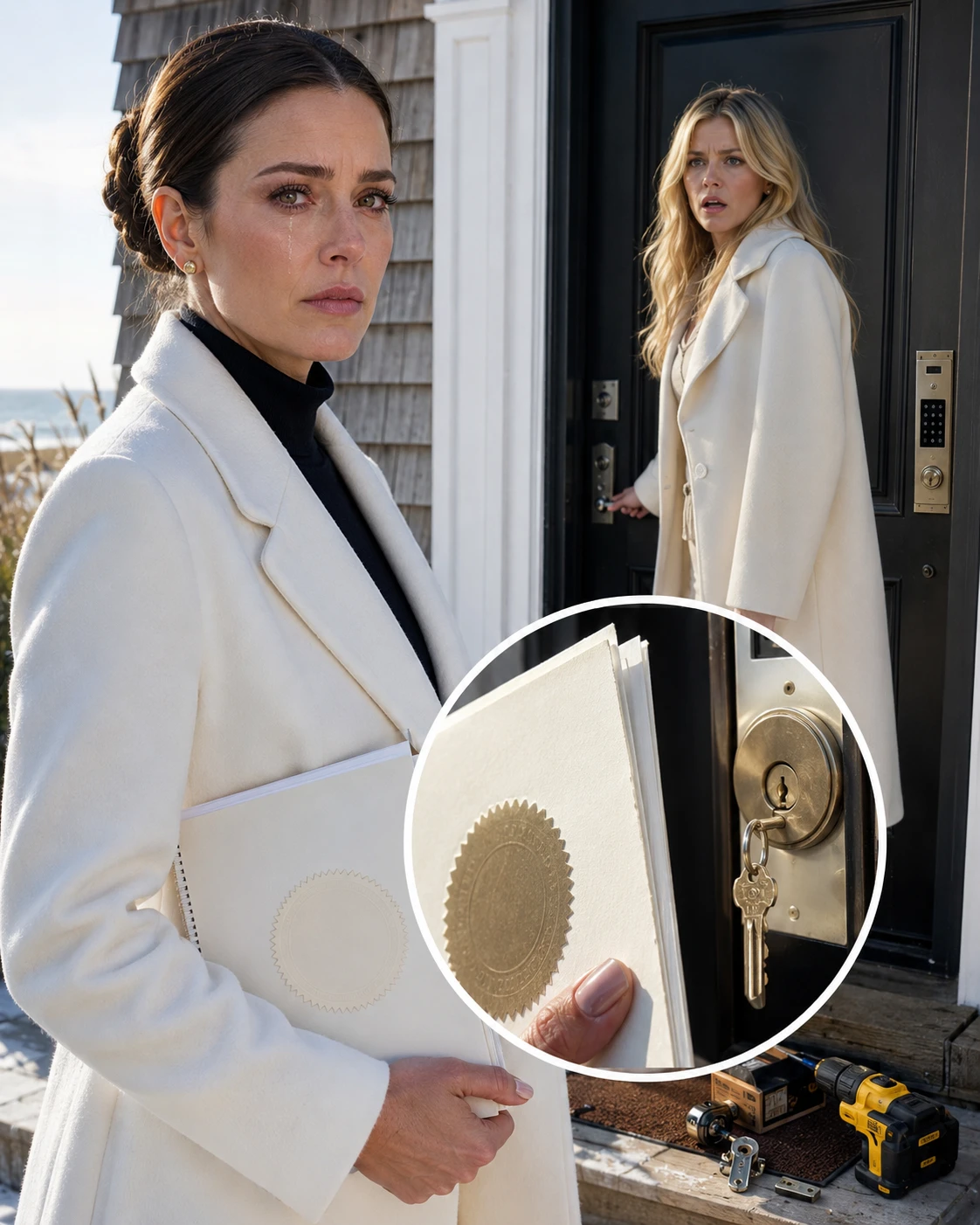
His mistress tried to change the locks on my beach house.
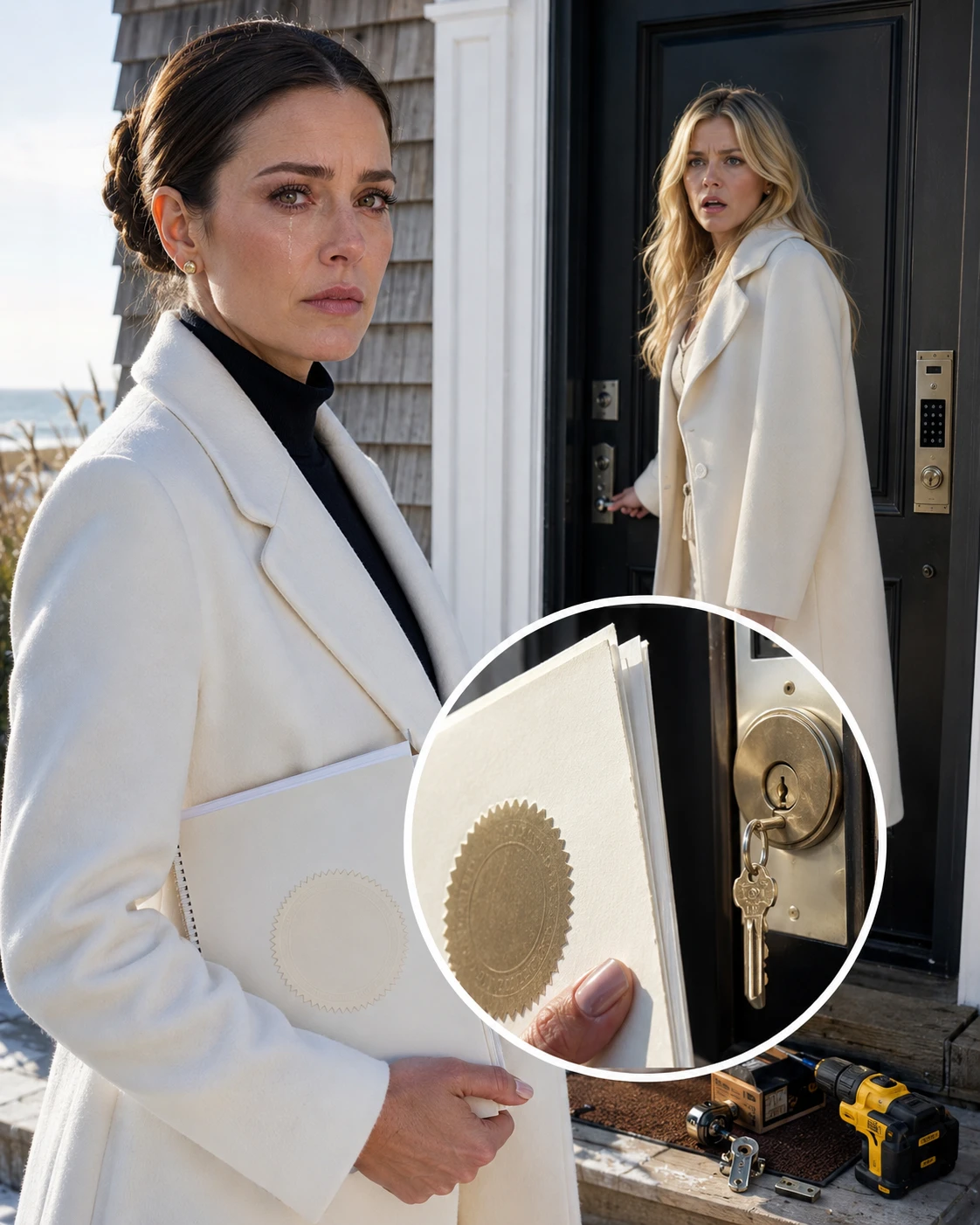
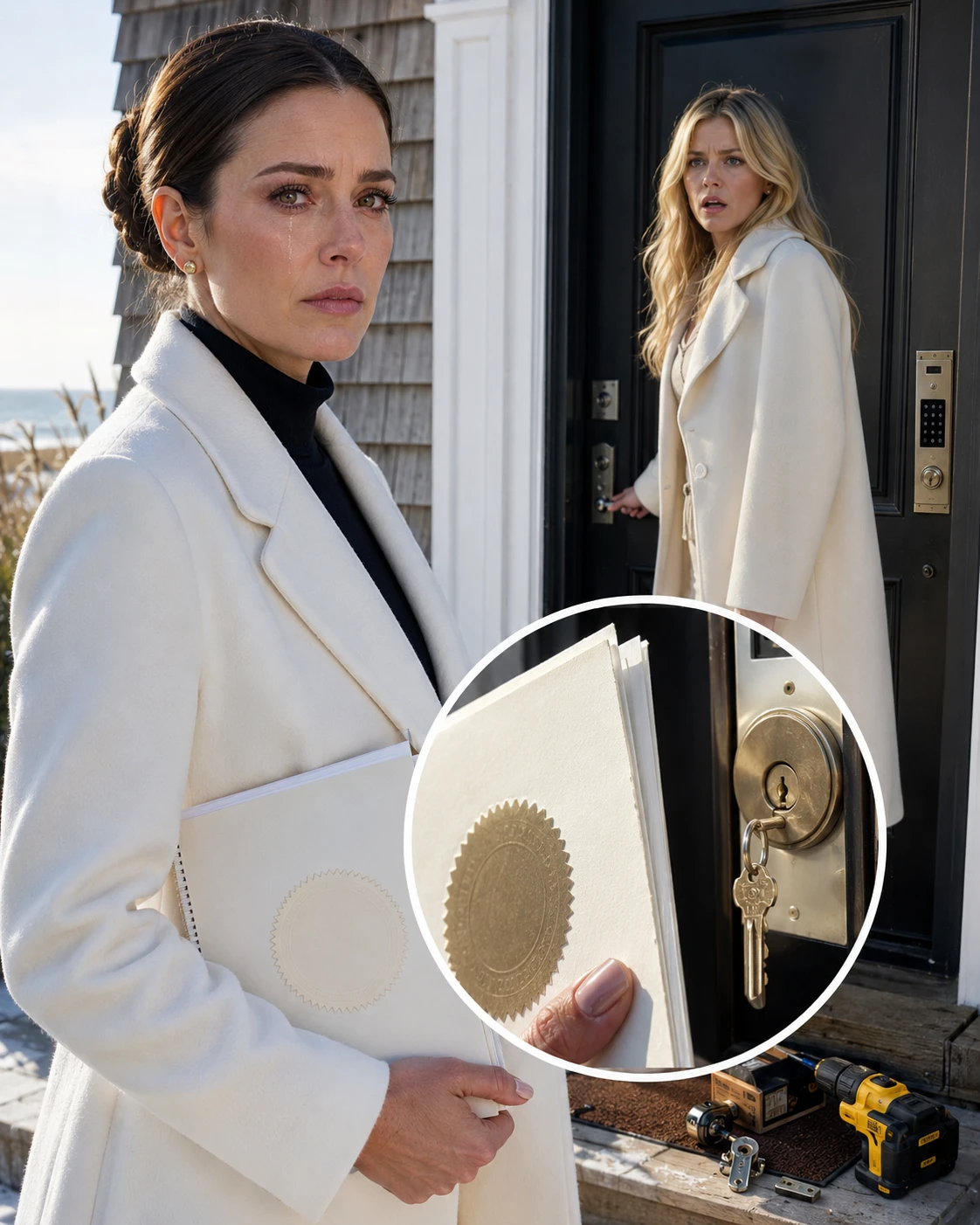
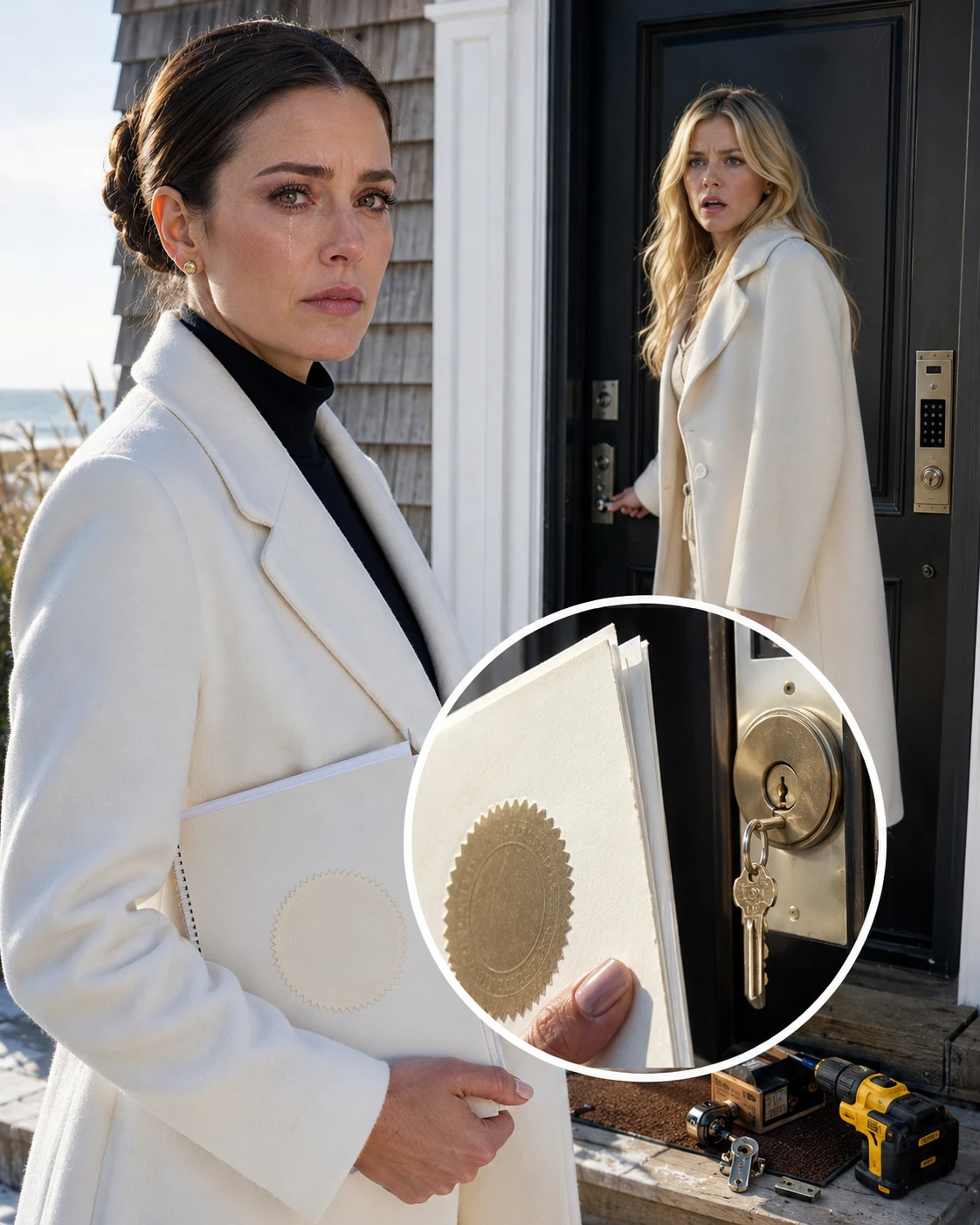
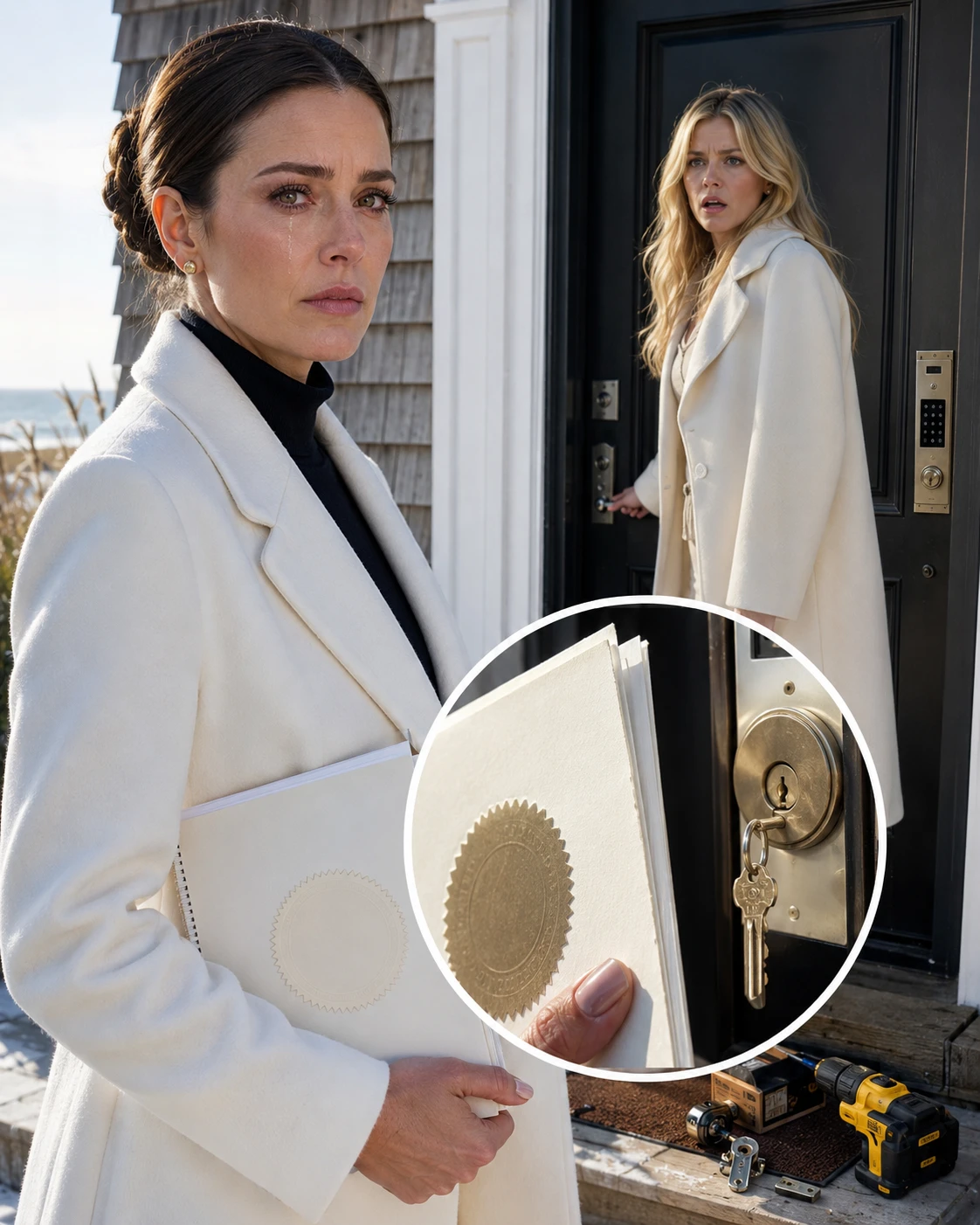
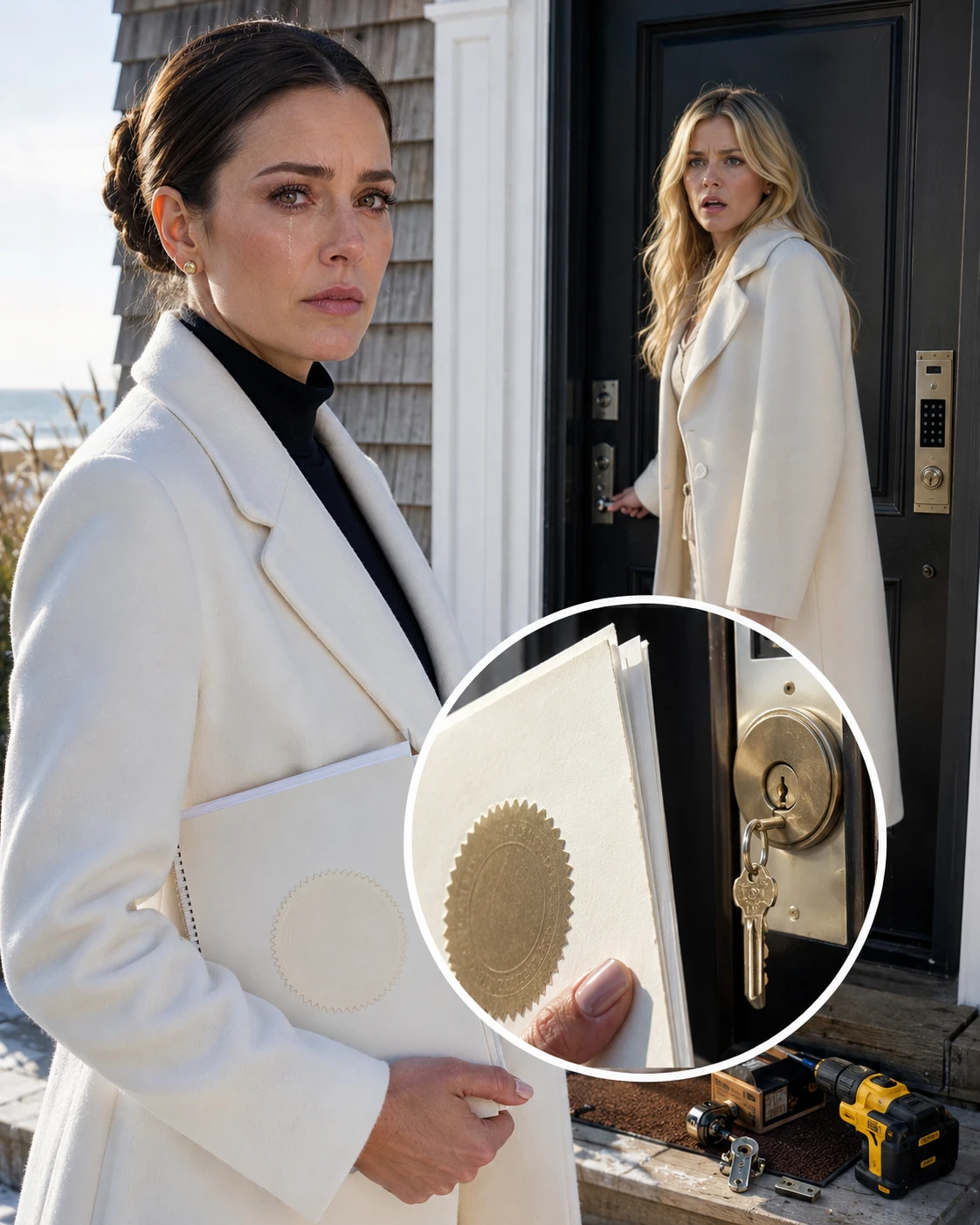
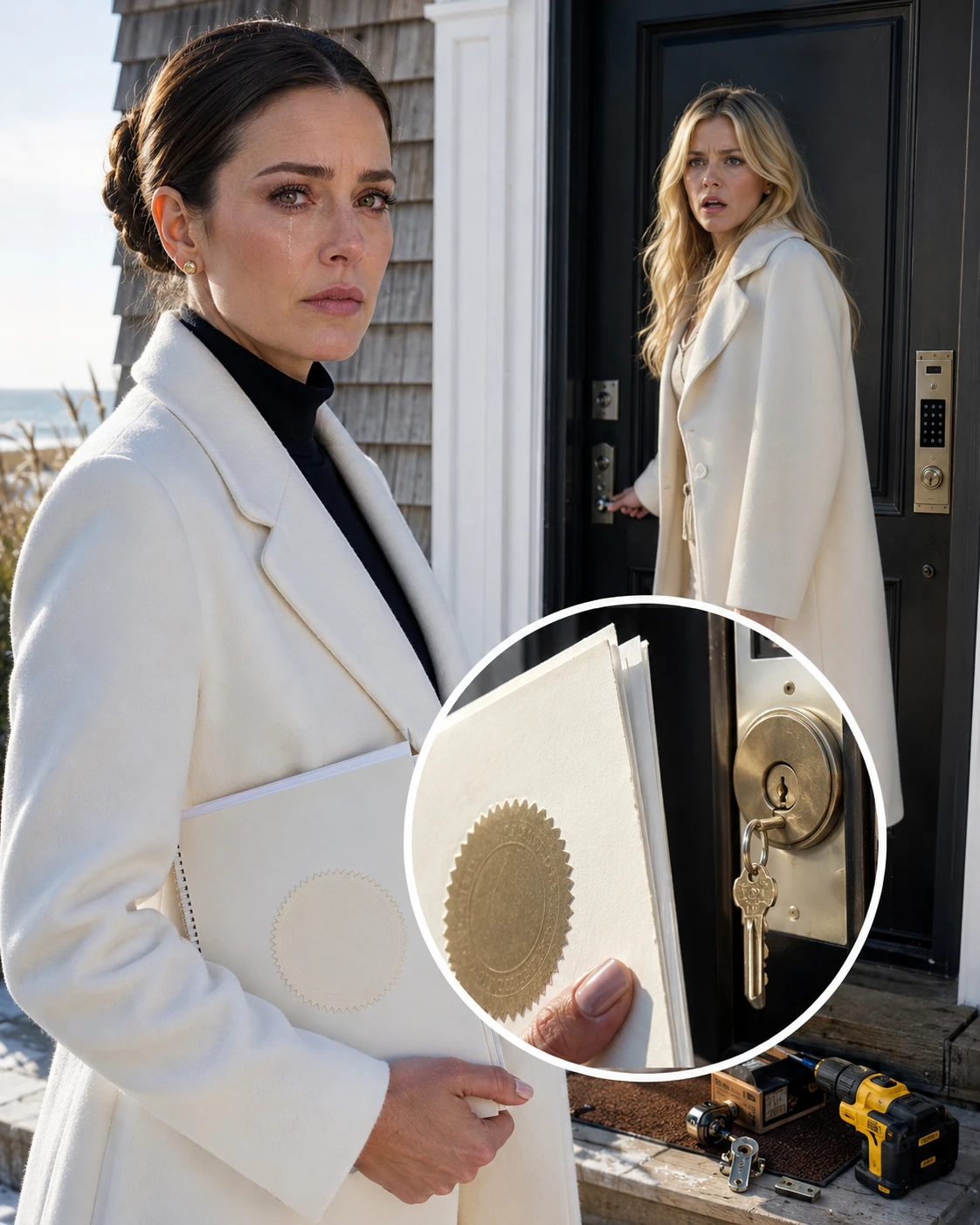
Not metaphorically. Not in the cute, cruel little way women like her rearranged flowers and replaced family photographs with abstract art. I mean she stood on my front porch in a cream cashmere coat, oversized sunglasses, and a diamond tennis bracelet she had no business wearing, and told a locksmith from Montauk that she was the new Mrs. Whitaker.
The locksmith, God bless men who read paperwork, called me because the property records did not match her story.
“Mrs. Whitaker?” he asked, his voice careful. “I’m outside the property on Dune Road. A woman here says she has authorization from your husband to change the locks.”
I was seated in the back of a black town car on Park Avenue, wearing last night’s silk blouse beneath an ivory coat, my hair twisted into the sort of knot women use when they are trying very hard not to fall apart in public.
“My husband?” I said.
“Yes, ma’am. Mr. Julian Whitaker.”
Outside my window, Manhattan gleamed like money after rain.
“And what name did she give you?” I asked.
There was a pause.
“She said she was Mrs. Whitaker.”
I looked down at my left hand. My wedding ring sat there, cold and bright, a perfect circle around a lie.
“Interesting,” I said. “Because I’m Mrs. Whitaker.”
Behind the locksmith, faintly, I heard a woman’s voice sharpen. “Is there a problem?”
There was always a problem with women who believed a man’s promises were stronger than a recorded deed.
I asked the locksmith to email me the appointment confirmation. He did. The request had been placed the night before at 11:42 p.m. using Julian’s assistant’s template, Julian’s personal credit card, and Julian’s private email.
My husband later claimed he knew nothing.
Men always claim amnesia when betrayal leaves a receipt.
I forwarded everything to my trust attorney before the coffee in my cup had cooled. By sunset, both Julian Whitaker and Sloane March were barred from the property by written notice, electronic access revoked, security notified, and a local attorney in Southampton instructed to file for injunctive relief if either of them crossed the threshold.
She ordered new locks.
I ordered legal distance.
CHAPTER 1: THE WOMAN HE HUMILIATED IN CRYSTAL LIGHT
Two nights before the locksmith called, my husband kissed his mistress under seventeen chandeliers.
It happened at the Whitaker Foundation Winter Benefit, inside the Plaza Hotel’s Grand Ballroom, with the kind of vulgar elegance rich people call tradition. There were white orchids tall enough to hide secrets, champagne towers catching the light, and waiters moving through the crowd with silver trays of caviar blini no one actually wanted but everyone took because indulgence looks better in small portions.
I had planned every inch of that room.
The foundation bore Julian’s family name, but for twelve years, I had made it respectable. Before me, the Whitakers were old Boston money with new scandal attached. His father had been charming, fraudulent, and conveniently dead. His mother had mastered the art of looking fragile while sharpening a knife behind her pearls. Julian had inherited the name, the cheekbones, and the astonishing confidence of men who believe women are weather systems they can move through without consequence.
I inherited none of it.
I came from Charleston by way of a scholarship, a mother who hemmed other women’s evening gowns, and a grandmother who taught me that a woman should never marry a man for money unless she understood the documents better than he did.
My grandmother, Lila Beaumont, had not been rich when I was born. She had been observant. She cleaned houses in Palm Beach in the seventies and noticed that the people with the most money rarely owned anything directly. They had trusts, holding companies, partnerships, shell entities, family offices, and lawyers with jawlines like tombstones. She listened. She learned. She invested in land nobody wanted, then land everybody wanted, then land nobody could get anymore.
By the time she died, she left me three things: her emerald ring, her rules, and a beach house on Dune Road held in a trust so carefully structured that even love could not touch it.
Especially love.
“Never put your heart and your deed in the same man’s hands,” she told me the summer I turned twenty-one.
I had laughed then, young and pretty and stupid enough to think education made me safe.
At thirty-nine, standing beneath the chandeliers of the Plaza, I understood she had been giving me a weapon.
Julian stood onstage that night in a midnight-blue tuxedo, thanking donors for funding a new arts education wing in Harlem. He was beautiful when he lied. It was one of the first things I loved about him, before I understood beauty could be a form of camouflage. He had silver threading his dark hair now, just enough to make women lean closer when he spoke. His voice had the warm weight of expensive whiskey.
“My wife, Harper,” he said, raising his glass toward me, “has been the heart behind this foundation.”
The room turned.
I smiled.
I had worn black silk. Not because I was mourning then, but because black made me look like I belonged to no one. My dress was simple, backless, severe. A diamond clasp at my throat had belonged to Julian’s grandmother and was technically on loan from the family vault, which his mother reminded me of whenever she drank too much.
Applause rose around me.
I nodded, gracious and composed, because women like me were trained to bleed internally.
Then Julian looked past me.
Just for a second.
But I had been married to him for twelve years. I knew the exact weight of his attention. I knew when it left me.
Sloane March stood beside the east bar wearing champagne satin and a smile built for damage.
She was twenty-eight, though every article about her called her “ageless” because lifestyle writers had become afraid of numbers. She ran a boutique interior design firm in Tribeca, the kind that placed a single dead branch in a ceramic vase and charged forty thousand dollars for restraint. Her hair was pale blonde, almost silver, cut blunt at her collarbone. Her face had the polished emptiness of someone who had studied rich women the way other people studied languages.
I had met her six months earlier, when Julian suggested we hire her to refresh the foundation’s office.
“She has a good eye,” he said.
She did.
She had seen my husband clearly.
At the gala, I watched her lift her glass toward him. Not toward us. Toward him.
And Julian, standing under the lights while six hundred people applauded his devotion to disadvantaged children, smiled back like a man seeing the life he thought he deserved.
My stomach folded in on itself.
A photographer stepped between us. A donor touched my elbow. Someone asked me about the silent auction. I answered perfectly. I always answered perfectly. Perfect answers were my first language.
The humiliation did not fully reveal itself until dessert.
I was near the balcony doors speaking with Senator James Voss, who had the sincere handshake of a man running for reelection, when the ballroom shifted. You could feel scandal before seeing it. It moved through people like cold air under a door.
A laugh broke too loudly.
A phone rose.
Another.
Then I saw Julian.
He was in the shadowed alcove near the service corridor, one hand at Sloane March’s waist, his mouth on hers.
Not a mistake kiss. Not a drunken brush. Not the kind of ambiguous betrayal a wife could insult herself by explaining away.
It was slow. Familiar. Public enough to wound, private enough to deny.
The senator stopped speaking.
My mother-in-law, Vivian Whitaker, stood fifteen feet away with a champagne flute halfway to her mouth. She did not look shocked. That was my first true injury.
Not his mouth on another woman.
His mother’s lack of surprise.
The second injury came when Sloane opened her eyes during the kiss and looked directly at me.
She wanted me to see it.
There are moments when every version of yourself arrives at once. The girl in Charleston who ironed her school uniform beneath a leaking ceiling. The bride in Newport who believed vows could make a family out of strangers. The woman who signed tax documents, sat through fertility consultations, hosted Christmas dinners, buried her father-in-law’s crimes beneath charitable donations, and turned a declining name into an institution people trusted again.
All of them stood inside me, waiting to see what I would do.
I did nothing.
That was what no one understood later.
They expected screaming. Wine thrown. A slap. Something shareable.
Instead, I set my untouched champagne on a passing tray and smiled at Senator Voss.
“Forgive me,” I said. “I need to handle something.”
I crossed the ballroom without hurrying.
People parted. Of course they did. Rich people adore violence as long as it is wrapped in manners.
Julian saw me when I was ten feet away. His hand left Sloane’s waist.
“Harper,” he said, and my name sounded like something he had dropped.
Sloane touched her lower lip with one finger. She looked almost pleased.
“Julian,” I said.
No one breathed.
I could have asked why. But why is the question women ask when they still believe answers matter.
So I looked at Sloane.
“You have lipstick on your teeth,” I said.
Her smile collapsed just slightly.
Then I turned and walked away.
By morning, the video had seventeen thousand views on a private Facebook group called East Coast Society Watch. By noon, someone had posted it to Reels with the caption: When the wife has more class than the husband has shame. By sunset, it had traveled everywhere women go when they are angry and pretending not to be: group chats, Pilates studios, comment sections, school pickup lines in Westchester, the back booths of restaurants where wives keep score.
Julian did not come home that night.
I did not call him.
At 2:13 a.m., he texted: We need to talk.
At 2:14 a.m., I replied: Through counsel.
I did not have counsel yet, not officially.
But I had Eleanor Vance.
Every wealthy woman has one friend who is not a friend so much as an emergency exit. Eleanor was mine. She was seventy-one, wore gray cashmere year-round, and had been my grandmother’s attorney before she became mine. Her office overlooked Bryant Park, and her voice could make bankers sweat.
I called her at 7:00 a.m.
She answered on the second ring.
“I saw the video,” she said.
“Of course you did.”
“Are you crying?”
“No.”
“Good. Cry after the asset review.”
I closed my eyes.
“Eleanor.”
“Harper, listen carefully. He embarrassed you publicly. That means he either believes you are powerless or he is desperate enough to stop caring. Both possibilities require documentation.”
Outside my bedroom window, Fifth Avenue shone with February frost. My apartment was silent, museum-perfect, decorated in shades of bone and smoke because Julian said color made him anxious. Our wedding portrait sat on the mantel. In it, he looked at me like a promise. I wondered whether promises always looked so clean before they rotted.
“I need to know everything,” I said.
“You already know the important thing,” Eleanor replied. “He showed you who he is in public. Now we find out what he has done in private.”
That was when the revenge began.
Not with rage.
With a spreadsheet.
CHAPTER 2: THE HOUSE ON DUNE ROAD REMEMBERS EVERYTHING
The beach house was not the largest property on Dune Road, but it was the one people noticed.
It sat behind a low dune of silver grass, cedar-shingled and quiet, with black-trimmed windows that reflected the Atlantic like a secret. In summer, the hydrangeas turned blue as old bruises. In winter, the house looked almost severe, softened only by the salt air and the long wooden path leading down to the water.
My grandmother bought it in 1986 from a retired judge who needed cash and hated real estate agents. Back then, people called that stretch “too exposed.” Lila called it “honest.”
“Water takes what is weak,” she told me. “Build accordingly.”
She reinforced the foundation, raised the structure, installed hurricane glass before hurricane glass became fashionable, and put the property into the Beaumont Coastal Trust with me as the primary beneficiary. The trust document was eighty-three pages long and written with the romantic warmth of a loaded gun.
Julian hated that house.
Not at first. At first, he adored it because men adore beautiful things until they discover they cannot own them. We spent our early summers there barefoot and sunburned, drinking Sancerre on the deck, pretending marriage was a place we had reached rather than a storm we had entered.
He proposed we renovate in our third year.
“Open up the kitchen,” he said. “Add a pool. Maybe a guest cottage.”
“We can discuss it,” I said.
“With your trustee?” he asked, smiling.
“With my trustee.”
His smile thinned.
The house became the one part of our marriage where Julian could not perform authority. He could charm contractors, bully concierges, seduce donors, and make journalists forget questions mid-sentence. But he could not sign for a hinge on Dune Road without my approval.
That bothered him more than his affair ever would.
The morning after the gala, I drove there alone.
Not because I was fleeing. Because I needed to stand inside something that was mine.
The highway unspooled beneath a pewter sky. Hampton Bays blurred past, then Southampton, then the quiet, expensive loneliness of winter on the East End. Summer people think the Hamptons belong to them because they arrive with linen and money. They do not know the truest version comes in February, when the ocean turns iron-colored and the restaurants close early and every house looks like it is keeping its own counsel.
I parked behind the dune and sat for a moment, hands on the wheel.
Inside my bag were two phones, three file folders, a list Eleanor had sent titled Preliminary Separation Priorities, and a printout of the gala video I had not watched but wanted preserved.
Women are told not to be cold.
Cold saves lives.
I stepped out. The wind cut clean through my coat.
The house smelled faintly of cedar, lemon oil, and the sea. My grandmother’s portrait hung in the entry, a black-and-white photograph taken when she was sixty, standing on the beach in trousers and a white shirt, hair pulled back, eyes narrowed against the sun. She looked like a woman who had already survived everyone’s opinion.
“Hello, Lila,” I whispered.
My phone rang.
Julian.
I watched his name glow on the screen until it stopped.
Then another call.
Vivian.
Then Julian again.
Then a text.
Don’t make this uglier than it has to be.
I laughed once, without humor.
Men create a fire and then blame the smoke for ruining the furniture.
I placed my phone on the kitchen island and opened my laptop. Eleanor had granted me access to a secure folder. Inside were the first pieces of our excavation: account statements, foundation expense reports, credit card summaries, wire transfers from Julian’s consulting LLC, and a list of entities tied to Whitaker Holdings.
At first glance, everything looked expensive but ordinary.
At second glance, it looked like rot under marble.
There were hotel charges in Miami during weekends Julian claimed to be in Boston. Jewelry purchases categorized as donor gifts. Payments to Sloane March Interiors routed through the foundation’s administrative budget. A wire to a Delaware LLC named Aster House Strategy. Consulting fees paid to Julian from organizations that had received foundation grants.
I called Eleanor.
“He is stealing from the foundation,” I said.
“Allegedly,” she replied. “Use that word until we have admissible proof.”
“He used charity funds to pay his mistress.”
“Allegedly.”
“I hate lawyers.”
“That is why you pay us.”
A gust of wind struck the windows. The ocean answered.
“What do we do?” I asked.
“We preserve records before he realizes you are looking. Do not confront him. Do not warn him. Do not negotiate emotionally. Assume every message you send will be read by a judge and every silence will be misinterpreted by a fool.”
“What about the board?”
“Not yet. If he has allies, they will protect the institution before they protect the truth.”
I looked at my grandmother’s portrait.
“And Sloane?”
“Women like that usually leave fingerprints because they think being chosen makes them safe.”
By afternoon, Eleanor had connected me with a forensic accountant named Maya Reyes, whose office in Midtown looked like it had been designed by someone allergic to softness. Maya was forty-five, blunt, and wore navy suits with no jewelry except a wedding band and a watch.
She joined a video call at 3:00 p.m. and said, “I reviewed the preliminary files. Your husband is either careless, arrogant, or both.”
“Both,” I said.
“That helps.”
She shared her screen.
Transactions bloomed in columns. Dates. Amounts. Vendors. Notes.
“Here,” Maya said, highlighting a series of payments. “Sloane March Interiors billed the foundation for design consulting on the Harlem arts wing. But the invoices list items delivered to a private residential address in Tribeca.”
“Sloane’s apartment,” I said.
“Likely. We will confirm. Also, Aster House Strategy received two hundred seventy-five thousand dollars in consulting fees over eight months. The registered agent traces back to a service company in Wilmington. I’ll need subpoenas eventually, but I can already tell you the timing aligns with transfers from Whitaker Holdings.”
“Why create a Delaware LLC?”
Maya looked at me as if testing whether I wanted comfort.
“To hide beneficial ownership.”
“Whose?”
“That is the question.”
After the call, I walked through the beach house room by room.
The living room still held the linen sofa Julian said was too plain. The shelves still carried novels my grandmother annotated in pencil. Upstairs, the primary bedroom faced the water. We had slept there for years, the Atlantic breathing against the glass. I opened the closet and found one of Julian’s sweaters folded on the top shelf, navy cashmere, smelling faintly of him and smoke.
I held it for exactly one breath.
Then I placed it in a box labeled RETURN THROUGH COUNSEL.
At dusk, headlights swept across the driveway.
For one wild second, I thought Julian had come.
Instead, a black Range Rover stopped near the garage and my younger sister, Tess Beaumont, climbed out wearing an oversized coat, leather gloves, and the expression of someone prepared to commit a felony for family.
She stormed in without knocking.
“I brought soup,” she said, holding up a paper bag. “And bourbon. And before you say you’re not hungry, I don’t care.”
Tess was thirty-four, a documentary producer in Brooklyn, and allergic to anyone with a trust fund unless that person was me. She had my mother’s warmth and my grandmother’s temper, which made her both comforting and dangerous.
She set containers on the counter and looked around.
“Good. You came here.”
“I needed air.”
“You needed walls with your name on them.”
I smiled despite myself.
She came closer, softer now.
“I saw the video.”
“Everyone saw the video.”
“Harper.”
I looked away.
There is a difference between humiliation and grief. Humiliation burns outward. Grief hollows. I could manage the burning. The hollow frightened me.
“I don’t want pity,” I said.
“Good. I’m terrible at it.”
She opened the bourbon.
We ate soup at the kitchen island while the sky went dark beyond the windows. Tess told me who had texted her, who had pretended concern, who had clearly always disliked Julian, and which society wife had posted an Instagram story about karma using a photo of a burning candle.
Then she said, “What do you need?”
I looked down at my bowl.
“The truth.”
Tess nodded.
“And maybe for him to suffer in a way that is legally elegant.”
“That’s our family specialty.”
At 11:42 that night, while Tess slept in the guest room and I sat awake reviewing foundation bylaws, Julian’s email was used to schedule the locksmith.
I did not know it then.
At 8:16 the next morning, the locksmith called me.
By noon, Eleanor had issued notices to Julian and Sloane. By 2:00 p.m., the security company had removed Julian’s access code. By 4:30 p.m., the local police precinct had been informed that any attempt by Sloane March to enter the property would constitute trespass. By sunset, two discreet cameras were installed at the front and rear entrances, and I had a scanned copy of the locksmith’s statement saved in three different places.
At 6:03 p.m., Julian finally arrived.
He did not come alone.
Sloane sat beside him in the passenger seat of his Aston Martin, wearing the same cream coat from the locksmith’s call, her hair shining like a threat.
I watched them from the upstairs window.
Tess stood beside me.
“Oh,” she said. “She’s bold.”
“No,” I replied. “She’s uninformed.”
Julian stepped out first. He looked tired, which offended me. He had no right to look wounded by the consequences of his own choices. Sloane followed, glancing at the cameras, then at the house.
He tried his old code at the side door.
The keypad flashed red.
He tried again.
Red.
Sloane crossed her arms.
I opened the window.
The ocean wind rushed in.
“Julian,” I called.
He looked up. Relief crossed his face, quickly rearranged into irritation.
“Harper. Open the door.”
“No.”
“This is ridiculous.”
“Most crimes are.”
His jaw tightened.
“I don’t know what that locksmith told you, but I had nothing to do with it.”
“The appointment confirmation went to your email.”
“Sloane misunderstood.”
Sloane’s face changed.
There it was. The first crack. Not because he lied to me. Because he used her as the container for his lie.
I leaned my hand on the window frame.
“Mr. Whitaker,” I said, because distance is a blade, “you have received written notice that you are not authorized to enter this property.”
His mouth opened slightly.
I had never called him that.
“Harper, don’t perform for her.”
“I am not performing,” I said. “I am documenting.”
Tess lifted her phone and waved.
Julian looked at Sloane, then back at me.
“You can’t bar me from our home.”
“This is not our home. This is my trust property.”
His face hardened into something old and ugly.
“That house only matters because my name made you matter.”
Sloane looked up at me with a tiny victorious smile, as if he had said something devastating.
But men like Julian always misunderstand what cuts.
He had not wounded me.
He had confirmed the diagnosis.
I closed the window.
Five minutes later, he was still standing in the drive, calling my phone. I let every call go unanswered. Then a police cruiser rolled slowly up the road, not dramatic, not loud, just present.
Julian saw it.
He left.
Sloane stared at the house until the Aston Martin door closed.
That night, the video from the security camera captured her looking back as they drove away.
She did not look heartbroken.
She looked hungry.
CHAPTER 3: SILK, SIGNATURES, AND THE PRICE OF A LIE
The thing about revenge is that people imagine it as heat.
A slap. A scream. A broken windshield. Red wine down the front of a white dress.
But real revenge, the kind that survives courtrooms and gossip cycles, is architectural. You build it quietly. You pour concrete where no one is looking. You measure twice. You wait until the structure can hold the weight of a collapse.
For the next six weeks, I became very still.
Publicly, I vanished.
No statements. No emotional posts. No tearful interviews with the one journalist who had been circling the story like a gull over trash. I attended one board meeting by video, wearing pearls and a black turtleneck, and said only that Julian and I were addressing private matters privately. Vivian Whitaker watched me from her little square on the screen, her face pale and powdered, her eyes calculating.
Privately, I moved like winter water.
Eleanor filed for legal separation in New York County. Maya expanded the forensic review. Tess tracked Sloane’s social media through screenshots sent by friends of friends. My personal assistant, Nora, separated household staff loyalties with the precision of a battlefield nurse. Anyone paid from my accounts stayed. Anyone loyal to Julian received a generous final check and a nondisclosure reminder.
Julian made noise.
He sent flowers. Then threats. Then apologies. Then a voice memo at 1:00 a.m. in which he said he missed “the way we were before money became so important to you,” which was fascinating from a man who had once refused to attend a charity luncheon because the sponsor seated him next to “new money from Dallas.”
I saved everything.
Sloane made content.
That was her mistake.
Her Instagram became a soft-focus campaign for victimhood. She posted coffee in bed, rain on windows, a book of Mary Oliver poems she had clearly never opened before, and captions about choosing love even when the world judges what it does not understand.
The comments were divided. Some women called her brave, because there is no shortage of fools willing to confuse selfishness with courage if the lighting is good. Others asked whether “love” included impersonating someone’s wife to gain access to a beach house. Those comments disappeared quickly.
Then came the first article.
Page Six ran a piece titled: Whitaker War Turns Frosty as Foundation Queen Freezes Out Younger Rival.
I read it in Eleanor’s office.
“Foundation Queen?” Tess said over my shoulder. “Honestly, that’s not bad.”
Eleanor did not smile.
The article cited “sources close to Julian” who claimed our marriage had been over for years, that I was controlling, icy, impossible to please. It said Sloane was “a breath of fresh air” and that Julian had “found happiness after a long private struggle.”
There it was.
The oldest story.
A man cheats, and suddenly the wife becomes weather. Cold. Difficult. A storm he survived.
I set the phone down.
“Can we respond?” Tess asked.
“No,” Eleanor said.
Tess groaned. “I hate discipline.”
“Discipline is why rich men fear discovery more than anger.”
I looked at Eleanor. “What do we have?”
Maya entered carrying a gray folder.
“Enough to make his attorney nervous,” she said. “Not enough to bury him.”
She opened the folder.
“We confirmed payments from the foundation to Sloane March Interiors for design work never delivered. We found multiple personal expenses categorized as donor cultivation. We found a pattern suggesting Julian used foundation relationships to funnel consulting fees through Aster House Strategy.”
“Who owns Aster?”
Maya’s expression sharpened.
“Not Julian directly.”
She slid a document across the table.
I read the name twice.
SLOANE MARCH.
For a moment, even Eleanor went quiet.
“She owns the LLC?” Tess asked.
“Through a holding structure,” Maya said. “But yes. She appears to be the beneficial owner.”
My body went cold in a clean, total way.
Julian had not simply given his mistress gifts.
He had built her a pipeline.
“How much?” I asked.
“Known transfers total four hundred eighty-two thousand dollars. There may be more.”
Tess swore.
I looked at the document again. Sloane’s signature sat at the bottom, all loops and vanity.
“Can we prove Julian knew?”
Maya smiled without warmth.
“We have emails.”
She produced printed messages. Julian asking Sloane if “Aster can invoice before quarter-end.” Sloane replying with a kiss emoji and “I love when you make things easy.” Julian forwarding internal grant timelines. Sloane sending bank details.
The room seemed to narrow.
“Why would he be this careless?” I asked.
“Because no one had ever made him afraid,” Eleanor said.
That afternoon, Julian requested an in-person meeting.
His attorney, Martin Kell, sent the email. Martin was a polished divorce lawyer with the moral texture of wet marble. He proposed a “private resolution preserving dignity for all parties.”
Eleanor read the message aloud and snorted.
“Translation: he wants you quiet.”
“What does he think I want?” I asked.
“Money, probably. Men like Julian always assume women want what they themselves worship.”
I stared out at Bryant Park, where people crossed the winter paths hunched against the cold.
“What do I want?” I asked quietly.
Neither woman answered.
Because the truth was still forming.
I did not just want Julian punished. Punishment was temporary. A headline. A settlement. A public apology drafted by crisis counsel.
I wanted separation from the life that had trained me to confuse composure with survival.
I wanted my name back from the mouth of every person who had said poor Harper while secretly enjoying the spectacle.
I wanted Sloane to learn that stepping into another woman’s house did not make you the owner.
And beneath all of that, in a place I did not yet know how to touch, I wanted to stop loving the man I was destroying.
We met Julian at the Carlyle because he insisted on neutral ground, and because men like him believe dark wood and lobby flowers make them look more innocent.
He arrived first.
Of course he did. It let him stand when I entered.
He wore charcoal cashmere and no tie, an attempt at humility that probably cost more than a month of my mother’s mortgage when I was a child. For a second, my body remembered him before my mind could stop it. The curve of his mouth. The scar at his thumb from a sailing accident in Maine. The way he used to touch the small of my back in crowded rooms, guiding me as though we belonged to each other.
Memory is cruel because it has no legal relevance.
“Harper,” he said.
“Julian.”
Eleanor sat beside me. Martin sat beside him.
We ordered coffee no one drank.
Julian leaned forward.
“I want to start by saying I’m sorry.”
I folded my hands.
“For what?”
He blinked.
“For hurting you.”
“How specifically?”
Martin shifted.
Julian’s jaw tightened.
“For the public nature of what happened.”
Not for the affair. Not for the theft. Not for bringing that woman to my house.
For the optics.
I smiled.
It was not a kind smile.
“There it is.”
His eyes darkened. “You’ve become very hard.”
“No. I’ve become very informed.”
Martin cleared his throat. “Our hope is that we can reach a settlement beneficial to both parties without unnecessary reputational harm.”
Eleanor opened her folder.
“Then your client should stop causing reputational harm.”
Julian ignored her. “Harper, I know you’re angry. You have every right to be. But you and I built a life together.”
“Yes.”
“And I don’t want this to become some ugly war.”
“Then surrender.”
Martin’s pen stopped.
Julian looked at me as if I had slapped him.
“What?”
“Surrender the foundation position. Agree to a full independent audit. Return any funds improperly routed. Stay away from Dune Road. Communicate only through counsel. We can discuss the rest after.”
He laughed once.
“Absolutely not.”
“Then it becomes ugly.”
His face lowered into that intimate expression he used when correcting me in private.
“Be careful, Harper. You are emotional right now.”
I saw Eleanor’s hand still.
The room went very quiet.
I leaned forward.
“Julian, I watched you kiss your mistress in a ballroom I paid to decorate with money I raised for children whose names you never bothered to learn. The next morning, she tried to change the locks on a house my grandmother protected from men exactly like you. Since then, I have found invoices, emails, and transfers that suggest you used a charitable foundation as your personal romance fund.”
His color changed.
Martin turned slightly toward him.
I continued.
“So when you call me emotional, understand that my feelings are the least dangerous thing in this room.”
Julian stared at me.
For one second, something like fear crossed his face.
Then he smiled.
It was small and ugly.
“You think you’re the only one with documents?”
Eleanor’s expression did not change, but I felt the air shift.
Julian reached into his coat and removed a thin envelope.
He placed it on the table.
Inside were photographs.
Me, leaving the Whitaker Foundation office late at night with Gabriel Stone.
Gabriel was the foundation’s former general counsel, a widower, a friend, and one of the few men in our circle who had never looked at me like an acquisition. He had resigned three months earlier after clashing with Julian over grant approvals. I had met him twice afterward, both times to discuss concerns about financial irregularities. In the photographs, angles did what lies do best. A hand at my elbow became intimacy. A private conversation became conspiracy. One image showed us outside the Lowell Hotel, where we had met in the lobby, though the framing made it seem we had come from upstairs.
Tess had once told me rich men did not need truth when they had photography.
Julian tapped the photos.
“I wonder how donors will interpret these.”
My heart beat once, hard.
Eleanor looked at the images, then at him.
“Is that your strategy?”
“It’s reality,” Julian said. “Harper has cultivated an image. Devoted wife. Perfect philanthropist. But images are fragile.”
I looked at him then, really looked.
And something inside me ended.
Not the marriage. That had ended under the chandeliers.
This was the end of nostalgia.
“You had me followed,” I said.
He shrugged.
“I was concerned.”
“No,” I said softly. “You were afraid.”
He smiled again.
“Maybe I know you better than you think.”
I gathered the photographs neatly and placed them back into the envelope.
“Thank you,” I said.
“For what?”
“For reminding me not to be merciful.”
We left him sitting there.
Outside, snow began falling over Madison Avenue in delicate, useless pieces.
In the car, Eleanor said, “We need Gabriel.”
“I know.”
“Will he help?”
I looked out the window.
Gabriel Stone had gray eyes, careful hands, and the sort of grief that made him gentle without making him weak. He had once found me crying in the foundation archive after my third failed IVF transfer and had said nothing, only placed a glass of water beside me and sat at a respectful distance until I could breathe again.
Julian had suspected intimacy because Julian did not understand tenderness without ownership.
“He will help,” I said.
And for the first time in weeks, I wondered whether being destroyed by one man might teach me how to recognize another who would never ask me to make myself smaller.
CHAPTER 4: THE EVIDENCE ROOM IN A HOUSE OF GLASS
Gabriel Stone lived in Brooklyn Heights in a brownstone filled with books, plants, and the kind of quiet that comes from surviving something you cannot replace.
His wife, Anna, had died four years earlier from an aneurysm at forty-one. He raised their daughter, Lily, alone with an elegance that never asked to be admired. At foundation events, he always left early for school plays, parent conferences, or bedtime. Julian mocked him for it once.
“Stone has no ambition,” he said.
I remember thinking: maybe he has priorities.
When I arrived at Gabriel’s house, he opened the door before I knocked.
“You’re being followed,” he said.
“Good evening to you too.”
His mouth almost smiled.
A black SUV idled half a block down beneath a bare sycamore tree. I had noticed it on Henry Street. Gabriel had noticed it from his window.
“Julian’s?” he asked.
“Almost certainly.”
He stepped aside. “Then let’s give them nothing useful.”
Inside, the house smelled like wood smoke and paper. A half-finished puzzle sat on the dining table. A child’s backpack leaned against a chair. For reasons I did not want to examine, the ordinary warmth of it nearly broke me.
Gabriel took my coat.
His fingers brushed my wrist, brief as a question.
“Are you all right?” he asked.
“No.”
He nodded, accepting the truth without trying to decorate it.
“Tea?”
“Bourbon.”
“Better.”
We sat in his study while he reviewed the photographs Julian had presented.
His expression did not change until he reached the Lowell Hotel image. Then he exhaled through his nose.
“He cropped out the lobby.”
“Yes.”
“And the paralegal who was sitting beside us.”
“Yes.”
He set the photos down.
“What do you need?”
“Everything you know.”
He leaned back.
For a long moment, he looked tired.
“I resigned because Julian was pushing grants to organizations connected to Whitaker Holdings. I told the board chair I had concerns.”
“Vivian?”
“No. Charles Renner.”
Charles Renner was a retired investment banker, longtime Whitaker family friend, and professional seat-warmer on boards from Manhattan to Palm Beach.
“What did Charles do?”
“He advised me not to confuse administrative messiness with misconduct.”
“Of course he did.”
“I began documenting anyway.”
My pulse changed.
Gabriel stood and went to a locked file cabinet. He removed a black binder and placed it on the desk between us.
“This is why Julian had you followed,” he said.
Inside were emails, memos, draft reports, meeting notes, and copies of internal documents I had never seen. Gabriel had traced conflicts of interest for months before resigning. Grants directed toward nonprofits that hired Julian as a consultant. Vendor contracts inflated to cover personal expenses. Payments to Sloane’s design firm approved outside normal procedure. Board minutes altered after the fact.
And one memo marked PRIVILEGED AND CONFIDENTIAL.
I read it once.
Then again.
Julian had attempted to pledge future foundation fundraising commitments as informal collateral for a private real estate acquisition in Miami.
A luxury condominium tower.
Through Aster House Strategy.
Sloane’s company.
My hands went still.
“He wasn’t just stealing,” I said. “He was building her a life.”
Gabriel’s voice was quiet.
“He was building himself an exit.”
The words moved through me slowly.
An exit.
Not an affair. Not a midlife collapse. Not a reckless romance with a younger woman who smelled like gardenias and ambition.
A plan.
Julian had been preparing to leave me publicly ruined, financially cornered, and socially discredited while he moved into a new life funded by the institution I had spent years protecting.
My humiliation at the gala had not been an accident.
It had been a rehearsal.
I looked at Gabriel.
“Did he plan for Sloane to change the locks?”
“I don’t know. But if he believed he could establish access to Dune Road before separation proceedings stabilized, he may have been trying to create leverage.”
“My trust owns it.”
“Yes. Which means he needed confusion, not ownership. Sometimes possession becomes its own argument.”
I thought of Sloane on my porch calling herself Mrs. Whitaker.
Not delusion.
Strategy.
The room seemed colder.
Gabriel watched me carefully.
“Harper.”
“I’m fine.”
“You’re not.”
“I don’t have time not to be.”
His face softened in a way that made me angry because I wanted to lean toward it.
“You do,” he said. “You’re allowed to be devastated.”
The word landed where all my discipline could not reach.
Devastated.
Not embarrassed. Not furious. Not strategic.
Devastated.
I stood too quickly and walked to the window. Outside, the SUV remained beneath the tree, patient and stupid.
“I gave him everything useful in me,” I said.
Gabriel did not answer.
“I made his family look clean. I made his foundation matter. I sat beside his mother through dinners where she treated me like an accessory with a scholarship. I smiled while people called me lucky. I lost three pregnancies and still hosted Christmas because Vivian said grief made guests uncomfortable.”
My voice broke on the last word.
I hated that.
Gabriel came to stand beside me, not touching.
“My wife died in our kitchen,” he said.
I turned.
He looked at the street, not at me.
“Lily was five. I was at work. Anna called me that morning to remind me to buy paper towels. That was our last conversation. For months after, people told me I was strong because I kept functioning. I wasn’t strong. I was just performing the tasks that kept my daughter alive.”
His eyes met mine.
“Functioning is not healing.”
I wanted to say something clever. Something composed.
Instead, I cried.
Not beautifully. Not cinematically. I cried like a woman whose body had finally overruled her reputation.
Gabriel did not touch me until I reached for him.
Then he held me.
There was nothing sexual in it. That made it more intimate. His arms were steady, his hand warm between my shoulder blades, his cheek against my hair. For the first time since the gala, I did not feel watched, measured, or translated into gossip.
When I pulled away, he handed me a handkerchief.
A real one.
I laughed through tears.
“Are you eighty?”
“My daughter says emotionally, yes.”
We sat back down.
The world had not changed. Julian was still dangerous. Sloane was still hungry. Vivian was still silent. But something in me had shifted half an inch toward life.
Gabriel slid the binder toward me.
“Use it.”
“Are you sure?”
“Yes.”
“He will come after you.”
“He already tried.”
There was more.
Of course there was.
Gabriel had kept copies of correspondence with Charles Renner. In one exchange, Charles wrote: We cannot invite scrutiny. The Whitaker name has endured worse. Let Julian correct course privately.
“Worse?” I asked.
Gabriel’s expression darkened.
“I wondered about that too.”
So did Eleanor.
When I brought her the binder, she read the Charles Renner email three times.
“The Whitaker name has endured worse,” she repeated.
“What does that mean?”
“It means old men are terrible at not confessing.”
Maya began digging into older records. Not current foundation accounts, but Whitaker family history. Real estate transfers. Settlement agreements. Probate filings. Shell companies. Archived litigation. Newspaper mentions from before search engines made shame convenient.
For days, nothing surfaced except the usual sins of old money: zoning disputes, unpaid contractors, a sealed discrimination complaint from the nineties, Julian’s father photographed with politicians who later became indictments.
Then Maya found the trust ledgers.
Not mine.
The Whitaker Family Preservation Trust.
It turned out Julian was not nearly as rich as everyone thought.
The family fortune had been shrinking for years, eaten by lawsuits, bad investments, and the spectacular incompetence that often hides beneath inherited confidence. The foundation had become his stage because the actual family money had become a myth wrapped in a tax strategy.
Whitaker Holdings was leveraged.
The Newport house was mortgaged.
The Palm Beach property belonged mostly to a bank.
Vivian’s jewelry was half loaned, half pledged.
And Julian’s personal liquidity was almost nonexistent.
“He needed your assets,” Eleanor said.
We were in her office at midnight, the city glowing beyond the glass.
“My assets are separate.”
“Yes. But your social capital, your donor network, your credibility, the beach house, your grandmother’s trust structure—those had value he could not access directly. So he appears to have tried indirectly.”
“Through Sloane?”
“Through Sloane, through foundation contracts, through public pressure, through a narrative that you were unstable or unfaithful.”
I sat very still.
“He wanted me to look like the problem so any legal action I took would look like revenge.”
“Correct.”
Tess, sitting cross-legged on Eleanor’s sofa, said, “I’m going to say something legally unhelpful.”
“No,” Eleanor said.
“I hope his hair falls out.”
“Acceptable.”
The legal machinery began to move.
Eleanor filed motions. Maya prepared reports. Gabriel provided sworn statements. We notified the foundation’s independent counsel and demanded preservation of records. A whistleblower complaint was prepared but not yet filed. Julian’s side attempted to delay, dismiss, and intimidate. Martin Kell sent letters accusing me of harassment, coercion, and “weaponizing private marital pain.”
Eleanor framed that one.
Meanwhile, Sloane escalated.
She posted a video from the passenger seat of Julian’s car, ocean flashing behind her, captioned: Some doors close because better ones are opening.
The internet noticed the road.
Dune Road.
Women in comment sections became detectives with the focus of federal agents.
Isn’t that Harper’s house?
Girl, not the beach house.
Didn’t she try to change the locks there?
This is so embarrassing for her.
For Harper or for the woman trespassing in cashmere?
Sloane deleted the video.
Too late.
Tess had saved it. So had half of New York.
At the next foundation board meeting, Julian arrived prepared to perform wounded dignity. I attended in person.
The boardroom occupied the thirty-second floor of a glass tower overlooking Columbus Circle. Around the table sat donors, trustees, lawyers, and people who had made entire careers out of appearing concerned while avoiding accountability.
Julian was at the head of the table when I entered.
My old seat, to his right, was empty.
I did not take it.
I sat across from him.
He noticed.
So did everyone else.
Vivian wore dove gray and an expression of aristocratic suffering. Charles Renner tapped his pen against a leather folder. Sloane was not present, obviously, but her perfume seemed to haunt the air anyway.
The board chair opened with a statement about privacy, transition, and the importance of unity.
I let him finish.
Then I stood.
“I have served this foundation for twelve years,” I said. “During that time, I have raised approximately forty-six million dollars, expanded our programming into five boroughs, and established compliance protocols that were meant to protect this institution from the exact situation we are now facing.”
Julian leaned back.
“Harper, this is not appropriate.”
I looked at the independent counsel.
“Is it inappropriate to discuss possible misuse of charitable funds at a board meeting?”
The counsel cleared her throat.
“No.”
A tremor moved around the table.
I opened the folder in front of me.
“I am formally requesting an independent forensic audit of all foundation expenditures, vendor payments, consulting agreements, and related-party transactions for the past thirty-six months.”
Charles Renner said, “That seems excessive.”
“Then the audit will prove that.”
Julian’s smile sharpened.
“My wife is upset. Understandably. But she is allowing personal issues to cloud her judgment.”
There it was again.
Emotional. Upset. Clouded.
I looked at him for a long moment.
Then I distributed copies of the locksmith statement.
No one spoke as the papers moved down the table.
“This is a sworn statement from a licensed locksmith who was hired to change the locks on a trust-owned property not belonging to Mr. Whitaker. The woman who requested access represented herself as the new Mrs. Whitaker. The appointment confirmation was sent to Mr. Whitaker’s email.”
Vivian closed her eyes.
Julian’s face went white around the mouth.
I placed the next document on the table.
“These are invoices from Sloane March Interiors billed to the foundation for services allegedly connected to the Harlem arts wing. These items were delivered to a private residence in Tribeca.”
A board member whispered, “Jesus.”
I placed the next.
“These are payments to Aster House Strategy, an entity beneficially owned by Ms. March.”
Charles Renner stopped tapping his pen.
I looked around the table.
“Today I am not asking you to choose between a husband and wife. I am asking you whether the Whitaker Foundation is a charity or a private account for men who confuse legacy with entitlement.”
Silence.
Then Vivian spoke.
Her voice was thin.
“Harper, surely this could have been handled privately.”
I turned to her.
“It was private when your son humiliated me in a ballroom. It became institutional when he billed the consequences to a foundation.”
For the first time in twelve years, Vivian had no reply.
The board voted to place Julian on administrative leave pending review.
Not unanimously.
But enough.
Afterward, Julian followed me to the elevator.
“You think you won,” he said.
I pressed the button.
“No.”
The doors opened.
I stepped inside.
He caught the door with his hand.
“You have no idea what you’re doing.”
I looked at his hand blocking the closing doors.
Then at his face.
“Yes, I do,” I said. “I’m changing the locks on my life.”
The doors closed between us.
For one glorious second, I saw my reflection in the polished metal.
I did not look broken.
I looked expensive, exhausted, and free.
CHAPTER 5: THE FINAL DEED AND THE WOMAN WHO NEVER LEFT
The hearing took place on a Wednesday morning in Manhattan Supreme Court, in a room far less glamorous than the lives being dismantled inside it.
That is one of the great disappointments of legal revenge. People imagine marble staircases and dramatic speeches. In reality, justice often arrives under fluorescent lights, through binders, in front of a judge who has already heard three custody disputes and a landlord-tenant motion before lunch.
But I wore white.
Not bridal white. Not innocent white.
Winter white. Wool. High-necked. Impeccably tailored.
Armor, but soft enough to insult them.
Julian arrived with Martin Kell and the expression of a man who had slept badly for several consecutive weeks. Sloane came too, though she had not been required. That was vanity. She wore black, perhaps thinking it made her look serious. It made her look like a woman attending the funeral of her own expectations.
When she saw me, her eyes moved over my coat, my gloves, my bare left hand.
No wedding ring.
Her mouth tightened.
Good.
Eleanor sat beside me. Gabriel sat two rows back, not as a lover, not as a savior, but as a witness. Tess sat beside him wearing sunglasses indoors because she said it helped her not commit contempt of court.
The matter before the judge was narrow: temporary orders concerning property access, communications, preservation of financial records, and restraints related to marital and separate assets.
But narrow doors can open into large rooms.
Eleanor rose with the serene menace of a woman who had destroyed louder men before breakfast.
“Your Honor,” she said, “this proceeding concerns the respondent’s repeated attempts to interfere with separate trust property owned by my client, as well as credible evidence of financial misconduct involving charitable and affiliated entities.”
Martin objected to almost everything. Eleanor expected this. She had brought receipts like offerings to a very practical god.
The locksmith statement.
The appointment confirmation.
The email header.
The security footage.
The trust documents.
The foundation invoices.
The Aster House filings.
The Gabriel Stone binder.
Every time Martin tried to describe the matter as marital discord, Eleanor returned him to paper.
Paper does not care who cried.
Julian watched the judge read.
Sloane watched Julian.
I watched myself not tremble.
Then Martin made his mistake.
He stood and said, “Mr. Whitaker had a reasonable belief that the Dune Road property functioned as a marital residence, given his years of access and contribution to maintenance and improvement.”
Eleanor looked delighted.
A shark hearing music.
“Your Honor,” she said, “may I respond?”
The judge nodded.
Eleanor opened a slim blue folder I had not seen before.
“This is the Beaumont Coastal Trust instrument. Section 9.4 expressly prohibits any spouse of the beneficiary from acquiring equitable interest through occupancy, contribution, reimbursement, marital use, or improvement absent written consent from the trustee.”
She paused.
“No such consent exists.”
Martin frowned.
Eleanor continued.
“In fact, in 2018, Mr. Whitaker signed an acknowledgment confirming he understood he had no ownership claim, no access rights independent of Ms. Whitaker’s invitation, and no authority to modify, encumber, lease, or secure the premises.”
She lifted a page.
“His signature is notarized.”
Julian leaned toward Martin, whispering sharply.
I looked at the signature.
I remembered the day. He had signed it at Eleanor’s office before we hosted Labor Day weekend guests. He complained afterward that my grandmother’s legal paranoia was “unromantic.”
He was right.
It was better than romance.
The judge granted the order.
Julian was barred from Dune Road. Sloane was barred by name. Neither could contact vendors, staff, security, or service providers related to the property. Julian was ordered to preserve all financial records connected to foundation vendors, consulting entities, and marital accounts. He was prohibited from transferring, pledging, destroying, or altering any assets subject to review.
It was not victory yet.
It was containment.
But containment is the first mercy women owe themselves.
Outside the courtroom, Sloane approached me.
Julian was speaking heatedly with Martin near the elevators. Vivian had not attended. Her absence said more than her pearls ever could.
Sloane stopped three feet away.
Up close, she looked younger than I remembered. Not innocent. Just young. There was a tiny blemish near her jaw her makeup had failed to hide.
“You must be very proud,” she said.
I almost laughed.
Pride had nothing to do with standing in court while strangers discussed your husband’s mistress and your grandmother’s trust.
“No,” I said. “Just thorough.”
Her eyes flashed.
“You think a deed makes you better than me?”
“No.”
“Then why are you acting like you own everything?”
I looked at her carefully.
Because there it was, the wound beneath the appetite. Sloane did not merely want Julian. She wanted the proof that choosing her had transferred value. The house. The name. The seat at the table. The right to make another woman disappear.
“I own what is mine,” I said. “That seems to offend you.”
She stepped closer.
“He doesn’t love you.”
The sentence was meant to land like a blade.
It landed like an old letter.
“I know,” I said.
That unsettled her.
“He told me you were cold,” she said.
“I became cold where warmth was wasted.”
“He said you never understood him.”
“I understood him last.”
Her face tightened.
Then she said the cruelest thing she could find.
“He said you couldn’t give him a family.”
For a moment, all the sound left the hallway.
The courthouse. The lawyers. The elevator bell. Julian’s voice in the distance.
Gone.
I saw three hospital rooms. Three white ceilings. Three times Julian held my hand with decreasing conviction. I saw Vivian sending lilies after the second loss with a card that said, Rest and try again, as though I were a horse.
Sloane saw my face change and mistook pain for weakness.
I stepped closer.
When I spoke, my voice was low enough that only she could hear.
“Sloane, there are things a decent woman does not use as weapons, even in war.”
Her mouth parted.
“And since you are not decent, let me explain something in a language you may respect. Every message you sent. Every invoice you signed. Every dollar you accepted. Every false statement you made to a locksmith, a vendor, a reporter, or yourself. It is all going to become discoverable.”
Her color faded.
“You don’t scare me.”
“I should.”
I walked away before she could answer.
Three days later, Sloane fired the first public shot.
She posted a video.
Not a soft one. Not poems and rain.
A face-to-camera confession filmed in her Tribeca apartment, with perfect lighting and a trembling voice.
She said she had fallen in love with a man trapped in a loveless marriage. She said she had been misled about legal technicalities. She said powerful women could be abusers too. She said she was being silenced by wealth, lawyers, and threats. She cried exactly once, beautifully.
The video went viral.
Of course it did.
The internet loves a mistress if she cries in good lighting and uses therapy words.
For twenty-four hours, I was dragged across comment sections by strangers with ring lights and no context.
Team Sloane.
The wife sounds scary.
Just because she has the deed doesn’t mean she has his heart.
Rich women hate when men leave.
I did not respond.
Tess wanted to respond so badly she paced a groove into my living room rug.
“Please,” she said. “One post. One sentence. Just let me call her a sentient invoice.”
“No.”
“She brought up your miscarriages.”
“I know.”
“She deserves to be publicly cremated.”
“She will be.”
“When?”
“When it is useful.”
The useful moment came sooner than expected.
Because Sloane, like Julian, mistook attention for power.
Two nights after her video, she appeared on a popular podcast hosted by a woman named Brielle Tate, who had built an empire interviewing attractive people about trauma they had not finished causing. The episode title was Love, Legacy, and the Woman Who Wouldn’t Let Go.
By morning, clips were everywhere.
Sloane said Julian had promised her the beach house because “it represented freedom.”
Sloane said I had emotionally abandoned him.
Sloane said she tried to change the locks only because Julian told her the house would be “theirs after the separation.”
And then, smiling through tears, she said, “Harper never built anything. She inherited everything and punished anyone who wanted love instead of control.”
I watched the clip once.
Then I called Eleanor.
“Now?” I asked.
“Now,” she said.
At noon, the Whitaker Foundation issued a statement announcing Julian’s administrative leave, an independent forensic audit, and referral of certain findings to appropriate authorities. It did not name Sloane directly.
It did not need to.
At 12:07 p.m., Gabriel’s attorney released a statement confirming that he had provided documentation regarding financial irregularities predating my separation filing.
At 12:15 p.m., Eleanor filed an exhibit in court including the locksmith statement and Julian’s signed acknowledgment of no ownership interest in Dune Road.
At 12:32 p.m., a reputable investigative journalist published a meticulously sourced piece detailing payments to Sloane March Interiors, Aster House Strategy, and the Miami development connection.
At 12:41 p.m., Tess posted one image.
Not a rant.
Not a caption.
Just the deed record showing the Beaumont Coastal Trust as owner of the Dune Road property, with personal details redacted, overlaid with the words:
THE HOUSE WAS NEVER HIS TO GIVE.
The internet turned like weather.
Fast.
Violent.
Total.
By dinner, Sloane’s podcast clips had been stitched into humiliating montages. Women who had defended her deleted comments. Legal creators explained marital property. Finance creators explained shell companies. Interior design creators zoomed in on her apartment and identified foundation-purchased pieces from invoices.
The phrase sentient invoice trended briefly because Tess had whispered it to the wrong friend, who posted it anonymously and then denied everything.
Julian called me seventeen times.
I answered none.
At 9:00 p.m., he came to the Fifth Avenue apartment.
I was not there.
I was at Dune Road.
The beach house glowed softly against the dark, every window reflecting the moonlit Atlantic. Tess was asleep upstairs. Gabriel had driven out that afternoon to deliver additional documents to Eleanor’s Southampton counsel and stayed for dinner after Lily’s grandmother picked her up for the weekend.
We stood on the deck with mugs of tea going cold between our hands.
The air smelled of salt and winter.
“You don’t have to watch the internet destroy them,” he said.
“I’m not.”
“Good.”
“I checked twice.”
His mouth curved.
I looked at him in the dim light.
Gabriel was not Julian’s opposite in the obvious ways. He was handsome, yes, but not polished into performance. He did not enter rooms expecting them to arrange themselves around him. He listened as if listening cost nothing and meant everything.
That was dangerous in a different way.
“I don’t know how to be anything but careful right now,” I said.
“I’m not asking you to be careless.”
“I’m still married.”
“I know.”
“I’m angry.”
“I know.”
“I may be angry for a long time.”
“I assumed.”
That made me smile.
He looked out toward the water.
“Harper, I’m not here to be your plot twist.”
I laughed softly.
“What are you here to be?”
“A witness. A friend. Someone who tells you when your tea is freezing.”
I held the mug tighter.
“And later?”
He turned to me.
“Later can introduce itself when you’re ready.”
The ocean moved in the dark.
For years, I had mistaken urgency for passion. Julian loved like acquisition: quick, consuming, proud of itself. Gabriel’s patience felt unfamiliar. Almost extravagant.
Behind us, inside the house, my grandmother’s portrait watched over the entry.
I thought of Lila telling me not to put my heart and deed in the same hands.
Maybe wisdom was not a warning against love.
Maybe it was a warning to choose hands that did not grab.
The final twist arrived the next morning in a banker’s box.
It came from Vivian Whitaker.
A courier delivered it at 8:30 a.m. to the beach house, along with a handwritten note on thick ivory stationery.
Harper,
I should have given you this years ago. I did not because I loved my son more than I loved the truth. That was not love. It was cowardice.
Vivian
Inside the box were documents dating back eighteen years.
Settlement agreements.
Private correspondence.
Bank records.
A sealed letter from Julian’s father, Arthur Whitaker, written before his death.
And one file marked LILA BEAUMONT.
My hands went numb.
Eleanor joined by video within twenty minutes. Maya followed. Gabriel stood behind my chair. Tess appeared wrapped in a blanket, hair wild, ready to fight a ghost.
I opened the file.
At first, I did not understand.
There were old contracts between Whitaker Holdings and a coastal development partnership from the eighties. Maps of Dune Road. Letters from Arthur Whitaker to a lawyer. A failed attempt to acquire several adjacent properties.
Including my grandmother’s house.
Then a memo.
Arthur Whitaker had tried to force Lila Beaumont out.
He had planned to assemble parcels for a luxury resort development before Southampton restrictions tightened. Most owners sold. Lila refused. Arthur pressured her through lawsuits, zoning complaints, contractor interference, insurance challenges. He underestimated her.
My grandmother fought him for years.
And won.
The beach house was not just mine.
It was the property the Whitaker family had failed to take before I was even old enough to understand inheritance.
Tess whispered, “Oh my God.”
Eleanor’s face on the screen looked carved from stone.
I kept reading.
There was more.
Arthur’s letter, written during his final illness, confessed that the family’s liquidity crisis began with the failed Dune Road development. He had borrowed against future holdings, expecting the resort deal to close. When Lila refused to sell and legal costs mounted, the project collapsed. Debt followed. Quiet settlements followed. The Whitaker fortune began its long, hidden decline.
Julian did not know the full history.
Vivian did.
She had watched her son marry the granddaughter of the woman his father could not defeat.
Not for love.
Not only for love.
Possibly for proximity.
My marriage rearranged itself in my mind, every memory acquiring a second shadow.
Had Julian known when he met me at that museum benefit in Boston? Had Vivian encouraged him? Had my beach house always been a locked door the Whitakers wanted reopened?
I wanted to vomit.
Gabriel placed a hand on the back of my chair, not touching me, just there.
Maya scanned the documents quickly.
“These are significant,” she said. “If Julian attempted to access or leverage the property knowing this history—”
“He claims he didn’t know,” Tess said.
“Vivian knew,” Eleanor said.
We read Vivian’s note again.
I loved my son more than I loved the truth.
The final document was a copy of a letter my grandmother had sent to Arthur Whitaker in 1991.
Her handwriting was sharp, elegant, unmistakable.
Mr. Whitaker,
You have mistaken persistence for entitlement. I will not sell you my home. I will not be frightened by your lawyers, your banker friends, your family name, or your belief that every woman eventually accepts the number written in front of her.
This house will remain in my family.
You may consider that my final answer.
Lila Beaumont
I pressed the letter to my chest.
For the first time since the gala, I cried without shame.
Not because Julian had betrayed me.
Because my grandmother had protected me before I knew I would need protecting.
The next phase was not viral.
It was better.
It was legal.
Vivian’s box gave Eleanor leverage sharp enough to cut bone. It established a long-standing family interest in the Dune Road property and supported the argument that Julian’s recent conduct was not merely romantic chaos but part of a broader pattern of attempted interference with separate trust assets. It also gave investigators a historical map of Whitaker financial desperation.
The foundation audit expanded.
Regulators were notified.
Julian resigned before he could be removed.
Sloane’s design firm lost three major clients in one week. Aster House Strategy became a name people said carefully, usually after calling their lawyers. Brielle Tate deleted the podcast episode and issued a statement about “not having full context,” which was the influencer version of washing blood off white carpet.
Julian tried one last time.
A letter.
Not from Martin.
From him.
Harper,
I know you hate me. Maybe you should. But not all of it was false. I did love you. I still do, in the way I am capable of loving anyone. I was drowning in expectations you never understood. Sloane made me feel seen. You made me feel judged.
I made mistakes. I am willing to make this right privately. You do not need to ruin me.
Please remember who we were.
J.
I read it at the kitchen table on Dune Road.
Then I turned it over and wrote one sentence on the back.
I remember who I was.
Eleanor sent it back through counsel.
The divorce settlement took months.
It did not give me everything. Real life rarely offers the satisfaction fiction promises. Julian kept some money. Lost more. The foundation survived under new leadership and a name change that removed Whitaker entirely. Vivian moved permanently to Palm Beach and sent me one more note, which I did not answer.
Sloane disappeared from public view for a while, then reemerged in Los Angeles with darker hair, a wellness rebrand, and comments limited.
As for Julian, he became what men like him fear most.
A cautionary anecdote told quietly at dinners.
Not a villain. Not a legend.
A man who reached for a house and exposed the ruins beneath his own.
One year after the locksmith called, I hosted a small dinner at Dune Road.
Not a gala. Not a performance.
Just Tess, Eleanor, Maya, Gabriel, Lily, my mother, and a few friends who had known when to be silent and when to arrive with food.
We ate at a long table beneath linen lanterns on the deck. The hydrangeas had returned blue and wild. The Atlantic glowed under a late-summer moon. Lily ran barefoot down the boardwalk with Tess chasing after her, both of them laughing hard enough to startle gulls from the dune grass.
Eleanor drank one glass of white wine and allowed herself to look pleased.
Maya brought pie from a place in Sag Harbor and claimed it was “evidence-based dessert.”
My mother stood in the kitchen touching the countertops like she was introducing herself to the life my grandmother had built.
At sunset, Gabriel found me at the edge of the deck.
“You’re quiet,” he said.
“I’m listening.”
“To what?”
I looked at the house, warm with light. At the table. At the people inside it. At the beach beyond, where the water kept arriving and leaving without apology.
“To the sound of nothing being taken from me.”
He stood beside me.
A year had taught us patience. My divorce was final. My name was Harper Beaumont again. Gabriel and I had moved slowly, carefully, with the kind of restraint that made every touch feel chosen instead of claimed. He had kissed me for the first time in May under the awning of a closed bookstore in the rain, after asking, “May I?” like a man who understood that permission could be romantic.
Now his hand found mine.
Not my wrist. Not my waist.
My hand.
I let him take it.
Inside, Tess shouted that someone needed to open another bottle before Eleanor started giving tax advice to the child.
Gabriel smiled.
“Are you happy?” he asked.
I thought about it.
Happiness once sounded to me like applause, like chandeliers, like my husband saying my name into a microphone as though acknowledgment could replace fidelity.
Now it sounded like dishes in the sink, my sister laughing, a child’s sandy footprints on the floor, a man holding my hand without trying to own the room, and a house that had survived three generations of men who believed women eventually surrendered.
“Yes,” I said. “But not in the way I expected.”
“That’s usually the better kind.”
The moon rose higher.
I thought of Sloane standing on my porch in her cream coat, telling a locksmith she was the new Mrs. Whitaker.
I almost felt sorry for her.
Almost.
Because the saddest women are not the ones who lose a man. They are the ones who believe taking one proves they have won.
She wanted the name.
I wanted my peace.
She wanted the house.
I had the deed.
CONCLUSION: WHAT THE HOUSE TAUGHT ME
People still ask me how I stayed so calm.
They ask at dinners, in powder rooms, at charity events where women lower their voices and lean close as if composure is a recipe I might write down on a cocktail napkin.
I tell them the truth.
I was not calm.
I was disciplined.
There is a difference.
Calm is a feeling. Discipline is a decision you make when your hands are shaking. It is forwarding the email instead of throwing the phone. It is calling the attorney before calling the husband. It is reading the deed when your heart wants to read old messages. It is understanding that dignity is not silence when silence protects the guilty. Dignity is choosing the moment your voice becomes evidence.
My grandmother knew that.
She left me more than a house.
She left me proof that women in my family did not need to be loud to be immovable.
On the anniversary of the day the locksmith called, I changed the locks myself.
Not because I had to. Because I wanted to hear the click.
The locksmith was the same man from that morning. His name was Ray. He arrived with a shy smile, a tool bag, and the awkward reverence of someone who had accidentally become part of a story told by millions of strangers online.
“Hope this one’s less dramatic,” he said.
I laughed.
“It is.”
He installed the new hardware while I stood in the entry beneath my grandmother’s portrait. When he finished, he handed me the keys.
“Anything else, Ms. Beaumont?”
I looked at the bright brass in my palm.
“No,” I said. “That’s everything.”
After he left, I walked through the rooms slowly.
The house was quiet. The ocean breathed against the shore. Sunlight moved over the floorboards. In the living room, Gabriel had left a book facedown on the sofa. Tess had forgotten sunglasses on the counter. Lily’s shell collection sat in a bowl by the window. My mother’s lemon cake cooled under a glass dome.
Nothing looked like revenge.
Everything looked like mine.
That is the part people forget.
Revenge is not the ending.
Freedom is.
The final twist was never that Julian lost, or Sloane was exposed, or the internet changed sides before lunch.
The final twist was that after all those years of trying to be chosen by a man, a family, a name, a room full of people beneath chandeliers, I finally chose myself.
And the house, faithful as a witness, opened every door.
She ordered new locks. I ordered legal distance.
Caption: The mistress wanted the beach house. The wife owned the deed.