PART 2
I want to tell you who Tiny was.
His name was Theodore Albrecht. Everybody who knew him called him Teddy when he was small and Tiny from about the age of fourteen, when he was already six foot two and somebody at his high school football practice in Pueblo, Colorado, called him Tiny as a joke and the name stuck for the next forty-six years.
He was sixty years old in March of 2012. He had been a patched brother in an independent motorcycle charter that rides out of the Denver Metro for twenty-eight years. He worked as a master plumber. He had owned his own small plumbing company in Denver for nineteen years. He had been married to his wife Donna for thirty-three years.
They had one son.
His son’s name was Theo, after his father. Theo Albrecht Junior. He had been born in November of 1989 with the same congenital ventricular septal defect that my son Ryan was going to be operated on for the next morning. The surgical techniques in 1989 were not what they are today. The hospital in Pueblo was not what Children’s Hospital Colorado in Denver is today. Theo Junior did not survive his surgery.
He was six weeks old when he died.
Tiny and Donna had no other children. They had tried. It had not happened.
In March of 1992, three years after they buried their son, Donna saw a small article in the Denver Post about a hospital volunteer program at Children’s Hospital Colorado that worked with pediatric patients who were scared. The program needed volunteers from non-traditional backgrounds. People kids would notice. People kids would not forget. The article specifically mentioned bikers.
Donna handed Tiny the newspaper.
Donna said: “Teddy. You should do this.”
Tiny said: “Donna. I would scare those kids.”
Donna said: “Teddy. You wouldn’t scare a kid you sat down for if your life depended on it.”
He signed up that week.
He has been a hospital volunteer at Children’s Hospital Colorado for twenty years by the time he walked into my son Ryan’s room in March of 2012. He has, by his own quiet count which he gave me one time on the phone four years after Ryan’s surgery, sat with three hundred and forty-one kids before their procedures.
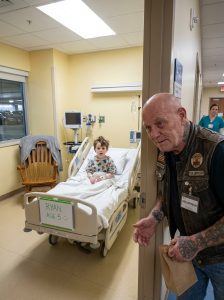
He did not call himself a clown. He did not bring puppets. He did not bring magic tricks. He came in his cut, with his beard, and his tattoos, and his three hundred pounds, and he sat down on the edge of a hospital bed and he told the kid what he was actually afraid of.
The thing he was actually afraid of — the spider thing — was real. Donna had confirmed it for me, four years later, on a Sunday afternoon in their kitchen in Aurora. Tiny had been terrified of spiders since he was nine years old. He could pick up a transmission off the floor of his shop. He could fix anything mechanical in the city of Denver. He could not, in his sixty years on this earth, handle a brown house spider in his own kitchen.
He had a wife who killed the spiders.
He had a wife who killed the spiders for thirty-three years.
The brown paper grocery bag Tiny brought into Ryan’s hospital room that Tuesday afternoon had eight things in it.
I am only going to tell you about the spider.
PART 3
What Tiny did next is the thing I have spent thirteen years describing badly to anybody who asks.
He sat on the edge of Ryan’s hospital bed for forty-five minutes.
He did not touch him.
He told Ryan about spiders. He told Ryan a story about a time he had jumped onto a kitchen counter so hard that he had hit his head on a hanging copper pot and given himself a concussion. He told Ryan about a time he had been working under a customer’s sink in 2003 and a wolf spider the size of a fifty-cent piece had crawled across his arm, and Tiny — three hundred pounds, fifty-one years old, two decades a master plumber — Tiny had screamed loud enough that the customer’s eight-year-old daughter had come running in to see what was wrong.
Ryan started laughing on the kitchen-counter story.
Ryan laughed for the first time in three days.
Tiny told him another spider story.
Ryan laughed again.
After about thirty minutes of spider stories, Tiny got quiet. He folded his enormous tattooed hands in his lap again. He looked at my son.
He said, very gently: “Buddy. You know what?”
Ryan said: “What?”
Tiny said: “Everybody is scared of something. Big people too. Doctors too. I am scared of spiders. Your surgeon — I bet you a million dollars he is scared of something. Your mom is scared of something.”
Ryan looked at me.
I nodded.
Tiny said: “The difference between brave people and not-brave people, buddy, is not who is scared. Everybody is scared. The difference is — brave people are scared and they still do the thing.”
Ryan said: “Even if they’re really scared?”
Tiny said: “Especially if they’re really scared. Brave isn’t not scared. Brave is scared and you do it anyway.”
Ryan was quiet for about ten seconds.
He looked at me again.
He looked at his hospital bracelet.
He looked at the IV tape on the back of his hand.
Then he looked back at Tiny.
He said: “I’m scared.”
Tiny said: “Yeah, buddy. I know.”
Ryan said: “But — but I’m gonna do it anyway.”
He held out his small left hand.
Tiny took it in his enormous tattooed right hand.
It was the first time my son had let anyone touch him in three days.
Three minutes later, Brenda the nurse — who had been watching all of this from the doorway with her hand over her mouth — Brenda walked into the room. She knelt down next to the bed. She said: “Ryan, honey. Can I take your blood pressure? I need to take it before tomorrow.”
Ryan looked at Tiny.
Tiny nodded.
Ryan held out his right arm to Brenda.
I cried. I am not going to pretend I did not.
The surgery happened at six fifteen the next morning. It lasted four hours and eleven minutes. The surgeon — a man named Dr. Aaronson, fifty-four years old, who has been doing pediatric cardiac repairs at Children’s Hospital Colorado for twenty-two years — Dr. Aaronson came out into the waiting room at ten thirty-eight a.m. with his mask pulled down around his neck and he said, very simply:
“Mrs. Castellano. He did great. He is going to be fine.”
I do not, even thirteen years later, fully remember the next four hours.
PART 4
What I do remember is what Ryan saw when he woke up.
He woke up at three twenty-five p.m. that Wednesday afternoon in the pediatric cardiac ICU. His chest was bandaged. He had a chest tube. He had two IVs. He had a small oxygen monitor clipped to his right index finger. He was groggy and pale and his small voice was hoarse from the intubation tube.
His eyes opened.
He looked around.
The first thing he looked at was the nightstand next to his bed.
On the nightstand — placed there by a nurse who had been instructed by Tiny three hours earlier when he had stopped by the ICU during a break in his shift — on the nightstand was a small black plastic spider. The cheap kind you buy at a Halloween store for ninety-nine cents. Eight rubber legs. A small red dot for the body.
Folded next to the spider was a single piece of lined notebook paper.
The handwriting on the paper was clumsy. Big block letters. The handwriting of a sixty-year-old man who had not held a pen for anything except a plumbing invoice in twenty years and who did not, in his own quiet judgment, have nice handwriting.
The note said:
Buddy —
I am scared of spiders. You are scared of surgery. Let’s hold these for each other. I will hold the spider. You hold the scar. They are our proof that we made it.
— Tiny
Ryan was five years old.
He could not read all of those words.
He had me read them to him.
I read them to him twice.
Then Ryan, with his small bandaged chest and his chest tube and his IV, picked up the plastic spider in his small right hand. He held it up at eye level.
He looked at it for about ten seconds.
He said, in his hoarse five-year-old voice: “Mommy. I made it.”
He held the spider against his chest, over the bandage, very gently.
He fell back asleep.
He slept for the next six hours holding that plastic spider against his bandage.
I did not move it.
PART 5
I want to back up and tell you the things you have been hearing without knowing you were hearing them.
Tiny lost his son Theo Junior in 1989 to the same congenital defect that Ryan was being operated on in March of 2012. The surgical mortality rate for ventricular septal defect repair in newborns in 1989 was approximately thirty percent in the regional hospital system Theo Junior was operated on in. The surgical mortality rate at Children’s Hospital Colorado in 2012 was less than one percent.
Ryan was, in the strictest statistical sense, almost certainly going to live.
Tiny knew that.
Tiny did not tell Ryan that. Tiny did not tell me that. Tiny did not tell Brenda the nurse that. He did not, in twenty years of volunteering at Children’s Hospital Colorado, ever once tell a parent the statistical odds of a procedure.
He told kids instead about spiders.
He told kids it was okay to be scared. He told kids being scared did not mean they were not brave. He told kids his own private thing — the spider — and he gave kids permission, by telling them, to have their own private thing.
He had been doing it for twenty years.
He told me, a year after Ryan’s surgery, on the phone, the only thing he ever told me about his own son.
He said: “Karen. Theo was six weeks old when we lost him. He never got to be scared of anything. I just want to make sure every kid I sit with gets to be scared of something and lives long enough to remember it.”
That is the sentence.
That is the whole arc.
The plastic spider was not a gift.
The plastic spider was permission.
It was Tiny telling my five-year-old son, in the only language a five-year-old could understand: Buddy. You are allowed to be scared. Holding the spider is allowed. The scar is allowed. Both of us made it. We carry these for each other.
The note in clumsy block-letter handwriting was the most important thing Tiny had ever given to a child he had ever met.
PART 6
Ryan kept the plastic spider on his nightstand.
He kept it through the rest of his ICU stay. He kept it when we moved him to the pediatric floor. He kept it when we brought him home to our small house in Aurora on a Sunday afternoon eight days after the surgery. He set it on the small white nightstand next to his twin bed in his room with the dinosaur stickers on the wall.
He kept it there.
He kept it through first grade. He kept it through every move we made — to the bigger house in Centennial when his father got the promotion, to the rental in Boulder when his father and I split in 2017. He kept it through middle school. He kept it through every science-fair project, every sleepover, every birthday party.
It moved with him to college last August.
It is on a small wooden nightstand in a small apartment in Boulder right now.
Tiny passed in 2019.
He was sixty-seven. He passed of a heart attack at his own kitchen table on a Sunday afternoon with his wife Donna in the kitchen and his lunch half-eaten in front of him. The funeral was at a small church on the east side of Aurora. There were a hundred and sixty Harleys in the parking lot. There were forty-three former pediatric patients in the church, ranging in age from seven to twenty-six. Their parents had brought them. Their parents had wanted them to be there. Ryan was twelve years old at the funeral.
He brought the plastic spider in his pocket.
He did not show it to anybody.
He set it on the small folding table near the front of the church where Donna had put a photograph of Tiny — and only Donna and me knew it was there, and Donna kissed me on both cheeks and held me for a long time when I told her.
After the service, Ryan walked up to Donna.
He said: “Mrs. Albrecht. Tiny gave me this. I want him to keep it now.”
He held out the plastic spider.
Donna closed her hand around his small hand.
She said: “Sweetheart. No. You keep it. He would want you to keep it.”
Ryan kept it.
PART 7
Ryan is eighteen now.
He passed his motorcycle endorsement at the Colorado DMV in August of this year, two months after he turned eighteen. He bought a used 2015 Harley-Davidson Sportster with the money he saved from working summers at his father’s machine shop, the down payment from me as his birthday present.
He started prospecting for the same independent charter Tiny rode with in September.
He has fourteen months to go before he can earn his patch.
He is having a small embroidered patch made — privately, on the inside front panel of his cut, over his heart, where no stranger will ever see it. The patch is going to be a small black square with two letters on it in white thread.
T.A.
Theodore Albrecht.
In the right saddlebag of his Sportster he keeps the plastic spider.
He has kept it there since the day he picked the bike up from the dealership.
He told me — last weekend, sitting at my kitchen table with his cut hanging on the back of the chair — that the spider rides with him every single time he goes out, in the right saddlebag, wrapped in a small piece of red flannel, sitting on top of a folded piece of lined notebook paper with clumsy block-letter handwriting on it that has gotten a little softer at the edges over thirteen years.
He has it.
He is keeping it for both of them.
Follow the page for more stories about the bikers America thinks it knows — and the plastic spiders they leave on hospital nightstands to prove the kid made it.