PART 2
I want to tell you who Dax was before he was Junie’s father.
Dax — his full name is Dexter Allen Crowder, but nobody outside his mother and his parole officer have called him Dexter since he was sixteen — grew up in a single-wide trailer outside Pueblo, Colorado, in the 1990s. His father drove long-haul. His mother worked the day shift at a Denny’s off the I-25. He had an older sister named Charlene who is now a registered nurse in Albuquerque. He had a younger brother named Ricky who is, by his last known address, somewhere in Florida and has not been in contact with the family since 2009.
Dax went into the Colorado state correctional system at the age of twenty-two for an aggravated assault charge that I am only going to give you the broad strokes of because the specifics are not mine to give. The man he assaulted had hurt Charlene. The man he assaulted was twenty-eight. Dax did not stop hitting him until two of his friends pulled him off, and even then, the man he had hit spent eleven days at St. Mary-Corwin Medical Center before he could go home.
Dax did three years.
He came out at twenty-five.
He did not go back.
He met me in 2013 at a bar in Pueblo called Mickey’s where I had stopped after a teacher’s-in-service day with two other young teachers from my school. I was twenty-three. He was twenty-nine. He bought me a beer. He told me — flat out, on the first conversation we ever had — that he was a felon, that he had done three years for an assault, that he had been clean and sober since 2010, and that he understood completely if I wanted to drink my beer and walk away. He told me before he asked my name.
I asked his name.
We got married in May of 2014 in a courthouse in Pueblo with my parents present and his charter brothers in folding chairs.
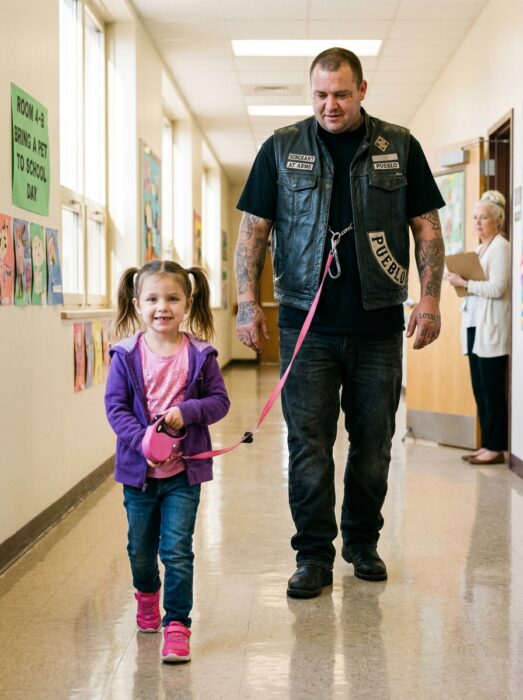
He prospected for an independent motorcycle charter in southern Colorado in 2011. He earned his patch in May of 2013, two weeks before he met me. He has been a patched brother in that charter for twelve years. The cut on his back has SERGEANT AT ARMS on the top rocker, which he earned in 2018. The bottom rocker reads PUEBLO. The diamond-shaped patch in the middle is not a one-percenter patch. It is a charter-specific patch that means something to the brothers in his charter and is not the rougher version. I want to be clear about that because Dax has earned the right to be described accurately.
He has a small embroidered patch on the inside front panel of his cut, over his heart, that I made for him in 2020 after Junie was born. It is a small square of pale yellow cotton with the letter J stitched on it in white thread.
He has worn that patch every day for five years.
Junie has known about that patch since she was three. He showed it to her one Sunday morning in the garage when she asked him what was inside his vest. He let her trace the J with her finger.
She has never forgotten it.
She asks him about it on Sunday mornings.
He shows it to her.
She traces it with her finger.
That ritual is going to matter in a minute.
I also want to tell you about Sparkle.
Sparkle was Junie’s first pet. She had been begging us for six months for a dog and we had told her, in the kind of compromise parents make, that she could start with a goldfish and we would see how she did. Dax took her to PetSmart on a Saturday morning in June and let her pick. She picked Sparkle — a small fan-tail goldfish with one orange spot on her side — out of a tank of forty identical goldfish. Dax paid the eleven dollars. Junie carried Sparkle home on her lap in the truck in a plastic bag of water.
Sparkle lived sixteen weeks.
Sparkle passed on a Tuesday in October. Junie found her on the morning of the day Ms. Halberg sent the flyer home about the pet day.
Junie cried for forty minutes.
Dax sat on the kitchen floor with her and held her in his lap while she cried. He did not tell her that Sparkle was in heaven. He did not tell her she could get another goldfish. He let her be sad. When she was done crying, he carried her out to the backyard, dug a small hole next to the cottonwood tree, and they buried Sparkle in the plastic bag together. Junie wrote SPARKLE on a piece of cardboard with a marker. Dax pushed the cardboard into the dirt.
He carried Junie inside on his shoulders.
That was Tuesday night.
The flyer was in her backpack on Wednesday morning.
She did not mention the flyer until Thursday at dinner.
She had been thinking about it for two days.
PART 3
The next morning — Friday, the third Friday of October — Dax got up at five thirty.
He took a shower. He shaved his neck. He did not shave his beard because Junie has been very clear, from the time she was two, that her father’s beard is the most important part of his face. He put on his clean black t-shirt and his dark jeans and his black motorcycle boots and his leather cut. He sat at the kitchen table with his coffee at six fifteen and he did not eat breakfast.
I came downstairs at six thirty.
I sat down across from him.
I said: “Dax. Are you okay?”
He looked at his coffee.
He said: “Honey. I’m scared.”
I said: “Of what?”
He said: “Renee. I have never been in a room full of children. I do not know what I am supposed to do. I do not know what the other parents are going to think. I do not know what those kids are going to think. I do not know what to say.”
I said: “Dax. You don’t have to say anything. Junie is going to do all the talking. You just have to sit there.”
He said: “Yeah.”
He took a sip of his coffee.
He said: “Renee. What if I scare them?”
I want you to understand what was happening in my husband’s chest at six thirty in the morning on the day his five-year-old had decided to bring him to school on a leash. He was not afraid of the school. He was not afraid of Ms. Halberg or the other parents. He was afraid that he was going to walk into a kindergarten classroom in his cut and his beard and his sleeves of tattoos and that twenty-five five-year-olds were going to look up at him and decide that the man their classmate had brought to school was something to be scared of, and that — because of him — Junie was going to have to spend the rest of the school year being the kid whose dad scared everybody.
He was forty years old. He had stood up to things in his life that I am never going to describe in writing. He had earned a sergeant at arms rocker in a motorcycle charter at thirty-three. He had done three years in a state correctional facility at twenty-two.
And on the morning of the third Friday of October, he was scared of twenty-five five-year-olds.
I reached across the table.
I took his hand.
I said: “Dax. You are the kindest person Junie has ever met. If anybody in that classroom sees something to be scared of, that is something they are going to figure out on their own. You are not going to scare those kids. You are going to be a Daddy.”
He nodded.
He did not say anything else.
He drank his coffee.
Junie came downstairs at seven fifteen in her purple jacket and her favorite jeans and her pink sneakers with the sparkle laces. She had her backpack on. She had a small pink dog leash in her right hand — a leash she had clearly taken from the bottom drawer in the laundry room where I keep the old pet supplies left over from Sparkle’s predecessor, an extremely small Yorkshire Terrier named Pickle that I had owned in college, who passed in 2016.
Junie walked up to her father at the kitchen table.
She held up the leash.
She said: “Daddy. Down.”
Dax slid out of his kitchen chair. He went down on one knee on the linoleum floor of our kitchen. His daughter clipped the pink leash to the carabiner she had picked out herself the night before — the carabiner he keeps clipped to the front of his cut for his keys — and she gave the leash a small testing tug.
He moved one inch toward her.
She clapped her hands once. Seriously.
She said: “Good Daddy.”
She held out the leash handle. She said: “Up.”
He stood up.
He picked up his daughter’s backpack.
The three of us walked out the front door.
I drove to school in my car. Dax walked Junie out to his truck — he did not ride the Harley because the noise scares her in the morning — and he put her in her car seat and he drove the eight miles to her school in his beard and his cut and her pink leash clipped to the front of his vest.
PART 4
Ms. Halberg was waiting at the door of room 4-B when they walked up the hallway.
Ms. Halberg is, as I said, sixty-one years old. She has been teaching kindergarten in Pueblo for thirty-six years. She has white hair that she keeps in a tight bun. She wears reading glasses on a beaded chain. She has the kind of unflappable calmness that you only get after you have, by her own count, taught approximately nine hundred five-year-olds the alphabet.
She watched Dax walk up the hallway with Junie in front of him on the pink leash.
She did not blink.
She crouched down to Junie’s eye level. She said: “Good morning, Junie. Who do we have here?”
Junie said: “Ms. Halberg. This is my pet. He is a Daddy. He is the only one I have.”
Ms. Halberg looked up at Dax.
Dax looked down at Ms. Halberg.
Dax said, very quietly: “Ma’am. I’m Dexter Crowder. Junie asked me to come today. We don’t have a pet at home. I told her I would do this. I am completely at your direction.”
Ms. Halberg stood up.
She put one hand on Dax’s enormous tattooed forearm.
She said: “Mr. Crowder. Welcome to room 4-B. Please come in.”
She walked them inside.
She sat Dax down on the carpet in the corner of the room — the area-rug carpet where the kids do circle time — and she let Junie clip the leash handle around her own small wrist while the rest of the class came in with their pets.
I want you to picture room 4-B on the third Friday of October.
There were twenty-five five-year-olds in that room. Twenty-three of them came in with a parent or grandparent or older sibling and a pet. There were nine dogs. Three cats in carriers. Two rabbits. One hamster. One large lizard in a tank that took up half a desk. One ferret. One small girl with a goldfish in a plastic bag. Three children who had brought stuffed animals because their families did not have pets. One child who had brought a framed photograph of his grandfather’s horse.
And one child — my daughter Junie — sitting on the carpet next to her father with a pink leash clipped to his cut.
Ms. Halberg started the introductions in alphabetical order.
The Davidson twins went first with their golden retriever named Biscuit.
The Garcia kid went second with his cat named Mittens.
A small Black girl named Khaleesi Patton went third with a hamster named Cheese.
The classroom worked through twenty-three pets.
Twenty-three sets of parents and grandparents stood at the back of the room, including me, who had walked over from my own classroom on my prep period.
Three other parents had brought their phones out.
One of them was Ms. Halberg herself, who had set her phone face-down on her desk and was recording the audio of every introduction for the class’s end-of-year memory book.
That phone recording is the reason this story is on the internet.
When Ms. Halberg called Junie Crowder, my daughter stood up.
She picked up the pink leash handle.
She walked to the front of the classroom.
The leash trailed eight feet behind her to her father, who stood up from the carpet and walked behind her at a slow, measured, deliberate pace.
He sat down cross-legged on the carpet in front of the class.
Junie turned around.
She faced the twenty-five other five-year-olds.
She held up the leash handle.
She said:
“This is my pet. His name is Daddy. He is forty years old. He eats coffee and sweet things. He barks when motorcycles start up. He is very good.”
The classroom went silent for about two seconds.
Then a small boy in the front row named Mason whispered, very loudly: “Whoa.”
Ms. Halberg, behind her desk, did not move her hand off her phone.
PART 5
What Junie said next — the part of the introduction that took her ninety more seconds and that Ms. Halberg later sent to me as a clean audio file with my daughter’s permission — I am going to give you in full because it is, in my opinion, the most important seven sentences any five-year-old has ever said about her father.
She held up the pink leash.
She said:
“He is not really a pet. He is my Daddy.”
She paused. She looked at her father on the carpet.
“But Sparkle died on Tuesday. Sparkle was my fish. And I did not have a pet for today. And my mom said it was okay to bring a stuffed animal. But I did not want to bring a stuffed animal because stuffed animals are not real. And my dad is real. And he is the best thing in my whole house. So I told him last night that I wanted him to be my pet for today. And he said okay.”
She looked at the other kids.
“He looks scary. I know. He has a lot of tattoos. He has a vest. He has a beard. He looks scary to grown-ups too. My mom’s friend cried one time because she thought he was going to hurt her. He did not hurt her. He never hurt anybody who did not deserve it.”
The room got even quieter.
“He is the softest pet you would ever have. He picks me up at school every day on Fridays. He braids my hair on Sunday morning. He makes pancakes shaped like cars. He sleeps on the floor next to my bed when I am sick. He carries my backpack when it is heavy. He cries when I read him the part where the dog dies in Where the Red Fern Grows. My mom read it to him so he would not be embarrassed reading it himself.”
She paused.
“He is the best pet I have ever had. He is better than Sparkle. He is better than Pickle was. I am sorry, Pickle, in heaven.”
She looked at her father.
“He has a small patch on the inside of his vest. It has my letter on it. J. For me. My mom made it. He wears it every day. He has worn it for five years. He will wear it forever.”
She turned back to the class.
“My pet is named Daddy. Thank you for letting him come to school.”
She gave a small curtsy.
She walked back to her seat with the leash still in her hand and her father still on the carpet behind her.
There was a pause of about three seconds in room 4-B.
Then twenty-five five-year-olds started clapping.
Then four parents at the back of the room started clapping.
Then Ms. Halberg, behind her desk, with her phone still recording the audio, put her reading glasses up to wipe her eyes very discreetly and started clapping too.
I was at the back of the room.
I want to be honest about what my husband’s face was doing at that moment, sitting cross-legged on a kindergarten carpet with his five-year-old daughter holding a pink leash clipped to his cut.
He was not crying. Dax does not cry in public.
But he was looking at his daughter the way a man looks at the only thing in his entire life that has ever fully understood him without him having to explain anything.
She walked back to him. She unclipped the leash from his cut. She kissed him on the top of his shaved head.
She said: “Good Daddy.”
He said, very quietly: “Good kid.”
PART 6
Ms. Halberg sent the audio to me that afternoon.
She sent it with a note that said: Renee — I have been doing this for thirty-six years. I have never recorded a moment like this. I thought you should have it. The classroom belongs to Junie. The recording belongs to your family.
I did not post it.
I sent it to Dax’s mother, who had not seen Dax in person in three years because of complicated family things I am not going to lay out here.
I sent it to my sister-in-law Rebecca, who lives in Phoenix and has been Junie’s favorite person on earth since the day Junie was born.
Rebecca, who runs a small business and has a Facebook with about two thousand followers, posted the audio with a single photo Ms. Halberg had taken of Junie holding the leash and Dax sitting on the carpet.
Rebecca posted it Friday night.
She tagged me. She did not tag Dax. She wrote one sentence as the caption.
She wrote: My niece brought her dad to school on a leash today. He is a biker. Listen.
The post had a hundred thousand views by Saturday morning.
It had a million by Sunday night.
It had eleven million by the following Friday.
The top comment, with two hundred and seventy thousand upvotes, said:
This is the best “pet” anyone has ever brought to school. Obedient. Loving. Bearded. 10/10. Would recommend bringing a Daddy.
The second top comment, with two hundred and thirty thousand upvotes, said:
The little girl said “he never hurt anybody who didn’t deserve it” and I had to put my phone down.
Dax did not have a Facebook.
He did not see the post for nine days.
Then his charter President — a man named Sully, sixty-two years old, who has been a patched brother for thirty-one years and who has known Dax since he prospected in 2011 — Sully showed him the post on Sully’s phone at the clubhouse on a Saturday night.
Sully said: “Brother. Your kid put you on the internet.”
Dax watched the video.
He watched it twice.
He gave Sully back the phone.
He did not say anything for about a minute.
Then Dax said: “Sully. She didn’t say my real name.”
Sully said: “What.”
Dax said: “She called me Daddy on the audio. She didn’t say Dexter. She didn’t say Dax. The internet doesn’t know my name. They just know I’m her dad. That’s all I want them to know.”
Sully said: “Brother. That is exactly what she did.”
Dax nodded.
He picked up his beer.
PART 7
Junie is six now.
She is in first grade. The pet day was last year. She has a new goldfish named Sparkle II — also a fan-tail, also with one orange spot, picked out by Junie herself at the same PetSmart on a Saturday morning in February. Dax paid the twelve dollars. Junie carried Sparkle II home on her lap in the truck.
The pink leash is in a drawer in Junie’s bedroom.
She does not use it for anything anymore.
But every Sunday morning, before pancakes, she walks into the kitchen, finds her father at the table with his coffee, holds her small hand out flat, and says: “Down.”
He gets down on one knee on the linoleum.
She unzips his cut.
She finds the small pale yellow patch over his heart with the white letter J on it.
She traces the letter with her finger.
She says: “Good Daddy.”
He says: “Good kid.”
He stands up. He makes pancakes. They eat them shaped like cars.
The Harley rolls out on Sundays at one.
He still wears the patch.
Follow the page for more stories about the bikers America thinks it knows — and the small daughters who put them on leashes because the leash is how you tell the world what they are really for.