His mistress wore my mother’s black dress to my father’s birthday dinner.
Not a black dress. Not something similar. My mother’s black dress.
The one she wore the last New Year’s Eve before the cancer took the strength from her hands. The one she had kept in a cedar-lined box with tissue paper folded like wings between the sleeves. The one my father never allowed anyone to touch, not because it was expensive—though it was, a vintage Valentino so rare that stylists whispered around it like it was holy—but because it still carried the faintest trace of my mother’s perfume if you pressed your face into the velvet and knew what you were grieving.
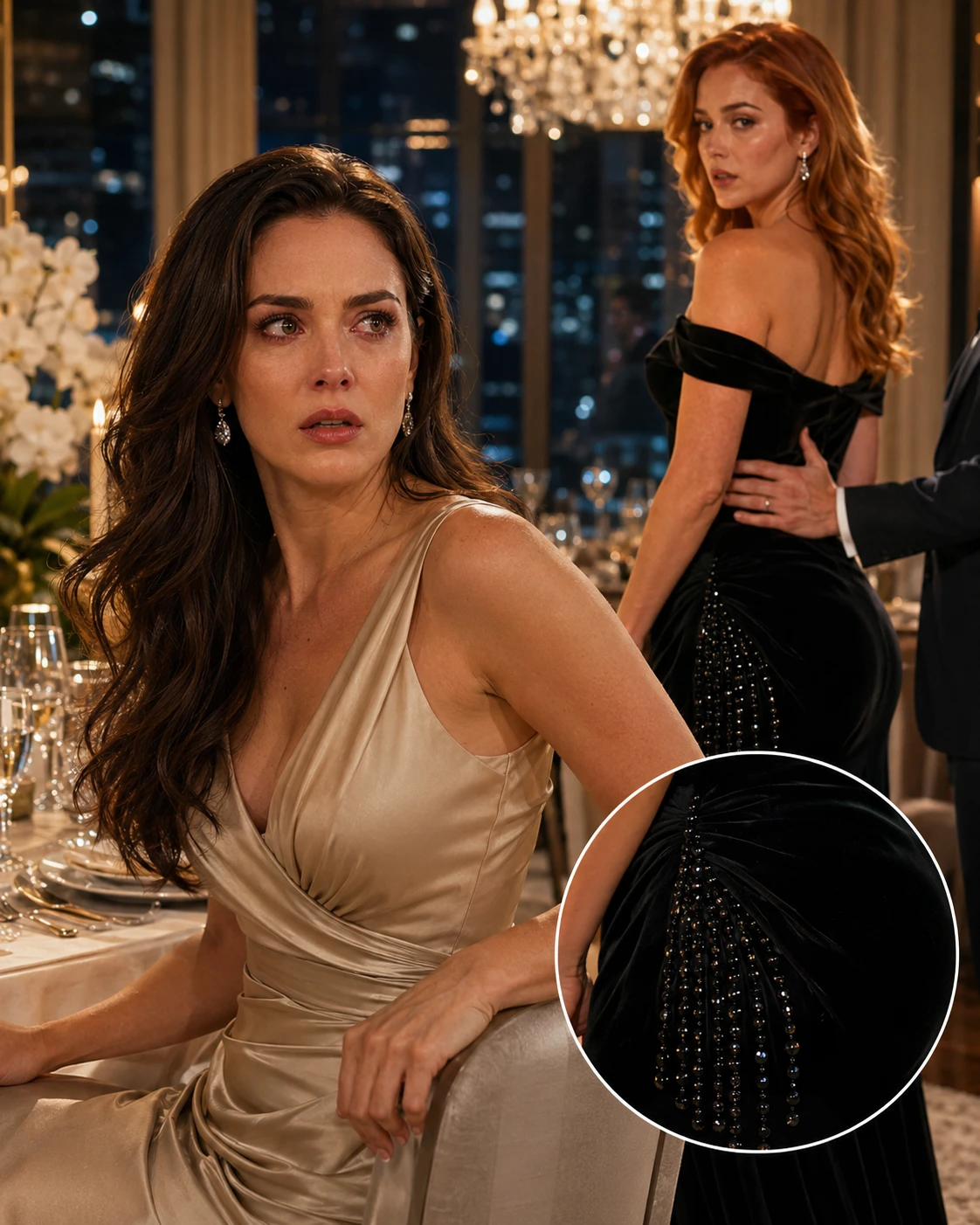
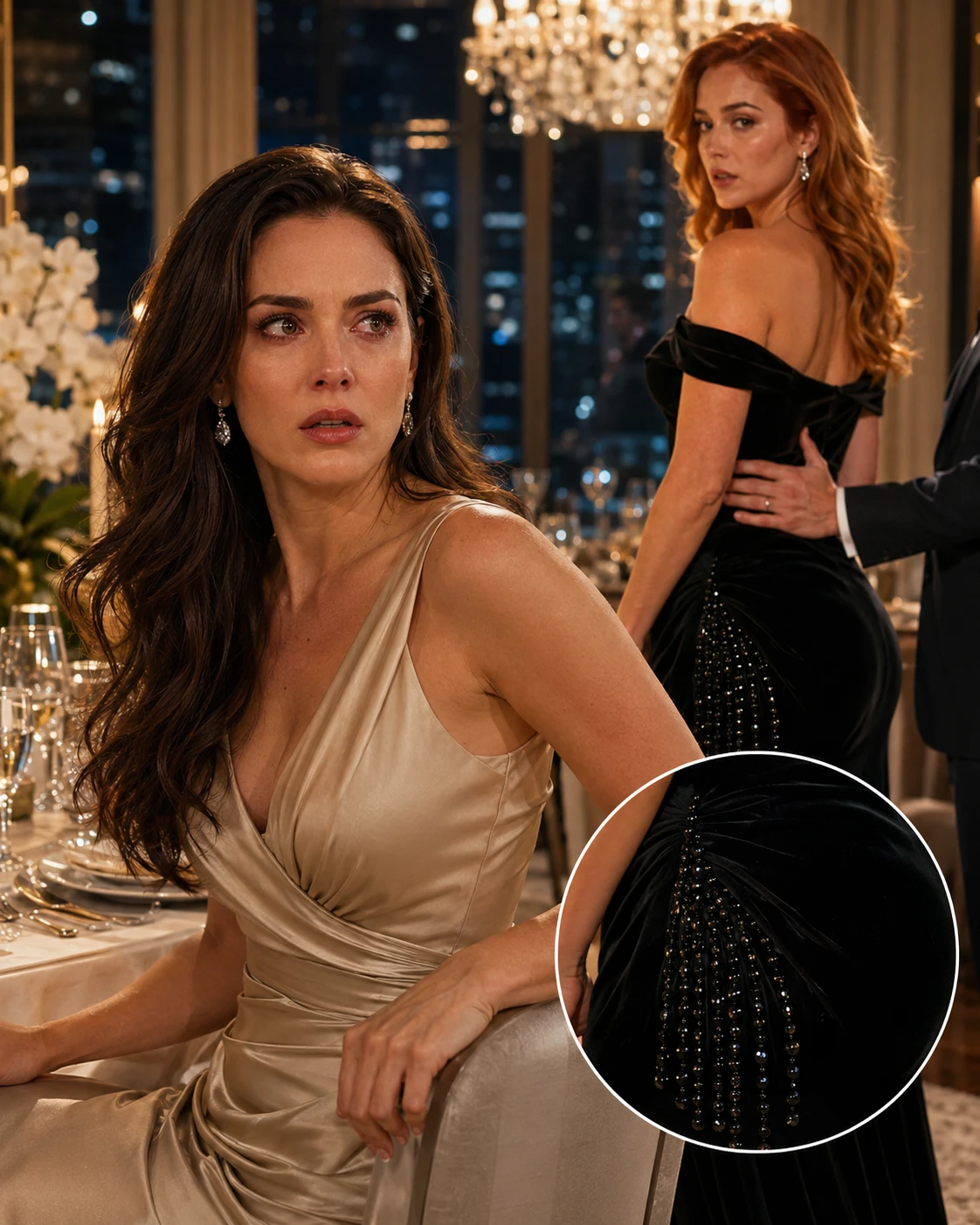
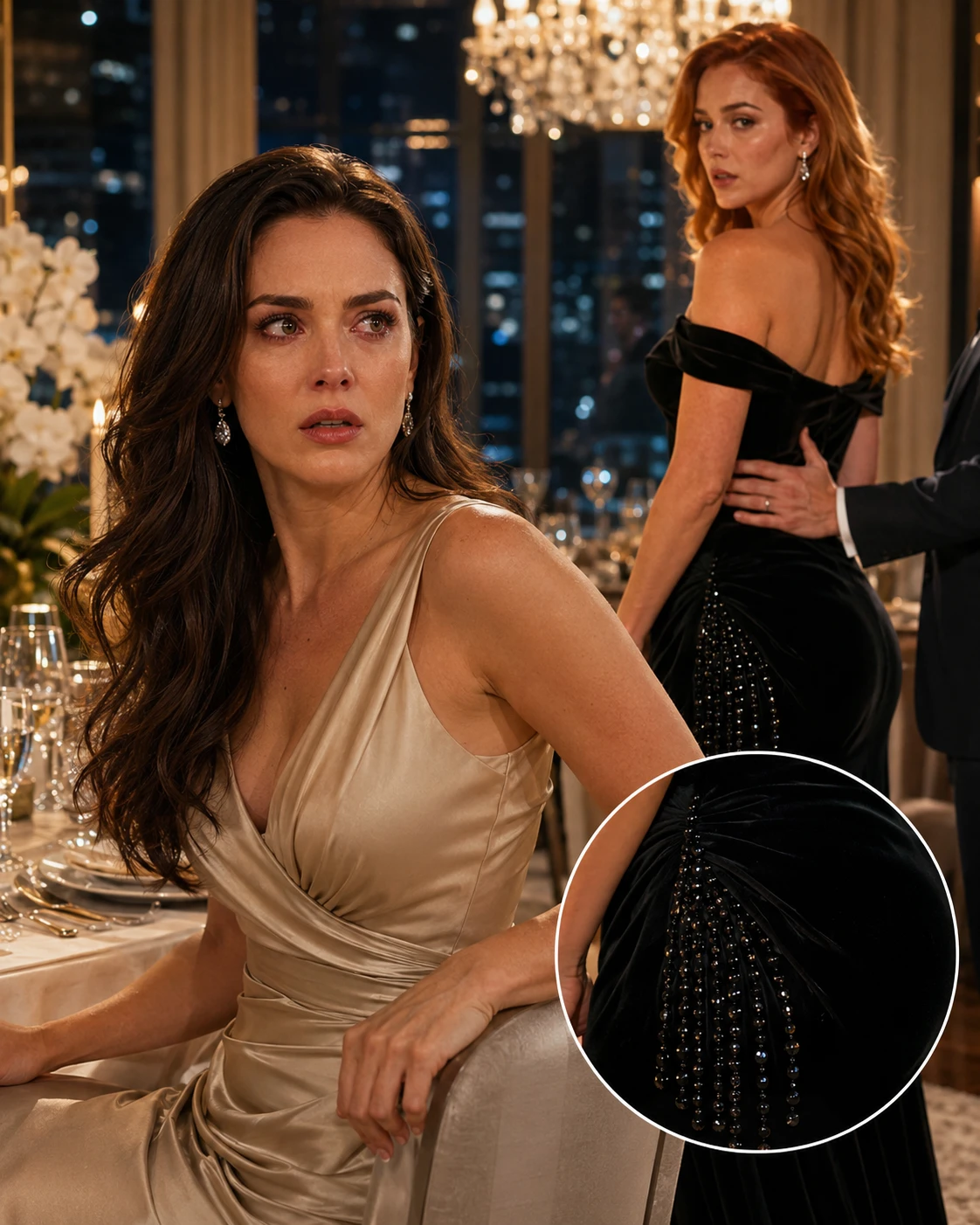
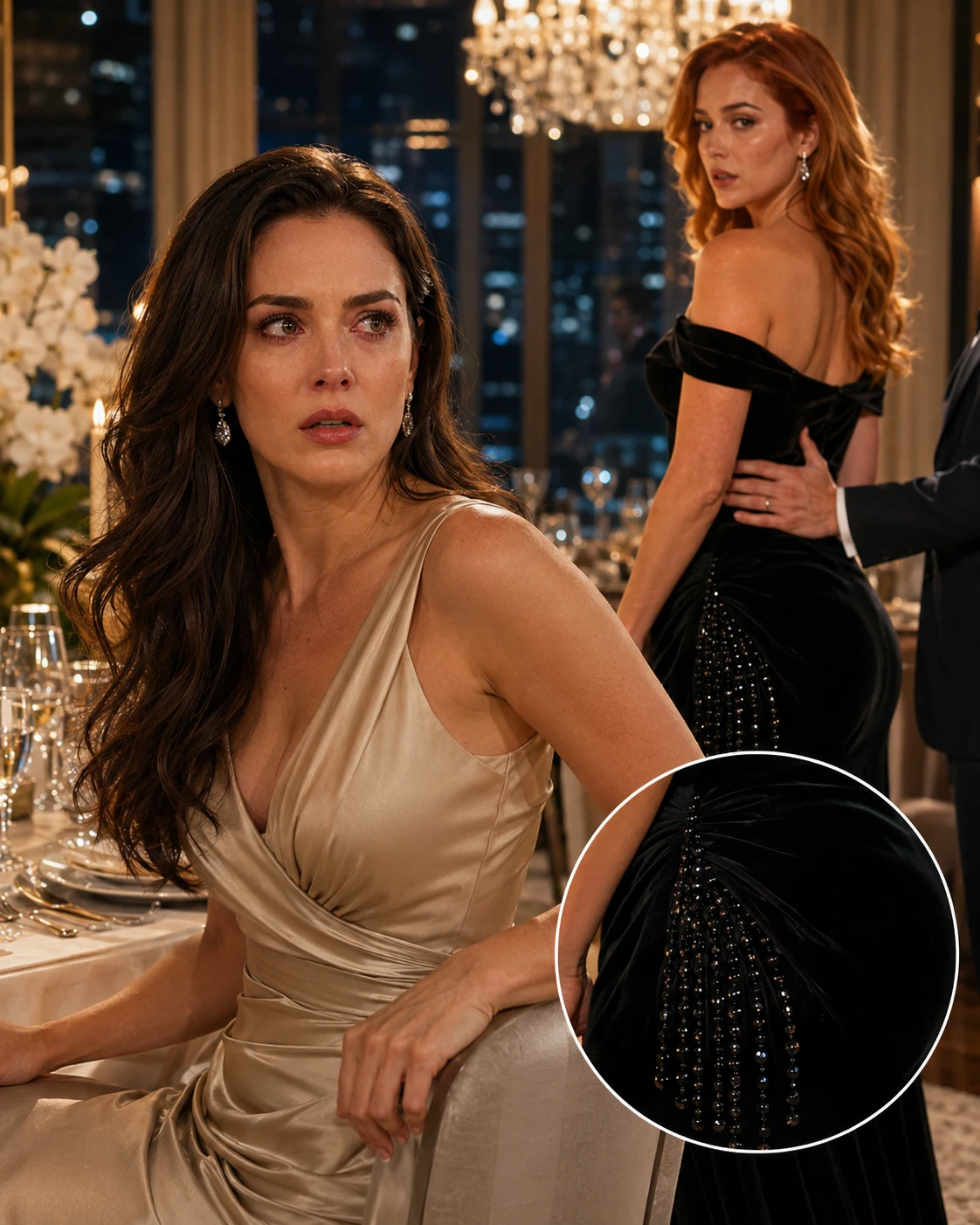
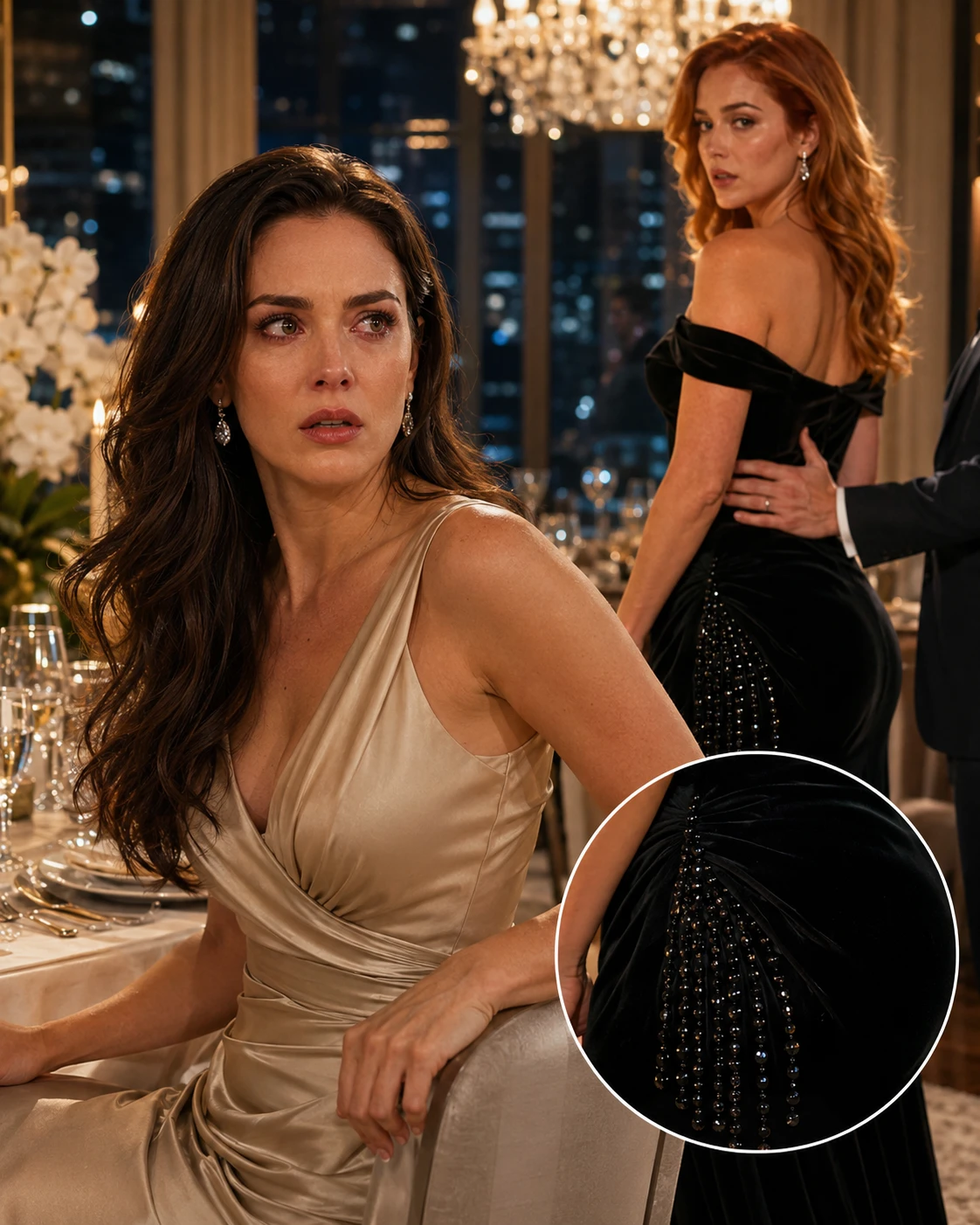
Sloane Mercer walked into The Whitby Room at the St. Regis in Manhattan wearing it like a weapon.
My father recognized the dress before she sat down.
My husband, Graham Montgomery, smiled with the careful arrogance of a man who thought wealth was the same as protection. He rested one hand at the small of Sloane’s back and said, “It was just in storage.”
My father calmly placed his napkin beside his plate and ended every financial guarantee he had ever given my husband.
The candles had not even been lit.
CHAPTER 1
THE BLACK VELVET INSULT
The dining room went silent in a way only wealthy rooms can go silent.
No chairs scraped. No fork dropped. No one gasped. The silence simply expanded, polished and lethal, moving over the crystal glasses, the white orchids, the silver chargers engraved with my father’s initials. It settled on every guest like a hand over the mouth.
Outside the tall windows, Midtown glowed like a jewelry box. Yellow taxis slipped along Fifth Avenue. Snow drifted down in soft, theatrical flakes, melting before it hit the pavement. Inside, the room smelled of bergamot, champagne, and money old enough to forget where it came from.
My father, Sterling Westbrook, turned sixty-five that night.
He wore a midnight-blue tuxedo, his silver hair brushed back, his cuff links shaped like tiny black onyx knots. He had built Westbrook Capital from a family office into a private empire that moved quietly through real estate, energy, shipping, and political rooms no one ever admitted existed. He did not raise his voice. He did not threaten. When my father was angry, he became more courteous.
That was how I knew Graham was already ruined.
I sat at my father’s right hand in a champagne silk dress Graham had chosen for me because he said it made me look “harmless.” His word. He said it with a laugh that afternoon as his assistant zipped the garment bag in our penthouse closet.
“Harmless is good for you tonight, Ava,” he had said, checking his reflection behind me. “Your father likes when you look soft.”
I had looked at him in the mirror. “Does he?”
Graham had kissed my temple without meeting my eyes. “He likes when you remember you’re his daughter and my wife.”
At thirty-four, Graham Montgomery looked like the kind of man magazines called inevitable. Tall, blond, sharp-jawed, educated at Princeton and polished in rooms where men learned to say nothing beautifully. His family had once owned half of Newport, then lost most of it through horses, divorces, and bad debt. Graham had married me three years ago and told the world it was love.
The world believed him because the world likes a clean story.
The Westbrook daughter and the Montgomery heir. The banker’s only child and the charming founder of Montgomery Meridian, a luxury development firm promising glass towers, private clubs, and “the future of American elegance.” Our wedding had been photographed on the cliffs of Rhode Island beneath a tent full of white roses. Vogue called us “an old-money revival.” My father walked me down the aisle with wet eyes. Graham cried during his vows.
I learned later that some men can cry and still be lying.
Sloane Mercer entered the room at 8:07 p.m.
She was twenty-seven, copper-haired, long-necked, and professionally delicate. She had once been hired as a consultant for Montgomery Meridian’s brand redesign, though her actual talent seemed to be standing close to married men while pretending not to know cameras existed. She moved through the doorway with one hand on Graham’s sleeve, her mouth curved into a soft, apologetic smile that said she had already practiced being forgiven.
And she was wearing my mother’s dress.
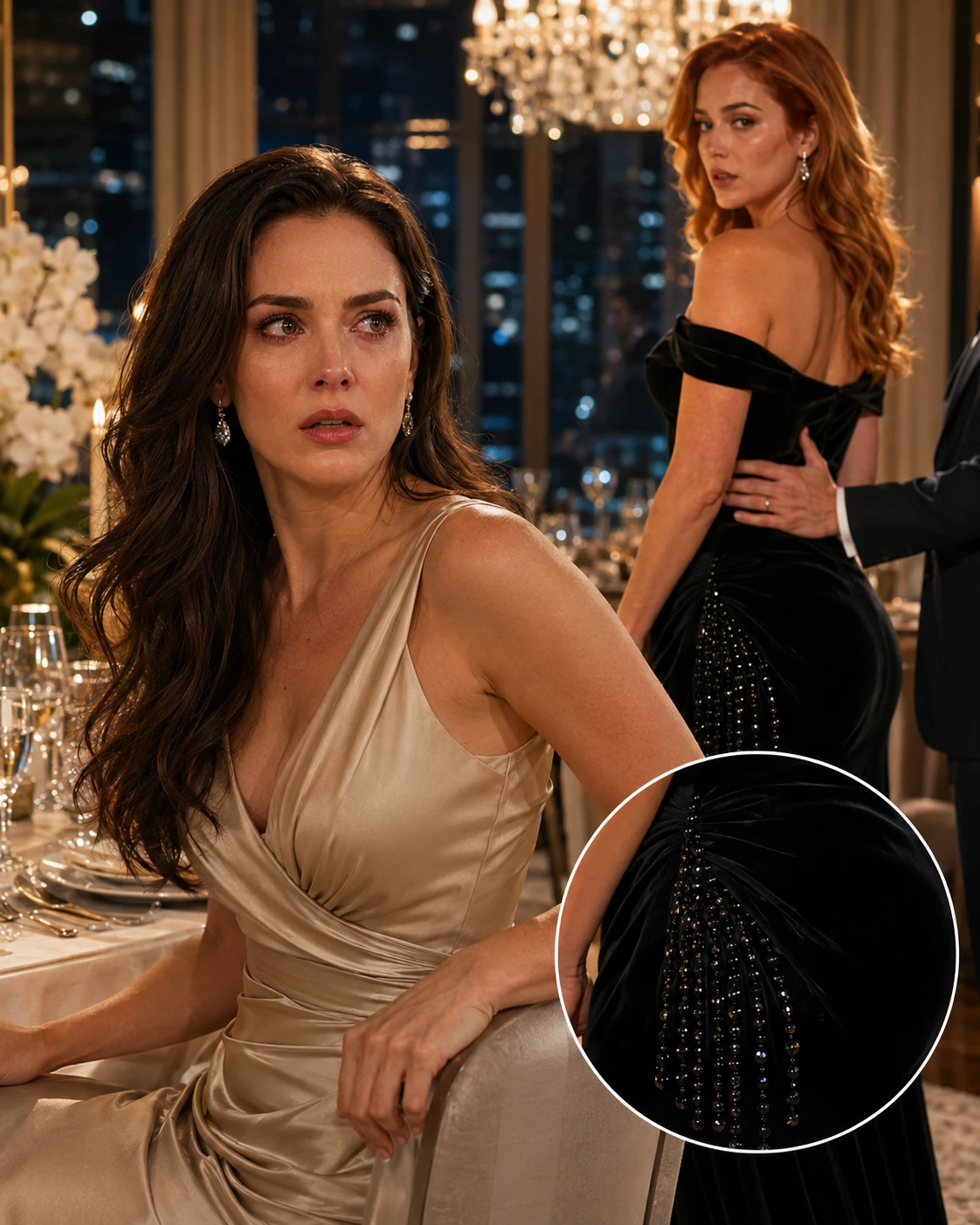
Black velvet. Off the shoulder. A narrow waist. A line of jet beads falling from the left hip like a dark waterfall. The neckline framed her collarbones with the exact severity my mother loved. The hem brushed the floor, hiding the shoes. On another woman, it might have looked glamorous.
On Sloane, it looked like a grave robbery.
My fingers tightened around my water glass. For one second, the room tilted. Not visibly. Never visibly. I was Sterling Westbrook’s daughter. I had been trained to bleed internally.
My mother, Eleanor, had worn that dress in a photograph that still sat on my father’s nightstand. She was laughing in it, one hand lifted to hold down her hair because the terrace doors had blown open behind her. My father stood behind the camera. I knew because my mother’s eyes were fixed on him with the unguarded warmth people spend entire lifetimes trying to earn.
That dress had been in the locked Westbrook storage vault in Darien.
Or it should have been.
Graham led Sloane toward the table as if the world belonged to him and everyone else was merely renting space in it. His mother, Patricia Montgomery, sat two seats down from me, diamonds glittering at her throat. Her expression did not change, but her lips parted slightly. She knew. Of course she knew. Women like Patricia always knew where the knives were hidden.
“Sterling,” Graham said brightly, “happy birthday.”
My father’s gaze did not move from the dress.
Sloane gave a tiny laugh, the kind women use when they are pretending to be nervous and actually enjoying themselves. “Mr. Westbrook, thank you so much for having me. Graham insisted I come. I hope that’s all right.”
No one moved.
Across the table, Senator Halpern stared into his wine as if praying for an emergency vote. My father’s chief counsel, Miriam Vale, leaned back a quarter inch. My best friend, Elise Hart, who had known my mother, looked at me with horror so controlled it almost passed for composure.
I looked at Graham.
He looked back with a warning in his eyes.
Behave.
The word was not spoken, but I heard it anyway. I had heard it for three years in different forms.
Don’t embarrass me.
Don’t question me.
Don’t make this difficult.
Don’t turn into one of those wives.
My father finally spoke.
“Where did you get that dress?”
His voice was calm, almost curious. He might have been asking about the weather.
Sloane looked at Graham. Graham’s smile tightened.
“Oh,” she said, touching the velvet sleeve, “Graham said it was vintage. I didn’t realize—”
“It belonged to my wife,” my father said.
A flush climbed Sloane’s throat, but her eyes flickered with satisfaction. It was quick, almost invisible, but I saw it. The pleasure of impact. She had known exactly what she was wearing. Maybe Graham told her. Maybe she found the photograph. Maybe they had laughed about it in my bedroom, her bare feet on my carpet, his hand on her waist.
Graham gave a soft, embarrassed chuckle. “Sterling, come on. It was just in storage.”
My father turned to him.
The air changed.
Graham was used to being liked. He was used to older men clapping his shoulder, younger men envying his watch, women forgiving his sins before he committed them. He had mistaken my father’s restraint for affection. He had mistaken access for acceptance.
“Just in storage,” my father repeated.
“Yes,” Graham said, recovering. “Ava never wore it. It was sitting there. Sloane had a wardrobe issue before dinner, and I thought—”
“You thought,” my father said.
Two words. Soft as snowfall.
Graham swallowed.
My father lifted his napkin from his lap, folded it once, and placed it beside his untouched plate. His hands did not tremble. Then he looked to his left, where Miriam Vale had already opened the slim leather folder she carried everywhere.
“Miriam,” he said, “effective immediately, terminate all Westbrook personal guarantees related to Montgomery Meridian, Montgomery Residential Holdings, and the Harborline redevelopment project.”
Graham’s face went white.
The table remained frozen.
“Notify First Atlantic, Chase Private, and the mezzanine lenders tonight,” my father continued. “Send formal notice before midnight. Also withdraw my advisory vote from the Series D extension. No bridge facility. No collateral comfort. No exceptions.”
Patricia Montgomery sat forward. “Sterling, surely this is not the appropriate—”
“My wife’s dress,” my father said, still looking at Graham, “was removed from a secured family archive and placed on your mistress at my birthday dinner.”
The word mistress landed like a blade across crystal.
Sloane’s hand slipped from Graham’s arm.
Graham forced a laugh. “That is a very dramatic word.”
“No,” my father said. “It is an accurate one.”
I should have felt triumph.
Instead, I felt something quieter and colder.
Relief.
For months, I had been living inside a marriage that looked like a penthouse from the outside and a locked room from within. Graham did not hit me. That would have been too crude for him. He corrected. Managed. Reduced. He spoke over me at dinners. He moved my meetings without asking. He told his investors I was “creative, not strategic,” though my trust money had kept his company breathing through two failed acquisitions. He told me I was paranoid when I found Sloane’s earring in our elevator vestibule. He told me I was unstable when I noticed her initials in his calendar as “SM—design.” He told me no one would believe me if I made a scene.
So I did not make a scene.
I made a file.
Graham leaned toward my father, voice low. “Sterling, I understand you’re upset, but you should think carefully before you act emotionally. The Harborline project alone has two thousand jobs attached to it. If you pull support, you don’t just hurt me. You hurt a lot of people.”
My father’s expression did not change. “You should have thought about those people before you stole from my dead wife.”
A tiny sound escaped Sloane, something between a gasp and a sob. It was pretty. She was good at pretty.
I looked at her then, truly looked. The dress fit her almost perfectly, except at the waist where my mother had been narrower. Sloane had clipped it in the back. I could see the small tension line in the fabric. She had altered the silhouette without altering the dress, which meant someone had cared enough to preserve the garment while still violating it.
My stomach turned.
Graham’s jaw hardened. “Ava,” he said.
Just my name. A command dressed as a plea.
Every face turned to me.
I placed my glass down carefully. I could feel the weight of my mother’s wedding band on my right hand, the one my father had given me after she died. My own wedding ring glittered on my left like a bad contract.
“Yes?” I asked.
Graham’s eyes flashed. “Tell your father this is a misunderstanding.”
There it was.
The old expectation. The wife steps forward. The wife softens the blow. The wife turns her own humiliation into a translation service for male consequences.
I looked at Sloane. She was blinking too quickly now, realizing that tears might not save her in a room where everyone knew the value of a loan covenant.
Then I looked at my father.
He was not looking at Graham anymore.
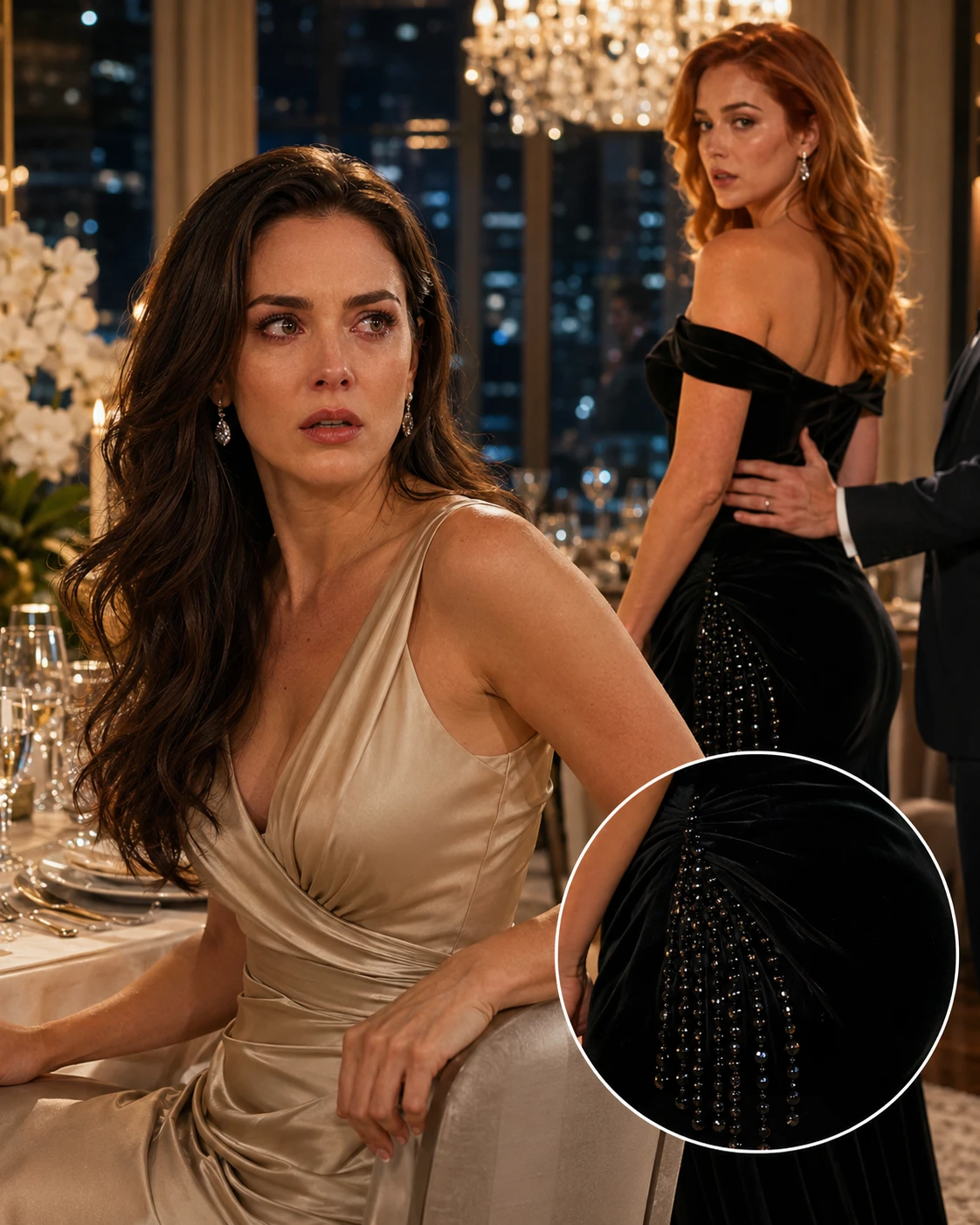
He was looking at me.
Not asking me to perform. Not asking me to defend him. Just waiting to see whether I would save the man who had brought my mother’s ghost to dinner and called it storage.
I smiled.
It was small. Almost nothing.
“I think,” I said, “my father understood perfectly.”
Graham stared at me as if I had slapped him.
A server appeared at the edge of the room carrying a silver tray with the birthday candles still unlit. She stopped, sensing disaster, and backed away so silently she might have been part of the wallpaper.
My father stood.
The entire table rose with him because power has gravity.
“This dinner is over,” he said.
Then he turned to me, and for the first time all evening, his face softened.
“Ava,” he said, “come home.”
I did not look at Graham when I left.
That was the first elegant thing I did.
CHAPTER 2
THE WIFE WHO DID NOT CRY
The car smelled of leather, cedar, and my father’s winter cologne.
We rode south through Manhattan in silence, past storefronts lit like stages, past couples laughing under umbrellas, past restaurants where people were still ordering dessert as if my life had not just cracked open in public.
My father sat beside me in the back of the Bentley, one hand resting on his cane. He had started using it after a riding accident two years earlier, though I suspected he kept it more for punctuation than support. The city lights crossed his face in pale gold bars.
“You knew,” he said finally.
It was not an accusation.
I watched snow dissolve on the window. “About Sloane? Yes.”
“How long?”
“Eight months for certain. Longer, probably.”
His eyes closed briefly. The pain in his face hurt me more than my own humiliation. Fathers like Sterling Westbrook are not supposed to age in front of their daughters. They are supposed to remain carved out of marble and willpower. But grief had found a new door into him that night, and Graham had opened it.
“I should have seen it,” he said.
“You saw what I let you see.”
He turned to me.
I kept my hands folded in my lap. “I needed time.”
“For what?”
“To make sure he couldn’t call me emotional.”
My father’s mouth tightened. In that instant, I saw him understand not only the affair, but the architecture around it. The slow humiliations. The careful isolation. The way Graham had turned charm into insulation and my silence into consent.
I had been raised among people who made decisions in quiet rooms, but marriage had taught me something darker: the most dangerous lies are not shouted. They are repeated gently until you begin to apologize to the person injuring you.
My father reached across the space between us and took my hand.
“I am sorry,” he said.
I shook my head. “Don’t be. You just did in ten seconds what he spent three years believing you’d never do.”
My father’s smile was brief and winter-cold. “I have been wanting to dislike him for longer than you know.”
That almost made me laugh.
Almost.
We did not go to the penthouse Graham and I shared on Park Avenue. We went to my father’s townhouse on East 70th, a limestone mansion with black shutters, brass lanterns, and a courtyard where my mother had planted white hellebores because they bloomed in the cold.
The housekeeper, Mrs. Alvarez, opened the door before the car stopped. She had worked for our family since I was twelve. When she saw my face, she did not ask questions. She simply wrapped me in a hug that smelled of starch and lavender and said, “Your room is ready, mija.”
My old room overlooked the courtyard. It had been redecorated after I married—less girlhood, more guest suite—but my mother’s blue cashmere throw still lay folded across the foot of the bed. On the desk, someone had placed a tray with tea, toast, and a single white rose.
I took off the champagne dress Graham had chosen and left it on the floor.
Then I showered until my skin turned pink, put on a black silk robe, and opened my laptop.
By 11:14 p.m., Graham had called twenty-six times.
By 11:22, his mother had called seven.
By 11:31, Sloane had posted a photograph.
Not of the dinner. She was not stupid enough for that. It was a close-up taken in a gilded elevator mirror, cropped at the mouth, showing the black velvet neckline, her copper hair, and Graham’s hand at her waist. The caption read:
Sometimes the wrong woman gets the ring. Sometimes the right one gets the room.
It was deleted four minutes later.
I had already saved it.
At midnight, Miriam Vale arrived at the townhouse with two associates, one forensic accountant, and a garment preservation specialist named Dr. Lillian Cho, who carried white gloves in a sealed pouch and looked as if she could identify a couture hem at fifty yards.
My father had changed into a dark cardigan. He stood in his study beside the fireplace, watching as Miriam spread documents across the long walnut table. It was the same table where my mother used to wrap Christmas presents and where my father had once taught me to play chess.
Now it became a war room.
Miriam placed a folder in front of me. “You should know what happens next.”
“I know some of it,” I said.
She gave me a look over her glasses. “Tell me.”
I opened my laptop and turned it toward her.
The first file was labeled CALENDAR.
Screenshots. Dinner reservations. Hotel entries. Flights to Miami during weeks Graham claimed to be in Boston. Sloane’s name hidden under initials, then under code names, then under the name of a fake design vendor: Mercer Creative Strategy.
The second file was labeled PAYMENTS.
Wire transfers from a Montgomery Meridian discretionary account to Sloane’s LLC. Consulting fees. Furnishings. Jewelry. A $19,800 “installation expense” from a boutique in SoHo that sold nothing under five thousand dollars and called everything an installation.
The third file was labeled STORAGE.
That one made my father go still.
Three months earlier, I had received an automated insurance renewal notice for the Westbrook family archive. I had only been copied because my mother had named me secondary custodian before she died. The archive held gowns, letters, jewelry, art, and personal effects too emotionally valuable to sit in a museum and too historically valuable to sit in a closet.
The access log showed three entries in the last year.
One by me.
One by Dr. Cho for a conservation review.
One by Graham.
My father looked at Miriam. “How did he get access?”
Miriam’s expression turned sharp. “He did not. Not legally.”
I clicked another file.
FORGED AUTHORIZATION.
There it was. A scanned access request bearing my signature.
Except I had never signed it.
Miriam read silently, her face giving away nothing. The forensic accountant, a woman named Priya Shah, leaned closer.
“Is that his assistant’s notary stamp?” Priya asked.
“Yes,” I said. “From a document she notarized for me two years ago. I think they lifted it.”
My father’s hand tightened around the back of a chair.
For the first time that night, his composure cracked. Not loudly. Only enough for me to see the father beneath the financier.
“He forged your name to steal Eleanor’s dress,” he said.
“And probably other things.”
That was when I opened the fourth file.
COLLATERAL.
The room changed again.
The affair had hurt. The dress had desecrated. But the collateral file was where Graham had crossed from cruelty into crime.
Three weeks before the dinner, I had found a draft loan schedule in Graham’s home office. He usually locked the room, but that morning he had been careless, rushing to meet Sloane at a hotel he thought I didn’t know about. The schedule listed “Westbrook Personal Archive Assets” as supplemental collateral under a bridge financing package for Harborline.
My mother’s art. My grandmother’s emeralds. A collection of letters from Georgia O’Keeffe to my great-grandmother. A Childe Hassam watercolor. My mother’s couture.
All valued. All pledged.
None of it his.
Miriam’s voice was quiet. “This is fraud.”
“Yes.”
Priya exhaled. “It is also desperation.”
My father looked at her.
She tapped the page. “Harborline has a liquidity gap. Large one. If the lenders discover the collateral is invalid and Mr. Westbrook’s guarantees are terminated, the project goes into default.”
“How fast?” I asked.
“Fast,” Priya said. “Depending on the covenants, possibly by morning.”
Miriam looked at me with new understanding. “You waited until he exposed possession of one of the archive assets in front of witnesses.”
I said nothing.
My father turned slowly. “Ava.”
I met his eyes.
There are moments in a daughter’s life when she becomes someone her father cannot protect because she has already protected herself. They are painful moments. Necessary ones.
“I didn’t know he would bring her to your birthday,” I said. “I knew he was getting bolder. I knew he wanted me to react publicly so he could make me look unstable before the divorce. But I didn’t know he would use Mom’s dress until this afternoon.”
“This afternoon?”
I opened a final image.
It was from our penthouse security camera. Graham entering the primary closet with a garment bag. Sloane following him barefoot, laughing. He unzipped the bag. Even on grainy footage, the black velvet was unmistakable.
“He told me I looked harmless,” I said. “Then he left for the hotel to dress her.”
My father sat down.
For a long moment, no one spoke.
The fire snapped softly.
I had not cried at the dinner. I had not cried in the car. I had not cried when I changed out of Graham’s dress or when I saved Sloane’s caption. But now, in my father’s study, with my mother’s memory spread across a table as evidence, my throat closed.
“I’m sorry,” I whispered.
My father looked up sharply. “For what?”
“For letting him near us.”
He stood and crossed to me faster than I expected with the cane. Then he cupped my face in both hands the way he had when I was little and feverish.
“No,” he said. “Listen to me. A thief does not become family because he learns where the silver is kept.”
That broke me.
Not loudly. Never loudly.
But tears came, hot and silent, and my father held me while Miriam pretended to read a document and Priya looked respectfully at the floor.
At 12:43 a.m., Graham sent a text.
You’re making a mistake. Call me before your father destroys both of us.
At 12:44, I replied.
There is no both of us.
Then I blocked him.
At 1:10 a.m., Miriam filed emergency notices to the lenders.
At 1:32, Priya initiated forensic preservation of Montgomery Meridian’s financial records through a board contact who owed my father his career.
At 1:50, Dr. Cho submitted a stolen-property notice for the dress.
At 2:03, I removed my wedding ring and placed it in a crystal ashtray my mother used to keep on her vanity, though she never smoked.
The diamond caught the lamplight.
For three years, I had worn Graham’s name like a locked necklace.
That night, I learned it had a clasp.
CHAPTER 3
THE VAULT BENEATH HER SILENCE
By morning, New York had done what New York always does with scandal.
It pretended not to care while consuming every detail.
The first blind item appeared at 7:18 a.m.
OLD MONEY BIRTHDAY DINNER ENDS BEFORE CAKE AFTER YOUNG FOUNDER ARRIVES WITH “BRAND CONSULTANT” IN DEAD WIFE’S COUTURE.
By eight, the private equity group chats had it.
By nine, Page Six had it.
By ten, Graham’s investors were calling Miriam instead of Graham.
By eleven, a paparazzi photographer caught Sloane leaving the Carlyle in sunglasses large enough to suggest grief and expensive enough to suggest sponsorship. She wore leggings, a camel coat, and the expression of a woman discovering that being chosen by a married man does not mean being protected by him.
Graham did not call me because he could not.
So he sent flowers.
Two hundred white roses arrived at the townhouse with a card.
Ava, let’s not let one ugly moment erase our marriage. I love you. G.
Mrs. Alvarez read the card, looked at me, and said, “Compost?”
“Compost,” I said.
By noon, the roses were in black bags behind the kitchen.
At one, Graham tried a different door.
His attorney, a polished man named Brent Phelps, sent a letter accusing me of “emotional volatility,” “coordinated financial sabotage,” and “defamatory implication of an extramarital relationship that may be subject to interpretation.”
Miriam laughed once.
It was a terrifying sound.
Then she drafted the divorce petition.
Adultery, financial misconduct, forgery, conversion of separate property, emotional abuse, and preservation of marital assets. She included enough exhibits to make Brent Phelps understand the weather had changed.
But revenge, real revenge, is not rage.
Rage burns the hand holding it. Revenge, done properly, is architecture.
You do not scream at the man who betrayed you. You study his load-bearing walls.
Graham’s first wall was money.
Montgomery Meridian looked glamorous from the outside: renderings of glass towers, private marinas, rooftop pools, champagne launch parties with drone footage, interviews where Graham spoke about “redefining American luxury for a new generation.” But beneath the marble and brass, the company was starving.
Harborline was supposed to save it.
A massive waterfront redevelopment in Charleston, South Carolina—luxury residences, a hotel, a members-only club, retail spaces curated to feel “heritage but not dusty.” Graham had charmed city officials, seduced investors, and promised lenders that Westbrook Capital stood behind the project.
It did not.
My father had given personal guarantees early in our marriage, not because he trusted Graham, but because I had asked him to.
That was my shame.
I had believed in my husband before I believed in myself.
The guarantees allowed Graham to borrow cheaply, move quickly, and stand in rooms where men with real money treated him as if he had real backing. Without those guarantees, his empire was a chandelier with the ceiling removed.
Graham’s second wall was reputation.
He had built a brand on taste. The correct watch. The correct wife. The correct restraint. Sloane had been acceptable as a rumor because rumors can make powerful men look virile. But Sloane in my mother’s dress at my father’s birthday dinner was not virility.
It was vulgar.
And the rich forgive many sins before they forgive vulgarity.
His third wall was me.
He thought I was decorative.
That was his most expensive mistake.
My mother had taught me to read balance sheets before she taught me to wear heels. “Beauty is useful,” she used to say, fastening pearls at her throat before a dinner. “But competence is safer.”
After she died, she left me more than jewelry.
She left me the Eleanor Westbrook Trust, structured through a quiet Delaware entity called Blackthorn Holdings. Graham knew I had family money. He did not know how much. He knew I sat on charity boards. He did not know I owned voting interests through trusts in three logistics companies, two hotel groups, and a private debt fund that had quietly purchased distressed paper after the pandemic.
He did not know because he never asked me questions unless he already knew the answer he wanted.
Two days after the dinner, Priya placed a new folder in front of me.
MONTGOMERY EXPOSURE MAP.
We sat in the townhouse breakfast room beneath a painting of the Maine coast. Outside, the courtyard hellebores had gathered snow in their petals.
Priya moved like a surgeon, clean and exact. “Your husband’s company has five pressure points. Debt maturity, invalid collateral, misuse of funds, governance breach, and personal liability.”
“Which one gets him first?” I asked.
“Debt maturity, if the lenders accelerate.”
“And which one keeps him from blaming me?”
“Invalid collateral,” she said. “The archive assets. He cannot explain those documents without admitting forgery or claiming someone inside his company created them without his knowledge.”
“Would that hold?”
Priya’s eyes were kind but unsentimental. “A CEO can delegate tasks. He cannot delegate ignorance when his wife’s separate family property appears in his financing package.”
Miriam entered with coffee. “There’s another problem for him.”
She placed a document on the table.
A shareholder agreement.
Graham had insisted I sign it eighteen months earlier when Montgomery Meridian took on new investors. He said it was a formality, a spouse consent clause so there would be no issue with marital rights. I had read it. He had been annoyed that I read it. Then I had sent it to Miriam.
Miriam had added one paragraph.
Graham had not read it.
I remembered the night perfectly. He was in a hurry, half dressed for a gala, irritated that paperwork dared exist in his life.
“Just sign, Ava,” he had said. “It’s standard.”
“I already did,” I told him.
He had kissed my head like I was a well-trained dog.
The paragraph Miriam added created a silent protection clause: if Montgomery Meridian used, pledged, represented, or transferred any asset belonging to the Eleanor Westbrook Trust or associated family archive without written authorization, all spousal consent terminated and any equity units transferred through marital consideration reverted to my separate trust.
At the time, it felt paranoid.
Now it felt like prophecy.
“How much does that give me?” I asked.
Miriam smiled. “Enough to call a board meeting.”
I looked out at the snow.
Somewhere in the city, Graham was learning that my silence had not been weakness.
It had been storage.
The board meeting happened on Friday at 4 p.m. because bad news delivered before the weekend ferments beautifully.
I did not attend in person. I watched through a secure video feed from my father’s study, wearing a cream sweater, no makeup, and my mother’s wedding band.
Graham appeared on screen from Montgomery Meridian’s conference room, looking slightly less perfect than usual. His tie was too tight. His eyes were bloodshot. Behind him, a wall of glass showed the Hudson River, gray and indifferent.
His board looked furious.
Not morally furious. That would have required imagination. Financially furious.
The chairman, Douglas Kane, tapped a pen against the table. “Graham, we need clarity. First Atlantic says Westbrook guarantees were terminated. Is that accurate?”
Graham’s smile was brittle. “Sterling is upset. This is a family matter.”
A woman named Celine Barrett, who ran one of the investment funds, said, “My capital is not your family matter.”
“Of course not,” Graham said. “We are addressing it.”
“Are the Westbrook archive assets valid collateral?” she asked.
Graham’s pause lasted one second too long.
Everyone saw it.
“I would need to review the package,” he said.
Celine leaned back. “You signed the certification.”
“I sign many certifications.”
Douglas Kane stopped tapping the pen. “That is not an answer.”
Then Miriam’s voice entered the room from the conference speaker.
“I can answer.”
Graham’s face hardened. “Miriam, this is a closed board session.”
“Not anymore,” Miriam said. “Ava Montgomery, through Blackthorn Holdings, has exercised her rights under Section 14.3 of the spousal consent and equity reversion agreement. Her trust now controls voting units sufficient to demand emergency review.”
Graham stared at the speaker.
For the first time since I had known him, he looked truly surprised.
Not angry. Not insulted.
Afraid.
“Ava has no operational role,” he said.
Miriam replied, “She does now.”
I watched his throat move.
The room waited.
There is a special pleasure in watching a man realize the woman he underestimated was not behind him, beneath him, or beside him.
She was already in the walls.
The board voted to appoint an independent forensic review. Graham was temporarily suspended from major financial decisions pending investigation. His corporate cards were frozen. His access to certain accounts was restricted. Harborline’s lender call was scheduled for Monday.
By Friday night, Graham appeared at the townhouse.
Mrs. Alvarez informed me through the intercom with the same tone she used for weather.
“Mr. Montgomery is at the door.”
I was in the library with my father and a man named Julian Cross.
Julian was not part of the original plan.
He had entered the story because Miriam said I needed a litigation partner for the South Carolina components and because my father said, with annoying innocence, “Julian is excellent.” He was thirty-eight, a partner at Cross & Baird, born in Savannah, educated at Yale Law, and dressed like a man who had never once chased approval. Dark hair. Gray eyes. Voice low enough to make every sentence sound like it had been considered twice.
We had met years ago at a charity auction, where he outbid Graham on a first edition of The Age of Innocence and sent it to me afterward with a note:
For the woman who looked like she understood the ending.
Graham had hated him immediately.
I had kept the book.
Now Julian sat across from me in my father’s library, reading the Harborline covenants with a fountain pen in his hand.
When Mrs. Alvarez announced Graham, Julian looked up. “Do you want him removed?”
It was the way he asked it that made warmth move unexpectedly through me.
Not “Are you all right?”
Not “What should we do?”
Not “Perhaps you should speak to him.”
Do you want him removed?
As if my preference were not a complication, but the central fact.
“No,” I said. “Let him in.”
My father frowned. “Ava.”
“I want to hear what desperation sounds like when it still thinks it’s charm.”
Julian’s mouth almost smiled.
Graham entered five minutes later without Sloane, without his coat properly buttoned, and without the confidence he had worn like a tailored suit for three years.
He stopped when he saw Julian.
“Of course,” Graham said. “Cross. I should have guessed.”
Julian stood. “Good evening, Graham.”
“This is a family matter.”
Julian glanced at the papers on the table. “It appears to be several lender matters, two criminal matters, one divorce matter, and possibly a securities issue. Family seems the least of it.”
Graham ignored him and turned to me.
“Ava,” he said softly.
That voice had once worked on me. The lowered tone. The wounded eyes. The suggestion that only I knew the real him, and everyone else was misunderstanding a sensitive man.
Now I saw the machinery.
“I made a mistake,” he said.
I said nothing.
He stepped closer. My father did not move, but the room felt suddenly full of weapons.
“Sloane is nothing,” Graham said. “She was convenient. Stupid. Flattering. I was under pressure. Harborline has been brutal. I missed you, and you were always with your father or your committees, and she—”
“Wore my mother’s dress,” I said.
He flinched.
“I didn’t know it mattered that much.”
My father’s cane struck the floor once.
Graham looked at him, then back at me. “That came out wrong.”
“Everything you say does.”
He inhaled slowly. “What do you want?”
There it was. Not apology. Not remorse.
Negotiation.
I stood and walked to the fireplace. Above it hung a portrait of my mother in her thirties, before illness, before the softness left her cheeks. She was not wearing the black dress in that portrait. She was wearing white. She looked untouchable.
“I want the dress returned,” I said. “Tonight.”
Graham’s mouth tightened. “Sloane has it.”
“Then get it from Sloane.”
“She’s upset.”
I turned.
For the first time, I let him see a fraction of what lived beneath my composure.
“Graham,” I said, “you brought another woman to my father’s birthday dinner in my dead mother’s stolen dress and asked me to call it a misunderstanding. Do not stand in my childhood home and tell me your mistress is upset.”
Color rose in his face.
Julian looked down at his papers, but I saw the quiet satisfaction in his eyes.
Graham shifted tactics. “If you keep pushing, everything burns. The company. The jobs. Your investment too.”
“My investment is insured.”
He blinked.
“Blackthorn purchased credit protection six months ago,” I said. “Quietly.”
Priya had called it inelegant but useful. I called it learning from my mother.
Graham stared at me. “You shorted my company?”
“No,” I said. “I protected myself from my husband.”
The distinction seemed to offend him.
“You’re enjoying this,” he said.
I thought about it.
“No,” I said. “Enjoyment is too warm.”
His face changed then. For one second, the mask slipped, and I saw the resentment he had hidden beneath every compliment.
“You think you’re better than me,” he said.
“I think I trusted you.”
“That is not the same thing.”
“No,” I said. “It was worse.”
He left without another word.
But at 11:58 p.m., a courier delivered the dress.
It came in a cheap plastic garment bag from Sloane’s hotel.
Dr. Cho opened it in the study wearing gloves.
The velvet was wrinkled. The left sleeve smelled faintly of champagne and Sloane’s perfume, something sharp and sugary. At the waist, two hidden clips still pinched the fabric where she had tried to make my mother’s body fit her own.
My father turned away.
I did not.
Dr. Cho inspected the lining. “There is stress at the seam. Minor makeup transfer. No permanent alteration.”
Then she paused.
“What is it?” I asked.
She bent closer, lifting the inner hem.
“There’s something sewn into the lining.”
CHAPTER 4
THE LETTER IN THE HEM
My mother had secrets.
All elegant women do.
Some secrets are small: the lipstick hidden in the glove compartment, the cigarettes smoked in college, the old love letter kept not because love remains but because youth deserves evidence.
Some secrets are larger.
The object sewn into the hem of the dress was a narrow black silk pouch, invisible unless you knew exactly where to feel. Dr. Cho removed it with surgical care and placed it on the table.
Inside was a key.
Not a modern key card. Not a safe deposit key with a plastic tag. A slim brass key, darkened with age, attached to a small enamel charm shaped like a black swan.
My father went completely still.
I looked at him. “Dad?”
He stared at the key as if it had risen from a grave.
“Eleanor,” he said under his breath.
Miriam looked between us. “Do you recognize it?”
My father sat down slowly. “I recognize the charm. Your mother wore it on a bracelet when we were first married.”
“What does it open?”
He did not answer right away.
For the first time in my life, I saw my father hesitate not because he lacked information, but because memory had become dangerous.
“There was a bank in Boston,” he said finally. “Private. Old. Your mother kept a box there before we married. I thought she closed it.”
“Thought?”
“She told me she did.”
Miriam’s eyes sharpened. “Do you know the bank?”
My father nodded. “Commonwealth Trust.”
By morning, Julian had arranged the legal access.
By afternoon, we were on a plane to Boston.
I wore black trousers, a gray cashmere coat, and no jewelry except my mother’s ring. My father came despite Miriam’s objection that he looked exhausted. Julian came because, as he put it, “old banks dislike giving answers to women with inconvenient keys unless a lawyer is present to make the inconvenience expensive.”
I should not have smiled.
But I did.
Commonwealth Trust occupied a granite building near Beacon Hill with bronze doors and clerks who looked genetically engineered to disapprove of urgency. The manager, Mr. Whitcomb, had white hair, rimless glasses, and the gentle panic of a man confronted by both a Westbrook and a court order.
The safe deposit box was larger than expected.
Inside sat three things.
A sealed envelope addressed to me.
A stack of documents tied with black ribbon.
And a small velvet case.
My hands shook when I picked up the envelope.
My mother’s handwriting moved across the paper in blue ink, slanted and graceful.
For Ava, when the dress finds its way back to you.
I had not heard my mother’s voice in seventeen years except in memory, and memory is cruel. It fades at the edges first. The exact rhythm of a laugh. The way someone says your name when they are tired. The difference between “I love you” as comfort and “I love you” as farewell.
But when I opened the letter, she returned entire.
My dearest Ava,
If you are reading this, then someone has taken what did not belong to them, and the dress has come back carrying a truth.
You will be angry. Good. Anger is not unbecoming when it is earned. But do not let anyone make a spectacle of your pain. Spectacles are for people who need witnesses. Power only needs records.
The documents with this letter concern the Montgomery family.
At that, my father made a sound.
I looked up. His face had drained of color.
Julian leaned forward but said nothing.
I kept reading.
Years ago, before your father and I married, I was engaged briefly to a man named Harrison Montgomery. He was charming, wounded, and very skilled at making debt look like destiny. I discovered his family had hidden liabilities and a pattern of using women’s money to rescue men’s pride. I ended the engagement quietly.
Harrison did not forgive me.
When Sterling and I began building our life, Harrison attempted to interfere in several investments through shell entities. Your father handled it. I kept copies.
If history ever repeats itself, do not be sentimental. Sentiment is how women are trained to finance their own destruction.
I love you more than every beautiful thing I ever owned.
Remember this: inheritance is not what you receive. It is what you refuse to surrender.
Mom
I read the letter twice.
Then I looked at my father.
“Harrison Montgomery,” I said.
He closed his eyes. “Graham’s father.”
The room seemed to narrow around us.
Harrison Montgomery had died when Graham was twenty-two. I knew the official story: heart attack in Palm Beach, tragic, sudden, leaving Patricia and Graham to preserve what remained of a declining dynasty. Graham rarely spoke of him except to say he had been “complicated.”
My mother had been engaged to him.
No one had told me.
My father looked older than he had at breakfast. “I wanted to tell you when Graham proposed.”
“Why didn’t you?”
“Your mother made me promise not to punish a son for his father.”
I laughed once, softly. It did not sound like me.
“And did he know?”
My father’s silence answered.
Graham had known.
Of course he had known. Graham, who knew every lineage, every scandal, every old engagement that might become a weapon. Graham had married the daughter of the woman his father lost. Graham had taken Westbrook guarantees the way his father had once tried to take Westbrook money. Graham had put Sloane in my mother’s dress not only to humiliate me, but to resurrect an old grievance he had inherited like a disease.
Julian’s voice was careful. “Ava, the documents.”
I untied the black ribbon.
Inside were old loan papers, correspondence, shell company records, and one handwritten note from Harrison Montgomery to my mother.
You will regret choosing him. Westbrook men think they can buy dignity. One day, a Montgomery will take it back.
My father turned his face away.
The final document was newer.
A transfer certificate from twelve years ago, after Harrison’s death. Patricia Montgomery had transferred several dormant shell entities into Graham’s control. One of those entities appeared in Priya’s map of Harborline’s debt structure.
Julian’s eyes narrowed. “This is not just personal.”
“No,” Miriam said when we called her from the bank’s private room. “It is continuity.”
The shell entity, Bellwether Lane LLC, had been used decades earlier by Harrison to pressure my mother’s family investments. Now Graham had revived it to move funds through Harborline. The same structure. The same appetite. The same family habit of dressing theft as entitlement.
The affair had been ugly.
The dress had been cruel.
But this was generational.
That night, back in New York, Sloane called from an unknown number.
I answered because by then curiosity felt like an indulgence I could afford.
Her voice was smaller than it had been at dinner. “Ava?”
“Yes.”
A pause. “I didn’t know about your mother.”
I looked across my bedroom at the garment box where Dr. Cho had placed the dress for restoration. “You knew enough.”
“Graham said she was cold to his father. That your family ruined his. He said the dress was symbolic.”
I closed my eyes.
Symbolic.
The word men use when they want cruelty to sound educated.
“He told me you didn’t care about him,” Sloane continued. “That your marriage was basically over. That you were using him for appearances.”
“Did he tell you to post the elevator photo?”
Silence.
“Sloane.”
Her breath caught. “He drafted the caption.”
Of course he had.
“Do you have proof?”
“I have texts.”
“Send them to Miriam Vale.”
“I don’t want to be dragged into this.”
I almost admired the innocence of that.
“You wore stolen property to a public dinner,” I said. “You are already in it.”
She began to cry then, not prettily. Real fear makes people less cinematic. “He said he loved me.”
I looked at my wedding ring in the ashtray.
“I’m sure he did,” I said. “In the moments when it was useful.”
Sloane sent the texts.
They were worse than I expected.
Graham had sent her photographs of my mother. He had circled the dress. He had written:
Ava’s father worships dead women. Let’s see if he notices when the living one wears her skin.
Another:
Ava won’t do anything. She never does. She just gets quiet. That’s how you know you own her.
And the worst:
My father should have had Eleanor. I’ll settle for everything she left behind.
I read that one at 2:16 a.m. in the dark.
For a few minutes, I did not move.
Then I got out of bed, walked barefoot to the bathroom, and vomited.
When I returned, Julian was standing in the hallway.
I had forgotten he was still downstairs with Miriam reviewing filings. He wore his shirtsleeves rolled to the forearms, tie loosened. His face changed when he saw me.
“Are you hurt?”
“No.”
He did not believe me, but he did not insult me by saying so.
I held out my phone. “Read.”
He read Graham’s messages without expression. Only his eyes changed, going flint-gray and cold.
When he finished, he handed the phone back carefully, as if it were evidence and a wound.
“I can have emergency filings ready by morning,” he said.
“I know.”
He hesitated. “Ava.”
The way he said my name was not like Graham. Graham used my name to summon. Julian used it to find me.
I looked away first.
He stepped no closer. That mattered. Men reveal themselves in the space they do not take.
“You do not have to be made entirely of steel tonight,” he said.
Something in me loosened.
“Steel is useful,” I said.
“So is sleep.”
“I don’t think I can.”
“Then sit,” he said. “I’ll make tea badly.”
Despite everything, a laugh rose in my throat, broken but real.
Julian Cross, lethal litigator, heir to one of Savannah’s oldest families, made terrible tea. Too strong, too hot, with honey he spilled on my father’s marble counter. We sat in the kitchen at three in the morning while the house slept, and he told me about his mother, who had left his father when Julian was fourteen and built a garden center into a regional business because “plants were more honest than aristocrats.”
I told him about my mother’s laugh.
Not her illness. Not her letters. Her laugh.
For one hour, revenge waited outside the kitchen door, patient as a driver.
At dawn, Miriam filed the amended petition with the texts attached under seal.
At nine, Sloane signed a sworn statement.
At eleven, First Atlantic accelerated the Harborline debt.
At noon, Graham was removed as interim CEO pending investigation.
At two, Patricia Montgomery called my father.
He placed the phone on speaker.
“Sterling,” she said, voice brittle with old silver. “This has gone too far.”
My father looked at me before answering. “No, Patricia. It has finally gone far enough.”
“My son made personal mistakes.”
“Your son committed fraud.”
“You and I both know families handle these things privately.”
My father’s smile was terrible. “Your family has been handling things privately for fifty years. That appears to be the problem.”
A silence.
Then Patricia said, “Eleanor was not a saint.”
My father stood so suddenly his chair moved back.
“No,” he said. “She was not. She was better. She saw your husband clearly and left him. My daughter saw your son clearly and is leaving him. You might consider what that says about the women in this story.”
Patricia hung up.
I looked at my father.
He looked back.
Then, for the first time since the birthday dinner, he smiled with something close to warmth.
“Your mother would have enjoyed that,” he said.
“Yes,” I said. “She would have corrected your pacing, but she would have enjoyed it.”
CHAPTER 5
THE AUCTION WHERE HE LOST EVERYTHING
The final move happened in Palm Beach.
Not because we needed theater.
Because Graham did.
Men like Graham do not believe they have lost until the right people watch it happen.
The Montgomery Winter Benefit was held every February at the Marisol Club, a private oceanfront estate with marble terraces, striped awnings, and a ballroom designed to make even new money feel ancestral. The benefit raised funds for historic preservation, though most guests cared more about preserving access to one another.
Patricia Montgomery chaired it.
She had not canceled because canceling would look like defeat. Instead, she doubled the flower budget, added caviar service, and instructed the press line that “the family would not be commenting on private legal matters.”
Naturally, everyone came to discuss private legal matters.
By then, the scandal had ripened.
Graham had not been charged criminally yet, but the investigations had multiplied. Harborline was frozen. Lenders were circling. Investors had filed civil claims. Montgomery Meridian’s board had accepted a restructuring proposal led by an outside group.
That outside group was Blackthorn Holdings.
Me.
Graham discovered it through a term sheet.
According to Priya, he threw a glass at a conference room wall.
I did not attend that meeting. I was busy choosing a dress.
Not my mother’s.
Mine.
A column of ivory silk with a high neckline, long sleeves, and a back cut low enough to make the society photographers remember I was alive. No diamonds. No emeralds. Only my mother’s wedding band on my right hand and a pair of black pearl earrings my father had given me that morning.
“You look like your mother,” he said.
I smiled. “Good.”
Then I flew to Palm Beach with Julian, Miriam, Priya, and two security consultants who looked like retired athletes and spoke only when necessary.
The Marisol Club glittered under a warm February sky. Palm trees moved in the ocean wind. The driveway was full of black cars and women stepping out of them like expensive birds. Cameras flashed. Champagne appeared on silver trays. Somewhere inside, a string quartet played something tender and doomed.
I entered alone.
That was important.
Not on my father’s arm. Not beside Julian. Not surrounded by lawyers.
Alone.
The conversation shifted as I crossed the terrace.
People tried not to stare. Failed. Tried again.
I smiled at Mrs. Whitaker from Newport, kissed Senator Halpern’s wife on both cheeks, and complimented a museum director on a recent acquisition. I was gracious. Soft-spoken. Impeccably dressed.
The more civilized I became, the more nervous everyone looked.
Patricia waited near the ballroom entrance in pale blue satin and diamonds heavy enough to require moral support. She looked at me with hatred refined by etiquette.
“Ava,” she said. “How brave of you to come.”
“Patricia,” I said. “How brave of you to continue.”
Her smile hardened. “I assume your father is hiding somewhere with his lawyers.”
“My father is enjoying a quiet dinner in New York.”
“Afraid to face us?”
“No,” I said. “Finished with you.”
A photographer’s flash went off.
Patricia’s nostrils flared.
Then Graham appeared behind her.
For one strange second, my body remembered loving him.
Not as he was now—tired, angry, exposed—but as he had been on a summer night in Newport before the wedding, when he slipped his jacket around my shoulders and told me he had never felt chosen until me. I remembered his hand in mine. I remembered wanting to believe that beauty could be evidence of goodness.
Then he looked at me, and memory closed like a door.
“Ava,” he said.
“Graham.”
He took in my dress, my bare left hand, my calm. “You came to gloat?”
“I came for the auction.”
His laugh was harsh. “You hate auctions.”
“I’ve grown.”
Patricia leaned closer. “Do not make a scene in my club.”
I looked around at the marble columns, the chandeliers, the white flowers, the donors pretending not to listen.
“I never make scenes,” I said.
And then I walked past them.
The auction began at nine.
Guests sat at round tables beneath a ceiling painted with clouds. The ocean was black beyond the windows. Waiters poured champagne no one needed. On stage, a silver-haired auctioneer warmed the room with jokes about generosity and legacy.
Lot 12 was a weekend at a Montana ranch.
Lot 18 was a private dinner with a celebrity chef.
Lot 23 was a diamond bracelet donated by Patricia.
Then came Lot 31.
The auctioneer cleared his throat. “Our next item is rather extraordinary. A rare archival opportunity connected to one of Palm Beach’s most storied families.”
The screen behind him lit up.
Not with my mother’s dress.
With the deed to Bellwether Lane.
A murmur moved through the ballroom.
Graham’s head snapped toward the stage.
Patricia stood halfway from her chair.
The auctioneer, reading from a card prepared by Miriam’s team and approved by the benefit’s own legal counsel, continued.
“Lot 31 represents a symbolic transfer of naming rights and archival materials associated with Bellwether Lane LLC, a historic entity previously connected to Montgomery family holdings. Proceeds will go toward the Eleanor Westbrook Fund for Financial Abuse Survivors, a new initiative supporting women whose assets have been misused through coercion, forgery, or marital fraud.”
The room erupted.
Not loudly. Again, wealthy rooms have manners. But the sound was unmistakable: shock disguised as coughing, whispers tucked behind champagne flutes, chairs shifting as people leaned toward the scandal.
Graham stared at me across the room.
I lifted my paddle.
The auctioneer blinked, then said, “We have an opening bid of one hundred thousand dollars.”
No one moved.
“One hundred thousand from Mrs. Montgomery,” he said.
I raised my paddle again.
A nervous laugh rippled through the ballroom.
“Two hundred thousand,” the auctioneer said.
Again.
“Three hundred.”
Again.
“Four.”
Graham pushed back his chair.
Julian, seated two tables away, did not move. But one of the security consultants stepped subtly into Graham’s path with the politeness of a wall.
The auctioneer’s voice steadied as he realized the room had surrendered to the performance. “Five hundred thousand dollars.”
I raised my paddle one final time.
“One million dollars.”
The ballroom went still.
Patricia’s face looked carved from salt.
The auctioneer swallowed. “One million dollars for the Eleanor Westbrook Fund. Going once. Going twice. Sold.”
The gavel struck.
That was when the screens changed.
A video began to play.
Not Sloane in the dress. Not Graham’s texts. We had released nothing lurid. Nothing that could be dismissed as jealous-wife spectacle.
Instead, the video showed documents.
Clean. Numbered. Impossible.
The forged storage authorization.
The collateral schedule.
The Bellwether Lane transfer.
The emergency lender notice.
The sworn statement confirming Graham directed Sloane to wear the dress.
The court order preserving assets.
The board resolution removing Graham from control.
The creation of the Eleanor Westbrook Fund.
No commentary. No music.
Just proof.
The room watched in the kind of silence that ruins people.
When the video ended, I walked to the stage.
The auctioneer stepped aside as if relieved to survive.
I stood at the microphone beneath the painted clouds and looked out at a room full of people who had once complimented my marriage, envied my wedding, accepted Graham’s smile as currency.
“My mother loved beautiful things,” I said. “Dresses. Paintings. Houses with gardens. Tables set properly. Letters written by hand.”
My voice was steady.
“But she taught me that beauty without ownership is decoration. And ownership without protection is bait.”
Graham’s face had gone gray.
“My husband believed my silence meant consent. He believed my grief was an object he could borrow. He believed my family’s assets were available because he could pronounce our name correctly in the right rooms.”
A few people looked down.
Good.
“Tonight, the proceeds from Lot 31 will establish the Eleanor Westbrook Fund. It will provide legal support, forensic accounting, emergency housing, and asset recovery assistance to women whose partners confuse marriage with access.”
I looked at Patricia.
“And to any family that mistakes privacy for permission, understand this: records outlive reputation.”
Then I stepped back.
No tears. No trembling. No raised voice.
Just the sound of a dynasty losing oxygen.
Graham found me on the eastern terrace twenty minutes later.
The ocean moved beyond the balustrade, black and silver under the moon. Music drifted faintly from inside. My security detail stood near the doors, close enough to intervene, far enough to let him speak.
He looked undone.
It should have satisfied me more than it did.
“You destroyed me,” he said.
I looked at the water. “No. I stopped funding you.”
“You bought my debt.”
“I bought distressed assets.”
“You took my company.”
“I took control of liabilities secured by stolen collateral.”
“You humiliated my mother.”
I turned then. “Your mother raised a man who brought his mistress to my father’s birthday dinner in my dead mother’s dress.”
His mouth tightened. “You keep saying that like it explains everything.”
“It does.”
He stepped closer. “Do you know why I married you?”
There it was. The confession men offer when they have no leverage left, hoping cruelty will feel like power.
“Yes,” I said.
That stopped him.
I reached into my clutch and removed a folded copy of my mother’s letter. Not the original. Never the original. He did not deserve to breathe near the paper she had touched.
“Your father wanted my mother,” I said. “She chose mine. He spent years trying to punish her for it. You inherited his debt and mistook it for destiny.”
Graham’s eyes flickered.
He had not expected me to know.
“My father told you?” he asked.
“My mother did.”
For the first time, he looked afraid of a dead woman.
I almost thanked her aloud.
Graham looked toward the ocean. “My father loved Eleanor.”
“No,” I said. “He wanted her.”
“You don’t know that.”
“I know the difference now.”
He flinched.
The terrace doors opened behind us.
Sloane stepped out.
For a second, I thought she had come to plead. She wore a simple black slip dress, not designer, not memorable. Her copper hair was pulled back. Without the performance, she looked younger. Tired. Human in a way I did not want to forgive.
Graham turned on her. “What the hell are you doing here?”
She held a phone in one hand.
Julian followed her out, his expression unreadable.
Sloane looked at me, not Graham. “I signed the statement. But there’s more.”
Graham went very still.
“Sloane,” he said softly.
She ignored him. “He made me record things.”
My stomach tightened.
“What things?” I asked.
“He said you were unstable. That eventually he would need proof. He told me to provoke you if I could. At the penthouse. At dinners. Online. He wanted clips.”
Julian’s jaw set.
Sloane held out the phone. “But I recorded him too.”
Graham lunged.
Security moved faster.
One consultant caught Graham by the arm and turned him with such efficient force that he hit the marble balustrade sideways, gasping.
No one inside heard the music change.
Sloane handed the phone to Julian.
Graham’s voice came from the speaker a moment later, low and clear.
Ava won’t break unless it’s Eleanor. The dress will do it. If she screams, I get the narrative. If she stays quiet, Sterling breaks. Either way, we get leverage before the debt call.
Then Sloane’s voice, uncertain:
And if she doesn’t react?
Graham laughed.
Then she proves what I always said. She’s empty. Pretty, quiet, useful. Like a room nobody lives in.
The recording ended.
The ocean kept moving.
There are insults that enter the body like knives. That one did not.
It missed me.
Because I was no longer the woman he had described.
Julian handed the phone to Miriam, who had appeared in the doorway like justice in black satin.
“Chain of custody starts now,” she said.
Graham stared at Sloane. “You stupid little—”
“Careful,” Julian said.
His voice was quiet, but Graham stopped.
Sloane wiped her face with the heel of her hand. “You told me she was nothing.”
I looked at her.
“And you believed him because you needed me to be,” I said.
She nodded, crying silently.
I did not comfort her.
But I did not destroy her either.
That surprised me.
Maybe mercy is not warmth. Maybe sometimes it is simply refusing to become the person who hurt you.
Graham was escorted out through the service entrance.
By midnight, the recording was in legal custody.
By morning, it was attached to an emergency motion.
By the following week, the court granted expanded preservation orders, the lenders accelerated fully, and Montgomery Meridian entered controlled restructuring under Blackthorn’s leadership. Graham resigned before he could be removed permanently. Patricia stepped down from three boards “to focus on family matters.” Brent Phelps stopped using phrases like emotional volatility.
The dress returned from restoration in April.
Dr. Cho brought it to the townhouse in a climate-safe archival box. The velvet had been cleaned. The seam repaired. The hidden pouch preserved separately. My mother’s perfume was gone, but by then I understood that memory does not live in fabric.
It lives in what you defend.
My father and I stood together in the archive room in Darien as the dress was placed back into its cedar case. Sunlight fell across the polished floor. Outside, spring was moving through the trees.
“Do you want it displayed?” Dr. Cho asked.
I looked at the dress.
For years, it had been a relic of loss.
Then a weapon used against me.
Then evidence.
Now it was simply my mother’s again.
“No,” I said. “Let it rest.”
My father nodded.
After Dr. Cho left, he lingered by the case.
“I failed to tell you about Harrison,” he said.
“Yes.”
He looked at me. “I thought silence would keep the past buried.”
“It usually just leaves a map for someone worse.”
A rueful smile touched his mouth. “You sound like your mother.”
“Good.”
He looked at the dress one last time. “She would be proud of you.”
I thought about that.
For most of my life, I had imagined my mother’s pride as something gentle. A hand on my hair. A kiss on my cheek. But now I pictured her in black velvet, laughing into the wind, fierce enough to sew a key into her own hem because she understood that women are too often asked to leave proof behind.
“She prepared me,” I said.
My father’s eyes shone.
“Yes,” he said. “She did.”
CONCLUSION
WHAT LOVE LOOKS LIKE AFTER FIRE
Summer came slowly that year.
Not because the weather hesitated, but because I did.
I moved back into my own life room by room.
The Park Avenue penthouse sold quickly to a tech founder’s ex-wife who said she liked the light and planned to replace every mirror. I wished her well. Graham tried to challenge the sale and failed. He tried to claim certain pieces of art and failed. He tried, through attorneys, to suggest reconciliation would be “financially sensible.”
Miriam sent back two words:
No basis.
I bought a townhouse in the West Village with a small garden and uneven floors. It was not as grand as my father’s house. That was why I loved it. The kitchen opened to the garden. The stairs creaked. In the mornings, sunlight hit the brick wall and turned it gold.
Elise came over with wine and labeled moving boxes according to emotional category.
Books: Safe.
Wedding China: Haunted.
Graham’s Espresso Machine: Evidence of Bad Taste.
Miscellaneous: Probably Trauma.
For the first time in months, I laughed until my ribs hurt.
The Eleanor Westbrook Fund opened its first office in Charleston, near the unfinished Harborline site. We hired attorneys, forensic accountants, social workers, and one retired detective who could find hidden bank accounts the way some people find lost earrings. The first woman we helped was a restaurant owner whose husband had forged her name on a loan. The second was a nurse whose fiancé emptied their house fund into crypto. The third was a grandmother whose son-in-law had quietly drained her retirement account.
Their stories were not glamorous.
That made them more important.
Not every betrayal wears couture. Sometimes it wears a work shirt. Sometimes it smiles at church. Sometimes it says, “Don’t worry, I handled the paperwork.”
We handled it back.
Graham eventually accepted a settlement after the criminal investigation widened enough to make him practical. He lost control of Montgomery Meridian, most of his equity, the Newport house Patricia had tried to shield, and the right to contact me except through counsel. Sloane moved to Arizona, according to Elise, and began working for a nonprofit. I did not ask which one.
Patricia sent one handwritten note.
Ava,
Whatever else is true, I loved my son.
I stared at that sentence for a long time before placing the note in a drawer.
Love is not proof of innocence. It is only proof that someone had a witness.
As for Julian Cross, he did not become my savior.
I did not need one.
That was why I let him stay.
He came by the West Village townhouse one rainy evening in September with a first edition of Rebecca and a bag of groceries because he claimed my refrigerator looked like “a deposition exhibit.” He cooked badly but with conviction. He burned the shallots. He opened the windows. We ate pasta at the kitchen island while rain tapped the garden leaves.
After dinner, he saw the photograph on my mantel.
My mother in the black dress, laughing into the wind.
“She looks like you,” he said.
“No,” I said. “I look like her.”
He smiled. “Fair correction.”
I waited for the old instinct to appear—the need to make myself pleasing, to soften the room, to become easier. It did not come. Julian stood beside me in silence, hands in his pockets, giving memory its space.
That was when I understood what safety felt like.
Not fireworks.
Not obsession.
Not a man promising he would never hurt you.
Safety was quieter. It was someone who did not reach for your wounds to prove intimacy. Someone who did not confuse access with love. Someone who could stand in a room full of ghosts and not try to become the most important thing in it.
Months later, on my father’s next birthday, we had dinner at home.
No ballroom. No donors. No press. Just a long table in the townhouse garden strung with warm lights, Mrs. Alvarez’s roast chicken, Elise telling terrible stories, Miriam drinking excellent wine, Priya explaining why everyone’s investment assumptions were wrong, and Julian helping my father choose a chess opening he absolutely did not need help choosing.
My father’s cake had sixty-six candles because Elise insisted symbolism mattered.
He looked around the table, embarrassed and pleased.
Before he blew them out, he raised his glass.
“To Eleanor,” he said.
We all drank.
The garden smelled of roses and rain-warmed stone. Somewhere beyond the walls, New York continued devouring and remaking people, but for once it felt far away. My father reached for my hand under the table and squeezed it once.
I squeezed back.
I used to think revenge would feel like fire.
It did not.
It felt like a door unlocking.
It felt like my mother’s letter in my hand, my father’s voice steady in a silent room, my own name returned to me without his attached to it.
It felt like learning that elegance is not softness. It is control.
And love—real love—is not a man putting his hand on your waist in public.
It is the people who stand up when someone tries to bury you in your own grief.
The next morning, a reporter asked me outside the fund’s office whether I had any final comment on the Montgomery scandal.
I should have said no comment.
I almost did.
Then I thought of Sloane entering the St. Regis in black velvet. Graham smiling like cruelty was clever. My father folding his napkin. My mother, seventeen years gone, still protecting me from inside a hem.
So I turned back.
The cameras lifted.
And I gave them the only sentence that mattered.
“She wore my mother’s dress. My father cut his lifeline.”
CAPTION
The mistress touched the wrong memory. The father answered with money.