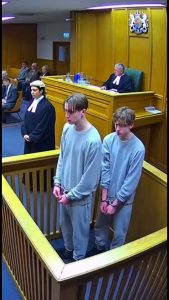
“I didn’t do this,” I shouted, but my words were swallowed by the chaos—the scraping chairs, clicking cameras, and hushed courtroom murmurs that made it clear the verdict about who I was had already been decided.
“I didn’t do this,” I shouted, but my words were swallowed by the chaos—the scraping chairs, clicking cameras, and hushed courtroom murmurs that made it clear the verdict about who I was had already been decided.
I remember the exact moment the room stopped belonging to me, though if you had asked anyone else in that courtroom, they would’ve told you it never did in the first place. It belonged to the judge, to the prosecution, to the cameras, to the story that had already been written long before I ever stood up to speak.
“I didn’t do this!” I shouted, or at least I think I did. The words left my mouth with force, but somewhere between my chest and the far wall, they collapsed under the weight of everything else—the scraping of wooden chairs, the mechanical stutter of camera shutters, the low, satisfied murmur of a crowd that had come not to listen, but to witness an ending they already believed in.
Judge Marlene Hargrove didn’t even look at me when she spoke.
“The defendant is hereby sentenced to life imprisonment without the possibility of parole.”
There are sentences you hear, and then there are sentences you feel. This one didn’t just land—it pressed down, like something with mass, something dense enough to alter the shape of your life in a single instant. My knees gave, just slightly, not enough to fall, just enough to remind me that my body was still there even as everything else was being stripped away.
Two deputies moved in without hesitation, each gripping one of my arms—not cruelly, not violently, but firmly enough to remind me that I no longer belonged to myself. I didn’t resist. Resistance would’ve implied there was still a direction to go, a door left open, some version of this moment where things turned out differently.
There wasn’t.
My name is Lucas Hale.
I was thirty-six years old when I was sentenced.
Before that—before all of this—I had been the kind of man people don’t remember. A senior compliance analyst for a mid-tier financial firm in Cincinnati, Ohio. I had a mortgage that stretched just a little too far into the future, a pickup truck that made a sound I kept meaning to get checked, and a wife—Clara—whose laugh had a way of cutting through even my worst days. Eleven days before the verdict, she gave birth to our son, Oliver.
Eleven days.
That’s all the time I had as a father before becoming something else entirely in the eyes of the world.
A murderer.
According to the prosecution, I had killed investigative journalist Adrian Cross to bury evidence of a massive fraud operation tied to Blackridge Holdings.
According to reality, I had been trying to help him expose it.
But reality is fragile in rooms where power has already decided what version of truth will survive.
Sitting in the front row, dressed in a tailored navy suit that looked like it had never known a wrinkle, was Malcolm Blackridge. Founder of Blackridge Holdings. Billionaire. Philanthropist. The kind of man who funded hospitals and quietly dismantled the lives of anyone who threatened him, all while maintaining the polished image of someone who had earned everything cleanly.
He wasn’t watching the judge.
He was watching me.
And he was smiling.
Behind him sat Clara, pale and trembling, holding Oliver so tightly it looked like she was afraid he might disappear if she loosened her grip. She had stayed. Through the headlines. Through the neighbors who stopped making eye contact. Through the whispered conversations that died the second she entered a room. She had stayed even when staying meant being pulled under with me.
But now, as the deputies began to turn me away, I saw something breaking behind her eyes.
“Your Honor,” I said, my voice catching in a way that felt almost humiliating, “please… just one minute. Let me hold my son.”
There was a pause—not long, not dramatic, but noticeable enough to ripple through the room. A few people shifted. Someone let out a short, uncomfortable laugh. Even the judge hesitated, as if weighing something she didn’t quite want to acknowledge.

Then she gave a small, reluctant nod.
Clara moved toward me carefully, each step measured, as though the wrong movement might shatter whatever fragile permission had just been granted. When she placed Oliver in my arms, everything else—the courtroom, the cameras, the sentence—fell away for a moment.
He was warm.
Incredibly small.
Real in a way nothing else had felt for months.
The cold bite of the handcuffs pressed against my wrists as I adjusted my hold, terrified I might hurt him, even more terrified of having to let go.
I lowered my head, bringing my mouth close to his ear.
And I whispered.
Not loudly. Not dramatically. Just enough.
“Your grandfather kept the ledger behind the cedar panel in the lower cellar,” I murmured. “Tell your mother to find Victor Saldana.”
Oliver stirred, his tiny fingers curling instinctively, wrapping around mine with a grip that was impossibly gentle and yet somehow unbreakable.
And then I looked up.
Malcolm Blackridge was no longer smiling.
He was standing.
Rigid.
The color draining from his face so quickly it was almost surreal.
In that instant, something shifted—not just in him, but in the room itself. It was subtle, but unmistakable, like the air pressure dropping before a storm.
Because fear, real fear, is difficult to hide.
And for the first time since this nightmare began, the man who had orchestrated everything looked like he had just lost control of it.
The silence that followed didn’t feel empty. It felt loaded, stretched tight with something no one had anticipated.
“What did he say?” Blackridge demanded, his voice sharper than it had any right to be in that room, stripped of its usual polish.
Every head turned.
Judge Hargrove struck the gavel. “Mr. Blackridge, sit down.”
But he didn’t. He couldn’t. His eyes were locked on me, then Clara, then the child in her arms, as though trying to calculate damage in real time.
That was when I knew.
I hadn’t guessed wrong.
Months earlier, before everything unraveled, I had stumbled onto discrepancies that didn’t belong—financial movements that didn’t just bend rules, they erased them. Shell companies feeding into charitable fronts, approvals signed by executives who had been dead for years, internal audit trails that looped back on themselves like someone had tried to rewrite history without understanding how carefully it needed to be done.
I copied what I could.
Not enough.
Never enough.
That’s when I reached out to Adrian Cross, one of the last journalists reckless—or honest—enough to chase a story like this. We met twice. Quiet places. No phones. No patterns.
On the second meeting, he told me about something bigger.
“A ledger,” he said, sliding a cheap burner phone across the table. “Handwritten. Old-school. Names, payments, leverage. The kind of thing men like Blackridge keep when they don’t trust digital trails.”
“Where is it?” I asked.
He shook his head. “Hidden. But I’ve got a lead. If anything happens to me, don’t go to the police. They’re not clean.”
Three days later, Adrian Cross was dead.
And forty-eight hours after that, I was in handcuffs.
Back in the courtroom, the ripple had turned into something closer to chaos. A man pushed forward from the back—Victor Saldana, a former federal prosecutor who had quietly built a reputation for dismantling financial empires before walking away under circumstances no one fully understood.
“I move for an immediate review of all sealed evidence,” he said, his voice cutting clean through the noise, “and a stay of transfer pending potential obstruction of justice.”
The prosecutor shot up, outraged, but Saldana didn’t even look at him. His focus remained on Blackridge, who, for the first time, looked like a man being cornered rather than admired.
Clara met my eyes.
And I saw it.
Not certainty.
But something close enough to act on.
“Go,” I mouthed.
That was the moment everything began to unravel.
The real climax didn’t happen in the courtroom.
It happened two nights later, in a place Blackridge thought he had erased from relevance—a vineyard property registered under a dissolved trust, sitting quietly in upstate New York, its ownership buried under layers of paperwork designed to discourage curiosity.
Saldana took Clara there himself.
The house was empty.
Too clean.
Like something had been removed recently, but not everything.
The cellar door resisted at first, swollen from damp and neglect, but when it gave, the smell hit them—aged wood, earth, and something metallic beneath it.
The rack was still there.
Cedar, not oak.
Built into the wall.
At first glance, it looked permanent.
Until it didn’t.
They found the seam.
The hidden latch.
And behind it—
The ledger.
Black leather.
Wrapped in plastic.
And alongside it, a sealed drive labeled in careful handwriting: “In case of failure.”
What they found inside didn’t just expose Blackridge.
It dismantled him.
Payments. Names. Judges. Officers. Accounts. My name included—not as a killer, but as a liability.
Fix before disclosure.
That was the phrase.
Not eliminate.
Not silence.
Fix.
Which, in his world, meant the same thing.
By the time the story broke, it didn’t trickle out—it detonated.
My conviction was halted within days, then overturned entirely as suppressed evidence, manipulated testimony, and financial trails came crashing into the open.
Blackridge was arrested.
So were others.
People no one expected.
The kind of people who had sat quietly in rooms like that courtroom, believing themselves untouchable.
The day I walked out, it was raining lightly.
The kind of rain that doesn’t demand attention, but changes everything anyway.
Clara was there, holding Oliver, who was older now, more aware, his eyes studying me with quiet curiosity.
“This time,” she said, her voice trembling despite the smile, “you get longer than a minute.”
When she placed him in my arms, there were no cuffs. No deputies. No countdown.
Just weight.
Warmth.
Reality, finally returning.
THE LESSON
The truth doesn’t always win because it’s stronger. Most of the time, it loses—quietly, repeatedly—because power is faster, louder, and far better organized. What saves it, when it is saved at all, is timing, courage, and the willingness of someone to act when acting feels impossible. The most dangerous people aren’t the ones who look like villains, but the ones who have learned how to look like saviors, because they are trusted without question. And sometimes, the only way to break that illusion isn’t to shout louder than them—but to say the one thing they hoped would never be spoken aloud.