PART 2: The cruiser’s lights painted the parking lot in alternating red and blue, slow pulses that turned every face into a flickering mask. I stood my ground, phone still warm in my pocket, the helmet cam footage now a silent witness no one could argue with. The rumble of my club’s bikes had settled behind me like a low chord, but I didn’t turn around. I watched the young man’s bravado crumble into something smaller, something that looked a lot like fear.
Two officers stepped out, doors closing with that heavy, official thud that makes everyone feel a little guilty even if they’ve done nothing wrong. The first one, a stocky man with sergeant stripes and a gray mustache, scanned the parking lot the way you’d read a bad contract—slow, skeptical, looking for the clause that’s going to cost you.
— Who called this in?
A woman from the crowd, the same one who’d shouted “What the hell is wrong with you?” a minute ago, pointed at me. Her finger trembled.
— He slapped that kid. Just hit him out of nowhere.
The sergeant’s eyes landed on me and did the math: leather vest, tattoos, gray beard, boots planted like I owned the asphalt. The young man saw the calculation happening and stepped forward, hand still pressed to his reddening cheek, voice pitched to sound younger than he probably was.
— He assaulted me. I was just talking to her, and he—
— He shoved her.
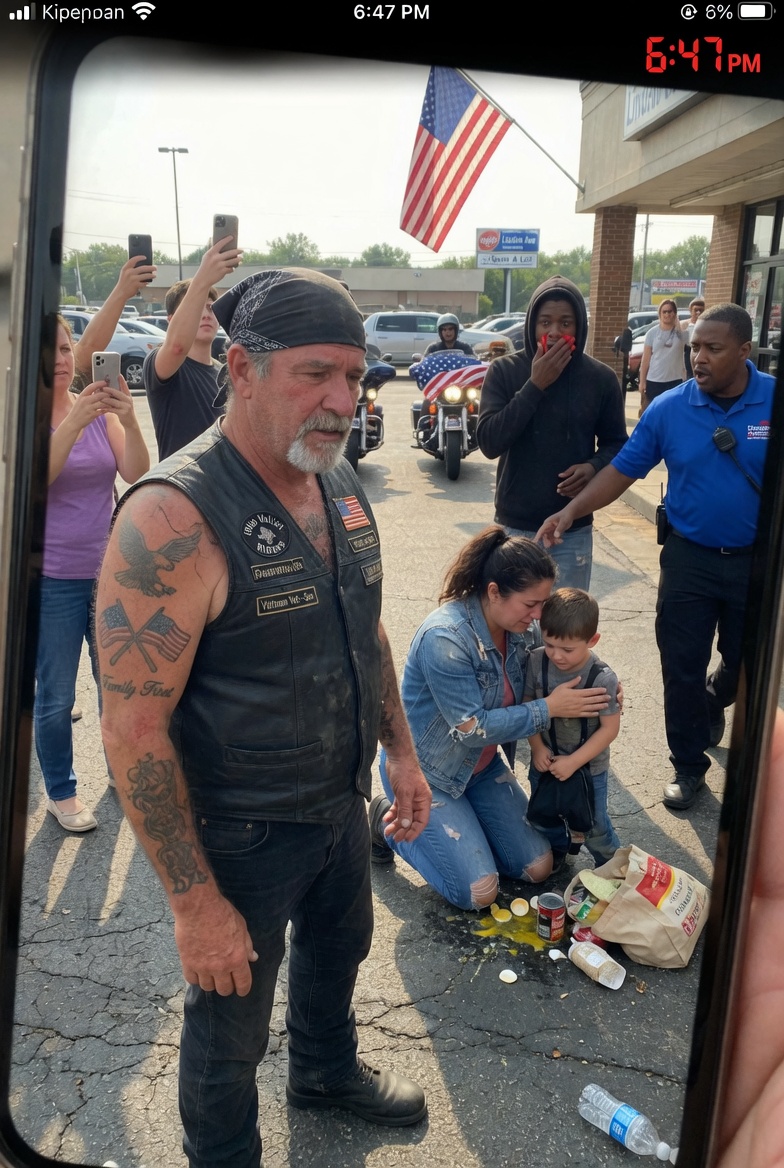
My voice came out level, quieter than I intended. The sergeant looked at Maria, still on her knees, still trying to gather herself while her boy clung to her side. Egg yolk glistened on the concrete. Her palms were scraped raw.
The second officer, a younger woman with a tight ponytail and watchful eyes, moved toward Maria immediately. She crouched, not touching, just present.
— Ma’am, are you hurt?
Maria shook her head, but tears cut clean tracks through the dust on her face. Her son’s lips were pressed thin, the way kids do when they’re trying not to cry because they think it’ll make things worse.
— I’m okay, she whispered. She wasn’t. We all knew she wasn’t.
The sergeant turned back to me. His hand rested on his belt, not threatening, but ready. The posture of a man who’s learned that parking lot disputes can turn into something else in half a heartbeat.
— You got a name?
— Frank Hayes.
— You want to tell me why you struck this young man?
I didn’t answer with words. I pulled out my phone again, unlocked it, replayed the clip. The sergeant took it, held it close, watched. His mustache twitched once. The young man shifted his weight, licked his lips.
— He didn’t have to hit me, the young man said, voice thinner now. That’s still assault.
The sergeant looked up from the screen, then at the young man. Then at me.
— You were intervening to stop an assault yourself. That’s what I’m seeing.
— He could’ve just yelled or something!
— Could’ve, I said. Didn’t.
The young officer helped Maria to her feet. Her son finally let go of the purse strap and wrapped both arms around her waist. A sound escaped him, a small, muffled sob that cut through the parking lot noise sharper than any slap.
The sergeant handed my phone back.
— I’m not going to arrest you, Mr. Hayes. But I’d advise you to let us handle things next time.
I nodded once. I didn’t promise anything. Some promises you can’t keep and still look at yourself in the mirror.
He turned to the young man, whose face had gone pale beneath the reddening mark on his cheek.
— You, on the other hand. Shoving a woman to the ground in front of her child. That’s assault, clear as day. You got ID?
The young man’s jaw tightened. For a moment, I thought he might run. His eyes darted toward the edge of the lot, toward the street, calculating distances. But the rumble of the motorcycles behind me hadn’t died. My club hadn’t moved an inch. They weren’t blocking exits. They didn’t need to. Their presence was enough.
He pulled a worn wallet from his back pocket, handed over a driver’s license. The sergeant read it, wrote something down.
— Marcus Webb. Twenty-one years old. You got a job, Marcus?
Marcus didn’t answer. His eyes fixed on the ground now, shoulders curling inward like a paper burning from the edges.
— He was asking me for money, Maria said suddenly. Her voice cracked but pushed through. I told him I didn’t have any. He didn’t believe me.
The young officer guided Maria a few steps away from the scene, toward the front of the store where a bench sat near the shopping carts. Her son walked pressed against her, looking back at Marcus with an expression I recognized. Not hatred. Confusion. The look of a child learning that the world can be sharp-edged without warning.
— Why’d you need money? the sergeant asked Marcus.
Silence. A long exhale. Then, so quiet I almost missed it:
— I was hungry.
The words landed like a stone dropped into still water. The crowd, which had been murmuring and shifting, went quiet. Even the woman who’d pointed at me lowered her hand.
Hungry.
I’d been hungry before. Not the kind of hungry you fix with a snack. The kind that hollows out your stomach and your pride at the same time. The kind that makes you look at a woman with a thin jacket and a bag of groceries and see not a person but a possibility. I knew that hunger. I’d worn it like a second skin through my twenties, after the factory closed, after my mother died, after I realized the world didn’t owe me anything but I still had to eat.
But knowing it didn’t excuse it.
— You shoved her, I said, not loud. You scared her kid.
Marcus looked at me then. Really looked. And for a split second, the anger peeled back and I saw what was underneath. Not a monster. A kid who’d run out of options and didn’t know how to ask for help without demanding it. I’d seen that look before. I’d worn it.
But I’d also been the boy clinging to his mother’s purse while a man’s shadow fell across the kitchen floor. I’d heard the slap that wasn’t directed at me but still rearranged something inside my chest. I’d learned, years later, that some lines have to be drawn so firmly that they leave a mark. Not because you want to. Because the alternative is worse.
The sergeant cuffed Marcus, not aggressively, just efficiently, and read him his rights. Marcus didn’t resist. His shoulders slumped, and he walked to the cruiser like a man who’d been waiting for the other shoe to drop for a very long time.
As he passed me, he paused. The officer didn’t stop him.
— You didn’t have to hit me, he said again, but this time it wasn’t anger. It was a question dressed up as a statement.
— Maybe not, I said. But you didn’t have to push her. We both made choices. Only one of us was protecting someone.
He stared at me for a long moment. Then he ducked his head and climbed into the back of the cruiser. The door closed with a sound that felt final.
The crowd began to break apart, murmuring, re-evaluating. A few people avoided my eyes as they passed. The woman who’d pointed at me walked by, opened her mouth, closed it, and hurried toward her car. I didn’t blame her. I’d judged plenty of men in my time. We all see what we expect to see until the evidence makes it impossible.
And that’s when I finally turned around.
My club stood in a loose line behind me. Five bikes. Five riders. Big Mike, sixty years old with a white beard and arms like bridge cables, stood closest. Next to him, Annie, a former army mechanic who could strip an engine blindfolded and had a laugh that filled any room. Then Leo, quiet and watchful, a man who’d pulled me out of a bar fight twenty years ago and never mentioned it again. Beside him, Tweak, wiry and restless, who’d been a kid on the streets until the club gave him a garage and a reason to wake up. And finally, Preacher, who wasn’t actually a preacher but had a way of speaking that made you want to be better without him ever saying the word.
They hadn’t said a word during the whole exchange. They didn’t need to. Their presence was the message: you don’t stand alone.
Big Mike stepped forward, hands in his pockets, expression unreadable.
— Helmet cam, huh?
— Always on, I said.
— Smart.
— Paranoid.
He almost smiled. Annie shook her head, her short gray hair catching the last of the afternoon light.
— You couldn’t have just yelled at the kid?
— Yelling doesn’t always stop momentum.
She studied me. We’d had this conversation before, in different forms, over campfires and cold beers. The line between protection and aggression. When a hand becomes a weapon. When silence becomes complicity. She didn’t agree with me, not entirely. But she understood. That was enough.
Preacher walked over to Maria, who was sitting on the bench now, her son beside her, the new carton of eggs and bag of rice that Leo and Tweak had quietly retrieved sitting at her feet. Preacher crouched, his knees popping, and spoke low enough that I couldn’t hear. Whatever he said, Maria nodded, and her shoulders dropped half an inch. Preacher had that effect on people.
I approached slowly, giving her space. The boy looked up at me, eyes still red-rimmed but less afraid now.
— You’re not going to hit anyone else? he asked.
— Not planning on it.
— Why’d you do it, then?
I knelt, so we were at the same level. My knees ached. The pavement was hard. None of that mattered.
— Because your mom was on the ground and nobody else was stopping it. Sometimes people need someone to step in.
— But you hit him.
— I did. And I’d rather not have. But sometimes a sharp sound is the only thing that gets through. Does that make sense?
He thought about it. Then he nodded, very slightly.
— My dad used to yell. Not hit. But yell real loud. Mom took me away from him.
The words hit me square in the chest. I’d guessed, from the way Maria flinched at shadows, that there was a history. You don’t kneel on asphalt in front of a stranger without having learned somewhere that resistance might make things worse.
— You and your mom are safe now, I said. That’s what matters.
Maria looked at me, her eyes puffy but steady.
— Thank you. I don’t know what would have happened if you hadn’t—
— Don’t. You don’t need to thank me. You need to go home, put something warm in your stomach, and let your boy see that the world isn’t all sharp edges. Can you do that?
She nodded. Then she glanced toward the patrol car, where Marcus sat silhouetted behind the glass.
— He was hungry, she said, quietly. I know that doesn’t excuse it. But—
— It doesn’t, I agreed. But it explains it. Doesn’t mean he gets a pass. Means maybe he gets a second chance later, if he chooses to take it.
I stood, joints protesting, and walked back toward my bike. The club gathered around me, a loose circle of leather and worn denim. Leo handed me a bottle of water. I took a long drink.
— You okay? he asked.
— I’ll be fine.
— You’re shaking.
I looked down at my hands. He was right. The tremor was subtle, but it was there. Not from fear. From something older, something that lived in the basement of my memory and only surfaced when a child cried or a woman hit the ground.
— Adrenaline, I said. It’ll pass.
Leo didn’t push. That’s the thing about men who’ve known you for decades. They know when to ask and when to just stand there, steady as a wall.
The police cruiser pulled out of the lot, Marcus inside. The crowd was nearly gone now, just a few stragglers pretending to check their phones. The store employees had gone back inside. Ordinary noise returned—shopping carts rattling, car engines turning over, a baby crying somewhere near the entrance.
Big Mike mounted his bike and looked at me over the handlebars.
— We’re heading to Molly’s for a drink. You coming?
— Yeah. Give me a minute.
The engines started one by one, a low, controlled rumble that felt less like noise and more like breath. They pulled out of the lot in formation, leaving me alone with the fading light and the egg stain on the asphalt.
I sat on the curb and stared at it for a while.
The egg stain. Yellow and slick, already drying at the edges. It was such a small thing, really. A carton of eggs, probably three dollars. But it had been enough to knock her down. Enough to make her son cry. Enough to make me swing my hand.
And enough to make a crowd of strangers decide I was the villain for a handful of seconds.
That’s the part that stuck with me, sitting there as the sun dropped lower and the streetlights flickered on. How fast they’d turned. How certain they’d been. And how easily I could have been the bad guy in the version of the story that got told without the footage.
I thought about the phone in my pocket. The helmet cam. A piece of technology I’d installed after an insurance dispute three years ago, when a driver sideswiped me at an intersection and swore I’d run the red. I’d been recording ever since, not because I expected trouble, but because I’d learned that the truth is a fragile thing. It needs proof. Without proof, it’s just one person’s word against another, and the louder voice usually wins.
Today, the proof had been on my side. But how many times had it not been? How many times had someone’s life tilted on the axis of a single misinterpreted moment?
I stood, brushed off my jeans, and walked to my bike. A 2008 Harley Softail, scratched and weathered, with a dent in the tank from a hailstorm in Nebraska. I’d ridden it through seventeen states, three relationships, and one funeral. It felt like an extension of my body at this point. I swung a leg over, paused, and looked back at the grocery store. The automatic doors slid open and closed, open and closed, swallowing people and spitting them out with their carts and their lists and their ordinary lives.
I wondered if any of them would remember this tomorrow. If the cashiers would whisper about it. If Maria would sleep tonight or lie awake replaying the shove, the fall, the crack of my hand.
I wondered if Marcus, sitting in a holding cell somewhere, would replay it too.
I started the engine and rode.
Molly’s was a bar on the east side of Dayton, a place with sticky floors and a jukebox that still played CDs. The kind of place where nobody asked questions and everybody knew your name but didn’t use it unless they had to. The club had claimed the back corner decades ago, and the owner, a sharp-eyed woman named Jolene, kept the table reserved whether we showed up or not.
Tonight, the table was full. Big Mike, Annie, Leo, Tweak, Preacher. A few others who hadn’t made it to the parking lot but had heard the rumble and followed. I walked in and the conversation dipped for half a second, then resumed. Normal. That was the rule. You didn’t make a scene about a scene.
I slid into the booth next to Preacher, and Jolene brought me a beer without asking.
— You look like you wrestled a ghost, she said.
— Just a parking lot.
She raised an eyebrow but didn’t press. I took a long sip. The cold cut through the dust in my throat.
Big Mike leaned back, arms crossed.
— You know that footage is going to end up online.
— Probably.
— You ready for that?
I hadn’t thought about it. I’d given the sergeant my phone to watch, but I hadn’t shared it anywhere. Still, enough people in that parking lot had been recording. Someone had probably already uploaded their version—the slap, the shove, maybe even a shaky shot of my phone screen showing the helmet cam clip. The internet had a way of finding things.
— I didn’t do anything I’m ashamed of.
— Didn’t say you did, Big Mike said. But people are going to have opinions. Some of them are going to call you a hero. Some are going to call you a thug. Neither one will be entirely right.
I nodded. He was right. I’d seen it happen to other people—that moment when a private act becomes public property, when strangers dissect your choices like they’re reading a script you never wrote. I wasn’t looking forward to it.
Annie leaned forward, elbows on the table.
— The kid you hit. Marcus. You think he’s going to press charges?
— He could try. But the sergeant seemed clear on where things stood. He shoved a woman. I intervened. The footage backs it up.
— Still, Annie said, you connected. That’s a line. Some prosecutors might see it differently.
— Then I’ll deal with it.
She held my gaze for a moment, then nodded slowly.
— You always do.
The conversation drifted after that, into safer waters. Tweak talked about a rebuild he was doing on a ’78 Shovelhead. Leo mentioned a charity ride coming up, something for a children’s hospital, and we all agreed to show. Preacher told a story about getting lost in West Virginia and finding a diner that served the best peach cobbler he’d ever tasted. It was ordinary. Comfortable. The kind of evening I’d had a hundred times before.
But underneath it, I was still in that parking lot. Still seeing Maria on her knees. Still hearing the boy’s muffled sob. Still feeling the sting of my palm and the weight of what came after.
Around ten, I paid my tab and stepped outside. The night air had cooled, carrying the faint smell of cut grass and exhaust. Leo followed me out, hands in his jacket pockets.
— You sure you’re okay?
— I’m fine.
— You always say that.
— Because it’s usually true.
He didn’t argue. We stood in silence for a minute, watching the traffic move along the street, headlights painting stripes across the asphalt.
— You know, he said finally, I was in a situation once. Years ago. Before the club. I saw a guy shove his girlfriend outside a bar. I stepped in, pulled him back, told him to knock it off. He swung at me. I put him on the ground. The girl yelled at me. Said I had no right to interfere. Said they were just arguing and I made it worse.
— What’d you do?
— I left. Thought about it for weeks. Wondered if I should have just walked by. But you know what? A year later I saw her again, at a gas station. She had a black eye. I asked if she was okay. She said she was. I don’t know if she was lying. But I know I’d have hated myself more if I’d done nothing.
I let that sit. The thing about intervention is that you never get to see the full ripple. You throw a stone into the water and the circles spread out in directions you can’t predict. Some of them might push someone toward safety. Some might push someone away. You don’t get to control it. You just get to make the choice.
— I’m not going to lose sleep over Marcus, I said.
— Good.
— But I might lose sleep over Maria. And her boy.
Leo nodded.
— Then do something about it.
I looked at him.
— Like what?
— You’ve got a helmet cam. You’ve got a story. Use it.
I frowned, not understanding.
— Write it down, he said. Or record it. Or both. Tell people what happened, from your side. Not for fame. Not for justification. For the record. Because right now, that parking lot is full of people who saw a biker hit a kid. The footage might clear you legally, but it won’t change the first impression. The first impression is what sticks.
I thought about that as he went back inside. Write it down. I wasn’t a writer. I’d barely finished high school. But I knew how to tell a story. I’d spent decades around campfires and bar tables, spinning yarns about the road, the people I’d met, the close calls and the long silences.
Maybe he was right. Maybe the only way to own the narrative was to tell it yourself.
I rode home that night with the idea turning over in my head.
My apartment was a small one-bedroom above a hardware store, the kind of place where the floors creaked and the radiator clanked but the rent was cheap and the landlord didn’t mind the motorcycle parked out front. I’d lived there for twelve years. The walls were covered with photos—my mother, my late brother, the club on various rides, a map of the continental U.S. with routes marked in red marker.
I sat at the kitchen table, opened my laptop, and stared at the blank screen for a long time. The cursor blinked. I typed a sentence. Deleted it. Typed another. Deleted that too.
Then I thought about Maria’s son. The way he’d asked, “You’re not mad?” The way he’d nodded when I explained why I’d done what I’d done. The way he’d said, “My dad used to yell.”
I thought about Marcus. The hollow look in his eyes when he said, “I was hungry.” The way his shoulders curled inward, like he’d been expecting a blow for a long time and was almost relieved when it came.
I thought about my mother. The way she’d count change on the kitchen table, the way she’d flinch when my father’s voice rose, the way she’d tell me, years later, that she stayed because she didn’t know where else to go. The way my father never hit her—not exactly—but used his voice like a fist, pounding the walls of our home until there was nothing left but rubble and silence.
I started typing.
I wrote about the parking lot. The slap. The crowd. The helmet cam. I wrote about Maria and her son, about the eggs cracked on the asphalt, about the way nobody moved until someone did. I wrote about Marcus, not as a villain, but as a kid who’d been hungry long enough to forget how to ask nicely. I wrote about the club, the way they’d shown up without being called, the way they’d picked up groceries and offered presence instead of threats.
I wrote until my eyes burned and my coffee went cold. Then I read it back, edited it, read it again. It wasn’t polished. It wasn’t professional. But it was true.
I posted it to my Facebook page at three in the morning, not expecting much. A few likes. Maybe a comment from Annie or Preacher. Then I went to bed and slept for the first time in what felt like days.
When I woke up, the world had shifted.
My phone buzzed with notifications. Hundreds of them. Thousands. The post had been shared so many times I couldn’t scroll to the bottom. Comments poured in—some supportive, some angry, some demanding more context. News outlets had reached out, their messages buried in my inbox like seeds waiting to sprout. A local TV station wanted an interview. A national podcast asked if I’d be willing to tell my story on air.
I sat on the edge of my bed, staring at the screen, my chest tight.
— What did I do? I muttered.
I called Preacher. He answered on the first ring, his voice rough with sleep.
— You seen it?
— Yeah, he said. You’re famous, Frank. Or infamous. Depends on who’s reading.
— I didn’t mean for—
— I know. But you told the truth. That’s rare. People are hungry for it. Just be careful. The internet is a hungry beast, and it’ll eat you if you let it.
I spent the morning fielding calls. A reporter from the Dayton Daily News was polite but persistent. I agreed to a phone interview, kept it short, stuck to the facts. Yes, I intervened. Yes, I slapped him. Yes, the footage showed what happened. No, I didn’t enjoy it. No, I didn’t regret it. Yes, I would do it again if I had to.
The article went up that afternoon, with a screenshot from the helmet cam footage—blurred for privacy, but clear enough to show Maria on the ground and Marcus standing over her. The headline read: “Local Biker Intervenes in Assault, Sparks Debate Over Vigilante Justice.”
By evening, the debate was everywhere. Facebook comment sections turned into battlefields. Pundits weighed in. Someone dug up my old arrest record—a bar fight from 1998, charges dropped—and tried to use it to paint me as a violent man. Someone else found a photo of me at a charity event, handing out toys at a children’s hospital, and used that to paint me as a saint.
Neither version was true. I was just a man who’d made a choice in a moment when a choice was needed.
The only perspective I truly cared about came two days later, in the form of a handwritten note slipped under my apartment door.
I found it when I came home from a ride, the envelope plain and unmarked. Inside, a single sheet of lined paper, folded neatly. The handwriting was careful, the letters rounded, the kind of penmanship you learn when you’re trying to make something look important.
“Mr. Hayes,
I don’t know if you remember me. My name is Maria Delgado. I’m the woman from the parking lot. The one with the eggs.
I wanted to write because I saw the article in the paper. I saw what people were saying. Some of it made me angry. Some of it made me cry. But most of it made me realize I never really thanked you properly.
My son, Diego, has been asking about you. He wants to know if you’re okay. He wants to know if the man you slapped is okay too. I don’t know how to answer that second question, but I’m trying to teach him that people are complicated. That someone can do something wrong and still not be a monster.
I was in a bad marriage for six years. My husband never hit me, but he made me feel small. Every day. When that young man shoved me, I felt small again. I felt like I deserved it somehow. Like I was back in that house with the curtains drawn and the TV loud enough to cover the yelling.
You stepping in didn’t just stop him. It reminded me that I don’t have to stay on the ground. That someone might actually care enough to help me up.
I don’t know how to repay that. But if you ever want a cup of coffee, or just someone to say thank you in person, I’d like that. Diego would too.
We’re staying at my sister’s place on Oak Street. Apartment 3B. Saturday mornings we make pancakes. If you’re free, there’s always extra batter.
Thank you, Mr. Hayes. For everything.
— Maria Delgado”
I read the letter three times. By the third time, my eyes were wet. I set it down on the kitchen table, next to the cold coffee and the blinking laptop, and I let myself feel the full weight of it.
Then I picked up my keys and walked out the door.
The hardware store below my apartment had a small section of greeting cards. I picked one out—simple, blank inside—and a bag of good pancake mix, the fancy kind with blueberries. I added a carton of eggs. Fresh ones. Not cracked.
I drove to Oak Street and found Apartment 3B. The building was older, the paint peeling in places, but the porch was swept clean and a pot of marigolds sat by the door. I knocked, the grocery bag dangling from my wrist.
Diego opened the door. He looked up at me, eyes wide, and then his face split into a grin.
— Mom! The biker’s here!
Maria appeared behind him, wearing an apron dusted with flour. She looked better than she had in the parking lot—more color in her cheeks, less weight on her shoulders. She smiled, a real smile, and something loosened in my chest.
— Mr. Hayes, she said. You came.
— Call me Frank. And I brought eggs.
I held up the carton. She laughed, a small, surprised sound, and stepped aside to let me in.
The apartment was small but warm. Furniture that didn’t match but was clean and comfortable. Children’s drawings on the fridge. The smell of pancakes and coffee in the air. Diego led me to the kitchen table, chattering about his favorite cartoon and the new bike his mom promised him for his birthday. I sat down, feeling larger than the space allowed, and yet somehow not unwelcome.
Maria poured me a cup of coffee and set a plate of pancakes in front of me. We didn’t talk about the parking lot right away. We talked about small things—weather, school, the best pancake toppings. Diego insisted that chocolate chips were superior to blueberries, and I told him I’d arm-wrestle him for the last of the syrup. He laughed. It was a good laugh, full and unguarded. A laugh that hadn’t been in the parking lot.
After breakfast, Diego went to the living room to watch cartoons. Maria and I sat at the kitchen table, the plates cleared, the coffee cooling.
— I meant what I said in the letter, she said quietly. You reminded me I don’t have to stay on the ground.
— You were never going to stay there, I said. You were already getting up. I just made sure nobody pushed you again before you could.
She looked down at her hands. The scrapes from the asphalt had scabbed over, dark against her skin.
— I’ve been on the ground before. Metaphorically. For years. When I finally left my husband, I promised myself I’d never let anyone push me again. And then that kid… he didn’t even have to try hard. I folded. Just like that.
— That’s not folding. That’s surviving. You froze. It happens. It doesn’t mean you’re weak.
— I felt weak.
— You’re not. You wrote me a letter. You invited a stranger to breakfast. That takes courage.
She smiled faintly.
— You’re not a stranger anymore.
We talked for a while longer. About her job—she worked at a nursing home, twelve-hour shifts, not enough pay. About Diego’s school, his struggles with reading, his love of drawing. About her sister, who’d taken them in after the divorce and treated Diego like her own. About the slow, difficult process of rebuilding a life from the rubble of someone else’s temper.
And then, inevitably, about Marcus.
— Do you know what happened to him? she asked.
— I called the station. He was charged with misdemeanor assault. Released on bail. Court date in a few weeks.
— Will you testify?
— If they ask me to. I’ll tell the truth. What I saw. What I did.
She nodded slowly.
— Do you think he’ll go to jail?
— I don’t know. Maybe. Maybe not. It depends on the judge, his record, whether he gets a good lawyer. But jail won’t fix what’s broken in him. That takes something else.
— What?
— Someone who sees him clearly and still offers a hand. I’m not sure I’m that person. But someone needs to be.
She looked at me, her dark eyes thoughtful.
— You’re more forgiving than I expected.
— I’m not forgiving. I’m realistic. That kid—Marcus—he shoved you because he was desperate. Desperation makes people ugly. I’ve been ugly. I’ve done things I’m not proud of. Someone gave me a second chance once. Without it, I’d probably be dead or in prison by now.
— Who gave you a second chance?
I leaned back, the chair creaking under my weight.
— A man named Henry. He owned a garage in Kentucky. I showed up one day, hungry and angry, looking for something to steal. He caught me trying to siphon gas from his truck. Instead of calling the cops, he offered me a job. Let me sleep in the back room for two weeks until I got on my feet. Never asked for anything in return. Just said, “You’re better than this. Act like it.”
— And you believed him?
— Not at first. But he kept saying it. And eventually, I started to act like it. Fake it till you make it, I guess. Eventually, it wasn’t fake anymore.
— Where is he now?
— Died about ten years ago. Heart attack. But I still think about him every time I see someone at a crossroads. Someone who could go either way. I don’t know which way Marcus is going to go. But I hope someone says the right thing to him. I hope someone sees more than a thug.
Maria was quiet for a moment. Then she reached across the table and squeezed my hand.
— Thank you, she said. Not just for the parking lot. For this. For coming here. For talking to Diego. For being a person who thinks about things.
I squeezed back, gently.
— Thank you for the pancakes.
She laughed, and the sound filled the small kitchen like sunlight.
I left a few hours later, with Diego’s drawing of a motorcycle tucked under my arm and a promise to come back next Saturday. As I walked down the stairs, the marigolds by the door caught my eye—bright orange, stubbornly cheerful, growing out of a cracked plastic pot.
Maria was like those marigolds, I thought. Rooted in something broken but still reaching for the sun.
Marcus was a different kind of plant. A weed, maybe, twisted and starved for light, growing in the crack of a sidewalk where nothing else could survive. He’d pushed someone down to get what he needed. That wasn’t okay. But it also wasn’t the whole story.
I thought about the court date. I’d be there. I’d tell the truth. But maybe, before I did, I’d find a way to say something else to Marcus. Something that wasn’t a slap. Something that might take root.
I didn’t know what that would look like yet. But I had a few weeks to figure it out.
The club met at Molly’s the following Thursday. Word had spread about the Facebook post, the news article, the ongoing debate. A few members had gotten questions from family and friends. Some had defended me. Some had stayed quiet. All of them showed up at the usual table, beers in hand, and looked at me like they were waiting for something.
Big Mike spoke first.
— So. You’re a writer now.
— Apparently.
— You any good?
— Not really. But I’m honest.
— Honest counts for something.
Annie leaned forward.
— There’s a guy on Twitter calling you a fascist. Another one called you a hero. I’m not sure either of them read past the headline.
— I don’t read the comments anymore.
— Smart, she said.
Preacher nursed his beer, his eyes thoughtful.
— You know what I’ve been thinking about? That moment. The slap. You could have grabbed him. You could have shoved him back. But you slapped him. Open hand. Why?
I hadn’t really analyzed it. It had been instinct, not calculation. But I sat with the question for a minute, turning it over.
— A punch feels like a fight, I said finally. A slap feels like a correction. I wasn’t trying to fight him. I was trying to stop him. Make him aware. Shock him out of whatever tunnel he was in.
— Did it work?
— For a second. Then he got angry. But in that second, he stopped pushing. He looked at me. He saw that someone was watching. That’s all I needed. Just that pause.
Preacher nodded slowly.
— The pause is where change happens. If you’re lucky.
— If you’re lucky, I agreed.
Tweak, who’d been quiet most of the night, set his bottle down with a clink.
— I got shoved once. When I was a kid. Homeless. Some guy wanted my sleeping bag. I fought back, got my *ss kicked. Nobody stepped in. I lay on the pavement for an hour before someone called an ambulance. I still got scars on my ribs.
He lifted his shirt to show a pale, jagged line.
— That woman, he said. Maria. She’s lucky you were there.
— She shouldn’t have to be lucky.
— No. She shouldn’t. But that’s the world we live in. Until it changes, people like us have to be there.
People like us. He meant the club. He meant the men and women who’d seen the underside of things, who carried their own scars and their own codes. We weren’t heroes. We weren’t saints. But we showed up. That counted for something.
The meeting broke up around midnight. I walked out into the cool night air, the street quiet except for the distant hum of the highway. Leo fell into step beside me.
— You going to see that kid in jail? Marcus?
— I’ve thought about it.
— You should. Not for him. For you. So you can look him in the eye and see him as a person. Otherwise he’s just a symbol in your head. And symbols are easier to hate than people.
I looked at him.
— When did you get so wise?
— I’ve always been wise. You just don’t listen.
I snorted. But he was right. I’d been thinking about Marcus as a problem to be solved, a story to be told, a lesson to be learned. I hadn’t thought about him as a person. Not really. I’d said the right things to Maria, about second chances and desperation, but I hadn’t faced him since the patrol car door closed.
Maybe it was time.
The county jail was a low, gray building on the outskirts of town, surrounded by chain-link fence and razor wire. I’d been there once before, years ago, to pick up a club member who’d gotten into a bar fight. It hadn’t changed. The same fluorescent lights. The same smell of disinfectant and sweat. The same heavy clang of doors closing.
I filled out the visitor request, waited in a plastic chair, and tried not to think about how many people had sat in this same room with the same knot in their stomach. After forty minutes, a guard led me to a small room with a glass partition and a phone on each side.
Marcus shuffled in on the other side. He looked smaller in the orange jumpsuit. Younger. The mark on his cheek had faded to a faint bruise. He sat down, picked up the phone, and stared at me through the glass.
Neither of us spoke for a long moment.
— Why are you here? he asked finally.
— I wanted to see how you were doing.
He laughed, a short, humorless sound.
— I’m in jail. How do you think I’m doing?
— Fair point.
Silence again. Then:
— You here to gloat?
— No.
— Then why? You already made me look like a fool. Your little video is all over the internet. Everyone thinks I’m some kind of monster.
— I don’t think you’re a monster.
He blinked. Something flickered in his eyes—surprise, maybe, or suspicion.
— What do you think I am?
— I think you’re hungry. And scared. And angry. And you don’t know what to do with any of those things, so you push people. You push until someone pushes back. And today, someone did.
He stared at the counter in front of him, jaw tight.
— You don’t know me.
— You’re right. I don’t. But I’ve been where you are. Not jail. Not exactly. But that place where you feel like the whole world is against you and the only way to survive is to take what you need before someone takes it from you. I lived in that place for years. It almost k*lled me.
He looked up.
— What got you out?
— Someone saw me clearly and offered a hand. I’m not offering you a hand. I’m not there yet. But I’m offering you five minutes of me seeing you clearly. No camera. No crowd. Just a man looking at another man and saying: you’re better than what you did.
His lip curled, but it was weak. A reflex, not conviction.
— You don’t know that.
— You’re right. I don’t. But I’m willing to find out. Your court date is in two weeks. I’ll be there. I’m going to tell the truth about what happened. But after that, if you want to talk, I’ll listen. No promises. No lectures. Just an ear.
He stared at me, his expression unreadable. Then, very quietly:
— Why?
— Because someone did it for me. And I owe a debt.
The guard tapped his watch. Time was up. I stood, set the phone back in its cradle. Marcus didn’t move. As I walked away, I heard him say something through the glass. I couldn’t make out the words. Maybe it was thank you. Maybe it was something else. It didn’t matter. The door had opened a crack. What happened next was up to him.
I walked out of the jail and into the afternoon sun, my chest feeling lighter than it had in weeks. Not because I’d fixed anything. Because I’d started something. A thread. Thin, fragile, maybe nothing. But threads can become ropes if you weave them carefully enough.
The court date arrived faster than I expected. The courtroom was small, wood-paneled, smelling of old paper and nervous sweat. Maria sat in the front row, her sister beside her. Diego wasn’t there—she’d decided it was better for him to stay in school, keep things normal. I sat a few rows back, wearing my cleanest shirt and a jacket that covered most of my tattoos.
Marcus stood before the judge, shoulders hunched, voice low. The public defender spoke about mitigating circumstances—poverty, lack of prior record, remorse. The prosecutor pointed to the helmet cam footage, the shove, the child’s presence. Maria’s victim impact statement, read aloud by the prosecutor, was brief and generous. She didn’t ask for jail time. She asked for accountability. She asked for Marcus to get help.
Then the judge called me to the stand.
I walked up, swore the oath, and sat in the chair that had held thousands of stories before mine. The prosecutor asked me to describe what I’d seen. I did. The shove. The fall. The slap. The aftermath. I kept my voice steady, my words simple.
Then the defense attorney cross-examined me. A wiry man with a sharp face and a skeptical tone.
— Mr. Hayes, you struck Mr. Webb. Is that correct?
— Yes.
— Why didn’t you use words instead?
— I’ve found that sometimes words aren’t enough. A shove is a physical act. It takes a physical act to stop it.
— So you believe in vigilante justice?
— I believe in protecting people who can’t protect themselves in the moment. If that makes me a vigilante, then call me that. I prefer to think of it as being a witness who didn’t just watch.
The defense attorney frowned but moved on.
— You’ve been arrested before, haven’t you? A bar fight in 1998.
— Yes. Charges were dropped. It was self-defense.
— So you have a history of violence.
— I have a history of surviving situations where violence found me first. There’s a difference.
— And do you feel any remorse for slapping Mr. Webb?
I paused. The courtroom was silent.
— I wish I hadn’t had to, I said. But no. I don’t feel remorse for stopping him. I feel sad that he was in a place where shoving a woman felt like his only option. I feel hopeful that he might find a different path. But I don’t regret the slap. If I had to do it again, I would.
The defense attorney had no further questions.
I stepped down and returned to my seat. Maria reached back and touched my shoulder briefly, a silent gesture of thanks.
The judge took a recess to deliberate. When she returned, her face was grave.
— Mr. Webb, she said, you made a terrible choice that day. You frightened a child. You injured a woman. You acted out of desperation, but desperation is not a license to harm others. However, I’m taking into account your lack of prior record, your cooperation with law enforcement, and the wishes of the victim, who has shown remarkable compassion.
She sentenced him to one year of probation, mandatory counseling, and 100 hours of community service. No jail time, provided he complied. If he violated any condition, he’d serve six months.
Marcus’s shoulders dropped. Relief, maybe. Or exhaustion. He glanced at me once, quickly, before being led out of the courtroom.
Outside, the sun was bright, almost mocking. Maria and her sister hugged me, and I promised to come for pancakes again on Saturday. Then I stood on the courthouse steps, watching the traffic move by, and thought about the thread. It was still there. Still fragile. But maybe a little stronger.
Over the next few months, things settled into a new rhythm. The Facebook post continued to circulate, but the comments section eventually quieted. The news cycle moved on to other stories. I went back to my ordinary life—rides, club meetings, repairs at the garage. But some things had changed.
Maria and Diego became part of my life. Saturdays at their apartment became a regular thing, pancakes and laughter and Diego’s drawings covering my refrigerator. I taught him how to ride a bicycle, running alongside him on the sidewalk until he found his balance. Maria and I talked for hours, about her past, about my past, about the strange, winding roads that had brought us both to that parking lot.
The club embraced them too. Annie taught Diego how to check the oil on a motorcycle. Big Mike made him a tiny leather vest with a patch that said “Junior.” Preacher gave Maria a book of poetry that she kept on her nightstand. Tweak built a small wooden box for Diego’s art supplies. Leo never said much, but he always made sure there were extra pancakes on the griddle when we all got together.
Marcus completed his community service at a food bank. I know because I checked. He went to his counseling sessions. He didn’t reach out to me, and I didn’t push. The thread was there if he needed it. That was enough for now.
One evening, as summer faded into autumn, I sat on the curb outside the grocery store where it all happened. The egg stain was long gone, scrubbed away by rain and foot traffic. The parking lot was busy, ordinary, unremarkable. No one here knew what had happened months ago. Or if they did, they didn’t think about it anymore.
But I thought about it. I thought about the choices we make in split seconds. The way a single motion—a shove, a slap, an open hand—can ripple outward in directions we can’t predict. I thought about the crowd that had condemned me and then recanted. I thought about the people online who’d called me a hero and the ones who’d called me a thug. I thought about Maria, rising from the asphalt like a marigold from a cracked pot. I thought about Marcus, somewhere out there, carrying his probation and his hunger and his fragile thread of hope.
And I thought about my mother. The way she’d flinch. The way I’d promised myself, as a boy, that I would never be the man who made someone flinch. And yet, in becoming the man who stopped the flinch, I’d used my hand. I’d drawn a line. I’d become, for a split second, the very thing I feared.
Was that wrong? I still didn’t have a clean answer. Maybe there wasn’t one. Maybe some questions aren’t meant to be resolved, only held. Held with honesty. Held with humility. Held with the willingness to be judged and to keep standing anyway.
A car pulled into the lot. A woman got out, pushing a cart, a little boy running ahead of her. They were laughing about something. The boy had a gap-toothed smile and sneakers that lit up when he ran. The woman looked tired but happy, the kind of tired that comes from a long day of work and a longer day of love.
I watched them for a moment. Then I stood up, walked to my bike, and put on my helmet.
The cam was still recording.
I smiled faintly at the blinking red light.
Then I started the engine and rode toward whatever came next, the road unwinding ahead of me like a story that wasn’t finished.
Because it wasn’t. None of our stories are. Every day, we get another page. Another choice. Another chance to decide what kind of person we want to be.
I’d decided, that day in the parking lot. And I’d decide again tomorrow. And the day after that. That was the only justice that mattered—the justice we build with our own hands, one moment at a time.
And if someone asks me, years from now, about the slap and the helmet cam and the crowd that almost got it wrong, I’ll tell them the same thing I told Diego, the same thing I told Marcus through the glass, the same thing I tell myself in the quiet hours before dawn:
You can’t control what people see. You can only control what you do. So do it clearly. Do it firmly. And if you have to draw a line, make sure it’s one you can stand by when the cameras turn off and the crowd goes home.
The engine hummed beneath me, steady and sure, as the grocery store faded in my mirrors. The marigolds at Maria’s apartment would be blooming again soon. Diego would be waiting with his drawings. Pancakes would be on the griddle. And somewhere, Marcus would be waking up to another day of probation, another chance to weave his own thread.
The world kept turning. The asphalt kept wearing down. And somewhere inside me, the sound of that slap still echoed—not as violence, but as a note struck in a chord I was still learning to play.
I twisted the throttle and let the road take me.
The story wasn’t over. It never would be.