PART 2: The neighbor’s voice cut through the morning like a siren before the sirens came.
— I’m calling the police.
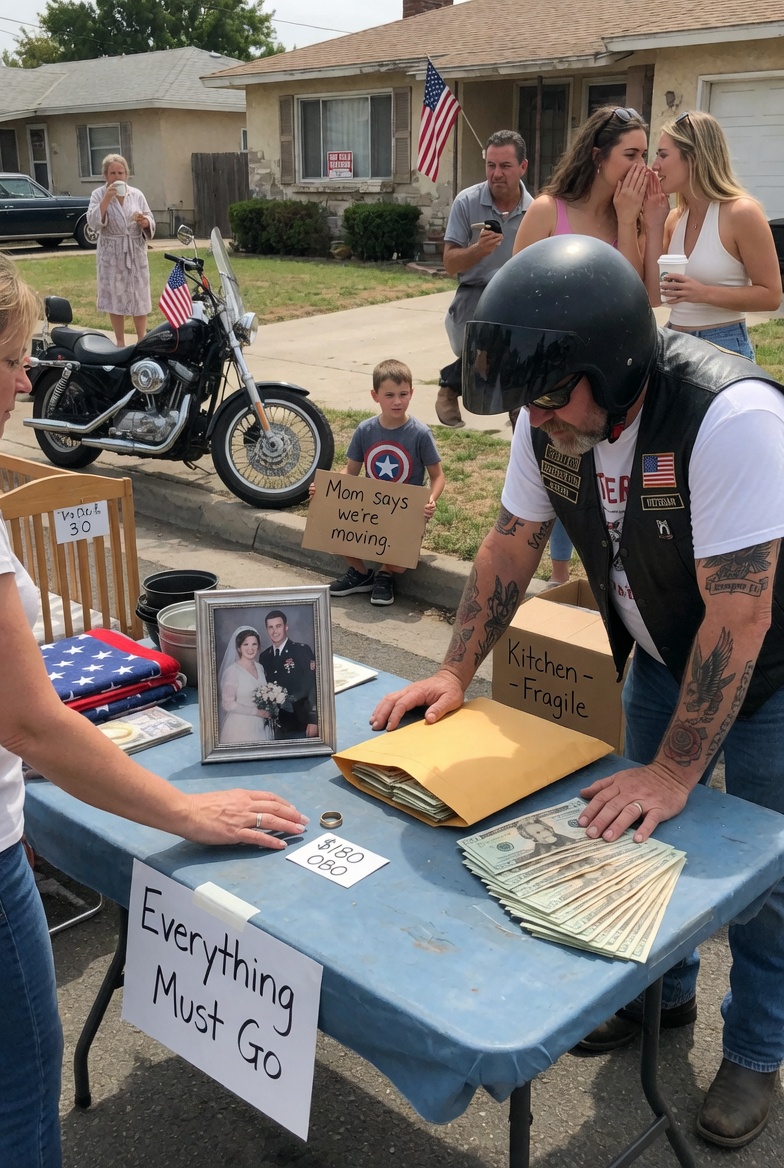
I didn’t turn around. I couldn’t. My eyes were locked on the thick envelope sitting on the plastic table, its flap open just enough to show the edge of more cash than I’d held in months. The biker stood across from me, still as a fence post, as if he hadn’t heard her at all. My son Noah scrambled up from the curb, his cardboard sign flapping against his knees. He pressed himself against my hip, and I felt the heat of his little body trembling.
— Mom? Are we in trouble?
I wanted to tell him no. I wanted to tell him everything was fine. But the truth was I didn’t know what we were anymore. Desperate. Exposed. The whole block watching from behind pulled curtains and half-closed blinds, their curiosity sharp as glass.
The woman with the cell phone was Diane Morrison from three houses down. She’d always been quick with a casserole dish and quicker with a judgment. Now she held her phone to her ear and stared at the biker like she’d spotted a rattlesnake on a playground.
— Yes, I need an officer, she said, voice pitched high enough for the whole street. There’s a man here, a biker, he just bought up everything at a yard sale. Cash. Something’s not right. I think he’s intimidating the homeowner.
I could feel the assumptions hardening around us like concrete setting in slow motion. Intimidation. That was the word she chose. Not desperation. Not a mother auctioning off the crib her son had slept in since infancy. Not the shame that had crawled into my chest the moment I wrote the price sticker for my wedding ring.
The biker hadn’t moved. He stood with his hands at his sides, his face unreadable beneath the shadow of his helmet, which he still hadn’t removed. I could see his eyes now, dark and steady, watching me rather than the neighbor. He didn’t flinch. He didn’t explain himself. He just waited, the way someone waits who has learned that words don’t matter until people are ready to hear them.
— You don’t have to do this, I whispered to him, my voice barely audible over the buzz of lawn sprinklers and the distant bark of a dog. Whatever this is. You can take your money back.
He shook his head once, slow and certain.
— I don’t take back what I bought.
My stomach dropped. I thought of all the things he now owned: the crib where Noah had once traced stars with his fingers before falling asleep, the couch where I’d sat nursing him at three in the morning, the framed wedding photo I’d turned face down because I couldn’t bear to look at the face of the man who’d walked out two years ago. The ring. The ring that still held the ghost of a promise that had broken me in half.
Noah tugged at my sleeve.
— Is he a bad guy?
I looked at the biker. Leather vest. Tattoos curling like scripture up his forearms. The gray-streaked beard that made him look older than he probably was. Boots that had walked a thousand miles I couldn’t begin to imagine. Was he a bad guy? I’d spent the last two years learning that the line between bad and good could blur faster than ink in rain.
— I don’t know, I said honestly.
Noah considered this, then stepped in front of me, planting his sneakers on the dry grass like a tiny soldier.
— If you’re a bad guy, he announced to the biker, I’ll protect my mom.
The biker’s expression shifted. It wasn’t a smile, exactly. More like a crack in a stone wall, letting through a sliver of light. He looked down at Noah for a long moment, and something flickered across his face that I couldn’t name. Grief, maybe. Or recognition.
— That’s a good job to have, he said quietly. Keep doing it.
Diane was still on the phone, her voice dropping to a stage whisper now, as if the biker couldn’t hear her four houses away.
— No, he’s still here. He hasn’t left. The mother looks terrified. There’s a child. Please send someone quickly.
I wasn’t terrified of him. I was terrified of the eviction notice tucked inside my kitchen drawer. I was terrified of the red letters that said FINAL NOTICE and the phone calls from the landlord that I’d stopped answering because my voice had run out of explanations. This man, this stranger in leather, had just handed me enough cash to keep a roof over Noah’s head for two more months. Maybe three. The terror in my chest was the terror of hope, that fragile, treacherous thing that had burned me so many times before.
The minutes stretched. A breeze kicked up, lifting the corner of the price sticker on the microwave. I watched it flutter and settle. The man who’d been examining my wedding ring had retreated to the edge of the driveway, arms crossed, face sour. He was still there, still watching, as if he expected the biker to suddenly snatch the cash back and roar away. The other neighbors had formed a loose semicircle on the sidewalk, not close enough to be involved but not far enough to miss anything. Yard sale vultures, I thought bitterly, and then immediately hated myself for the thought because some of these people had brought me meals after my husband left. Some of them had offered to watch Noah when I worked double shifts. But none of them had offered to help me keep my house.
The squad car rolled in fifteen minutes later. No lights. No siren. Just a slow, deliberate approach that felt somehow more ominous than flashing blue. The officer who stepped out was a woman, mid-thirties, with short blonde hair tucked beneath her cap and a posture that suggested she’d seen enough trouble to recognize it but not so much that she’d stopped caring. Her nameplate read OFFICER DANIELS. She scanned the lawn, the furniture, the envelope of cash, the biker, and finally me, and I saw her expression settle into something carefully neutral.
— Afternoon, she said. We got a call about a possible disturbance. Someone want to fill me in?
Diane pushed forward immediately, phone still clutched in her hand like a weapon.
— Officer, I’m the one who called. This man showed up about half an hour ago. He’s not from the neighborhood. He walked right up to her table, pulled out a huge envelope of cash, and bought everything. Just like that. It doesn’t feel right. It feels coercive.
Officer Daniels looked at the biker, then at me.
— Ma’am? She addressed me directly, and something about the way she did it — calm, respectful, without assumption — made my throat tighten. Is any of this against your will?
I shook my head.
— No. I mean — he paid. I gave him a price and he paid it. More than I asked, actually.
— Did he threaten you? Raise his voice? Block you from leaving?
— No. None of that.
Daniels turned to the biker.
— You got a name?
— Marcus Webb.
— You forcing anything here, Mr. Webb?
— No.
— You related to this family?
— No.
— Then why? Officer Daniels asked the question the whole street wanted answered. Why would you buy a yard sale worth of used furniture and household goods for more than the asking price?
Marcus Webb didn’t answer right away. He shifted his weight, and I noticed for the first time how tired he looked. Not physically, exactly, though there was weariness in the lines around his eyes. It was something deeper. Something carried.
— Because it was for sale, he said finally.
The officer’s expression didn’t change.
— That’s not an answer that’s going to make the neighbors feel better.
— I’m not here to make the neighbors feel better.
Diane sputtered.
— See? That’s exactly what I mean. He’s evasive. He’s hiding something.
— Being evasive isn’t a crime, Officer Daniels said mildly. She looked at Marcus again. I’m going to need to see some ID.
He handed it over without hesitation. No argument. No ego. The same calm he’d worn since the moment he stepped off his motorcycle. I watched Officer Daniels study the license, then radio in the information. The crackle of the dispatcher’s voice drifted across the lawn, tinny and distant. Nothing came back. No warrants. No flags.
She handed the ID back.
— You plan to remove these items today, Mr. Webb?
My chest seized. There it was. The question I’d been dreading. He owned everything now. The crib. The couch. The microwave. The bookshelves. All of it. Legally, he could load it onto a truck and drive away and I would have nothing but an envelope of cash that would run out faster than hope.
Marcus glanced toward the house. Then at Noah, who was still standing in front of me, arms crossed in his best impression of a bodyguard. Then back at the officer.
— Yes, he said.
The word dropped like a stone into still water. Diane made a small sound of vindication. The man at the edge of the driveway smirked. My knees went weak. I reached for Noah’s shoulder, steadying myself. I had known, of course. I had known the moment he put the cash down that nothing in this world comes without a cost. But knowing and hearing it spoken aloud were two different things.
Noah looked up at me, his dark eyes wide.
— Mom? He’s taking our stuff?
I didn’t know how to answer. I had sold it. I had put a price on our whole life and a stranger had met it. What right did I have to complain now?
Marcus reached into his vest pocket. Diane tensed. Officer Daniels’ hand drifted toward her belt. But what he pulled out wasn’t a weapon. It was a cell phone, battered and plain, the screen cracked in one corner. He typed something with his thumb, short and precise, then put it away.
— Who are you calling? Officer Daniels asked.
Marcus looked down the street, toward the intersection where the morning sun was starting to burn off the last of the haze.
— You’ll hear.
And then I heard it. Low at first, like thunder a county away. Then louder. A rumble that vibrated up through the soles of my feet and into my chest. Engines. Multiple engines. Approaching in formation.
Diane’s face went pale.
— Oh my God. He’s called in a gang.
I had the same thought for about three seconds. That this was it. That I had somehow stumbled into something far darker than a yard sale, that the cash was a down payment on trouble I couldn’t even imagine. I pulled Noah behind me and felt my heart hammer against my ribs like a trapped bird.
The first motorcycle turned the corner. It was a touring bike, not a crotch rocket, its engine a deep-throated hum rather than a scream. Behind it came three more, then five, then two after that, all riding in a neat, staggered line. They didn’t rev. They didn’t roar. They rolled in slowly, steadily, like a procession rather than an invasion.
The first rider pulled to the curb and killed her engine. She removed her helmet and I saw that she was a woman in her late forties, her silver-streaked hair pulled back in a neat braid, her face calm and unlined. She was wearing a leather vest similar to Marcus’s, but hers had a patch stitched across the left side. I couldn’t read it from where I stood. The other riders followed suit, parking along the curb with careful precision, not a single bike blocking the driveway or the fire hydrant. They removed their helmets one by one. Men and women, ranging from their thirties to their sixties. A few had gray beards. One woman had a sleeve of floral tattoos that wound from her wrist to her elbow. They all wore the same vest, and now I could see the patch clearly:
COMMUNITY RELIEF RIDE
Veterans Support & Housing Assistance
Not a gang. Not a threat. Something else entirely.
Officer Daniels’ posture relaxed, though she kept her eyes moving.
— You’re with a charitable organization?
— We’re volunteers, the silver-haired woman said. Her voice was low and warm, like a radio host on a late-night shift. Marcus called. Said there was a situation that needed hands.
— What kind of situation?
Instead of answering, the woman walked toward Marcus. They exchanged a look, something passing between them that was too quick and too private for me to catch. Then she turned to the bikes and began pulling something from one of the saddle bags.
Moving blankets. Thick, quilted ones, neatly folded.
Another rider opened a small trailer that had been hitched behind one of the touring bikes. Inside were hand trucks, plastic wrap, bungee cords, and more blankets.
I stared. My brain couldn’t put the pieces together. These people had come equipped to move things. All this time I’d assumed Marcus was going to take my furniture away. But moving blankets weren’t for loading things onto a truck. They were for protecting them.
— You’re moving the items? Officer Daniels asked, echoing the question forming on my own lips.
Marcus nodded once.
— Yes.
— Where?
He looked at me for the first time since the cash had been laid on the table, and his eyes were different now. Softer. Weighed with something that looked almost like memory.
— Back inside, he said.
The silence that followed was the loudest thing I’d ever heard.
Diane’s mouth opened and closed. The man at the end of the driveway uncrossed his arms. The other neighbors, the ones who’d been hovering and whispering, went still as photographs. Even the birds in the maple tree overhead seemed to pause their chatter.
I couldn’t speak. I couldn’t move. My body had gone numb, the way it had when the doctor told me my father’s cancer was terminal, the way it had when my husband looked at me across the kitchen table and said he couldn’t do this anymore. The world tipped sideways and I was falling through a space I didn’t understand.
— You bought it, I finally managed, my voice cracking on every word. You paid for it. Why would you put it back?
Marcus didn’t answer me. He walked to the crib, the one with the teething marks on the rail and the faded dinosaur sheet that Noah refused to give up, and he lifted it gently, the way you lift a sleeping child. He carried it past me, past the folding table, past the wedding photo still lying face-up, and through my open front door. I watched him set it down in the exact spot where it had stood for six years, beneath the window in Noah’s room.
I followed him inside without realizing I was doing it. My legs carried me up the steps and into the hallway, and I stood in the doorway of my son’s bedroom and watched a tattooed stranger in motorcycle boots place a crib back where it belonged with more care than I’d seen my own husband show anything in the last year of our marriage.
— It’s not a stunt, I said, the words coming out half-question, half-statement.
Marcus straightened up and faced me. The light from the window caught the lines around his eyes, the deep furrows that spoke of years squinting into sun and wind.
— No, he said. It’s not a stunt.
— Then what is it? I heard my voice rise, tears pressing at the back of my throat. I don’t understand. I don’t know you. I don’t know any of these people. Why would you do this for a stranger?
He was quiet for a long moment. Outside, I could hear the other riders beginning to work, their boots soft on the grass, the rustle of plastic wrap, a low murmur of voices asking each other where things went. Someone laughed quietly, a warm sound that didn’t match the tension.
Marcus looked at the crib, then at the floor, then at me.
— My mom did this once, he said.
The words landed in the center of my chest and stayed there.
— She sold everything, he continued. The couch. The TV. Her jewelry. Our kitchen table. She put it all out on the lawn one Saturday morning when I was nine years old. She smiled at everyone who walked up. Made small talk. Pretended it was just spring cleaning. But I knew. I knew because I’d heard her crying on the phone with the bank the night before.
I didn’t move. I barely breathed.
— A woman from our church showed up. She looked at the price tags. Then she looked at my mom. And she said, loud enough for everyone to hear, ‘This is what happens when you don’t budget properly.’
The anger that flashed through me was sudden and hot and entirely on behalf of a woman I had never met. I thought of Diane’s whispered comments. Probably bad choices. Always a story. The casual cruelty of people who had never had to choose between electricity and food.
— What happened? I asked.
— My mom finished the sale. Packed what was left into trash bags. We moved into a motel for six weeks. And not one person who walked past our yard that day ever asked if she was okay.
He looked at me, and the weight in his eyes was the weight of decades.
— People see a yard sale, they think opportunity. They don’t think survival. And when someone shows up and buys the whole thing, they don’t think generosity. They think threat. They think angle. Because it’s easier to believe the worst in people than to admit you didn’t see the best.
The tears I’d been holding back spilled over. I didn’t wipe them away. I let them fall.
— I’m not a church lady, Marcus said, a ghost of something almost like a smile pulling at the corner of his mouth. But I’ve got a little more sense than one.
I laughed. It came out wet and broken and strange, a sound I hadn’t made in months.
— Thank you, I whispered. I don’t know how to say it properly.
— You just did.
He walked past me, back out to the lawn, and I followed him. The scene outside had transformed. The riders moved with quiet efficiency, wrapping the couch in plastic, carrying the bookshelves up the porch steps two at a time. The silver-haired woman was kneeling beside Noah on the curb, showing him something on her phone. He was laughing, his small face bright with the kind of joy I hadn’t seen since before his father left. The microwave was already back on the kitchen counter. The boxes labeled Kitchen were being unpacked by a woman with a sunflower tattoo on her forearm.
Diane stood frozen on the sidewalk, her phone dangling from her hand, her expression unreadable. The other neighbors had drawn closer, their fear replaced by something that looked almost like shame.
Officer Daniels was standing by her squad car, arms crossed, watching the whole operation with a look I couldn’t quite interpret.
— You could have just written a check, she said when Marcus walked by.
He gave a faint shrug.
— She wouldn’t have taken it.
The officer looked at me, and I realized with a jolt that she was waiting for my confirmation. She wanted to know if it was true. If this man who had walked into my life an hour ago already understood me better than the people who had lived on my street for six years.
— I wouldn’t have, I said, my voice steadier now. I would have said no. I would have said I didn’t need charity.
— But you’d take it in a sale?
— That’s different. That’s a transaction. I was selling something. He was buying it. I could live with that.
Officer Daniels nodded slowly, processing. Then she turned back to Marcus.
— You bought everything back just to give it back.
— I bought the right to give it back, he corrected. There’s a difference. She didn’t owe me anything after the cash was in her hand. It was mine to do with as I wanted. And I wanted to put it back.
— That’s a very particular kind of logic.
— It’s the kind that works.
The officer was quiet for a moment. Then she did something that surprised me. She smiled. It was a small smile, professional around the edges, but genuine nonetheless.
— All right. I don’t see a crime here. She raised her voice, addressing the street. Folks, there’s no disturbance. Everything’s consensual. You can all go back to your Saturdays.
No one moved. They just kept watching the furniture walk back into my house piece by piece.
The floral-tattooed woman carried my wedding photo up the steps. She paused at the door and turned to me.
— Where does this go?
I hesitated. For two years, that photo had sat on the mantel, and then one day I couldn’t look at it anymore without feeling the weight of everything I’d lost. I’d turned it face down and buried it in a box of things I didn’t know how to throw away.
— The bedroom, I said finally. On the dresser.
She nodded like she understood, and maybe she did. Maybe everyone in this strange, leather-clad congregation understood something about loss.
The crib was back in place. The couch was back in place. The bookshelves were back against the wall, and someone had even arranged the books alphabetically, a small, meticulous kindness that made my heart ache. The microwave hummed quietly when someone plugged it in to test it. The boxes were empty. The lawn was bare except for the folding table and the canopy, which the riders were now dismantling with the same calm efficiency they’d shown in everything else.
Marcus walked to the table and picked up the last item that hadn’t been moved. My wedding ring. It sat in his palm, small and gold, the diamond catching the morning light.
— This doesn’t belong on a plastic table, he said.
He held it out to me.
My hand trembled as I reached for it. The metal was cool against my fingers, familiar and foreign at the same time. I hadn’t worn it in nearly a year. I wasn’t sure I would wear it again. But taking it back from his hand felt like reclaiming something I hadn’t known I’d surrendered.
— I don’t know how to repay you, I said.
— You don’t.
— There has to be something.
He reached into his vest pocket and pulled out a business card. Plain white. Black text. No logo, no flash. Just a name — Marcus Webb — and a phone number, and a line beneath it: Community Relief Ride — Veterans Support & Housing Assistance.
— If you’re late on rent again, he said, call. We don’t do loans. We don’t do handouts. We do what we did today.
— Buy everything?
— Make it so people don’t have to choose.
I took the card. It was the smallest thing I’d held all day and somehow the heaviest.
Noah came running up, still clutching his cardboard sign. The silver-haired woman had written something on the back of it, and when he showed it to me, I saw she’d drawn a picture of a motorcycle with a dinosaur riding it.
— Look, Mom! I’m on a bike!
— That’s a T-Rex, I said, managing a smile.
— T-Rexes are fast, Noah informed me. They’re faster than everyone.
He looked up at Marcus with the unguarded curiosity of a child who hadn’t yet learned to fear people who looked different from him.
— Are you a superhero? he asked.
The question hung in the air. I saw something pass across Marcus’s face, a flicker of emotion too quick to name.
— No, he said. Just paid for some stuff.
Noah considered this, then nodded, apparently satisfied.
— Okay. But you could be one if you wanted.
— Maybe, Marcus said. We’ll see.
The riders were finishing up. The moving blankets were folded and stored. The trailer was reattached. The canopy was bundled into its carrying case. The silver-haired woman gave Noah a fist bump and walked over to join Marcus.
— All set? she asked.
— All set.
She turned to me, and her eyes were kind, the kind of kind that didn’t ask for anything in return.
— You take care of yourself, she said. And that boy of yours.
— I will.
— I mean it. She glanced at the card in my hand. Use that number. We answer.
She walked to her bike and swung her leg over with the ease of someone who had done it a thousand times. The other riders followed suit, engines starting one by one. Not loud. Not dramatic. Steady. The sound of people who had somewhere to be and no need to announce it.
Marcus put on his helmet. He didn’t say goodbye. I was learning that he wasn’t the kind of man who needed to. The things that mattered had already been said.
I stood in my doorway, the wedding ring clutched in my fist, and watched them pull away in quiet formation. No parade. No cameras. No viral headline waiting. Just a street that looked ordinary again, its houses unchanged, its lawns the same shade of green they’d been that morning.
But inside the house at the end of the driveway, everything had shifted.
I walked back through the rooms slowly, touching things. The couch where I’d cried myself to sleep more nights than I could count. The crib where Noah had slept until he was four because he said it made him feel safe. The bookshelves filled with picture books and self-help paperbacks I’d bought from thrift stores. The microwave that had reheated a thousand meals because cooking felt like more energy than I had.
All of it was back where it belonged. But the woman standing among it was not the same woman who had dragged it onto the lawn at six o’clock that morning.
Noah tugged my sleeve.
— Mom? Are you crying?
— A little.
— Happy crying or sad crying?
I knelt down and pulled him into my arms, breathing in the scent of his shampoo and the grass stains on his knees and the sweetness of a child who still believed in superheroes, even if they came wearing leather instead of capes.
— I don’t know yet, I said. Maybe both.
We stayed like that for a long time, wrapped up in each other on the couch that had nearly been sold. The morning light moved across the floor inch by inch, and I watched it and thought about all the things I’d been carrying alone.
When I finally stood up, I walked to the kitchen and pulled the eviction notice out of the drawer. I stared at the red letters. FINAL NOTICE. PAYMENT DUE. EVICTION PROCEEDINGS.
Then I tore it in half. And half again. And again, until it was confetti in my hands.
I didn’t call the number right away. I wasn’t ready. Some kindnesses take time to settle in, like rain soaking into dry ground. I spent the rest of the day putting the house in order, re-folding blankets, wiping down countertops, opening windows to let the stale air out. Noah helped by arranging his stuffed dinosaurs on the couch and announcing that they were guarding the fort.
That evening, as the sun was setting and the streetlights were flickering on, there was a knock at the door. I opened it to find Diane Morrison standing on my porch, holding a casserole dish wrapped in tinfoil.
— I brought you dinner, she said.
She didn’t apologize. Not in so many words. But her eyes were red-rimmed, and she wouldn’t quite meet my gaze, and when I took the dish from her hands, she held on for a second longer than necessary.
— I didn’t know, she said quietly.
— Most people don’t.
— I should have asked.
— Yes.
She flinched, but she didn’t walk away. Instead, she took a breath and said the thing that must have been burning a hole in her chest all afternoon.
— I called the police on someone who was trying to help you. I made it worse. I made it so much worse, and I didn’t even see it.
I looked at her, this woman who had always been quick with a casserole and quicker with a judgment, and I felt something inside me shift. Not forgiveness, exactly. Not yet. But the beginning of understanding.
— You were scared, I said. We all were. Fear makes us stupid.
— That’s generous.
— It’s honest.
She nodded, and then she did something that surprised me. She reached out and squeezed my hand.
— If you ever need anything — and I mean anything — you call me. Not a charity. Not a hotline. Me. I live three houses down, and I’ve been here for six years, and I have never once asked you if you were okay. That changes now.
I didn’t know what to say. So I just said thank you, and she left, and I carried the casserole inside and set it on the kitchen counter next to Marcus Webb’s business card.
Two things that hadn’t existed in my life that morning. Two things that made the future feel less like a cliff and more like a road.
I called the number three days later. My hands were shaking. I still had enough cash left to cover the rent, but just barely, and the panic was starting to creep back in around the edges. Noah was at school. The house was quiet. And I sat at the kitchen table, staring at the business card, and I dialed.
It rang twice before someone picked up.
— Community Relief Ride. This is Elena.
The silver-haired woman. I recognized her voice immediately.
— Hi, I said, my voice small. This is Amanda Reeves. Marcus bought my yard sale last weekend.
— Amanda. She said my name like we were old friends. I was hoping you’d call.
— I don’t — I don’t know what I’m asking for. I’m not behind on rent yet. But I’m close. And I can’t keep doing this alone.
— You’re not alone. That’s the whole point. Tell me what you need.
And so I did. I told her about the part-time job that wasn’t enough, about the child support that never came, about the degree I’d dropped out of when Noah was born, about the exhaustion that sat in my bones like lead. I told her about the shame, the way it coated everything, the way it made me stop answering phone calls and opening mail and knocking on neighbors’ doors. I told her things I hadn’t even admitted to myself.
Elena listened. She didn’t interrupt. She didn’t offer platitudes. When I finally ran out of words, she said:
— We can help with rent this month. No strings. But I want to offer you something else, too.
— What?
— We have a program. Job training. Resume building. Childcare while you do it. It’s not charity. It’s a hand up. You have to show up. You have to do the work. But we’ll be there every step.
I closed my eyes. The tears were back, but they felt different this time. Lighter.
— Why? I asked. Why do you do this? All of you?
Elena was quiet for a moment. When she spoke, her voice was softer.
— Because we’ve all been where you are. Every single one of us. Marcus, me, the whole crew. We’ve all stood on the edge and looked down. And someone was there to pull us back. So now we pull back whoever we can.
— Even strangers?
— There are no strangers. Just people whose stories we haven’t heard yet.
We talked for another hour. By the end of it, I had an appointment to come in the following week, a list of things to bring, and a feeling in my chest I hadn’t felt in years.
Hope.
The next Saturday, Noah and I drove to a community center on the other side of town. It was a low brick building with a playground out front and a mural on the side that someone had painted with care: a phoenix rising from flames, its wings spread wide. Beneath it, in bold letters: WE RISE TOGETHER.
Inside, there were folding chairs arranged in a circle. A coffee station. A table with cookies that looked homemade. And people. So many people. Men and women, young and old, some in leather vests, some in business casual, some in clothes that had seen better days. All of them with the same look in their eyes — the look of someone who had been through something and come out the other side.
Elena was there, her silver braid draped over one shoulder. She hugged me when I walked in, and then she knelt down and offered Noah a cookie.
— Chocolate chip? she asked.
— Yes please, Noah said, suddenly shy.
— Good choice.
Marcus was there too, standing by the coffee station, a cup in his hand. He nodded at me but didn’t approach right away. I was learning that he wasn’t the type to crowd people. He let you come to him.
I walked over after a few minutes, coffee in hand, heart pounding.
— I wanted to thank you properly, I said. For everything.
— You did.
— No, I mean — I don’t think I understood. That day. I was so scared and so ashamed, I couldn’t see what you were doing. I thought it was a trick. I thought it had to be a trick. Because no one just does something like that.
Marcus took a sip of his coffee, his eyes steady on mine.
— People do. They just don’t always know how.
— You knew how.
— Because I’d been on the other side. My mom sold everything. We lost the house anyway. And I spent a long time being angry about it. Angry at the people who didn’t help. Angry at the system. Angry at myself for not being old enough to fix it.
— What changed?
— I got help. Eventually. A lot later than I should have. Someone saw me sleeping in my car and didn’t just walk past. He knocked on the window. Asked if I wanted breakfast. That breakfast turned into a conversation, and that conversation turned into a job, and that job turned into a life. And somewhere in there, I decided I was going to be the knock on the window for as many people as I could.
I thought about that. The knock on the window. The small, terrifying act of noticing someone’s pain and refusing to look away.
— I want to be that, I said. Someday. When I’m back on my feet. I want to be the knock on the window.
Marcus looked at me for a long moment. Then he nodded, and I could have sworn there was the faintest hint of a smile beneath the beard.
— Then you will be.
The meeting started a few minutes later. People shared their stories. A woman who had escaped an abusive relationship and spent six months living in her car with two kids. A veteran who had come home to find his job gone and his savings drained. A young couple who had lost everything in a medical bankruptcy. One by one, they stood up and spoke, and the room held them. No judgment. No pity. Just presence.
When it was my turn, I stood up and my legs were shaking. I looked around the circle at all these strangers who had, in the space of a morning, become something else. Not family, exactly. But something close. A net. A net woven from shared pain and stubborn hope.
— My name is Amanda, I said. And a week ago, I sold everything I owned on my front lawn.
The room went quiet, but it was a listening quiet, not a judging one. And so I told them. All of it. The eviction notice. The empty bank account. The wedding ring on the plastic table. The neighbor calling the police. The biker who showed up and bought my whole life back for me.
— I thought it was a scam, I said, my voice cracking. I thought he was going to take everything. And then he carried my son’s crib back inside, and I didn’t know how to process it. I still don’t. I keep waiting for the other shoe to drop. I keep waiting for someone to say there’s been a mistake.
Elena spoke from her seat.
— There’s no mistake. You’re exactly where you’re supposed to be.
And the room murmured agreement, a soft wave of sound that wrapped around me like a blanket.
After the meeting, Noah ran up to me with a drawing he’d made in the childcare room. It was a picture of our house, with a motorcycle parked out front, and a stick figure with a beard standing next to it.
— That’s Marcus, he said. He’s the guy who fixed everything.
I looked at the drawing, at the crooked crayon lines and the bright blue sky Noah had colored above the roof, and I felt something crack open inside me. Not in a painful way. In a way that let light in.
— He didn’t fix everything, I said, kneeling down to his level. But he helped us. And now we’re going to learn how to help ourselves. And someday, maybe we’ll help someone else.
— Like a superhero team?
— Exactly like a superhero team.
The weeks that followed were hard. I won’t pretend they weren’t. I started the job training program, which meant early mornings and late nights and more coffee than any human should consume. Elena helped me find childcare for Noah, a wonderful older woman named Mrs. Patterson who had raised five kids of her own and treated Noah like a grandchild. Diane from down the street started coming by on Tuesdays with dinner, and we’d sit on the porch and talk, really talk, about the things we’d both been hiding.
I learned that she’d lost a son to an overdose five years earlier. She’d never told anyone on the street. She’d just kept bringing casseroles and keeping busy because stopping meant feeling, and feeling meant drowning.
— I judged you, she said one evening, staring at the sunset. I saw a single mom selling her furniture and I thought, what did she do wrong to end up there. Because if I could make it your fault, I didn’t have to face the fact that it could happen to me. To anyone.
— It can happen to anyone, I said. It did happen to anyone. It happened to me.
— I know that now.
She reached over and took my hand, and we sat like that until the sky turned dark.
The job training led to a certification. The certification led to a job — a real one, with benefits and a salary that didn’t require me to hold my breath every month when rent was due. It was at a local nonprofit that helped families in crisis, which felt like the universe’s idea of a joke until I realized it wasn’t a joke at all. It was a calling.
I started in the intake department, answering phones and listening to stories that sounded like mine. Every time I picked up the receiver, I remembered Marcus’s voice, low and steady, saying I don’t take back what I bought. And I understood now that what he’d bought wasn’t furniture. It was the right to make a choice on my behalf. To choose kindness when I couldn’t choose it for myself.
Six months after the yard sale, I found myself at a Community Relief Ride event. It was a fundraiser, held in a park on the edge of town, with food trucks and live music and a line of motorcycles gleaming in the sun. Noah was there, wearing a tiny leather vest that Elena had made for him, his name stitched across the back in silver thread. He ran through the crowd handing out flyers and telling anyone who would listen about the superhero bikers who saved our house.
Marcus was there, of course. He was always there. He stood at the edge of the crowd, watching the chaos with the same quiet calm he’d worn the day I met him.
I walked over and stood beside him.
— Quite the turnout, I said.
— It’s grown.
— Because of you.
— Because of everyone.
I shook my head.
— Because you knocked on my window. Because you didn’t look away. That’s the spark, Marcus. Everything else is just what catches fire.
He didn’t respond right away. He watched a group of kids climb on one of the bikes, their laughter carrying across the park.
— I used to think I was angry at the people who didn’t help my mom, he said finally. But I wasn’t. I was angry at the world for making her need help in the first place. And I couldn’t fix the world. But I could fix one Saturday morning for one family.
— You did more than that. You fixed the way I see people. You fixed the way I see myself.
— That was already in you. I just reminded you it was there.
I thought about the wedding ring, still sitting on my dresser. I hadn’t put it back on. I wasn’t ready. Maybe I never would be. But I looked at it differently now. It wasn’t a symbol of failure anymore. It was a symbol of survival. Of a day when I’d put everything I owned on a folding table and a stranger had put it all back.
— I’m going to volunteer, I said. With the Ride. I want to be one of the people who shows up.
Marcus turned to look at me, and this time, the smile was unmistakable. It cracked his whole face open, revealing something younger and lighter underneath.
— I figured you would.
— You did?
— You’ve got the look.
— What look?
— The look of someone who’s been pulled back from the edge and knows exactly how far down it is.
I laughed. It wasn’t a wet, broken laugh this time. It was full and real and surprised even me.
— That’s a hell of a look.
— It’s a good one.
Noah came running up then, breathless and grinning, dragging Elena by the hand.
— Mom! Elena says I can be a junior volunteer when I’m ten! I can help wash the bikes!
— That’s a big responsibility, I said.
— I’m ready. I’m almost seven. That’s basically ten.
Elena winked at me.
— He’s got the spirit.
We all stood there, the four of us, in the middle of a park full of people who had all been pulled back from edges of their own. And I realized that this was what community meant. Not people who lived near you. People who showed up for you. People who saw your yard sale and didn’t see bargains. They saw a cry for help, and they answered it with moving blankets and hand trucks and cash they didn’t expect to get back.
That night, after Noah was asleep and the house was quiet, I sat on the couch — the same couch that had been wrapped in plastic and carried up my porch steps by a woman with sunflower tattoos — and I held the wedding ring in my palm. The diamond caught the lamplight, small and steady. I thought about the day I’d put it on for the first time, full of hope and promises I didn’t know would break. I thought about the day I’d taken it off, alone in this same living room, sobbing so hard I couldn’t breathe. And I thought about the day a stranger picked it up off a plastic table and handed it back to me like it was something precious.
I didn’t put it back on. But I didn’t hide it away either. I set it on the mantel, next to Noah’s drawing of the motorcycle and the stick-figure superhero. Two things that belonged in the light.
The months rolled on. Winter came, then spring. I kept volunteering with the Ride, answering phones, showing up at events, learning how to wrap furniture in moving blankets and carry it gently into houses that had almost lost everything. I went on my first ride that April, on the back of Elena’s bike, the wind roaring past my ears and the road unspooling beneath us. It felt like flying. It felt like freedom.
One Saturday, we pulled up to a yard sale in a town an hour east. A woman about my age, with dark circles under her eyes and a baby on her hip, was standing behind a folding table covered in household items. A crib. A microwave. A box of books. The whole scene was so familiar my breath caught in my throat.
Elena cut the engine and looked at me.
— You want to take this one?
I nodded. My heart was pounding, but my hands were steady. I walked up to the table, and the woman looked at me with the same guarded, exhausted expression I remembered wearing.
— Can I help you? she asked.
I looked at the crib. At the baby on her hip. At the price stickers on everything.
— How much for all of it? I asked.
She stared at me, and I saw the fear flash behind her eyes — the fear of being scammed, of being judged, of being seen.
— I’m not giving it away, she said.
— Didn’t ask you to.
I pulled out an envelope. Not as thick as the one Marcus had carried, but enough. Enough to matter. I laid it on the table.
— I want to buy everything.
— Why?
I smiled, and I felt the tears pricking at the corners of my eyes, and I said the words that had been gifted to me nearly a year before:
— So I can give it back.
She didn’t understand right away. They never do. But she would. By the end of the morning, her crib would be back in her house, her couch would be unwrapped, and her baby would be sleeping in a room that still belonged to them. She would cry, and I would tell her about a biker who showed up on my lawn when I was at the end of everything, and she would ask if she could ever repay me, and I would say the truest thing I knew:
— Someday, you’ll knock on someone else’s window. And that will be enough.
That evening, I drove home with the setting sun at my back and the road humming beneath my tires. I wasn’t on a motorcycle yet, but I was saving up. I’d already picked out the helmet. When I pulled into my driveway, Noah was on the porch with Mrs. Patterson, drawing with sidewalk chalk. He ran to greet me, and I scooped him up and spun him around until we were both dizzy and laughing.
— Did you help someone today, Mom?
— I did.
— Like a superhero?
— Just like one.
He hugged me tight, and I held him, and I thought about all the people who had carried my furniture back inside that day. Elena. Marcus. The woman with the sunflower tattoo. The man with the gray beard. All of them strangers once. All of them now woven into the fabric of my life so deeply I couldn’t imagine it without them.
Courage doesn’t always shout. Sometimes it writes a check. Sometimes it shows up on a motorcycle with moving blankets in the saddle bags. Sometimes it looks at a yard sale and sees not a bargain, but a cry for help.
And sometimes, if you’re lucky — if you’re very, very lucky — it buys everything.
Just to give it back.