PART 3
“My name is Detective Sandra Alvarez. I’d be careful how you describe what happened.”
Dylan looked her up and down.
“Oh, we’re involving the police now?”
I answered before anyone else could.
“No. I’m finally telling the truth.”
He looked back at me as though he genuinely couldn’t understand the sentence.
“You’ve always told the truth.”
“No,” I said quietly.
“I’ve protected you.”
Silence.
“So every lie I told your teachers…”
I swallowed.
“…was for you.”
“Every landlord I apologized to…”
“…was for you.”
“Every employer I begged not to press charges when you stole tools…”
“…was for you.”
His eyebrows drew together.
“You told Dad that?”
Richard answered.
“No.”
“She never told me.”
“I found out myself.”
Dylan looked surprised.
“You knew?”
“I’ve known a lot more than your mother realizes.”
The detective watched all three of us carefully.
She wasn’t impatient.
She’d clearly seen families explode before.
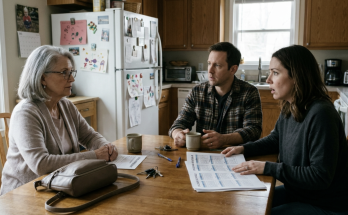
Richard slowly pushed the brown folder across the table.
“You should read this.”
Dylan didn’t touch it.
“What is it?”
“Copies.”
“Of what?”
“The police reports your mother never filed.”
Dylan frowned.
“What reports?”
Richard opened the folder himself.
“There was the hole you punched through the hallway wall.”
Another paper.
“The television you threw.”
Another.
“The neighbor who called because they heard screaming.”
Another.
“The emergency room visit after your mother said she slipped on ice.”
Dylan immediately looked at me.
“You told them that.”
“Yes.”
“You covered for me.”
“Yes.”
His confidence flickered.
Only for a second.
Then anger returned.
“So?”
“So,” Richard said evenly, “today she isn’t.”
Dylan scoffed.
“You two planned this?”
“No.”
Richard’s eyes never left his son’s.
“We should’ve done this years ago.”
Dylan pointed at me.
“You’re really going to have me arrested?”
My throat tightened.
“I don’t want you arrested.”
“Then what’s all this?”
“I want the violence to stop.”
“It stopped.”
“You hit me once.”
“And?”
The room became so quiet that even Dylan seemed to hear his own answer.
Even he realized how terrible it sounded.
His face hardened.
“You deserved it.”
The words landed harder than the slap ever had.
I felt something inside me finally settle.
Not break.
Settle.
Because hope had finally stopped arguing with reality.
Richard stood.
Not aggressively.
Simply standing.
“I’m going to ask you one time.”
“What?”
“Do you believe your mother deserved to be hit?”
Dylan crossed his arms.
“I think she needed to learn she can’t control me.”
Richard nodded once.
Very slowly.
Then he looked at Detective Alvarez.
“I think we’re done here.”
The detective stepped forward.
“Dylan Miller.”
“What?”
“I’ve spoken with the State’s Attorney’s office this morning.”
He blinked.
“What?”
“Your mother has the right to file charges.”
He looked at me.
“You already did?”
I shook my head.
“No.”
“Then what are you talking about?”
“I haven’t signed it.”
He smiled again.
Relief washed over his face.
“I knew it.”
He looked at Richard with almost childish satisfaction.
“See?”
“I told you.”
“My mom would never—”
I picked up the pen.
The one lying beside the report.
His smile disappeared.
“Eleanor…”
His voice sounded different now.
Smaller.
I looked down at my own name.
The signature line waited patiently.
For years I had signed permission slips.
School forms.
Loan documents.
Medical releases.
Checks that emptied my savings to rescue my son again.
This signature felt heavier than every one of those combined.
Richard didn’t speak.
Neither did the detective.
Nobody told me what to do.
Because this decision belonged only to me.
I signed.
The scratch of ink across paper sounded unbelievably loud.
Dylan stared.
“No.”
His voice cracked.
“No, Mom.”
I placed the pen down carefully.
“I’m done protecting the person who hurts me.”
For the first time since coming downstairs, fear entered his eyes.
Real fear.
“You can’t do this.”
“I already did.”
“You’ll ruin my life.”
I looked directly at him.
“No.”
“You’ve been ruining your own life.”
“I’ve been cleaning up after you.”
He stepped toward me.
The detective immediately moved between us.
“Stay where you are.”
“I wasn’t going to touch her.”
She didn’t move.
“I said stay.”
His breathing became faster.
“This is insane.”
Richard answered.
“No.”
“This is accountability.”
“You abandoned me!”
Richard absorbed the accusation without flinching.
“I failed you.”
“I know that.”
“I regret it every day.”
“But your mother stayed.”
“She gave you chance after chance after chance.”
“You don’t get to repay love with violence.”
Dylan suddenly kicked one of the dining chairs.
It crashed across the hardwood floor.
The detective didn’t even blink.
“Mr. Miller.”
He looked at her.
“If you damage anything else or threaten anyone, you’re leaving in handcuffs today.”
He froze.
The fight slowly leaked out of him.
Like air escaping a punctured tire.
He looked around the room.
His father.
The detective.
His mother.
None of us looked frightened anymore.
That confused him more than anything.
Bullies always expect fear.
When fear disappears, so does much of their power.
He whispered,
“So… that’s it?”
I nodded.
“You can’t stay here anymore.”
“I have nowhere to go.”
Richard spoke.
“That’s not true.”
Dylan looked over.
“I’ve already arranged a place.”
He frowned.
“What place?”
“A court-approved crisis housing program.”
“I’m not living in some shelter.”
“Then you’ll need to find another legal place.”
“I’m not going.”
Richard sighed.
“You don’t have a choice.”
Dylan laughed bitterly.
“You think you’re both heroes now?”
“No.”
I said softly.
“I think we’re finally acting like parents.”
He stared at me.
“You don’t love me.”
The sentence almost undid me.
Almost.
Because I remembered another sentence.
If you ever tell me no again…
…you’re going to regret giving birth to me.
I took one slow breath.
“I love you enough to stop helping you become someone you shouldn’t be.”
His eyes watered.
For a fraction of a second, I saw my little boy.
The child who collected pretty rocks.
The child who used to draw hearts on my grocery lists.
The child who disappeared somewhere beneath years of excuses, alcohol, resentment, and unchecked rage.
Then he looked away.
“I hate both of you.”
Neither Richard nor I answered.
Because hate spoken in anger doesn’t always deserve an audience.
Detective Alvarez handed him a printed sheet.
“This explains the temporary protective order.”
He stared at it.
“What?”
“You are not permitted to return to this property without permission.”
“You’ve got to be joking.”
“No.”
She paused.
“And if your mother decides to pursue the criminal complaint, today’s report becomes part of that process.”
He looked at me one final time.
“I’ll never forgive you.”
My heart hurt.
But it didn’t change my answer.
“I hope someday you don’t have to.”
Two uniformed officers who had been waiting discreetly outside stepped through the open front door.
Not rushing.
Not grabbing him.
Simply present.
One officer spoke calmly.
“We’ll give you a few minutes to collect your belongings.”
Dylan looked like he wanted to scream.
Instead, he marched upstairs.
Every step echoed through the house.
Ten minutes later he came down carrying one duffel bag.
That was all.
Twenty-three years of life.
Reduced to a single bag.
He paused at the front door.
For just a moment, I thought he might turn around.
Apologize.
Say something.
Anything.
Instead he walked out without another word.
The patrol car pulled away slowly.
I watched until it disappeared around the corner.
Only then did my knees begin to shake.
Richard was beside me before I even realized I was falling.
He steadied me gently.
“You did it.”
I covered my face.
And after an entire night without tears…
After the slap…
After the signature…
After watching my only child leave…
I finally cried.
Not because I regretted what I’d done.
Because I was mourning the son I had been trying to save for years.
And accepting the man he had become.
Richard held my shoulders while I cried.
Neither of us pretended everything would be okay tomorrow.
Some wounds don’t heal overnight.
Some families don’t mend with a single conversation.
But for the first time in years…
My house was quiet.
Not the quiet of fear.
The quiet of safety.
I looked around my dining room.
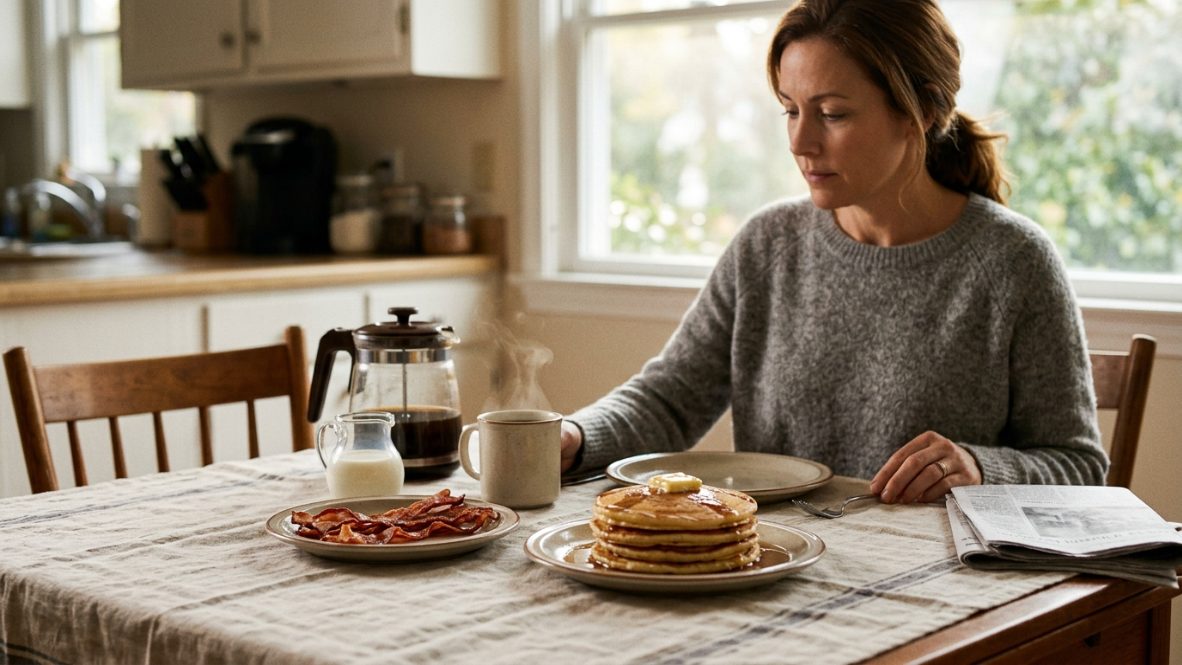
The pancakes were cold.
The coffee had gone bitter.
The good tablecloth was stained with tears.
It was the saddest breakfast I had ever made.
And somehow…
It was also the first meal I had eaten as a woman who finally chose herself.
PART 4
The house was too quiet.
For years I had prayed for silence.
Now that I finally had it, I discovered silence has its own sound.
It echoes.
The patrol car disappeared around the corner, leaving behind only the faint rumble of traffic from Sheridan Road and the chirping of birds outside the kitchen window.
I stood there longer than I realized.
Richard finally placed a gentle hand on my shoulder.
“Come sit down.”
I looked at the breakfast table.
The pancakes had gone cold.
The butter had melted into little yellow puddles.
The coffee was bitter.
Nobody had eaten a single bite.
I almost laughed.
I had spent two hours making breakfast for the most painful morning of my life.
Richard pulled out a chair.
“You need to eat.”
“I’m not hungry.”
“I know.”
He pushed the plate toward me anyway.
“You still need to eat.”
I picked up my fork.
My hands were shaking so badly that I couldn’t cut a pancake.
Richard quietly reached over and did it for me, the same way he used to when we had first married and I had broken my wrist in a bicycle accident.
For a second…
For only one second…
It felt like we were twenty-five years younger.
Then reality settled back into the room.
“I’m sorry,” he said.
I looked up.
“For what?”
“For leaving.”
I sighed.
“We’re really doing this now?”
“I have to.”
“No.”
“You don’t.”
His eyes were red.
“I wasn’t here.”
“You couldn’t have known.”
“I should have.”
I leaned back.
“Richard… we both failed him.”
He nodded.
“I know.”
“No.”
I shook my head.
“I don’t think you do.”
He looked confused.
“I failed him by protecting him.”
“You failed him by disappearing.”
“We each gave him something unhealthy.”
“You gave him abandonment.”
“I gave him permission.”
Neither of us spoke after that.
There wasn’t anything left to argue about.
The truth had finally become too obvious to avoid.
By noon, the house no longer belonged to the frightened woman who had answered the phone at one twenty in the morning.
Detective Alvarez had left after explaining the next legal steps.
The emergency protective order would remain in place.
The report had been officially filed.
Someone from the victim services office would contact me within forty-eight hours.
She also gave me a card.
“If he contacts you in any threatening way, call immediately.”
I slipped the card into my purse.
Not because I expected to use it.
Because I finally understood why people carried them.
Richard insisted on staying until evening.
He fixed the loose lock on the back door.
He replaced the burned-out porch light.
He even trimmed the bushes beneath the front windows because he said they gave someone too many places to hide.
Watching him quietly repair little things around the house made me realize how long I had been living in survival mode.
Not once during those years had I stopped to think about my own safety.
Everything had revolved around keeping Dylan calm.
Keeping Dylan comfortable.
Keeping Dylan from exploding.
When had I become a guest in my own life?
Around four o’clock, my phone buzzed.
Unknown number.
Richard looked at me.
“You don’t have to answer.”
I stared at the screen.
Then accepted the call.
“Eleanor Miller?”
“Yes.”
“This is Dr. Karen Whitmore from North Shore Behavioral Health.”
My stomach tightened.
“Is something wrong?”
“No.”
She paused.
“I’m calling because your son was admitted this afternoon for an emergency psychological evaluation.”
I looked toward Richard.
He immediately understood from my expression.
“He… agreed to that?”
“He didn’t have much choice after his behavior this morning.”
I closed my eyes.
The image of Dylan being escorted away flashed through my mind.
The doctor continued.
“He admitted to heavy alcohol use.”
“He admitted to frequent blackouts.”
“He admitted that his anger has become difficult to control.”
My heart sank.
He admitted it.
To strangers.
Not to me.
Never to me.
“We’re recommending a thirty-day residential treatment program.”
I whispered,
“Will he go?”
“We don’t know.”
“But this morning was enough to qualify for emergency intervention.”
I thanked her before hanging up.
Richard poured us both fresh coffee.
“What did they say?”
“They’re evaluating him.”
He nodded slowly.
“Good.”
“I don’t know if he’ll stay.”
“Neither do I.”
“But at least someone finally has a chance to reach him.”
That night…
I slept.
Not well.
But I slept.
No footsteps upstairs.
No doors slamming.
No drunken shouting.
At two in the morning I woke up automatically, expecting to hear Dylan stumbling through the front door.
Instead…
Nothing.
The silence no longer felt empty.
It felt peaceful.
Three days later I returned to work.
I almost called in sick.
My bruise was fading from purple to yellow.
Makeup covered most of it.
Not all.
The moment I walked into the library, my coworker Linda looked at me.
“Eleanor.”
She stopped shelving books.
“What happened?”
I smiled automatically.
“Oh, I just—”
Then I caught myself.
There it was again.
The lie.
The comfortable one.
The familiar one.
I took a deep breath.
“My son hit me.”
Linda’s face changed instantly.
Not to judgment.
To heartbreak.
“Oh my God.”
I nodded.
“But he’s gone now.”
Without saying another word, she walked around the circulation desk and hugged me.
Not tightly.
Gently.
Like someone handling broken glass.
“You don’t have to be embarrassed,” she whispered.
That’s when I realized something.
I wasn’t embarrassed because my son hit me.
I was embarrassed because I had spent years pretending he hadn’t.
There is a difference.
A huge one.
Word spread much faster than I expected.
Not gossip.
Concern.
Parents.
Teachers.
Neighbors.
People I’d smiled at for years without ever letting them know what was happening behind my front door.
Mrs. Donnelly from across the street knocked on my door that Saturday carrying a casserole.
“I’ve been meaning to ask for years if everything was okay.”
I smiled sadly.
“It wasn’t.”
She nodded.
“I know.”
“You knew?”
“I heard the yelling.”
“I saw the broken flower pots.”
“I watched you apologize to delivery drivers for his behavior.”
Tears filled my eyes.
“You never said anything.”
She looked almost ashamed.
“I thought you’d tell me if you wanted help.”
That sentence stayed with me for days.
People aren’t mind readers.
They often stay silent because they don’t know whether speaking would help or hurt.
I had hidden everything so well that I had unknowingly locked the door from the inside.
A week later, Richard asked if he could stop by.
He brought pizza.
We sat on the back porch as the sun disappeared behind the maple trees.
“This feels strange,” he admitted.
“What does?”
“Talking without arguing.”
I laughed softly.
“We’re older.”
“We’re tired.”
“We’ve buried enough pride.”
He smiled.
“I missed that laugh.”
I looked away.
“We weren’t good spouses.”
“No.”
“But maybe…”
He hesitated.
“…we can become good friends.”
I looked at him.
“I’d like that.”
For the first time since our divorce…
There wasn’t resentment between us.
Only two aging parents trying to understand how love had gone so wrong.
Exactly two weeks after that breakfast, my phone rang again.
This time…
The caller ID read:
Dylan Miller.
My heart immediately began pounding.
Richard had warned me this day would come.
Detective Alvarez had warned me too.
I stared at the screen until it almost stopped ringing.
Then…
I answered.
Neither of us spoke.
Finally, I heard breathing.
Then a quiet voice.
Not angry.
Not drunk.
Just…
Small.
“Mom?”
“Yes.”
“I… they said I could call.”
I recognized the sound behind his words.
Not confidence.
Not manipulation.
Exhaustion.
“Are you in treatment?”
“Yeah.”
Silence.
Then…
“I’m… thirty-six hours sober.”
My eyes closed.
I didn’t know whether to cry.
Or to protect myself from hoping too soon.
“I’m glad you’re getting help,” I said carefully.
He didn’t answer immediately.
Instead…
I heard something I hadn’t heard from my son in almost ten years.
He started crying.
Real crying.
Not dramatic.
Not angry.
Broken.
“I don’t remember all of that night.”
I swallowed.
“I remember asking you for money.”
“I remember yelling.”
“I remember…”
His breathing became uneven.
“…then the counselor showed me the report.”
Another silence.
Then he whispered the words I had dreamed of hearing for years.
“I hit you.”
“Yes.”
“I’m so sorry.”
I leaned back in my chair.
The apology didn’t erase the bruise.
It didn’t erase the fear.
It didn’t erase years of manipulation.
But it was the first honest sentence my son had spoken to me in a very long time.
I answered carefully.
“I believe you’re sorry.”
He cried harder.
“But that doesn’t mean everything goes back to the way it was.”
“I know.”
“No, Dylan.”
“I need you to really understand.”
“You cannot come home.”
“I know.”
“You cannot ask me for money.”
“I won’t.”
“You have to earn trust.”
“I know.”
His voice cracked again.
“I don’t expect forgiveness.”
I looked up at the evening sky.
“I hope one day you’ll earn it.”
Neither of us spoke for almost a minute.
Then he quietly asked,
“Did you really make pancakes that morning?”
Despite everything…
I smiled.
“Yes.”
“I smelled them when I came downstairs.”
“They were your favorite.”
He began crying again.
“I didn’t even notice.”
“No.”
“You noticed something else.”
“What?”
“The moment your mother stopped being afraid of you.”
He didn’t answer.
Because there was nothing left to say.
The call ended a few minutes later.
I sat on the porch until sunset, realizing that healing had finally begun.
Not because my son had apologized.
But because, for the first time in years, his recovery no longer depended on me sacrificing myself.