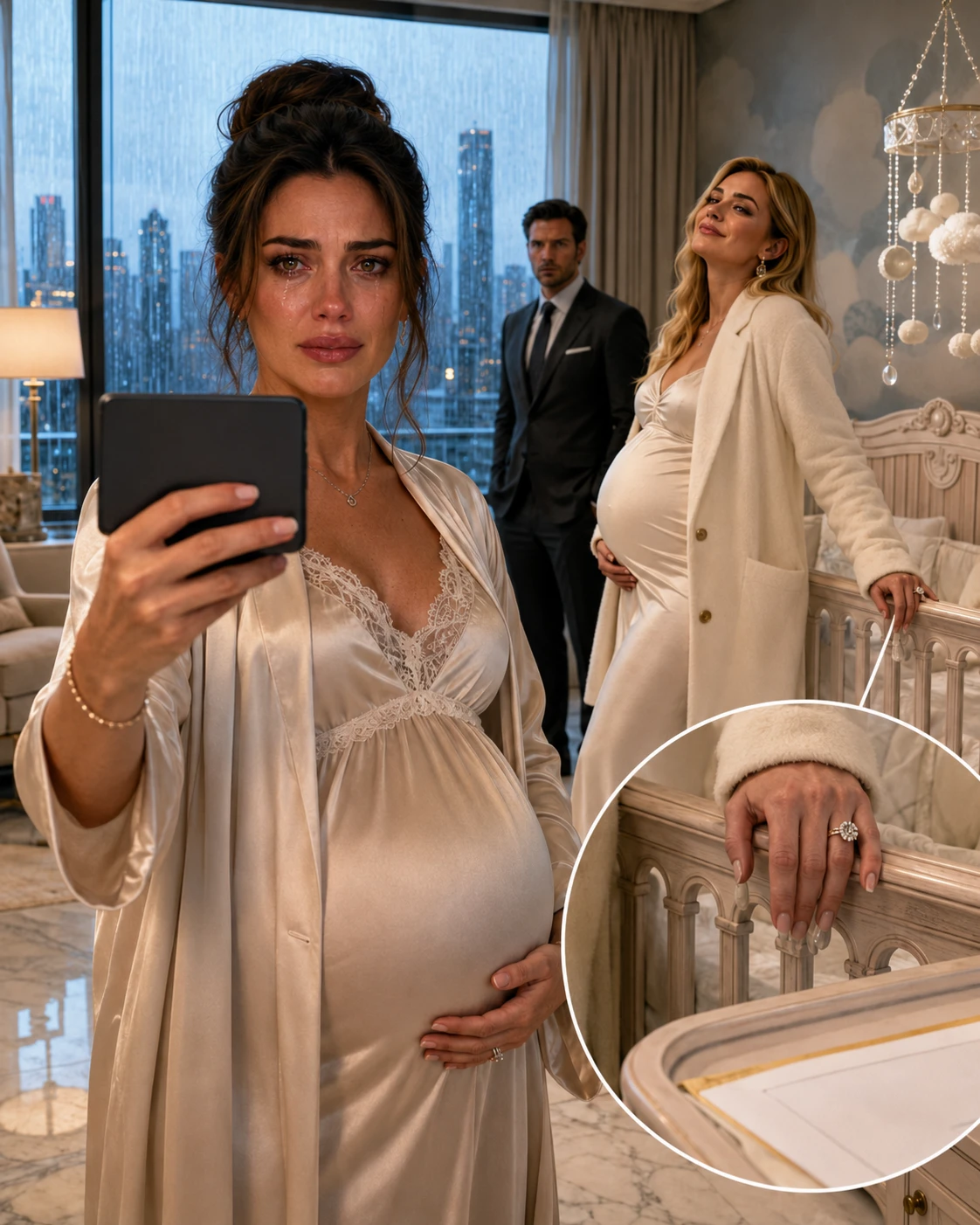
His mistress walked into my nursery and said, “This room belongs to my baby now.”
She said it softly, almost kindly, as if she were asking permission to borrow a silk scarf.
I was six months pregnant, barefoot on the heated marble floor of the penthouse my husband had bought with our wedding money and decorated with my mother’s taste. Outside the floor-to-ceiling windows, Manhattan glittered in the rain like a diamond bracelet dropped into black water. Inside, the nursery smelled faintly of fresh paint, French lavender, and the cedar rocking chair my father had restored for me before he died.
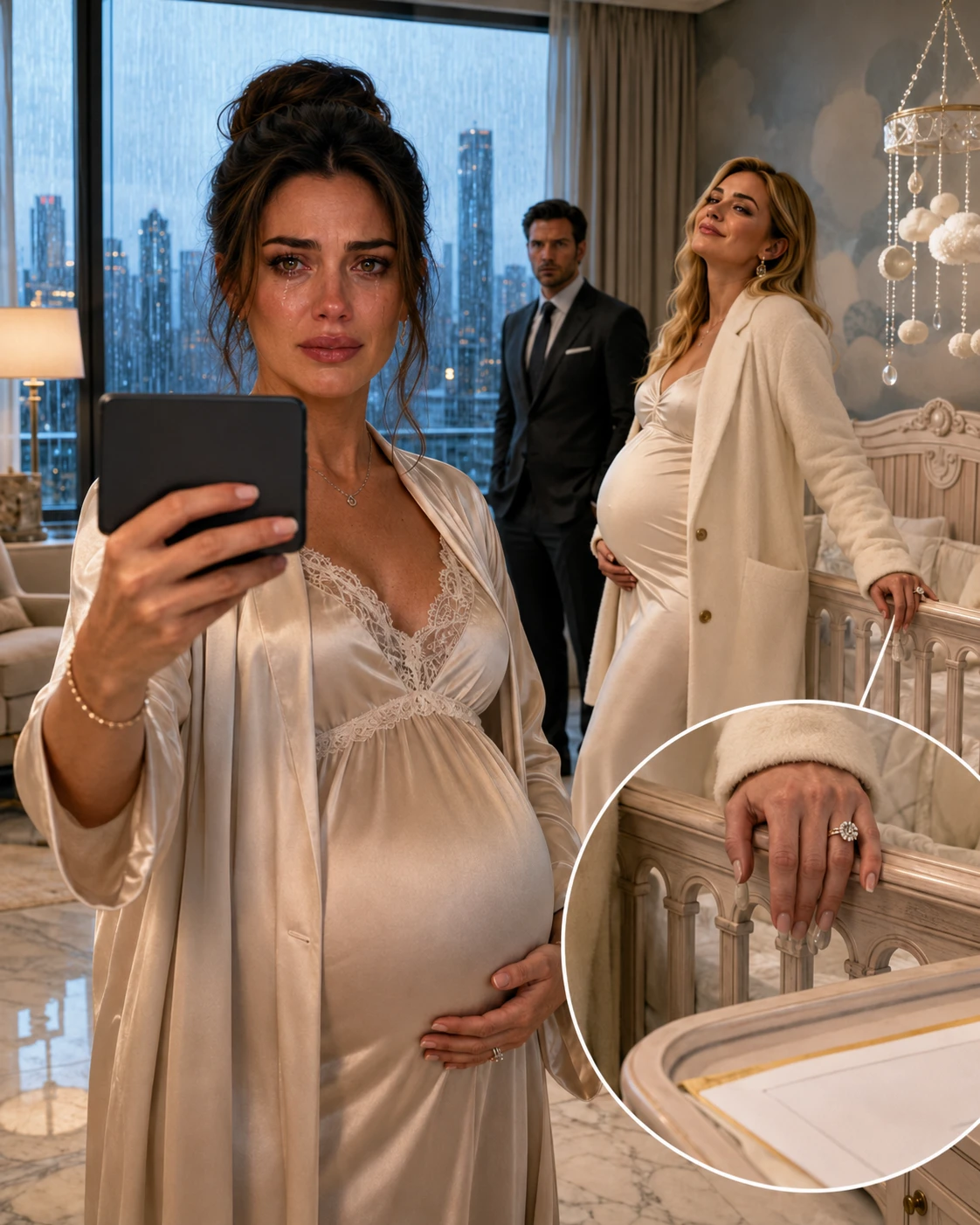
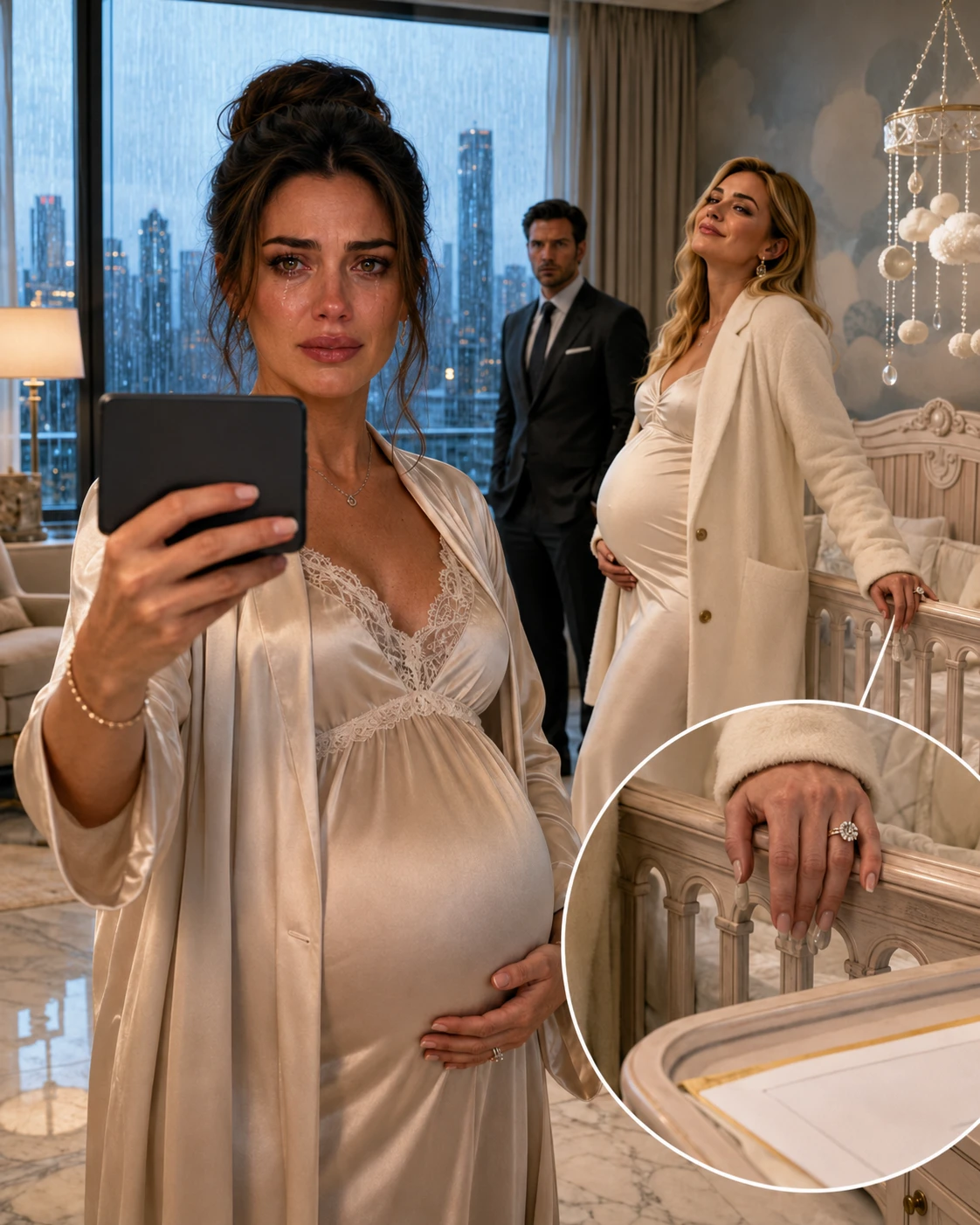
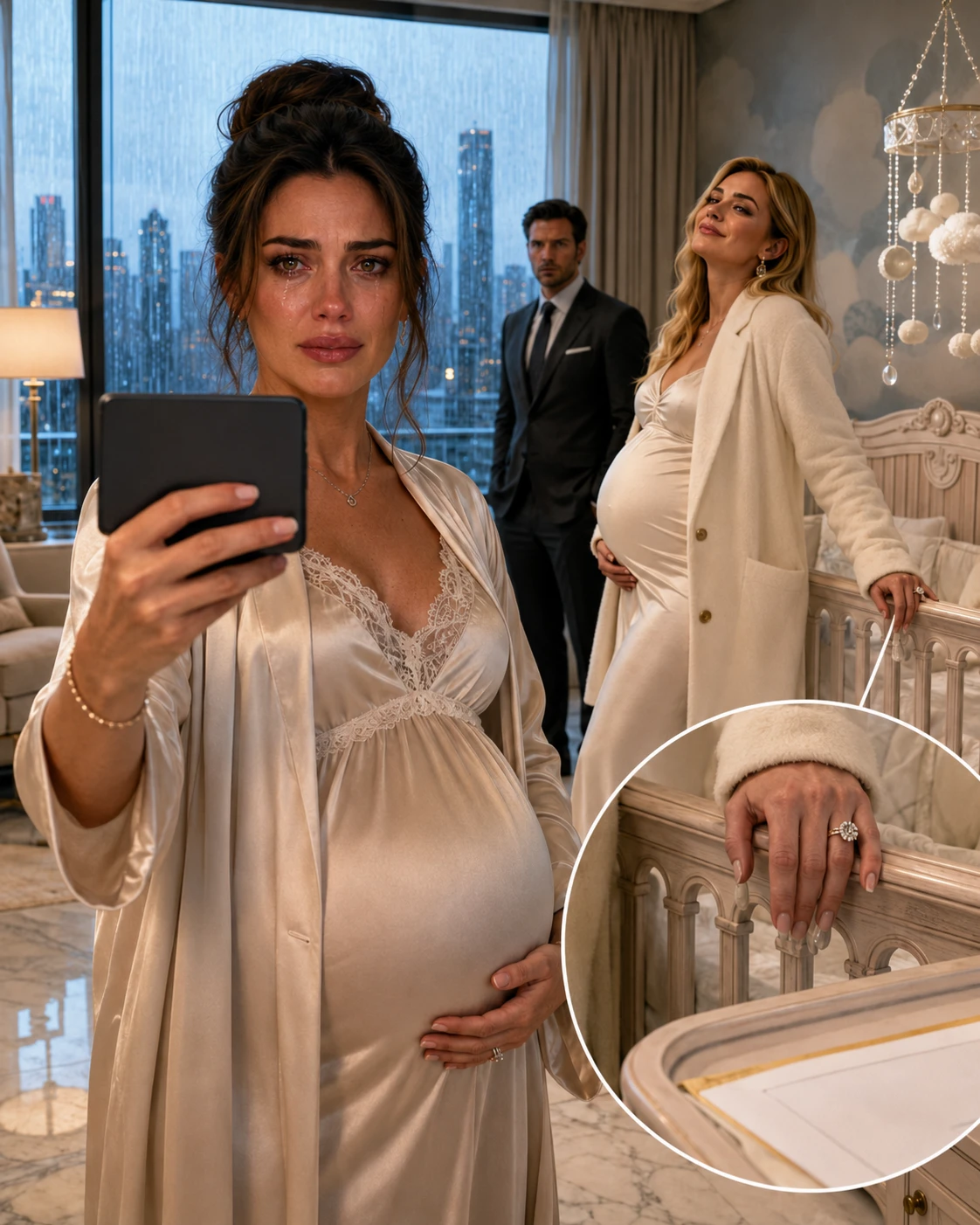
My husband’s mistress stood beneath the crystal mobile, running one manicured finger along the edge of the crib my mother had ordered from a small workshop in Vermont. It was white oak, hand-carved, with tiny moons and stars tucked into the corners.
Her name was Brielle Sutter.
Twenty-seven. Blonde. Pretty in the expensive, polished way of women who knew which angles made men stupid. She wore a cream cashmere coat over her swollen stomach, one hand resting on her own pregnancy like it was a crown.
Behind her, my husband, Graham Whitaker, leaned against the nursery wall in a charcoal suit that cost more than my first car. He looked tired. Not guilty. Not afraid. Just inconvenienced.
“Don’t make this harder than it has to be,” he said.
That sentence did something to me.
Not loudly. Not dramatically.
Something in me went perfectly still.
I did not scream. I did not slap him. I did not grab Brielle by her perfect hair and drag her away from the crib where my son was supposed to sleep.
I simply lifted my phone.
One photo.
Brielle’s hand on my crib. Graham in the background. The nursery door behind them. The wall mural with our son’s name, Theodore, painted in gold leaf above the changing table.
Theo.
My baby.
My breath.
My proof.
Graham’s eyes sharpened. “Eleanor.”
He always used my full name when he wanted control.
I lowered the phone and smiled for the first time since they had walked in.
It was not a warm smile.
It was the kind of smile my grandmother used to call “Sunday silver.” Beautiful from a distance. Sharp enough to cut meat.
“You’re right,” I said. “We shouldn’t make this harder than it has to be.”
Brielle’s expression flickered, just once.
She did not know yet.
Men like Graham always choose women who know how to take a room, but not how to read one.
That photo, the property order, and the pregnancy timeline became the beginning of the custody battle he never saw coming.
But the nursery was only where the war began.
CHAPTER 1
THE ROOM THAT STOPPED BREATHING
There are homes that hold laughter in the walls, and there are homes that hold strategy.
The Whitaker penthouse held both, at first.
When Graham and I married, he was not yet the kind of man who ordered betrayals the way other men ordered bourbon. He was thirty-two, handsome, hungry, and brilliant enough to make old money nervous. His family owned Whitaker-Hale, a private investment firm that had survived three recessions, two scandals, and one senator’s divorce.
I was Eleanor Vance, daughter of a museum curator and a probate attorney from Connecticut. My family had money, but not Whitaker money. We had books with marginal notes, silver polished by hand, fireplaces that smoked in winter, and a belief that dignity was something you practiced when nobody was watching.
Graham used to say he loved that about me.
“You make wealth look quiet,” he told me once, during a charity gala at the Frick.
I was twenty-nine then, wearing a navy dress and my mother’s pearls. He had looked at me as if he had discovered a private painting hidden behind a public wall.
I should have known.
Collectors always admire what they plan to own.
For the first four years, we were beautiful in the way people love to photograph. We appeared at benefits and openings. We spent summers in Nantucket, Christmas in Aspen, and Sunday mornings reading in bed while the city hummed beneath us.
Then came the waiting.
Three miscarriages in two years.
The first one was blood on white sheets at eleven weeks. The second was a silent ultrasound at fourteen. The third was a tiny heartbeat that stopped three days before my birthday.
Grief made our marriage quiet. Mine became prayer. His became distance.
By the time I became pregnant with Theo, I had learned to keep joy folded small inside me, like a letter I was afraid to read.
Graham cried when I told him. Actually cried. He knelt in our bathroom with the pregnancy test in his hand and pressed his face to my stomach.
“Finally,” he whispered.
I thought he meant our baby.
Now I know men like Graham always mean themselves.
He became attentive again. He came to appointments. He sent peonies every Friday. He hired a designer for the nursery and then fired her when I said I wanted to do it myself.
“This room should feel like us,” I told him.
He smiled, kissed my forehead, and said, “Then make it perfect.”
So I did.
I chose a pale dove-gray wallpaper with hand-painted clouds. I ordered linen curtains from a woman in Charleston who embroidered tiny constellations into the hem. My mother bought the crib. My best friend Celeste found the antique brass lamp in an estate sale in Virginia. I painted the name THEODORE above the changing table myself, balanced carefully on a step stool while my mother scolded me over FaceTime.
Every object had a story.
Every corner was a promise.
Then, on a Tuesday in November, Brielle walked in and turned the room into evidence.
I remember the details too clearly.
Her perfume was jasmine and something metallic. Her coat was Max Mara. Her engagement ring—yes, engagement ring—was an emerald-cut diamond set in platinum.
Not mine.
A newer one.
Bigger.
She looked around the nursery with the calm inspection of someone touring a house she had already decided to buy.
“This is gorgeous,” she said, and placed her hand on my crib. “Honestly, Eleanor, you have such taste. I told Graham you would.”
Her voice had a sweet tilt to it, Southern maybe, though later I learned she was from Scottsdale and had cultivated the softness in her vowels like a brand.
I stood in the doorway with my hands on my stomach.
“Graham,” I said, and heard how thin my voice sounded.
He did not move toward me.
That was the first answer.
Brielle turned, smiling with sympathy that had been rehearsed. “I know this must be uncomfortable.”
Uncomfortable.
A blister is uncomfortable. A crowded elevator is uncomfortable. Seeing your husband’s pregnant mistress in your unborn child’s nursery is something else entirely. It is a blade you only notice after it is already inside you.
“Why is she here?” I asked.
Graham exhaled, impatient. “We need to discuss logistics.”
“Logistics?”
Brielle’s smile dimmed. “The babies are due very close together.”
Babies.
Plural.
My world narrowed until all I could see was Graham’s face.
“How close?” I asked.
He looked away.
Brielle answered for him. “I’m due February second.”
My due date was February eighteenth.
Sixteen days.
Sixteen days between my miracle and his mistake.
But no. That was too generous. Mistakes happen once, in shadows, followed by shame. This had a due date. A ring. A woman confident enough to touch my crib.
I swallowed.
“How long?”
Graham pushed a hand through his hair. “Eleanor—”
“How long?”
Brielle looked at him, then at me, almost pleased to be the one holding the knife.
“About a year,” she said.
A year.
During my third miscarriage. During the fertility treatments. During the injections I gave myself in the bathroom while Graham told me he had late meetings. During the nights I apologized because grief made me difficult to love.
A year.
Something inside me cracked, but it did not collapse.
My mother raised me around antiques. I knew the difference.
A cracked thing can still be priceless.
Graham stepped forward, finally. “I didn’t want you to find out this way.”
I laughed once. It sounded nothing like me.
“How did you want me to find out? In a handwritten note? On heavy stationery?”
His jaw tightened. “We’re trying to be adults.”
Brielle touched her stomach. “There’s no need for ugliness.”
I looked at her hand on my crib.
“Remove your hand.”
Her eyebrows lifted.
“Eleanor,” Graham warned.
“Remove your hand from my son’s crib.”
Brielle withdrew it slowly, but not because she was afraid. She was performing restraint. She wanted Graham to see her as reasonable and me as unstable.
That was her first mistake.
Never perform for a woman who has spent her entire marriage learning how to host dinner parties beside people who secretly hate her.
Graham opened a leather folder he had placed on the rocking chair. My rocking chair.
“We’ve had counsel draft a temporary arrangement.”
Counsel.
The word landed with a cold little click.
He handed me a document.
I did not take it.
So he placed it on the changing table, beneath THEODORE’s name.
“This isn’t personal,” he said.
Of all the lies men tell, “this isn’t personal” is the one they reserve for crimes committed in daylight.
I looked down at the paper.
TEMPORARY RESIDENTIAL AND PROPERTY USE AGREEMENT
My eyes moved over the lines without absorbing them at first. Then the meaning formed.
Graham wanted me out of the penthouse before the birth.
He was offering to “relocate” me to our house in Greenwich until divorce proceedings were finalized.
He wanted exclusive use of the Manhattan residence.
He wanted the nursery left intact.
He claimed it would “serve the needs of the minor children,” meaning his child with Brielle and my unborn son, as if our babies were matching pieces of luggage requiring shared storage.
And then I saw the clause.
The nursery, already prepared and furnished, was to remain in the marital residence for use by Mr. Whitaker’s newborn child.
His child.
Not ours.
His.
I placed one hand on my stomach. Theo shifted, a soft roll beneath my ribs, as if reminding me he was still there.
Graham spoke gently, because he had always been most dangerous when gentle.
“You’ll be more comfortable in Greenwich. Less stress. More space. Your mother is nearby.”
“My mother is in Litchfield.”
He blinked. “Close enough.”
Close enough.
Brielle stepped beside him. “I’m not trying to take anything from you.”
“No?” I said.
She looked at the crib.
Then she said the line.
“This room belongs to my baby now.”
There are moments in life when anger arrives as fire.
Mine arrived as ice.
The room went quiet. Even the rain against the windows seemed to pause.
I lifted my phone and took the photo.
Graham’s face changed.
“Delete that.”
I looked at the screen. The image was perfect. Brielle in cream cashmere, hand hovering above the crib. Graham in the background. The document visible on the changing table. THEODORE shining above them in gold.
“No.”
“Eleanor, delete it.”
“No.”
Brielle’s confidence faltered. “It’s just a photo.”
I put my phone in the pocket of my robe.
“Yes,” I said. “It is.”
Graham took another step toward me. “Don’t be dramatic.”
That was his second mistake.
Dramatic women scream. Strategic women document.
“I want you both out of this room,” I said.
Brielle glanced at Graham, waiting for him to handle me.
He lowered his voice. “Don’t make this harder than it has to be.”
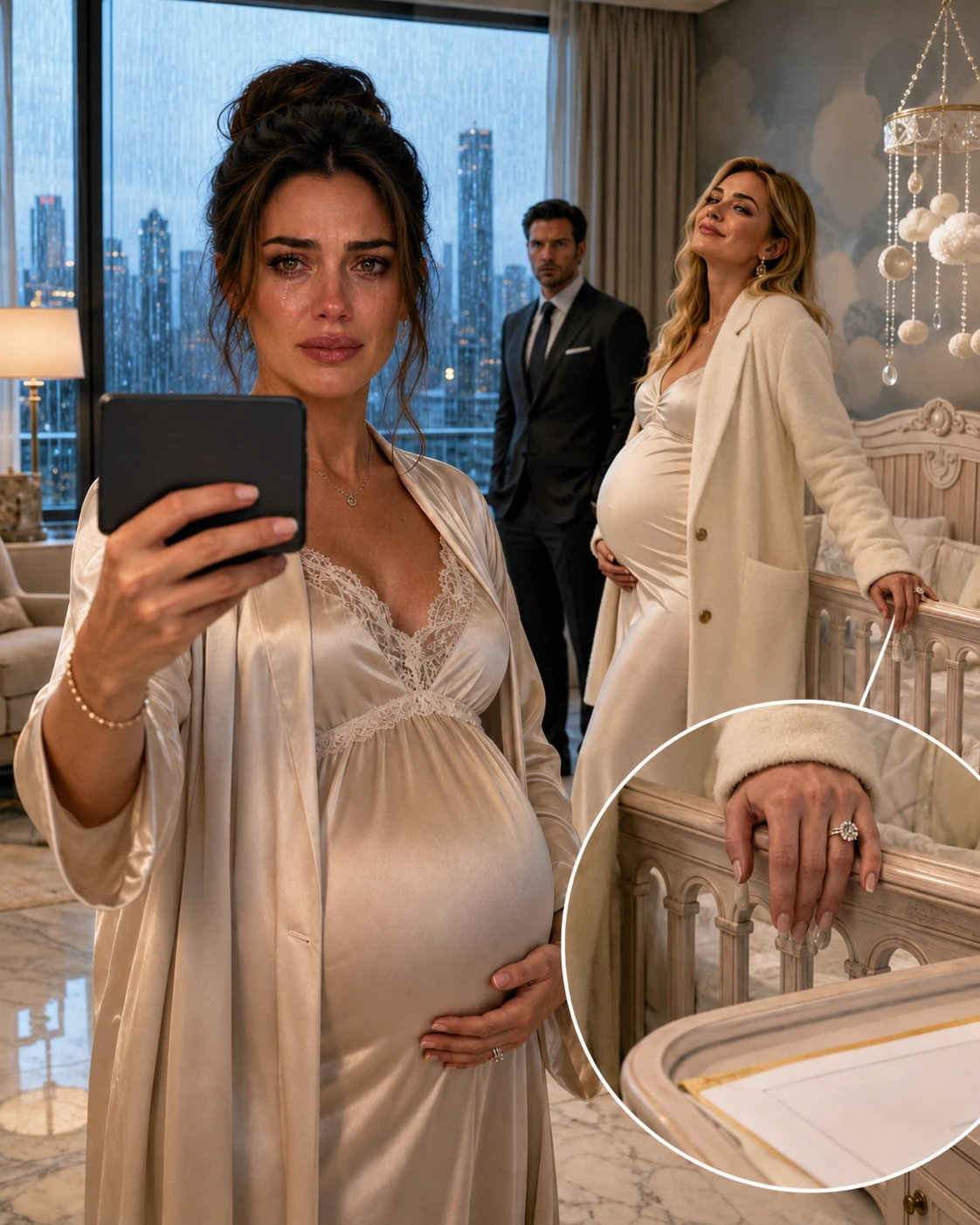
I looked at my husband, the father of my unborn child, the man who had held my hand through three losses and somehow carried another woman’s secret through the ashes.
Then I smiled.
“You’re right.”
I walked past them, picked up the leather folder, and tucked it under my arm.
Graham reached for it. “That’s not yours.”
“It has my name on it.”
“It’s a draft.”
“Then you won’t mind me keeping it.”
He stared at me.
For the first time that day, he understood something was wrong.
Not with me.
With his plan.
I left the nursery, walked down the hall to my bedroom, and locked the door.
Then I sat on the edge of my bed, shaking so hard my teeth clicked together.
I wanted to call my mother. I wanted to throw up. I wanted to crawl under the covers and wake up in a world where my husband had not turned our baby’s room into a negotiation.
Instead, I opened my phone.
I texted one person.
Celeste Monroe.
My best friend since boarding school. Former federal prosecutor. Current partner at one of the most terrifying family law firms in New York.
The message was simple.
I need you. Now.
She called in twelve seconds.
“What happened?”
I tried to speak. Nothing came out.
“Ellie,” she said, and her voice changed. “Are you safe?”
I looked at the locked door. Beyond it, I could hear Graham speaking in low tones. Brielle murmured something. The elevator chimed.
“For now.”
“Are you alone?”
“Yes.”
“Good. Listen to me carefully. Do not cry where he can see you. Do not sign anything. Do not leave the residence. Do not argue. Send me everything.”
“The nursery,” I whispered.
“What about it?”
“She said it belongs to her baby now.”
There was a silence.
When Celeste spoke again, her voice had gone velvet-soft.
“Oh, Eleanor.”
“I took a photo.”
“Send it.”
I did.
She opened it while we stayed on the phone. I heard the tiny sound of her breath leaving her body.
“Beautiful,” she said.
I almost laughed. “That is not the word I would use.”
“No, honey. Legally, it’s gorgeous.”
I looked down at my stomach.
Theo moved again.
Celeste continued, crisp now, deadly. “I’m coming over. Pack a small bag, but don’t move out. Gather your passport, medical records, prenatal files, financial documents, jewelry receipts, anything from your trust, and every piece of communication with Graham. Quietly.”
“Celeste.”
“Yes?”
“I think he’s going to take my baby.”
Another pause.
Then: “Not if I breathe first.”
Twenty minutes later, Graham knocked.
“Eleanor.”
I did not answer.
“We need to talk.”
Still nothing.
His voice hardened. “This isn’t healthy for the baby.”
There it was. The first attempt to turn my pain into maternal failure.
I pressed record on my phone and placed it on the nightstand.
“Open the door,” he said. “You’re acting irrationally.”
I looked at the screen. The red recording line moved like a heartbeat.
When he left, I sent that too.
By sunset, Celeste arrived wearing a black wool coat, red lipstick, and the expression of an angel sent specifically to ruin men.
She swept into my bedroom, locked the door behind her, and hugged me so tightly I finally let one sob break loose.
Only one.
Then she held my face in both hands.
“Listen to me. Tonight you grieve. Tomorrow you become a problem.”
“I don’t know how.”
“Yes, you do.” Her eyes flashed. “You were raised by women who smiled at funerals and sued afterward.”
Despite everything, I laughed.
Celeste sat me down and began making lists.
Assets. Accounts. Properties. Trusts. Medical care. Timeline. Witnesses. Staff. Security footage. The nursery items purchased by my family. The clause in the property order. Brielle’s pregnancy timeline. Graham’s affair timeline. The engagement ring.
“The ring matters?” I asked.
“The ring always matters.”
By midnight, my heartbreak had columns.
By dawn, it had exhibits.
Graham slept in the guest room.
Brielle, I later learned, spent that night in his suite at The Carlyle, posting a photo of room service pancakes with the caption: peaceful mornings are a blessing.
I did not comment.
I did not text.
I did not beg.
Instead, at 7:15 a.m., while the city was still silver with rain, I walked into the nursery alone.
I stood in front of the crib.
For one terrible second, I let myself imagine her baby there. Her lullabies. Her perfume in the curtains. Her laughter in the room I had built from grief and hope.
Then I began removing things.
Not everything. Not enough to look frantic.
Just what was mine.
My mother’s crib paperwork. The receipt. The artisan’s letter. The embroidered curtains. The antique lamp. The cedar rocking chair’s restoration records. The gold paint invoice. The baby blankets knitted by my aunt.
I photographed each item in place.
Then I packed the documents in a folder labeled THEO.
When Graham walked in at nine, freshly showered and irritated, the nursery looked the same.
But it was not the same.
Neither was I.
He stood at the doorway. “We should sit down with lawyers.”
I turned from the window.
“Of course.”
He seemed relieved.
That was his third mistake.
He mistook calm for surrender.
CHAPTER 2
VELVET GLOVES, STEEL TEETH
The first rule of wealthy divorces is that nobody says war.
They say transition.
They say settlement.
They say wellness.
They say we both want what is best for the child while instructing assistants to bury each other alive in documents.
Graham’s lawyer was Martin Kell, a man whose smile looked leased. He had handled enough billionaire separations to know that cruelty should always be printed on cream paper.
We met in a conference room on the forty-eighth floor of a glass tower overlooking Bryant Park. Outside, December snow drifted in elegant little flakes. Inside, eight lawyers sat around a table long enough to host a royal autopsy.
Graham wore navy. Brielle was not present, but I could feel her in every clause.
I wore black.
Not mourning black.
Investment black.
Celeste sat to my right. Beside her was Nadine Alvarez, a custody specialist with silver hair, kind eyes, and a reputation that made judges sit straighter.
Martin began with concern.
“Mrs. Whitaker, everyone here understands this is emotionally challenging.”
Celeste smiled. “Try again.”
He blinked.
“She’s not emotionally challenging. The situation is. Caused by your client. Continue.”
Graham’s jaw tightened.
Martin adjusted his papers. “Mr. Whitaker is prepared to offer generous temporary support and residence in Greenwich, with all medical expenses covered, in exchange for exclusive use of the Manhattan residence until the birth of both children.”
“The birth of both children,” Nadine repeated. “Interesting phrase.”
Martin ignored that. “Given Mrs. Whitaker’s current condition, a quieter environment may be preferable.”
“My current condition?” I asked.
He gave me a paternal smile. “Pregnancy can amplify stress responses.”
I placed my hands neatly in my lap.
“Are you suggesting pregnancy makes me legally incompetent to remain in my home?”
“No one said incompetent.”
“You implied unstable.”
Graham leaned forward. “Eleanor, don’t twist this.”
I looked at him.
“That’s what you said outside the bedroom, too. Irrational. Unhealthy for the baby. I have the recording, if your lawyer needs a transcript.”
Silence lowered itself into the room.
Martin’s pen stopped.
Celeste did not look at me, but I saw the corner of her mouth lift.
Graham’s face darkened. “You recorded me?”
“In my bedroom, while you were demanding entry and questioning my mental state? Yes.”
Nadine made a note.
Martin cleared his throat. “Let’s stay productive.”
“Gladly,” Celeste said. “Withdraw the property demand.”
“Impossible,” Martin replied.
“Then explain why a pregnant wife should be removed from her marital residence so her husband’s pregnant fiancée can use her unborn child’s nursery.”
The word fiancée landed hard.
Graham’s eyes flashed. “She’s not—”
Celeste slid a printed photograph across the table.
Brielle’s Instagram. Diamond ring. Caption: forever starts quietly.
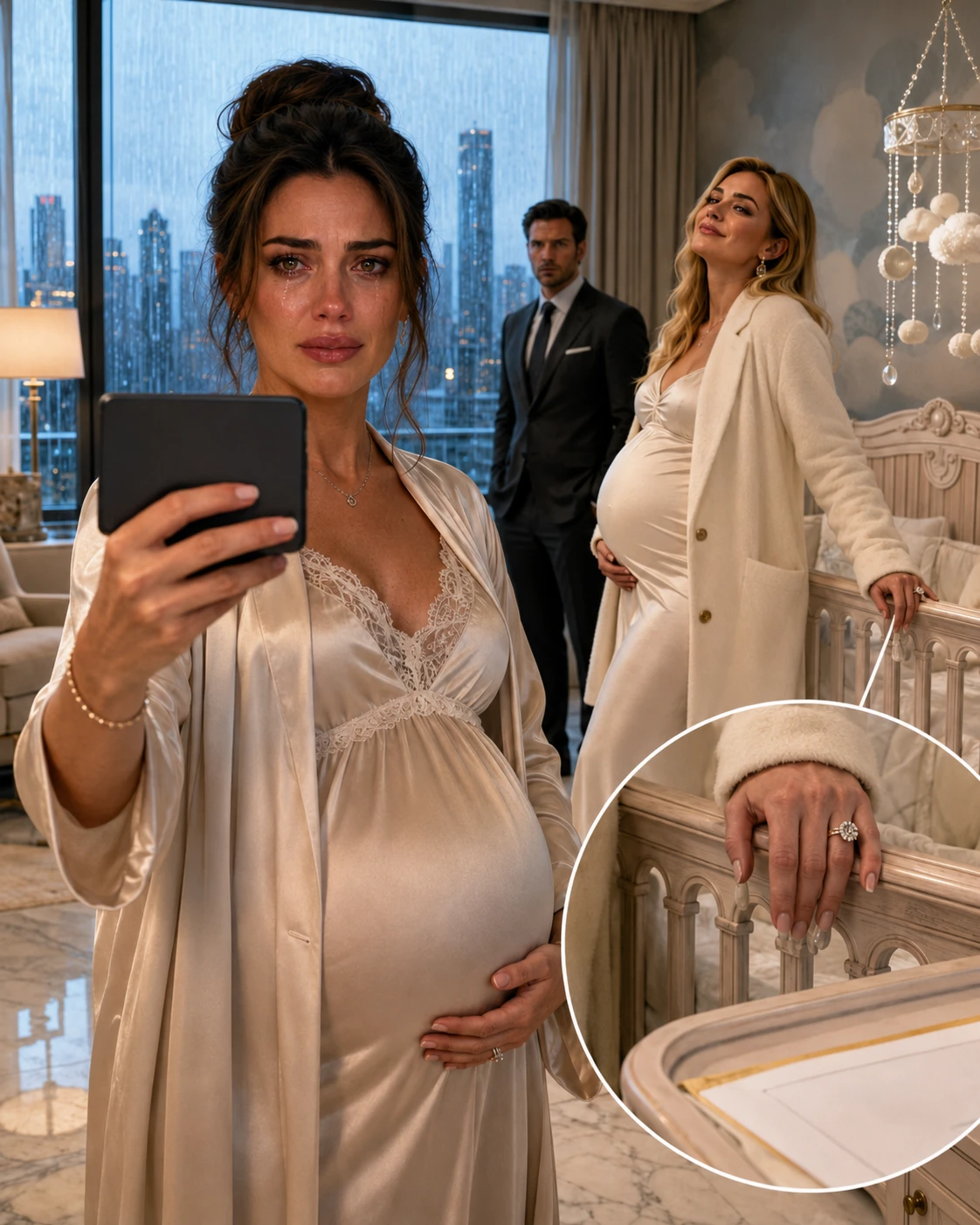
Date stamped. Three weeks earlier.
Graham stared at it.
Martin sighed almost imperceptibly.
I watched my husband realize, perhaps for the first time, that romance posted online becomes discovery.
Celeste added another document. “We also have photographs of Ms. Sutter in the nursery, the proposed property order assigning use of Mrs. Whitaker’s nursery furnishings to Ms. Sutter’s child, and a pregnancy timeline indicating conception during a period when Mrs. Whitaker was receiving fertility treatments and recovering from pregnancy loss.”
Graham looked at me then.
Something like shame moved across his face.
Too late. Much too late.
Martin leaned back. “Morality is not custody.”
“No,” Nadine said calmly. “But judgment is.”
I had thought the meeting would break me. Instead, it educated me.
Graham wanted three things.
The penthouse.
A clean public narrative.
Access to Theo after birth on terms broad enough to let him parade as a devoted father while Brielle occupied my home.
He did not want scandal. Whitaker-Hale was finalizing a merger with a Boston-based fund. Family instability, hidden liabilities, misuse of marital property—these were not the perfume of investor confidence.
I learned that day that power is often not about having the sharpest knife.
It is about knowing which room cannot afford blood on the carpet.
We did not settle.
By the time I left, snow had covered Fifth Avenue in soft white silence. Photographers stood outside the building because someone had tipped them off.
Not me.
Graham looked furious.
I stepped into the cold with one hand over my coat, protecting Theo from nothing and everything.
A camera flashed.
“Mrs. Whitaker! Are you and Graham separating?”
Another flash.
“Is it true there’s another baby?”
I did not answer.
I simply looked ahead and walked into Celeste’s waiting car.
By evening, Page Six had posted a blind item.
A Manhattan finance prince, two pregnant women, and one nursery no one wants to talk about.
Brielle posted nothing for forty-eight hours.
Graham called me twenty-three times.
I answered none.
Instead, I moved through the penthouse like a ghost with a spreadsheet.
The staff had begun avoiding eye contact. Not from disloyalty. From fear. Wealth makes servants of everyone near it, including those paid to serve. The housekeeper, Marta, cried when I asked whether she had seen Brielle before that day.
“Yes, Mrs. Whitaker,” she whispered. “Three times.”
My stomach turned.
“In the nursery?”
Marta nodded.
“Did Mr. Whitaker bring her?”
“Yes.”
“Did she touch anything?”
“She sat in the chair once.”
The chair my father had restored.
I kept my face still.
“Marta, I’m going to ask you something, and you can say no. Did you feel uncomfortable?”
Her eyes filled. “Very.”
“Did he ask you not to tell me?”
She looked toward the hallway, then nodded.
I did not ask for more. Celeste did.
Within a week, Marta had signed an affidavit.
So had Lionel, the evening doorman, who remembered Brielle arriving under Graham’s name while I was at prenatal appointments.
So had the building concierge, who had copies of visitor logs.
Then came the security footage.
Graham’s team tried to block it, claiming privacy. Celeste filed a motion so sharp I imagined it slicing open envelopes by itself.
The footage showed Brielle entering the penthouse building on dates that aligned with my medical procedures.
October 12th: I had a specialist appointment after bleeding.
Brielle entered at 3:14 p.m.
September 9th: I had a prenatal anatomy scan.
Brielle entered at 11:06 a.m.
August 21st: Graham told me he was in Chicago.
Brielle stayed overnight.
The dates became a second language.
A woman learns to measure betrayal differently when it has timestamps.
But the real shift came from a place Graham never bothered to understand: my side of the money.
He thought he knew my finances because he knew my family was comfortable. He knew about the Vance trust in general terms. He knew my mother collected art and my father had handled estates. But Graham, like many men born into louder wealth, confused quiet with small.
My grandmother, Beatrice Vance, had been old New England steel wrapped in cashmere. She never trusted charming men, especially the ones with good cufflinks.
Before I married, she insisted on a prenuptial agreement so thorough Graham’s attorneys joked it had weather patterns.
I had signed it reluctantly, embarrassed.
Gran had taken my hand afterward and said, “Love is a garden, Eleanor. Paper is the fence. Only fools plant without one.”
When she died, she left me controlling interest in several family entities Graham dismissed as “legacy holdings.” Historic properties. Art funds. Mineral rights in Pennsylvania nobody mentioned at parties. A quiet but significant stake in a biotech firm that had gone public two years after our wedding.
Graham knew pieces.
He did not know the architecture.
My attorney did.
The prenup protected premarital assets. It also contained something Graham had laughed at when we signed it.
A morality-triggered custody expense clause.
Not custody outcome. No agreement can pre-decide a child’s best interest. But if one spouse’s extramarital conduct created reputational, residential, or legal harm during pregnancy, that spouse would bear advanced litigation costs related to protective proceedings.
Graham had called it “your grandmother’s Puritan tax.”
I had forgotten it existed.
Celeste had not.
When she found it, she looked up from the document and whispered, “Beatrice, you magnificent dead woman.”
The motion for fees hit Graham’s legal team like crystal dropped on stone.
Suddenly, he was paying for my lawyers to prove his conduct endangered my stability.
It was elegant.
It was brutal.
It was exactly how Gran would have liked it.
Still, power does not make heartbreak disappear. It only gives heartbreak a desk.
At night, when the city went blue and quiet, I sat in the nursery and cried with my hand over my mouth. Not because I wanted Graham back. That desire had died the moment he stood behind Brielle and let her claim the crib.
I cried because I missed who I had been before I knew.
Trust is not just belief in another person. Trust is a room inside you where you can sleep.
Graham had burned mine down.
One night, two weeks before Christmas, I woke at 2:00 a.m. to my phone lighting up.
A text from Graham.
Can we talk without lawyers?
I stared at it.
Another came.
I made mistakes. But you’re escalating this beyond repair.
Then:
Think about Theo. A child needs both parents.
There it was again. Theo as shield. Theo as leverage. Theo as soft place to press a blade.
I typed and deleted three responses before writing one sentence.
All communication through counsel.
I placed the phone facedown.
It rang immediately.
I did not answer.
Then my intercom buzzed.
My blood went cold.
I checked the security feed from my phone.
Graham stood in the private elevator vestibule, hair damp from snow, coat open, face flushed. He must have used his building credentials before Celeste’s emergency access restriction was processed.
I called the doorman.
“Mrs. Whitaker?” Lionel answered, alarmed.
“Please document that Mr. Whitaker is here unannounced after midnight. I am not granting access.”
“Yes, ma’am.”
The buzzer rang again.
Then Graham’s voice came through the door.
“Eleanor, open up.”
I stood in the hallway, shaking.
“I know you can hear me.”
Theo kicked, hard.
Graham’s voice softened. “Ellie. Please.”
That almost undid me.
He had not called me Ellie in months.
I leaned my forehead against the wall and closed my eyes.
“Remember Nantucket?” he said through the door. “Remember that storm? We lost power and you made grilled cheese over the fireplace.”
I remembered.
I remembered laughing because he burned the first sandwich black. I remembered his face lit by candles. I remembered thinking marriage was not a contract, but a shelter.
His voice cracked. “I miss us.”
For one dangerous second, I wanted to open the door.
Then my phone buzzed in my hand.
Celeste.
Do not engage. Police are being called for documentation, not drama. Stay away from the door.
I had not even texted her.
The doorman had.
Good man.
Graham knocked again.
“Ellie, she doesn’t mean anything.”
And just like that, the spell broke.
Because Brielle did mean something.
She meant he could lie while touching my stomach.
She meant he could watch me mourn our lost children while making another one.
She meant he could bring her into the room I built for Theo and ask me to leave politely.
I stepped back from the door.
When building security escorted him down, I watched on camera.
He looked up once, directly into the lens.
I felt nothing.
That frightened me more than anger ever had.
The next morning, Brielle posted a black-and-white selfie with tearful eyes.
Please be kind. Pregnancy should be sacred.
The internet chose sides before breakfast.
Some called me cold.
Some called her brave.
Some called Graham what he was.
By noon, #NurseryGate was trending in certain circles rich enough to pretend they did not enjoy gossip.
Graham’s merger partners noticed.
That afternoon, Martin Kell requested an emergency settlement conference.
Celeste forwarded the email with no comment, only a champagne emoji.
But the first real twist arrived three days later, wrapped in brown paper and addressed in handwriting I did not recognize.
Inside was a flash drive.
No note.
Just a label.
FOR THE CRIB.
CHAPTER 3
THE WOMEN HE UNDERESTIMATED
I did not plug the flash drive into my laptop.
That was one of many things Celeste had taught me in the previous weeks, along with how to breathe during deposition prep and how not to throw porcelain when reading legal lies.
Instead, I called her.
She sent over a forensic tech named Priya Singh, who arrived in sneakers, a wool beanie, and the serene confidence of someone who could make billionaires cry by opening metadata.
Priya examined the drive on a sterile device while I sat across the table with ginger tea cooling between my hands.
“It’s video,” she said.
My pulse shifted.
“Of what?”
“Looks like interior security footage. Audio too.”
“From where?”
She clicked carefully. “Your penthouse.”
The room tilted.
I had not known there was audio inside. Graham had always told me the cameras were visual only, for insurance and staff safety, no sound.
Priya’s expression tightened. “There are multiple files. Dates from August through November.”
Celeste arrived halfway through the review and immediately became very still.
The first clip showed Graham in the nursery with Brielle in September. I was at a prenatal appointment. Brielle sat in the cedar rocking chair, laughing, her feet tucked beneath her.
“This is better than the room in Tribeca,” she said.
Graham leaned against the crib. “Eleanor won’t be here much longer.”
My stomach dropped.
Brielle looked up. “You really think she’ll go quietly?”
“She’ll do what’s best for the baby. She always does.”
Brielle smiled.
“What if she fights?”
Graham shrugged. “Then we make her look unstable.”
The words entered the room and changed the temperature.
Celeste said, softly, “Pause it.”
Priya did.
No one spoke.
I felt Theo move beneath my ribs and placed a hand over him.
There are betrayals of the body. There are betrayals of the heart.
Then there are betrayals of reality itself.
Make her look unstable.
Every gentle concern. Every comment about stress. Every lawyer’s phrase about my condition. It had been planned.
Celeste’s voice was quiet. “Ellie, I’m sorry.”
“Play the rest.”
The next clips were worse.
Graham telling Brielle that once Theo was born, he would push for a psychological evaluation if I resisted shared residency.
Brielle suggesting I might “spiral” because of my miscarriages.
Graham saying judges responded to documented maternal volatility.
Brielle asking whether the nanny could report concerns.
Graham replying, “Staff can be encouraged.”
I did not cry.
I think some pain becomes too large for tears. The body refuses to waste water on a house already flooded.
Then came the clip that made Celeste swear.
November 3rd. The nursery.
Graham on the phone.
“Yes, Martin, I know timing is sensitive. The Greenwich move needs to happen before the birth. Once Eleanor is out, the optics settle. Brielle can transition in gradually.”
He listened.
“No, I don’t care if the crib was a gift from her mother. It’s furniture.”
Furniture.
My mother’s gift.
My father’s memory.
My son’s first safe place.
Furniture.
The next voice on the recording was faint but clear through speakerphone.
Martin Kell.
“Do not put anything in writing about replacing her in the residence before filing. We frame it as maternal comfort and reduced stress.”
Celeste stared at the screen like it had personally offended her.
“Well,” she said. “That’s a problem for Martin.”
For the first time in weeks, I felt something almost like laughter rising in me.
Not joy.
Recognition.
The war had just changed shape.
“Who sent this?” I asked.
Priya checked the package again. “No return address. Postmarked from Queens.”
I knew before anyone said it aloud.
“Marta,” I whispered.
The housekeeper.
The woman who had avoided my eyes, then signed an affidavit with trembling hands.
Celeste nodded slowly. “Maybe. We don’t ask yet.”
The flash drive became sealed evidence. Priya preserved the chain of custody. Celeste filed an emergency motion requesting protection of residential access, preservation of all building and interior surveillance, and sanctions for attempted manipulation of custody narratives.
The filing was not public.
But the consequences leaked into private rooms quickly.
Martin Kell withdrew from Graham’s representation within forty-eight hours.
Not loudly. Not with scandal. Just a tasteful notice citing “professional considerations.”
In our world, that was a scream.
Graham hired new counsel, a woman named Rebecca Sloan who was known for being ruthless and allergic to foolish clients. Her first message to Celeste was simple.
We need to talk.
Meanwhile, Brielle’s public softness began to crack.
She posted quotes about narcissistic women weaponizing pregnancy. Then she deleted them. Then she posted a photo of herself crying in a nursery showroom, hand on a display crib, captioned: Some dreams are stolen before they begin.
The comments were not kind.
People can forgive an affair in theory. They can romanticize messy love, second chances, forbidden passion.
But touch a pregnant wife’s crib?
Even the internet has its old gods.
The story spread because it was simple enough to understand and luxurious enough to watch. A penthouse. A mistress. Two babies. A nursery. A wife who did not scream.
Reels appeared with AI voices narrating my life over footage of rain on windows and diamond rings. Strangers debated my marriage while making coffee. Women stitched videos saying, “She touched the crib? I would have become a felony.”
I remained silent.
Silence is unbearable to people who expect women to collapse in public.
Graham tried a different tactic.
Flowers arrived first.
White roses. Hundreds.
I sent them to a women’s shelter.
Then a letter.
Hand-delivered.
Eleanor,
I know you hate me. You have every right. But the situation has moved beyond us. Our son deserves peace. I am asking you to stop allowing Celeste to turn this into a spectacle. Brielle is under immense stress. Her doctor is concerned. Whatever you think of me, please do not punish an unborn child.
Graham
I read it twice.
Then I handed it to Celeste.
She scanned it and said, “He mentions Brielle’s stress before yours.”
“I noticed.”
“He calls Theo ‘our son’ but Brielle’s baby ‘an unborn child.’ Emotional hierarchy.”
“I noticed that too.”
She looked at me with something like pride.
Grief had sharpened me. I hated that it had to.
But the strangest thing about revenge is that people imagine it as hot, bloody satisfaction.
Mine was mostly paperwork.
Document requests.
Financial disclosures.
Medical privacy protections.
Emergency motions.
Custody evaluations.
Deposition notices.
The luxury was in the details.
Graham’s emails printed on thick paper.
Brielle’s Instagram posts archived with timestamps.
The nursery invoice tied to my mother’s credit card.
The prenatal appointment calendar aligned with visitor logs.
The audio transcript formatted cleanly, every cruel sentence numbered.
Line 42: “Then we make her look unstable.”
Line 87: “Staff can be encouraged.”
Line 103: “It’s furniture.”
Furniture became a word I could not hear without tasting metal.
In January, I moved—not out, but up.
My grandmother had owned a co-op on the Upper East Side, a prewar apartment overlooking Central Park that had sat empty since her death because I could not bear to change it. It had herringbone floors, a library with green lacquer walls, and windows that turned morning light into honey.
The court granted me temporary exclusive occupancy of that apartment, funded through my trust, with Graham ordered to maintain support and barred from entering without written agreement. The penthouse became contested property, frozen by litigation.
I rebuilt the nursery in Gran’s old guest room.
Not identical.
Better.
The crib stood near the window beneath a mobile of brass stars. The cedar rocking chair faced the park. The curtains had been rehung, their embroidered constellations catching pale winter light. Above the changing table, I repainted THEODORE in gold.
My mother came to help.
She did not cry when she saw the crib.
My mother, Vivian Vance, was too disciplined for that. She wore camel trousers, a silk blouse, and the expression of a woman mentally selecting which ancestor to summon.
She ran her hand along the carved moons.
“I should have bought the larger one,” she said.
That was her way of saying she loved me.
I leaned into her shoulder.
“I’m sorry.”
“For what?”
“For choosing him.”
She turned sharply. “No. You do not apologize for trusting your husband. Shame belongs to the person who broke the vow, not the one who believed it.”
I breathed in her perfume, Chanel and old books.
“What if Theo asks one day?”
“Then you tell him the truth in pieces he can carry.”
That became my compass.
Truth in pieces he could carry.
Because despite everything, Theo was not a weapon. He was not proof. He was not a headline.
He was a child who would one day have Graham’s eyes, maybe my mouth, maybe his own private soul untouched by any of this unless we were careless.
So I made a rule with myself.
I would destroy Graham’s plan.
Not Theo’s father.
That distinction mattered.
Even when Graham did not deserve it.
Especially then.
Two weeks before my due date, the court scheduled a hearing on temporary custody, residential protections, and sanctions. Graham sought future shared parenting time immediately after birth, plus access to medical updates. I sought sole temporary legal and physical custody through the newborn period, supervised visitation after medical clearance, strict communication protocols, and a protective order around the nursery assets and staff manipulation.
Brielle was not a legal party to my custody case.
But she haunted it.
Then, three nights before the hearing, she called me.
Unknown number.
I answered because I was tired, heavily pregnant, and foolish enough to think there might be an emergency.
“Eleanor?”
Her voice was different without an audience.
“What do you want, Brielle?”
Silence.
Then: “I need to know if you’re planning to release the videos.”
I closed my eyes.
“No.”
“You swear?”
“I don’t swear things to you.”
Her breath shook. “He said you would ruin us.”
“He says many things.”
“He said you were trying to take his company.”
I looked out at Central Park, black trees against snow.
“I’m trying to protect my child.”
Another silence.
Then she said something I did not expect.
“I didn’t know about the miscarriages.”
My hand tightened around the phone.
“What?”
“I knew you had trouble getting pregnant. Graham said you were obsessed with having a baby. He said the losses were early. He said you used them to control him.”
For a moment, I could not speak.
The cruelty was so intimate it felt almost surgical.
Brielle continued, words spilling now. “I didn’t know he was with me the day after your procedure. I didn’t know he brought me there when you were at appointments. I thought…” She laughed, but it broke. “I thought he loved me.”
I should have felt satisfaction.
I did not.
Pain recognizes pain, even when it arrives wearing your enemy’s perfume.
“He loved what you allowed him to be,” I said.
“What does that mean?”
“Unaccountable.”
She cried then. Quietly. Not theatrically.
I sat with the phone pressed to my ear, listening to the woman who had touched my crib fall apart.
Finally, she whispered, “I’m scared.”
“For your baby?”
“For both of us.”
I did not answer immediately.
Outside, a siren moved through the city and faded.
“Brielle,” I said, “do you have your own lawyer?”
“Graham said I didn’t need one.”
Of course he did.
“Get one.”
“He’ll be angry.”
“Yes.”
“I don’t have your kind of money.”
I thought of the ring. The coat. The nursery showroom tears.
Then I thought of a child who had not asked to be born into this.
“There are attorneys who will consult. Call the Women’s Bar Association referral line. Call tonight. Do not tell Graham first.”
She was silent.
“Why are you helping me?”
I looked at the crib.
“I’m not,” I said. “I’m helping your baby.”
She hung up without saying goodbye.
I did not tell Celeste until morning.
When I did, she studied me carefully.
“You okay?”
“No.”
“Regret it?”
“No.”
She nodded. “Good. Mercy is cleaner when it has boundaries.”
But Brielle did more than get a lawyer.
She disappeared.
The day before the hearing, Graham’s counsel notified the court that Ms. Sutter was unavailable for voluntary interview due to medical rest.
Graham looked composed in filings.
But by then I knew his composition. It was thin ice over dark water.
At 11:37 p.m., Celeste received an encrypted email from an attorney in New Jersey representing Brielle.
Attached was a declaration.
Brielle had signed it.
I read it sitting in Gran’s library while Theo pressed against my ribs like he too wanted to hear.
In the declaration, Brielle admitted Graham had encouraged her to believe I would leave the marriage voluntarily after childbirth due to “mental fragility.” He told her the nursery had been prepared with family funds but would be “reassigned.” He advised her not to communicate with me directly because I was “volatile.” He gave her a ring and told her he was “effectively separated” from me before I knew the affair existed.
Then came the line that made every nerve in my body wake.
Mr. Whitaker stated repeatedly that once Mrs. Whitaker gave birth, the newborn would be easier to manage through nurses, scheduling, and court pressure than during pregnancy.
Easier to manage.
Not love.
Not parent.
Manage.
Celeste looked up from the declaration, eyes bright with fury.
“He is done.”
But the final paragraph was stranger.
Brielle wrote:
I have reason to believe Mr. Whitaker misrepresented financial arrangements involving the marital residence, including the source of funds used for renovations and certain transfers from accounts associated with Mrs. Whitaker’s family trust. I am willing to provide additional information under subpoena.
I stared at the page.
“What transfers?”
Celeste was already reaching for her phone.
That was the second war opening beneath the first.
And Graham, arrogant enough to bring his mistress into my nursery, had forgotten the oldest rule of betrayal.
Never teach two women that they were both disposable.
CHAPTER 4
THE HEARING AT THE TOP OF THE WORLD
The courthouse was not glamorous.
That surprised people online later, when they imagined marble stairs and dramatic speeches. Family court is fluorescent light, tired parents, paper cups of bad coffee, and the low-grade grief of strangers trying to divide love into schedules.
Our hearing took place in a private courtroom because of the media attention. Graham’s team had requested sealed proceedings. We agreed, with certain exceptions for filings related to financial misconduct.
He arrived first.
I saw him through the glass before we entered. He wore a dark suit, white shirt, no wedding ring. He looked thinner. Still handsome. Still Graham. The sight of him hurt in an old, automatic place, like pressing on a bruise you thought had healed.
Then he saw me.
For a moment, his face changed.
I was eight and a half months pregnant, wearing a cream coat over a black dress, my hair swept into a low knot, Gran’s pearls at my throat. I looked calm because three women had spent the morning making sure I did: my mother, Celeste, and Nadine.
“Let him see the woman he failed to break,” Celeste had said, fastening my bracelet.
So I did.
Graham stepped toward me.
Celeste moved first. Not dramatically. Just half a step.
He stopped.
“Eleanor,” he said.
“Graham.”
His eyes dropped to my stomach. Something softened. “How is he?”
I hated that my heart answered before my mouth.
“He is well.”
“I’m glad.”
I believed him.
That was the worst part.
People want monsters to be monstrous all the time. They rarely are. Graham could love Theo and still harm me. He could want to be a father and still try to control the mother. He could regret consequences without regretting choices.
The courtroom doors opened.
Inside, Judge Marion Fletcher sat beneath the seal of New York State, reading glasses low on her nose and patience already limited.
Judge Fletcher had a reputation for disliking theatrics and loving documentation.
Celeste adored her from afar.
The first hour was procedural.
Temporary custody. Medical privacy. Residence. Communication. Visitation after birth.
Graham’s new attorney, Rebecca Sloan, was careful. She did not attack my mental state directly. The flash drive had made that impossible.
Instead, she argued Graham had been misguided under emotional strain but remained committed to co-parenting. She emphasized his attendance at medical appointments, financial support, and preparation for fatherhood.
Nadine responded with the recordings.
Not all of them.
Just enough.
The courtroom listened to my husband say, “Then we make her look unstable.”
No one moved.
Even Graham closed his eyes.
Judge Fletcher looked over her glasses.
“Mr. Whitaker, is that your voice?”
Graham swallowed. “Yes, Your Honor.”
“And what did you mean by that statement?”
Rebecca touched his arm, warning.
He said, “I was angry. I spoke poorly.”
Celeste rose. “Your Honor, may we direct the court to the transcript, line 87?”
Judge Fletcher nodded.
Celeste read it aloud.
“Staff can be encouraged.”
She looked at Graham. “Encouraged to do what?”
Rebecca objected. Overruled.
Graham’s mouth tightened. “I don’t recall.”
Celeste smiled.
It was not a kind smile.
“Fortunately, the recording does.”
The judge’s pen moved.
Then Brielle’s declaration entered the record under seal.
Graham’s face went pale when he saw it.
Not because he felt exposed.
Because he felt betrayed.
That told me everything.
He did not look remorseful when my pain was described. He looked shaken when Brielle refused to protect him from it.
Rebecca requested a recess.
Judge Fletcher granted fifteen minutes.
In the hallway, Graham turned on me.
“You got to her.”
His voice was low, furious.
I looked at him, almost amazed.
“You still think women only act because someone controls them.”
His eyes flashed. “You don’t know what she’s going through.”
“No. But I know what you put us both through.”
“She’s carrying my child.”
“So am I.”
He recoiled slightly, as if the obvious had struck him.
For one moment, the hallway disappeared. No lawyers. No cameras. No polished shoes on institutional tile. Just us, standing on opposite sides of the life we had ruined and survived.
“I loved you,” I said.
His face cracked.
“I know.”
“No,” I said. “You don’t. Because you thought love meant I would make myself smaller around your betrayal.”
His eyes shone.
“Ellie—”
“Do not call me that.”
He looked down.
When we returned to the courtroom, Celeste moved to the financial issue.
This was supposed to be secondary. A warning shot.
It became the explosion.
Brielle’s attorney had provided enough information to justify emergency subpoenas. Graham had allegedly used funds from a renovation account linked to the penthouse to prepare a secondary residence for Brielle while representing those expenses as marital improvements.
But the forensic accountant found something else.
Years earlier, during a refinancing of the penthouse, Graham had authorized transfers through a holding company to cover renovations. Some funds had been drawn from an account connected to a Vance family entity. The account required dual authorization for major transfers.
One signature was mine.
Except I had never signed.
On the screen, under court seal, appeared a scanned authorization form.
Eleanor Vance Whitaker.
My signature.
But not my hand.
The room went silent in a different way.
My mother sat behind me. I heard her inhale once, sharp as a blade.
Celeste’s voice was controlled.
“Mrs. Whitaker, did you sign this document?”
“No.”
“Did you authorize Mr. Whitaker to sign on your behalf?”
“No.”
“Were you aware that funds connected to your family trust were used in this manner?”
“No.”
Rebecca Sloan stood quickly. “Your Honor, we object to the characterization. These are complex marital financial matters outside the scope—”
Judge Fletcher interrupted. “Counsel, if forged authorization intersects with housing, financial control, and coercive conduct during pregnancy, I will hear enough to determine temporary protections.”
Graham leaned toward Rebecca, whispering urgently.
For the first time, he looked afraid.
Not stressed. Not angry. Afraid.
The accountant continued.
The forged transfer had helped pay for renovations to the penthouse, including the nursery wing expansion.
My money.
My family’s money.
My forged name.
And then Graham had tried to remove me from the home and give that room to Brielle.
I stared at him.
He could not meet my eyes.
I thought of Gran, who had warned me about fences. I thought of my father, who had taught me that signatures were sacred. I thought of my mother’s crib.
Every betrayal suddenly connected.
Not messy. Not impulsive.
Architectural.
Graham had not merely cheated. He had built a life in which my body, my home, my grief, my money, and my child could all be managed.
That was the moment love died cleanly.
Before that, it had been bleeding.
Now it simply stopped.
Judge Fletcher ordered temporary sole legal and physical custody to me upon Theo’s birth, with Graham permitted supervised visitation after medical clearance and only through a court-approved supervisor. She ordered all communications through a parenting app. She barred Graham from entering my residence, contacting staff outside counsel, or discussing my mental health publicly or privately with third parties involved in childcare.
She also referred the financial signature issue for further civil and potential criminal review.
Graham’s empire did not fall in that room.
But the first load-bearing wall cracked.
When the hearing ended, I stood carefully. My back ached. My feet were swollen. Theo was pressing so low I felt like my body had become a bell waiting to ring.
Graham approached again, ignoring Rebecca’s whispered warning.
“Eleanor, please. We can fix this.”
I looked at him then.
Really looked.
At the man I had married. At the boyish charm still hiding beneath the expensive ruin. At the father of my son. At the stranger who had forged my name.
“No,” I said. “We can tell the truth. That is different.”
Outside, reporters waited behind barricades despite the sealed hearing. Snow fell in hard little flakes. Celeste guided me toward the car while cameras flashed.
Someone shouted, “Mrs. Whitaker, did your husband steal from you?”
I did not answer.
Another voice: “Do you have a message for Brielle?”
I paused.
Celeste’s hand tightened on my arm, but she did not stop me.
I turned slightly toward the cameras.
“My message is for the babies,” I said.
The shouting quieted.
“They are not responsible for the adults who failed them.”
Then I got into the car.
That ten-second clip went viral before dinner.
Not because I cried.
Because I didn’t.
America loves a woman who bleeds beautifully, but it fears a woman who learns clotting.
That night, Brielle went into early labor.
I found out from Celeste, who found out from Brielle’s lawyer, who communicated because the legal world had become the strangest group chat imaginable.
A baby girl was born at 1:22 a.m.
Her name was Lila Grace Sutter.
Graham was at the hospital.
So was a process server.
Celeste had not planned the timing. She was ruthless, not cruel. But legal papers arrive when legal papers arrive.
Graham was served in the maternity ward waiting area with notice of the financial preservation order.
By morning, Whitaker-Hale’s board had scheduled an emergency meeting.
By noon, three investors had requested clarification.
By evening, Graham’s father called me.
Harrison Whitaker had never liked me much. Not openly. He was too well-bred for open dislike. He considered me insufficiently dazzled by his family, which in old money circles is close to treason.
His voice on the phone was gravel and ice.
“Eleanor.”
“Harrison.”
“I am told there are allegations.”
“There is evidence.”
A pause.
“You understand the damage this could do.”
“To whom?”
“To many people.”
I sat in the library, one hand on Theo.
“Interesting how that phrase never seems to include me.”
He sighed. “Graham behaved foolishly.”
“No. Foolish is losing money in a poker game. Graham forged my signature, attempted to remove me from my home while pregnant, and coordinated a narrative questioning my stability.”
Another silence.
Then, quieter: “What do you want?”
It was the first honest question any Whitaker had asked me.
I looked at the fire. Gran’s portrait hung above the mantel, her painted eyes amused.
“I want my son protected. I want my assets restored. I want Graham removed from control over any entity connected to forged documents. I want the penthouse transferred out of dispute or sold, with my family’s funds reimbursed. I want Brielle’s child financially protected without using my child as cover. And I want your family to stop mistaking silence for weakness.”
Harrison said nothing for a long time.
Then: “You sound like your grandmother.”
“Thank you.”
“It was not a compliment.”
“I know.”
Two days later, the board placed Graham on temporary leave pending investigation.
The public statement cited “personal matters and governance review.”
Nobody believed it.
Brielle remained in the hospital with Lila.
I sent flowers.
Not white roses.
Yellow tulips.
The card read: For Lila. May every room she enters be safe.
Brielle texted me a photo of the flowers beside the hospital bassinet.
Thank you, she wrote.
I did not reply.
Some bridges do not need rebuilding. Some only need enough light for children to cross later.
Theo arrived twelve days after Lila, during a snowstorm that shut half the city down.
Labor began at 4:40 a.m. with a pain that wrapped around my spine like a fist. My mother drove because she trusted no one else with my body in weather. Celeste met us at the hospital with a folder of medical directives and a bag of snacks she claimed were for me but mostly ate herself.
Graham was notified through the parenting app after admission, per court order.
He replied within two minutes.
Is she safe? Is the baby safe?
For once, I believed the questions had no agenda.
The labor was long. Twenty-one hours. I moved through pain like a country with changing weather: thunder, heat, whiteout, dawn. There were moments I thought I could not do it. Moments I heard the ghosts of all the babies I had lost. Moments I felt my body split not just with birth, but with every grief that had brought me there.
At 1:03 a.m., Theodore James Vance Whitaker entered the world screaming.
A furious, perfect sound.
They placed him on my chest, warm and slippery and impossibly real.
His hair was dark. His fists were tiny. His mouth opened in outrage at the entire concept of air.
I began to sob then.
Not one disciplined tear.
Not silent elegance.
I sobbed like an animal, like a mother, like a woman whose body had finally brought someone safely through the fire.
My mother cried openly.
Celeste cried while pretending she was not.
Theo stopped screaming when I spoke.
“Hello, my love,” I whispered. “I kept the room safe.”
Graham saw him six hours later under supervision in the hospital.
I had dreaded it.
But when he entered, something in his face collapsed so completely that even Celeste looked away.
He washed his hands. The supervisor explained the rules. He approached the bassinet as if it contained both treasure and judgment.
“May I?” he asked me.
I nodded.
He lifted Theo carefully, awkwardly, tears already falling.
“Hi,” Graham whispered. “Hi, buddy.”
Theo yawned.
Graham laughed once, broken.
For a moment, I saw the father he could have been without all the rot.
That hurt too.
He looked at me across our son’s tiny head.
“Thank you,” he said.
I knew what he meant. Thank you for letting me hold him. Thank you for surviving. Thank you for not making this uglier in this room.
I did not absolve him.
I did not punish him.
I said, “He deserves peace.”
Graham nodded.
“Yes.”
Then Theo began to cry, and Graham handed him back immediately, as if the sound physically pained him.
My son settled against me.
Mine, but not possession.
Mine, as in responsibility.
Mine, as in every choice now had a witness.
For three weeks after Theo’s birth, the world softened.
Not legally. The cases continued. The investigation widened. Graham’s position at Whitaker-Hale deteriorated. Civil claims were filed. The forged signature became a stone dropped into deep water, rippling through banks, trustees, boardrooms.
But inside Gran’s apartment, there was milk, sleep, tiny socks, and sunlight.
Theo slept in the crib beneath brass stars.
I learned the geography of his face. The crease between his brows. The way his left hand opened when he dreamed. The soft sigh he made after nursing, as if satisfied with the universe.
I was not healed.
I was healing.
There is a difference, and it matters.
Then came the final twist.
The one no one—not Graham, not Brielle, not the board, not even Celeste—saw coming.
It arrived in a letter from my grandmother’s estate attorney.
Mr. Alden Pierce was ninety-one years old and still wore three-piece suits to Zoom calls. He had handled Gran’s affairs for decades and regarded urgency as a vulgar modern habit.
His letter was brief.
Dear Eleanor,
In light of recent developments and pursuant to your grandmother’s conditional instructions regarding the Whitaker marriage, I believe it is time to review the sealed codicil attached to the Beatrice Vance Family Trust.
Please come at your earliest convenience.
A sealed codicil.
I called my mother.
She knew.
I could hear it in her silence.
“What did Gran do?” I asked.
My mother exhaled. “She built another fence.”
CHAPTER 5
THE LAST THING IN THE VAULT
Alden Pierce’s office was on Madison Avenue, above a jeweler that displayed diamonds like captured ice.
I brought Theo because I was not ready to leave him for more than an hour and because some part of me wanted Gran’s ghost to see him.
He slept against my chest in a navy sling, warm and oblivious, while Mr. Pierce opened a folder sealed with red wax.
Celeste sat beside me. My mother sat on the other side, hands folded.
Mr. Pierce adjusted his glasses.
“Your grandmother was very specific about the circumstances under which this document should be opened.”
“What circumstances?” I asked.
He looked at me over the page.
“Evidence of marital misconduct involving financial coercion, reproductive vulnerability, or attempted alienation from residence during pregnancy.”
Celeste whispered, “I want to be her when I die.”
Mr. Pierce ignored that.
He began to read.
Gran had anticipated more than betrayal. She had anticipated patterns.
The codicil stated that if my spouse engaged in documented conduct intended to deprive me of residence, assets, or legal autonomy during pregnancy or postpartum vulnerability, additional trust protections would activate.
First, immediate independent funding for litigation, security, and childcare.
Second, transfer of certain Vance-controlled voting interests out of any shared marital influence.
Third, and most startling, an option.
Years before our marriage, quietly, through layered entities, Gran had acquired a minority but powerful stake in Whitaker-Hale during a period of internal liquidity pressure. She never publicized it. She never mentioned it at holidays. She simply held it through the Vance trust, with voting rights dormant unless triggered by specific governance concerns involving a Whitaker family member’s misconduct toward a Vance beneficiary.
I stared at Mr. Pierce.
“Gran owned part of Whitaker-Hale?”
“Owns,” he corrected. “Through the trust.”
Celeste sat back slowly.
My mother looked at the window.
“She said Harrison Whitaker was arrogant in 1998,” my mother said. “Apparently she found that expensive.”
I almost laughed, but Theo stirred against me and I touched his back.
Mr. Pierce continued.
The stake was not large enough to control the company outright.
But combined with the board’s governance review, investor panic, and the financial misconduct tied to my forged signature, it was enough to force a vote.
A vote on Graham’s removal.
A vote on structural reforms.
A vote Harrison Whitaker could not quietly bury.
Gran had not left me a weapon.
She had left me a key.
And the door it opened led directly into the room Graham cared about most.
Not our bedroom.
Not the nursery.
Not the court.
The boardroom.
The special meeting took place two weeks later at Whitaker-Hale’s headquarters in Midtown, on the sixty-second floor, in a room with smoked glass walls and a view of the city so grand it made people forget gravity.
I was not required to attend.
I attended anyway.
Theo stayed with my mother in a private room nearby, guarded by a security consultant Celeste trusted and a nanny whose references had been checked so thoroughly she joked she now knew her own childhood better.
I wore ivory.
Not bridal ivory.
Resurrection ivory.
Graham was already there when I entered with Mr. Pierce and the Vance trust representatives. Harrison sat at the head of the table, looking ten years older than he had three months before.
The directors knew. Not everything, perhaps, but enough.
Powerful rooms have their own scent: coffee, leather, fear disguised as cologne.
Graham stood.
“Eleanor.”
I inclined my head.
“Graham.”
His eyes moved to the folder in Mr. Pierce’s hands.
“What is this?”
“The fence,” I said.
He did not understand.
He would.
The meeting began with governance language so polished it almost hid the violence beneath.
Misconduct.
Exposure.
Fiduciary concerns.
Unauthorized transfers.
Reputational risk.
Leadership continuity.
Then Mr. Pierce spoke.
He presented the Vance trust’s dormant voting rights. He presented the trigger. He presented the forged authorization connected to accounts under trust protection. He presented the board’s duty to investigate and prevent further misuse.
Graham’s face went from confusion to disbelief to rage held barely under skin.
Harrison looked at me with something almost like respect.
Almost.
“You can’t do this,” Graham said finally.
Mr. Pierce lifted one eyebrow. “She can.”
Graham turned to me. “This is my family’s company.”
I thought of the nursery.
The crib.
The document.
His voice saying, “It’s furniture.”
“No,” I said quietly. “It is a company with shareholders, bylaws, duties, and records. You taught me to respect documents.”
The board voted.
Not unanimously.
Men like Graham always have friends who confuse charm with innocence.
But the motion passed.
Graham Whitaker was removed from executive authority pending full investigation, stripped of signing control over certain accounts, and barred from involvement in any matter touching Vance trust assets.
Harrison remained chairman, but diminished.
Whitaker-Hale survived.
Graham did not, at least not as he had been.
After the meeting, he followed me into the hallway.
No lawyers this time. No cameras. Just smoked glass and a city glittering beneath us.
“Was this always the plan?” he asked.
“No.”
“But you enjoyed it.”
I looked at him.
There was a time when I would have rushed to deny that, to prove I was good, soft, forgiving.
I was still good.
I was no longer soft in places where knives had been kept.
“I enjoyed being safe,” I said. “I enjoyed watching truth become more powerful than your version of it.”
He looked away.
“I’m not a monster, Eleanor.”
“I know.”
That seemed to hurt him more.
“Then why are you treating me like one?”
“I’m not. I’m treating you like a man with documented patterns of coercion, dishonesty, financial misconduct, and poor judgment around vulnerable women.”
His mouth tightened. “You sound like a lawyer.”
“I sound like evidence.”
For a moment, neither of us spoke.
Then he said, very quietly, “I lost everything.”
I thought of Brielle in a hospital room. Lila in a bassinet. Theo under brass stars. My mother’s hands packing nursery receipts. Marta trembling through an affidavit. My own signature forged on a page.
“No,” I said. “You lost the things you used other people to hold.”
His eyes filled, but no tears fell.
“What happens now?”
That was the saddest question.
Because it was the first one that sounded like surrender instead of strategy.
“Now,” I said, “you become the kind of father a court does not need to supervise. Or you don’t.”
He swallowed.
“And us?”
I looked at his face one last time as a wife.
Then I let her go.
“There is no us.”
I walked away before he could answer.
The divorce finalized months later.
Not quickly. Wealth delays everything except consequences.
The settlement restored the Vance funds with penalties. The penthouse was sold quietly to a tech founder’s ex-wife who reportedly loved the nursery wing and turned it into an art studio. Graham accepted restricted parenting terms that expanded only after therapy, compliance, and demonstrated stability.
Brielle did not marry him.
That surprised the internet.
It did not surprise me.
She moved to a small house in Montclair with Lila and, eventually, began working for a nonprofit that supported women navigating high-conflict separations. People mocked her transformation. People always mock women for changing after they punish them for staying the same.
I did not befriend her.
But once a month, through attorneys at first and later through a parenting coordinator, we shared updates about the children’s schedules. Lila had Graham’s eyes. Theo had mine. They were half-siblings before they were symbols, and I refused to let adult shame poison a child’s bloodline.
When Theo was six months old, I agreed to a supervised park visit where Graham saw both babies at once.
It was early summer in Central Park. The trees were bright and overgenerous. Nannies pushed strollers past joggers and old men playing chess.
Graham sat on a bench holding Lila while Theo slept in my arms.
Brielle stood a few feet away, thinner now, quieter, wearing no ring.
For once, none of us performed.
Graham looked at the children and began to cry.
Not loudly. Not for sympathy.
Just a man sitting with the living proof of every choice he had made.
Brielle looked away.
I did not comfort him.
But I did not enjoy it either.
That is the thing nobody tells you about winning.
Sometimes victory is not champagne. Sometimes it is watching the person who hurt you finally understand the size of the wound and realizing their pain does not repair yours.
Still, life kept moving.
Theo grew.
He learned to roll toward sunlight. He laughed at the brass mobile. He loved pears, hated peas, and once sneezed so dramatically that my mother declared him theatrical on the Vance side.
The apartment became warm again.
Not the old warmth of believing nothing could break.
A better warmth.
The kind built after winter, when every flame is chosen.
I hosted Sunday dinners. Celeste came with too much wine and stories she claimed were not confidential because she changed everyone’s names. My mother read Theo poetry he could not possibly understand. Marta came once with homemade arroz con leche and cried when she saw the crib safe by the window.
I hugged her.
“Thank you,” I said.
She shook her head. “I should have told you sooner.”
“You told me when you could.”
That is another thing pain taught me.
Courage often arrives late. It still counts.
When Theo turned one, I took him to the ocean in Nantucket.
Not the house Graham and I had rented during happier years. A different one, smaller, weathered gray, with wild roses along the fence and a porch that faced the water.
I carried Theo down to the beach at sunrise.
The sky was pink and gold. The Atlantic breathed in long silver sheets. He clapped at the gulls, delighted by their theft and noise.
I thought of the woman I had been in that nursery doorway, six months pregnant, watching another woman touch the crib.
I wanted to reach back and hold her.
Tell her she would not break.
Tell her the photo mattered.
Tell her silence could be a blade.
Tell her the room would be safe.
Tell her revenge was not the opposite of love when love had become a cage.
It was the restoration of choice.
On Theo’s first birthday, after cake and candles and my mother singing slightly off-key, I posted for the first time since everything began.
Not a statement.
Not an accusation.
A photo.
Theo’s tiny hand gripping the carved edge of the white oak crib. No face. No location. Just his hand, the moons and stars, and a line of morning light.
The caption read:
The mistress claimed the nursery. The wife claimed protection.
I almost deleted it.
Then I thought of every woman who had ever been told to be quiet so a man’s reputation could remain well-lit. Every woman called unstable for reacting to instability. Every woman asked to surrender rooms she built, children she carried, money she earned, names she signed, futures she bled for.
I posted it.
By midnight, millions had seen it.
Some called it cold.
Some called it iconic.
Some said I should have forgiven him.
Some understood that forgiveness is not the same as returning stolen keys.
But the comment I remembered came from a woman named Marissa in Ohio.
I left with my baby today. I took photos because of you.
I sat in the nursery, reading that, while Theo slept beneath the brass stars.
The city outside was dark velvet and scattered diamonds.
For the first time in a long time, I felt no anger.
Only peace.
Not soft peace.
Earned peace.
The kind with locks on the doors, names on the deeds, documents in order, and a baby breathing safely in the room that had once been used to threaten me.
CONCLUSION
A WARM HOUSE, A QUIET CRADLE
People still ask whether I got revenge.
They want the cinematic answer. The black dress. The courtroom gasp. The boardroom downfall. The mistress in tears. The husband ruined. The wife reborn in diamonds and silence.
Yes, those things happened.
But revenge was not the most beautiful part.
The most beautiful part was much quieter.
It was Theo waking from a nap with pillow creases on his cheek.
It was my mother laughing in the kitchen.
It was Celeste asleep on my sofa after pretending she only came by for ten minutes.
It was Marta dancing with Theo to old salsa music while soup simmered on the stove.
It was Lila toddling toward her brother in the park months later, both of them too young to know the story adults had tried to write around them.
It was realizing that a home is not protected by walls, money, or even love alone.
A home is protected by truth.
By women who answer the phone.
By friends who save screenshots.
By mothers who buy cribs.
By grandmothers who build fences from beyond the grave.
By judges who read the transcript.
By signatures that matter.
By the moment a humiliated woman decides she will not become the villain in a story written by the man who betrayed her.
Graham is still Theo’s father.
He is learning.
Slowly. Imperfectly. Under rules he once thought were for other people.
Brielle is still Lila’s mother.
She is learning too.
So am I.
I am learning that elegance is not silence. It is choosing exactly when to speak.
I am learning that luxury is not marble, cashmere, or diamonds. It is sleeping without fear. It is raising a child in rooms no one can steal. It is owning your name so completely that no forged signature can survive contact with the real thing.
And sometimes, when the apartment is quiet and Theo is asleep, I stand in the nursery doorway and look at the crib.
The same crib.
My mother’s gift.
My son’s bed.
My proof that what is touched is not always taken.
The stars above him turn slowly in the warm air.
Outside, New York shines like it has secrets.
Inside, my baby dreams.
And I remember the day Brielle Sutter walked into my nursery and told me the room belonged to her baby now.
She touched my crib. I touched the court file.