My husband’s mistress brought a wedding planner to my baby shower.
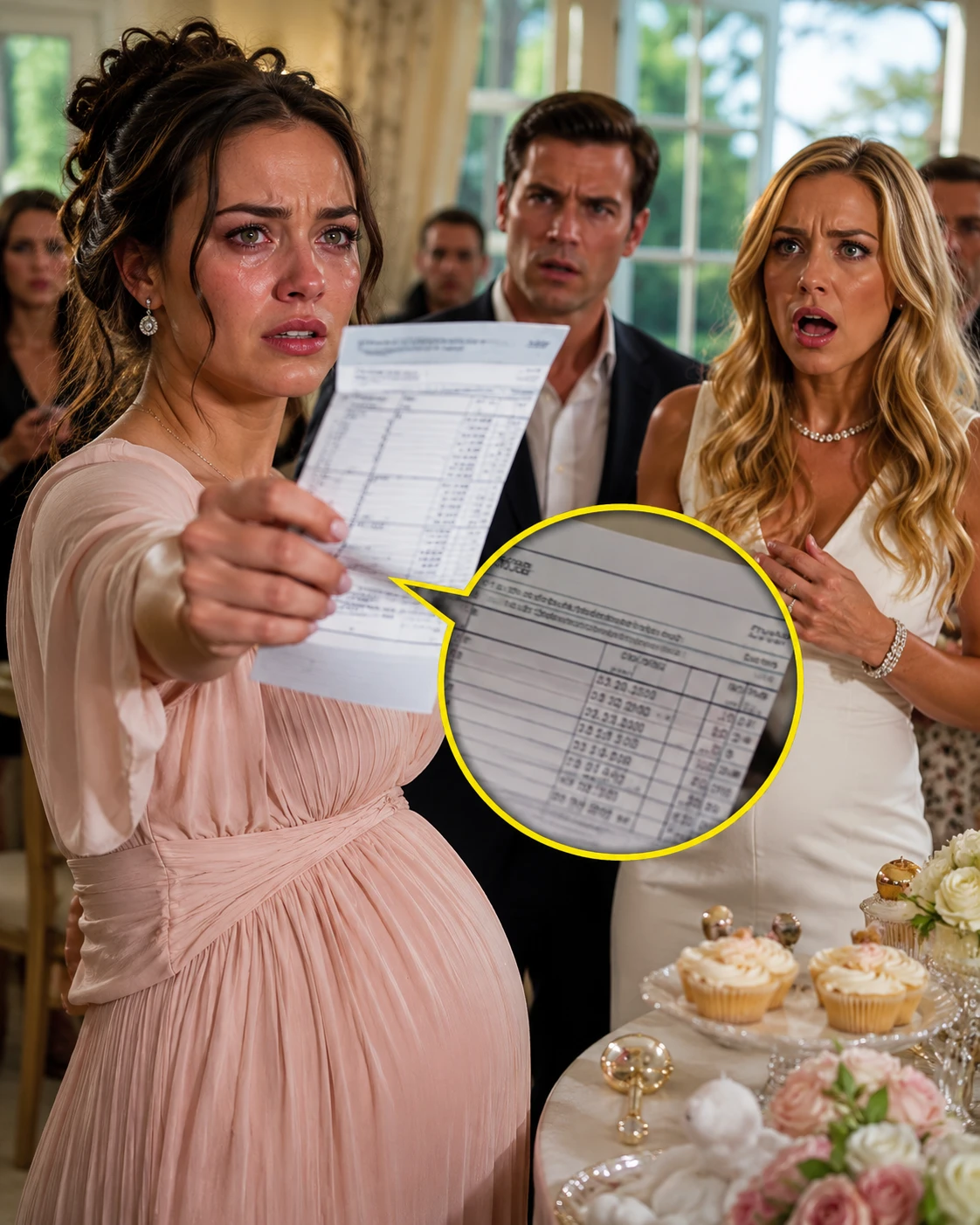
She waited until the gifts were being opened, when the room was soft with tissue paper and champagne bubbles, when every woman in silk was smiling too hard and every man in a navy jacket was pretending not to watch my belly.
Then Sloane Everly stepped into my sunroom like she owned the light.
She was wearing winter white in May, a dress too bridal to be accidental, with pearls at her throat and a diamond tennis bracelet I had seen on a credit card statement three weeks earlier. Her hair fell in that expensive, effortless wave women paid five hundred dollars to pretend they had woken up with. Behind her stood a woman with a leather folio, a measuring tape, and a smile trained by wealthy people’s chaos.
The wedding planner.
Sloane placed a stack of venue brochures beside the lemon cupcakes.
Not near the coats. Not discreetly on the console table. Beside the cupcakes. Beside the tiny gold cake toppers that said WELCOME BABY. Beside the silver rattle my mother-in-law had just presented to me like an award for producing a Whitaker heir.
“Oh,” Sloane said, widening her blue eyes at the room. “I’m sorry. Are we interrupting?”
Nobody answered.
Nobody had to.
The room had already tilted.
My husband, Callum Whitaker, stood near the French doors with one hand in his pocket and one hand wrapped around a glass of sparkling water he had not touched. He was beautiful in the way marble is beautiful—cold, expensive, and carved by people who never had to apologize.
“Maren,” he said quietly, warning in his voice.
That was the first time he had spoken my name that afternoon with any real feeling.
Sloane smiled at me. Not a guilty smile. Not a nervous one. A woman does not wear white to a pregnant wife’s baby shower by mistake. She does not bring a wedding planner unless she wants witnesses.
“I just need Callum to approve the Newport florals,” she said. “The venue is being impossible about the installation.”
Someone gasped.
My aunt Beverly dropped a satin bib into her lap.
My mother-in-law, Evelyn Whitaker, went pale in a way that had nothing to do with shame and everything to do with optics.
The planner, poor thing, opened the folio because she had been paid to open folios. Her hands were immaculate. Her nails were the color of expensive apologies. She spread floor plans, floral mockups, and a proposal sheet across my dessert table.
CALLUM WHITAKER & SLOANE EVERLY
BLACKWATER HOUSE, NEWPORT
JUNE 14
ESTIMATED EVENT TOTAL: $486,000
For one heartbeat, I saw my whole marriage laid out in cream cardstock and embossed lettering.
A wedding.
His wedding.
Not to me.
My baby kicked under my ribs. Once. Hard.
Callum crossed the room fast.
“Maren,” he said again, lower this time. “Don’t make a scene. Stress is bad for the baby.”
I looked at him, this man who had kissed my forehead that morning and told me the peonies looked nice. This man whose child I carried. This man who thought silence was something he could buy if the room was rich enough.
I smiled.
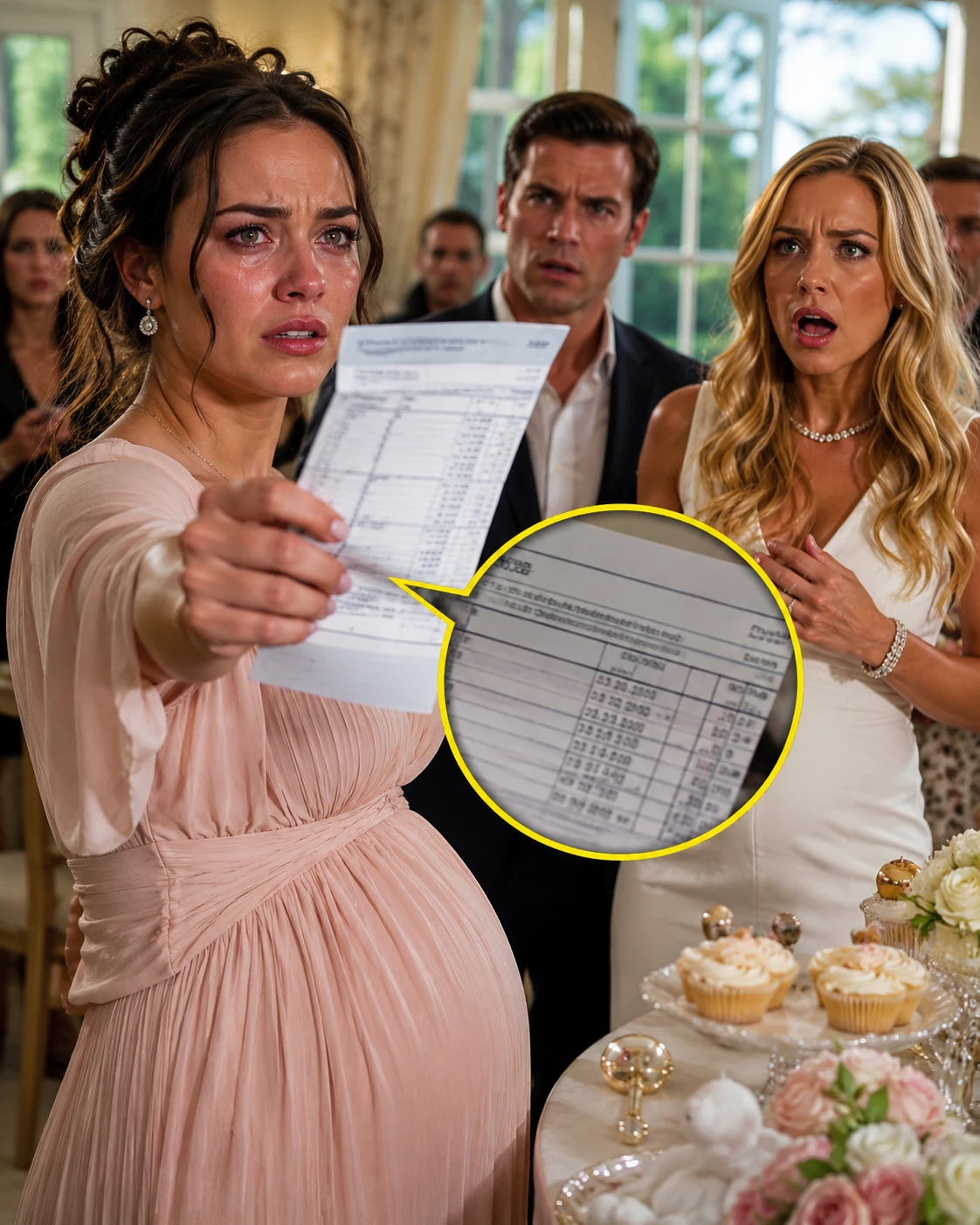
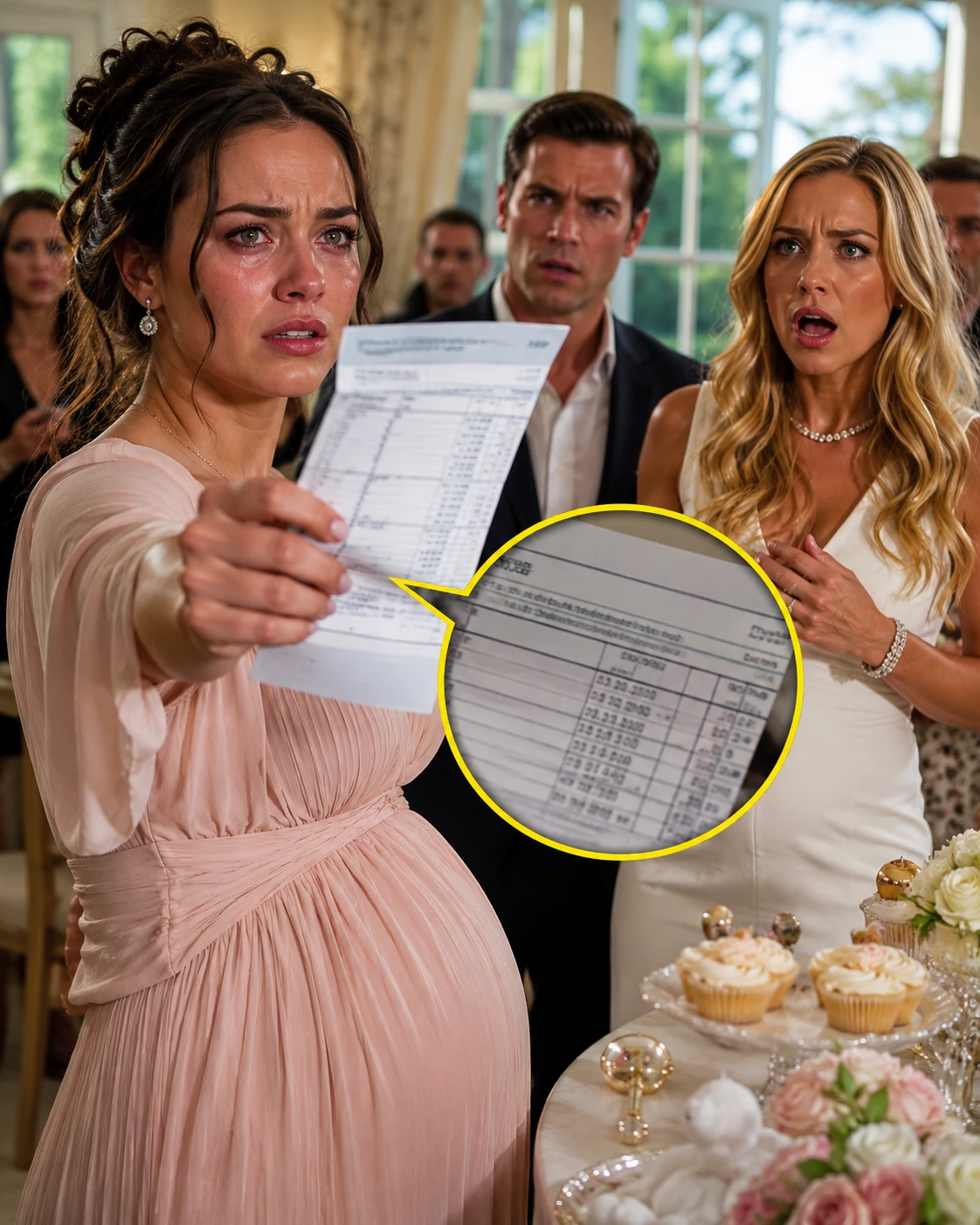
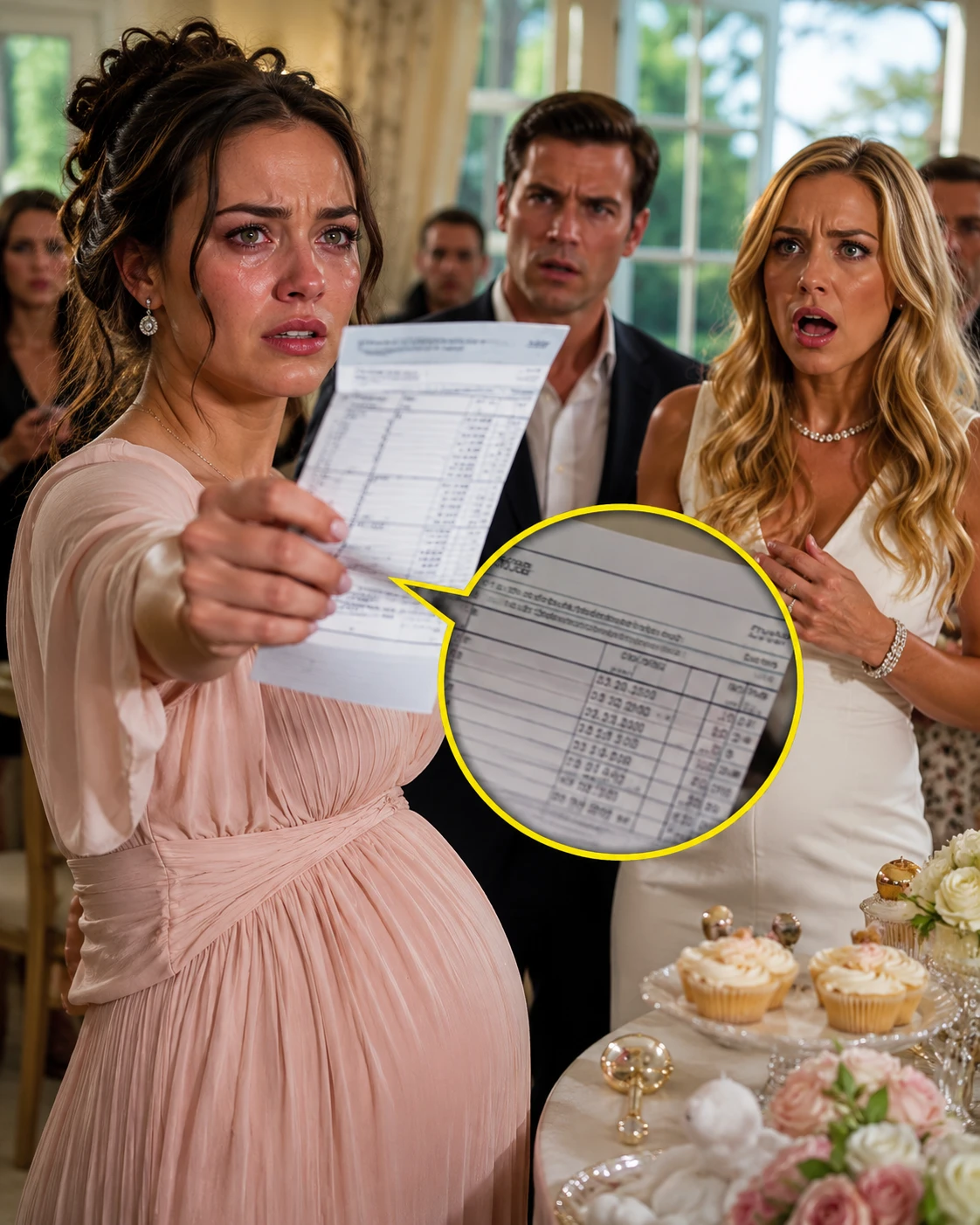
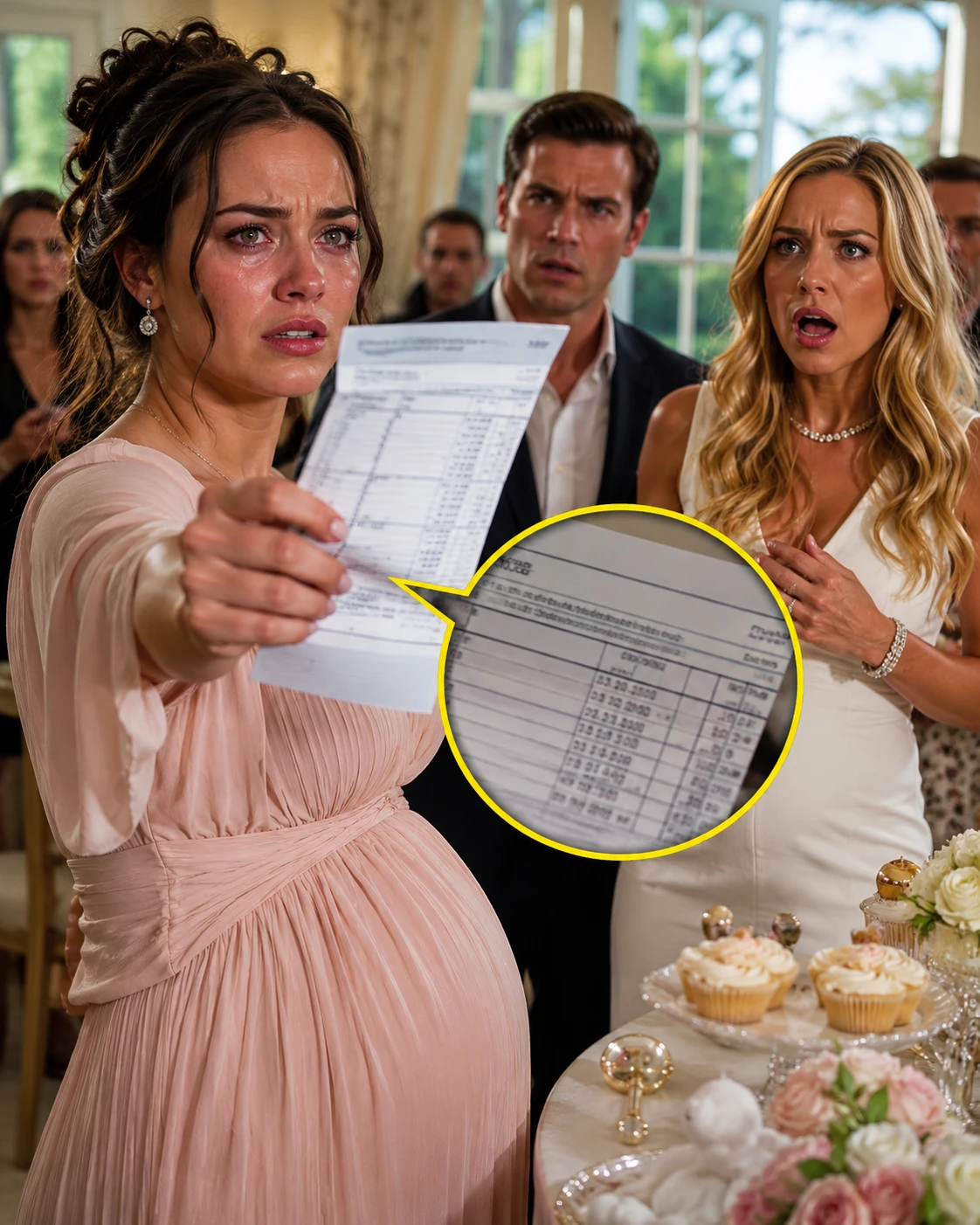
“Callum,” I said, lifting the planner’s invoice between two fingers, “asset concealment is worse for divorce.”
The sunroom went silent.
Even Sloane stopped smiling.
Because the planner’s invoice had not just revealed a wedding.
It had revealed the hidden account paying for it.
And by then, I already knew where every dollar had come from.
CHAPTER 1: SUGAR ROSES AND SILVER KNIVES
The Whitaker house sat on six acres in Greenwich, Connecticut, behind black iron gates and a row of sycamore trees planted before women in that neighborhood were allowed to have bank accounts without a husband’s signature.
It was not technically mine.
That was the first lie everyone believed.
They believed the house belonged to Callum because his last name was carved into half the donor walls between Manhattan and Newport. They believed the oil portraits in the hallway were his history, the silver in the dining room was his inheritance, the champagne in the cellar was his generosity.
They believed I was a pretty girl from Nashville who had married well.
That was the second lie.
I let them believe it because people are most careless around women they think are ornamental.
The baby shower had been Evelyn Whitaker’s idea. She had sent invitations on thick ivory paper without asking me, because in Evelyn’s world, pregnancy was not a medical condition or a miracle. It was a family announcement. A branding opportunity. A soft-focus campaign for legacy.
“Maren needs something elegant,” Evelyn had said in January, when I was still vomiting every morning and pretending not to notice that my husband had started taking calls in the pantry. “No silly games. No plastic bottles. Nothing vulgar.”
So we got orchids, harp music, passed cucumber sandwiches, hand-painted onesies from a boutique on Madison Avenue, and one hundred twenty guests who had never met my friends but knew exactly which trust held which family’s money.
The theme was “Baby in Bloom.”
By three o’clock, it looked like a magazine spread.
By three-thirty, it looked like a crime scene with better lighting.
Sloane Everly arrived exactly when I began opening gifts.
Timing matters.
Humiliation is theater, and Sloane had rehearsed.
She had been Callum’s “strategic communications consultant” for eighteen months. That was the title on the company website. In person, she was thirty, golden, sharp, and hungry in a way that made older men feel chosen and older women feel tired. She had a laugh that landed like ice in a glass. She called people “darling” when she did not remember their names. She wore perfume that smelled like lilies and power.
I had met her twice before she started sleeping with my husband.
Once at the Whitaker Foundation gala, where she complimented my dress and watched Callum watching me.
Once at a company Christmas party, where she held my coat too long and said, “You’re so lucky. Callum is impossible to impress.”
I should have known then.
A woman does not call your husband impossible unless she has been trying.
Still, I was not naive. I was pregnant, not blind.
The calls. The late meetings. The second phone. The new shirts. The gym membership he suddenly used. The way he stopped touching me like a husband and started touching me like a man checking whether an object was still in place.
By March, I knew.
By April, I had proof.
By May, I had a plan.
But I did not expect Sloane to walk into my baby shower carrying the weapon herself.
The planner’s name was Portia Lane. Her company, Lane & Lace Events, specialized in weddings for people whose flowers cost more than most cars. She had that polished professional terror of someone who had accidentally walked into a private war.
“I really am sorry,” Portia murmured, looking from me to Callum to Sloane. “Ms. Everly said Mr. Whitaker approved this time.”
“Mr. Whitaker approves many things without thinking,” I said.
A few guests looked down.
Callum’s jaw tightened.
Sloane recovered first. Women like Sloane always do. Her smile returned, softer now, decorated with pity.
“Maren,” she said, “I know this is emotional.”
That was her mistake.
Public betrayal is one thing. Public condescension is another.
I set the invoice down on top of the cupcake stand, careful not to smear the gold lettering.
“Is it?”
Her lashes fluttered.
“I never wanted you to find out this way.”
“No,” I said. “You wanted me to find out surrounded by witnesses, while holding a monogrammed burp cloth.”
The room inhaled.
Sloane’s cheeks colored. Just a little.
Callum stepped closer. “Enough.”
The word landed with all the entitlement of a man who had never learned the difference between authority and volume.
I turned toward him. He was close enough that I could see the tiny pulse at the base of his throat.
He had worn the watch I gave him for our third anniversary. Platinum. Patek Philippe. Engraved on the back: For the life we build.
At the time, I had believed we were building one.
“What exactly is enough?” I asked. “Your mistress? Her wedding planner? Or the fact that you paid the deposit from an account you forgot I knew existed?”
He went still.
That was the first crack.
Not when Sloane entered. Not when the brochures came out. Not when I said divorce.
The crack came when he realized I had not been surprised.
“Take this upstairs,” he said.
“No.”
“Maren.”
“You wanted an audience,” I said, glancing at Sloane. “Let’s not punish them by being boring now.”
Evelyn finally moved. She crossed the marble floor as if approaching a spill that might stain.
“Maren, dear,” she said, voice glassy. “Perhaps you’re tired. Pregnancy can make women feel things more dramatically.”
I laughed once.
It was not a pretty sound.
“Evelyn, your son is planning a wedding with his mistress while his wife is seven months pregnant. I think my feelings are exactly the right size.”
The room shifted again.
There are silences that protect men.
Then there are silences that bury them.
This was becoming the second kind.
Sloane folded her arms. The diamond bracelet flashed.
“Callum told me the marriage was over,” she said.
“Did he tell the bank?”
She blinked.
“Excuse me?”
“Did he tell the bank the marriage was over when he transferred marital funds into Hearth & Tide Holdings? Did he tell the court? Did he tell his board? Did he tell the IRS?”
Callum’s hand tightened around his glass.
Portia Lane made a tiny sound and closed her folio halfway, too late.
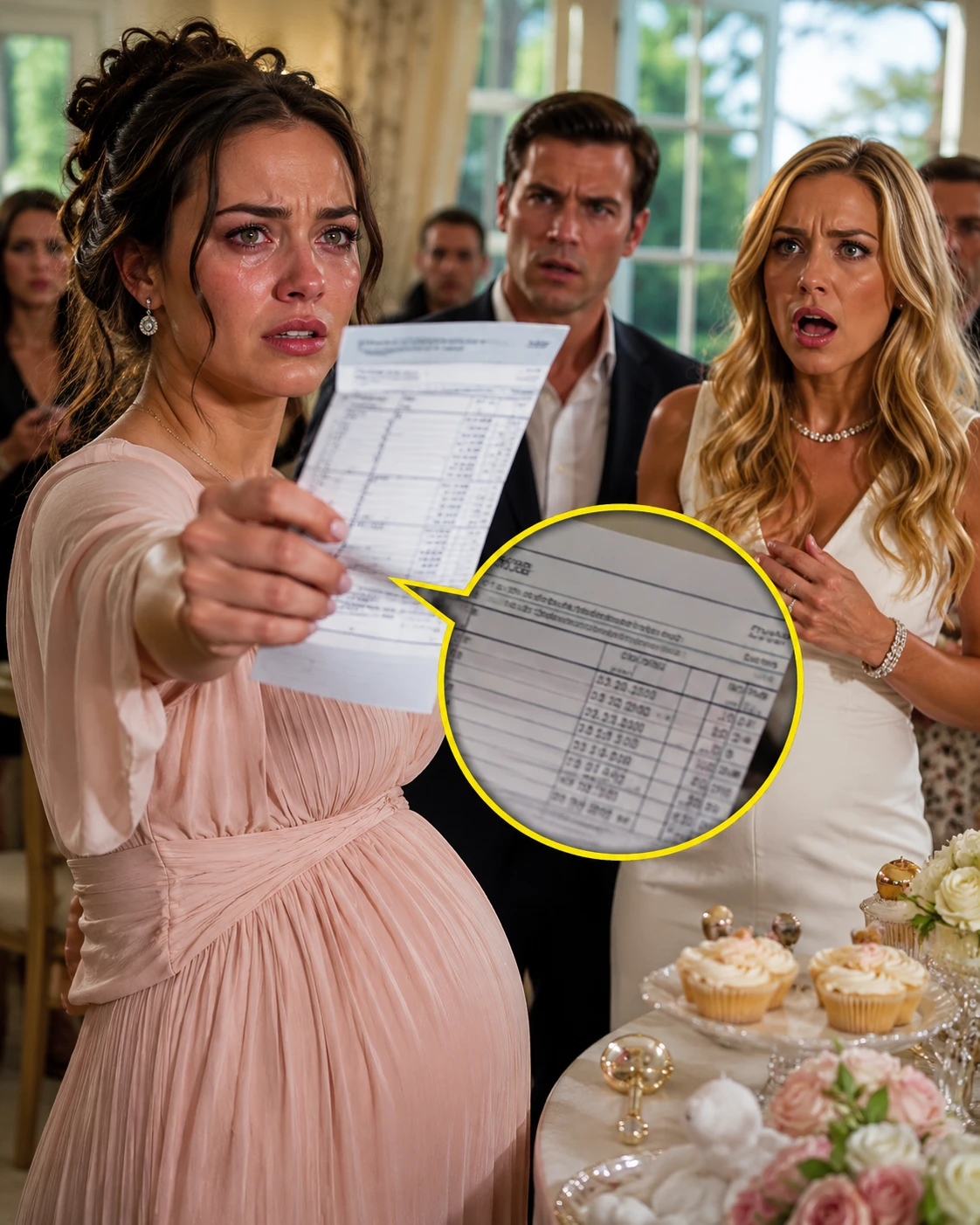
I picked up the invoice again.
Lane & Lace Events.
Deposit received: $125,000.
Paid by wire.
Originating entity: Hearth & Tide Holdings LLC.
A small line. A careless line.
Men like Callum believe betrayal is emotional. They forget it is also administrative.
Every affair leaves paperwork.
Flights. Hotels. Jewelry. Apartments. Transfers. Consulting contracts. Venues.
Love may be irrational, but luxury is invoiced.
Sloane looked at Callum. “What is she talking about?”
For the first time all afternoon, her voice had lost its satin.
Callum did not answer her.
He looked at me like I had become someone else.
But I had not become someone else.
I had simply stopped pretending to be the woman he preferred.
My daughter kicked again.
I placed one hand on my belly and felt, with startling clarity, that this child would never learn silence from me.
“Ladies,” I said to the room, because men had already taken up too much of it, “I apologize for the interruption. Please enjoy the cupcakes. They were paid for from an account everyone can see.”
My cousin June, God bless her, was the first to laugh.
Then someone else did.
Then the laughter spread, nervous at first, then bright, then cruel enough to be honest.
Sloane grabbed the brochures.
Portia whispered, “I am so sorry,” again, but this time I believed her.
Callum leaned in close to me, his voice barely audible.
“You have no idea what you’re doing.”
I looked at the man who had underestimated me all the way to his own destruction.
“Yes,” I said. “That’s why it’s going to hurt.”
CHAPTER 2: THE WIFE HE MISTOOK FOR WALLPAPER
Before I was Maren Whitaker, I was Maren Hale.
People in Greenwich said “Hale” like it was a sweet little Southern name, soft and harmless. They imagined church porches and lemonade. They did not imagine my grandmother, Patricia Hale, who built a commercial real estate empire out of warehouse leases, tax liens, and the kind of patience that makes men nervous.
My grandmother had three rules.
Never marry a man who calls your intelligence intimidating.
Never sign anything without reading the footnotes.
And never reveal the whole size of your purse.
She died six months before I met Callum, leaving me a collection of pearls, a house in Nashville, and controlling interest in a private family trust that held more quiet assets than the Whitakers held loud ones.
I did not tell Callum that immediately.
Not because I was ashamed.
Because I wanted to know who he was when he thought I had less.
At the time, Callum seemed different.
We met at a fundraiser in Charleston during hurricane season. The air smelled like magnolias and wet stone. I was twenty-eight, working as a forensic accountant for a firm that specialized in complex asset tracing. He was thirty-six, recently appointed CEO of Whitaker Development Group, charming everyone under a tent while rain hammered the canvas roof.
He found me near the bar, where I was hiding from a venture capitalist who had spent ten minutes explaining my own job to me.
“You look like you’re solving a murder,” Callum said.
“Financially, maybe.”
He smiled. “Should I be worried?”
“Depends. Do you hide money?”
“Only from my mother.”
I laughed.
That was how it started.
He was attentive then. Almost reverent. He sent books instead of flowers after I told him flowers made me sad because they looked expensive while dying. He flew to Nashville to meet my father and sat through a three-hour dinner without checking his phone once. He said he loved the way my mind worked.
For a while, I believed him.
Marriage is not one lie. It is a thousand small agreements to trust the same version of reality.
Our wedding was held in October at a vineyard in Virginia. Evelyn complained about the location but looked stunning in navy. Callum cried when I walked down the aisle. Real tears, I think. Even now, after everything, I try not to revise every good memory into a warning sign. That feels like letting betrayal steal too much.
The first year was beautiful.
The second was busy.
The third became strategic.
Callum wanted a child. More accurately, the Whitakers wanted continuity. A baby meant magazine spreads, foundation photos, Christmas cards with matching cashmere, and Evelyn saying things like, “A boy would be lovely, of course, but healthy is what matters,” in a tone that suggested one mattered more.
Getting pregnant was harder than expected.
Three miscarriages. Two surgeries. One winter where I learned grief could sit at the breakfast table and drink coffee beside you.
Callum was kind at first.
Then he grew impatient with sorrow.
By the time I was pregnant again, successfully, terrifyingly, beautifully pregnant, my husband had learned to treat my body like a delayed project.
“Don’t overthink,” he would say.
“Stay calm.”
“Think of the baby.”
He meant: Be easier to betray.
Sloane entered the story while I was twelve weeks pregnant and still afraid to buy tiny socks.
She was hired to soften Callum’s public image after a zoning scandal in Brooklyn. She followed him to meetings, wrote his statements, curated his foundation appearances, and slowly became necessary in the way ambitious women become necessary to men who mistake flattery for oxygen.
I noticed the shift in February.
Callum began showering at odd hours.
He bought a cologne he had once called “aggressive.”
He stopped leaving his phone face-up.
The first proof came by accident.
A courier delivered a Van Cleef box to the house while Callum was in Chicago. I signed for it, assuming it was an early push present. Inside was a diamond bracelet, delicate and viciously expensive, with a note tucked beneath the velvet.
For the woman who makes the future feel possible.
C.
I sat at my kitchen island and read that sentence nine times.
Then I photographed everything, repacked the box, and told the courier service they had made a mistake.
The bracelet appeared on Sloane’s wrist at a Whitaker Foundation board cocktail two weeks later.
That was when the wife in me broke.
The accountant in me stood up.
I began quietly.
First, credit cards.
Then travel.
Then reimbursements.
Then vendor payments buried under marketing expenses.
Callum was not merely cheating. Cheating is stupid, but usually simple. Callum was arrogant enough to make it complex.
He had created Hearth & Tide Holdings LLC eight months earlier through a Delaware registered agent. On paper, it was a “hospitality investment vehicle.” In practice, it was a velvet-lined trash can for money he did not want me, his board, or eventually a judge to see.
Funds moved from Whitaker Development consulting accounts into Hearth & Tide. From there, they paid for Sloane’s apartment in Tribeca, jewelry, private flights, a Range Rover lease, and finally, the deposit for a Newport wedding venue called Blackwater House.
The company books called these payments brand strategy.
I called them what they were.
Concealment.
In Connecticut, divorce courts do not smile kindly at spouses who move marital assets into fake companies to fund mistresses. Neither do corporate boards when the money touches business accounts. Neither do federal investigators when charitable foundation resources start sharing vendors with private romantic events.
Callum had built a chandelier over a gas leak.
All I needed was a match.
I did not confront him immediately.
People imagine revenge as fire. They picture screaming, broken glasses, clothes thrown from balconies. That is not revenge. That is weather.
Real revenge is architecture.
You measure first.
You plan load-bearing points.
Then, when the time comes, the whole structure falls without you raising your voice.
I hired Elena Cross on a rainy Thursday.
Her office was on the forty-second floor of a tower in Midtown, all black glass and pale wood, overlooking a city that looked especially honest from above. Elena was a divorce attorney with a reputation that made rich husbands develop sudden respect for mediation.
She wore charcoal suits, red lipstick, and no wedding ring.
After I finished explaining, she leaned back and said, “How angry are you?”
“Very.”
“Good. Are you reckless?”
“No.”
“Better.”
I slid the documents across her desk.
Bank traces. Invoices. Screenshots. Vendor emails. Corporate filings. Photos of Sloane in jewelry purchased through accounts tied to Callum’s business entities.
Elena studied them for a long moment.
Then she looked up.
“Mrs. Whitaker,” she said, “your husband appears to have confused adultery with tax planning.”
“That sounds expensive.”
“For him,” she said. “Yes.”
She referred me to a forensic accounting team, which felt like sending a chef to buy knives. I knew what to look for, but I needed independent experts. Judges prefer professionals who are not seven months pregnant and emotionally invested in destroying a liar.
For weeks, I lived two lives.
In one, I smiled at Evelyn’s nursery suggestions, approved monogrammed blankets, and let Callum kiss my cheek in public.
In the other, I built a case.
I learned Sloane’s apartment lease was guaranteed by Hearth & Tide.
I learned Callum had pledged marital securities against a private line of credit he did not disclose.
I learned the Newport venue deposit had been split into three payments to avoid internal review thresholds.
I learned Sloane had chosen white peonies for her wedding bouquet.
White peonies had been my wedding flowers.
That detail made me angrier than the money.
Money can be traced. Taste, apparently, can be stolen.
Then came the email that changed everything.
It arrived from Lane & Lace Events by mistake, forwarded from a junior assistant who thought I was part of “the Whitaker event team.” The subject line read:
RE: BLACKWATER HOUSE — FINAL INVOICE PACKAGE / C. WHITAKER APPROVAL
Attached were floral renderings, seating charts, payment schedules, and one clean, beautiful invoice showing Hearth & Tide as the paying entity.
At the bottom was a note.
Portia, please keep Mrs. W away from all vendor communications until after June 14. C says she is unstable because of the pregnancy.
I stared at that line for a long time.
Not because it hurt.
Because it clarified the shape of the war.
Callum was not only betraying me. He was preparing to discredit me.
Unstable.
Emotional.
Pregnant.
The oldest trick in the book is calling a woman crazy before she gets a chance to tell the truth.
I printed the email.
I sent it to Elena.
Then I replied to the assistant.
Thank you. Please confirm all outstanding balances and original payment sources for my records.
She did.
By the next morning, I had the entire wedding budget.
By the next week, Elena had drafted the petition.
By the week after that, preservation letters were ready for Callum, Whitaker Development Group, Hearth & Tide Holdings, Lane & Lace Events, Blackwater House, three banks, two jewelers, and one very nervous florist in Newport.
But I waited.
Not because I was afraid.
Because Evelyn’s baby shower was on Saturday.
And my grandmother had always said timing was a form of mercy.
You can use it.
Or you can withhold it.
CHAPTER 3: THE ACCOUNT UNDER THE ROSES
After Sloane’s performance in my sunroom, the party did not end.
That may sound strange, but wealthy people do not flee scandal quickly. They linger near it, pretending to be polite while gathering enough detail to retell it accurately at dinner.
A senator’s wife asked for tea.
My cousin June poured champagne into a coffee cup.
Evelyn disappeared into the powder room and did not come out for twelve minutes.
Portia Lane packed her folio with shaking hands, but before she left, she placed a business card beside me.
“I really didn’t know,” she whispered.
“I believe you.”
“I’ll cooperate with whatever I’m legally required to provide.”
“That would be wise.”
Her eyes flicked to Callum. “He told us you were separated.”
I smiled. “Did he mention we still share a bed?”
Portia’s face went scarlet.
Sloane heard. Good.
Callum pulled her aside near the orchids. Their voices were low, but anger has a frequency. You do not need words to recognize it.
I watched them from the sofa while opening a gift from Evelyn’s oldest friend, a cashmere baby blanket embroidered with the Whitaker crest.
A crest.
For a baby who did not yet have fingernails.
My father, Henry Hale, sat beside me. He had flown up from Nashville that morning and looked deeply uncomfortable in a room full of people who used “summer” as a verb.
He took the blanket from my lap, folded it once, and said, “You all right, button?”
I had not been called button since I was twelve.
“No.”
He nodded. “Good. Don’t waste energy lying to me.”
My father was a retired IRS criminal investigator. He could smell hidden income the way bloodhounds smell rain. He had taught me spreadsheets before he taught me to drive.
“I have counsel,” I said.
“I figured.”
“I have documents.”
“I figured that too.”
“I’m filing Monday.”
He looked across the room at Callum. His expression did not change, but something in it went still.
“You want me to hit him?”
I laughed for the first time all day and meant it.
“No.”
“Shame.”
“I want him solvent.”
Dad nodded. “Worse.”
By five o’clock, the guests began leaving with the delicate urgency of people escaping a burning building while pretending not to smell smoke.
Some hugged me too tightly.
Some promised to call.
Some avoided Callum’s eyes.
Sloane left before he did.
That mattered.
She had entered like a queen and exited like a woman who had just realized the palace had cameras.
When the last car rolled down the drive, Callum and I stood alone in the sunroom among crushed tissue paper, half-eaten cupcakes, and three hundred thousand dollars’ worth of floral arrangements trying their best not to look complicit.
He closed the doors.
The click sounded theatrical.
“You humiliated me,” he said.
There it was.
Not “I hurt you.”
Not “I’m sorry.”
Not “How much do you know?”
You humiliated me.
The anthem of men who confuse consequences with cruelty.
I removed my earrings slowly and placed them on the table. Pearls. My grandmother’s.
“You brought your mistress’s wedding planner to my baby shower.”
“I didn’t bring her. Sloane made a mistake.”
“She made a choice.”
“She was upset.”
“That must have been hard for her.”
His eyes narrowed. “Don’t do that.”
“Do what?”
“Act superior.”
“I’m not acting.”
He laughed under his breath, but there was no humor in it. “You think a few invoices make you powerful?”
“No. I think discovery does.”
Something moved behind his face.
Fear, perhaps.
Or calculation.
“You don’t want a divorce fight,” he said. “Not now. Not pregnant.”
“I agree. That’s why my petition is already drafted.”
He went quiet.
Outside, late afternoon sun spread gold across the lawn. It made everything look forgiving.
“I’ll take care of you,” he said.
The tenderness in his tone was so sudden I almost admired the craftsmanship.
“Will you?”
“Yes. You and the baby. But you need to be reasonable.”
Reasonable.
Another old word.
Reasonable meant accept less than the truth because the truth embarrasses men.
Reasonable meant protect the family name because the family name has never protected you.
Reasonable meant swallow the knife politely.
I walked to the dessert table and picked up the Lane & Lace invoice.
“Here is what will happen,” I said. “On Monday morning, Elena Cross will file for divorce and emergency financial orders. You will preserve all documents related to Hearth & Tide Holdings, Sloane Everly, Lane & Lace Events, Blackwater House, and any entity used to transfer, conceal, pledge, or dissipate marital assets.”
His face hardened. “Elena Cross?”
“Yes.”
“You hired a butcher.”
“I hired a woman who reads.”
“Maren, listen to me.”
“No.”
The word felt better every time I used it.
He stepped closer. “You have no idea how ugly this can get.”
“Callum, I have had three miscarriages, one surgery without anesthesia because the epidural failed, and lunch with your mother every month for four years. Define ugly.”
His mouth tightened.
“I can make sure you don’t get full custody.”
There it was.
The real man, finally tired of wearing polish.
My daughter turned inside me like she heard him.
I placed both hands over my belly.
“If you threaten custody again,” I said, “I will add that to the affidavit.”
He smiled. “No one heard me.”
I looked toward the corner of the room.
“Actually,” I said, “the baby monitor did.”
He followed my gaze.
On a shelf near the bassinet display sat a sleek little monitor with a camera, one of the many gifts Evelyn’s friends had insisted I open and admire. It was connected to my phone for demonstration. It had been recording short motion-triggered clips all afternoon, including the moment Sloane spread wedding brochures across my baby shower.
Callum’s face changed.
I did not need illegal recordings. I did not need tricks. Sometimes men walk directly into evidence and complain about the lighting.
“You planned this,” he said.
“No,” I said. “You did. I documented it.”
On Monday, Elena filed.
By Tuesday, a judge issued temporary restraining orders preventing Callum from moving, concealing, transferring, or dissipating marital assets.
By Wednesday, subpoenas began landing like ravens.
Lane & Lace produced invoices.
Blackwater House produced contracts.
The jeweler produced receipts.
The bank produced records.
Sloane produced drama.
She posted a quote on Instagram: Some women would rather destroy a man than admit they lost him.
June sent me the screenshot with three skull emojis.
I did not respond publicly.
Silence, when chosen, is not weakness.
It is control.
Callum moved out of our bedroom but not the house. His lawyers advised him not to abandon the marital residence. Mine advised me not to throw his clothes into the fountain, which showed admirable restraint on everyone’s part.
For two weeks, we lived like ghosts with counsel.
He took calls in the library.
I took calls in the nursery.
He ordered wine.
I ordered document productions.
He sent me flowers.
I sent him interrogatories.
The more we uncovered, the worse it got.
Hearth & Tide was not just a mistress account. It was part of a chain.
Funds had moved from Whitaker Development into consulting vendors, then into Hearth & Tide, then into personal luxury expenses. Some of the original money had come from a development project funded partly by investors who had not approved “brand strategy” expenses involving diamond bracelets and Newport weddings.
There were also foundation overlaps.
The Whitaker Foundation had paid Sloane’s firm for public relations work. That same firm had subcontracted vendors who later appeared on the wedding budget at suspiciously discounted rates. The florist. The lighting company. The photographer.
Callum had not merely mixed business and pleasure.
He had put them in the same bed and billed the investors for champagne.
Elena explained it to me one evening over speakerphone while I sat in the nursery surrounded by wallpaper samples.
“Your divorce is now the least interesting of his problems,” she said.
“That’s comforting.”
“It should be.”
“I’m seven months pregnant and my husband’s mistress has a wedding hashtag.”
“What’s the hashtag?”
“ForeverWhitaker.”
Elena paused.
Then, very calmly, she said, “We’re going to enjoy changing that.”
CHAPTER 4: DISCOVERY WEARS BLACK SILK
The first settlement meeting took place at Whitaker Development’s headquarters in Manhattan, because Callum wanted home-field advantage.
That was his first mistake of the day.
The conference room was on the fifty-sixth floor, with smoked glass walls, a walnut table long enough to host diplomacy, and a view of Central Park that made even failure look expensive.
Callum arrived with three attorneys, two associates, and the exhausted confidence of a man who had been told all his life that problems could be managed.
I arrived with Elena Cross, one forensic accountant, and a black silk maternity dress that made me feel like a widow at a coronation.
Callum looked at the dress.
Then at my belly.
Then at my face.
For half a second, something like regret passed through him.
I did not trust it.
Regret is often just fear wearing perfume.
His lead attorney, Martin Kessler, began with civility.
“We all understand emotions are high,” he said.
Elena smiled. “We understand assets are missing.”
Kessler cleared his throat.
Callum looked out the window.
I looked at him.
There was a time when I could read that profile with love. The straight nose, the dark hair, the mouth that softened when he slept. I had memorized him once. I had believed memorizing someone was a form of safety.
Now he looked like evidence.
Kessler slid a folder across the table.
Their offer was insulting in the polished way expensive lawyers specialize in.
Primary residence until the child turned five.
Monthly support.
A confidentiality agreement with penalties large enough to frighten someone who had not already stopped being afraid.
No admission of wrongdoing.
No further inquiry into Hearth & Tide.
A parenting plan granting Callum equal decision-making authority.
Elena read in silence.
Then she closed the folder.
“No.”
Kessler blinked. “Counselor, perhaps you should review—”
“I reviewed.”
“This is a generous offer.”
I spoke before Elena could.
“Generous compared to what? Honesty?”
Callum leaned forward. “Maren, this doesn’t have to be a public execution.”
“That depends on who keeps bleeding documents.”
His eyes flashed.
Kessler intervened. “Mrs. Whitaker, inflammatory language is not productive.”
“Neither is financial misconduct.”
Elena opened her own folder.
I knew what was inside.
Still, seeing the documents laid out on that table felt like watching a storm take human form.
Wire transfers.
Credit applications.
A lease guarantee for Sloane’s Tribeca apartment.
A Van Cleef receipt.
Private aviation invoices.
Blackwater House contracts.
A promissory note connected to marital securities.
Emails from Callum instructing staff to keep me away from “sensitive personal matters.”
And finally, the internal memo that shifted the entire room.
Whitaker Development funds had been moved through a vendor controlled by one of Callum’s college friends. The vendor had billed for “strategic market positioning.” The same week, Hearth & Tide received a transfer in the exact amount, minus a fee.
Three days later, Sloane’s wedding deposit was paid.
The forensic accountant, Mateo Ruiz, explained it without emotion. That made it worse.
“These are not isolated personal expenditures,” he said. “They suggest a pattern of deliberate movement through entities designed to obscure origin and use.”
Kessler’s face tightened.
Callum said nothing.
Elena tapped the final page.
“We are prepared to request expanded discovery, depositions, sanctions, adverse inferences, and referral of relevant materials to appropriate corporate and regulatory authorities.”
Kessler removed his glasses.
“Are you threatening us?”
Elena’s smile turned almost kind.
“No. We are explaining the weather.”
For the first time, I saw Callum understand that money could not charm numbers.
Numbers are loyal to whoever keeps them.
The meeting ended badly for him.
Worse still, it ended quietly.
No shouting. No dramatic exit. No thrown folder.
Just Callum staring at the table while his lawyers asked for a recess and Elena said, “Take all the time your client has left.”
In the hallway, Callum caught up to me near the elevator.
“Maren.”
I kept walking.
“Maren, please.”
That stopped me.
Please was new.
I turned.
His face looked different under office lights. Older. Less mythic. More man than monument.
“I made mistakes,” he said.
I almost smiled.
“Mistakes?”
“Yes.”
“A mistake is forgetting an anniversary. You planned a wedding.”
His throat moved.
“I was confused.”
“No, Callum. You were entitled.”
A group of employees pretended not to watch from the far end of the hall.
He lowered his voice. “I never stopped loving you.”
I looked at him for a long moment.
There was the final insult.
Not that he lied.
That he thought the lie was still useful.
“You stopped respecting me,” I said. “Love without respect is just appetite.”
The elevator doors opened.
I stepped inside.
He put a hand on the door.
“She means nothing,” he said.
I thought of Sloane in white, Sloane with my flowers, Sloane smiling beside my cupcakes.
“That may be the cruelest thing you’ve said yet.”
His hand dropped.
The doors closed.
I did not cry until I reached the car.
Grief is strange. It does not obey pride. You can win a legal motion at noon and sob into a seat belt at twelve-fifteen because the man who ruined your life once knew how you liked your coffee.
My driver, Thomas, said nothing.
He had worked for my grandmother before me. He had the rare masculine gift of understanding that silence can be protection, not avoidance.
After a minute, he handed me a packet of tissues over the seat.
“Your grandmother would have liked that dress,” he said.
That made me cry harder.
The next month moved like a knife through silk.
Depositions began.
Portia Lane was first.
She arrived nervous, cooperative, and dressed like a woman who had learned that rich people’s secrets did not come with hazard pay. Under oath, she confirmed that Callum and Sloane had toured Blackwater House in February. She confirmed Sloane had discussed “transitioning gracefully” after my baby was born. She confirmed Callum had insisted all invoices go through Hearth & Tide. She confirmed he had told her I was mentally fragile.
Then she produced the note that became Exhibit 47.
It was handwritten on Blackwater House stationery.
Maren cannot know until after delivery. E says optics matter. S needs reassurance. Pay from H&T.
C.
E.
Evelyn.
My mother-in-law had known.
Not only known.
Advised.
There are betrayals you expect from lovers. There are betrayals you expect from rivals.
Then there is the woman who touched your belly at brunch and said, “This baby will heal everything,” while helping her son plan the timing of your replacement.
I sat very still when Elena showed me the note.
“You don’t have to decide what to do with this today,” she said.
“Yes, I do.”
She waited.
“Use it.”
Elena nodded once.
After Evelyn’s deposition notice went out, the Whitaker family machine finally panicked.
Calls came from cousins, board members, old friends, priests, and one former governor who said he hoped we could “resolve this privately for the child’s sake.”
I asked whether he had called Callum with that advice before or after the wedding deposit.
He did not call again.
Sloane’s deposition was scheduled for a Thursday in June.
She arrived in pale blue and left in gray.
Under oath, she was less polished. Anger made her careless. She admitted Callum had promised to marry her after the baby was born. She admitted he gave her access to the Blackwater House planning portal. She admitted the apartment was “part of the transition.” She admitted she knew he was not legally separated when the venue was booked.
Then Elena asked about the bracelet.
Sloane touched her wrist automatically, though she was not wearing it.
“Was the bracelet a gift from Mr. Whitaker?”
“Yes.”
“Did you know how it was paid for?”
“No.”
“Did you ask?”
“No.”
“Did you care?”
Sloane’s eyes flashed.
“I loved him.”
Elena let the silence sit.
Then she said, “That was not my question.”
By the end of the deposition, Sloane understood something Callum had hidden from her too.
He had not been free.
Not emotionally.
Not legally.
Not financially.
He had sold her a future with money he did not fully control, in a venue he did not fully understand, under a name he did not fully own.
That last part mattered most.
Because Blackwater House, the Newport mansion where Sloane planned to become Mrs. Whitaker, did not belong to the Whitakers.
It belonged to an old Rhode Island holding company called Crown & Laurel Properties.
And Crown & Laurel Properties belonged to the Hale-Lockwood Trust.
My grandmother’s trust.
My trust.
Callum did not know because the ownership chain was intentionally private, layered through entities created decades before he was born. The venue operated independently, managed by a hospitality firm. To Callum, it was just another exclusive coastal property with a long waitlist and polished staff.
To me, it was a line item I reviewed every quarter.
That was why the invoice reached me.
That was why the payment source mattered.
That was why I had waited.
My husband’s mistress had booked her wedding at a house I owned.
Not symbolically.
Not emotionally.
Legally.
There are moments so perfect they feel less like revenge and more like divine administration.
I did not tell Callum immediately.
Elena wanted to save it.
“Let him keep lying,” she said. “Lies earn interest.”
So I waited again.
By then, waiting had become my art.
CHAPTER 5: THE BRIDE WHO FORGOT THE OWNER
June 14 arrived blue and bright.
A Newport day.
The kind of day wedding photographers pray for. Sun on the water. Salt in the air. Hydrangeas heavy along stone walls. Sailboats cutting across the harbor like white knives.
Blackwater House stood on a cliff above the Atlantic, all gray stone, ivy, terraces, and windows flashing gold in the morning light. My grandmother bought it in the 1980s from a shipping family that had run out of heirs and liquidity. She restored it, converted it into a private event property, and once told me, “Never sell land near water. Men get emotional around views.”
She was right.
Callum and Sloane had paid for the full weekend.
Welcome dinner Friday.
Ceremony Saturday.
Farewell brunch Sunday.
Except, legally, there would be no ceremony.
Callum’s divorce was nowhere near final. A detail Sloane had apparently chosen to treat as administrative fog. They had planned a “commitment ceremony,” which rich people sometimes use when the law refuses to keep up with their delusions.
The staff called me at nine that morning.
“Ms. Hale,” the property manager said, carefully using my legal ownership name, “the bride is requesting access to the bridal suite.”
“Is she calm?”
A pause.
“No.”
“Is Mr. Whitaker there?”
“Yes.”
“Good. I’m ten minutes away.”
I wore cream.
Not white. Cream.
A soft cashmere dress, low heels, my grandmother’s pearls, and a camel coat despite the season because ocean wind has no respect for pregnancy. I was eight months along by then, moving slower, sleeping badly, and feeling more powerful than I had ever felt in my life.
Elena came with me.
So did Mateo.
So did a process server named Denise who looked like a kindergarten teacher and had the soul of a hawk.
Blackwater House’s front doors opened before I reached them.
Inside, the entry hall smelled of roses, sea air, and panic.
Flowers covered every surface.
White peonies.
Of course.
Sloane stood beneath the chandelier in a silk robe with BRIDE embroidered across the back. Her hair was half-pinned, her makeup half-finished, her expression fully unprepared for me.
Callum stood beside her in shirtsleeves.
For one absurd second, they looked like actors caught between scenes.
Sloane spoke first.
“What are you doing here?”
I looked around the hall. “Owning the place.”
The silence that followed was almost musical.
Callum’s face drained.
Sloane laughed sharply. “That’s not funny.”
“No,” Elena said, stepping forward. “It’s documented.”
She handed Sloane’s attorney, who had appeared from somewhere near the staircase, a folder. Then she handed Callum’s attorney another. Denise moved with cheerful efficiency and served additional papers.
Callum did not open his folder.
He looked at me.
“You knew.”
“Yes.”
“How long?”
“Long enough.”
Sloane grabbed the contract from a nearby table, flipping pages with frantic hands.
“This is with Blackwater House Events.”
“Yes,” I said.
“You don’t own Blackwater House Events.”
“No. I own the company that owns the property leased to Blackwater House Events. Your event contract permits cancellation for fraud, misrepresentation, unlawful funding sources, or reputational harm to ownership.”
Elena added, “All four are implicated.”
Sloane turned on Callum. “You said this was handled.”
He looked trapped.
A man who had lied to two women and discovered both had brought paperwork.
“The event is canceled,” I said.
Sloane stared at me. “You can’t do that.”
“I just did.”
“We have guests coming.”
“I know.”
“The flowers—”
“Are lovely.”
“The press—”
“Will be fascinated.”
Callum stepped forward. “Maren, don’t.”
That word again.
Don’t.
As though his life had gone wrong because I failed to obey it.
I looked at him, truly looked.
Once, I would have given anything for him to choose me in a room full of people.
Now he was choosing himself again, and I felt almost nothing.
That was freedom arriving quietly.
“You used marital assets and potentially company funds to pay for an event designed to humiliate your pregnant wife,” I said. “You concealed accounts, misrepresented our separation, threatened custody, and allowed your mother to help manage the optics of replacing me after delivery.”
Sloane whispered, “After delivery?”
She had not known that part.
Good.
Let truth be generous.
Callum closed his eyes.
When he opened them, he looked at me with something near hatred.
“You’ll destroy the family over this?”
“No,” I said. “You used the family as cover. I’m removing it.”
As if summoned by the line, Evelyn appeared at the top of the staircase.
She wore lavender silk and terror.
“Maren,” she said, one hand on the banister. “Please. There are guests.”
I looked up at the woman who had once corrected how I held a salad fork and later helped her son schedule my heartbreak.
“Yes,” I said. “You’ve always cared beautifully about guests.”
Her mouth trembled.
For a moment, I saw what lay beneath the pearls and posture. Not remorse. Fear of exposure. Fear of being seen as she was.
That was enough.
Elena handed her a subpoena.
Evelyn did not take it, so Denise placed it gently on the banister beside her.
“Served,” Denise said brightly.
Sloane began crying then.
Not delicate tears. Angry ones. She turned on Callum with mascara running and said, “You told me she was nothing.”
I almost felt sorry for her.
Almost.
Because I had been nothing too, in his version.
Nothing but a wife.
Nothing but a womb.
Nothing but a woman who should stay calm.
Callum said, “Sloane, not now.”
She laughed, wild and broken. “Not now? There is no now. There’s no wedding. There’s no house. There’s no money. What exactly is left?”
No one answered.
That was the moment she understood she had not stolen a crown.
She had borrowed a spotlight from a burning stage.
Outside, cars began arriving.
Guests in linen and summer dresses stepped from black SUVs, squinting toward the house, sensing trouble the way birds sense storms. Staff redirected them politely to the lower terrace, where coffee was being served because I am not a monster. Ruin is one thing. Bad hospitality is another.
Callum’s phone began ringing.
Then ringing again.
Then Elena’s phone buzzed.
She glanced at it and leaned toward me.
“The emergency board meeting started early.”
Of course it had.
At nine-thirty that morning, Elena had delivered a confidential evidence packet to Whitaker Development’s independent directors. Not gossip. Not emotion. Documents. Transfers. Vendor records. Misrepresentations. The kind of proof that makes board members remember fiduciary duty with religious intensity.
By eleven, Callum was suspended pending investigation.
By noon, his corporate email was locked.
By one, two investors had requested an audit.
By two, the Whitaker Foundation issued a statement about reviewing vendor relationships.
By three, Sloane’s PR firm removed her biography from its website.
But at ten-twelve that morning, standing in the chandeliered hall of Blackwater House, Callum did not know all of that yet.
He only knew the wedding was gone.
Sometimes mercy is telling a man only the first bad thing.
The rest can arrive on schedule.
He followed me onto the side terrace while Elena handled the lawyers.
The ocean below threw itself against the rocks.
“Maren,” he said, voice ragged.
I stopped because I wanted to hear what a ruined man thought love sounded like.
“I was wrong,” he said.
“Yes.”
“I panicked.”
“Yes.”
“I thought after the baby… I don’t know what I thought.”
“You thought I would be too exhausted to fight.”
He looked away.
That was answer enough.
The wind lifted my hair. I pressed one hand to my belly. My daughter was quiet, as if listening.
“I loved you,” he said.
I believed him then.
That was the terrible part.
I believed that, in whatever limited way he understood love, Callum had loved me. He had loved my beauty, my calm, my usefulness, my forgiveness, my place beside him in photographs. He had loved the idea of coming home to someone who knew the worst of him and stayed.
But he had not loved me enough to tell the truth.
He had not loved me enough to protect my dignity.
He had not loved me enough to choose our child’s peace over his appetite.
A love that small did not deserve a monument.
“I loved you too,” I said.
His eyes filled.
I let him have that. Not as comfort. As fact.
Then I added, “That’s why I know exactly what you wasted.”
He flinched.
Good.
The final twist came from the safe in Blackwater House.
Not a dramatic safe. Not one hidden behind a portrait. Just a fireproof records cabinet in the property office containing old ownership documents, maintenance archives, and scanned copies of significant event contracts.
When the property manager reviewed Callum and Sloane’s file, she found an addendum submitted by Callum’s assistant three months earlier. It authorized a reduced venue insurance requirement based on “existing family ownership relationship.”
The signature at the bottom was mine.
Except I had not signed it.
Forgery is such an ugly word.
It makes betrayal leave the realm of marriage and enter the realm of crime.
The signature was good at first glance. Elegant. Slanted. Close enough for a lazy eye.
But I had changed my legal signature after my grandmother died, adding my middle initial to distinguish trust documents from personal ones. The forged signature lacked it.
Callum had not known.
Sloane had signed as witness.
Evelyn had emailed approval.
And Portia Lane, trying desperately to be helpful, had preserved the original PDF metadata.
It had been created on Callum’s office computer.
When Elena showed it to Callum on the terrace, his face did something I will never forget.
It collapsed inward.
Not from guilt.
From recognition.
He knew the difference now.
This was no longer a divorce scandal.
This was evidence.
Elena’s voice was calm. “We will be amending our filings.”
Callum whispered, “Maren.”
I looked at him.
He did not ask forgiveness.
Men like Callum rarely do when it finally matters. They ask for rescue and hope women mistake it for remorse.
I turned away.
Behind me, inside the house, Sloane was shouting. Evelyn was crying. Lawyers were speaking in low, urgent tones. The flowers stood everywhere, extravagant and doomed.
Outside, the ocean kept going.
That steadied me.
Some things do not care what men lose.
By sunset, the guests were gone.
The flowers were donated to a hospice in Providence.
The uneaten cake went to the staff.
The champagne remained unopened.
Blackwater House was quiet again.
I walked through the empty ballroom before leaving. The ceremony arch had been dismantled. Petals lay scattered on the floor like the aftermath of a beautiful lie.
I paused where the aisle would have begun.
For a second, I imagined Sloane walking it.
I imagined Callum waiting.
I imagined myself at home, swollen and sedated by everyone’s insistence that I stay calm, while another woman stepped into my name with my flowers, my money, my silence wrapped around her like a veil.
Then the image vanished.
Because it had not happened.
Because I had not allowed it.
Because my daughter would one day ask me what I did when people tried to erase me, and I would have an answer.
CONCLUSION: WHAT THE BABY REMEMBERED
My daughter was born three weeks later during a thunderstorm.
I named her Clara Patricia Hale.
Not Whitaker.
Hale.
Callum objected from the hallway of the hospital, where he was permitted to wait but not enter. Temporary custody orders were already in place. His access was supervised until the court reviewed his threats, conduct, and the ongoing investigations.
Evelyn sent flowers.
I donated them.
Sloane vanished from New York for a while. Someone said Palm Beach. Someone said Austin. Someone said she was writing a memoir. I wished her clarity, which is not the same as wishing her well.
Callum resigned from Whitaker Development before the board could finish removing him. The public statement called it a personal decision. Private documents called it something else. The divorce settled nine months later, after expanded discovery, asset tracing, amended claims, and one unforgettable mediation session where Elena Cross used the phrase “fraudulent concealment” so gently it sounded like a lullaby.
I kept the Greenwich house temporarily, then sold it to a woman who turned the sunroom into an art studio.
That pleased me.
I bought a brownstone in Brooklyn Heights with tall windows, creaking floors, and a little garden where Clara later learned to walk barefoot. Not because I needed to disappear. Because I wanted a home that did not know how to whisper.
Some nights, after putting Clara to bed, I would sit by the window with tea and think about the woman I had been at that baby shower.
Seven months pregnant.
Publicly humiliated.
Surrounded by cupcakes, couture, and cruelty.
Everyone had expected me to break beautifully.
Instead, I became precise.
That is what no one tells you about betrayal. It can destroy you, yes. But it can also introduce you to the version of yourself who was waiting beneath the manners.
The version who reads the invoice.
The version who calls the lawyer.
The version who understands that dignity is not the absence of pain.
It is refusing to let pain make you small.
A year after Clara was born, I returned to Blackwater House.
Not for a wedding.
For a fundraiser.
The Hale Foundation launched a legal aid program for women facing financial abuse in divorce. Elena helped build it. Mateo taught workshops on tracing hidden assets. My father gave a speech that lasted four minutes and made half the room cry, mostly because he said, “Believe women, but also teach them spreadsheets.”
I wore black velvet.
Clara wore a tiny gold bow.
Near the end of the evening, I stepped onto the terrace overlooking the Atlantic. The same terrace where Callum had tried, too late, to sound sorry. The air smelled like salt and roses.
For the first time in a long time, I did not feel haunted.
I felt awake.
My phone buzzed with a message from June.
She had sent me a screenshot of an old gossip post from the day of the baby shower. Someone had written:
The mistress tried to steal the baby shower. The wife found the money.
Under it, June had typed:
Still the coldest thing I’ve ever seen.
I smiled.
Inside, my daughter laughed in my father’s arms, bright and wild and free.
That sound was the only applause I needed.
People still ask me when I knew my marriage was over.
They expect me to say the bracelet.
Or the wedding planner.
Or the hidden account.
But the truth is, my marriage ended the moment Callum looked at my pain and called it stress.
He thought betrayal was the worst thing he could do to me.
He was wrong.
The worst thing he did was underestimate what I could become after it.
She brought a planner. I brought discovery.