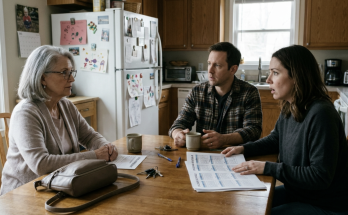

The paper lay between us on my kitchen table, held flat beneath my coffee mug, and for the first time since my sister announced her wedding, nobody in my family had anything clever to say.
Sophia stood on the other side of the table with her arms folded against her cream-colored sweater, her engagement ring flashing every time her fingers tightened. Mark sat beside her, too still, the way people get when they realize a conversation has slipped out of their control. My mother kept looking from the document to me, as if the printed words might rearrange themselves into something kinder if she stared long enough. My father leaned back in his chair with a line between his brows that made him look older than he had that morning.
I kept my hand on the folder Emma had given me. Inside were highlighted pages, property records, screenshots, contractor emails, and one receipt that had changed the temperature of the room.
A furniture deposit.
For my cabin.
My sister’s name was on it. Mark’s card had paid for it. The delivery address was my place in the mountains, three hours away, a two-bedroom cabin on five acres that I had bought with ten years of careful savings and more lonely weekends than I cared to admit.
Sophia looked at the receipt like it had betrayed her personally.
I looked at her and said, quietly enough that everyone had to listen, “I let you use my place for one day. Not move in forever.”
No one answered. Outside my parents’ suburban kitchen window, the neighbor’s lawn sprinkler clicked steadily across a perfect green yard. Somewhere down the hall, the family dog scratched at a door, then gave up. The house smelled like coffee, lemon cleaner, and the casserole my mother had put in the oven before everything went wrong.
The silence in that room did not arrive all at once. It had been building for months, maybe years. Maybe it had started long before the cabin, before Sophia met Mark, before I signed my closing papers with shaking hands and drove up the mountain alone with a cooler full of groceries and a folding chair in the back of my truck.
Maybe it started when we were kids and my parents praised us in opposite directions, never realizing they were teaching us to stand on opposite sides of every room.
Sophia was the bright one. The polished one. The one teachers remembered by name. She made honor roll by accident, captained school clubs with color-coded binders, and smiled in every family photo like she had already been approved by the world. I was Lucas, the quiet older brother who took apart old computers in the basement, forgot deadlines, changed majors twice, and needed five years to finish my computer science degree.
My parents loved us both. I believe that, even now. But love can still do damage when it comes wrapped in comparisons.
“Sophia got another scholarship letter,” my mother would say at dinner, glowing with pride, before turning to me. “Lucas is creative in his own way, though.”
Or my father would clap me on the shoulder after I fixed the garage door opener and say, “See? College isn’t everything. Your sister has books, you’ve got common sense.”
They thought they were balancing the scales. Instead, they made us feel like there was a scale at all.
By the time Sophia left for college with a full scholarship and three matching suitcases, I had learned to stop competing in races I was never going to win. I stayed home, worked part time, took classes, failed one, retook it, switched programs, and eventually found my way into software engineering. It was not dramatic. It was not glamorous. It was mostly cheap dinners, used textbooks, late-night coding forums, and the dull ache of believing I was behind everyone else.
When I finally got a stable job in the city, I lived smaller than I had to. I rented the cheapest decent apartment I could find, cooked most of my meals, drove the same aging Honda until the passenger window stopped rolling down, and put money away with a stubbornness that surprised even me.
I did not know exactly what I was saving for until I found the listing.
Two bedrooms. Five acres. Pine trees. A deck that looked out over a valley that turned gold in October. Not fancy. Not a vacation home from a glossy magazine. Just a place with knotty pine walls, a stone fireplace, a gravel drive, and enough quiet to hear myself think.
The first time I drove up there after closing, the cabin smelled like dust, cedar, and old rain. The previous owner had left a stack of firewood, a chipped blue mug, and a note taped to the refrigerator that said, Hope this place gives you peace.
It did.
After years of being the family disappointment, then the late bloomer, then the quiet one nobody quite knew how to explain, the cabin became the first thing in my life that did not need explanation. I had bought it. I had fixed the loose railing myself. I had spent two weekends replacing cabinet hinges and another crawling under the sink with a flashlight clenched between my teeth. I put a secondhand leather chair by the window, set up a small desk for remote work, and stocked the pantry with coffee, soup, and the kind of snacks I never kept in my city apartment.
On Friday evenings, I drove out of the city while office towers turned pink behind me and traffic thinned into two-lane roads lined with gas stations, antique shops, and fields. By the time I reached the mountain road, my shoulders usually dropped without permission. The cabin was not an escape from responsibility. It was proof that I had carried enough responsibility long enough to earn a place where no one measured me.
That was why I should have said no the second my mother suggested it.
But I did not.
Sophia and Mark announced their engagement at my parents’ house on a Sunday night in early spring. My mother made roast chicken, my father opened a bottle of wine he had been saving, and Sophia arrived in a pale blue dress with Mark beside her, smiling like a man posing for a brochure about dependable futures.
They had been together for two years. Mark was twenty-seven, calm, clean-cut, and good at sounding reasonable. He worked in a legal office downtown, not as flashy as Sophia sometimes made it sound, but respectable enough that my parents treated him like he came with built-in credibility. He shook hands firmly, remembered birthdays, brought flowers for my mother, and always helped clear dishes without being asked. I had never disliked him. If anything, I thought he was a little too smooth, but I told myself that was my own discomfort around people who never seemed unsure.
Sophia flashed the ring before dessert. My mother cried. My father hugged Mark like he had just passed a final exam. I hugged Sophia and felt her bouncing on her toes the same way she had when we were kids and she got exactly what she wanted for Christmas.
Then the wedding talk began.
At first it was harmless. Dates. Guest lists. Whether to do plated dinner or buffet. My mother’s church friend who did flowers. Mark’s cousin who knew a photographer in Asheville. Sophia said she did not want a ballroom or a hotel banquet room. She wanted something intimate. Natural. Something with trees and lights and a view.
“I’ve always dreamed of a mountain wedding,” she said, resting her chin on her hand.
My mother’s eyes brightened before I understood the danger.
“Lucas,” she said. “Your cabin.”
The room turned toward me with the warm, expectant force of a spotlight.
Sophia gasped, already halfway in love with the idea. “Oh my God, yes. The deck. The valley. We could do string lights between the trees. Wildflowers. A little ceremony at sunset.”
Mark smiled at me. “That would be incredible. Only if Lucas is comfortable, obviously.”
He said the right words. That was one of Mark’s talents. He always left a door open just wide enough for you to feel like walking through it had been your idea.
I looked at my sister’s face. She was radiant. My mother clasped her hands beneath her chin. My father nodded as if generosity had already been decided.
“It’s not really set up for a wedding,” I said.
“We’d keep it small,” Sophia promised. “Family and close friends. Maybe forty people.”
Forty people on my deck sounded like a structural question, but the look on her face softened me. I loved my sister. We had our history, our weird competitions, our awkward adult distance, but I loved her. I wanted to be the kind of brother who could offer something beautiful.
“One day,” I said. “For the ceremony and reception. We’d have to talk details.”
Sophia came around the table and threw her arms around me so tightly my chair scraped backward. “You’re the best brother ever.”
My mother wiped her eyes. My father lifted his glass. Mark leaned across the table and said, “We’ll make sure it’s handled professionally.”
That sentence should have bothered me more than it did.
Two days later, Sophia sent me a Pinterest board full of lights, floral arches, long wooden tables, white chairs, and couples kissing beneath pine trees. I scrolled through it at my desk during lunch, smiling at first, then frowning as the images changed. The inspiration photos were not just wedding decorations. They were full exterior transformations. Fresh paint. Expanded decks. Permanent stone paths. Built-in benches. A wide leveled platform where my uneven side yard sloped toward the tree line.
Then she called.
“I was thinking,” she said, which with Sophia usually meant she had already decided. “The cabin would photograph so much better if we freshened up the outside.”
“Freshened up how?”
“Nothing crazy. Maybe repaint the exterior, upgrade the deck railing, install a little permanent dance area, maybe turn the master bedroom into a bridal suite for the day.”
“The master bedroom is my bedroom.”
“I know, but just for getting ready. And afterward, you’d have a nicer room. It increases your property value.”
That phrase would come back again and again. Property value. Improvements. Family use. Shared memories. Words that sounded generous until you noticed they all pointed in the same direction.
I told her we needed to slow down. She laughed, light and dismissive.
“Lucas, you’re acting like I want to bulldoze it. Mark and I would cover the costs. You’d basically get free upgrades.”
Mark called me that evening. His voice was easy, professional, almost soothing. He said he understood why I might feel protective. He respected that. He wanted everyone comfortable. He suggested putting a simple agreement in writing “to protect all sides.”
“That sounds reasonable,” I said, because it did.
He emailed it the next day with a subject line that read: Cabin Wedding Renovation Understanding. The attachment was eight pages long. I opened it on my phone between meetings, saw paragraphs of formal language, and closed it again. I told myself I would read it properly later.
Later became the next day, then the weekend, then another phone call from Sophia asking whether they could get access three months before the wedding so contractors could plan safely.
“Three months?” I asked.
“Not full-time,” she said quickly. “Just enough time to coordinate things. Deliveries, repairs, decorating. You know how schedules are.”
I did know how schedules were. I also knew my cabin was where I went to get away from schedules. But my parents had already started telling relatives the wedding would be at “Lucas’s mountain place,” and every time someone mentioned it, they praised me like I had become generous by accident and now had to stay that way to deserve the compliment.
So I hesitated. I compromised. I said we could discuss limited access. Sophia heard permission.
That was how the first crack opened.
The second came when my cousin Emma visited.
Emma was thirty-one, sharp-eyed, and practical in a way that made people underestimate her until it was too late. She worked in real estate, wore simple gold hoops, carried two phones, and could spot a bad property description from across a room. She had been close to both Sophia and me growing up, but unlike most of the family, she never acted like our childhood roles were permanent.
She came to the cabin on a Saturday in June, bringing bakery muffins and a bottle of good maple syrup because she said guests should never arrive empty-handed. We drank coffee on the deck while morning fog lifted from the valley. She looked around with genuine appreciation.
“You did good, Lucas,” she said.
Those four words settled somewhere deep in me.
I told her about the wedding plans. At first she smiled. Then I mentioned the three months of access, the renovations, the agreement Mark had sent, and the way Sophia had started calling the cabin “our mountain spot” in family conversations.
Emma’s coffee cup stopped halfway to her mouth.
“Has she asked you to sign anything?”
“Mark sent something. Just to cover the renovations.”
“Have you signed it?”
“Not yet.”
She set the cup down hard enough that coffee jumped over the rim. “Show me.”
I tried to laugh it off. “Emma, it’s probably standard.”
“Then it’ll take five minutes.”
It did not take five minutes.
She sat at my small kitchen table with her laptop, reading the document line by line while I pretended to wipe the counter. The cabin was quiet except for the faint hum of the refrigerator and the occasional click of Emma’s fingernail against the trackpad. Sunlight moved slowly across the floorboards. My phone buzzed twice with messages from Sophia about chair rentals. I did not answer.
After twenty minutes, Emma stopped making notes. After forty, she pulled her hair into a low knot. After an hour, she looked at me with an expression I had never seen on her face before.
Anger, but controlled. Disbelief, but focused.
“Lucas,” she said, “this is not a simple renovation agreement.”
I sat down across from her.
She turned the laptop toward me. Paragraphs were highlighted in yellow.
“This gives them access for three months, but the language is broad enough that access could become occupancy. It allows modifications they deem necessary. It requires you to acknowledge the improvements as part of a shared family event. And this clause here—memorial and anniversary access—this is dangerous.”
“It just says they can visit on anniversaries.”
“It says ongoing access for memorial purposes connected to the event. That is not casual wording. It creates an argument. Maybe not a winning argument by itself, but an argument. And combined with improvements, deliveries, and possible bills sent there, it gets messy.”
My stomach tightened. “You think they’re trying to take it?”
“I think someone wants a foothold.”
The word made the cabin feel less like a home and more like a door someone had been trying to wedge open while I stood there smiling.
I argued with her because the alternative hurt too much. Sophia was dramatic, sure. Entitled sometimes. Competitive. But she was my sister. Mark was polished, maybe pushy, but he was marrying into the family. This had to be careless wording. A bad template. Legal language gone too far.
Emma listened, then asked one question.
“Why would a wedding agreement need ongoing access after the wedding?”
I had no answer.
She did not push me to cancel anything that day. That was Emma’s gift. She did not panic unless panic was useful. She told me to call a property attorney before signing a single page. She told me to change the cabin locks because too many people had handled spare keys over the years. She told me to document every conversation in writing and stop agreeing to vague plans over the phone.
Then, before she left, she said, “And Lucas? Do not let them make you feel guilty for protecting what you built.”
That sentence followed me around for the next forty-eight hours.
On Monday morning, Emma called before I had finished my first cup of coffee. Her voice had lost its casual edge.
“I checked a few things,” she said.
My office window looked out over six lanes of traffic, brake lights blinking in the gray morning. “What things?”
“Public property records. Permit inquiries. Nothing private. Nothing I shouldn’t be looking at. But there have been questions made about your parcel.”
“What kind of questions?”
“Ownership history. Mailing address changes. Short-term rental rules. Establishing residency for seasonal property use.”
I closed my eyes.
“There’s more,” she said. “Sophia has a private board online. Not as private as she thinks. She titled it Our Mountain Home.”
The words hit harder than they should have, maybe because they were so simple. Not wedding. Not cabin ceremony. Our Mountain Home.
Emma sent screenshots. I opened them one by one while my inbox filled with work notifications I could not process.
There was my cabin, saved from one of my own old photos, with digital notes layered over it. New exterior paint color. Porch swing here. Children’s room someday? Seasonal wreath storage. A kitchen inspiration image with the note: Replace Lucas’s bachelor cabinets with something warm. A living room layout featuring a sectional I would never buy, beside the caption: Cozy family retreat for anniversaries and summers.
Then I saw the one that made my hand go cold.
Can’t wait to turn Lucas’s little bachelor pad into our forever place.
I stared at the screen until the words blurred.
That night I drove to my parents’ house because confronting Sophia over text felt too easy for her to twist. She arrived ten minutes after me, smiling too brightly, Mark not with her. My mother made tea nobody drank. My father turned down the television and stayed in the living room doorway like a man hoping a problem might remain polite if he did not sit down.
I asked Sophia directly.
“What are your long-term plans for my cabin?”
Her smile faltered, then recovered. “My long-term plans? Lucas, it’s a wedding.”
“Are you planning to use it after the wedding?”
“Well, maybe for anniversaries. We talked about that. You said we could make memories there.”
“I said you could have the wedding there for one day.”
She rolled her eyes. “You’re being so literal.”
I pulled out my phone and opened the screenshot of the board. I did not shove it in her face. I placed it on the coffee table between us.
Her expression changed instantly.
“You went snooping through my private stuff?”
“It’s my property.”
“It’s a Pinterest board. People dream.”
“People don’t schedule contractors for dreams.”
The room sharpened. My mother looked up. My father stepped fully into the room.
Sophia’s jaw tightened. “God, Lucas. You barely use it.”
That was the first honest thing she said.
I looked at her. “What?”
“You go there, what, one weekend a month? Maybe two if you’re in one of your moods? Mark and I would actually appreciate it. We’d take care of it. Improve it. Use it the way it should be used.”
“The way it should be used,” I repeated.
“As a family place.”
“It isn’t family property.”
She gave a small, humorless laugh. “You always do this. You act like because you paid for something, nobody else matters.”
“Because I paid for it, Sophia. That is what ownership means.”
My mother said my name softly, warningly, but I did not stop.
“I saved for ten years. I worked overtime. I drove a car with no air conditioning for two summers. I skipped trips, dinners, upgrades, everything. That cabin is mine.”
Sophia’s face flushed. “Must be nice to save money while living at home forever.”
I felt that one land. She knew exactly where to aim.
“I lived at home because I was trying to finish school and not drown,” I said.
“I went away to college. I took loans. I did everything right.”
“And that means you get my house?”
“That means maybe you could support your sister for once instead of guarding your precious little retreat like some lonely mountain king.”
The words hung there. My mother inhaled sharply. My father looked away.
For a moment, I almost backed down. Not because she was right, but because she sounded so certain. Families have a way of making old shame feel like evidence. I was suddenly twenty-two again, sitting at that same house after dropping a class, listening to my parents tell me Sophia had made the dean’s list.
Then I thought of the note the previous owner had left on the refrigerator.
Hope this place gives you peace.
I stood up.
“I’m calling an attorney,” I said. “No one goes to the cabin until this is sorted out.”
Sophia stared at me. “You’re unbelievable.”
“No,” I said. “I’m late.”
It took three days to get a meeting with the attorney Emma recommended. His name was Peter Caldwell, and his office was above a bakery in a small town halfway between the city and the mountains. The waiting room smelled faintly of cinnamon rolls, which made the whole thing feel absurd until he sat across from me, put on reading glasses, and began marking Mark’s agreement with a red pen.
He did not dramatize it. That made it worse.
“This is not something I would advise you to sign,” he said.
I asked him if Emma had overreacted.
He looked at me over his glasses. “Your cousin was kind to call it dangerous. I would call it designed.”
That word stayed with me too.
Designed.
He explained it carefully. Not as a movie villain plot. Not as some guaranteed theft. Something quieter, messier, more plausible. If I signed, Mark and Sophia could establish a pattern of access. If they received mail there, stored belongings there, paid for improvements, hosted family events, and returned on anniversaries under a written clause, they might not own the cabin, but they could create complications. Claims. Disputes. Pressure. Enough confusion to make a clean boundary expensive.
“Most people don’t lose property overnight,” Peter said. “They lose peace first. Then time. Then leverage.”
I thought of the cabin at dusk, the deck boards warm under my feet, the valley turning blue. I felt something inside me harden—not into cruelty, but into clarity.
Peter drafted a new agreement. One day only. No renovation without my written approval. No deliveries without my written permission. No overnight stays before or after. No mailing address use. No storage of personal property. No ongoing access rights. Liability spelled out. Guest limits. Parking limits. Cleanup terms.
It was fair. Maybe stricter than Sophia wanted, but fair.
I sent it to Mark first.
He called within ten minutes.
“Lucas,” he said, with a soft laugh, “I think your attorney may have misunderstood our intentions.”
“Then this agreement should be easy to sign.”
A pause. Small, but there.
“I just don’t want Sophia hurt. This wedding means everything to her.”
“I’m not canceling the wedding. I’m setting terms for my property.”
“Of course. But family arrangements don’t need to feel so hostile.”
“The first agreement felt hostile once I read it.”
Another pause.
When he spoke again, the warmth had thinned. “I hope you’re not letting outside people poison this. Emma can be intense.”
“Emma read what you sent.”
“And now you’re treating your sister like she’s done something wrong.”
“I’m treating my cabin like it belongs to me.”
He sighed, the way reasonable men sigh when they want you to feel childish. “Let’s all calm down.”
But calm did not survive Sophia receiving the new agreement.
She called my mother crying. My mother called me disappointed. My father called fifteen minutes later sounding tired before he even began.
“Lucas, don’t make this harder than it has to be,” he said.
“I’m not.”
“She’s your sister.”
“I know.”
“Family helps family.”
“I offered the cabin for one day.”
“She feels like you don’t trust her.”
“I don’t trust the paperwork Mark sent.”
“Mark works with legal documents. He probably just wanted things done properly.”
I closed my eyes and pressed my fingers to the bridge of my nose. “Dad, have you read it?”
Silence.
“Not every word,” he admitted.
“Then read it.”
He did not. Not then.
Instead, the family did what families do when the truth is inconvenient. They turned the issue into feelings. Sophia was hurt. Mark was offended. My mother was embarrassed because relatives had already heard about the mountain wedding. My father wanted everyone to stop making him choose. Aunts and uncles drifted into the group chat with cautious opinions. One cousin sent me a private message saying I was right. Another said I would regret putting property over family.
Sophia posted online about “people who can’t stand to see others happy.” Mark shared a vague quote about jealousy wearing the mask of concern. Neither named me, which somehow made it worse. It turned the whole family into detectives and judges.
For two miserable weeks, my phone never seemed to stop buzzing.
I kept working. I kept driving to the cabin on weekends. I changed the locks, installed a small camera by the driveway, and packed away the spare key that used to hang behind my parents’ laundry room door. The first time I sat on the deck after doing all that, the cabin did not feel peaceful. It felt guarded. The trees were the same. The valley was the same. But I was not.
One evening, as rain moved across the mountains in silver sheets, I almost called Sophia and told her to forget the agreement. I imagined how relieved everyone would be. My mother would cry. My father would say he knew I would come around. Sophia would hug me and maybe, for one night, I would be the good brother again.
Then Emma called.
I did not tell her what I had been thinking. She heard it anyway.
“You’re about to cave,” she said.
“No.”
“Lucas.”
I looked out at the rain dripping from the deck railing. “I hate this.”
“I know.”
“She’s my sister.”
“Yes. And you are her brother, not her doormat.”
I laughed despite myself, then hated how close to tears I was.
Emma’s voice softened. “This is not about whether you love her. It’s about whether love requires you to hand over the thing you built because she wants it. Those are not the same question.”
“She thinks I’m selfish.”
“She thinks your boundary is an obstacle. That doesn’t make it wrong.”
I did not call Sophia.
The next day, I sent one final email to her and Mark, copying my parents because I was done letting conversations dissolve into emotions no one could verify.
You are welcome to use the cabin for the wedding under the attached agreement. One day only, with the terms listed. If that does not work for you, I understand, and you should choose another venue.
Sophia responded seven minutes later.
Don’t worry. We found somewhere better.
Then she removed me from the wedding group chat.
The new venue was a resort with mountain views, polished stone terraces, and a price tag that made my father stop mentioning “simple family weddings.” My parents helped pay. Sophia said the change was for the best. Mark said it was more professional anyway. I was not invited.
The wedding happened in September.
I saw the photos because relatives posted them. Sophia looked beautiful in a fitted ivory dress, her dark hair pinned low with pearl clips. Mark wore a navy suit and smiled with one hand at her waist. My parents stood on either side of them, stiff but present. The backdrop was stunning. Blue ridges, white flowers, gold chairs, a sunset so perfect it looked rented too.
I spent that weekend at the cabin.
On the day my sister got married without me, I fixed a loose hinge on the screen door, made chili in the slow cooker, and sat on the deck as the sun dropped behind the ridge. I told myself I was fine. I told myself boundaries were supposed to feel lonely sometimes. I told myself peace would return if I waited long enough.
But when my mother posted a photo captioned, Our beautiful girl finally got her mountain wedding, I turned off my phone and sat in the dark until the stars came out.
For three months after that, the family settled into a cold new shape. My parents were polite but distant. Sophia did not contact me. Mark never had. A few relatives acted like I had caused a permanent fracture over a weekend venue. Emma remained firmly on my side, but even she could not make the silence easier.
Then, in December, she called me from a professional networking event.
I could barely hear her over restaurant noise and holiday music.
“Lucas,” she said, “I need you to stay calm.”
No sentence beginning that way has ever made anyone calm.
“What happened?”
“I ran into someone who works with Mark.”
My hand tightened around the spatula I was using to make eggs for dinner because I had forgotten to buy groceries.
“And?”
“He talked too much.”
Emma explained carefully. She had been at a real estate and small business mixer downtown. One of Mark’s colleagues recognized her last name, connected her to Sophia, and after enough small talk, started joking about Mark’s “mountain property strategy.” At first Emma thought he meant the wedding drama. Then he said Mark had been proud of how close he came to turning a family venue into a long-term asset.
I sat down at my kitchen table.
The colleague had not described it like a crime. That was the chilling part. He described it like cleverness. Mark had apparently told people his future brother-in-law was “emotionally easy to pressure” and that a few improvements, a few bills, and a sentimental anniversary clause could make the cabin hard to keep exclusively mine. He had referred to me as “the quiet type who avoids conflict.” He had said Sophia was perfect for the approach because she could make it sound like family.
Emma had not just relied on memory. She had written down what she could immediately afterward and convinced the colleague to confirm several pieces by text under the pretense of asking whether Mark had really meant it. The replies were not polished, but they were clear enough.
Then she sent me the rest.
A furniture order from a store outside the city. Deposit paid two months before the wedding confrontation. Delivery window requested for my cabin address.
A contractor inquiry for deck expansion, referencing Sophia and Mark as “future regular users of the property.”
An email draft Sophia had forwarded to herself and forgotten to delete from a shared family planning folder, listing “address transition ideas,” including magazine subscriptions, bank statements, and utility correspondence.
Screenshots of Mark’s spreadsheet, which Emma had received from the colleague after he realized the situation was uglier than office bragging. The spreadsheet had tabs labeled Wedding Costs, Cabin Improvements, Family Asset Timeline, and Rental Potential.
Rental Potential made me stand up from the table because sitting still suddenly felt impossible.
My cabin was on that sheet not as a home, not as my sanctuary, not as the place where I had slowly become proud of myself. It was a number. A projection. A future income stream Mark had calculated before I had even signed a single thing.
The final document Emma sent was the receipt that would later sit on my parents’ kitchen table beneath my coffee mug.
Furniture deposit. Sectional sofa, queen bed frame, dining table, nursery-style convertible storage bench. Delivery location: my cabin road.
I drove to my parents’ house the next morning with a folder in the passenger seat.
No one knew I was coming except Emma, who met me there because she said I should not have to walk into that room alone. My mother opened the door wearing her reading glasses on top of her head and an apron dusted with flour. She smiled automatically, then saw my face.
“What’s wrong?”
“Call Sophia,” I said. “And ask Mark to come too.”
My father came in from the garage wiping his hands on a rag. “Lucas?”
“Please,” I said. “Just call them.”
Something in my voice stopped the usual questions.
Sophia arrived first, annoyed, her hair in a ponytail and her winter coat still zipped. Mark came ten minutes later in a charcoal overcoat, carrying himself with the controlled patience of a man prepared to manage unreasonable people.
Emma sat at the end of the kitchen table with her phone face down and her expression unreadable.
I placed the folder in the center.
Mark looked at it, then at me. “What is this?”
“The part where we stop pretending.”
My mother whispered, “Lucas, what’s going on?”
I opened the folder.
I did not start with accusations. I started with the agreement Mark had sent, the clauses highlighted by Peter Caldwell. I explained what they meant in plain language. My father looked uncomfortable. My mother looked confused. Sophia stared at the table, jaw set.
Mark leaned back. “Again, this was all misunderstood. Those clauses were standard protections.”
Emma slid the furniture receipt forward.
“Was this standard too?” she asked.
Sophia’s eyes snapped to it.
My mother picked up the paper. “Furniture?”
“For the cabin,” I said.
Her hand trembled slightly. “But Lucas never agreed to—”
“No,” I said. “I didn’t.”
Mark’s face did not collapse. People like Mark rarely give you that satisfaction. But something behind his eyes tightened.
Sophia reached for the receipt, then stopped when she saw all of us watching.
“It was just planning,” she said.
“You put down a deposit.”
“We would have canceled if—”
“If I caught you?” I asked.
Her cheeks reddened.
I added the contractor email. Then the address transition list. Then the spreadsheet.
With every page, the room changed. My mother sat down. My father’s face moved from confusion to disbelief to a quiet anger that made him look nothing like the easygoing man who had told me to help family. Mark stopped interrupting. Sophia’s eyes shone, but whether with fear or shame, I could not tell.
When the spreadsheet reached my father, he read the tab names twice.
“Family Asset Timeline,” he said slowly.
Mark cleared his throat. “That was a hypothetical planning document.”
My father looked up. “Why is my retirement account mentioned in a hypothetical planning document?”
The room went so still I heard the oven click on.
Sophia turned to Mark. “What?”
Mark’s mouth opened, then closed.
Emma leaned forward. “There are notes about your parents’ future estate planning, too. Not detailed enough to mean anything official, but enough to show intent.”
My mother put a hand over her mouth.
Mark straightened. “This is being taken completely out of context.”
I almost laughed. Not because anything was funny, but because the phrase sounded so small beside the pile of paper on the table.
“Then put it in context,” I said.
He looked at Sophia. That was his mistake. Until that second, she had been defensive, embarrassed, cornered. But when he looked at her as if she were the person expected to rescue him, something in her expression shifted.
It was small. A blink. A breath. A widening of the eyes.
For the first time, Sophia saw herself from outside the story Mark had sold her.
She looked down at the receipt again. The nursery-style bench. The anniversary notes. The spreadsheet. The family asset tab. Then she looked at him.
“You said this was about us having a place,” she whispered.
“It was about building a future.”
“You said Lucas didn’t need it.”
Mark lowered his voice. “Soph, not here.”
That soft command did more damage than a shout could have.
Sophia leaned away from him.
My father noticed. So did my mother.
Mark tried to recover. “We were all talking about family property. Everyone knew Lucas barely used the place. I suggested improvements that would benefit him too. This has been twisted into something ugly because Lucas is insecure and Emma likes drama.”
Emma did not move. My father did.
He stood at the head of the table and put one hand flat on the wood.
“Do not,” he said, in a voice I had rarely heard from him, “speak to my family like they are obstacles in your business plan.”
Mark’s face colored. “With respect—”
“No,” my father said. “You have had enough of our respect.”
My mother began to cry quietly, not the dramatic tears she cried at engagement announcements or wedding dresses, but small, stunned tears that seemed to come from someplace older. Sophia looked at her, then at me, then at the papers.
“I didn’t know about the retirement notes,” she said.
I believed her. I did not want to, but I did.
“What did you know?” I asked.
Her lips parted. For a few seconds she looked twenty-five and fifteen at the same time, a girl caught between wanting to win and realizing the prize had teeth.
“I knew about the furniture,” she said. “And the contractors. And the address thing, sort of. Mark said it would help make the cabin feel like ours after the wedding. He said if we were improving it and using it, it was only fair we had some security.”
“It was never yours,” I said.
Her eyes filled. “I know that now.”
“No,” I said, and my voice cracked before I could stop it. “You knew it then. You just thought you deserved it more.”
That was the sentence that broke her.
Sophia covered her face with both hands. Mark reached for her arm, but she pulled away.
My mother whispered her name.
Sophia lowered her hands slowly. Her mascara had smudged beneath one eye. She looked at me with a kind of fury, but it was no longer aimed only at me. It had turned inward, and that made it painful to witness.
“You were supposed to be the failure,” she said.
My mother flinched. My father closed his eyes.
Sophia let out a bitter, shaking laugh. “That sounds awful. I know it does. But that’s what I thought. You took forever to graduate. You lived at home. You didn’t care about half the things I was killing myself to be good at. And then somehow you ended up happy.”
I did not speak.
“You had the job. The cabin. The quiet weekends. No one asking when you’d get promoted or whether your relationship looked good enough or whether your life made sense. You just walked away from the whole competition.”
“I didn’t know we were competing.”
“That made it worse,” she said, tears running freely now. “I was running against someone who had left the track.”
The kitchen seemed to breathe around us. My mother sat very still. My father stared at the floor. Emma’s eyes had softened, but she stayed silent.
Sophia turned on Mark then.
“And you knew that,” she said. “You knew exactly where to push.”
Mark’s expression hardened. The reasonable mask thinned enough for all of us to see the impatience beneath it.
“I encouraged you to claim what your family should have shared,” he said.
“My brother bought it.”
“With family support.”
I laughed once. “What support?”
Mark looked at me. “You lived at home.”
“I paid rent after I got my first full-time job. I paid my loans. I bought that place myself.”
He waved a hand like the details bored him. “The point is, assets within families should benefit families.”
“My assets should benefit your spreadsheet,” I said.
That landed. My father looked at the spreadsheet again, then slid it away as if it smelled bad.
Mark stood. “This has become hostile. Sophia, we’re leaving.”
But Sophia did not stand.
He looked down at her. “Sophia.”
She stared at the receipt. “Did you want the cabin for us or for rentals?”
His jaw tightened.
“Answer me,” she said.
He exhaled sharply. “Both things can be true.”
The last of her illusion left her face.
There are moments when a room changes forever, and they are rarely loud. No one slammed a door. No one shouted. Mark did not confess in some grand speech. He simply stood there in my parents’ kitchen, under warm pendant lights, and admitted with four words that my sister’s dream had been a calculation.
Both things can be true.
Sophia removed her engagement ring then, even though they were already married. She did it slowly, twisting it over her knuckle with shaking fingers. The small sound it made when she set it on the table was almost delicate.
Mark stared at it. “Don’t be dramatic.”
She looked up at him. “Get out.”
“Sophia.”
“Get out,” my father said.
Mark’s gaze moved around the room, measuring. For the first time since I had known him, there was nothing left for him to manage. No soft tone, no legal phrase, no appeal to reason. Just five people looking at him with the same clear understanding.
He took his coat from the back of the chair and left without another word.
The door closed quietly.
My mother began to sob.
Sophia did not ask me to forgive her that day. I am grateful for that. An apology too early can feel like another demand.
She sat at the table while my parents cried and Emma gathered the documents into neat stacks. I stood by the sink, looking out at the same perfect backyard where Sophia and I had once chased fireflies while our father grilled burgers and our mother warned us not to track grass into the house. It seemed impossible that the same family could contain that memory and this one.
But families contain everything. That is the problem and the miracle.
In the weeks that followed, Sophia moved back into my parents’ house. Mark tried to explain himself in emails that got colder as people stopped answering. He claimed he had been misunderstood, then blamed Sophia’s “emotional expectations,” then suggested the family owed him for wedding expenses, then tried to present himself as the wronged outsider who had married into dysfunction.
Nobody bought it anymore.
My parents had to sit with the humiliation of having defended him. My father took it hardest. He had liked Mark. More than liked him, maybe. He had seen in Mark the kind of polished, ambitious son-in-law who made family stories easy to tell. Now he had to admit that his good judgment had been flattered into silence.
My mother struggled differently. She kept apologizing in bursts. On the phone. By text. In person. Over and over, as if enough apologies could go back in time and make her read the agreement before calling me paranoid.
“I should have believed you,” she told me one evening.
“Yes,” I said.
She cried then, not because I was cruel, but because I did not soften the truth for her.
Sophia and I did not speak for almost a month.
Then she called at 2:13 a.m.
I almost did not answer. The cabin was dark around me, the fireplace down to embers, my phone glowing on the side table. Her name looked strange on the screen after so much silence.
When I picked up, she was crying.
“He doesn’t even like the mountains,” she said.
I sat up.
“He said they were inconvenient. Too far from the city. Bad cell service. Too much maintenance. He never cared about anniversaries there. He cared about what he could charge per weekend.”
“Sophia,” I said, not sure what else could hold the moment.
“He had a spreadsheet for everything,” she whispered. “My salary. My parents’ house. Your cabin. Wedding gifts. Tax refunds. He looked at people and saw doors.”
I looked toward the window. Moonlight silvered the deck railing. The place was silent except for the old house settling around me.
“I’m sorry,” she said.
The words came out raw, stripped of performance.
I closed my eyes.
“I know.”
“No, Lucas. I am sorry. Not because I got caught. Not because Mark turned out to be worse than I thought. I’m sorry because I wanted it. He pushed, but I wanted to believe him. I wanted to believe taking from you was fair.”
That was the first apology that mattered.
I did not tell her it was okay. It was not okay. I did not tell her I forgave her. I was not there yet. I told her to drink water, sleep if she could, and call our mother in the morning.
After we hung up, I sat awake until dawn.
Outside, the sky lightened slowly over the valley. For a few minutes before sunrise, everything was gray and blue and undecided. I thought about Sophia as a little girl sitting cross-legged on her bedroom floor, arranging trophies by height. I thought about myself in the basement, pretending not to hear my parents praising her upstairs. I thought about Mark studying our family and seeing not love, not history, but pressure points.
He had found them because they were real.
Six months after the wedding, Sophia asked me to meet for coffee.
Not at the cabin. Not at our parents’ house. Neutral ground, she said. A cafe downtown with brick walls, hanging plants, and students taking up tables with laptops. She arrived early and looked nervous in a way I had rarely seen. No perfect outfit. No full makeup. Just jeans, a gray sweater, and hair tucked behind her ears.
She stood when I came in, then seemed unsure whether to hug me.
I saved us both by sitting down.
For a few minutes, we talked about coffee and weather, the safe little bridges people build over canyons. Then Sophia wrapped both hands around her mug and looked at me directly.
“I’ve hated you for years,” she said.
It should have hurt more, but after everything, honesty felt almost generous.
“Not real hate,” she added quickly. “Not like I wanted bad things for you. More like resentment. Constant resentment. Every time something good happened for you, it felt like a mistake in the universe.”
I took a slow breath.
“You never acted like you were competing,” she said. “That was the worst part. I would get the grade, the scholarship, the internship, the boyfriend everyone approved of. And you’d be over there building a computer or going hiking alone or buying some used chair for your cabin, and you seemed… free.”
“I didn’t feel free,” I said.
She looked surprised.
“I felt behind. All the time. I felt like the example parents used when they wanted to feel better about you. Like, sure, Lucas struggled, but Sophia did everything right.”
Sophia looked down.
We sat with that for a while. A barista called out drink names. Rain tapped lightly against the front windows. At the table beside us, a woman laughed into her phone, completely unaware that twenty years of sibling rivalry were being dismantled six feet away.
“Mom and Dad compared us constantly,” Sophia said.
“They thought they were being fair.”
“I know. That’s what makes it hard. They didn’t mean to make everything a contest.”
“No.”
“But they did.”
“Yes.”
Sophia wiped beneath one eye with her thumb. “The cabin was never really about the cabin.”
I waited.
“It was about having something bigger than you. Something that proved I had won adulthood. I had the degree, the wedding, the husband, the plan. But you had this real thing. This place that was yours because you built toward it quietly. I hated that.”
“I didn’t buy it to beat you.”
“I know that now.”
Her voice broke on now.
She told me about therapy. Individual therapy, not the couples counseling Mark had suggested as a way to keep control of the story. She told me her therapist had asked what she liked when no one was watching. Sophia had not known how to answer. She had spent so long becoming impressive that she had forgotten how to become herself.
“I’m twenty-five,” she said with a humorless laugh. “I’m getting divorced, living in my childhood bedroom, and trying to figure out whether I actually like half the things I spent years chasing.”
“That sounds terrifying.”
“It is.” She looked at me. “It’s also the first honest thing I’ve done in a long time.”
I believed her.
Rebuilding did not happen in one coffee shop conversation. That would be too easy, and easy would have been false.
We met again the next week. Then the week after. Sometimes it went well. Sometimes it did not. Sophia would slip into old accusations, saying I had no idea what it was like to be under pressure to succeed. I would snap back that being labeled the family disappointment was not exactly a vacation. We had decades of bad language to unlearn.
Emma joined us once, at Sophia’s request, and listened for twenty minutes before delivering the kind of sentence only Emma could get away with.
“You two were raised like racehorses,” she said, stirring her iced tea. “Not like children. Everything was performance, comparison, outcome. One of you learned to run until she collapsed. The other learned to leave the track and pretend he didn’t care.”
Sophia stared at her. I stared too.
Emma shrugged. “Am I wrong?”
She was not.
My parents started their own slow work. My mother read books with sticky notes and tried very hard to stop turning praise into comparison. She did not always succeed. Once, during dinner, she said, “Sophia is doing so well at her new job, maybe you should think about—” and then stopped so abruptly my father nearly dropped his fork.
She looked at me, horrified. “I’m doing it again.”
“You are,” I said.
Sophia smiled faintly into her water glass.
My father apologized less often but changed in quieter ways. He asked about my work without turning it into a conversation about salary. He asked Sophia how she felt instead of what she had accomplished. Sometimes he got visibly uncomfortable with the answers, but he stayed in the room.
The divorce from Mark finalized faster than anyone expected, mostly because there was not much to divide and because Mark’s attempts to claim compensation for “lost opportunities” made even his own advisor sound tired. He left with nothing from my family except whatever lesson he was willing to learn, which I suspect was not the right one.
Sophia got a job at a nonprofit that paid less than her previous corporate role but made her sound lighter when she talked about it. She moved slowly, deliberately, as if afraid any sudden ambition might become the old hunger in a new outfit. She dated no one. She bought cheap dishes from a thrift store for the apartment she hoped to have someday. She started sending me photos of small things she liked without asking whether they were impressive.
A blue lamp. A used bookshelf. A plant she had not killed yet.
The cabin remained unchanged.
No expanded deck. No permanent dance floor. No bridal suite. No sectional sofa delivered under my name. The walls stayed the same weathered cedar. The gravel drive still washed out after heavy rain. The kitchen cabinets still stuck when the air got humid. My old leather chair stayed by the window, cracked on one arm, perfectly mine.
For a while, I kept the cabin separate from everyone. I needed to. Boundaries do not become real just because you announce them. They become real because you live them, especially when people are disappointed.
Then, almost a year after the engagement dinner, Sophia asked if she could see it.
She asked carefully. No pressure. No assumption.
I said yes.
She drove up on a Saturday in October, when the hills were burning red and gold. I watched her car come slowly up the gravel drive and felt my chest tighten with old memory. The last time her dream had approached this cabin, it had come with contractors, clauses, and furniture receipts. This time she came alone, carrying a paper bag from the bakery near my apartment.
“I brought muffins,” she said when she stepped out. “Emma said guests should never arrive empty-handed.”
“She’s created a monster.”
Sophia smiled, nervous but real.
I gave her the small tour, though she knew the layout from photos and plans she had once treated like a claim. She paused in the living room, looking at the fireplace, the books stacked beside the chair, the framed map of nearby trails on the wall. Her eyes moved not with ownership now, but with recognition.
Outside on the deck, the valley stretched wide beneath us. A hawk circled above the tree line. Somewhere down the slope, leaves moved in a gust of wind like applause.
Sophia leaned against the railing.
“It really is beautiful,” she said. “I can see why you love it.”
I stood beside her, leaving space between us.
“You’re welcome to visit,” I said. “As my sister. As a guest.”
She nodded. “I’d like that. Maybe not too often at first.”
I looked over.
She gave a small, sad smile. “I need to learn who I am when I’m not trying to take something from you.”
The sentence hurt. It also healed.
We stood there for a long time without filling the silence. That was new for us. Childhood had taught us that silence meant judgment, comparison, someone waiting to announce the score. But on the deck, silence was just weather, distance, breath.
Thanksgiving was my idea, though Emma claimed credit because she had been hinting at it for weeks.
“Not a takeover,” I told my mother when I invited everyone. “Not a tradition unless I decide I want it to be. Just this year. Dinner at the cabin.”
My mother said she understood in the careful tone she used now around boundaries. My father offered to bring the turkey fryer, then caught himself and asked if that was okay. Sophia texted to ask what she could contribute and accepted “pie” without turning it into a competition.
Emma brought her partner and two bottles of wine. My parents arrived with too many side dishes. Sophia came last, carrying a pumpkin pie in a cardboard bakery box and a small envelope.
The day was not perfect. Perfect would have worried me.
My mother almost compared Sophia’s nonprofit work to my career, then stopped and changed the subject to mashed potatoes. My father tried to fix my porch light without asking, then backed away when I gave him a look. Sophia got quiet when someone mentioned wedding venues in a different context. I felt old irritation rise twice and had to walk outside once under the excuse of checking the firewood.
But we made it through.
We ate at a rented folding table I covered with a plaid cloth. The cabin was too small for elegance, but warm enough for grace. Rain tapped softly against the windows. The fireplace threw orange light across everyone’s faces. Emma made a toast to “places that survive us while we figure ourselves out,” which made my mother cry and Sophia laugh at the same time.
After dinner, Sophia found me on the deck.
The rain had stopped. The air smelled like wet leaves and wood smoke. She handed me the envelope.
“What’s this?”
“Not paperwork,” she said quickly.
I opened it.
Inside was a printed listing for a small condo on the edge of town. One bedroom, old brick building, modest kitchen, balcony barely large enough for a chair. At the bottom, Sophia had written: Smaller than your cabin, but mine someday. No schemes. No shortcuts. Just saving and working.
I looked at the page for a long time.
“You’re thinking of buying?”
“Not yet. I’m not ready. But I opened a savings account. A real one. Not connected to anyone else. I wanted you to see it because…” She paused. “Because when I hated you, I thought having what you had would make me feel better. Now I think earning something of my own might.”
I swallowed around the tightness in my throat.
“I’m proud of you,” I said.
Her eyes shone, but she smiled.
“I’m proud of me too,” she said. Then she added, “And I’m proud of you for saying no.”
That surprised me.
She looked out at the dark valley. “If you had let me take this place, I would have stayed married to a man who saw me as a tool. I would have kept believing love meant winning. Mom and Dad would still think comparison was encouragement. You would have hated all of us quietly. We never would have gotten here.”
I thought about the receipt on the kitchen table. The clauses. The screenshots. The way my voice had sounded when I finally said, not move in forever. At the time, it had felt like I was saving only the cabin.
Maybe boundaries are like that. They look small from the outside. A locked door. A signed agreement. A refused request. People call them selfish because they can only see what they wanted from you, not what you are protecting inside yourself.
But sometimes a boundary is the first honest sentence in a family that has been lying politely for years.
The cabin still stands on its five acres, unchanged by Sophia’s old renovation plans. The deck remains the same size. The master bedroom never became a bridal suite. No anniversary clause hangs over my door. No furniture I did not choose fills my living room.
Yet everything around it has been renovated from the foundation up.
My parents are learning to love without ranking. Sophia is learning to live without performing. I am learning that peace is not the same as avoidance, and generosity without boundaries is just another way to disappear. Emma still calls out family nonsense with the precision of a home inspector finding rot behind fresh paint, and we all pretend to resent it less than we actually appreciate it.
Sophia and I are not perfect siblings now. We still stumble into old patterns. She still sometimes hears judgment where I meant nothing by it. I still sometimes mistake her ambition for a threat. There are moments when the past walks into the room and sits between us like an unwanted guest.
But now we name it.
That has made all the difference.
A few weeks ago, I found the old note from the previous owner tucked in the back of a kitchen drawer while looking for batteries. Hope this place gives you peace. The paper had yellowed at the edges. The tape had gone brittle. I stood there holding it while afternoon light poured across the counter, thinking about how peace had not come from keeping the cabin untouched by conflict.
Peace came from telling the truth inside it.
It came from refusing the wrong kind of sharing so the right kind could exist later. It came from letting my sister be angry without handing her my life as an apology. It came from watching my parents face what they had built without pretending love excused all damage. It came from seeing Sophia stand on my deck, not as someone trying to claim the view, but as someone finally able to admire it without needing it to belong to her.
That is why the cabin means more to me now than it did the day I bought it.
Back then, it was proof that I could build a life despite my family’s expectations. Now it is proof that a family can change when someone finally stops playing the role assigned to them.
Sometimes the most loving thing you can say is no.
Sometimes the door you refuse to open becomes the reason everyone learns to knock.
And sometimes the place someone tried to take from you becomes the place where, after all the anger and shame and truth have passed through, your family finally learns how to come home.