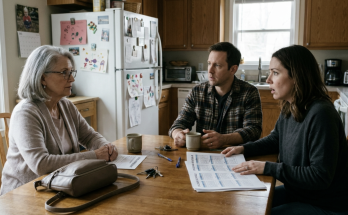

My mother’s voice was calm when she told me my ruined apartment was not her problem.
That was the part I could not stop hearing later. Not the smoke alarm. Not the distant sirens echoing between the apartment buildings. Not the voices of neighbors calling names into the cold dark. Her voice. Flat. Awake enough to understand me. Careless enough to end the call anyway.
“It’s not our problem, Ivy,” she said. “You should have been more careful.”
Then the line went quiet.
I stood in the parking lot at 2:58 in the morning with a stranger’s blanket wrapped around my shoulders and one bare foot pressed on top of the other because the concrete was so cold it hurt. My shoes were gone. I had put them on, I was sure of that, but somewhere between the fourth-floor hallway and the stairwell I must have lost them. The world had turned into flashing red light, wet pavement, and neighbors standing in pajamas with their arms folded tight over their chests.
Behind us, the building I had called home for six years glowed from the inside like a terrible lantern.
Unit 4B was mine. Or it had been.
My grandmother’s quilt was inside. The one she made from old church dresses and flour-sack cotton, with one corner patched in a blue fabric that never matched. My father’s record collection was inside too, stacked in a milk crate I had carried through every apartment since I was twenty-two. There were photo albums from the wedding I never had, the ivory heels I never wore, the little ceramic bowl my dad bought me at a roadside market in Oregon, the stack of birthday cards he wrote before he got too tired to hold a pen for long.
All of it was inside.
And I was outside with nothing but my phone, my keys, and the thin cotton pajamas I had worn to bed.
The building crew and emergency workers moved with quiet urgency. Nobody was shouting anymore. That somehow made it worse. A neighbor from 3A, a woman named Tessa who I only knew from elevator nods and her habit of carrying plants in paper grocery bags, put the blanket over me when she saw me shaking. She asked if I had called anyone.
I had not even thought of it.
My brain had narrowed down to small pieces of information. Breathe. Stand. Stay out of the way. Watch the windows. Count the people from my floor. Do not look too long at the dark opening where your bedroom used to be.
Then Tessa placed my phone in my hand.
“Call your family,” she said gently. “You shouldn’t be alone right now.”
Family.
That word still had power over me then.
My mother picked up on the fourth ring.
“Ivy?” she mumbled, her voice thick with sleep. “Do you know what time it is?”
“Mom,” I said, and my voice sounded strange to me, thin and scraped. “My apartment. Something happened. The building had to be cleared out. My unit is gone. I don’t have anything. I don’t know where I’m supposed to go.”
There was silence on the other end. Not confusion. Not panic. Not the sound of a mother sitting up too fast and reaching for a robe. Just silence.
I waited for her to say she was coming.
I waited for her to ask where I was.
I waited for my mother to become the woman I had spent my whole life pretending she could be when it mattered enough.
Instead, she exhaled.
“It’s not our problem,” she said. “You should have been more careful.”
“Mom?”
“Ivy, I can’t do this tonight.”
Then she hung up.
For a few seconds, I kept the phone pressed to my ear even after the screen went dark. I thought maybe the call had dropped. I thought maybe she would call back, breathless now, embarrassed, saying she had misunderstood. I imagined her pulling up in the old silver Toyota she refused to trade in, wearing sweatpants and one of my stepfather’s jackets, carrying a thermos of coffee and a pair of sneakers. I imagined her saying, “Honey, I’m sorry. Tell me where you are.”
The phone never rang.
A woman from a relief organization gave me a voucher for a motel three blocks away. She had kind eyes and a clipboard with damp corners. She asked my name, my age, whether I had medication inside the unit, whether I had somewhere safe to stay after the voucher ran out. I answered in short pieces because every complete sentence felt too heavy.
My name is Ivy Meyers.
I’m thirty-two.
I live alone.
No, I don’t have anyone coming.
The motel room smelled like old carpet and lemon cleaner. The bedspread had a pattern of brown leaves, and the ceiling above the lamp had a water stain shaped almost like a hand. I sat on the edge of the bed until dawn with the blanket still around me, my phone lying screen-up beside my knee.
No missed calls.
No messages.
At 7:12 a.m., my mother texted.
Hope you figured something out.
I stared at that sentence for a long time.
Then I turned the phone face down.
My mother’s name was Linda Carver, and for most of my life I had been told she was “doing her best.” That phrase followed her everywhere like a protective coat. When she forgot school events, she was doing her best. When she spent grocery money on things my stepbrother Weston wanted because he was “going through something,” she was doing her best. When she let my father’s memory shrink into a box in the garage after he passed, she was doing her best. When she remarried and rebuilt our family around Weston’s needs, Weston’s moods, Weston’s emergencies, everyone looked at me and expected understanding.
I became very good at understanding.
Weston was five years younger than me and entered my life when I was fifteen. He was charming in photographs and difficult in rooms. He could make adults laugh, then leave other people to clean up whatever came after. He borrowed things and forgot to return them. He told half-truths with the confidence of someone who had never paid full price for a lie. My mother called him sensitive. My stepfather called him spirited. I called him exhausting, but only in my head.
By the time I was twenty-seven, Weston had become the center of every family gathering without doing anything useful at one. If he was late, dinner waited. If he was in trouble, plans changed. If he needed money, my mother found a way to describe it as temporary. If I said no, she looked at me like I had failed a test I should have been born ready to pass.
The last real conversation I had with Weston happened a year before my apartment was ruined.
He came to my office lobby at 4:40 on a Thursday afternoon, wearing a denim jacket too light for the weather and a smile that tried to arrive before shame could. I worked as an account coordinator for a home renovation company then, handling client schedules, invoices, and the million little details that keep a project from falling apart. I had just finished calming down a customer from Bellevue who believed cabinet hardware counted as an emergency.
Weston waited by the reception desk with two coffees.
“I come in peace,” he said.
I knew immediately he needed something.
We sat in the diner across the street, the one with chrome edges on the tables and a waitress who called everyone sweetheart. Weston pushed one coffee toward me and told me he was “in a tight spot.” He had made promises he could not keep. He owed people he did not want to disappoint. He needed twelve thousand dollars by Monday.
I almost laughed because the number was so absurd.
“Weston, I don’t have twelve thousand dollars sitting around.”
“But you have savings.”
“I have an emergency fund.”
He leaned closer, lowering his voice. “This is an emergency.”
“For you.”
His expression changed then. The charm slipped just enough for me to see the resentment underneath.
“You always act like you’re better than me.”
“No,” I said. “I act like my rent is due on the first.”
He called our mother before I even made it back to work. That night she phoned me and said family was supposed to show up for family. I asked her if family included paying me back for the last three times. She went quiet, then said I sounded cold.
Two weeks later, I mailed Weston his birthday gift anyway because I hated the idea of becoming the kind of person who let disappointment decide everything. It was a small silver keychain shaped like a fox. I had found it at a craft market near Pike Place months earlier and bought it because when Weston was little, he used to draw foxes on every napkin, homework page, and birthday card. For a while, before life taught him the wrong lessons, he had loved them.
He never thanked me.
I never saw the keychain again.
Until the morning Grant Holloway held it up in a clear plastic sleeve outside what used to be my apartment.
Grant was a building safety reviewer hired after the incident, a man in his mid-forties with gray at his temples and a calm voice that made every word feel weighed before it left his mouth. He called two days after I moved into the motel and asked if I could meet him near the building. He said there were a few things in the report he wanted to walk through with me personally.
I almost said no.
I did not want to see Unit 4B again. I did not want to smell what remained of my life. But insurance had already started asking questions, and the landlord had sent a message full of legal-sounding phrases that made my stomach tighten. I needed answers, even if I was afraid of them.
The building looked smaller in daylight. Sadder. Yellow tape marked the stairwell entrance, and the windows on my floor were dark, open, empty. The parking lot had been cleaned, but I could still see where water had run in black streams toward the drain.
Grant stood near the side entrance with a clipboard tucked under his arm.
“Ms. Meyers?” he asked.
“Ivy,” I said automatically.
He shook my hand carefully, as if he understood I had been touched by too many strangers already. “I’m sorry you’re going through this.”
Most people said that quickly. He did not. He let the sentence stand.
Then he asked, “Do you know who had access to your apartment in the last week?”
The question landed wrong.
“My landlord,” I said. “Maintenance, maybe, if they had a reason. Me.”
“Any family members?”
“No.” I hesitated. “My mother used to have a spare key, years ago. For emergencies. But I asked for it back after my father passed.”
“Did she return it?”
I opened my mouth.
Closed it.
I remembered standing in her kitchen three years earlier, asking for the key. She had said it was in a drawer somewhere and she would find it later. Later became next week. Next week became forgotten. Eventually I changed the subject because asking again made her sigh like I was accusing her of something.
“I don’t know,” I said quietly.
Grant wrote that down.
We did not go all the way inside. He said it was not safe for me to enter, but he walked me to the doorway where I could see just enough. My living room was unrecognizable, not dramatic in the way movies make destruction look, but dull and soaked and gray. The couch was a collapsed shape. The bookshelves bowed away from the wall. The framed print my father gave me when I got my first apartment was gone from its hook, leaving only a pale rectangle behind.
I gripped the railing.
Grant waited.
After a moment, he said, “The origin point was not the kitchen. It wasn’t an overloaded outlet, and it wasn’t anything connected to your appliances.”
I looked at him.
“Then what was it?”
He glanced down at his folder. “The first signs started near the back bedroom window. There’s no wiring there. Nothing in the normal layout explains it.”
My hands went cold.
“I don’t understand.”
“That’s why I asked about access.”
He reached into the folder and removed a sealed clear sleeve. Inside was a small object, blackened on one side, warped by heat, but still visible.
A silver fox.
For a second, the whole parking lot seemed to tilt.
The little pointed ears were bent. The tail had melted into a dark curve. But I knew it. I knew the shape because I had stood at a craft booth with it in my palm, thinking stupidly, Maybe he’ll remember he used to be sweet.
“That’s Weston’s,” I whispered.
Grant did not interrupt.
“My stepbrother,” I said. “I gave it to him for his birthday.”
“When was the last time he was in your apartment?”
“Never,” I said.
Then I corrected myself.
“Not with my permission.”
Grant’s eyes sharpened, but his voice stayed even. “There’s more I can explain in the written report. For now, I can tell you this: something happened in that room that should not have happened by accident. There are signs of unauthorized entry. There are signs someone tried to leave quickly. This charm was found beneath the window.”
Beneath the window.
Not by the door. Not in the hallway. Not somewhere it could have fallen from a visitor’s pocket during a normal afternoon. Beneath my bedroom window, in the room where I had been sleeping when the alarm began.
I turned away and pressed one hand over my mouth.
Grant lowered the sleeve.
“Do you feel safe contacting your family?”
It was a simple question.
I did not know how to answer it.
That night, I sat on the motel bed with Grant’s report summary on my lap and my phone in my hand. The paper listed times, locations, observations, careful phrases that did not accuse anyone but refused to pretend nothing was wrong. My mother’s text thread glowed on the screen.
Hope you figured something out.
I called her.
This time she answered quickly.
“Ivy,” she said, too alert.
That was how I knew.
Not because she sounded guilty. Because she did not sound surprised.
“I met with the safety reviewer today,” I said.
Silence.
“They found something in my apartment.”
“What do you mean?”
“A keychain. A silver fox.”
Another silence. Longer.
I closed my eyes.
“Mom.”
Her breath changed. It became shallow, uneven, the sound of a person stepping carefully around a truth she had already broken.
“He didn’t mean for any of this to happen,” she said.
The sentence opened a hole under me.
I stood so quickly the report slid to the floor.
“You knew?”
“Ivy, listen to me.”
“You knew?”
“He was scared.”
I laughed once, but there was no humor in it. “I was standing outside at three in the morning with nowhere to go, and you told me it wasn’t your problem.”
“He came to me the next morning crying,” she said, her voice rising. “He was beside himself. He said he only went there because he thought maybe you kept cash or documents somewhere, something you could spare. He never meant for things to get out of hand.”
“How did he get in?”
She did not answer.
I stared at the motel wall, at the faint hand-shaped stain above the lamp.
“How did he get in, Mom?”
“I still had the key.”
The room went quiet around me.
There are some betrayals that arrive all at once, loud enough to knock the breath from you. Others come in layers. A key not returned. A son protected. A daughter left outside. A mother’s silence folded over everything like a clean tablecloth hiding a stain.
“You gave him my key.”
“He said he only wanted to look,” she whispered. “He said you owed him after turning your back on him.”
“I owed him?”
“I know it sounds bad.”
“It is bad.”
“You don’t understand what he’s been dealing with.”
There it was. The old family hymn. Weston had pressure. Weston had feelings. Weston had reasons. Ivy had responsibilities.
I picked up the report with one shaking hand.
“My home is gone.”
“I know.”
“My father’s records are gone.”
“Ivy—”
“Dad’s letters. Grandma’s quilt. Everything I had left.”
“I said I know.”
“No,” I said, and my voice became very calm. “You don’t know. Because if you knew, you would have come.”
She started to cry then, but even her crying sounded careful, as if she were still deciding which parts of herself to reveal.
“I was trying to keep the family from falling apart.”
“The family fell apart when you gave him my key.”
“He’s your brother.”
“He is not the person who called you from a parking lot with nothing.”
She said my name again, softer this time. “Please don’t make this bigger than it needs to be.”
I looked at the clear sleeve Grant had given me in a second envelope, the fox charm dark against the plastic.
“It is already bigger than you want it to be.”
I ended the call.
For a while, I did not move. Outside the motel window, headlights slid along the curtains. Someone walked past laughing too loudly. The heater clicked on, pushing dry air into the room. My hands were still trembling, but something inside me had settled into place.
I had spent my life absorbing the shape of other people’s excuses.
I was done.
The next morning, I called Grant and told him everything. I gave him the timeline, the spare key, the phone call, Weston’s money request, my mother’s admission. He listened without rushing me. He asked if I had written anything down immediately after the call. I had. Three pages in the motel notepad, the pen pressing so hard it tore the paper in places.
“Keep those,” he said. “And send a copy to your claims representative and your attorney if you retain one.”
Attorney.
The word made me feel older than I was.
I did not have money for an attorney, not really. My emergency fund had been meant for rent gaps, car repairs, medical co-pays, ordinary disasters with receipts and solutions. But my boss, Marianne, heard what happened and insisted I speak with her cousin Rachel Kim, a civil attorney who handled property and insurance disputes.
Rachel’s office was on the second floor of a brick building above a bakery. The waiting room smelled like coffee and warm sugar. I arrived wearing donated jeans, a sweater from Tessa, and sneakers half a size too big. Rachel greeted me like none of that mattered.
She was small, precise, and impossible to talk over.
I handed her Grant’s report, my notes, photographs from the building, screenshots of my mother’s text, and the old messages from Weston asking for money. She read everything without expression. When she reached the part about the spare key, she placed one finger on the page and looked up.
“Your mother had access and gave it to him?”
“Yes.”
“Did she admit that in writing?”
“No.”
“Will she?”
I almost smiled. “Not willingly.”
Rachel nodded. “Then we build around what we can prove and what they cannot comfortably deny.”
That sentence became a hinge in my life.
Over the next few weeks, while I slept in the motel and wore clothes strangers had donated through a community group, Rachel helped me organize everything. Insurance forms. Replacement lists. Photographs. Witness statements from neighbors who had seen Weston near the building days earlier but had not known it mattered. A message from my mother saying, Please do not drag Weston into this, which Rachel printed and placed in a folder with a yellow tab.
“People often confess around the edges,” she said.
Meanwhile, my family began to circle.
My aunt Carol texted first.
Your mother is worried sick. Please call her.
Then my cousin Brianna.
I heard there was a misunderstanding. Weston feels terrible.
Then my stepfather Nolan, who had never once called just to ask how I was.
This is getting out of hand. Families handle things privately.
Privately.
That word made me laugh in the motel laundry room while my donated sweater spun behind scratched glass. Privately was where my family put every uncomfortable truth. Privately was where Weston’s messes went to be renamed. Privately was where my mother stood when she decided my safety mattered less than his future.
I did not answer any of them.
But my silence did not make them stop.
Two Sundays after I met Rachel, my mother appeared at my motel.
I knew it was her before I opened the door because of the knock. Three quick taps, then a pause, then two more, as if even now she expected doors to recognize her authority.
I looked through the peephole. She stood in the walkway wearing a beige cardigan and holding a paper grocery bag like a peace offering. Her hair was done. Her lipstick was on. She looked more prepared for church than for an apology.
I opened the door but kept the chain on.
Her eyes flicked to it.
“Ivy.”
“Mom.”
“I brought you some things.”
“I don’t need groceries.”
Her mouth tightened. “Can I come in?”
“No.”
The word surprised both of us.
She looked past me into the motel room, taking in the bare wall, the suitcase on the chair, the stack of forms on the bed. For one moment, something like discomfort crossed her face. Not grief. Not yet. Discomfort, as if the consequences were rude enough to show themselves.
“Ivy, this is not who we are.”
I held the door with one hand. “Then who are we?”
“We are a family.”
“No,” I said. “We are people related to each other. Family would have shown up the night I called.”
She flinched.
“I panicked.”
“You hung up.”
“I didn’t know what to say.”
“You said enough.”
She lowered her voice. “Weston is not sleeping. He is sick over this. He wants to write you a letter.”
“Rachel can receive it.”
Her face changed at the attorney’s name.
“You hired someone?”
“I got help.”
“Ivy, please. Once lawyers get involved, everything becomes colder.”
I looked at her through the gap in the door.
“Colder than ‘not our problem’?”
The grocery bag rustled in her arms.
She started to speak, then stopped.
In the silence, a man two rooms down opened his door, glanced at us, and quickly looked away. My mother noticed. Her cheeks colored. That was the moment I understood something important. She had not come because she was finally ready to see me. She had come because other people might.
“I am asking you,” she said carefully, “to think about what this will do to Weston.”
“I am thinking about what Weston did to me.”
“He made a terrible mistake.”
“A mistake is forgetting to return a pan. A mistake is missing a birthday. He used a key you gave him to enter my home without asking. Then he left me to wake up to a smoke alarm and lose every piece of my life that could not be replaced.”
Her lips trembled, but her eyes hardened. “You have always been unforgiving.”
There it was.
The old script, pulled from the drawer and offered like proof.
I looked at my mother, really looked at her. She was still beautiful in the way some women remain beautiful because they believe the world owes them softness. She had the same green eyes I did, though hers had learned to turn away faster. I wondered if she had ever seen me clearly, or if I had only ever been the reliable daughter in the background of Weston’s emergencies.
“I was forgiving for thirty-two years,” I said. “You mistook it for permission.”
Then I closed the door.
My legs shook afterward, and I sat on the edge of the bed until the shaking passed. The grocery bag remained outside for ten minutes before she picked it up and left. Through the curtains, I watched her walk to her car with her shoulders straight, the same way she walked out of parent-teacher conferences when she had decided the teacher was unfair to Weston.
That night, Rachel emailed me a scanned copy of a formal notice sent to Weston and my mother. It requested cooperation, repayment documentation, and preservation of all messages about the incident. It was polite, firm, and clean. Not emotional. Not cruel. Just a door that could no longer be closed quietly.
The family group chat went silent within an hour.
For the first time in weeks, I slept.
Not well. Not peacefully. But I slept.
The next month became a strange season of rebuilding and paperwork. My life had been reduced to lists. Socks. Coat. Laptop. Bed frame. Kitchenware. Work shoes. Replacement driver’s license. Copy of birth certificate. Statement for insurance. Statement for building management. Statement for myself, though no form asked for that.
I wrote it anyway.
I wrote about waking to the alarm. About the hallway. About Tessa’s blanket. About my mother’s voice. About the fox charm. About the fact that I had once bought that charm with love, and it had returned to me as proof.
Marianne let me work from home when I could, though home was a motel desk beneath a flickering lamp. Coworkers left gift cards in an envelope labeled For Ivy, no pressure, just love. Tessa dropped off a pair of boots and a small potted fern from her collection.
“You need something alive in that room,” she said.
I named the fern Fred because my father would have found that funny.
Slowly, the official pieces moved. The insurance company accepted Grant’s findings. Weston retained his own counsel after ignoring the first letters. My mother stopped texting me directly and started sending messages through Aunt Carol, who seemed to believe she had been appointed ambassador to a country no one respected.
Then, one afternoon, Rachel called.
“They want a meeting,” she said.
My stomach tightened. “Who?”
“Weston’s attorney requested a mediated family conference before the civil claim moves further.”
“Do I have to go?”
“No,” Rachel said. “But it may help. Only if you’re ready.”
Ready was too strong a word. I was not ready to sit across from Weston. I was not ready to see my mother defend him in person. I was not ready to hear apologies shaped like excuses.
But I was tired of them speaking about me in rooms where I was not present.
“Where?” I asked.
Rachel arranged for the meeting at her office after hours. Neutral. Quiet. No family home, no old dining table, no familiar walls trying to pull me back into old roles. I wore black pants, a cream sweater, and the new coat Marianne had helped me find on sale. My hair was shorter because the ends had smelled faintly smoky no matter how many times I washed them, and one morning I cut three inches off in the motel bathroom before work.
When I arrived, Rachel was already in the conference room with folders arranged in front of each chair. A glass pitcher of water sat at the center of the table. Beside my folder, she had placed the sealed sleeve with the silver fox charm inside.
Seeing it there steadied me.
Not because it was pleasant.
Because it was real.
My mother arrived first with Nolan. She looked smaller than she had at the motel but more guarded. Nolan nodded once, his mouth flat. Weston came in last.
I had not seen him in over a year.
He looked thinner, his face pale under the office lights, hair longer than usual and pushed back badly. He wore a navy button-down with sleeves rolled to his elbows, as if he had tried to look responsible and run out of confidence halfway through. His eyes went to the fox charm and stopped.
For a second, nobody sat.
Rachel gestured calmly. “Let’s begin.”
My mother chose the chair beside Weston. Of course she did. Nolan sat on her other side. I sat across from them with Rachel to my right.
Weston did not look at me at first.
Rachel opened the meeting by explaining the purpose in careful language. Losses. Unauthorized access. Responsibility. Restitution. Cooperation with the claim process. No raised voices. No interruptions.
My mother folded her hands tightly on the table.
“We all want healing,” she said.
Rachel looked at her. “Healing requires facts.”
That silenced the room.
Weston cleared his throat. “Ivy, I’m sorry.”
The words arrived too early. Too clean. Like he had practiced them in the car.
I looked at him. “For what?”
He blinked.
“For everything.”
“No,” I said. “For what?”
His jaw shifted. He looked at my mother, and I almost laughed because even now he searched for permission.
She gave him the smallest nod.
He looked back down.
“For going into your apartment without asking.”
“And?”
“For causing the situation that ruined it.”
“And?”
His face flushed. “For not coming forward.”
I waited.
He swallowed. “For letting Mom tell you it wasn’t her problem.”
My mother stiffened. “Weston.”
Rachel lifted one hand. “Let him finish.”
The authority in her voice changed the room. Not loudly. Not dramatically. But clearly. My mother was used to being the person who decided when discomfort ended. Here, she did not have that power.
Weston stared at the charm.
“I was scared,” he said. “I knew if I told the truth, everything would fall on me. Mom said we should wait. She said maybe the report would say it was electrical or something with the building. I wanted to believe that.”
I felt cold, but not surprised.
My mother’s eyes shone. “I was trying to protect you.”
I turned to her.
“You protected him from a conversation. You did not protect me from a night I still wake up inside.”
She looked away.
Nolan spoke for the first time. “Linda was in an impossible position.”
“No,” I said. “She was in a difficult position. She chose.”
That distinction landed hard.
Rachel slid a document across the table. “This is the proposed restitution agreement. It does not prevent other formal processes from continuing if required, but it establishes immediate responsibility for personal property losses not covered, temporary housing, and related costs. It also includes written acknowledgment of unauthorized access.”
Weston stared at the pages.
“How am I supposed to pay this?”
The old question. The question that had started so much.
Rachel answered before I could. “Over time. With structure. With documentation. Like most adults do when they owe a debt.”
My mother’s face tightened at the word debt.
“Ivy,” she said softly, switching tactics, “I know you’re hurting. But if you push too hard, you may regret it. He is still young.”
“He is twenty-seven.”
“He made one mistake.”
I leaned forward and placed my hand beside the fox charm.
“No. He made choices. You made choices. The first one was entering my home. The next was staying quiet. The next was letting me sleep in a motel while you waited to see if the truth would disappear. The next was coming to my door and asking me to protect the person who left me with nothing.”
My voice did not rise. That made everyone listen harder.
Weston’s eyes filled with tears. My mother reached toward him, but he pulled his hand back.
“No, Mom,” he said quietly.
She froze.
He looked at me then, directly for the first time.
“I’m sorry,” he said. “Not because I’m in trouble. I mean, I am. But I’m sorry because when I heard you lost Dad’s records, I knew exactly what that meant. And I still let Mom handle it.”
My throat tightened at the mention of my father.
My dad, Peter Meyers, had been a quiet man who fixed radios for fun and believed every good day needed music in it. After he passed, his records became the last physical sound of him I had. Some were replaceable in theory. Most were not. It was not about money. It was about his handwriting on the sleeves, his little notes tucked inside, the way he circled favorite tracks with a blue pen.
Weston looked down.
“I found one thing,” he said.
My mother turned sharply. “Weston, don’t.”
He reached into his jacket pocket and pulled out a small padded envelope.
Rachel sat straighter.
Weston placed it on the table and pushed it toward me.
“I took it before everything happened,” he said. “I thought it might be worth something. It wasn’t. I kept it because I didn’t know what to do.”
My hand hovered over the envelope before I opened it.
Inside was a record sleeve.
Not the record. Just the sleeve. Smoke-smudged on one edge, creased down the center, but intact enough to recognize.
Sam Cooke. My father’s favorite.
On the back, in faded blue ink, he had written: Ivy danced to this in the kitchen, age four. Refused to stop.
The room blurred.
For a moment, I was not thirty-two in an attorney’s office. I was four years old standing on my father’s shoes while he spun me carefully across yellow linoleum, my mother laughing from the sink back when laughter still sounded easy in that house. I remembered his hand above my head, his voice counting the rhythm, his promise that music made every room bigger.
I pressed the sleeve flat on the table with both hands.
“You had this,” I whispered.
Weston nodded, crying now without trying to hide it. “I’m sorry.”
My mother covered her mouth. Whether she was crying for me, for him, or for the fact that the room had finally turned where she could not control it, I did not know.
Rachel waited, then spoke gently. “Ivy?”
I looked at the restitution agreement. At Weston. At my mother. At the fox charm that had once been a gift. At my father’s handwriting, returned to me not whole, but not gone.
There was a version of me, the old version, that might have softened too soon. That might have taken one recovered sleeve as a sign to absorb the rest. That might have let my mother call this healing because everyone was uncomfortable and wanted to go home.
But the woman who had stood in the parking lot in a stranger’s blanket was still inside me.
And she deserved better than a beautiful shortcut.
I wiped my face, took the pen Rachel had placed beside me, and pushed it toward Weston.
“Sign it,” I said.
My mother inhaled sharply. “Ivy.”
I did not look at her.
“Sign it,” I repeated. “Then write the full apology Rachel requested. Not just to me. To the insurance representative, the property owner, and everyone you allowed to believe this was an ordinary accident. You are going to put the truth somewhere you cannot take it back from.”
Weston stared at the pen.
For once, nobody rescued him from the silence.
He picked it up.
His hand shook as he signed.
The sound of the pen moving across paper was small, almost nothing. But in that room, it felt like a door closing on the life where my family could rename harm as misunderstanding and expect me to carry the difference.
When he finished, my mother looked at me with red eyes.
“Are you cutting us off?”
I thought about that.
I thought about the motel. The phone call. The grocery bag outside my door. The family group chat. The way she had said Weston’s fear like it weighed more than my loss.
“I am cutting off the version of this family where I pay the emotional bill for everyone else,” I said. “What comes after that depends on what you do without me begging you to do the right thing.”
She did not answer.
There was nothing left for her to say that would fix the order of what had happened.
In the months that followed, life did not repair itself quickly. It never does. People like clean endings because they make pain feel organized, but real rebuilding is messy and dull and full of receipts. Weston began making monthly payments through Rachel’s office. The insurance claim covered some things and denied others. The property owner returned my security deposit with a note that simply said, I’m sorry for your loss. Tessa helped me find a new apartment two towns over, smaller than 4B but bright, with morning light in the kitchen and a grocery store within walking distance.
I bought a new lock before I bought a couch.
Then I bought a fireproof safe.
Inside it, I placed the Sam Cooke sleeve in an archival folder, three reprinted photographs friends found on old phones, my birth certificate, my lease, and the silver fox charm. I kept the charm not because I wanted to remember Weston, but because I wanted to remember the truth had survived in a form small enough to fit in my palm.
My mother wrote me a letter in late November.
It arrived in a cream envelope with my name written in her careful holiday-card handwriting. I left it on the kitchen island for two days before opening it.
She apologized, but not perfectly. She used the word overwhelmed twice. She said she had failed me, then softened it by saying she failed everyone. She wrote that she had confused protecting Weston with loving him. That was the one sentence I believed.
I did not write back right away.
On Thanksgiving, Aunt Carol invited me to dinner. She said my mother hoped I would come. She said Weston would not be there if that made me more comfortable. She said everyone missed me.
I looked around my apartment while she talked. The fern from Tessa sat on the windowsill, fuller now. A secondhand blue sofa faced the TV. My father’s record sleeve rested in its frame above the small dining table. There were still empty corners, still boxes I had not unpacked because half of what I owned had been purchased in the last three months and none of it knew me yet.
But the place was mine.
No one had a spare key.
No one could enter because my mother thought someone else needed something more.
“Thank you,” I told Aunt Carol. “Not this year.”
She was quiet for a moment. “Are you alone?”
I looked at the pie cooling on my counter, at the playlist I had made from songs my father loved, at the new lock on the door.
“No,” I said. “I’m with myself.”
That evening, I cooked badly and ate anyway. The turkey breast was dry. The green beans were too salty. The pie was excellent because I bought it from a bakery and did not pretend otherwise. I played Sam Cooke from my phone because the record itself was gone, and when the first notes filled the apartment, I stood in the kitchen and let myself cry.
Then I danced.
Not gracefully. Not like a movie. Just a woman in socks, in a small apartment, moving because grief had taken enough stillness from me.
By Christmas, Weston had made three payments. He sent a letter through Rachel, not directly to me, as agreed. In it, he did not ask for forgiveness. That was the first smart thing he had done. He wrote that he had started financial counseling. He wrote that he was working at a warehouse outside Tacoma and that every payment was a reminder. He wrote that he understood if I never wanted to see him again.
I believed some of it.
Not all.
Belief, like trust, should be rebuilt with tools, not wishes.
My mother called on New Year’s Day. I let it ring. Then I listened to the voicemail.
“Hi, Ivy. It’s Mom. I know I don’t have the right to ask for anything. I just wanted to say I hope your year is better. I hope your apartment feels safe. I hope you know I think about that night every day.”
She paused.
“I should have come.”
That was the first sentence from her that did not defend anyone.
I saved the voicemail.
I did not call back that day. Or that week. But I saved it.
Spring came slowly. Seattle softened into rain and pink blossoms. I learned the sounds of my new building: the elevator hum, the neighbor’s dog’s small bark at 6 p.m., the delivery trucks in the alley, the teenager upstairs practicing guitar badly but enthusiastically. I bought a real bed frame. I bought two plants after keeping Fred alive. I found a used turntable at a flea market and began rebuilding my father’s collection one record at a time.
The first album I bought was Sam Cooke.
Not the same pressing. No blue handwriting. No note about me dancing in the kitchen.
But when I placed it on the turntable and heard the soft crackle before the music began, I felt something loosen in my chest. Not replaced. Never replaced. But continued.
One Saturday in April, Tessa came over with a bottle of sparkling cider and a plant cutting wrapped in a damp paper towel.
“Housewarming,” she said, even though I had lived there for months.
We sat at my small dining table with takeout Thai food and talked about ordinary things. Rent. Work. Her terrible luck with dating apps. My boss Marianne’s habit of sending emails with no subject line. The fern, now apparently famous among Tessa’s plant friends.
At some point, she looked at the framed record sleeve on the wall.
“Ivy,” she said, “you made a home again.”
I followed her gaze.
The apartment was not full. It did not have everything 4B had. It did not smell like my grandmother’s quilt or hold my old books or display the chipped blue bowl from Oregon. But there were curtains I chose, music I loved, a lock I trusted, and a table where someone kind sat across from me eating noodles from a carton.
“Yes,” I said. “I did.”
That night, after Tessa left, I opened the safe and took out the silver fox charm. The metal was still warped, the tail darkened, the tiny ears bent. Once, it had been a gift to someone I wanted to believe could become better. Then it became proof of something terrible. Now, in my palm, it felt like a third thing.
A boundary.
A reminder that love without accountability is not love. That family silence can be louder than public truth. That some doors should stay locked, not because you are bitter, but because you finally understand what safety costs.
I placed the charm back inside the safe beside my father’s sleeve.
Then I closed the door and turned the key.
I have not become hard. People who benefit from your softness often call boundaries hardness because it frightens them to lose easy access. I still care. I still send flowers when Aunt Carol is sick. I still hope Weston keeps making payments and learns how to live without being rescued. I still listen to my mother’s voicemail sometimes, not because it heals everything, but because it is the first honest brick in a wall that may or may not become a bridge someday.
But I no longer confuse being needed with being loved.
I no longer hand out spare keys to people who treat my life like a drawer they can open when convenient.
Some nights, I still wake at 2:47.
The apartment is dark. The hallway is quiet. The air smells like laundry soap and rain, not smoke. For a few seconds, my heart forgets where I am. Then I reach toward the nightstand and touch the small lamp, the glass of water, the edge of my new phone. I listen until I hear the hum of the refrigerator and the distant sound of traffic moving normally through the wet streets.
Safe, I tell myself.
Mine.
In the morning, light comes through the kitchen window and falls across the framed record sleeve. My father’s handwriting catches it just enough to shine.
Ivy danced to this in the kitchen, age four. Refused to stop.
So I don’t stop.
Not for the apartment I lost. Not for the mother who chose wrong. Not for the stepbrother who mistook my kindness for something he could spend. Not for the family members who preferred a quiet lie over an uncomfortable truth.
I keep going.
I rebuild slowly. Carefully. With receipts, locks, music, new furniture, honest friends, and a safe full of the few things that survived. I rebuild with my own name on the lease and my own hand on the key. I rebuild without waiting for the people who failed me to approve of the woman I had to become.
And every time I turn the lock behind me, I remember the night my mother said my loss was not her problem.
She was wrong.
It was never only my problem.
It was the truth finally asking to be let in.