
The suitcase wheels scraped across the hallway carpet before I understood that my daughter-in-law was not making a point. She was putting me out.
Britney pulled my small navy travel bag through the apartment doorway with one hand and set it hard beside the elevator, then dropped my purse on top of it as if both things had become offensive by belonging to me. The hallway smelled faintly of lemon cleaner and someone’s Sunday roast. A door opened two apartments down. Another chain lock clicked quietly. People were listening, trying not to be caught listening.
Britney stood in the doorway of Apartment 4B wearing a cream lounge set, her hair twisted into a perfect knot, her phone still in her other hand. She did not look embarrassed. That was the part that stayed with me. Not the suitcase. Not the purse. Not even the word she used a moment later.
She smiled.
“I am done carrying your burden energy in my home, Evelyn,” she said, loud enough for the hallway to hear. “You need to leave.”
For a second, all I could see was the brass number on the door behind her.
4B.
My husband Thomas had polished those numbers himself twenty-six years earlier, back when the building still smelled like wet plaster and fresh paint, back when we believed owning twelve apartments in Columbus would be the biggest risk of our lives. He had stood in that very hallway with a screwdriver in his mouth and a pencil behind his ear, grinning because the electricity had finally passed inspection.
“Someday,” he told me, “this place will take care of you when I can’t.”
At the time, I laughed and told him not to speak like an eighty-year-old man. We were barely forty then. Mason was ten, all elbows and untied sneakers, running up and down those stairs while I told him not to touch the wet paint. Thomas called the building Carter House, though the official records used a plain limited liability company name because he believed sentiment belonged inside the walls, not on legal documents.
Now my daughter-in-law stood under those same hallway lights, throwing me out of a building my husband and I had bought with overtime, secondhand furniture, and twenty years of careful repairs.
I looked at Britney. Then at my suitcase. Then at the small black dome of the hallway security camera near the ceiling.
The red light blinked once.
It was recording.
“Britney,” I said quietly, “Mason isn’t home.”
“I know.” Her smile sharpened. “That’s why we can finally talk honestly.”
Honestly.
People often save that word for the moment they intend to be cruel.
I had come by that Saturday afternoon with homemade chicken soup because Mason had been working long hours again. He had texted me three days earlier that he was tired, that his new warehouse supervisor job had him leaving before sunrise and coming home with his shoulders aching. He did not ask for anything. Mason almost never asked directly. But mothers learn the shape of need in the spaces between words.
So I made soup.
Carrots cut small the way he liked when he was a boy. Extra thyme. Fresh bread from the bakery on Henderson Road. I also brought a small overnight bag because my own unit downstairs was having a plumbing repair that evening, and Mason had told me the week before, “Mom, if your place is a mess, just sleep on our couch.”
I thought that had included Britney.
I should have known better.
When she opened the door, the first thing she looked at was the bag.
The second thing was the soup.
“Oh,” she said. “You’re staying?”
“Just one night,” I told her. “Mason said the couch would be all right.”
Her eyes moved down the hallway, then back to me. “Mason says a lot of things when he wants to avoid feeling guilty.”
I stood there with the warm container in both hands and felt something inside me sink. Not sharply. Not suddenly. More like a floorboard giving way by half an inch.
“I can make other arrangements,” I said.
“That would be best.”
But then she kept talking.
That was what people like Britney did when they sensed a room tilting in their favor. They kept pressing. They needed the moment not only to happen, but to become a performance.
She said I visited too often. She said I made Mason act like a child. She said I brought food to make her feel inadequate. She said older parents had a way of “attaching themselves” to adult children and calling it love. She said their apartment was their home now and I needed to respect that.
Their apartment.
Their home.
I looked past her shoulder into the living room. The throw pillows were new. The lamp by the window was new. The framed print above the sofa had replaced the old landscape I had found at an estate sale before Mason and Britney moved in. It was a pretty apartment. Bright. Comfortable. Discounted far below market rate because Mason had lost his job eight months earlier, and I had not wanted my son to feel ashamed.
I had lowered their rent quietly through the property office.
I had covered two late utility balances from the building maintenance account and told Gail, my manager, not to mention it. I had approved a new dishwasher when the old one still had another year in it because Britney said the kitchen felt “tired.” I had done all of it without attaching my name to the kindness, because Thomas and I had always believed help should leave people with dignity.
Britney had taken that dignity and mistaken it for weakness.
“I brought soup,” I said, because sometimes the smallest sentence is the only one available.
She glanced at the container.
“Leave it if you want.”
Then she reached for my suitcase.
I did not stop her.
That surprises people when I tell them. They expect me to say I fought back. That I snatched it from her hand or demanded she remember who she was speaking to. But in that moment, I felt no need to wrestle for my own belongings. I had already seen enough. Arguing in the hallway would only give her the kind of scene she wanted.
So I watched her drag my bag out, set my purse on top, and announce that she was done with me.
Mrs. Alvarez from 4A had opened her door three inches. Young Caleb from 4C stood behind his mother, still holding a juice box. Mr. DeWitt, who had lived in 3B since before Thomas died, came up the stairs carrying his mail and stopped halfway when he saw my purse on the floor.
Britney noticed them watching.
Instead of softening, she lifted her chin.
“I’m allowed to protect my peace,” she said.
I almost admired the confidence it took to misuse good language so badly.
“Yes,” I said. “You are.”
That seemed to irritate her.
She had expected tears, maybe. Or apology. Or the familiar mother-in-law scramble to soothe and excuse. I had given Britney too many years of that. When she criticized my clothes, I smiled. When she joked that I made “depression-era food,” I laughed lightly and brought dessert next time. When she told Mason that his mother needed hobbies, I pretended not to hear. I wanted peace for my son. I wanted Sunday dinners, holiday cards, maybe a grandchild someday who would know the story of the building and the man who polished brass numbers by hand.
Peace, I had come to understand, is not always quiet.
Sometimes quiet is only what disrespect sounds like when everyone has learned to endure it.
I picked up my purse, looped it over my arm, then gripped the handle of my suitcase.
Britney crossed her arms. “Don’t come back without calling first.”
I looked at her directly.
“I wish you a peaceful evening.”
She blinked. The sentence confused her because it contained no surrender and no visible anger.
The elevator doors opened behind me.
As I stepped inside, I heard her laugh once. A bright, relieved sound. She believed she had won something.
The doors slid shut between us.
The elevator descended past floors I had repainted, carpets I had replaced, smoke detectors I had personally tested after Thomas got sick, and apartments I had kept affordable for tenants who paid on time, watched out for one another, and still called me Mrs. Carter even though I told them Evelyn was fine.
My phone rang before I reached the lobby.
Gail.
Gail Patterson had managed Carter House for nine years. She was a former paralegal with a voice like black coffee and a talent for knowing when a tenant’s “small issue” was about to become a formal problem. Thomas hired her six months before he died because he said I needed someone who knew files better than feelings.
“Evelyn,” she said, “where are you?”
“In the elevator.”
“I saw the hallway feed.”
“Then you saw enough.”
Her voice became careful. “Are you all right?”
I looked down at my suitcase, at the little silver tag Mason had given me for Christmas years ago. Mom, it said on one side. Always packed for everyone else on the other.
“I’m fine,” I said.
“No, you’re not. Come to the office.”
The building office was on the first floor behind the old mailroom. Years before, it had been a storage closet full of paint cans, spare tiles, and a mop sink that never drained correctly. Thomas converted it into a proper office the winter before his diagnosis, installing shelves, a desk, and a little heater under the window because he said my feet were always cold when I did paperwork.
Gail was already standing when I came in.
She was a tall woman in her late fifties with steel-gray hair cut to her jaw and glasses hanging from a chain around her neck. On the desk, her computer monitor showed paused security footage from the fourth floor hallway. Britney’s face was turned toward the camera, mouth open mid-sentence. My suitcase sat near the elevator. My own expression looked calmer than I had felt.
Gail looked at the screen, then at me.
“I can issue a lease conduct notice tonight.”
“Not tonight.”
“Evelyn.”
“I said not tonight.”
Her mouth tightened, but she listened.
I set the soup container on the desk. “Would you like dinner?”
She stared at me for a second.
Then she laughed softly, not because it was funny, but because it was either laugh or cry.
“You really are impossible.”
“No,” I said. “I’m tired.”
That evening, I stayed in the small guest room behind the office. Thomas had insisted on building it after one winter storm knocked heat out in two units and we ended up letting tenants sleep in our living room. The room held a twin bed, a quilt, a small lamp, and a framed photograph of the building the day we bought it. In the picture, Thomas stood on the front steps with his hands on his hips, grinning at a structure that needed new wiring, new windows, new plumbing, and more faith than money.
I sat on the edge of the bed and studied his face.
“What would you do?” I whispered.
I knew, of course.
Thomas would have been angry. Not loud, but precise. He would have made coffee, pulled out the lease, reviewed every clause, and said, “Feelings are not the opposite of paperwork, Evie. Sometimes paperwork is how feelings defend themselves.”
I slept badly.
At 6:12 the next morning, Gail texted me two files.
The hallway footage.
The rent ledger for Apartment 4B.
I opened the ledger first.
Regular monthly rent. Discounted rent. Deferred late fees. Utility credits. Maintenance upgrades. Appliance replacement. Every quiet favor I had approved was there in clean columns, stripped of emotion. Numbers tell the truth without asking whether anyone is ready to hear it.
Then I opened the footage.
Watching yourself be dismissed is different from living it. In the moment, your body protects you. It narrows your attention. It gives you only what you need to move through the next ten seconds. But video is patient. It gives you everything.
Britney’s eyes rolling when I held up the soup.
Her hand closing around my suitcase.
Mrs. Alvarez’s door opening.
Mr. DeWitt stopping on the stairs.
My own face when Britney called me a burden.
Not broken.
Just very still.
I watched it once.
Then I forwarded both files to my attorney.
By seven-thirty, Mason called.
I let it ring.
He called again at eight.
Then at eight-oh-six, a text appeared.
Mom, what happened? Britney says there was a misunderstanding.
Misunderstanding.
The word people use when they want harm to become fog.
I typed back:
Please come to the building office tomorrow at 10 a.m. Bring Britney. This is a property matter.
He replied almost immediately.
A property matter? Mom, are you okay?
I looked at the message for a long time.
Then I wrote:
I will be.
Britney arrived before Mason the next morning.
That told me something.
She swept into the office in a camel coat, sunglasses pushed into her hair, phone in hand, expression polished into annoyance. She expected a small administrative dispute. A complaint about tone, perhaps. A conversation she could redirect with phrases like boundaries, stress, and needing space. She was good at borrowing the vocabulary of maturity while avoiding its obligations.
Gail sat at her desk. My attorney, Mr. Levenson, sat beside the filing cabinet with a folder open on his lap. He was a quiet man in a charcoal suit who had helped Thomas and me set up the ownership structure years earlier. He looked harmless until he began reading contracts aloud.
Britney glanced at him, then at Gail.
“Is all this really necessary?” she asked. “I have a full day.”
“So do I,” I said.
She turned.
I stood near the wall of framed documents behind the desk. It was not a wall I usually drew attention to. Most people came to the office to discuss leaking faucets, parking permits, or mail keys. They did not study ownership certificates. They did not notice the old photograph of Thomas and me signing the purchase papers. They did not read the framed inspection approval from 1998.
Britney noticed now.
Her eyes moved from the documents to my face, then back to the largest frame.
Carter House Apartments.
Registered Owner: Evelyn Carter, Trustee, Carter Family Property Trust.
Her expression changed slowly.
Not guilt.
Calculation.
“Mason never told me,” she said.
“Mason didn’t know all of it.”
That was true.
My son knew I had “some ownership” connected to the building. He knew his father had bought property. He knew I worked with Gail. But Thomas and I had made a deliberate choice never to raise Mason around the idea that inherited security was the same as personal achievement. We wanted him to build his own life, not wait for ours to become his.
When he and Britney needed a place after his layoff, I told him one of the apartments was available through the management office. I did not say I owned the whole building. I did not say the discounted rent was a mother’s hand beneath him.
I wanted to help without making him feel small.
Britney had done that part herself.
Mason arrived five minutes later, breathless, still in his work jacket. He looked at me first, then at Britney, then at the framed documents.
“Mom,” he said quietly. “What’s going on?”
I motioned toward the chairs.
“Sit down.”
Mason sat.
Britney remained standing for two seconds too long, then lowered herself into the chair beside him.
Gail closed the office door.
That small click was the first sound that made Britney’s confidence falter.
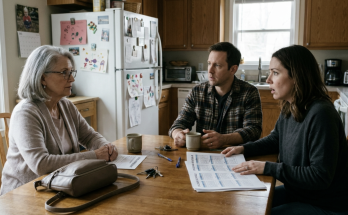
I sat across from them at the table. Between us, I placed three things.
The lease.
The rent ledger.
A printed still from the hallway video.
Britney’s eyes went to the photograph. In it, she was holding my suitcase handle. My purse was already on the floor. My face was turned slightly toward her. The hallway camera had captured Mrs. Alvarez watching through her cracked door.
Mason reached for the photograph.
His hand stopped above it.
“What is this?”
“A moment you missed,” I said.
Britney leaned forward. “That looks worse than it was.”
Gail’s eyebrows lifted.
I kept my voice even. “Then we’ll watch the full recording.”
“No,” Britney said too quickly.
Mason looked at her.
That was the first real crack.
Mr. Levenson turned the laptop toward them and pressed play.
The room filled with Britney’s voice.
I’m done carrying your burden energy in my home.
You need to leave.
Don’t come back without calling first.
The video showed everything. My soup container. My suitcase. The neighbors. The elevator doors closing while Britney laughed.
Mason did not move.
When the clip ended, the office felt smaller than it had before.
“Mom,” Mason said, but his voice failed him.
Britney folded her arms. “I was overwhelmed.”
“No doubt,” I said.
“I didn’t mean it the way it sounded.”
“You meant it because you thought I had nowhere to stand.”
She looked down.
“You thought I was an older woman depending on your kindness,” I continued. “You thought this apartment was yours because no one had corrected you. You thought you could put my belongings in a hallway, speak to me like an inconvenience, and close the door without consequence.”
Mason covered his face with one hand.
“Mom, I’m so sorry.”
I wanted to comfort him.
That instinct rose in me so strongly I had to press my palm against the folder to keep from reaching across the table. Mothers are trained by love to reduce their children’s discomfort, even when discomfort is the only honest teacher left.
So I let him sit in it.
Mr. Levenson slid the rent ledger forward.
“Apartment 4B has received a temporary hardship reduction for eight months,” he said. “Approved by Mrs. Carter after Mason Carter’s employment interruption. The reduction was discretionary, not permanent, and not guaranteed under the lease.”
Britney’s head lifted.
“Hardship reduction?”
Mason looked at me. “Mom, you said the building was adjusting rates.”
“I did.”
“You were paying the difference?”
“Absorbing it through the property account.”
His face flushed with shame.
Britney glanced from him to the ledger. “How much?”
Gail answered before I could.
“Enough that you should have been sending thank-you notes instead of redecorating the balcony and telling neighbors you were thinking of buying a second car.”
Britney’s lips parted.
I gave Gail a look.
She looked back as if to say she had behaved long enough.
I turned to Britney.
“Your rent returns to the standard rate on the first of next month. Late fees will apply exactly as written. Utility credits end today. Any future maintenance requests will go through Gail during business hours unless there is an emergency.”
Britney’s face went pale.
“That’s not fair. We budgeted around the current amount.”
“No,” I said. “You benefited from the current amount. You did not build a right to it.”
Mason spoke quietly. “Mom, I’ll handle it.”
Britney turned on him. “Handle it how? We can’t just suddenly pay hundreds more because your mother is offended.”
The word offended entered the room like a match.
I felt Gail go still beside me.
I looked at my daughter-in-law carefully.
“I am not offended,” I said. “I am informed.”
That silenced her.
“There is a formal conduct clause in your lease,” Mr. Levenson said, opening the document. “It covers treatment of other residents, guests, staff, and building representatives. Mrs. Carter has chosen not to issue a termination notice at this time.”
At this time.
Britney heard it. Her fingers tightened around the strap of her purse.
I placed the final document on the table.
It was a written lease compliance warning.
Not emotional. Not insulting. Not dramatic.
Just dated, documented, and enforceable.
“Any further incident involving intimidation, harassment, or interference with another resident or building representative will result in a formal lease review,” I said. “Through proper legal process.”
Britney’s mouth trembled. Whether from anger or fear, I did not know.
“You would really do that to family?”
The question landed exactly where she aimed it.
Family.
The word she had ignored when I arrived with soup. The word she had not remembered when my suitcase sat beside the elevator. The word she now reached for because it was useful.
I looked at Mason.
Then back at her.
“Family is not a shield for disrespect.”
For the first time since she entered the room, Britney had nothing ready to say.
The meeting ended ten minutes later.
Mason stayed after Britney left.
I watched through the office window as she crossed the lobby, shoulders stiff, phone already in her hand. The old Britney would have called someone immediately and shaped the story in her favor. Maybe she still would. But now there were documents, footage, ledgers, a lease, and a building full of people who had seen her speak before she knew who held power.
Mason remained seated.
His eyes were red, but he had not cried. He looked tired in a way that made him seem younger and older at the same time.
“Why didn’t you tell me?” he asked.
“That I owned the building?”
“That you were helping us so much.”
“Because I didn’t want you to feel indebted every time you came home.”
He looked at the table.
“I thought we were doing okay because Britney said she had the bills organized.”
“Maybe you should know more about your own bills.”
He nodded.
It was not defensive. That gave me hope.
“I heard things,” he said. “Little things. I told myself she was stressed. I told myself you didn’t mind. I told myself a lot of things because I wanted home to be peaceful.”
I thought of all the times I had done the same.
“So did I,” I said.
He looked up.
That surprised him.
“I ignored comments because I wanted peace for you,” I continued. “You ignored them because you wanted peace for yourself. The result was the same.”
Mason pressed his palms against his eyes.
“I’m sorry.”
“I believe you.”
“Does that fix anything?”
“No.”
He nodded again.
Good. He was starting to understand the difference between regret and repair.
Over the next month, the building changed less than Britney did.
The rent payment for 4B arrived on time, full amount, through the online portal. No note. No complaint. Gail sent me a screenshot with only one word in the message: Interesting.
Britney stopped lingering in the lobby as if it were her personal reception area. She stopped correcting delivery drivers about where to park. She stopped telling Mrs. Alvarez that the hallway smelled like “old people food” when Mrs. Alvarez made soup. She smiled too tightly when we passed each other by the mailboxes, but she smiled.
Whether it was growth or simple consequence, I did not know.
I did not need to know yet.
Mason came by every Thursday evening.
Not to ask for money. Not to request favors. At first, he came to fix things: a sticky drawer in my kitchen, the porch light outside my unit, the loose handle on the old supply closet. Then one night he brought takeout from the Thai place Thomas had loved and asked if I would show him the building books.
So I did.
We sat in the office with paper cartons open between us while I explained insurance, reserves, tenant deposits, maintenance schedules, property taxes, emergency funds, and why good ownership was less about collecting rent than protecting a structure people trusted with their lives.
He listened.
Really listened.
At one point, he picked up the old photograph of Thomas and me on the front steps.
“Dad always wanted me to know this place,” he said.
“Yes.”
“I think I was too busy wanting something newer.”
“That happens.”
He traced the edge of the frame with his thumb.
“I don’t want to be someone who only values things after I almost lose them.”
That sentence stayed with me.
Two months after the hallway incident, Britney asked to meet alone.
Gail did not like that.
Mr. Levenson liked it even less.
But I agreed to a daytime conversation in the office, with the door open and Gail in the mailroom within earshot.
Britney arrived without makeup, or with so little that her face looked more human than polished. She held no phone in her hand. No coffee. No designer tote. Just a folded sheet of paper.
“I wrote this down because I don’t want to make it about excuses,” she said.
I nodded.
She read the apology plainly. She said she had treated my generosity as if it were Mason’s status. She said she had felt embarrassed by needing help and turned that embarrassment into control. She said she had believed that if she acted like the apartment was hers by right, no one would see how afraid she was of losing it. She said none of that justified how she spoke to me.
Then she folded the paper and placed it on the desk.
“I don’t expect you to trust me,” she said.
“Good.”
The answer startled her.
Then she gave the smallest smile. Not amused. Relieved, maybe, that the truth had not been softened.
“I wouldn’t trust me either,” she said.
That was the first honest thing she had ever said to me.
I did not forgive her that day.
Forgiveness is not a coupon people can redeem after one sincere conversation. But I accepted the paper. I told her respect would have to become visible, repetitive, and boring before I believed in it. She said she understood.
Time would tell.
Winter settled over Columbus. Snow gathered on the parking lot lines and melted into gray slush by noon. The boiler in 2C acted up twice. Mr. DeWitt’s daughter had a baby, and the tenants organized a meal train without being asked. Mrs. Alvarez slipped homemade tamales into the office fridge for Gail and me. Life in Carter House went on the way buildings go on when properly cared for: not perfectly, but steadily.
One evening in January, I found an envelope outside my unit door.
Inside was a photograph.
It showed Thomas standing in the fourth-floor hallway years ago, sleeves rolled up, one hand on the brass number 4B, the other holding a screwdriver. On the back, in Mr. DeWitt’s careful handwriting, was a note.
He said this building would show people who they were. Thought you might like to have this.
I sat at my kitchen table and cried for the first time since the hallway.
Not because I was hurt.
Because I could feel Thomas in the walls again.
By spring, Mason and Britney moved out of 4B.
Not because I forced them. Because Mason had been saving. Because Britney found work at a small design office and, to her credit, kept it. Because they decided they needed a place that did not begin with secrecy, discount, and resentment. They rented a modest townhouse twenty minutes away, with beige carpet and an ugly kitchen they would have to improve slowly with their own money.
On moving day, Britney stood in the hallway beside a stack of boxes.
No audience this time.
No performance.
She looked at the elevator, then at me.
“I’m sorry for what I did in this hallway,” she said.
I looked at the place where my suitcase had once stood.
“I know.”
Mason carried the last box out, then came back and hugged me. He held on longer than usual.
“Thank you for not letting us stay the way we were,” he whispered.
That was not the thank-you I expected.
It was better.
A week later, I walked through Apartment 4B with Gail. The rooms were empty, sunlight falling across the hardwood in long clean strips. There were nail holes to patch, cabinets to wipe, a loose towel bar in the bathroom. Nothing beyond repair.
Gail looked around.
“Raise it to market?”
I stood by the living room window and watched a young couple pushing a stroller on the sidewalk below.
“No,” I said. “List it at fair rent. Not maximum.”
She smiled.
“Thomas would approve.”
“I know.”
That summer, a single mother with a twelve-year-old son moved into 4B. She worked at the hospital and asked whether the building was quiet. I told her mostly. Her son carried the first box in and asked if the elevator always made that humming sound. I told him yes, and he said it sounded like a spaceship. Two weeks later, I saw him helping Mrs. Alvarez bring groceries from the lobby without being asked.
Buildings remember.
Not in wood or brick or brass numbers, but in the behavior they allow and the standards they keep.
Britney thought she was throwing me out because she believed I was only an old woman with a suitcase and nowhere better to stand. She did not know the floor beneath her had been paid for by my husband’s overtime, my patience, and a lifetime of quiet decisions. She did not know kindness could have a deed, a ledger, and a security camera.
I never wanted revenge.
I wanted the truth to have a room of its own.
And in the end, it did.