
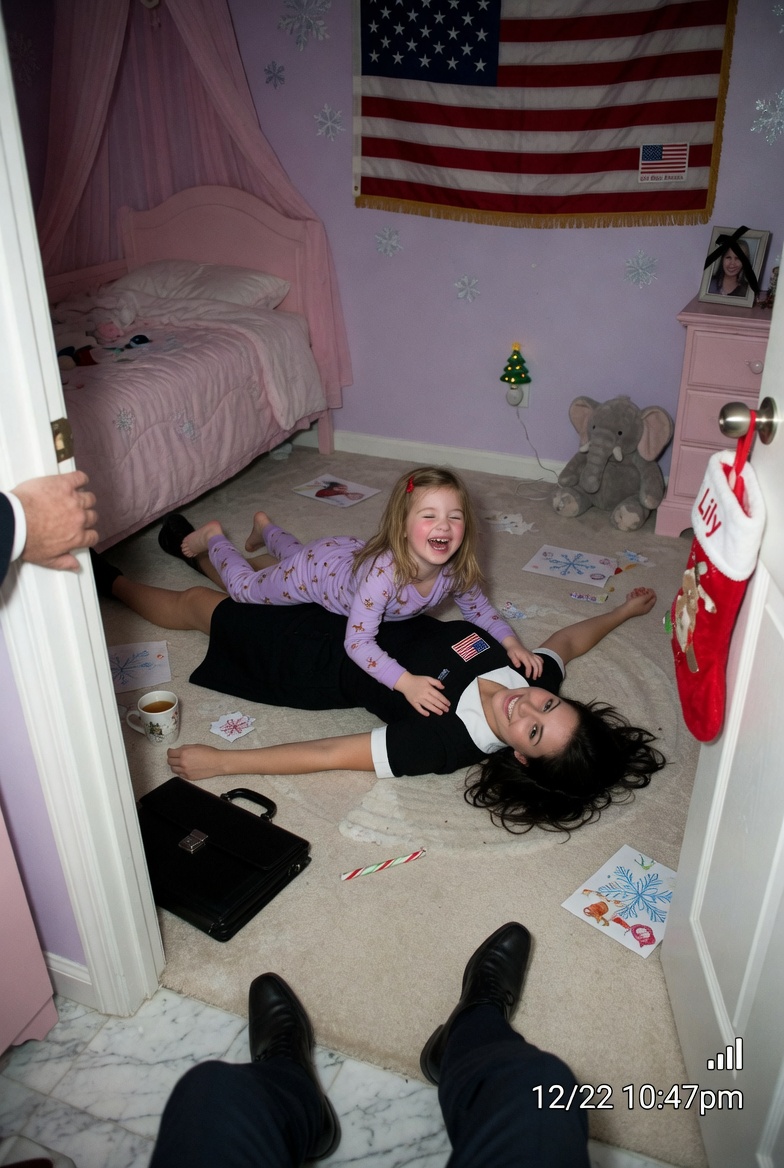
Part 2 – The Night I Broke Everything
That night, I didn’t sleep.
I sat in the dark living room, the half-empty whiskey glass sweating on the marble table. Upstairs, Lily had fallen asleep in Sofia’s arms. I’d watched through the crack in the door as Sofia gently laid her in the crib, humming a song I didn’t recognize.
Then Sofia walked past me without a word. She went to her small room behind the kitchen. The door clicked shut.
And I sat there, drowning in a feeling I couldn’t name.
Fear.
Not for Lily. She had laughed. She had moved. She had said “Daddy.”
For the first time in eighteen months, I had proof that my daughter wasn’t gone forever.
So why did I feel like the ground was disappearing?
Because Sofia had done what I couldn’t.
Because I was the father. The billionaire. The man who paid for everything. And yet, a woman who cleaned toilets had reached my child in ways I never could.
That thought ate through me like acid.
By 3 a.m., I had made a decision.
It was the wrong one.
But fear doesn’t care about right or wrong. Fear only cares about control.
Part 3 – The Firing
Morning came gray and cold.
I found Sofia in the kitchen, wiping down the counters. Lily was still asleep. The house was quiet again, but the silence felt different now. Charged. Like the moment before a thunderstorm.
I stood in the doorway, arms crossed. My suit was still from yesterday. I hadn’t shaved.
Sofia looked up. Her eyes were soft. Kind. That made it worse.
— “Good morning, Mr. Harrison,” she said. “Can I make you coffee?”
— “No.”
She paused, dishrag in hand. The clock ticked above the stove.
— “I’ve been thinking,” I said. My voice sounded strange. Flat. “About last night.”
She nodded slowly. “Lily did so well. She’s ready to—”
— “You’re fired.”
The words landed between us like stones.
Sofia’s hand stopped moving. She stared at me. Not angry. Not crying. Just… confused.
— “I don’t understand,” she said.
— “You crossed a line.” I heard how ridiculous that sounded even as I said it. “You’re hired to clean. Not to… not to do… whatever that was.”
— “Mr. Harrison, I was just—”
— “You were on the floor.” My voice rose. “With my daughter. Without my permission. You took advantage of—”
— “Of what?” Sofia’s voice didn’t shake. That surprised me. “Of a child who hasn’t moved in a year and a half? Of a father who works sixteen hours a day and never sits on the floor with her? I didn’t take advantage of anything. I sat with her. That’s all.”
The truth in her words cut deeper than any insult.
— “Pack your things,” I said. “You have one hour.”
She set down the rag. Very slowly. Then she untied her apron and folded it neatly on the counter.
— “Lily needs you,” she said quietly. “Not your money. Not your specialists. You.”
— “Get out.”
She walked past me. Her shoulder didn’t brush mine. She left no trace.
Except the folded apron.
And the silence that followed was worse than anything before.
Part 4 – The Morning After
Lily didn’t laugh that day.
She didn’t cry, either. She just sat by the window again. The stuffed elephant was back in her arms. Her eyes were open, but they weren’t looking at anything.
I hired a new nanny within four hours. A woman with credentials. Certifications. References three pages long.
Her name was Patricia. She had a degree in early childhood development from an American university. She spoke perfect English. She wore beige cardigans and smelled like antiseptic.
— “I’ll have Lily walking in six weeks,” Patricia said on her first day.
I believed her. Because I wanted to believe.
That night, I stayed home. I sat in Lily’s room. Patricia had placed colorful mats on the floor and arranged toys in a precise semicircle.
Lily ignored everything.
— “Sweetheart,” I said, kneeling beside her. “Daddy’s here.”
She turned her face toward the wall.
— “Can you look at me?”
Nothing.
— “Please, baby. Just one look.”
Her fingers tightened around the elephant’s ear. That was all.
I stayed for two hours. Then three. The whiskey called my name from downstairs, and eventually, I answered.
At midnight, I stood in the kitchen and poured a glass. The folded apron was still on the counter. I hadn’t moved it.
I thought about Sofia’s hands. How gentle they looked when she touched Lily’s hair. How she never forced anything. How she just… stayed.
I thought about her last words: “Lily needs you.”
I drank until I couldn’t think anymore.
Part 5 – Seven Days of Collapse
The week that followed was a slow-motion disaster.
Patricia tried everything. She used flash cards. She used musical toys. She used a therapy ball and a vibrating pillow and something called “tactile integration brushes.”
Lily didn’t respond.
Not a glance. Not a sound. Not a single movement beyond breathing and blinking.
On day three, Patricia sat me down in the study.
— “Mr. Harrison, I need to be honest with you.” Her voice was clinical. “Your daughter is exhibiting signs of severe dissociative withdrawal. This isn’t a motor problem. It’s a trust problem. Someone broke her trust, and now she doesn’t believe the world is safe.”
— “Her mother died in front of her,” I said. “A car accident. Lily was in the back seat. She saw everything.”
Patricia’s face softened for a fraction of a second. Then the professional mask returned.
— “Then she needs someone she trusts. Not a therapist. Someone who will sit with her in the pain. Not try to fix it.”
I knew who she was describing.
I didn’t say her name.
On day five, I fired Patricia.
On day six, I called three more specialists. Two were booked for months. The third came for a consultation, spent an hour with Lily, and told me gently that she couldn’t help unless Lily “participated.”
“She’s three years old,” I said. “She’s not refusing to participate. She’s terrified.”
— “Then perhaps you should consider residential care,” the specialist said. “There’s a facility in Switzerland that—”
— “Get out.”
I threw a glass against the wall after she left. The red wine bled down the white paint like a wound.
On day seven, I found myself driving.
I didn’t plan it. My hands just took the wheel. The GPS wasn’t on. But somehow, I ended up in a part of the city I never visited.
The bus station.
The place where Sofia had said she would go if she ever needed to leave.
I parked the car and sat there for twenty minutes. The rain started. A thin, cold rain that matched everything inside me.
Then I saw her.
Sofia sat on a bench near the departures gate. A duffel bag at her feet. Her coat was thin. Her hands were wrapped around a paper cup. She wasn’t looking at her phone. She was looking at nothing.
She had been there for seven days.
Because she had nowhere else to go.
My chest caved in.
I got out of the car. The rain soaked through my suit in seconds. I walked toward her. Each step felt like pushing through concrete.
She saw me before I reached her. Her eyes widened. Then she looked down at her cup.
I stopped two feet away. The rain fell between us.
— “Sofia.”
— “Mr. Harrison.” Her voice was quiet. Not cold. Just tired. “How did you find me?”
— “I didn’t. I just… drove.”
She nodded slowly. “How’s Lily?”
I opened my mouth. Nothing came out. The truth was too heavy.
— “She stopped again,” I finally said. “Completely. Won’t move. Won’t look at me. Won’t eat unless someone puts the spoon in her hand.”
Sofia closed her eyes. A single tear mixed with the rain on her cheek.
— “I’m sorry,” she whispered.
— “Don’t be sorry.” I sat down on the bench beside her. The wet wood soaked through my trousers. I didn’t care. “I’m the one who should be sorry. I fired you because I was scared. Because you did something I couldn’t. Because I’ve spent eighteen months hiding behind money and specialists and whiskey, and you just… lay down on the floor.”
Sofia didn’t answer.
— “She needs you,” I said. The words scraped my throat. “And I need you to teach me how to be her father again.”
She turned her head. Looked at me. Really looked. The way Lily used to look at me before everything broke.
— “I can’t do it for you,” Sofia said. “I can sit with her. I can show you what I do. But you have to be the one she trusts. Not me. You.”
— “I know.”
— “And you have to fire the version of yourself that thinks money fixes everything.”
I almost laughed. Almost cried. Both got stuck somewhere in my chest.
— “I’m trying,” I said.
Sofia picked up her duffel bag. Stood. The rain had stopped as suddenly as it started.
— “Then let’s go home,” she said.
She said “home.”
Not “your house.”
Home.
Part 6 – The Return
We drove back in silence.
Sofia sat in the passenger seat. Her duffel bag on her lap. She didn’t turn on the radio. She didn’t ask questions. She just watched the wet streets pass by, and every few blocks, she glanced at me like she was making sure I was still there.
When we pulled into the driveway, she paused before getting out.
— “Before we go inside,” she said, “I need you to understand something.”
— “What?”
— “The first time I lay down on the floor with Lily, it wasn’t a strategy. I wasn’t trying to fix her. I was just tired. So tired that I couldn’t stand anymore. And I thought, if I’m going to be on the floor, maybe she doesn’t have to be alone there.”
I gripped the steering wheel.
— “You didn’t see her as a problem,” I said. “You saw her as a person.”
— “That’s all any of us want,” Sofia said. “To be seen as a person. Not a project. Not a diagnosis. Not a broken thing to be repaired.”
She opened the car door. The cold air rushed in.
— “Are you ready to get on the floor with her?” she asked.
I thought about my suit. My meetings. My reputation. The board of directors who expected me to be unshakable.
Then I thought about Lily. Sitting by the window. Hugging an elephant. Waiting for someone to lie down beside her.
— “Yes,” I said. “I’m ready.”
Part 7 – The Floor
We walked upstairs together.
The door to Lily’s room was closed. I could hear the new nanny—her name was Diane, the fourth one in a week—humming something tuneless on the other side.
I opened the door.
Diane looked up from her phone. She was sitting in the rocking chair, ten feet away from Lily. The toys were still in their perfect semicircle. Untouched.
— “Mr. Harrison, I was just—”
— “You can go,” I said. “I’ll take it from here.”
Diane frowned but didn’t argue. She gathered her bag and left. The door clicked shut.
Sofia stood beside me. She didn’t move toward Lily. She waited.
Lily sat in her usual spot. Back against the wall. Knees pulled up. Elephant clutched to her chest. Her face was blank. But her eyes… her eyes flickered when she saw Sofia.
Just a flicker. A tiny spark in all that darkness.
— “Now,” Sofia said quietly. “Watch.”
She walked to the center of the room. Slowly. Deliberately. Then she sat down. Then she lay back. Flat on the carpet. Arms spread. Legs straight.
She made a snow angel.
No words. No coaxing. No “Lily, come here” or “Look what I’m doing.”
Just presence.
I held my breath.
For a long time, nothing happened. The seconds stretched into minutes. Lily didn’t move. Sofia didn’t move. The only sound was the wind against the window.
Then Lily’s fingers loosened on the elephant.
Just a little.
Her head turned. One inch. Two inches. She was looking at Sofia.
Not at me. At Sofia.
And then—
Lily pushed herself off the wall.
Her arms trembled. Her legs scraped against the carpet. She didn’t stand. She crawled. One hand. One knee. One hand. One knee.
It took her almost two minutes to cover the six feet between the wall and Sofia.
But she did it.
She crawled to Sofia. And then she lay down. On top of Sofia’s chest. Her small face pressed into Sofia’s neck.
Sofia wrapped her arms around Lily. Gently. Not squeezing. Just holding.
And Lily sighed.
A deep, whole-body sigh. Like she had been holding her breath for eighteen months and finally let it go.
I sank to my knees. The tears came. I didn’t wipe them away.
— “Daddy’s here,” I whispered. “Daddy’s here, baby.”
Lily didn’t look at me. But her hand reached out. Her small fingers stretched toward my direction.
I crawled to them. I lay down on Sofia’s other side. The three of us on the floor. A snow angel, a broken father, and a little girl who was learning to trust again.
We stayed like that for an hour.
No one spoke.
Nothing was fixed.
But something had shifted.
Something had begun.
Part 8 – The First Steps
The weeks that followed were not a montage.
They were hard. Exhausting. Full of setbacks and tears and moments when I wanted to scream.
Sofia taught me something every day.
She taught me that you don’t force a child to make eye contact. You sit near them. You read aloud. You let them come to you.
She taught me that touch should never be a demand. You offer your hand. You wait. If they don’t take it, you don’t pull away. You just stay.
She taught me that healing happens in the quiet moments. Not in the big breakthroughs. In the small ones.
Like the first time Lily reached for my hand.
It was day four after Sofia’s return. I was sitting on the floor, reading a picture book about a rabbit who lost his mother. My voice cracked on the sad parts. I didn’t hide it.
Lily was three feet away. Her back against the wall. Elephant in her lap.
I read the line: “And even though the rabbit couldn’t see his mother anymore, he felt her love in the warmth of the sun.”
Lily’s hand moved.
Slowly. Uncertainly. Her fingers stretched across the carpet.
I stopped reading. I didn’t move. I didn’t even breathe.
Her fingers touched mine.
Just the tips. Just for a second.
Then she pulled back.
But she had reached.
I looked at Sofia, who was sitting by the door. She had tears in her eyes. She nodded once.
I kept reading.
The next day, Lily took my whole hand.
The day after that, she pulled herself up using the windowsill.
She didn’t walk. Not yet. But she stood. For three seconds. Her legs shook. Then she sat back down.
Three seconds.
It felt like a lifetime.
Part 9 – The Conversation I Feared
One night, after Lily had fallen asleep, Sofia and I sat in the kitchen.
The house was quiet. Not the heavy silence of before. A soft silence. The kind that feels like a blanket.
I had stopped drinking. Thirty-seven days sober. I didn’t talk about it. I just didn’t pour the whiskey anymore.
Sofia was making tea. She moved around the kitchen like she belonged there. Because she did.
— “Can I ask you something?” I said.
She nodded, pouring hot water into two mugs.
— “Why didn’t you leave? When I fired you. Why did you stay at the bus station for seven days?”
She set the kettle down. Took her time answering.
— “Because I made a promise,” she said.
— “To who?”
— “To myself.” She looked at me. “When I dropped out of university, I promised that I would never give up on someone who needed me. My mother needed me. So I stayed. Lily needed me. So I stayed. Even when you told me to go.”
— “That’s not healthy,” I said. “Staying where you’re not wanted.”
— “Maybe.” She shrugged. “But it’s who I am. And in the end, you came back. So maybe it wasn’t stupid. Maybe it was just… patient.”
I stared at the steam rising from my tea.
— “I was cruel to you,” I said. “I’m sorry doesn’t cover it.”
— “No,” Sofia agreed. “It doesn’t. But sitting on the floor with Lily every day does. Watching you learn to be gentle does. Watching you fail and try again does.”
She sat across from me. Wrapped her hands around her mug.
— “I’m not here because I forgive you,” she said. “I’m here because Lily deserves two people who won’t give up on her. Forgiveness takes time. Like walking. Like trust.”
I nodded. The word “thank you” felt too small. So I didn’t say it. I just sat there, drinking tea with a woman who had every right to hate me.
And somehow, that silence was enough.
Part 10 – The Rehabilitation Center in Querétaro
Three months later, we traveled to Querétaro.
A specialist there had agreed to evaluate Lily. Not to fix her—we had stopped trying to “fix” her. But to confirm what we already suspected.
Her body was fine.
Her brain was fine.
She had been protecting herself. And now, slowly, she was coming out of hiding.
The center was a low white building surrounded by jacaranda trees. Purple flowers carpeted the ground. Lily held my hand as we walked inside. Her grip was tight. But she was walking.
She had taken her first real steps two weeks before the trip. Four steps. From the windowsill to Sofia’s outstretched arms. Then she collapsed. Sofia caught her. Lifted her up. Spun her around.
Lily laughed.
The first laugh since the snow angel.
I recorded it on my phone. I’ve watched that video over a hundred times.
At the center, doctors ran tests. They asked questions. They observed Lily playing with blocks and looking at picture cards.
The lead doctor, a woman named Dr. Reyes, sat me down in her office. Sofia sat beside me. I had asked her to be there.
— “Mr. Harrison,” Dr. Reyes said, “your daughter has no physical or neurological impairment. Her motor skills are age-appropriate. Her cognitive function is excellent. The issue was never medical.”
— “What was it?” I asked, even though I already knew.
— “Traumatic withdrawal.” Dr. Reyes leaned back. “She witnessed her mother’s death. Her mind made a decision: if I don’t move, if I don’t speak, if I don’t engage, then nothing bad can happen to me again. It was a survival mechanism.”
— “So why is she walking now?” Sofia asked.
Dr. Reyes looked at both of us. A small smile.
— “Because someone convinced her that the world is safe again. Not through therapy. Through presence. Through patience. Through love that didn’t demand anything from her.”
She paused.
— “You didn’t cure her. You earned her trust. And that is infinitely harder.”
I reached over and took Sofia’s hand under the table. She didn’t pull away.
Part 11 – The First Sentence
It happened on a Tuesday.
No special reason. The sun was out. Lily was sitting at the small table in the kitchen, coloring. Sofia was making lunch. I was working on my laptop at the counter.
The house felt normal. Alive. There was music playing—something soft with a guitar.
Lily put down her crayon. She looked at Sofia. Then at me. Then back at Sofia.
— “Sophy.”
Her voice was small. Scratchy. Like someone learning to use an instrument after years of silence.
Sofia froze. The spatula in her hand hovered over the pan.
— “What did you say, mi amor?” Sofia whispered.
— “Sophy.” Lily pointed at her. Then she pointed at me. “Daddy.”
— “Yes, baby,” I said. My voice broke. “That’s Daddy. And that’s Sofia.”
Lily shook her head. She pointed again. First at Sofia. Then at me. Then she pressed her tiny hands together, fingers interlaced.
Like she was putting us together.
Sofia let out a sound—half laugh, half sob.
— “Lily, what are you trying to say?”
Lily looked at her drawing. It was a mess of purple and yellow. But in the middle, there were three figures. One small. One medium. One taller.
She pointed to the tall one. “Daddy.”
The medium one. “Sophy.”
The small one. “Lily.”
Then she looked up at us with those big eyes that had been empty for so long.
— “Family.”
One word.
One impossible, beautiful, heart-shattering word.
I crossed the kitchen in two steps. I picked her up. I held her so tight that she squirmed and laughed.
— “Family,” she said again, giggling. “Family, family, family.”
Sofia wrapped her arms around both of us. The eggs burned on the stove. Neither of us cared.
We stood there in the smoke-filled kitchen, three people who had found each other in the wreckage.
And for the first time in almost two years, I believed that we might be okay.
Part 12 – The Proposal (Not What You Think)
People always ask if Sofia and I ended up together.
The answer is yes. But not in the way they expect.
A year after Lily spoke her first word, I asked Sofia to become Lily’s legal guardian.
Not her mother. Not my wife. Her guardian.
We were sitting on the back porch. Lily was asleep inside. The stars were out. Sofia was knitting something—a scarf for Lily’s stuffed elephant.
— “I’ve been talking to a lawyer,” I said.
Sofia’s needles paused. “About what?”
— “About what happens if I die.”
She looked at me sharply. “Don’t say that.”
— “I have to. I’m not young. And Lily can’t go to my relatives. They’re strangers to her. She needs someone she trusts.”
Sofia set down the knitting.
— “You’re asking me to be her legal guardian?”
— “I’m asking you to be her family. On paper. So that no one can take her away from you.”
She was quiet for a long time. The crickets filled the silence.
— “I don’t have money,” she finally said. “I don’t have a degree. I don’t have—”
— “You have her trust.” I leaned forward. “That’s the only thing that matters. The money is mine. The house is mine. None of that means anything without her. You gave her back to me, Sofia. You. Not the doctors. Not the specialists. You.”
Her eyes glistened.
— “I was just the maid,” she whispered.
— “You were never just anything.”
She reached over and took my hand. Her fingers were calloused from cleaning. From cooking. From holding on when everything told her to let go.
— “Yes,” she said. “I’ll be her guardian. But on one condition.”
— “Name it.”
— “You go back to the floor.” She smiled. “Every night. Ten minutes. No phones. No work. Just you and Lily on the carpet. Making snow angels.”
I laughed. For the first time in years, a real laugh.
— “That’s not a condition,” I said. “That’s the best part of my day.”
Part 13 – The Letter We Never Sent
A year and a half after the snow angel, I found something in Sofia’s room.
She had moved out of the small room behind the kitchen. I had given her the guest bedroom overlooking the garden. It had a window seat and a view of the oak tree.
I was looking for an old photo album. Instead, I found a letter.
Handwritten. Folded in thirds. Tucked inside a book of poetry.
It was addressed to “Lily” and dated the same week I had fired Sofia.
This is what it said:
Dear Lily,
Your dad told me to leave today. He’s scared. Not of you. Of himself. He doesn’t know how to love without fixing. But you already know that, don’t you?
I’m writing this because I might not see you again. And there’s something I need you to know.
You are not broken.
You are not a problem to be solved.
You are a little girl who saw something terrible, and your heart decided to hide until it felt safe again. That’s not weakness. That’s wisdom.
I don’t know if I’ll ever come back. But if I don’t, I want you to remember: someone saw you. Not the silence. Not the wheelchair. Not the diagnosis. You.
I saw you.
And I will carry the sound of your laugh in my chest for the rest of my life.
Be patient with your dad. He’s learning.
And if you ever learn to walk again, walk toward the light. Not away from the dark.
With all my heart,
Sofia
I sat on her bed and read the letter three times.
Then I walked downstairs. Sofia was in the living room, reading a story to Lily. Lily sat in her lap. Her legs dangled over the arm of the chair. She was wearing shoes—real shoes with laces that she had learned to tie the week before.
I leaned against the doorframe.
— “I found your letter,” I said.
Sofia looked up. Her face went pale.
— “I never sent it,” she whispered.
— “I know.”
Lily looked between us, confused. “Daddy sad?”
I shook my head. “No, baby. Daddy’s grateful.”
I walked over and knelt beside the chair. I took Sofia’s hand. I kissed Lily’s forehead.
— “Can I keep the letter?” I asked Sofia. “For when she’s older?”
Sofia nodded. Tears slid down her cheeks.
— “I meant every word,” she said.
— “I know.”
Lily reached out and wiped Sofia’s tears with her small thumb.
— “No cry, Sophy,” she said. “Family.”
Sofia laughed through the tears. She pulled Lily closer.
And I sat on the floor beside them. Right where I belonged.
Part 14 – The Graduation
Two years later, Sofia finished her physiotherapy degree.
She had enrolled in an online program. I paid for it. She didn’t ask me to. I just did.
On graduation day, we drove to the university in Monterrey. Lily wore a yellow dress and new white shoes. She held a sign she had made herself: “SOPHY DID IT!”
Sofia walked across the stage in a black cap and gown. Her mother was there too—the one who had suffered the stroke. She was in a wheelchair, but she was alive. She was smiling.
After the ceremony, Sofia found me in the crowd. She hugged me so hard I couldn’t breathe.
— “Thank you,” she whispered.
— “You did this,” I said. “Not me.”
She pulled back. Looked at Lily, who was twirling in circles, making her yellow dress spin.
— “No,” Sofia said. “She did this. She reminded me why I wanted to help children in the first place. Because every child deserves someone who won’t give up on them.”
Lily ran over and grabbed both our hands.
— “Sophy, Daddy, look!” She pointed at the sky. A balloon had escaped from someone’s grip and was floating up, up, up.
— “It’s going to heaven,” Lily said. “To Mama.”
I felt my throat close.
Sofia squeezed my hand.
— “Yes, baby,” Sofia said softly. “To Mama.”
Lily waved at the balloon until it disappeared.
Then she took off running across the grass. Her legs pumped hard. Her shoes kicked up green. She was laughing.
She was running.
The girl who couldn’t walk.
The girl who couldn’t speak.
The girl who had hidden inside herself for eighteen months.
She was running.
And Sofia and I stood side by side, watching her, two broken people who had somehow become whole.
Not because of money.
Not because of medicine.
Because someone lay down on the floor.
Because someone refused to give up.
Because hope doesn’t always arrive making noise.
Sometimes, it lies on the ground and makes snow angels until a broken heart remembers how to laugh again.
Epilogue – Snow Angels in July
It’s summer now.
Lily is five years old. She runs. She jumps. She talks so much that sometimes I miss the silence.
Sofia lives with us. She has her own practice now—a small clinic for children who can’t afford expensive therapy. She sees patients three days a week. The other days, she’s home.
We never got married. People ask why. The answer is simple: we don’t need a piece of paper to know what we are.
We’re a family.
Not because of blood. Not because of obligation. Because we chose each other.
Every night, after dinner, the three of us go to Lily’s room. We push the furniture aside. We lie on the carpet. We make snow angels.
Even in July.
Even when it’s ninety degrees outside.
Lily insists.
— “Snow angels make Mama happy,” she says.
So we make snow angels.
And somewhere, I believe, her mother is watching.
And smiling.
Because her little girl is walking.
Because her little girl is laughing.
Because her little girl is loved.
The End