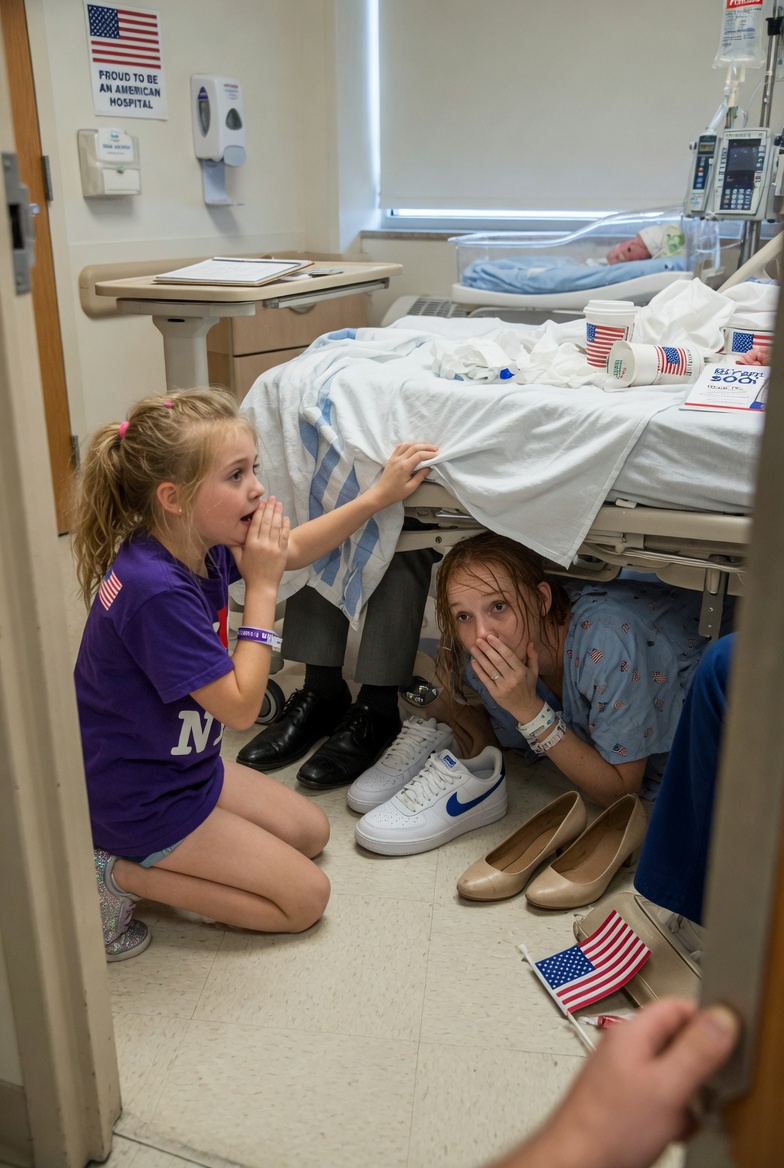
Part 2: I pressed my palm to my mouth so hard my teeth left marks. The cold seeped through the thin hospital gown, through my skin, all the way into the marrow of my bones. Above me, the mattress dipped slightly as someone leaned against the bed frame. I could smell Linda’s perfume—roses and something chemical, a scent that had always made my stomach turn at family dinners. Now it made my throat close.
— Doctor, she should be ready now. Postpartum patients can deteriorate so quickly.
The man with the silver watch cleared his throat. His voice was smooth, practiced, the kind of voice that explained complicated procedures to terrified families without ever actually saying anything.
— Indeed. The consent forms are all in order. We’ll need to move quickly once the medication is administered. The reaction should appear entirely natural—a sudden embolism, perhaps. Tragic, but not uncommon.
My vision blurred. Not from tears. From pure, undiluted terror. They weren’t just talking about hurting me. They were scripting my death like a scene in a play. A tragic, unavoidable loss. A grieving husband. A comforting grandmother stepping in to help raise the children. The narrative was already complete. I just wasn’t supposed to be alive to hear it.
A soft squeak of shoes on linoleum. The nurse with the blue-striped sneakers spoke, her voice smaller, tighter.
— Doctor, I reviewed her chart this morning. Her vitals were perfectly stable. No underlying conditions. This protocol… is it really necessary?
Silence. The kind of silence that pulls the air out of a room. I watched the nurse’s feet shift backward half an inch.
— Nurse Patterson, the doctor said, his tone dropping to something cold and surgical, you’ve been with us for three months. You’re still in your probationary period, correct?
Another pause. Then, quietly:
— Yes, doctor.
— Good. Then you understand that your observations are noted but not actionable. Prepare the IV drip. I’ll handle the family.
The white sneakers didn’t move for a long moment. I saw them tremble—actually tremble—and for a heartbeat I thought she might refuse. I thought someone in this room might choose to be human. Then they turned and walked toward the door.
My last hope walked out on blue-striped rubber soles.
Linda exhaled, a sound of theatrical relief.
— I do apologize for the dramatics. My son has no idea, of course. He’s far too gentle for these kinds of decisions. That’s why I handle the difficult things.
— Your son signed the initial intake forms, the doctor said. That’s legally sufficient. Combined with the patient’s signature, there’s no liability.
— Good. Because I want this finished before Mark returns from his call. He’ll be emotional, but he’ll recover. He always does. And those children… well, they need stability, don’t they? A mother who almost died during childbirth makes for a very touching story. A stepmother who thrives in the aftermath? Even better.
She was already planning her replacement. A new wife. A compliant daughter-in-law who wouldn’t bring baggage or ask questions. The thought made bile rise in my throat, hot and bitter, and I had to clamp my jaw shut to keep from making a sound.
Emily was still standing beside the bed. I could see her small feet in their rainbow socks, planted firmly on the cold floor. She hadn’t moved an inch. My eight-year-old child, surrounded by adults conspiring to end her mother’s life, and she stood there like a stone pillar while I cowered beneath a mattress.
Shame burned through the terror. Not the shame of hiding—I would hide in a thousand beds to stay alive for her—but the shame of not seeing this coming. The shame of trusting polite smiles and holiday dinners. The shame of believing that evil needed to look like a monster, when in reality it wore pearl earrings and asked if you’d gained weight.
— Where is the patient? the doctor asked suddenly.
I felt the air shift as they all looked toward the empty bed.
Linda’s voice sharpened.
— Emily, sweetheart, where did your mother go?
My daughter’s feet didn’t move. When she spoke, her voice was small but steady, the way a candle flame stays lit in a storm.
— She isn’t here.
— What do you mean? Linda stepped closer, her beige heels clicking with impatience.
— My mom went to the bathroom.
— That’s impossible, the doctor snapped. She delivered three hours ago. She’s on strict bed rest. She wouldn’t be allowed to—
The door swung open with enough force to hit the wall.
A pair of scuffed brown loafers stopped in the doorway. Mark’s shoes. I’d bought them for his birthday two years ago, when we still laughed together, when his mother was just a difficult relative and not a woman planning my funeral.
— Allowed to what?
Silence crashed down like a wave. I saw Linda’s heels pivot sharply.
— Oh, Mark, darling. We were just checking on—
— Why is there a doctor in here talking about consent forms? Mark’s voice was tight, confused, but not yet angry. Not yet. I just spoke to the nurse’s station. They said Sarah hasn’t been cleared for anything. What forms?
The doctor’s polished Oxfords shifted an inch. Regrouping.
— Mr. Reynolds, I’m sure there’s been a misunderstanding. Your wife signed the standard postpartum care waivers earlier this morning. We were simply reviewing—
— She was barely conscious this morning. She signed things, sure. I was standing right there. But those were admission forms. Not consent for additional procedures. What procedure are we talking about?
Linda laughed, a brittle, sparkling sound.
— Mark, you’re always so serious. The doctor was just explaining some precautionary measures. Nothing to worry about.
— Then why did the nurse at the station look terrified when I mentioned this room? Why did she say she wasn’t authorized to discuss my wife’s case with me?
The white sneakers—Nurse Patterson—reappeared in the doorway. She’d come back. Something had pulled her back. Maybe the sound of Mark’s voice. Maybe the last ember of a conscience that Linda Reynolds hadn’t managed to extinguish.
— Sir, the nurse said, her voice shaking like a plucked wire, I need to tell you something. I was instructed to prepare a medication that isn’t on your wife’s chart. When I asked why, I was told to stay in my lane or find a new career.
Mark’s feet took two heavy steps toward the doctor.
— Is that true?
— This is highly irregular, the doctor said, his tone climbing into indignation. I don’t answer to nurses. And I certainly don’t answer to—
Emily dropped to her knees and lifted the bed skirt. Light flooded under the bed, harsh and fluorescent, and I saw my daughter’s face streaked with tears she hadn’t let fall until that moment.
— Dad. Mom is under here because Grandma is trying to hurt her.
Everything stopped.
Mark knelt slowly, the way a man kneels when the world has just cracked open and he’s trying not to fall in. His face appeared in the gap beneath the sheet, and our eyes met.
His were wide with confusion, searching my face for an explanation that would make this all a joke. A strange game. A misunderstanding.
My face must have told him everything, because the color drained from his cheeks like water from a broken glass.
— What? he whispered.
I couldn’t speak. My throat had locked tight, clamped around all the words I should have said months ago. Years ago. Every time she’d made a cutting remark and he’d said, “That’s just how she is.” Every holiday I’d spent dreading her arrival and smiling anyway. Every night I’d lain awake wondering why his mother’s hatred felt like a threat instead of just an annoyance.
I hadn’t been paranoid. I’d been perceptive.
And I’d almost died for the crime of convincing myself otherwise.
Mark’s hand reached under the bed, trembling, and I grabbed it. His fingers closed around mine with a grip so tight it hurt, but the pain was grounding. It was real.
— Someone explain this right now, he said, and his voice had changed. The confusion was gone. In its place was something harder, something I’d never heard from him before. Something almost like courage.
Linda stepped forward, her heels clicking.
— Mark, this is absurd. Emily is a child. She had a nightmare. Sarah is clearly unwell—postpartum psychosis is a real condition, you know. She’s crawled under a bed, for heaven’s sake. This is not the behavior of a stable mother.
The doctor seized the lifeline.
— I’ve seen this before. Hormonal shifts after delivery can trigger paranoid episodes. The patient may believe she’s in danger when she’s perfectly safe. We should call psychiatric services immediately.
Emily’s voice cut through like a blade.
— You’re lying. Both of you. I heard Grandma say on the phone that everything would be “taken care of” today. She said Mommy wouldn’t be a problem anymore. She was talking to you—she pointed a trembling finger at the doctor’s silver watch—and she told you to make it look like something natural.
The room went deadly still.
You could hear the fluorescent lights buzzing overhead. A distant intercom paging a different doctor to a different room. The muffled cry of a newborn from somewhere down the hall.
Mark looked from Emily to his mother, and something in his face collapsed. Not just anger. Recognition. The terrible, belated recognition of a son who had spent decades making excuses for the woman who raised him, only to discover that the monster under the bed was never under the bed at all.
It was standing in the doorway, wearing his mother’s face.
— Mom? His voice cracked. Tell me she’s wrong. Tell me right now.
Linda’s mask didn’t slip so much as dissolve. One moment she was the concerned grandmother, the bewildered mother-in-law. The next, her expression hardened into something cold and calculating, the way ice hardens over a pond so smoothly you don’t see the cracks until you’re already underwater.
— I have been telling you for six years that this woman was a mistake. I have been telling you that she was dragging you down, that those children would be the end of your career, your future, your relationship with your real family. But you never listened. You never listen.
— What did you do?
— What needed to be done. What you were too weak to do yourself. She was going to leave you eventually, Mark. They always do. Better that she leave this world as a tragic memory than as another ex-wife collecting your paycheck. At least this way, you’d have been the grieving widower. Sympathy. Support. A clean break.
Mark stood up so fast his shoes scraped against the floor. I saw him take a step toward his mother, and for a terrible moment I thought he might do something he couldn’t take back. But Nurse Patterson was faster.
She ran into the hallway and screamed for security at the top of her lungs.
What happened next was a blur of uniforms and shouting and Mark’s voice calling my name over and over as hands reached under the bed to help me out. I remember the sting of the fluorescent lights after the darkness. I remember the shocked faces of the hospital staff gathering in the doorway. I remember Emily wrapping her arms around my waist and burying her face in my gown, her whole body shaking with sobs she’d held in for what must have felt like a lifetime.
And I remember Linda’s eyes meeting mine as two security guards took her by the arms.
There was no remorse in those eyes. No guilt. No fear. Just cold, seething fury—the fury of a woman who had planned something so carefully, who had waited so patiently, only to be undone by an eight-year-old girl with rainbow socks.
— You’ll regret this, she said, and her voice was as calm as when she’d told the doctor I should be ready.
I didn’t answer. I couldn’t. My throat was still a locked door. But I held her gaze as they led her out, and I let my silence say what my voice couldn’t.
I already regretted everything. Every family dinner. Every forced smile. Every moment I’d let her into my home, into my life, into my children’s lives. The regret was already a mountain. Her threat was just another stone.
The security team cleared the room. The doctor with the silver watch attempted to leave with them, his face a mask of professional outrage, but Mark blocked the doorway.
— Where do you think you’re going?
— This is a misunderstanding, the doctor said. I was following the patient’s signed consent forms. If there’s been a forgery, that’s a legal matter, not a medical one.
— You were going to inject my wife with something that would make her death look like an embolism. I heard you. My daughter heard you. So sit down, shut up, and wait for the police like the pathetic excuse for a human being you are.
The doctor’s mouth opened and closed. Then he sat in the visitor’s chair, his silver watch glinting under the lights, and he didn’t speak again for a very long time.
The police arrived within ten minutes. Two officers, one younger and one older, both wearing the careful, neutral expressions of people trained to walk into chaos and make sense of it. The older one, a woman with gray-streaked hair and a voice like gravel, knelt beside my bed while I sat propped against pillows that suddenly felt like the only solid things in the universe.
— Ma’am, my name is Detective Alvarez. I need you to tell me what happened. Every detail you can remember. Take your time.
I looked at Emily, who hadn’t let go of my hand. Her fingers were still cold. They’d been cold for almost an hour now, ever since she’d pressed them against my wrist and begged me to hide.
— My daughter saved my life, I said. My voice came out as a croak, rough and unfamiliar, like an old machine starting up after years of disuse. She heard my mother-in-law conspiring with a doctor to end my life. She told me to hide under the bed. I did. And then I listened to them plan my death like they were ordering lunch.
Detective Alvarez nodded, her pen moving steadily across a small notebook. She didn’t look surprised. That was the worst part. She looked like someone who had heard stories like this before.
— And your relationship with your mother-in-law? Was there a history of conflict?
— She hated me. From the beginning. She blamed me for Mark leaving his corporate job. She hated that I already had Emily from my first marriage. She said I was a “package deal” her son didn’t need. When I got pregnant again, she called it a “strategic mistake.”
— Did you ever feel physically threatened before today?
I thought about all the small moments. The way she’d stand too close during arguments, her finger jabbing the air an inch from my face. The way she’d “accidentally” trip and spill hot coffee on my shirt at family gatherings. The way she’d joke about how easy it would be to “make someone disappear” if you knew the right people. Jokes, always jokes. The kind of jokes that make you uncomfortable but not scared—until you realize they were never jokes at all.
— I thought she was just cruel. I didn’t think she was capable of… this.
— Most people don’t, the detective said quietly. The dangerous ones don’t wear signs.
The younger officer interviewed Emily in the corner of the room. I watched my daughter answer his questions with a composure that broke my heart. She didn’t cry. She didn’t stammer. She just told them exactly what she’d heard, exactly what she’d seen, exactly what she’d done.
— I pretended to be playing on my tablet, she said. I was sitting in the hallway outside Mommy’s room because the nurses said I had to wait. But I plugged my headphones in without turning anything on, so it looked like I was listening to something. Grandma Linda didn’t see me. She was on the phone. She said, “Yes, this afternoon. The doctor is ready. Make sure the paperwork is clean.” Then she said, “Once she’s gone, Mark will have no choice but to come home.” She sounded happy.
My stomach turned inside out. She’d been standing in the hallway, invisible, absorbing every word while the adults around her assumed she was just a child glued to a screen. But she hadn’t been distracted. She’d been listening. Watching. Learning.
I had raised a survivor without even realizing it.
The hospital administration arrived shortly after the police. A pale man in an expensive suit introduced himself as the hospital’s legal counsel and began talking about internal investigations and “full cooperation with authorities.” His voice was smooth, practiced, the same kind of voice the doctor had used when he’d discussed my “sudden embolism.”
I didn’t trust him. I didn’t trust anyone in that building anymore.
Mark stood by the window during most of the interviews, his back to the room, his shoulders rigid. Every few minutes, he’d turn around and open his mouth like he wanted to say something, then close it again. His face was a battlefield—shock, rage, guilt, all fighting for control.
When the police finally left, taking the doctor with them in handcuffs, Mark walked over to my bed and sat down heavily in the chair where his mother had stood an hour earlier.
— Sarah, I…
— Don’t.
— I didn’t know. I swear to God, I didn’t know what she was planning.
— But you knew what she was like. You knew how she treated me. You knew she called our child a strategic mistake. And you did nothing.
He flinched like I’d slapped him.
— I thought I was keeping the peace. I thought if I just… managed her… kept things calm… it would be okay. I didn’t think she would ever—
— She almost killed me, Mark. She forged my signature. She hired a doctor to make my death look like a medical complication. She was going to raise our son as her own, find you a new wife, and erase me from existence. And you didn’t think she’d go that far?
— I’m sorry.
— Sorry doesn’t undo the fact that I hid under a bed while your mother discussed the best way to end my life. Sorry doesn’t change the fact that our daughter had to save me because the adults in this room—including my husband—failed to protect me. Sorry is a word. I need more than words right now.
He didn’t have an answer for that. He just sat there, his head in his hands, the weight of his mother’s crimes settling onto his shoulders like a coat made of lead. I looked at him, and I felt something shift inside me—not hatred, exactly, but a cold, clear recognition that the man I’d married, the man I’d trusted, had never truly been on my side. He’d been on the side of least resistance. And when resistance became a matter of life and death, he hadn’t been there.
Emily climbed onto the bed beside me, curling into the space under my arm like she used to when she was a toddler. She didn’t say anything. She just rested her head on my shoulder and breathed slowly, in and out, her small body warm against mine.
— You were so brave, I whispered into her hair.
— I was scared, she whispered back.
— Being brave doesn’t mean you weren’t scared. It means you did the right thing anyway. You saved me, Emmy. You saved me.
She closed her eyes, and for the first time since this nightmare started, I saw the tension in her face begin to ease.
The hospital moved me to a different room later that evening, one with a window and a door that locked from the inside. They brought my son back to me, swaddled in a blue blanket with tiny elephants printed on it, and I held him against my chest and cried until I couldn’t cry anymore.
He was so small. So fragile. So completely unaware that the world he’d entered just hours earlier was full of people who would hurt him just to get to me.
I named him Leo. Leo means lion. I wanted him to carry strength in his name, a reminder that he came into this world through fire and survived.
The days that followed were a whirlwind of lawyers, statements, and reporters. Someone had leaked the story to the press—a nurse, maybe, or one of the officers—and suddenly my face was on every local news channel. “Mother Hides Under Bed to Escape Murder Plot.” “Grandmother Conspires with Doctor.” “Eight-Year-Old Hero Saves Mom from Certain Death.”
The headlines made me sick. They turned my terror into entertainment, my daughter’s trauma into a feel-good story with a happy ending. But the story didn’t feel happy to me. It felt like the aftermath of a bomb going off—rubble and dust and the slow, painful process of figuring out what was still standing.
Mark stayed in the hospital for three days, sleeping on a cot in the corner of my new room. We barely spoke. Every conversation we tried to have circled back to the same dead end—his mother, his choices, his failure to see what was right in front of him.
On the third night, around two in the morning, he broke the silence.
— I should have protected you.
I was nursing Leo in the dim glow of the bedside lamp. The room smelled of baby powder and exhaustion. Outside, the hospital parking lot was quiet, the streetlights casting orange pools on the asphalt.
— Yes, I said. You should have.
— I kept telling myself she wasn’t dangerous. She was difficult, sure. Manipulative. But not dangerous. I thought dangerous meant someone who owned weapons. Someone with a criminal record. Not someone who wore pearl earrings and baked casseroles for the church potluck.
— Danger wears a lot of costumes, Mark. You just have to be willing to see them.
— I didn’t want to see. That’s the truth. I didn’t want to believe my own mother could be a monster. So I closed my eyes and pretended everything was fine and told myself you were being too sensitive.
— And if Emily hadn’t heard that phone call?
The question hung in the air between us, heavy and unanswerable. We both knew what would have happened. The doctor would have administered whatever lethal cocktail Linda had arranged. My death would have been called a tragic postpartum complication. Mark would have grieved, his mother would have comforted him, and within a year or two, Linda would have introduced him to a new woman—someone she approved of, someone she could control.
And Emily? Emily would have known the truth. She would have carried that knowledge for the rest of her life, a secret too heavy for any child to bear alone.
— I can’t fix this, can I? Mark asked.
— I don’t think there’s a version of this story where we go back to normal. The normal we had wasn’t real. It was a house of cards, and your mother just blew it down.
— What do you want to do?
I looked at him—really looked at him—for the first time in days. He was exhausted, unshaven, dark circles under his eyes. He looked like a man who had aged ten years in a week. And I felt something for him, something complicated and sad, but it wasn’t love. Not anymore. Love requires trust, and trust is a fragile thing. Once it shatters, you can glue the pieces back together, but you’ll always see the cracks.
— I want a divorce, I said.
He didn’t argue. He didn’t beg. He just nodded slowly, his jaw tightening, and looked down at his hands.
— I understand.
— It’s not a punishment, Mark. It’s clarity. I can’t be married to someone who couldn’t see a threat until it was almost too late. I can’t raise our children in a home where I have to sleep with one eye open. I need… peace. Simple, clean, uncomplicated peace.
— I’ll give you whatever you want. The house. Full custody. I won’t fight anything.
— I’m not asking you to disappear from their lives. You’re their father, and Emily loves you. But I need space. I need safety. And I need to know that your mother will never be within a mile of my children again.
— I’ll make sure of it. She’s going to prison, Sarah. What she did… there’s no coming back from that.
I wanted to believe him. But I also knew that Linda Reynolds had spent decades learning how to manipulate the world around her. She had money. She had connections. She had a way of making problems disappear.
I wouldn’t feel safe until I saw her behind bars with my own eyes.
The legal process was brutal. Testimony after testimony. Depositions. The hospital’s internal investigation. Linda’s defense team—slick, expensive lawyers who tried to paint me as mentally unstable, Emily as a child with an overactive imagination, the doctor as a rogue actor acting alone.
But the evidence was overwhelming. Nurse Patterson had kept a detailed log of every unusual request the doctor had made regarding my case. The forged consent forms were traced back to Linda’s email account, where she’d sent a digital copy to the doctor with instructions. And Emily, my brave, brilliant daughter, gave a deposition so clear, so detailed, so devastating that the defense attorney eventually stopped asking questions.
The trial lasted three weeks. I sat in the courtroom every single day, watching Linda from the back row. She wore elegant blouses and tasteful jewelry, her silver hair perfectly styled. She looked like someone’s grandmother. She looked like the kind of woman who volunteered at charity events and hosted book clubs.
And when she testified, she lied with the same calm, practiced voice she’d used to plan my death.
— I was only trying to help my son. Sarah was unstable. I worried about the children’s safety. I contacted the doctor because I thought she needed treatment, not because I wanted to hurt her.
The prosecutor, a sharp-eyed woman named Angela Torres, eviscerated her.
— Then why did you forge her signature on consent forms for a lethal injection, Mrs. Reynolds?
— I didn’t forge anything.
— We have your email. We have the digital timestamp. We have the metadata proving you edited that document from your personal laptop. Would you like me to show the jury?
Linda’s composure flickered. Just for a moment. But it was enough.
The jury deliberated for four hours. Guilty on all counts—conspiracy to commit murder, forgery, fraud. The doctor was convicted separately, his medical license revoked, his career reduced to ashes. Linda was sentenced to twenty-five years without the possibility of parole.
I cried when the verdict was read. Not tears of joy or relief—something deeper, something that had been lodged in my chest like a shard of glass since the moment I crawled under that hospital bed. The glass finally worked its way loose.
Emily sat beside me in the courtroom, holding my hand the way she’d held it that day. She was nine now. Older. Quieter. She didn’t smile easily anymore, but she smiled when the judge announced the sentence.
— She can’t hurt us now, Emily whispered.
— No, I said. She can’t.
I filed for divorce the following week. As Mark had promised, he didn’t fight it. He gave me the house, agreed to supervised visitation until I felt comfortable with more, and signed over full custody of both children. He was a broken man, hollowed out by guilt and grief, and I pitied him even as I walked away.
The first night in our new apartment—small, bright, safe—I tucked Emily into bed and sat beside her until she fell asleep. Then I went to the living room, fed Leo in the rocking chair by the window, and watched the city lights flicker outside.
I thought about all the women who had trusted the rooms they were in. The partners who had ignored warning signs. The mothers who had swallowed their fear because speaking up felt too dramatic, too rude, too paranoid.
I thought about the version of this story where Emily hadn’t been listening. Where I’d stayed in that bed and let them wheel me away. Where the world had accepted my sudden death as a tragic medical event and moved on without asking questions.
That version of me was a ghost, a possibility that had almost been real.
The next morning, I made a decision. I couldn’t change what had happened to me, but I could talk about it. I could write about it. I could be the voice that told other women: listen to your instincts. Pay attention to the small cruelties. The cutting remarks. The family members who seem too interested in your vulnerabilities. Danger doesn’t announce itself with a villain’s monologue. It whispers. It smiles. It signs papers for you while you’re too weak to hold a pen.
I started a blog. Then a support group for survivors of familial abuse. Then a nonprofit that helped women navigate the legal system when the people trying to hurt them wore nice clothes and knew how to work the system.
Emily grew up fierce and articulate, just as I’d known she would. She carried the trauma of that day with her—nightmares, a lingering distrust of hospitals, a tendency to startle at sudden noises—but she also carried something else. A fire. A refusal to accept injustice. A belief that small voices, when they speak at the right moment, can change everything.
She’s in college now, studying pre-law. She still tells people she wants to be a lawyer “to stop bad people who wear nice clothes.” Sometimes she says it with a smile. Sometimes she doesn’t.
Leo is twelve, with his father’s eyes and my stubbornness. He knows what happened—not the details, not yet, but the outline. He knows his grandmother is in prison. He knows his sister is a hero. He knows that sometimes the people who are supposed to love you are the ones you need to fear most.
As for Mark, he’s still in therapy, still trying to untangle the web of manipulation his mother wove around him since childhood. We’re not friends. We’re not enemies. We’re two people who survived something terrible and learned, in different ways, that survival is just the beginning.
Sometimes, in the quiet hours of the night, I still feel the cold of that hospital floor against my skin. I still hear Linda’s voice, calm and rehearsed, discussing my death like a scheduling conflict. I still see Emily’s feet in their rainbow socks, planted firmly on the linoleum, refusing to run.
And I remember that I am alive because an eight-year-old listened when the adults around her assumed she couldn’t hear. Because she trusted her fear instead of dismissing it. Because she loved me enough to whisper the four words that gave me a chance to fight back.
— Hide under the bed.
I did. And I’m still here.
If you’re reading this, and something in your gut tells you that a person in your life isn’t safe—listen. Don’t rationalize. Don’t minimize. Don’t let politeness override your survival instinct. The monster under the bed might not have claws and fangs. It might have a key to your house and a seat at your dinner table.
Pay attention to the children who hear things you don’t. They’re listening. They’re watching. They might be the only ones who can see the danger before it’s too late.
And if you ever find yourself in a room where someone is planning your erasure while you’re too weak to fight back, remember: there’s always space under the bed. There’s always a breath you can hold. There’s always a chance, however small, that the truth will find its way out.
My daughter gave me that chance. I’ve spent every day since trying to deserve it.
This story is for every woman who was told she was overreacting. Every mother who was undermined by someone who was supposed to help. Every survivor who hid in the dark while evil wore a familiar face.
You are not crazy. You are not alone. And you are not done fighting.
If my story made you pause, if it made you think twice about someone in your life, if it helped you hear your own instincts a little more clearly—then it was worth telling. Share your thoughts. Tell your story. Listen to the whispers before they become screams.
The small voices in the room are often the ones that save us. Emily was mine.
And she’s still the reason I wake up every morning, put my feet on the floor, and choose to live.