

He Divorced His Pregnant Wife for Failing to Give Him a Son—Then the Real Test Result Exposed the Secret His Mother Had Buried for Years
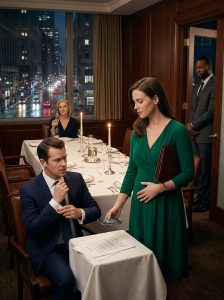
Grant Whitmore placed the divorce papers beside his pregnant wife’s untouched dinner and told the security guards to remove her before dessert.
“The baby changes nothing,” he said, adjusting the gold cuff link she had given him on their fifth anniversary. “I need a son, Claire. I’m done wasting years on disappointments.”
Claire Whitmore stared at the signature line while the child Grant had wanted his entire life moved beneath her heart.
Their child was a boy.
She had learned that morning.
Grant had no idea.
Around them, candlelight trembled across the private dining room of Manhattan’s Halcyon Club. Thirty floors below, December traffic crawled through wet streets. Inside, the linen was white, the silver was polished, and Grant’s mother sat at the far end of the table wearing the satisfied expression of a woman watching a plan reach its final step.
Evelyn Whitmore lifted her champagne glass.
“This is painful for everyone,” she said.
Claire looked at her.
Evelyn’s voice was gentle enough for witnesses.
Her eyes were not.
Grant pushed the papers closer.
“My attorney says you have seventy-two hours to remove your belongings from the Greenwich house. You can keep the car until the end of the month.”
Claire rested one hand over the slight curve beneath her emerald dress.
She did not beg him to reconsider.
She did not scream that he was throwing away his own child.
She did not reveal the word printed beneath the laboratory seal in her purse.
She did not give Evelyn the panic she had come to collect.
She did not let Grant see that, in the space between one heartbeat and the next, she had stopped being his wife and become the most dangerous witness his family had ever underestimated.
Claire reached for the fountain pen beside the documents.
Grant leaned back.
Relief softened his face.
Evelyn’s mouth curved almost invisibly.
Claire uncapped the pen, drew a neat line through the signature box, and wrote three words across the page.
Received. Not agreed.
Then she photographed every sheet.
Grant’s relief vanished.
“What are you doing?”
“Documenting the time and place you served me.”
“This isn’t a negotiation.”
“No,” Claire said. “It’s evidence.”
Evelyn set down her glass.
One of the security guards shifted near the door. He looked uncomfortable. Claire recognized him from company events. Marcus Reed. Former NYPD. A widower with a daughter at Rutgers. Two years earlier, Claire had quietly helped reverse the company’s decision to eliminate his health benefits.
She met his eyes.
“I’ll leave voluntarily.”
Grant laughed once.
“You always need to make a performance out of everything.”
Claire folded the papers and placed them inside her leather portfolio.
“No performance. I simply prefer accurate records.”
“You should be grateful I’m offering support.”
“You haven’t offered anything.”
“I’m not going to argue over semantics.”
“Then don’t.”
His face tightened.
For seven years, Grant had mistaken her patience for weakness. He had mistaken her quiet for surrender. He had mistaken every crisis she solved behind closed doors for proof that crises somehow solved themselves.
Tonight, Claire allowed him to keep making that mistake.
She stood carefully.
At nineteen weeks pregnant, sudden movement made the room tilt for half a second. She waited until the sensation passed, then lifted her coat from the chair.
Grant glanced at her stomach.
Something uncertain crossed his expression.
It disappeared when Evelyn spoke.
“Claire, the least you can do is make this dignified.”
Claire slid her arms into her coat.
“You invited security to a private dinner before serving divorce papers.”
“Grant wanted to avoid a scene.”
“And yet he brought an audience.”
Grant’s jaw hardened.
“Don’t blame my mother because you failed to understand what this family requires.”
Claire looked at the man she had once loved enough to build a life around.
He was forty-one, handsome in the polished, expensive way magazine profiles described as disciplined. His dark hair had begun to silver at the temples. His navy suit had been tailored in London. His watch cost more than the first home Claire’s parents had bought in Ohio.
Nothing in his appearance suggested that he had slept beside his wife the night before.
Nothing suggested he had kissed her shoulder at dawn.
Nothing suggested he had asked whether the baby had moved and then left for work before she could answer.
“What does this family require?” Claire asked.
Grant’s gaze moved to Evelyn.
Only for a second.
But Claire saw it.
“A future,” he said.
The child moved again.
Claire placed her palm over him.
“You’re right,” she said. “It does.”
She walked toward the door.
Marcus opened it for her. As she passed, he spoke so quietly only she could hear.
“Mrs. Whitmore, your driver was sent away.”
Claire did not pause.
“Thank you, Marcus.”
Grant called after her.
“The house codes will be changed at midnight.”
Claire turned in the doorway.
“That might be a problem.”
“For you.”
“For whoever advised you to lock a co-owner out of marital property during an active pregnancy.”
Evelyn’s fingers tightened around the stem of her champagne glass.
Claire noticed.
Then she left.
The elevator doors closed on the Halcyon Club’s gold-paneled lobby. Claire stood alone beneath a small brass camera, listening to the mechanical hum as she descended.
Her phone showed three missed calls.
All from Dr. Lena Morris.
A fourth call arrived as the elevator passed the twenty-second floor.
Claire answered.
“Dr. Morris.”
“Claire, thank God. I’ve been trying to reach you.”
“I was occupied.”
“There’s a problem with your screening report.”
Claire looked at her reflection in the elevator wall.
Her face was pale.
Her eyes were steady.
“What kind of problem?”
“The report uploaded to the Whitmore family medical portal is not the report our laboratory issued.”
Claire said nothing.
Dr. Morris continued quickly.
“Our laboratory result shows a healthy male fetus. Low risk on every screened condition. But the document accessed through the Whitmore concierge system lists a female fetus and an elevated concern requiring additional testing.”
Claire opened her purse and touched the sealed copy Dr. Morris had given her that morning.
“Who accessed the original?”
“I’m still checking. Someone from Whitmore Family Health Services called our office yesterday and requested that the results be routed through their private portal. My nurse assumed you had authorized it.”
“I didn’t.”
“I know. That’s why I called. Claire, the altered document has my electronic signature attached to it.”
The elevator passed the twelfth floor.
“Can you preserve the access logs?”
“Yes.”
“Do not contact Whitmore Family Health Services.”
A pause.
“You think someone did this intentionally?”
“I think my husband filed for divorce tonight because he believes I’m carrying a girl.”
Dr. Morris breathed in sharply.
“Claire…”
“Preserve everything. Emails, phone logs, portal access, document metadata. Send nothing to the family system. Use the personal address I gave you this morning.”
“I will.”
“And Lena?”
“Yes?”
“Do not tell anyone the baby is a boy.”
The elevator reached the lobby.
Claire stepped into a marble corridor decorated with white lilies and holiday garlands.
“Not yet,” she said.
Rain swept across Fifth Avenue. The club’s doorman offered an umbrella, but no car waited beneath the awning.
Grant had dismissed her driver before telling her she was no longer welcome in her home.
Claire opened a rideshare app.
Her hands trembled only once.
She closed them around the phone until they stopped.
A black sedan pulled up eight minutes later. She climbed inside, gave the driver an address in Brooklyn, and watched Manhattan blur through the rain.
She did not call Grant.
She did not call her mother, who would hear one change in her breathing and book the first flight from Cincinnati.
She called Naomi Brooks.
Naomi answered on the second ring.
“Tell me you’re not calling from jail.”
“Not tonight.”
“That is not the reassuring answer you think it is.”
“Grant served me divorce papers at the Halcyon Club.”
Silence.
Then Naomi’s voice changed.
The humor vanished.
“Are you safe?”
“Yes.”
“Where are you going?”
“The Brooklyn house.”
“Does Grant know you still own it?”
“He believes I sold it.”
“Did you?”
“No.”
“Good. Are the divorce papers signed?”
“No.”
“Did he threaten you?”
“He changed the codes to the Greenwich house, dismissed my driver, and told me I had seventy-two hours to remove my belongings.”
“Did he put that in writing?”
“Some of it.”
“Witnesses?”
“His mother, two security officers, three servers, and at least four cameras.”
Naomi exhaled.
“I’m starting to understand why you called me instead of your mother.”
“There’s more.”
“There’s always more with the Whitmores.”
Claire told her about the altered prenatal report.
By the time she finished, the sedan was crossing the Manhattan Bridge.
Naomi did not speak for several seconds.
Finally she said, “Do you have proof?”
“I have the original result in my purse. Dr. Morris has the laboratory data and the access logs.”
“Grant thinks the baby is a girl?”
“Yes.”
“And he filed tonight?”
“Yes.”
“Claire, don’t tell him anything.”
“I wasn’t planning to.”
“I mean it. No emotional call. No late-night confrontation. No message that can be turned into harassment or instability. You say nothing without me.”
“I understand.”
“Go to the Brooklyn property. Lock the doors. I’m sending a private security team.”
“That’s unnecessary.”
“He cut off your transportation while you’re pregnant and locked you out of your home. I’m not waiting for him to become reasonable.”
Claire looked at the rain streaking sideways across the window.
“He won’t hurt me.”
“Maybe not physically. But men like Grant don’t think financial harm counts as violence.”
“He’ll freeze the accounts tomorrow.”
“He already tried.”
Claire sat straighter.
“What?”
“I received an alert eleven minutes ago. His attorney filed an emergency notice with the bank claiming marital assets could be dissipated.”
“I haven’t moved anything.”
“That doesn’t matter. They’re creating a narrative.”
“Can they freeze my separate accounts?”
“They can try. They’ll fail.”
The car descended into Brooklyn.
Naomi continued.
“Listen carefully. Do you still have your original consulting agreements from Whitmore Biologics?”
“In the Brooklyn safe.”
“The Series C warrants?”
“Same place.”
“Your father’s correspondence with Richard Whitmore?”
“The blue ledger and two storage drives.”
“Good. Tomorrow morning, we remind Grant exactly how much of his company exists because you kept it alive.”
Claire closed her eyes.
The baby shifted softly beneath her ribs.
She remembered Grant’s words.
I’m done wasting years on disappointments.
“Naomi?”
“Yes?”
“Don’t file anything aggressive tonight.”
“Why not?”
“Because Grant thinks he has removed the only obstacle between himself and complete control.”
“You want him comfortable.”
“I want him careless.”
Naomi was quiet again.
Then she said, “There you are.”
“Where?”
“The woman I met before she married into that family.”
The Brooklyn house stood on a narrow tree-lined street in Cobble Hill, its brownstone steps slick with rain. Claire had inherited it from her father, David Bennett, six years earlier.
Grant had hated the place.
The rooms were too small.
The street was too public.
The plumbing made noise.
The kitchen had not been designed for caterers.
He had persuaded Claire to list it shortly after they moved to Greenwich. She had agreed, then quietly withdrawn the listing when her father’s attorney reminded her that David had placed the property in a separate trust.
Grant never asked whether it sold.
He only asked whether her boxes had been removed.
Claire had kept the house furnished.
Not beautifully.
Not extravagantly.
But enough.
There were clean sheets in the upstairs bedroom, canned soup in the pantry, bottled water beneath the sink, and a wool blanket folded across the old leather sofa.
There was also a safe behind the false back of her father’s study closet.
Claire entered at 10:43 p.m.
She locked the door behind her.
For the first time that night, no one was watching.
Her composure did not break.
It changed.
She leaned against the door and allowed one breath to leave her slowly.
Then another.
The house smelled faintly of cedar, dust, and the lemon oil the cleaning service used once a month.
On the small table near the stairs sat a framed photograph she had forgotten was there.
Her father at fifty-eight, standing beside Claire on the day she earned her MBA. David Bennett’s tie was crooked. His smile was enormous. Claire’s mother had been the photographer and had captured them both laughing at something neither remembered.
David had died nine months before Claire married Grant.
He had met Grant only twice.
After the second meeting, he had asked Claire to take a walk.
They had crossed a park in Cincinnati while dry leaves scraped over the pavement.
“Grant is impressive,” David had said.
“That sounds like a warning.”
“It is.”
“You don’t like him?”
“I didn’t say that.”
“You didn’t have to.”
David had stopped beside a pond where a child was throwing bread to ducks.
“He looks at you like a man looking at a bridge.”
Claire had frowned.
“A bridge?”
“Something useful that will carry him where he wants to go.”
“That’s unfair.”
“I hope it is.”
She had defended Grant.
David had listened.
Then he had kissed her forehead and told her one thing she remembered now with painful clarity.
“Never let love make you surrender the parts of yourself that existed before it.”
Claire touched the edge of the photograph.
“I didn’t,” she whispered.
Upstairs, she changed into sweatpants and one of her father’s old Ohio State sweatshirts. It hung loosely over her stomach.
She made tea she did not drink.
At midnight, the security system on the Greenwich house sent an automated notification to her phone.
User access revoked.
Two minutes later, the joint credit card app stopped loading.
At 12:07 a.m., her health insurance portal displayed a termination notice scheduled for the end of the month.
Claire took screenshots of everything.
At 12:19 a.m., Grant sent his first message.
This can remain civil if you cooperate.
She forwarded it to Naomi.
At 12:26 a.m., Evelyn sent one.
A prolonged fight will only harm the child.
Claire forwarded that too.
At 12:34 a.m., Grant wrote again.
You should consider whether you are emotionally equipped for a custody dispute.
Claire stared at the message.
There it was.
The narrative Naomi had predicted.
Unstable wife.
Difficult pregnancy.
Questionable emotional state.
A mother who could be pressured into surrendering rights before the child was born.
Claire typed a reply.
Then she deleted it.
She opened her father’s study instead.
The safe was exactly as she had left it.
Inside were property records, corporate contracts, two encrypted drives, her original prenuptial agreement, and the blue leather ledger David had carried throughout the final decade of his career.
David had not been wealthy by Whitmore standards.
He had been an intellectual-property attorney who represented scientists, engineers, and medical researchers. Years before Claire met Grant, David had helped Richard Whitmore restructure the patent holdings that became the foundation of Whitmore Biologics.
Richard was Grant’s father.
He died suddenly three years into Claire and Grant’s marriage.
According to the family, a heart attack took him during a fishing trip in Maine.
After Richard’s funeral, Evelyn assumed control of the family trust. Grant became chief executive. Claire became the invisible person both of them called whenever the company faced a disaster no one else could solve.
She opened the ledger.
Most pages contained notes in David’s compact handwriting.
Patent numbers.
Trust references.
Names of inventors.
Dates.
Near the back, a strip of red ribbon marked a page Claire had never read closely.
At the top, David had written:
Whitmore succession amendment—never rely on summary. Appendix C controls.
Below that was a single sentence.
If Evelyn obtains sole trusteeship, Claire must receive full copy before the birth of any qualifying heir.
Claire read it twice.
Then a third time.
She turned the page.
It had been cut out.
Not torn.
Cut cleanly near the binding.
The next page was blank except for a faint indentation.
Claire took a pencil from the desk drawer and shaded the paper gently.
Letters emerged from the pressure marks left by whatever David had written on the missing page.
First biological male descendant.
Voting control held by custodial parent.
Thirty-one percent.
Claire stopped shading.
Rain tapped against the study window.
Grant had spoken about wanting a son for years.
He said it was tradition.
Legacy.
The Whitmore name.
He had never mentioned thirty-one percent of the company.
Claire reached for her phone and called Naomi again.
“I found something.”
Naomi answered sleepily but alert.
“What?”
“A reference to a succession amendment. Appendix C. It appears to place thirty-one percent voting control with the custodial parent of the first biological male descendant.”
“Grant’s custodial parent?”
“The child’s.”
There was a pause.
“You.”
“If the baby qualifies.”
“Which he does.”
“Yes.”
“And Evelyn altered a report to make Grant believe you were carrying a girl.”
“Yes.”
“Then convinced him to divorce you before the birth.”
“Yes.”
Naomi’s voice lowered.
“This isn’t about giving Grant the son he wants.”
“No.”
“It’s about making sure the son is born after the marriage is legally dissolved.”
Claire looked at the cut page.
“They think the divorce prevents the transfer.”
“Does it?”
“I don’t know.”
“We’ll find the full trust.”
“Evelyn will have it locked inside Whitmore Family Holdings.”
“Then we get it through discovery.”
“She’ll destroy it.”
“She might alter a copy. She can’t erase every filed version.”
“You sound certain.”
“I sound expensive. There’s a difference.”
Claire almost smiled.
Naomi continued.
“Do not reveal the gender. Not to Grant. Not to anyone connected to the company. If Evelyn believes her plan is working, she has no reason to accelerate.”
“Agreed.”
“Tomorrow we file for financial restraints, medical coverage, access to personal property, and preservation of all electronic records.”
“Not the trust yet.”
“Claire.”
“If she knows we found the clause, she’ll change strategy.”
“She may already know you’re suspicious.”
“She thinks I’m hurt.”
“You are hurt.”
“Yes,” Claire said. “But she thinks that makes me helpless.”
At 7:00 the next morning, Grant arrived at Whitmore Biologics headquarters in Midtown expecting the world to congratulate him for taking control of his life.
Instead, his chief financial officer met him outside the executive conference room with a tablet in one hand and panic in his eyes.
“The revolving line has been suspended.”
Grant removed his coat.
“Why?”
“Bennett Capital withdrew its guarantor consent.”
Grant looked toward the glass office that had once belonged to his father.
“Claire’s family office?”
“Yes.”
“She doesn’t control Bennett Capital.”
The chief financial officer hesitated.
“She is Bennett Capital.”
Grant stopped.
“What are you talking about?”
“Her father’s trust owns it. Mrs. Whitmore has been the sole managing beneficiary since 2019.”
“That’s impossible. Bennett Capital is a minority partner.”
“It guarantees ninety million dollars in development financing.”
“My mother arranged that financing.”
“No. Mrs. Whitmore did.”
Grant’s expression chilled.
“Restore the line.”
“We need her authorization.”
“Use the board resolution.”
“The resolution requires two Class C signatures.”
“Mine and my mother’s.”
“Yours and Claire’s.”
Grant stared at him.
The chief financial officer lowered the tablet.
“I thought you knew.”
At 7:14 a.m., Grant called Claire.
She watched his name appear on her screen while eating toast in her father’s kitchen.
She let it ring.
He called again.
She forwarded both calls to Naomi.
At 7:21, he sent a message.
You are interfering with company operations.
Claire took another bite of toast.
At 7:23, a second message appeared.
Call me immediately.
At 7:24:
This is bigger than our marriage.
Claire finally replied.
Please direct all legal and financial communication to Naomi Brooks.
Grant called Naomi.
Naomi answered.
He shouted for eleven minutes.
She billed him for twelve.
By noon, Claire had filed for temporary financial protections and preservation of marital and corporate records. The filing included screenshots of the revoked house access, canceled transportation, health-insurance termination, and Grant’s suggestion that she was emotionally unfit for custody.
It did not mention the baby’s gender.
It did not mention the altered report.
It did not mention Appendix C.
At 2:30 p.m., Evelyn Whitmore entered Grant’s office without knocking.
He stood by the windows, phone pressed to his ear, while three attorneys waited around the conference table.
Evelyn closed the door behind her.
Grant ended the call.
“Did you know Claire controlled Bennett Capital?”
Evelyn removed her gloves one finger at a time.
“Of course.”
“You told me her father left her a few properties and a modest investment account.”
“Compared with Whitmore assets, it is modest.”
“It guarantees our development line.”
“Temporarily.”
“She also has a Class C signature.”
“An administrative oversight.”
“It was signed by Dad.”
“Your father made many sentimental decisions toward the end of his life.”
Grant crossed the office.
“You advised me to file yesterday.”
“I advised you to protect your future.”
“You didn’t tell me she could freeze ninety million dollars.”
“She cannot freeze it permanently.”
“She did it overnight.”
Evelyn’s face remained composed.
“Then you should ask yourself why your wife prepared for war before you ever mentioned divorce.”
Grant hesitated.
It was all Evelyn needed.
She moved closer.
“Claire has always been strategic. You mistake her softness for innocence.”
“She didn’t know I was filing.”
“Are you certain?”
“She looked surprised.”
“Claire looks exactly as she wishes to look.”
Grant turned toward the windows.
Below them, taxis and buses moved through the gray streets.
“I offered her support.”
“You offered her an opportunity to leave with dignity.”
“She didn’t take it.”
“She never intended to.”
Evelyn touched his arm.
“You have spent seven years trying to make a marriage work with a woman who treats every kindness as leverage. You wanted a family. She gave you delays, complications, and grief.”
Grant’s mouth hardened.
“The screening showed another girl.”
Evelyn’s voice softened.
“I know how deeply that hurt you.”
He looked away.
Two years earlier, Claire had lost a pregnancy at seventeen weeks.
The baby had been a girl.
Grant had stood beside Claire in the hospital, holding her hand while she stared at the empty bassinet near the wall.
For weeks afterward, he had brought food to her bed and turned off his phone during dinner.
Then Richard Whitmore died.
Evelyn became trustee.
Grant became chief executive.
And somewhere between grief and power, Grant began speaking about the next pregnancy not as a child, but as an answer.
A son would stabilize the family.
A son would reassure investors.
A son would continue the name.
A son would prove that the loss had not been meaningless.
Claire had asked him never to speak that way again.
He had accused her of refusing to move forward.
Evelyn watched the memory move across his face.
“You deserve another chance,” she said.
“With someone else?”
“With someone who understands the responsibility of standing beside you.”
Grant knew whom she meant.
Lauren Vale, the thirty-four-year-old communications director who had accompanied him to conferences in London, Dubai, and San Francisco.
Lauren laughed at his jokes.
Lauren admired his ambition.
Lauren never challenged Evelyn in meetings.
Claire had once asked whether something was happening between them.
Grant had said no.
Technically, at the time, it had been true.
Three months later, in a hotel suite in Chicago, it stopped being true.
Grant told himself the marriage had already failed.
He told himself Claire had become distant.
He told himself a man carrying the future of a public company was allowed one place where he did not feel judged.
Evelyn knew about Lauren.
She had known before Claire did.
“Lauren understands the family,” Evelyn said.
Grant looked at her.
“This is not about Lauren.”
“Of course not.”
But it was partly about Lauren.
It was about the life Grant believed waited for him once Claire stopped forcing him to see himself clearly.
By evening, the Whitmore legal team delivered an offer to Naomi’s office.
Five million dollars.
A Manhattan apartment.
Three years of medical coverage.
No claim to Grant’s future earnings.
No interference with Whitmore Biologics.
In exchange, Claire would agree to an expedited divorce, waive any interest in family trusts, surrender all Class C authority, and promise never to use the Whitmore name for the child without Grant’s written consent.
Naomi read the final clause twice.
Then she called Claire.
“They’re afraid of your baby’s name.”
Claire stood inside a private storage facility in Queens, watching a locksmith open a unit registered to her father’s estate.
“Read it exactly.”
Naomi did.
Claire looked at the rows of archive boxes inside the unit.
“They don’t want the child identified as a Whitmore.”
“They don’t want the child making a trust claim.”
“Which means the divorce alone may not defeat Appendix C.”
“That’s my interpretation.”
“Reject the offer.”
“With a counter?”
“Yes.”
“What do you want?”
“Immediate restoration of medical insurance. Access to my belongings. Preservation of all medical and trust records. No public statements about my health, pregnancy, or fitness as a parent. No contact except through counsel.”
“And the five million?”
“I don’t want it.”
“I could ask for twenty.”
“I still wouldn’t want it.”
Naomi paused.
“You understand he may spend more than that trying to punish you.”
“Yes.”
“And you understand silence would be easier.”
“Easier for whom?”
Naomi did not answer.
Claire entered the storage unit.
Her father had kept everything.
That had annoyed Claire when he was alive. David never discarded a contract, letter, receipt, or handwritten note if he believed it might matter later.
Now, under the fluorescent lights, his caution felt like a hand reaching across the years.
The boxes were labeled by client.
BENNETT MEDICAL SYSTEMS.
GARDNER RESEARCH.
WHITMORE.
There were twelve boxes bearing the Whitmore name.
Claire opened the first.
Patent assignments.
Licensing terms.
Board memoranda.
Correspondence between David and Richard.
The second contained trust drafts.
Most were incomplete.
The third held copies of letters Richard had written but apparently never sent.
Claire sat on the concrete floor and read.
David,
Evelyn insists Grant should remain unaware of the full succession language until he demonstrates maturity. I fear secrecy may produce the very weakness we are trying to prevent.
Another:
The voting provision is not a reward for producing a male child. It is a safeguard. Control rests with the custodial parent because the company must never be used to separate a child from a decent mother or father.
And another:
If Claire and Grant marry, I hope she never needs these protections. But I have watched Evelyn confuse possession with love for thirty-five years. Promise me your daughter will receive the truth if I am no longer here to give it.
Claire read the final sentence again.
Promise me your daughter will receive the truth.
The letter was dated six weeks before David’s death.
Claire searched the box until the light outside the storage unit’s narrow window faded.
She found no complete Appendix C.
But she found a key.
It was taped beneath a folder and labeled in her father’s handwriting.
R.W.—Grand Central vault.
The next morning, Grant appeared at the Brooklyn house.
Claire saw him through the camera before he rang the bell.
He was alone.
No driver.
No lawyer.
No Evelyn.
Snow had begun falling lightly over the street. White dust collected on the shoulders of his dark coat.
Claire did not open the door.
She spoke through the intercom.
“All communication goes through Naomi.”
“I need five minutes.”
“You have an attorney.”
“This isn’t legal.”
“You made it legal at dinner.”
Grant glanced toward the windows.
“Claire, I know you’re inside.”
“I’m aware.”
“Open the door.”
“No.”
His face changed.
Grant was not accustomed to closed doors.
Not when his name appeared on hospitals, research buildings, charity wings, and invitations to rooms most people never knew existed.
He pressed the bell again.
“I’m not leaving.”
Claire picked up her phone and called the private security team stationed two blocks away.
Grant saw the movement through the camera.
His voice lowered.
“You called security on me?”
“You brought security to our divorce.”
“That was different.”
“Because you arranged it?”
“I came to talk.”
“Then talk.”
He looked at the camera directly.
“What did you do to the credit line?”
“I withdrew a guarantor consent.”
“You could damage the company.”
“The company survived before that credit line.”
“Not with three trials in development.”
“Then the chief executive should have reviewed the financing terms before dismissing one of the required signatories.”
His face reddened.
“You never told me.”
“You never asked.”
“I’m your husband.”
“You filed for divorce.”
“After years of you hiding things.”
Claire almost laughed.
Instead she said, “Name one.”
“You kept the Brooklyn house.”
“It’s separate property.”
“You kept Bennett Capital.”
“It existed before our marriage.”
“You kept board authority.”
“Your father granted it to me.”
“Why?”
“Because I earned it.”
Grant stepped closer to the intercom.
“Do you enjoy this?”
“No.”
“You sound like you do.”
“I sound calm. You’ve always confused calmness with cruelty when it prevented you from controlling the conversation.”
For a moment, Grant said nothing.
Snow settled in his hair.
“I didn’t come here to fight.”
“Why did you come?”
“I want the financing restored.”
“Speak to Naomi.”
“I’m speaking to my wife.”
“You served your wife in front of witnesses, removed her transportation, locked her out of her home, canceled her medical coverage, and threatened to question her fitness as a mother before she reached a safe place to sleep.”
“I did not threaten you.”
“You documented it in writing.”
“I was angry.”
“I know.”
“I didn’t mean it that way.”
“I know exactly how you meant it.”
Grant looked down the street as a black security vehicle turned the corner.
His voice changed.
“Is the baby healthy?”
Claire’s hand rested over her stomach.
“Yes.”
“Did Morris recommend more tests?”
“Why?”
“The report showed elevated risk.”
“The report you saw was not sent to me.”
“What does that mean?”
“It means you should ask whoever gave it to you.”
Grant’s gaze sharpened.
“My mother received it from the family medical service.”
“Then ask your mother.”
“Are you saying it was wrong?”
“I’m saying my private medical information should never have been routed through your mother.”
The security vehicle stopped at the curb.
Two officers stepped out.
Grant glanced at them, then back at the camera.
“Claire, don’t do this.”
She looked at the man standing outside the house her father had left her.
“Grant, I didn’t.”
She ended the intercom connection.
Grant remained on the steps for another minute.
Then he left.
That afternoon, he confronted Evelyn.
She was in her townhouse library, reviewing invitations to the Whitmore Foundation’s winter benefit.
Grant placed a printed copy of the prenatal report on the desk.
“Where did you get this?”
Evelyn did not look up.
“You know where.”
“Claire says it wasn’t sent to her.”
“She is trying to create confusion.”
“Was it altered?”
Evelyn lifted her eyes slowly.
“Why would it be altered?”
“That isn’t an answer.”
“It is an answer to an irrational question.”
Grant placed both hands on the desk.
“Did you speak to her doctor?”
“I spoke to the family medical office. You asked me to handle the appointment logistics.”
“I asked you to make sure the insurance authorization was complete.”
“And I did.”
“Who downloaded the report?”
“One of the medical coordinators.”
“Which one?”
“I do not memorize staff assignments.”
Grant watched her.
Evelyn closed the invitation folder.
“Claire has frozen financing, hired a combative attorney, and refused a generous settlement. Now she is suggesting a conspiracy involving her prenatal screening. Does that sound stable to you?”
“She didn’t suggest a conspiracy.”
“What did she suggest?”
“That I ask you.”
Evelyn’s expression did not change.
But Grant noticed her right thumb moving against the emerald ring on her hand.
She did that when calculating risk.
He had watched her do it before board votes, funerals, and negotiations.
“She wants you suspicious,” Evelyn said. “Suspicion makes you weak.”
“Did you alter the report?”
“No.”
The answer came smoothly.
Too smoothly.
Grant stepped back.
“I want the portal logs.”
“You are the chief executive of a biotechnology company. Do you intend to spend your day chasing clerical errors in a pregnancy that no longer changes your future?”
He looked at the report.
“It’s still my child.”
“Then act like a father and prevent Claire from using the child to destabilize your company.”
Grant left with the report in his hand.
Evelyn waited until the front door closed.
Then she took out a second phone.
She called a number stored without a name.
“He’s asking questions,” she said.
The voice on the other end responded.
Evelyn listened.
“No. Do not touch the laboratory system again. Preserve the version already uploaded.”
Another response.
“I understand what preservation orders mean.”
She looked toward the dark window.
Snow was falling harder now.
“The divorce must be final before the birth. Everything else is noise.”
At Grand Central Terminal, behind a row of high-end shops and beneath a clock thousands of commuters passed every day, Claire found a private vault service that had operated for more than a century.
The brass key opened Box 314.
Naomi stood beside her as the vault attendant placed the narrow metal box inside a private viewing room.
“Your father enjoyed drama,” Naomi said.
“He considered online storage a temporary form of self-sabotage.”
“He may have been right.”
Claire lifted the lid.
Inside were three items.
A sealed envelope addressed to her.
A notarized copy of the Whitmore succession amendment.
And a small digital recorder.
Claire opened the amendment first.
Appendix C was seventeen pages long.
The crucial language appeared on page eleven.
Upon the live birth of the first verified biological male-line descendant of Richard Alexander Whitmore, custodial voting authority over thirty-one percent of the controlling shares shall vest in the child’s custodial parent or court-appointed guardian until the descendant reaches twenty-five years of age.
Marital status was not mentioned.
Divorce changed nothing.
Claire read the clause again.
Naomi leaned over her shoulder.
“Evelyn’s plan doesn’t work.”
“Not under this version.”
“Is it executed?”
Claire checked the signatures.
Richard Whitmore.
Two independent trustees.
David Bennett as counsel.
A notary seal.
“It’s executed.”
Naomi turned another page.
“Keep reading.”
A second clause stated that any intentional effort by a trustee or beneficiary to conceal, obstruct, or manipulate the qualifying birth would trigger immediate suspension of that person’s voting rights.
Claire’s pulse quickened.
“If we prove the report was altered…”
“Evelyn loses her trust vote.”
“And if Grant knowingly participated?”
“He loses his too.”
Claire sat back.
“Grant doesn’t know.”
“You sound certain.”
“He knew the summary. Not the appendix.”
“How can you tell?”
“Because if Grant knew divorce wouldn’t stop the transfer, he wouldn’t have filed so urgently.”
Naomi considered that.
“Unless he knows something we don’t.”
Claire looked at the digital recorder.
It was old but carefully preserved.
A note was attached.
For Claire, if Richard cannot explain himself.
She pressed play.
Static filled the room.
Then Richard Whitmore’s voice emerged.
Older.
Weary.
Recognizable.
“Claire, I hope you never hear this.”
She closed her eyes.
Richard had always called her Claire, never daughter-in-law. He had treated her ideas seriously before Grant did. At board dinners, he asked her opinion and waited for the answer.
The recording continued.
“If David gives you this, then either I am gone or I have failed to correct a serious mistake.”
Naomi sat across from Claire.
Richard’s voice crackled.
“The succession clause was written after Grant’s birth. Evelyn believed control should pass to our son automatically. I refused. Blood without judgment is not stewardship. The company needed a safeguard against any beneficiary who might value inheritance more than the child carrying it.”
Claire looked down at the signed amendment.
“I chose the custodial parent because the person protecting the child should hold the power. Evelyn never forgave me.”
A faint sound interrupted the recording, as though Richard had turned away from the microphone.
“If Grant grows into a decent man, this document will remain irrelevant. If he does not, it may protect someone he has failed.”
Claire’s throat tightened.
Richard continued.
“There is another matter.”
The recorder clicked.
The audio stopped.
Claire pressed play again.
Nothing.
The battery indicator blinked red.
Naomi reached for her bag.
“I have a charger.”
They waited five minutes.
The recorder powered on.
Claire advanced to the last position.
Richard’s voice returned.
“There is another matter concerning the phrase first biological male-line descendant. Evelyn demanded that wording. At the time, I believed it referred to Grant’s future son.”
Static swallowed several seconds.
Then Richard said, “I later learned she may have had another reason.”
The recorder ended.
Naomi stared at it.
“That’s all?”
Claire replayed the final section.
Same words.
Same static.
Same abrupt end.
“What other reason?” Naomi asked.
“I don’t know.”
“Did Richard have another son?”
“Not that anyone knew.”
“Did Grant?”
“Not that I knew.”
Naomi looked at Claire’s stomach.
“We have enough without understanding that sentence.”
“For the divorce, yes.”
“For the company too.”
Claire folded the amendment carefully.
“We don’t use it yet.”
Naomi gave her a long look.
“Evelyn altered a medical document to manipulate the timing of your divorce.”
“We suspect she did.”
“We have motive.”
“We need the access logs.”
“We’ll subpoena them.”
“When we have those, we reveal everything at once.”
Naomi leaned back.
“You’re planning something.”
“The Whitmore Foundation benefit is in five weeks.”
“Claire…”
“Shareholders, trustees, research partners, and every board member will be there.”
“You want to expose them in a ballroom?”
“I want Evelyn to make public claims she cannot retract.”
“That could become ugly.”
“She relies on privacy when she lies and prestige when she threatens.”
Naomi’s expression slowly changed.
“You want to take away both.”
Claire placed the recorder inside her purse.
“I want the truth to arrive in a room too crowded for her to bury it.”
The next weeks became a quiet war.
Grant restored Claire’s health insurance after Naomi filed an emergency motion and attached the termination notice to a request for sanctions.
He restored access to the Greenwich house after a judge informed his attorney that self-help eviction was not a recognized marital remedy in Connecticut.
Claire did not return to live there.
She entered once, accompanied by Naomi, a court-approved property officer, and Marcus Reed.
Her closet had been emptied.
Boxes lined the hallway.
Her clothes had been packed carelessly beneath framed photographs and kitchen items. A crystal bowl from her mother was wrapped inside one of Grant’s old gym shirts. Her wedding album lay face down at the bottom of a carton marked DONATE.
Claire photographed each box.
Marcus watched from the doorway.
“I’m sorry,” he said.
“You didn’t pack these.”
“No.”
“Who did?”
“Mrs. Evelyn Whitmore brought a team.”
“When?”
“The morning after the dinner.”
Claire turned.
“The morning after?”
“Yes.”
“The court preservation notice had already been served.”
Marcus nodded.
“She said it didn’t apply to personal effects.”
Naomi wrote something down.
“Did anyone enter Claire’s office?”
Marcus hesitated.
“Yes.”
“Who?”
“Mrs. Whitmore. Two men from family security. They removed files.”
“Which files?” Claire asked.
“I couldn’t see. Blue folders. One small box.”
Claire looked toward the upstairs office.
The blue ledger had been in Brooklyn.
The Grand Central key had been in Queens.
Whatever Evelyn expected to find, she had not found it.
“Was Grant present?” Claire asked.
“No.”
“Did he authorize the search?”
“I don’t know.”
They entered the nursery.
Claire had chosen pale green paint before they knew the gender. The crib had arrived in pieces and remained unassembled against the wall.
Someone had opened every drawer.
A tiny cream sweater lay on the floor.
Claire bent slowly and picked it up.
She had bought it after hearing the heartbeat for the first time.
Grant had teased her for purchasing clothing too early.
Then he had held the sweater against his chest and smiled.
That memory hurt more than the divorce papers.
Not because it proved Grant had loved her.
Because it proved he had been capable of tenderness and had chosen ambition when tenderness became inconvenient.
Marcus looked away.
Claire folded the sweater and placed it inside her bag.
Naomi stepped into the hallway to answer a call.
Marcus remained near the door.
“Mrs. Whitmore?”
“Claire is fine.”
He nodded.
“Claire, I saw something the night of the dinner.”
She waited.
“Your mother-in-law spoke with the club manager before you arrived. She asked him to make sure every camera in the private room was working.”
“Did she say why?”
“She called it a security concern.”
“Anything else?”
“She gave the guards instructions before Mr. Whitmore arrived.”
“What instructions?”
“To remove you if you became emotional.”
Claire looked at him.
“She expected a scene.”
“She expected something.”
“Would you put that in a statement?”
Marcus looked toward the hall.
“I have a daughter. I can’t lose my job.”
“I understand.”
“She’s a sophomore. Tuition isn’t…”
“You don’t need to explain.”
His face tightened with embarrassment.
Claire reached into her bag and removed a card.
“Call Naomi’s office. You may qualify as a protected witness under the preservation order. We can’t promise your job, but retaliation would create a separate claim.”
Marcus took the card.
“I don’t want money.”
“I didn’t offer any.”
“I know how these families work.”
“So do I.”
He looked at her for a moment.
Then he put the card in his pocket.
At Whitmore Biologics, the suspended credit line began creating visible damage.
A research partner delayed shipment of specialized materials.
A hospital consortium postponed signing a trial agreement.
The board demanded answers.
Grant told them the problem was temporary.
Claire attended the emergency meeting by video from Naomi’s office.
The board chairman, seventy-year-old Thomas Hale, adjusted his glasses.
“Mrs. Whitmore, what conditions would restore Bennett Capital’s consent?”
“Independent financial oversight.”
Grant leaned toward the microphone.
“This is a domestic dispute being used to interfere with corporate governance.”
Claire looked at him on the screen.
“You canceled the health insurance of a pregnant Class C signatory twelve hours after serving divorce papers.”
“That had nothing to do with the company.”
“The family office that canceled my coverage also manages the trust holding seventeen percent of company shares.”
Evelyn sat beside Grant.
Her posture was perfect.
“This is precisely why family matters should not be discussed here.”
Claire turned to the chairman.
“I agree. That is why I propose an independent committee review all transactions between Whitmore Biologics, Whitmore Family Holdings, and Whitmore Family Health Services.”
Grant’s head lifted.
Evelyn did not move.
Thomas Hale looked down the table.
“Is there a reason such a review would be problematic?”
“No,” Evelyn said.
Grant spoke at the same time.
“It’s unnecessary.”
The overlap hung in the room.
Claire said nothing.
One of the independent directors, Dr. Helen Park, folded her hands.
“I support the review.”
Another director nodded.
“So do I.”
Grant looked toward them.
“This is an overreaction.”
Claire remained still on the screen.
The vote passed six to three.
That was the first public crack in Grant’s authority.
It would not be the last.
After the meeting, Lauren Vale entered Grant’s office and closed the door.
She wore a cream suit and carried a folder of media summaries.
“Business journals are asking why the financing line was suspended.”
“Tell them it wasn’t.”
“They have bank sources.”
“Then tell them it’s an administrative review.”
“They’re also asking about Claire.”
Grant looked up.
“What about her?”
“Someone leaked the divorce filing.”
“Who?”
Lauren hesitated.
“The family office circulated talking points to two foundation donors. One of them spoke to a reporter.”
Grant stood.
“What talking points?”
Lauren handed him the folder.
The first page described Claire as emotionally fragile following reproductive difficulties.
The second suggested she had interfered with company financing after Grant expressed concern for her mental health.
The third described Grant as a private husband focused on protecting his unborn child.
Grant read the pages twice.
“I didn’t approve this.”
“I know.”
“Did my mother?”
“The file originated from her communications consultant.”
He dropped the folder on the desk.
“Kill it.”
“The story may run tonight.”
“Then stop it.”
“Grant, they have the court filing. Claire documented the insurance cancellation and lockout.”
“Why would my mother send these talking points?”
Lauren looked at him carefully.
“Because she thinks she can win public sympathy before Claire speaks.”
“Claire won’t speak.”
“You don’t know that.”
“I know my wife.”
Lauren’s expression shifted.
“Do you?”
Grant ignored the question.
“Call every outlet. No statement about Claire’s mental health. No reference to the pregnancy.”
“Evelyn won’t like that.”
“I’m the chief executive.”
Lauren picked up the folder.
“Then you should start acting like it.”
She left.
Grant stood alone in the office.
For the first time, he wondered whether Lauren admired him or had simply admired proximity to power.
That evening, the first article appeared.
BIOTECH HEIR’S DIVORCE RAISES QUESTIONS ABOUT COMPANY FINANCING.
It quoted unnamed family sources who described Claire as distressed and unpredictable.
Naomi wanted to sue immediately.
Claire chose a different response.
She released four sentences.
My pregnancy is healthy, and I remain fully capable of managing my personal and professional responsibilities. The termination of my medical coverage and removal from my home occurred before any financial action by Bennett Capital. All relevant documentation has been submitted to the court. I will not discuss my child for public entertainment.
No attack.
No accusation.
No emotional plea.
Within an hour, the article’s comments shifted.
By morning, three women’s-health organizations had criticized the use of pregnancy as a public-relations weapon.
A major shareholder requested an ethics review.
The company’s stock fell four percent.
Grant called Evelyn.
“What did you do?”
“I protected you.”
“You made it look like I canceled Claire’s insurance because she wouldn’t give me the child I wanted.”
“That is not what the statement says.”
“It is what everyone thinks.”
“Public attention fades.”
“The board is asking for an ethics review.”
“Then give them one.”
“Did you alter the prenatal report?”
Silence.
Grant stood near his office windows, holding the phone tightly.
Evelyn answered at last.
“No.”
“Send me the portal logs.”
“They’re confidential.”
“It’s my family system.”
“Claire is the patient.”
“You accessed her report.”
“On your behalf.”
“Then send me the logs.”
Evelyn’s voice cooled.
“You are allowing Claire to distract you from the only issue that matters.”
“What issue is that?”
“Control.”
The word landed between them.
Grant looked toward the conference room where his father’s portrait hung.
“What does the baby have to do with control?”
Evelyn did not answer.
“Mother?”
“You should focus on finalizing the divorce.”
“Why?”
“Because uncertainty weakens everything you have built.”
“What happens if the child is born before the divorce is final?”
Another silence.
Grant’s pulse quickened.
“Is there a trust provision?”
“You have read the trust summary.”
“I asked about a provision.”
“Grant, your father’s documents contain obsolete language written before the company went public.”
“What language?”
“Nothing that changes your position.”
“That isn’t what I asked.”
Evelyn ended the call.
Grant stared at the phone.
Then he called the family trust attorney.
The attorney refused to discuss Appendix C without trustee authorization.
That answer told Grant more than cooperation would have.
Three days later, Grant filed a motion demanding a prenatal paternity test.
Naomi read it aloud in Claire’s kitchen.
“He alleges that your refusal to provide complete medical records creates uncertainty concerning paternity.”
Claire stirred honey into her tea.
“He had access to my medical records without authorization. Now he claims I withheld them.”
“Yes.”
“Can he force the test?”
“Not easily. Invasive prenatal testing carries risk. Courts generally wait until birth unless there is a compelling medical reason.”
“He doesn’t want proof.”
“What does he want?”
“A headline saying paternity is disputed.”
Naomi closed the motion.
“We can oppose it quietly.”
“No.”
Claire looked toward the snow-covered garden behind the brownstone.
“Request a noninvasive test through an independent laboratory.”
Naomi frowned.
“You don’t owe him that.”
“I know.”
“Then why?”
“Because Evelyn expects me to resist. She needs uncertainty.”
“For what?”
“To argue later that the child doesn’t qualify under the trust.”
Naomi considered the idea.
“You want verified paternity before birth.”
“Yes.”
“Grant will receive the result.”
“Paternity only. Not gender.”
A slow smile appeared on Naomi’s face.
“You want to remove one of their future defenses without revealing what they’re defending against.”
“Exactly.”
The test was performed under court supervision.
Claire’s blood was drawn in a private clinic.
Grant provided a sample the same day.
The result came back one week later.
Probability of paternity: 99.9998 percent.
Grant received the sealed result during a board luncheon.
He opened it beneath the table.
For several seconds, he could not breathe normally.
It was his child.
He had always known that, but certainty felt different when printed beneath a laboratory seal.
He remembered Claire in the Brooklyn doorway camera, asking him to question the report.
He remembered Evelyn refusing to provide logs.
He remembered the trust attorney’s guarded silence.
That evening, he went to his mother’s townhouse again.
This time, he brought his own attorney.
Evelyn received them in the library.
Grant placed the paternity result on her desk.
“The child is mine.”
“I never said otherwise.”
“You supported the motion.”
“I supported certainty.”
“You said Claire was creating uncertainty.”
“She was.”
“Where is Appendix C?”
Evelyn’s gaze moved to the attorney.
“This is a family conversation.”
“No,” Grant said. “It’s a trust conversation.”
His attorney spoke carefully.
“As a named beneficiary, Mr. Whitmore is entitled to relevant governing documents.”
“You have the summary.”
“We want the executed appendix.”
Evelyn stood.
“The appendix contains contingencies that have never become relevant.”
Grant looked directly at her.
“What happens when my child is born?”
“Nothing you need to fear.”
“That answer means something happens.”
Evelyn’s face hardened.
“You are embarrassing yourself.”
“I filed for divorce because you told me the pregnancy could never produce the heir the company needed.”
“You filed because your marriage was failing.”
“You showed me a report.”
“I showed you information provided through the family medical system.”
“Was it altered?”
“No.”
“Then give me the logs.”
“I will not violate Claire’s privacy.”
Grant laughed bitterly.
“You already did.”
His attorney stepped closer to the desk.
“Mrs. Whitmore, if we do not receive the complete trust instrument by tomorrow afternoon, we will seek judicial enforcement.”
Evelyn looked at her son.
“You brought a lawyer into my home.”
“You brought yourself into my marriage.”
The words surprised both of them.
Grant had never spoken to her that way.
Evelyn’s expression became still.
“You are not strong enough to manage what Claire is doing.”
“She hasn’t lied to me yet.”
“Not that you have discovered.”
“You have.”
His mother’s eyes narrowed.
“Be very careful.”
“Is that advice or a threat?”
“It is the last kindness I may be able to offer you.”
Grant left without the appendix.
The next morning, Evelyn delivered a copy.
It was fourteen pages long.
The executed version in Claire’s possession was seventeen.
Appendix C had been removed.
Grant’s attorney noticed the page-number gaps.
By afternoon, Grant knew someone had altered the trust packet.
He still did not know Claire had the original.
He called her again.
This time, she answered with Naomi listening on the line.
“Claire.”
“Grant.”
“I need to ask you something.”
“Naomi is present.”
“I assumed she would be.”
“What do you need?”
“Did your father keep copies of my family trust?”
Claire looked at Naomi.
Naomi gave no signal.
Claire answered truthfully.
“My father kept records from his legal work.”
“Do you have Appendix C?”
“Why are you asking?”
“My mother gave me an incomplete document.”
“That sounds like an issue between you and your mother.”
“It affects our child.”
“You said the baby changed nothing.”
Grant closed his eyes.
“I was angry.”
“You were prepared.”
“I made a mistake.”
“You arranged security.”
“My mother arranged security.”
“You used it.”
He paced inside his office.
“Claire, please.”
It was the first time he had used that word since the dinner.
She felt no triumph.
Only exhaustion.
“What does Appendix C say?” he asked.
“You should obtain advice from independent counsel.”
“You have it.”
“I did not say that.”
“You know what happens when the child is born.”
“So does your mother.”
Grant gripped the phone.
“Is that why you froze the financing?”
“No.”
“Is that why you refused the settlement?”
“I refused because it required me to surrender my child’s identity and rights.”
“I didn’t draft that language.”
“You offered it.”
“I didn’t read every clause.”
“That is becoming a common defense.”
His breathing changed.
“Is the report wrong?”
Claire waited.
Naomi wrote on a legal pad.
Do not answer gender.
Claire said, “The report routed through your family system was altered.”
Grant stopped pacing.
“You can prove that?”
“Yes.”
“Who altered it?”
“We are still gathering evidence.”
“My mother?”
“We are still gathering evidence.”
He sat down slowly.
“Why didn’t you tell me?”
“Would you have believed me?”
“Yes.”
“No, Grant. You would have called Evelyn.”
He had no answer.
Claire continued.
“You chose to serve me before asking my doctor one question.”
“I thought…”
“I know what you thought.”
“I thought the baby was another girl.”
The sentence sounded uglier aloud than it had inside his mind.
Claire’s voice became very quiet.
“Our daughter died.”
Grant looked toward the window.
“I know.”
“You stood beside her empty bassinet and promised me you would never let anyone speak about her like she had been a failure.”
“I didn’t mean…”
“You did.”
He pressed a hand to his forehead.
“Claire, I’m sorry.”
“For which part?”
“All of it.”
“You haven’t discovered all of it yet.”
She ended the call.
The Whitmore Foundation Winter Benefit arrived beneath a sky full of snow.
The event occupied the grand ballroom of the Metropolitan Museum of Art. White orchids lined the entrance. A string quartet played beneath towering arrangements of silver branches. More than six hundred guests moved through the galleries in tuxedos and gowns.
The benefit raised money for pediatric research.
Claire had chaired it for five years.
Evelyn assumed she would stay away.
Grant assumed she would stay away.
Lauren Vale sent Naomi a private message suggesting that Claire’s attendance might create unnecessary media attention.
Claire arrived at 8:10 p.m.
She wore a midnight-blue gown with long sleeves and a high neckline. Her golden-blonde hair fell in soft waves over one shoulder. The pregnancy was no longer easy to conceal.
Conversation changed as she entered.
Not stopped.
Changed.
People lowered their voices.
Heads turned.
Phones appeared discreetly.
Claire walked beside Naomi through the center of the room.
She did not avoid the cameras.
She did not seek them.
At the top of the marble staircase, Evelyn stood greeting donors in a silver gown.
Grant was beside her.
Lauren stood on his other side wearing red.
Evelyn saw Claire first.
For one second, her expression revealed pure disbelief.
Then the hostess returned.
She descended three steps.
“Claire,” she said warmly. “We weren’t certain you felt well enough to attend.”
“I feel excellent.”
“You should have informed us. We would have arranged appropriate accommodations.”
“I arranged my own.”
Evelyn’s gaze moved to Naomi.
“Of course.”
Grant stepped forward.
“What are you doing here?”
Claire looked around the museum.
“I’m a foundation trustee.”
“You resigned from the benefit committee.”
“I resigned from planning dinner.”
Lauren approached carefully.
“There are reporters near the east gallery.”
Claire looked at her.
“Then I’m sure they’ll enjoy the art.”
Grant lowered his voice.
“This isn’t the place.”
“For what?”
“You know what.”
“Actually, I don’t.”
Evelyn touched Grant’s sleeve.
“Not here.”
Claire saw the gesture.
Control disguised as comfort.
The same gesture Evelyn had used throughout Grant’s childhood, marriage, and career.
Claire smiled politely.
“Enjoy the evening.”
She walked away.
The first mini-payoff arrived twenty minutes later.
Thomas Hale announced that Bennett Capital had agreed to restore the development credit line after the board approved permanent independent oversight of related-party transactions.
Applause filled the room.
Grant stood near the stage, expression fixed.
Evelyn did not clap.
The second arrived during dinner.
Dr. Helen Park announced that Claire had personally secured a new partnership providing trial access to three rural hospital networks.
The partnership had been negotiated before the divorce.
Grant had not known.
The third arrived when the foundation’s largest donor, Margaret Ellis, crossed the ballroom to embrace Claire in full view of the press.
“My dear,” Margaret said loudly, “your statement was the only dignified thing anyone has said all month.”
Evelyn heard.
So did Grant.
At 9:35, Evelyn took the stage.
The ballroom settled.
She spoke about children, legacy, and scientific hope. Her voice never trembled. She thanked Grant for leading the company through “a season of private difficulty.”
Then she made the mistake Claire had been waiting for.
“Families,” Evelyn said, “are defined not merely by blood, but by stability, truth, and the courage to protect future generations from those who might use a child as leverage.”
A few guests shifted uncomfortably.
Grant looked toward her.
Evelyn continued.
“The Whitmore family remains united in its commitment to responsible stewardship.”
Claire rose from her seat.
She did not interrupt.
She waited until Evelyn finished.
Applause came thinly.
Then Claire walked toward the stage.
Naomi remained seated, holding a folder against her lap.
Evelyn watched Claire approach the microphone.
“This program is complete,” she said.
Claire smiled.
“I’ll be brief.”
Grant stepped between them.
“Claire, don’t.”
She looked at him.
“You wanted this private?”
“Yes.”
“Then your mother should not have described me publicly as someone using our child for leverage.”
Evelyn’s voice sharpened.
“I named no one.”
“No. You simply looked at me while saying it.”
Cameras turned toward the stage.
Thomas Hale rose near the front table.
Lauren stood frozen beside a column.
Claire faced the room.
“My husband filed for divorce after receiving a prenatal report through Whitmore Family Health Services.”
Grant whispered, “Claire.”
She continued.
“That report stated our child was female and possibly facing a serious medical concern.”
Murmurs spread through the ballroom.
Evelyn’s hand tightened around the microphone stand.
Claire removed a sealed document from her evening bag.
“The report was false.”
Grant stared at her.
Claire unfolded the certified laboratory result.
“Our child is healthy.”
She paused.
The room became completely silent.
“And our child is a boy.”
Grant’s face emptied.
Not paled.
Emptied.
Every assumption, every justification, every cruel sentence he had repeated to himself collapsed in the space of those six words.
Our child is a boy.
He looked at Claire’s stomach.
Then at the paper in her hand.
Then at Evelyn.
His mother did not look surprised.
That was what destroyed him.
Evelyn looked afraid.
Claire saw him understand.
“You knew,” Grant whispered.
Evelyn stepped away from the microphone.
“Not here.”
“You knew.”
Claire turned back to the guests.
“The original report was accessed without my authorization. A replacement document bearing my doctor’s copied electronic signature was uploaded into the family system.”
Evelyn recovered quickly.
“These are serious allegations made during an emotionally difficult separation.”
Naomi stood and handed a second folder to Thomas Hale.
Claire’s voice remained calm.
“They are facts supported by laboratory records, server logs, and sworn testimony.”
Evelyn looked toward the exits.
Two board attorneys had already entered the ballroom.
Thomas Hale opened the folder.
His expression changed as he read.
Claire continued.
“The same family office that controlled the false report also manages a trust containing a provision tied to the birth of Richard Whitmore’s first biological male-line descendant.”
Grant turned fully toward his mother.
“What provision?”
Evelyn said nothing.
Claire removed a copy of Appendix C.
“Upon my son’s birth, custodial voting authority over thirty-one percent of Whitmore controlling shares transfers to his custodial parent.”
The ballroom erupted in whispers.
Grant looked at Claire.
“You knew.”
“I learned after you filed.”
“You let me…”
“I let you make decisions using the values you already had.”
His face twisted with pain.
“I didn’t know he was a boy.”
“No,” Claire said. “You only knew he was your child.”
That silenced him.
Evelyn reached for the microphone.
“This document is obsolete.”
Thomas Hale spoke from the floor.
“It bears three active trustee certifications.”
“The trust was amended later.”
Naomi stepped forward.
“Then I’m sure you’ll provide the executed amendment in response to tomorrow morning’s subpoena.”
Evelyn’s eyes flashed.
Claire continued.
“The trust also states that any beneficiary or trustee who conceals or manipulates a qualifying birth may have voting rights suspended.”
Grant looked at his mother as if seeing her for the first time.
“What did you do?”
Evelyn’s lips barely moved.
“I protected what your father built.”
“No,” Claire said. “You protected yourself from losing control of it.”
Evelyn turned toward her.
“You think a child gives you the right to dismantle a century of family work?”
“A child gave you a reason to falsify medical records.”
“You have no idea what is required to preserve this family.”
“I know exactly what you were willing to destroy.”
The cameras captured everything.
Evelyn’s composure finally cracked.
Only slightly.
But enough.
“You were never meant to control Whitmore.”
Claire looked at her.
“There it is.”
Grant stepped back from his mother.
Evelyn realized what she had said.
Naomi did too.
So did every reporter in the room.
The benefit ended early.
By midnight, videos from the ballroom had been viewed millions of times.
By morning, the company announced that Evelyn Whitmore had been temporarily suspended from all trust and board duties pending an independent investigation.
Grant remained chief executive for thirty-six more hours.
Then three directors demanded he take administrative leave.
He refused.
The board voted.
Six to three.
Grant left the headquarters through a private garage while reporters crowded the main entrance.
Claire watched none of it live.
She spent the morning at Dr. Morris’s office, listening to her son’s heartbeat.
Strong.
Fast.
Steady.
Dr. Morris moved the monitor gently across Claire’s stomach.
“He’s growing perfectly.”
Claire looked at the screen.
A small hand opened and closed.
For the first time since the dinner, tears reached her eyes.
They did not fall.
She smiled instead.
“Hello, Samuel,” she whispered.
She had chosen the name the night before.
Samuel David Bennett.
Samuel for her grandfather.
David for her father.
Bennett because a surname was not a reward for regret.
Grant learned the name through a court filing.
He called immediately.
Claire did not answer.
He came to the Brooklyn house again.
This time, he stood across the street rather than on the steps.
Claire watched from an upstairs window.
He looked smaller without the company car, the security detail, or the certainty that every door would open.
He waited twenty minutes.
Then he left a letter with Naomi’s courier.
Claire opened it that night.
Claire,
I have written six versions of this and destroyed all of them because each one sounded like an explanation. There is no explanation that makes what I did acceptable.
I blamed my mother.
Then I blamed the report.
Then I blamed the company.
The truth is that I saw only what I wanted to see. I wanted a son because I believed a son would prove I was stronger than my father, more successful than my father, more permanent than my father. When I thought our child was a girl, I treated her as evidence that life had denied me something.
I heard myself say it at the dinner. I still said it.
I cannot ask you to forgive me.
I am asking to know when Samuel is born.
Grant
Claire folded the letter.
She placed it in a drawer with the divorce papers.
She did not respond.
The investigation moved quickly.
Whitmore Family Health Services produced partial server logs.
Naomi’s forensic expert recovered the rest.
The false report had been created on a workstation inside Evelyn’s private family office.
The user credentials belonged to a medical administrator named Caroline Pike.
Caroline initially denied involvement.
Then Naomi showed her an email instructing her to “ensure the family-facing version reflects the appropriate succession designation.”
The email came from Evelyn’s executive assistant.
The assistant claimed she acted under verbal instructions.
Evelyn denied giving them.
No dramatic confession followed.
No one announced the entire scheme in a convenient speech.
Instead, the truth emerged the way real corruption often does.
Through calendar entries.
Deleted drafts.
Access logs.
Expense reports.
A payment to a private trust consultant.
A request for expedited divorce counsel sent four days before Claire’s altered report was uploaded.
A memo analyzing whether a child born after legal separation could still trigger Appendix C.
Evelyn’s motive became undeniable without her ever admitting it.
She had learned the baby was a boy before Claire did.
She had discovered that the birth would move thirty-one percent voting authority away from her.
She could not change the trust without independent trustee approval.
She could not remove Claire as custodial parent without cause.
So she created cause.
A false medical report.
A rushed divorce.
Public suggestions of instability.
A paternity dispute.
If Claire broke emotionally, Evelyn would call her unfit.
If Claire accepted the settlement, the child’s identity and trust claims would disappear behind an agreement.
If Grant believed the child could never be the son he wanted, he would cooperate without asking why the divorce needed to happen so quickly.
The plan had not required Grant to be intelligent.
Only vain.
He had provided the rest himself.
At Evelyn’s deposition, Naomi placed the altered report beside the original.
“Did you know the fetus was male before December third?”
Evelyn folded her hands.
“I was informed of various preliminary results.”
“Did you know the laboratory classified the fetus as male?”
“I do not recall the precise date.”
“Did you tell your son?”
“I discussed the pregnancy with him.”
“Did you tell him the fetus was male?”
“I do not recall.”
“Did you tell him the fetus was female?”
“I may have referenced the family portal.”
“Did you know the portal document was false?”
“No.”
“Did you ask Caroline Pike to change the succession designation?”
“No.”
“Did your assistant act independently?”
“I cannot speculate.”
Naomi slid an invoice across the table.
“Did you authorize a payment of eighty-five thousand dollars to Halpern Trust Strategies?”
“Yes.”
“For what purpose?”
“Trust analysis.”
“Specifically, analysis of whether divorce before a male descendant’s birth would prevent the custodial voting transfer?”
Evelyn’s attorney objected.
Naomi waited.
The objection was noted.
Evelyn’s answer came carefully.
“The family office routinely analyzes contingent provisions.”
“Did you inform Grant that divorce would not prevent the transfer?”
“I was advised the provision might be unenforceable.”
“That wasn’t my question.”
“I do not remember every conversation with my son.”
“Did you inform Claire?”
“No.”
“Why not?”
“She was not a trust beneficiary.”
“Her child was.”
“The child had not been born.”
Naomi leaned forward.
“But you already knew he was a boy.”
Evelyn did not answer.
The silence lasted nine seconds.
It was more damaging than a confession.
Grant’s deposition lasted longer.
He admitted the affair with Lauren.
He admitted asking his attorney to file quickly.
He admitted authorizing the removal of Claire’s access to the house.
He admitted approving the insurance termination without checking whether replacement coverage had been secured.
He admitted repeating information about Claire’s emotional health to his mother’s communications adviser.
He denied knowing the report was altered.
The evidence supported him.
He had been manipulated.
He had also been cruel.
Both things were true.
Naomi asked, “Would you have filed for divorce on December third if you had known the child was male?”
Grant looked toward Claire.
She sat across the room with both hands resting over her stomach.
His answer came quietly.
“No.”
Naomi did not soften.
“So your commitment to the marriage depended on fetal sex?”
“My marriage had other problems.”
“That was not my question.”
Grant looked down.
“No.”
“Would you have canceled Claire’s medical insurance if you had known she carried the son you wanted?”
“No.”
“Would you have threatened to challenge her fitness for custody?”
“I was angry.”
“That was not my question.”
“No.”
Naomi let the silence sit.
Then she said, “You understood the baby was yours regardless of sex.”
“Yes.”
“You understood the baby was healthy enough that additional testing had not yet confirmed any concern.”
“I trusted the report.”
“You did not contact the doctor.”
“No.”
“You did not ask Claire.”
“No.”
“You did not wait twenty-four hours.”
“No.”
“You arranged security before serving her.”
“My mother arranged it.”
“You permitted it.”
“Yes.”
“You dismissed her driver.”
“Yes.”
“You changed the house codes.”
“Yes.”
“You packed her belongings.”
“My mother’s staff did.”
“With your permission?”
Grant closed his eyes briefly.
“Yes.”
“Then the false report did not make you do those things.”
“No.”
“What did?”
His voice was almost inaudible.
“I did.”
Claire looked at him then.
For one second, she saw the man he might have become if power had not rewarded every weakness.
Then the moment passed.
The man he had become remained.
At thirty-two weeks, Claire experienced contractions during a board committee meeting.
She paused halfway through a sentence.
Dr. Helen Park noticed.
“Claire?”
“I’m fine.”
“You just stopped breathing.”
“I’m deciding whether that was a contraction.”
Every person at the table froze.
Helen stood.
“How many have you had?”
“Three.”
“In what period?”
“Twenty minutes.”
Helen closed her folder.
“We’re going to the hospital.”
“The vote…”
“Can happen without you.”
“It shouldn’t.”
Helen looked around the table.
“Does anyone here intend to argue with a pregnant woman in possible preterm labor?”
No one moved.
Claire gathered her papers.
“I can walk.”
“You can also be quiet for five minutes, but apparently neither of us is getting what we want.”
At the hospital, doctors stopped the contractions.
Samuel remained safely inside.
Grant learned about the hospitalization from the court-appointed parenting coordinator.
He arrived at the hospital carrying no flowers.
No gifts.
No camera-ready gesture.
He sat in the waiting room for six hours.
Claire did not permit him inside.
At midnight, Naomi found him asleep in a chair with his coat folded beneath his head.
“He’s still here,” she told Claire.
Claire lay in a private room, one hand beneath the monitoring straps around her stomach.
“He can stay there.”
“Do you want me to send him away?”
“No.”
Naomi studied her.
“You don’t owe him kindness.”
“I’m not being kind.”
“What are you being?”
“Accurate. He’s Samuel’s father. He’s allowed to be afraid.”
“That’s generous.”
“It isn’t forgiveness.”
Grant was still there the next morning.
A nurse gave him an update with Claire’s permission.
The baby was stable.
Claire would remain under observation.
Grant asked whether he could send a message.
The nurse returned with a blank card.
He wrote one sentence.
I am here if Samuel needs me, and I will not ask you for anything.
Claire read it.
Then she placed it on the bedside table.
Three days later, Grant left administrative leave to testify before the board.
He did not ask to remain chief executive.
He resigned.
His statement was seventeen lines long.
He accepted responsibility for using company resources during a marital dispute.
He admitted failing to protect patient confidentiality.
He acknowledged that personal ambition had impaired his judgment.
He did not blame Evelyn.
He did not mention the baby’s sex.
He did not ask the public to forgive him.
Claire read the statement from her hospital room.
Naomi stood near the window.
“Do you believe him?”
“I believe he regrets losing control.”
“That isn’t what he wrote.”
“People often discover moral language after consequences arrive.”
“Do you think he regrets losing you?”
Claire looked down at the monitor tracing Samuel’s heartbeat.
“Yes.”
“And?”
“Regret is not repair.”
When Claire returned home, she found a package outside the brownstone.
Inside was the cream sweater from the Greenwich nursery.
She had already packed it herself.
Someone had washed it, folded it, and placed it inside tissue paper.
No note.
The return label belonged to Grant’s temporary apartment.
Claire held the sweater for a long time.
Then she placed it inside Samuel’s drawer.
Not for Grant.
For the child who had done nothing wrong.
The court issued its trust ruling six weeks before Claire’s due date.
Appendix C was valid.
The attempted concealment triggered the suspension provision.
Evelyn lost all trustee voting authority pending the conclusion of civil and criminal investigations.
Grant’s voting authority was not suspended because the court found insufficient evidence that he knew about the alteration or concealment.
However, he was removed from any role controlling medical or financial decisions for Claire or the unborn child.
Upon Samuel’s live birth, custodial voting authority would vest in Claire.
Thirty-one percent.
Combined with Bennett Capital’s shares and proxy agreements from two independent trustees, Claire would control the largest voting block in Whitmore Biologics.
Reporters called it a takeover.
Claire called it temporary stewardship.
She told the board she would not become chief executive.
She appointed Helen Park as interim CEO.
She formed an employee pension committee.
She restored protections for whistleblowers.
She ordered a full audit of the family office.
The changes were approved before Samuel was born.
Evelyn watched from outside the boardroom.
She had been barred from entering.
Claire passed her in the hallway after the vote.
Evelyn wore black.
For the first time, there was no assistant behind her, no attorney beside her, no board member rushing to ask what she needed.
“Enjoy it,” Evelyn said.
Claire stopped.
“Enjoy what?”
“The illusion that they respect you.”
“I don’t need the board to respect me. I need them to follow the governance rules.”
“They will turn on you.”
“Then the rules will still exist.”
Evelyn stepped closer.
“You believe this is about one altered document.”
“No. I believe it’s about what you thought you had the right to do.”
“You will learn.”
“What?”
“That protecting a child requires choices decent people are too weak to make.”
Claire studied her.
“Is that what you told yourself about Grant?”
Evelyn’s face changed.
“He was born into obligations you cannot understand.”
“You taught him love was conditional and called it preparation.”
“I made him strong.”
“You made him afraid of disappointing you.”
“He became chief executive of a billion-dollar company.”
“And lost it because he never learned to question his mother.”
Evelyn’s voice dropped.
“You think Samuel will be different because you give him softness?”
“I think he’ll be different because I won’t make him earn the right to be loved.”
Something moved behind Evelyn’s eyes.
Pain, perhaps.
Or rage.
Claire did not stay to identify it.
As she walked away, Evelyn called after her.
“Samuel is not the beginning of this.”
Claire stopped.
The hallway seemed to narrow.
“What does that mean?”
Evelyn smiled faintly.
It was the first real smile Claire had seen from her since the investigation began.
“You have Richard’s appendix. You should read his wording more carefully.”
“First biological male-line descendant.”
“Yes.”
“You believed Samuel qualified.”
“I believed many things.”
“Is there another descendant?”
Evelyn’s smile vanished.
“I have nothing further to say.”
She walked away.
Claire told Naomi about the exchange.
Naomi dismissed it as intimidation.
“She knows Richard’s recording mentioned another matter. She’s trying to make you paranoid.”
“She doesn’t know I have the recording.”
“Are you sure?”
“No.”
“Then assume she does.”
Claire replayed Richard’s words that night.
Evelyn demanded that wording. At the time, I believed it referred to Grant’s future son. I later learned she may have had another reason.
Another reason.
Another descendant.
Another secret.
Claire searched David’s boxes again.
She found nothing.
Two weeks later, labor began at 3:12 in the morning.
Claire woke to pressure low in her back and a strange stillness in the room.
Then her water broke across the bedroom floor.
She looked at the clock.
She called Dr. Morris.
Then Naomi.
Then her mother.
Naomi arrived first, wearing jeans beneath a wool coat and carrying a hospital bag Claire had packed three weeks earlier.
“You are disturbingly calm,” Naomi said.
Claire gripped the banister as a contraction tightened.
“I am trying not to have the baby on my father’s stairs.”
“That is an excellent short-term objective.”
The ride to the hospital took eighteen minutes.
By the time they arrived, contractions were three minutes apart.
Claire’s mother landed in New York shortly after noon.
Grant learned at 7:00 a.m.
He sent no message.
He went directly to the hospital and sat in the same waiting room where he had spent the night weeks earlier.
He did not ask to enter.
He did not contact reporters.
He did not call Evelyn.
At 4:46 p.m., Samuel David Bennett was born.
Seven pounds, eight ounces.
Dark hair.
Strong lungs.
Ten fingers curled tightly against Claire’s chest.
When the nurse placed him beneath her chin, the world became smaller than power, money, betrayal, and revenge.
There was only warmth.
A soft cheek.
A furious cry.
A heartbeat she had protected before anyone else believed it mattered.
Claire kissed his head.
“Hello, Samuel.”
Her mother wept openly beside the bed.
Naomi stood near the window pretending to examine her phone.
Dr. Morris smiled.
“He is perfect.”
Claire looked down at her son.
“No,” she whispered. “He’s real.”
Perfect children existed only inside the expectations adults placed on them.
Samuel would be allowed to be real.
The parenting coordinator asked whether Grant could be informed.
Claire said yes.
Grant received the message in the waiting room.
Your son was born at 4:46 p.m. Mother and child are healthy.
He read it once.
Then he bent forward, covered his face with both hands, and remained that way for a long time.
A nurse eventually approached.
“Mr. Whitmore?”
He stood quickly.
“Is he all right?”
“He’s healthy.”
“And Claire?”
“She’s doing well.”
Grant nodded.
“Thank you.”
The nurse hesitated.
“Mrs. Bennett has permitted you to view the baby through the nursery window. She is not receiving visitors.”
Grant followed her down the corridor.
Samuel lay beneath a white blanket in a clear bassinet.
A card beside him read:
SAMUEL DAVID BENNETT.
Grant touched the glass.
His son’s hand moved near his face.
Grant remembered the dinner.
I need a son.
As though a son were a title.
As though a son were an asset.
As though the child behind the glass had arrived to complete him instead of needing protection from everything incomplete inside him.
Grant lowered his hand.
“I’m sorry,” he whispered.
Samuel slept.
The final divorce hearing occurred four months later.
Claire wore a cream suit.
Grant wore navy.
They sat on opposite sides of a courtroom without photographers.
The settlement was simple because Claire refused to negotiate revenge.
She kept the Brooklyn house.
Grant kept the Greenwich property.
Their separate investments remained separate.
Claire waived spousal support.
Grant agreed to substantial child support based on his personal income, not the family trust.
Custody remained with Claire.
Grant received supervised visitation twice a week, subject to parenting therapy and review after one year.
Evelyn was prohibited from contact with Samuel pending the outcome of the medical-record investigation.
The judge asked Claire whether the marriage was irretrievably broken.
“Yes,” she said.
The judge asked Grant the same question.
He looked at Claire.
“Yes.”
The decree was entered at 11:18 a.m.
Outside the courthouse, Grant approached her.
Naomi remained nearby.
“Claire.”
She stopped.
Grant looked older than he had five months earlier.
Not dramatically.
Just honestly.
The silver at his temples was more visible. His face was thinner. He no longer wore the gold cuff links from the dinner.
“I won’t keep you.”
“All right.”
“I wanted to thank you for allowing the visits.”
“They’re for Samuel.”
“I know.”
“He enjoys the wooden train you brought.”
Grant’s face softened.
“I wasn’t sure if it was too early.”
“He mostly chews it.”
“I saw.”
A small silence passed.
Grant looked toward the courthouse steps.
“My mother has been charged.”
Claire knew.
The district attorney had announced charges that morning involving medical-record tampering, conspiracy, obstruction, and falsification of trust documents.
“She’ll fight,” Grant said.
“I expect her to.”
“She asked me to testify that you manipulated the evidence.”
“What did you say?”
“No.”
Claire studied him.
“That should not have been difficult.”
“It wasn’t.”
“Good.”
He looked at her.
“I know there is nothing I can do to change what happened.”
“That’s true.”
“I also know Samuel may ask one day.”
“He will.”
“I won’t lie to him.”
“That is the minimum.”
Grant accepted the words.
“I’m trying to become someone who can give him more than the minimum.”
Claire adjusted the strap of her bag.
“Then do it when no one is watching.”
She walked down the courthouse steps.
Grant remained behind.
Six months passed.
Samuel learned to roll over.
He laughed whenever Claire’s mother sneezed.
He hated peas.
He loved the sound of the old ceiling fan in David’s study.
Grant attended every supervised visit.
He completed parenting classes.
He never missed a support payment.
He did not ask Claire to reconcile.
Lauren left Whitmore Biologics and accepted a position in California. Before leaving, she sent Claire a brief apology for helping create the public narrative around the divorce.
Claire did not respond.
Evelyn remained under house arrest while awaiting trial.
Her attorneys attacked the forensic evidence, blamed employees, challenged the trust, and accused Claire of orchestrating a corporate coup.
None of it restored her board authority.
Whitmore Biologics stabilized under Helen Park.
The rural trial partnership expanded.
Employee retention improved.
The company posted its strongest ethical-compliance score in a decade.
At the first annual meeting after Samuel’s birth, Claire sat in the chair Richard Whitmore once occupied.
She opened the meeting by announcing a rule that no family member would ever again control the company’s private medical system.
The vote passed unanimously.
Afterward, Thomas Hale approached her with a small padded envelope.
“This was delivered to my office,” he said.
“No return address?”
“None.”
“Who sent it?”
“I was hoping you knew.”
Claire turned the envelope over.
Her name had been typed across the front.
Inside was a brass key.
Not the Grand Central key.
This one was smaller.
Older.
A number had been engraved along one edge.
11-17-1986.
Beneath it was a photograph.
Claire held it beneath the boardroom light.
Richard Whitmore stood outside a cabin beside a lake.
He looked approximately forty.
A woman stood beside him.
Not Evelyn.
She had dark hair and held a newborn wrapped in a blue blanket.
On the back, someone had written:
Alexander Richard Cole.
First son.
Claire’s heartbeat slowed.
The date on the key was five years before Grant’s birth.
Thomas looked over her shoulder.
“Who is that?”
“I don’t know.”
Her phone rang.
Unknown number.
Claire answered.
No one spoke at first.
Then a man’s voice said, “Mrs. Bennett?”
“Yes.”
“You don’t know me, but my mother knew Richard Whitmore.”
Claire looked again at the photograph.
“What is your name?”
“Alexander Cole.”
The boardroom seemed to tilt.
Claire gripped the edge of the table.
The man continued.
“I believe Evelyn found my mother thirty-five years ago.”
“Where are you?”
“Closer than you think.”
“What do you want?”
“The same thing you do.”
“I don’t know what that is.”
“The truth about why Richard died.”
Claire stopped breathing.
Richard’s death had been ruled a heart attack.
A fishing trip.
A locked cabin.
No witnesses except a guide hired through the Whitmore family office.
Alexander’s voice lowered.
“Evelyn didn’t alter your prenatal report because Samuel was the first male heir.”
Claire stared at the child in the photograph.
“Then why?”
“Because his birth would force the trustees to verify the bloodline.”
A soft click sounded behind her.
The boardroom door had opened.
Grant stood there holding Samuel’s diaper bag after arriving early for his supervised visit.
He saw the photograph in Claire’s hand.
His face changed.
Not with confusion.
With recognition.
Claire looked from the photograph to her former husband.
“Grant,” she said slowly. “Who is Alexander Cole?”
Grant did not answer.
The man on the phone whispered, “Ask him what he removed from Evelyn’s safe the night before he filed for divorce.”
Grant’s hand tightened around the diaper bag.
Claire’s blood turned cold.
He had claimed he knew nothing.
The court had believed him.
She had believed he was vain, weak, and manipulated.
But not informed.
Not involved.
Not until now.
“Grant?” she said.
He closed the boardroom door behind him.
Then he looked at the brass key in her palm.
“You weren’t supposed to receive that yet.”
THE END