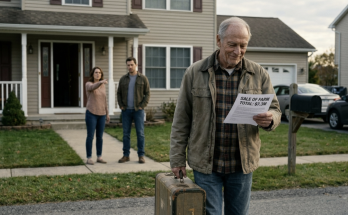
The Day My Successful Children Had No Room for Me
At seventy-one, Judith Bellamy never imagined that everything she owned would fit inside one faded suitcase.
She stood outside a grand stone house in Scarsdale, New York, with one hand wrapped around the handle of her suitcase and the other holding a wooden cane. A cold autumn wind moved through the carefully trimmed trees lining the driveway.
Behind the tall front door, Judith could hear her eldest son speaking.
“My business partners are coming tonight. What are they supposed to think if they see my mother sleeping downstairs?”
Judith froze before she could knock again.
Her son, Preston, had become a successful real estate developer. His home had six bedrooms, a heated swimming pool, a private office, and a guesthouse that seemed larger than the apartment where Judith had raised her three children.
Yet Preston was worried there would be nowhere to hide his mother.
When the door opened, he looked at Judith’s worn coat and old suitcase before meeting her eyes.
“Mom, you should have called first.”
“I did,” Judith answered quietly. “You didn’t pick up.”
Preston glanced over his shoulder as though he feared someone might see them talking.
“What happened?”
Judith swallowed the shame that had been sitting heavily in her chest all morning.
The small house she had shared with her late husband, Walter, had been taken by the lender after years of unpaid medical bills and mounting interest. Judith had tried to manage everything alone, but the final notice had arrived two weeks earlier.
That morning, she had handed over her keys.
“I only need somewhere to stay for a little while,” she explained. “I’m not asking you for money. I can sleep in the basement or even on the sofa.”
Preston rubbed his forehead.
His wife, Vanessa, appeared behind him wearing a cream sweater and holding a tablet.
“The basement is being remodeled,” she said. “And the guest room is prepared for my sister. She may visit next month.”
Judith looked toward the enormous staircase visible behind them.
“What about the smaller room near the kitchen?”
Vanessa’s expression tightened.
“That room is used for storage.”
Judith remembered working overnight shifts in a school cafeteria so Preston could attend a private university. She had sold her mother’s necklace to help him make the down payment on his first property.
When he was twenty-three, Preston had hugged her and promised that one day she would never have to worry again.
Now he stood in front of a house with more rooms than people and could not offer her a chair.
“I’ll book you a motel for two nights,” Preston said. “After that, we’ll figure something out.”
Judith understood what he truly meant.
After two nights, she would become someone else’s problem.
“Keep your money,” she replied. “I have one more place to go.”
Preston seemed relieved.
He leaned forward as if he might hug her, then stopped.
“Call me when you’re settled.”
The door closed gently, but to Judith, it sounded final.
Five Hundred Dollars and a Closed Gate
Judith’s youngest son, Wesley, had driven her to Preston’s house in his aging pickup truck.
Wesley worked as a carpenter and repairman. He rented a small two-bedroom apartment in Queens with his wife, Tessa, and their eight-year-old son, Micah.
When Judith returned to the truck, Wesley immediately understood.
“He said no, didn’t he?”
Judith placed the suitcase at her feet.
“Take me to Meredith.”
Her daughter, Dr. Meredith Bellamy, owned a private dermatology practice in Greenwich, Connecticut. She lived in a modern home with glass walls, polished floors, and a driveway wide enough for several cars.
Meredith came outside wearing fitted medical scrubs beneath a long coat. Her phone remained pressed to her ear until she saw Judith standing beside Wesley’s truck.
“I’ll call you back,” Meredith said before ending the conversation. “Mom, what are you doing here?”
Judith told her what had happened.
For a moment, Meredith looked concerned. Then her eyes shifted toward the suitcase.
“You’re asking to stay here?”
“Only until I can arrange something permanent.”
Meredith released a long breath.
“Mom, this house is not set up for an older person. There are stairs everywhere, and Graham works from home. The children have activities every afternoon. We don’t have time to provide the kind of care you might need.”
Judith stared at her daughter.
“I can still bathe myself, cook my meals, and clean a room. I’m not asking anyone to care for me.”
Meredith opened her designer handbag and pulled out several bills.
She placed five hundred dollars in Judith’s hand.
“Use this for food and transportation. There are excellent senior communities with assistance programs. I can ask my receptionist to send you a list.”
Judith looked down at the money.
Years earlier, when Meredith was studying medicine, Judith had skipped heating the house during one bitter winter to help pay for textbooks.
She closed her fingers around the bills, then placed them carefully on the stone pillar beside the gate.
“I came here looking for my daughter, not a referral.”
Meredith’s face flushed.
“That isn’t fair.”
“Neither is standing outside your child’s home and realizing there is no place for you inside.”
Judith turned away before Meredith could see her tears.
The Son Who Had the Least
Wesley said nothing during the drive back to Queens.
His apartment building stood above a laundromat on a crowded street. The hallway light flickered, and the elevator had been out of order for months.
When they entered the apartment, Tessa was sitting at the kitchen table sorting envelopes into two piles.
Bills they might be able to pay.
Bills that would have to wait.
Micah slept beneath a blanket on the sofa with a warm cloth resting across his forehead. He had been home from school with a stubborn fever.
Tessa stood when she saw Judith’s suitcase.
She did not ask whether Judith planned to stay.
She simply walked over and hugged her.
“You can have our bedroom,” Tessa said. “Wesley and I will sleep in the living room.”
Judith shook her head immediately.
“Absolutely not. I can sleep on the sofa.”
“Micah is already on the sofa,” Wesley said. “You’ll take his room. He can sleep with us until we work something out.”
Judith looked around the apartment. There was barely enough room for the family already living there, yet nobody spoke about inconvenience.
That evening, she overheard Wesley and Tessa talking quietly in the kitchen.
“The pharmacy won’t extend the account again,” Tessa whispered. “Micah needs the prescription, and the electric bill is due Friday.”
Wesley opened a drawer and removed a small velvet box.
Inside were their wedding rings.
“I’ll take them to the pawn shop in the morning.”
Tessa touched her ring for a long moment before removing it.
“We can buy them back someday.”
“I’m sorry,” Wesley said.
Tessa placed the ring in his palm.
“I married you, Wesley. I didn’t marry the ring.”
Judith covered her mouth to keep from making a sound.
Her wealthiest children had refused to share one empty room.
The son who had almost nothing was willing to trade the symbol of his marriage so his mother and child would have food, medicine, and warmth.
That night, Judith lay awake in Micah’s little bed, staring at the glow-in-the-dark stars on the ceiling.
For the first time, she understood that love was not proven by promises made during easy years.
Love revealed itself when there was barely enough to share, yet someone still moved over and made room.
The Envelope Behind the Cabinet
Three mornings later, someone knocked urgently on the apartment door.
Wesley opened it to find an older woman named Sylvia Crane standing in the hallway. Sylvia had lived near Judith and Walter for more than twenty years.
She held a thick, yellowed envelope.
“Judith, I’ve been trying to find you,” Sylvia said. “The new owners hired my nephew to remove some built-in cabinets. He found this taped behind the largest one in Walter’s study.”
Judith recognized her late husband’s handwriting immediately.
“For Judith—keep this safe.”
Her knees weakened.
Wesley guided her to a chair while she opened the envelope.
Inside were several financial statements, legal documents, and a letter.
“My dearest Judith,
If I am unable to explain this myself, contact Samuel Greer. I created this so you would never have to depend on anyone’s kindness. You spent your life protecting our family. This is my way of protecting you.”
Judith read the letter twice before looking at the documents.
The papers described a trust funded years earlier after Walter sold his share of a commercial warehouse in New Jersey.
Judith had believed most of that money had been used for his treatment and household debts. She had never known Walter placed a significant portion into a protected account.
The original trust contained $940,000.
With investments and accumulated interest, the balance had grown to more than $1.8 million.
“Is this real?” Wesley asked.
Judith could barely speak.
“I don’t know.”
That afternoon, they met with Samuel Greer, an estate attorney in Manhattan.
After verifying Judith’s identity and reviewing the papers, he folded his hands on the desk.
“Mrs. Bellamy, the trust is active. You are its sole primary beneficiary.”
Judith stared at him.
Her home had been taken while nearly two million dollars sat untouched in an account she did not know existed.
“Why didn’t anyone contact me?”
“The firm listed on the original documents closed years ago. Your husband apparently intended to give you the paperwork himself.”
Samuel leaned back.
“Before you tell anyone about this, I strongly recommend documenting your mental and legal capacity. Large sums of money often create sudden concern from relatives who showed very little concern before.”
Judith thought of Preston’s closed door and Meredith’s five hundred dollars.
“I understand,” she said.
Unfortunately, someone else learned about the trust before Judith could protect it.
Suddenly, Everyone Was Worried About Her
Four days later, two luxury vehicles stopped outside Wesley’s apartment building.
Preston arrived with Vanessa.
Meredith came with her husband, Graham, who worked as a regional banking executive.
They entered the small apartment and looked around as if the peeling paint might stain their clothes.
Preston spoke first.
“Mom, we heard about Dad’s trust.”
Judith’s eyes moved toward Graham.
“How did you hear about private financial information?”
Graham adjusted his cuff.
“Certain account activity triggered a review. I became aware of it through professional channels.”
Judith understood immediately.
He had searched for information that did not belong to him.
Meredith sat beside her mother and used the careful voice she reserved for nervous patients.
“Mom, this is a complicated financial situation. At your age, it would be easy for someone to influence you.”
Her eyes moved toward Wesley.
Preston continued.
“We think you should sign a financial power of attorney. Meredith and I can manage everything together. We’ll give you a generous monthly allowance.”
Wesley stood.
“It is her money. She doesn’t need an allowance.”
Preston pointed at him.
“You’ve had her here for less than a week, and now she happens to discover a fortune. That looks suspicious.”
Tessa stepped between them.
“He brought his mother home because neither of you would.”
Meredith ignored her.
“Mom, we may need an independent evaluation. Not because we want to upset you, but because we want to make sure you understand what is happening.”
Judith looked at her children one by one.
When she had possessed nothing but an old suitcase, Preston had worried about his partners and Meredith had offered money at the gate.
Now that Judith owned something valuable, they had arrived together, calling their greed concern.
“You are welcome to leave,” Judith said.
Preston laughed without humor.
“If Wesley is manipulating you, we will take legal action.”
Judith rose carefully, leaning on her cane.
“When I had nowhere to sleep, he opened his home. When you learned I had money, you opened a case against him. That tells me everything I need to know.”
Judith Made Her Own Decision
The following morning, Judith met Samuel Greer again.
She completed a full independent evaluation with a licensed specialist who asked her questions about dates, finances, family history, and the consequences of every decision she intended to make.
The final report stated clearly that Judith Bellamy was fully capable of managing her affairs and understood the nature of her assets.
With Samuel’s assistance, she established new protections around the trust.
“What would you like this money to do?” he asked.
Judith had thought about that question all night.
“I want a modest house with three bedrooms and a small yard. I want Wesley, Tessa, and Micah to live there with me, but I want legal safeguards so no one can force them out.”
Samuel made notes.
“I want to recover their wedding rings. I also want to help Wesley open a home repair and building supply shop. He understands the work, and Tessa is good with numbers.”
“And your other children?”
Judith looked out the window.
She did not hate Preston or Meredith.
A mother’s love did not disappear simply because it had been taken for granted.
But love did not require surrender.
“I want education funds for every grandchild. Payments should go directly to schools so none of the parents can withdraw the money.”
Samuel nodded.
“Anything for Preston and Meredith directly?”
“Not at this time. I already gave them my strength, my savings, and many years of sacrifice. I will not give them control of what remains of my life.”
Judith also directed part of the trust toward a housing program for older women facing financial hardship.
“No parent should have to stand outside a child’s home to discover how little space they have in that child’s heart,” she said.
The Meeting That Revealed Everything
One week later, all three children gathered in Samuel Greer’s conference room.
Judith arrived wearing a simple navy dress. She did not look wealthy.
She looked certain.
Samuel began by placing the capacity report on the table.
“Mrs. Bellamy has been independently evaluated and found fully capable of managing her legal and financial affairs. Any unsupported attempt to challenge her capacity will be addressed appropriately.”
Meredith’s face tightened.
Samuel continued.
“Mrs. Bellamy has established binding instructions for her trust. A residence will be purchased for her and for Wesley Bellamy’s family, ensuring her permanent housing and care.”
Preston pushed back his chair.
“So Wesley gets a house?”
Judith met his eyes.
“Wesley gave me a home when he did not have a spare room. You had several empty rooms and still left me outside.”
Samuel explained the business fund, the educational accounts for the grandchildren, and the charitable contribution.
Then he reached the final page.
“Preston and Meredith Bellamy will receive no direct distribution at this time.”
Meredith stared at her mother.
“How can you do this to your own children?”
Judith’s voice remained calm.
“I was still your mother when I stood outside your gate with my suitcase. I was still your mother when you placed five hundred dollars in my hand and suggested I find somewhere else to live.”
Meredith lowered her eyes.
At that moment, Graham’s phone rang.
He stepped away to answer it, but his voice quickly changed.
“An internal compliance review? I accessed the records because of a family concern. What do you mean it was unauthorized?”
His face lost its color.
Seconds later, Preston received a call from a major investor. Questions had surfaced about exaggerated property values and hidden debts connected to one of his developments.
Preston returned to the table looking shaken.
Samuel closed the file.
“Mrs. Bellamy’s trust will not be used to rescue businesses, careers, or personal debts.”
Preston looked at his mother.
“So you’re abandoning us?”
Judith felt pain move through her chest, but she did not look away.
“No, Preston. You let go of me first. I simply learned how to stop falling.”
The Home Beneath the Maple Tree
Months later, Judith moved into a white house in a quiet neighborhood outside White Plains.
A maple tree stood in the yard, and sunlight filled the kitchen each morning.
Micah had his own room. Tessa planted herbs near the back steps. Wesley repaired the porch himself.
Their store, Bellamy Home Supply, opened before winter.
Wesley understood tools, lumber, fixtures, and materials better than most people understood expensive suits. Tessa managed the accounts carefully.
The first personal purchase they made was not a car or new furniture.
They returned to the pawn shop and recovered their wedding rings.
One year later, Judith saw Preston sitting alone outside a bus station.
His expensive clothes were gone. His company had collapsed after investors withdrew their support, and Vanessa had moved away with the children.
For a moment, Judith saw the boy he had once been.
Then she remembered the man who had closed the door.
She walked over and offered him the sandwich she had packed for herself.
Preston began to cry.
“I don’t deserve anything from you.”
“You are still my son,” Judith replied. “But feeding you today does not mean surrendering my peace tomorrow.”
She told him Wesley’s store needed someone to clean, lift boxes, and organize deliveries.
“You would begin at the bottom, like everyone else.”
Preston nodded.
“I understand.”
Judith hoped he truly did.
Forgiveness, she had learned, did not require returning to the same place where someone had failed to value you.
Sometimes forgiveness meant leaving a small door open while keeping the locks on everything that needed protection.
A family should never be measured by the size of its homes, the value of its cars, or the titles printed beside its members’ names, because true family is revealed by who makes room when life becomes uncomfortable.
The people who promise to care for you during prosperous years may not be the same people who remain beside you when you arrive with nothing but a suitcase and a tired heart.
Generosity is most meaningful when it comes from someone who has little, because sharing from scarcity often requires more love than giving from abundance.
Parents may forgive their children’s mistakes, but forgiveness should never become permission for repeated disrespect, emotional pressure, or financial control.
Money does not always change people; sometimes it simply gives them a reason to reveal the intentions they had been hiding all along.
A person can remain loving while establishing firm boundaries, because protecting your peace does not mean your heart has become cold.
Success without compassion is only an impressive-looking building with no safe room inside for the people who helped construct its foundation.
No parent should feel ashamed for needing assistance after spending decades helping everyone else stand, grow, and reach opportunities they could not have reached alone.
The child who has the least may still offer the greatest gift, because loyalty cannot be measured by income, education, social status, or the neighborhood written on an address.
And sometimes the greatest inheritance a parent can leave is not money, property, or a successful business, but the lesson that love must be accompanied by dignity, responsibility, gratitude, and the courage to say, “You may enter my life with honesty, but you may never again use my heart as something you are entitled to control.”