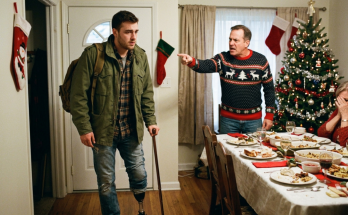
The fluorescent lights buzzed like angry wasps.
— You’re telling me you fell? Dr. Martinez didn’t look up from the X-ray.
— My sister pushed the cake into my face. I fell backward and hit the table.
I was still picking dried frosting from my hair. The staples in my scalp pulled every time I moved. After midnight, the ER had emptied out, just me and the doctor and the humming machines.
— Hmm. He traced something on the film with his fingertip. — And this happened last night?
— Yes. Around seven.
— And you waited until this morning to come in?
— I thought it was just a headache.
He turned then, and I saw something shift in his expression. His mouth went tight. His eyes moved from the X-ray to my face, then back again.
The silence stretched too long.
— Doctor?
— I need to make a phone call. He was already reaching for the wall phone. — Please stay here. Don’t leave this room.
My heart hammered against my ribs. — What’s wrong? Is there bleeding? A fracture?
— There’s a fracture, yes. He dialed three numbers. — But it’s not new. This is a healed fracture. And this small shadow here, and this one… these are patterns I see in abuse cases. Old trauma. Repeated trauma. And now this fresh injury from tonight.
The word “abuse” hit me harder than the table had.
— No, I started. — It was my sister. It was just a stupid birthday prank. She’s always been rough with me, but—
— Yes, this is Dr. Martinez at County General. I need police dispatch immediately. His voice was calm and urgent and absolutely terrifying. — I have a patient with injuries consistent with long-term assault. Head trauma, old and new. Possible pattern of domestic violence.
The room tilted.
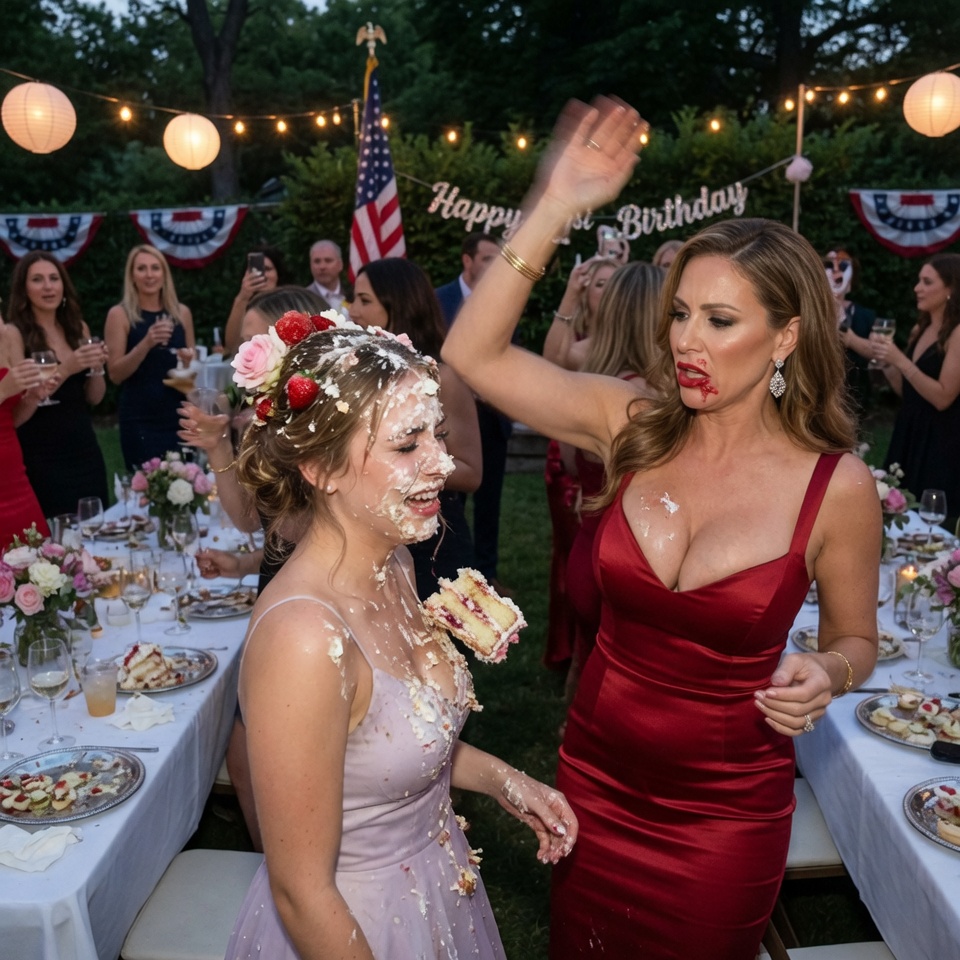
My sister Vanessa’s laughter echoed in my memory. The way she’d slammed that cake into my face, the force behind it. The way my chair tipped backward. The crack of my skull against the table edge. Blood mixing into pink frosting roses.
And everyone at the table—Mom, Dad, Pierce—they’d just sat there. Mom had said, “Vanessa, that might have been too much.”
Too much. Not wrong. Not violent. Just… too much.
— I need you to tell me everything, the doctor said after hanging up. — Every incident you can remember. Every fall, every accident, every time your sister “played rough.”
I opened my mouth to explain it was all a misunderstanding.
But the words wouldn’t come.
Because suddenly I was twelve years old, falling down the stairs with Vanessa’s hands still hot on my back. I was fifteen, my fingers caught in a car door she’d slammed while looking right at me. I was seventeen, drowning in a pool as everyone laughed at the “surprise” swim after my ear surgery.
Twenty-eight years of “jokes” and “accidents” and “just being dramatic.”
I touched the staples in my scalp.
And finally, for the first time, I stopped making excuses.
— I need to call my parents, I whispered.
— After the police arrive, Dr. Martinez said gently. — First, let’s make sure you’re safe.
The door opened. A police officer walked in, her badge catching the fluorescent light.
— Ma’am? I’m Officer Hayes. Can you tell me what happened at your birthday dinner?
I took a breath that shook all the way down.
And I started talking.
Part 2: Officer Hayes pulled a plastic chair close to my bed, the metal legs scraping against the linoleum floor. She didn’t pull out a notepad right away. Instead, she just looked at me with quiet, tired eyes that had probably seen a lifetime of women making excuses for the people who hurt them.
— Can you tell me what happened tonight? Your words, no rush.
I opened my mouth to say it was an accident, a misunderstanding, a birthday prank that went too far. Those were the sentences my family had been handing me since I could walk. But the staples pulled at my scalp, and the ghost images on the X-ray still glowed behind Dr. Martinez’s eyes, and something cracked open inside my chest.
— It was my birthday dinner, I said. — My sister, Vanessa, she invited me over. She said she wanted to make it special.
Officer Hayes nodded. — And did something happen at that dinner?
I pulled the thin hospital blanket up to my waist. The fluorescent lights buzzed. My voice came out strange, like it belonged to someone else.
— She smashed the cake into my face. Hard. I fell backward and hit my head on the edge of the dining table.
— Did she say anything before or after she did it?
I closed my eyes. The memory flashed in pieces. The flickering candles. Vanessa’s smile, wide and sharp. The sudden impact, the frosting clogging my nose, the taste of blood and sugar mixed together. Her laugh ringing out like a bell.
— She said it was just like when we were kids. And then she laughed. Everyone laughed. My mom said it might have been “too much.” My dad helped me up and told me to stop being dramatic.
Officer Hayes’s jaw tightened almost imperceptibly. She finally pulled out a small digital recorder and set it on the bedside table.
— I’m going to record this, with your permission. Is that okay?
— Yes.
She pressed the red button. — Tell me about when you were kids. You said “just like when we were kids.” Has she done things like this before?
The question unlocked a door I’d nailed shut years ago. I felt Dr. Martinez still hovering near the doorway, his arms crossed, his face unreadable. I looked at the X-ray monitor that still displayed the ghostly images of my skull. I could see the marks he’d pointed out, even if I didn’t understand them medically. Old breaks. Healed fractures. Proof that my body had been keeping score while my mind made excuses.
— Yes. All the time. Since I was little.
— Can you give me some examples?
I started with the stairs. I was twelve. It was the week after I’d won a spelling bee at school, and Mom had hung my certificate on the refrigerator. Vanessa ripped it down and threw it in the trash, and when I went to pull it out, she shoved me from behind. I tumbled down the entire flight—eleven wooden steps—and broke my wrist at the bottom. Vanessa stood at the top, her face blank, then suddenly twisted into panic. “She tripped,” she screamed. “Mom, Claire tripped on the carpet.” I was too stunned to correct her. By the time we got to the hospital, the story was set. The tripping story. The accident story. The version where Vanessa was the good sister who tried to grab my arm but couldn’t reach in time.
— And your parents believed her? Officer Hayes asked.
— They always believed her.
It came out flat, almost matter-of-fact. As if I were reciting a weather report. But my hands were shaking under the blanket. I told her about the car door when I was fifteen. I’d just gotten my learner’s permit, and Vanessa offered to let me practice driving her old sedan. But when I opened the front door, she slammed it shut with my fingers still curled around the frame. The pain was blinding, immediate. Two of my fingernails turned black and fell off over the next few weeks. Vanessa swore it was an accident—she hadn’t seen my hand there. And my parents nodded. “Vanessa feels terrible,” Mom said. “She’s been crying all night.” Nobody asked how I felt.
— She was crying? Officer Hayes repeated, like she couldn’t quite believe it.
— She cried after every single incident. It was part of the pattern. She’d hurt me, then immediately fall apart, and our parents would rush to comfort her. I’d end up apologizing to her for making her feel guilty.
— And what about your dad?
I let out a breath that was almost a laugh. — My dad told me I needed to learn how to take a joke. That’s his favorite phrase. He used it when Vanessa pushed me into the deep end of a pool two weeks after my ear surgery. I got a severe infection. I was deaf in one ear for three months.
Silence filled the room. Officer Hayes looked at the recorder as if she wanted to make sure it was still running. Dr. Martinez shifted his weight in the doorway, but he didn’t speak. I realized I’d never said any of this out loud before. Not all at once. Not without immediately following it with “but she didn’t mean it” or “I’m probably overreacting.”
— My parents always told me it was normal sibling stuff, I added. — That all sisters fight. That Vanessa was just more physical than most. They said I was too sensitive.
— And what did you believe?
The question landed like a stone in my stomach. For a long moment, I couldn’t answer. I thought about all the birthday cards Vanessa had given me over the years, the ones that said “Love you, sis” in loopy cursive, while her eyes held that same flat, hungry look. I thought about all the family dinners where I’d sat in silence while my parents praised her promotion or her parenting or her latest vacation. I thought about how small I’d learned to make myself, how I’d perfected the art of swallowing my own voice until I couldn’t even hear it anymore.
— I believed I was the problem, I whispered. — I believed everything they told me.
Officer Hayes reached over and gently touched my hand. Her fingers were warm and solid. She didn’t squeeze or pat or do the performative comfort gestures people do when they’re uncomfortable with someone else’s pain. She just rested her hand there and let the silence breathe.
— You’re not the problem, she said quietly. — You never were.
Dr. Martinez cleared his throat. — Officer, I’d like to add my medical findings to the record. The new injury alone—a depressed occipital skull fracture with mild subdural hematoma—is consistent with a significant blow, not a simple fall. But there are also at least three separate healed fractures visible on the CT scan. One to the left orbital, one to the temporal bone, and one to the right radius that appears to have been set improperly at some point. That fracture would be consistent with a childhood wrist injury.
— The stairs, I said automatically. — That’s the wrist.
— How old would you have been? Dr. Martinez asked.
— Twelve.
He turned back to Officer Hayes. — These are not injuries that happen from normal childhood play. Taken together, they indicate repeated, escalating trauma. I’m legally required to report this as suspected abuse.
The word “abuse” hung in the air like smoke. I wanted to wave it away, to open a window and let it escape. But it settled into my lungs and stayed there, heavy and undeniable. Abuse. Not sibling rivalry. Not roughhousing. Not jokes taken too far. Abuse.
Officer Hayes asked more questions, gentle but thorough. She wanted to know about the incident with the pool, the car door, the stairs, any other times Vanessa had touched me in anger or caused injury. She asked about emotional abuse, manipulation, isolation. She asked if anyone outside the family had ever noticed or tried to intervene. I thought about the teachers who had asked about bruises, the friends’ parents who had looked at me with concern but never followed up. I remembered my high school guidance counselor who had called my house once, and how my mother had screamed at me afterward for “airing our family’s private business to strangers.”
— My aunt knew, I said slowly. — My mother’s sister, Aunt Rosemary. She tried to talk to my parents once when I was fourteen. They stopped inviting her to holidays for three years.
— And she’s still in your life?
— She’s the only family member I still talk to. I paused, correcting myself. — The only one who talks to me, anyway.
By the time Officer Hayes turned off the recorder, the first pale light of dawn was bleeding through the hospital window blinds. The night had passed without me realizing it. I was exhausted in a way that went beyond physical, down into some deep well of myself I hadn’t known existed.
— We’re going to investigate, Officer Hayes said, standing up and tucking the recorder into her jacket. — Based on your statement and the medical evidence, I’m recommending pressing charges for assault and battery. I’ll be contacting the district attorney’s office first thing in the morning.
I felt a spike of pure, animal panic. — What about my parents? They’ll be furious. They’ll say I’m lying.
— Let them say it. Officer Hayes’s voice was calm but iron-hard. — The X-rays don’t lie.
She left, and Dr. Martinez came back a few minutes later to check my vitals. His hands were steady as he shined a light in my eyes, checked my reflexes, adjusted the bandage on my head.
— You did a brave thing, he said without looking at me. — I know it doesn’t feel like it right now. But you did.
I didn’t feel brave. I felt like a house that had been standing on a cracked foundation for twenty-eight years, and someone had finally pointed out that the walls were leaning. Now that I saw it, I couldn’t unsee it. And I was terrified the whole thing was about to collapse on top of me.
A nurse brought me breakfast, but I couldn’t eat. The scrambled eggs cooled into a rubbery yellow lump. The toast went stale. I kept my phone in my hand, staring at the screen, waiting for the calls I knew were coming.
The first one arrived at 8:17 AM.
Mom.
I let it ring. The voicemail notification appeared a minute later, and against every instinct screaming at me to delete it, I pressed play. Her voice filled the hospital room, sharp and familiar and already weaponized.
“Claire, it’s your mother. I just received a very disturbing phone call from the police. They’re saying you’re pressing charges against your sister. Against your own sister. I don’t know what you think you’re doing, but you need to stop this right now. You’re going to destroy this family over a little accident at dinner? Call me immediately.”
I set the phone down on the bedside table as if it had burned me. A little accident. The same phrase Dr. Martinez had used, but with completely opposite meaning. To him, it meant something that had left evidence behind. To her, it meant something I should be ashamed of even acknowledging.
The phone buzzed again. Dad.
This time I didn’t listen to the voicemail. I couldn’t.
I called Aunt Rosemary instead.
She answered on the second ring. — Sweetheart, are you okay? I heard from your mother—she sent a group text to the entire family. She’s telling everyone you’ve had some kind of breakdown and you’re making outrageous accusations.
I closed my eyes. — The doctor called the police. They’re pressing charges against Vanessa for assault. They found… old fractures on my X-ray. Things from when I was a kid.
The line went quiet for a long moment. Then I heard Aunt Rosemary exhale. It wasn’t shock. It was exhaustion. The sound of someone who had been waiting for this phone call for years.
— I was afraid of this, she said quietly. — I tried so many times to talk to your mother. When you broke your wrist, I told her it didn’t make sense. A twelve-year-old doesn’t just trip and fall down an entire staircase with that much force. And she looked me right in the eye and said, “Vanessa told us what happened. End of discussion.”
— Why didn’t you call social services?
— I did. She said it with a heavy, dull ache. — I called child protective services after the car door incident. Someone came to the house. By the time they arrived, your mother had rehearsed both of you. Do you remember that visit?
I searched my memory. There was a fuzzy image of a woman with a clipboard, my mother standing behind me with her hand on my shoulder, her fingers digging in just enough to remind me not to speak out of turn. I remembered Vanessa acting sweet and shy, her eyes wide, her voice trembling. No, officer, I’d never hurt my sister. We’re best friends. It was just an accident.
— I remember, I said. — Mom made me recite everything Vanessa had told me to say.
— And I couldn’t prove anything. After that, your mother cut me off. She told the rest of the family I was mentally unstable and trying to tear her marriage apart. I didn’t get to see you again until you were seventeen.
Tears burned at the corners of my eyes. All those years, I’d thought nobody had noticed. But Aunt Rosemary had noticed, and she’d been punished for it just like I had.
— I’m scared, I admitted. — Mom’s already calling. She’s telling everyone I’m crazy. What if nobody believes me?
— The X-rays are real, Rosemary said firmly. — The police are involved. This isn’t a family argument anymore. This is the law. And I will stand beside you through every second of it, do you hear me?
I nodded, even though she couldn’t see it. — I hear you.
— Get some rest. Don’t answer your parents’ calls. Let them leave messages. Everything they say can be evidence.
Evidence. The word felt cold and clinical, but also oddly comforting. Evidence meant objective truth. Evidence meant I wasn’t just a daughter with a grudge, a sister with a grudge. Evidence meant the X-rays, the staples, the recorded statement. Evidence couldn’t be gaslit.
That afternoon, Officer Hayes returned. She had a folder with her, thick with paperwork, and a new gravity in her expression.
— Vanessa was taken into custody about an hour ago. She’s being charged with aggravated assault. Her husband answered the door. He looked… Officer Hayes paused, searching for the right word. — Shaken. I think he’s been holding a few questions of his own for a long time.
— What happens next? I asked.
— An arraignment hearing will be scheduled, probably within the week. The DA will present the charges. Your sister will enter a plea. If she pleads not guilty, this goes to trial.
— And my statement?
— It’s part of the evidence. As are the medical records and the testimony from your doctor. Officer Hayes paused. — I’m not going to lie to you. Cases like this, where the abuse is mostly historical and the victim is an adult, can be tough. But this isn’t just historical. She attacked you last night, and we have witnesses. We’re going to interview everyone who was at that dinner.
I thought about Pierce, my brother-in-law. The awkward hug he gave me when I arrived. The way he’d looked at the floor when I was bleeding. He’d given me a towel while Vanessa laughed. He’d helped me into Dad’s car. In twenty-eight years, he was the first person in that house who had ever acknowledged something wasn’t right.
— Pierce might talk, I said. — Vanessa’s husband. He’s been… I think he’s been seeing things for a while. He just didn’t know what to do about it.
Officer Hayes made a note. — That could be very helpful. We’ll speak with him soon.
I was discharged from the hospital around three in the afternoon. Aunt Rosemary picked me up, her silver sedan smelling like lavender air freshener and the peppermints she always kept in the glove compartment. She didn’t try to fill the silence with chatter. She just squeezed my hand once and drove me home.
My apartment felt different when I walked through the door. Smaller, maybe. Or bigger. Or both. The walls were the same pale gray I’d painted them two years ago. The couch cushions still sagged in the middle the way they always had. But something fundamental had shifted. The space no longer felt like a hiding place. It felt like a command center.
I sat on the couch and let Aunt Rosemary make me tea. She moved around my kitchen like she’d done it a thousand times, even though she’d only visited a handful of occasions. She found the honey without asking, added a splash of milk, handed me a steaming mug.
— Here’s what’s going to happen, she said, sitting across from me. — Your parents are going to circle the wagons. They’re going to call every relative, every family friend, every person they’ve ever met, and they’re going to tell them you’ve lost your mind. They’ll say you’ve always been difficult, always been jealous of your sister, always been looking for attention.
— That’s what they’ve always said.
— I know. She leaned forward, her eyes fierce. — But now it’s not just their word against yours. It’s their word against medical records. Against police reports. Against a jury, if it comes to that. And you have me. You have the truth. You can survive this.
I held the warm mug against my chest and let her words settle into my bones. For the first time in as long as I could remember, someone believed me without requiring evidence first. Someone had believed me all along.
I didn’t sleep much that night. Every time I closed my eyes, I saw Vanessa’s face looming over me, cake smeared across her palm, her smile stretched wide. I heard my mother’s voice on the voicemail, cold and accusatory. I felt the ghost of my father’s disappointment, heavier than any physical blow.
I got out of bed at 3 AM and opened my laptop. I started writing down everything I could remember. Every shove. Every slap disguised as a playful tap. Every “joke” that left a bruise. Every time my parents looked the other way. The document grew and grew until my eyes burned from the screen, and by the time I finished, I had forty-three pages of pain I’d never allowed myself to name.
When I finally collapsed into sleep, I dreamed I was twelve years old again, lying at the bottom of the stairs with a broken wrist. But this time, when I looked up, it wasn’t Vanessa standing at the top. It was Officer Hayes, her hand extended toward me, ready to pull me to my feet.
The arraignment hearing took place in a small, wood-paneled courtroom that smelled like floor wax and old paper. I sat in the back with Aunt Rosemary, her hand wrapped around mine. Vanessa stood at the front with her attorney, a tall man in an expensive suit who looked at her with the tired patience of someone who’d heard a very different version of events from his client.
When the judge read the charges—aggravated assault, battery, and a third count of reckless endangerment—Vanessa’s face flickered through a dozen emotions before settling on wounded outrage. She’d dressed carefully for the occasion: a modest blouse, minimal makeup, her hair pulled back in a way that made her look younger and softer. The woman who’d smashed a cake into my skull hard enough to fracture bone was nowhere in sight.
— Not guilty, Vanessa said when the judge asked for her plea. Her voice trembled just enough to sound like a victim. — I would never hurt my sister on purpose. This is all a terrible misunderstanding.
The judge, a stern woman named Judge Anderson, looked at Vanessa over the top of her glasses. — Duly noted. The court will reconvene for pre-trial motions in sixty days. The defendant is released on her own recognizance with a temporary protective order barring any contact with the alleged victim.
Vanessa nodded, dabbing at her eyes with a tissue. As she turned to leave, she looked directly at me. And for one brief, unguarded moment, the mask slipped. I saw the flat, cold fury I’d seen a thousand times before in the moments just before she hurt me. Then it was gone, replaced by the trembling-lipped performance she’d perfected since childhood.
My parents were waiting in the hallway when I stepped out. Dad’s face was flushed with anger, Mom’s pale with something that looked like grief. They didn’t rush toward me. Instead, Dad walked over slowly, the way you approach a stray dog you don’t trust.
— Claire, he said, his voice low and tight. — This has gone far enough. Call the prosecutor. Tell them you exaggerated. Tell them you were stressed and confused. We can still fix this.
I saw Aunt Rosemary start to step forward, but I held up my hand. I looked at my father—the man who’d taught me how to ride a bike, who’d come to my school plays, who’d told me bedtime stories about brave knights and clever princesses. And I saw, for the first time, the coward who’d looked away every time his daughter was bleeding.
— The X-rays don’t exaggerate, Dad. The broken bones don’t exaggerate. The staples in my head don’t exaggerate.
— That’s not what I’m saying—
— Yes, it is. It’s exactly what you’re saying. You’re saying my reality isn’t real. You’ve been saying it my whole life. And I’m done pretending.
His face went very still. Mom stepped up beside him, her hand clutching his arm. She didn’t speak. She just stared at me as if I were a stranger wearing her daughter’s skin.
— If you go through with this, Dad said quietly, — you won’t have a family anymore. Is that what you want?
The words hit me like a slap. But I didn’t crumble. I thought about the staples, the X-rays, Aunt Rosemary’s hand in mine.
— I haven’t had a family for a long time, I said. — I just didn’t know how to admit it.
I turned and walked away, Rosemary at my side. The corridor stretched ahead of us, cold and bright and terrifying. But my feet kept moving. And for the first time in my life, I didn’t look back.
The weeks leading up to the trial were a slow-motion hurricane. My parents did exactly what Aunt Rosemary had predicted—they called every relative, every family friend, anyone who might listen. The story they told was polished and precise: Claire had always been unstable. She’d been jealous of Vanessa since childhood. This was a vindictive attempt to destroy her sister’s reputation because she couldn’t handle a harmless birthday joke. The cake smash was an accident. The old injuries were childhood mishaps blown wildly out of proportion.
Some relatives bought it completely. My mother’s brother, Uncle Paul, sent me a long email about family loyalty and forgiveness, urging me to “let go of bitterness before it consumes you.” My father’s sister, Aunt Linda, posted a vague, passive-aggressive status on Facebook about how “blood is thicker than water, but some people forget that.” I blocked her.
A few cousins reached out privately with messages that were as cautious as they were conflicted. “I believe you, I think, but I can’t say anything publicly or my mom will never speak to me again.” I understood. I’d spent my whole life trapped in that same silence.
Then there was Aunt Rosemary. She took the calls none of them had the courage to make. She told the relatives who would listen that she’d seen the signs for years. She told them about the pool incident, the car door, the stairs. She asked them where they’d been when a twelve-year-old had shown up to Easter dinner with a cast on her wrist and a terrified look in her eyes. Most of them couldn’t answer.
The worst day came about three weeks before the trial. I received a package at my apartment with no return address. Inside was a photo album I’d never seen before—one my mother had kept hidden all these years. It was filled with pictures of me and Vanessa as children: matching Christmas pajamas, birthday parties with lopsided cakes, beach vacations with sandy smiles. But someone had gone through the album with a red marker and crossed out my face in every single photo. In the margins, in my mother’s handwriting, were notes: “Liar.” “Traitor.” “You ruined her.”
I sat on my kitchen floor and shook for an hour. Aunt Rosemary came over when I called her. She looked at the album, closed it carefully, and set it aside.
— This is evidence, she said quietly. — We’ll give it to Christine.
Christine Walker, my attorney, was a sharp, no-nonsense woman in her forties who’d been practicing criminal law for nearly two decades. The first time we met, she’d listened to my entire story without interrupting, her pen moving steadily across a yellow legal pad. When I finished, she set the pen down and met my eyes.
— I’ve seen a lot of cases, she said. — This is one of the most textbook examples of long-term family abuse I’ve ever encountered. The medical records are damning. The witness testimony from your brother-in-law is going to be crucial, and from what the police have told me, he’s cooperating. But we need to prepare you for what the defense is going to do.
— My sister’s lawyer?
— He’s going to try to tear you apart on the stand. He’s going to call you dramatic, vindictive, attention-seeking. He’s going to bring up every mistake you’ve ever made and twist it into a character flaw. He’s going to try to make the jury believe you’re just a bitter younger sister who’s jealous of Vanessa’s success.
— But the X-rays—
— The X-rays are strong. Very strong. But juries are emotional. They want a story that makes sense to them. The defense’s story is going to be: “Why is this adult woman suddenly making accusations about childhood events? What does she have to gain?” We need to give them a better story. A truer story.
So we worked. Christine coached me through mock cross-examinations, her voice sharp and relentless. She pushed me until I broke down crying, then pushed some more. She taught me how to stay calm when every instinct told me to scream. She taught me how to look the jury in the eye and tell them the truth without flinching.
Dr. Forester, my therapist, entered my life around that same time. Christine had recommended her, saying I needed professional support to handle the psychological toll of the trial. Dr. Forester had a small office decorated with plants and soft lighting, and she spoke in a voice so gentle it sometimes made me cry just to be addressed that way.
During one of our early sessions, she asked me to describe my relationship with my parents. I talked for almost an hour straight, the words pouring out like water from a cracked dam. I described the endless cycle—Vanessa hurting me, Mom comforting Vanessa, Dad telling me to lighten up. I described the way love was always conditional, offered only when I played my assigned role as the difficult daughter who needed to be managed.
— What do you want from them now? Dr. Forester asked.
— I want them to see me, I said. — Just once. I want them to look at me and see a person, not a problem.
— And if that never happens?
The question hung between us. I stared out the window at the gray sky.
— Then I have to learn to be seen by myself, I guess.
Dr. Forester nodded slowly. — That’s a good place to start.
Pierce’s deposition was a turning point. I wasn’t in the room when it happened—Christine handled it—but she called me afterward, her voice vibrating with the kind of energy she rarely showed.
— Your brother-in-law confirmed everything. And I mean everything. He’s been documenting Vanessa’s behavior for over a year. Journal entries. Recorded arguments. He was building a case for a custody battle before any of this even happened.
— He knew? I felt dizzy. — All this time, he knew what she was doing?
— He suspected. But he told us your family’s gaslighting was so intense that he genuinely doubted his own perceptions for years. Your parents, your mom especially, convinced him that this was all just “sibling dynamics” and he was being too sensitive. Sound familiar?
It did. I thought about all the times Pierce had looked at me a little too long, a little too carefully. The way he’d sometimes step between Vanessa and me at family gatherings, as if unconsciously trying to create a buffer. The quiet, awkward way he’d handed me that towel on my birthday while everyone else was laughing.
— He’s filing for divorce, Christine added. — And he’s willing to testify. The prosecution is calling him as a witness.
That night, I sat on my balcony and stared at the stars. The city hummed around me, oblivious and indifferent. Somewhere out there, Vanessa was probably screaming at Pierce, or crying to my mother, or plotting her next move. But she couldn’t reach me anymore. The protective order was firmly in place. Any attempt to contact me would result in immediate arrest. For the first time in my life, there was a wall between us she couldn’t break through.
The trial began on a rainy Tuesday in early November. The courtroom was small and crowded, the air thick with tension and the smell of damp wool coats. My parents sat on Vanessa’s side, their faces carved from stone. Aunt Rosemary sat on mine, her hand resting on my knee. A handful of reporters occupied the back row—the case had gotten local news coverage after someone leaked details of the medical evidence. “Sister Charged with Assault After Birthday Cake Attack Reveals Decades of Abuse,” one headline read. The attention felt surreal, like reading about someone else’s life.
The prosecution opened with the medical evidence. Dr. Martinez took the stand and walked the jury through the X-rays with calm, devastating precision. He pointed out each healed fracture, explained how long they would have taken to heal, described the level of force required to cause each one. When the prosecutor asked him to compare the newly visible fracture patterns to the types of accidents Vanessa had claimed caused them, he shook his head.
— A fall down stairs typically produces specific patterns of injury depending on whether the person trips or is pushed. The pattern I see in the 2010 wrist fracture is more consistent with a high-impact shove from behind. A car door closing on a hand with the force described here—two crushed fingernails, hairline fractures in three metacarpal bones—would require significant force. More than an accidental slip.
The defense attorney tried to poke holes. He questioned whether the old injuries could have been caused by childhood sports or general clumsiness. He suggested that the medical records were being interpreted with hindsight bias. But Dr. Martinez remained steady, his voice never wavering.
— In my professional opinion, these injuries, taken together with the new trauma sustained on the evening in question, indicate a pattern of repeated physical assault over a period of at least sixteen years.
The jury looked at Vanessa. She sat very still, her expression carefully arranged into one of bewildered innocence. But I saw her hands, tucked beneath the defense table, trembling. Not with fear. With rage.
Pierce testified on the third day. He walked to the stand with the heaviness of a man carrying a burden he’d never asked for. His voice was quiet but clear as the prosecutor led him through the events of my birthday dinner. He described the moment Vanessa slammed the cake into my face—the force of it, the way my chair tipped, the sickening sound of my head hitting the table. He described my blood on the floor, my parents’ immediate excuses, Vanessa’s laughter.
— Were you surprised by what happened? the prosecutor asked.
— No. Pierce paused, his jaw working. — I wish I could say I was. But I’d seen her be cruel before. Never quite this badly, but… I’d seen the pattern. I just didn’t want to believe it was as serious as it was.
He described arguments he’d had with Vanessa over the years, moments when she’d say something about me so venomous it had shocked him. He talked about the time he’d found a journal of hers where she’d written about how “easy” it was to manipulate me. He’d confronted her, and she’d cried and apologized and promised to change. And for a few months, things would be better. Then the cruelty would creep back in, slow and subtle, until it felt normal again.
— Why didn’t you leave sooner? the prosecutor asked.
Pierce looked at the jury, then at Vanessa. His eyes were filled with something that looked like grief.
— Because I loved her. And because her parents, everyone around her, kept telling me this was just how sisters were. That Claire was too sensitive. That Vanessa meant well. And I wanted to believe them. Believing them was easier than facing what was really happening in my home.
The cross-examination was brutal. Vanessa’s attorney tried to paint Pierce as a bitter husband using the trial to gain leverage in a custody dispute. He brought up a few minor conflicts Pierce and Vanessa had had in their marriage, tried to suggest that Pierce was exaggerating or even fabricating his testimony to hurt his soon-to-be ex-wife. But Pierce didn’t crack. He answered every question with the same quiet, exhausted honesty. And when the defense attorney finally dismissed him, several members of the jury were watching Pierce with undisguised sympathy.
Then it was my turn.
I’d been dreading this moment for weeks. The thought of sitting in that chair, facing down Vanessa’s lawyer, with my sister’s eyes boring into me from across the room, made my stomach twist into knots. But Christine had prepared me well. And Aunt Rosemary was in my eyeline, her face calm and steady. I focused on her as I walked to the stand and swore to tell the truth.
The prosecutor’s questions were gentle. She led me through the story chronologically, starting with my earliest memories of Vanessa’s cruelty. The shoves that were always just “playing.” The pinches that left bruises my mother claimed were from playground accidents. The words—the endless stream of casual cruelty disguised as jokes. “You’re so ugly, it’s a good thing you’re smart.” “Nobody actually likes you, you know. They just feel sorry for you.” “If you died tomorrow, I think Mom and Dad would finally be happy.”
The jury shifted uncomfortably. I could see them reevaluating Vanessa, who sat there in her soft blouse with her trembling-lip performance. The image of the innocent victim was starting to crack.
Then came the cross-examination.
Vanessa’s attorney, Mr. Calloway, was good at his job. He approached me with a smile that didn’t reach his eyes, and his first question was deceptively mild.
— Ms. Hartley, you’ve described a childhood that sounds very difficult. Why didn’t you ever report this to anyone?
— I tried, I said. — Once, I told a teacher about the bruises. She called my parents. They told her I was lying for attention. After that, I learned not to try again.
— And as an adult? You’re twenty-eight years old. Why wait until now to press charges?
— Because until now, I didn’t have proof. Until that night, I still believed I was overreacting. I thought… I thought everyone was right about me. That I was just too sensitive.
— So you’re saying you didn’t know you were being abused until a doctor told you?
The question was designed to make me sound absurd. I took a breath, remembering Christine’s coaching.
— I’m saying I was trained from childhood to believe that what was happening to me wasn’t abuse. That’s what gaslighting does. It makes you doubt your own reality.
Mr. Calloway changed tactics. He brought up my job, my relationships, anything that could be twisted into a character flaw. He suggested I was jealous of Vanessa’s successful career, her happy marriage. He asked if I’d ever sought psychiatric help, implying that my mental state made me unreliable. Christine objected multiple times, and the judge sustained her objections, but the damage of the insinuations lingered.
Then he asked the question that nearly broke me.
— Ms. Hartley, do you hate your sister?
I looked at Vanessa. She was watching me with the smallest, almost imperceptible smile. The smile of someone who was absolutely certain she was going to win.
— No, I said. — I don’t hate her. I used to love her. I wanted her to love me back. That’s the part that still hurts.
The smile vanished.
Mr. Calloway dismissed me shortly after. I walked back to my seat on legs that felt like rubber. Aunt Rosemary squeezed my hand. Christine leaned over and whispered, — You did perfectly.
The jury deliberated for three days. I spent those days in a haze of anxiety, barely eating, barely sleeping. I went through the motions of my life—therapy sessions with Dr. Forester, long phone calls with Aunt Rosemary, aimless walks through the park near my apartment—but my mind was always in that courtroom, watching twelve strangers decide whether my entire lifetime of suffering was real enough to matter.
When the verdict came back, I couldn’t feel my fingers.
Guilty on all counts.
Vanessa’s sentencing happened a month later. Judge Anderson looked at her with the kind of exhaustion I recognized—the weariness of someone who’d seen too many people refuse to take responsibility for too much harm.
— The evidence presented in this trial indicates a pattern of violence stretching back nearly two decades, Judge Anderson said. — The defendant has shown no genuine remorse. She has, at every opportunity, blamed the victim for her own injuries. This court cannot overlook the severity or duration of the abuse.
Vanessa was sentenced to three years of probation, two hundred hours of community service, mandatory anger management and psychological counseling, and a permanent protective order barring any contact with me. The sentence was lighter than it could have been—no prison time, which infuriated Christine—but the protective order was permanent, and that was what mattered most.
My parents didn’t attend the sentencing. They’d stopped coming to the trial after Pierce’s testimony, and I later learned they’d moved to be closer to Vanessa, helping her navigate the divorce and custody proceedings. They sent me one final email, jointly written, announcing they were cutting off contact until I “came to my senses” and dropped the protective order. The email was CC’d to seventeen extended family members.
I read it, deleted it, and called Dr. Forester.
— How do I accept that my parents chose her over me? I asked. — Again. Still. Forever?
— You don’t have to accept it all at once, Dr. Forester said. — Grief is a process. Let yourself grieve the family you never really had.
So I did. I grieved in therapy, in the quiet hours of early mornings, in the tears that ambushed me at random moments—the grocery store, the office, a park bench. I grieved for the little girl who’d gone home with a broken wrist and no one to defend her. I grieved for the teenager who’d nearly drowned and been told it was a joke. I grieved for the woman I could have become if I hadn’t spent twenty-eight years believing I was the problem.
And then, slowly, I started to rebuild.
I moved to a new city six months after the trial concluded. A fresh start, Christine called it. A chance to be someone other than Vanessa’s victim or Gerald and Lorraine’s difficult daughter. I found a small apartment in a neighborhood full of coffee shops and used bookstores, got a job at a marketing firm that valued my skills without knowing anything about my past, and started cautiously building a life that felt like my own.
My new boss, Catherine, was a warm, efficient woman who offered praise freely and criticism kindly. The first time I made a significant mistake on a project, she called me into her office, and I braced myself for the kind of verbal lashing I’d been conditioned to expect. Instead, she said, — Let’s walk through what happened and figure out how to fix it. Mistakes happen. That’s how we learn.
I nearly cried right there in her office.
I made friends who knew nothing about the trial or the news coverage. Sarah from accounting invited me to her book club, and I went, even though my instinct was to decline. The group met monthly in different members’ homes, drinking wine and debating whether fictional characters were being idiots. Nobody asked invasive questions about my family. Nobody looked at me with pity in their eyes. I was just Claire, the new girl who had strong opinions about unreliable narrators.
Through Sarah, I met Marcus, who worked in IT and had an encyclopedic knowledge of bad sci-fi movies. Our friendship started with a shared eye roll at a book club meeting when someone insisted Blade Runner was the worst thing ever made, and it deepened into weekend movie marathons where we competed to find the most ridiculous special effects. Marcus was easy in a way I hadn’t known friendship could be. He didn’t need me to be entertaining or agreeable. He just showed up with snacks and terrible movies and a complete absence of judgment.
For the first year in my new city, I didn’t date. I needed time to figure out who I was without the distorting mirror of my family’s expectations. Dr. Forester, who I continued seeing via video calls, helped me navigate the process of learning to trust my own perceptions again.
— You spent decades being told your feelings were wrong, she said during one session. — It’s going to take time to learn to trust them again. Be patient with yourself.
I took her advice literally. I started a journal where I wrote down my emotional reactions to everyday situations, then reviewed them a week later to see if they still felt true. Almost always, they did. My instincts weren’t broken. They’d just been buried under layers of gaslighting.
Pierce reached out about eighteen months after the trial. His divorce had been finalized, Vanessa’s visitation with Madison and Tyler was supervised pending completion of her court-mandated counseling, and he’d started dating a woman named Laura who the kids apparently adored. He wanted to know if I’d be open to occasional communication.
We met for coffee at a neutral location—a small café in the town where he’d moved with the children. He looked older, the lines around his eyes deeper, but also lighter somehow, as if a weight had been lifted from his shoulders.
— I owe you an apology, he said as we sat down. — A real one. I should have done something sooner. I saw what was happening, or at least I saw enough to know something was wrong, and I stayed quiet because it was easier.
— You testified, I said. — That wasn’t nothing.
— It was the bare minimum. He looked down at his coffee cup. — I’ve been talking to Madison about her mother. Age-appropriate stuff. She’s starting to ask questions about why you’re not in our lives.
My heart tightened. — What do you tell her?
— The truth, gently. That her mother hurt you for a long time, and you needed to protect yourself. That sometimes love means staying away from people who aren’t safe, even when they’re family. She understands more than I expected.
— And Tyler?
— He’s still young. He just knows he has an aunt he doesn’t see. Someday, when they’re both old enough, I’d like them to be able to make their own choices about contacting you. If that’s something you’d be open to.
I thought about it for a long moment. These children were not their mother. They bore none of the blame for what Vanessa had done. And I remembered being a child in a family where communication was controlled, where contact was weaponized. I didn’t want to repeat those patterns.
— When they’re older, I said, — I’d like them to know they can reach out. But I need to meet them in a context that doesn’t put them in the middle of anything. No pressure, no expectations.
Pierce nodded, and I saw his eyes glisten. — Thank you. That’s more than I had any right to ask for.
The memoir came about almost by accident. I’d been writing privately for years—journal entries, fragments of memory, letters I’d never send—and one day, during a conversation with a writer I’d met at a local literary event, I mentioned the project. She was silent for a moment, then said, — That’s a book. You have a book.
I brushed it off at first. The idea of putting my story into the world, of exposing the ugliest parts of my life to strangers, felt terrifying. But the idea kept coming back. I thought about the people who’d been in similar situations, living with the same shame and self-doubt I’d carried for decades. I thought about the power of seeing your own experience reflected in someone else’s words—the way it could cut through isolation and make you feel less alone.
I found a ghostwriter named Rebecca, a patient woman in her fifties who specialized in memoir and had helped other survivors tell their stories. We met weekly, first over coffee, then at her small office cluttered with books and plants. I talked, and she recorded, and slowly, painstakingly, the story took shape.
The hardest chapter to write was about my parents. I kept softening their role, making excuses for them, padding their failures with context. Rebecca would read my drafts and gently push back.
— You’re still protecting them, she said once, after we’d been working together for months. — You’re writing about them the way you’ve been trained to think about them—as people who meant well, who just didn’t understand. But your own words tell a different story.
— What story?
She pulled out the draft and pointed to a paragraph I’d written about the time my mother found bruises on my arms after a family gathering. Mom had looked at them, then looked at Vanessa, then looked back at me. “Don’t start anything,” she’d said.
— That’s not a mother who didn’t understand, Rebecca said. — That’s a mother who knew exactly what was happening and chose to protect the abuser instead of the victim. You need to name that.
Naming it was excruciating. It meant letting go of the fantasy that my parents had just been clueless, that they’d loved me in their own misguided way. It meant accepting that the neglect was active, not passive. That they’d made conscious choices, over and over, to prioritize Vanessa’s feelings over my safety.
But once I named it, something shifted. The guilt I’d been carrying—the persistent, suffocating belief that I’d torn the family apart by pressing charges—finally started to dissolve. I hadn’t destroyed anything. The family had been broken long before that birthday dinner. I’d just been the one to finally stop pretending it wasn’t.
The book was published two years after the trial. It was a quiet release, not a blockbuster, but it found an audience. I started receiving emails and letters from people who’d read it—some with similar stories, some who’d never told anyone what they’d endured. A few asked for advice, which I wasn’t qualified to give, but I shared what had helped me: therapy, boundaries, the long, messy work of learning to trust your own reality.
The book also attracted attention from people in my past. Some extended family members reached out, sheepishly admitting they’d believed my parents’ version of events and now felt terrible. I had complicated feelings about these messages. I appreciated the acknowledgments, but I also remembered their silence when I’d needed them most.
My parents sent a cease-and-desist letter through their attorney, demanding the book be pulled from publication. Christine handled it efficiently, responding with a detailed letter pointing out that every claim in the book was either a matter of public record or a protected expression of personal experience. The letter was firm and legally airtight, and I never heard from my parents’ attorney again.
Aunt Rosemary threw me a small publication party at her house. She invited friends from her book club, a few of her coworkers, and a handful of neighbors. Marcus drove three hours to attend, bringing a ridiculous cake shaped like a typewriter that made me laugh so hard I nearly cried. Sarah sent flowers with a note that said, “Proud to know you.”
That night, after everyone had gone home, Rosemary and I sat on her back porch, watching fireflies blink in the dark.
— You know, she said, — I used to pray your parents would see the truth. I thought if they could just understand what was happening, everything would change.
— They did understand, I said. The words no longer felt sharp in my mouth. — They just made a choice.
— I know. Rosemary sipped her tea. — Your mother was the same way with me when we were younger. The dynamic was different, but the pattern was the same. I was always the one causing problems by pointing out problems. She was always the one who got to be the victim of my “cruelty.”
I looked at her, this woman who had been cut off from her own sister for years because she’d tried to protect me. — How did you survive it?
— I built a different family. Friends, colleagues, people who saw me clearly. It took a long time, and it hurt like hell, but eventually the new family felt more real than the old one ever did.
I leaned against her shoulder, and we watched the fireflies until the night swallowed them.
The years unspooled slowly after that. I turned thirty, then thirty-two, then thirty-five. The staples scar faded to a thin silver line along my hairline, barely visible. The other scars—the ones nobody could see—took much longer to fade, and some never did. Dr. Forester and I transitioned from weekly sessions to monthly, then to occasional check-ins. I learned to navigate triggers without being overwhelmed by them. I learned to recognize the difference between healthy caution and the hypervigilance I’d developed as a survival mechanism.
I started dating again, tentatively at first, then with more confidence. There were a few false starts, men who didn’t understand why I had firm boundaries or why I flinched at certain types of teasing. I learned to screen for red flags I’d been trained to ignore. I learned that love didn’t have to hurt.
Then I met someone who didn’t flinch at my history. His name was Ben, and he was a high school history teacher who’d grown up in a large, noisy, functional family that had taught him what healthy love looked like. On our third date, I told him the short version of my story, bracing myself for the awkwardness that usually followed. He listened quietly, then reached across the table and took my hand.
— Thank you for trusting me with that, he said. — I’m glad you survived.
No pity. No performative horror. Just acknowledgment and gratitude. I think that’s when I started falling in love with him.
We took things slow. I’d learned too much about the cost of rushing into relationships to make that mistake again. But Ben was patient in a way that felt genuine, not performative. He didn’t push. He didn’t try to fix me. He just showed up, consistently and kindly, until one day I realized I trusted him completely. It was a strange and wonderful feeling.
Pierce’s children, Madison and Tyler, grew up in the way children do—fast and surprising. When Madison turned sixteen, she reached out to me through an email that had clearly been drafted and revised a dozen times. She wanted to know her aunt. She’d heard enough from her father to understand the basics, and she wasn’t looking for a relationship with her mother’s version of events. “I just want to know you,” she wrote. “If you’re open to that.”
I was. We started with video calls, stiff and careful at first, then gradually more comfortable. Madison was thoughtful and curious, with her father’s gentle demeanor and none of her mother’s cruelty. Tyler, two years younger, was shyer but equally sweet. They both asked hard questions, and I answered as honestly as I could without burdening them with more than they were ready to handle.
I never pressured them to take sides. I simply existed as an option, an open door. And they walked through it, slowly but steadily.
I heard about Vanessa only in fragments, filtered through Pierce or Aunt Rosemary or the occasional news story that referenced the case. She’d completed her court-mandated therapy, petitioned for and received a modification to her custody arrangement that allowed unsupervised visitation with the children. She’d apparently moved to a different state and remarried. The thought of her still sent a chill down my spine, but it no longer consumed me. She had become a scar, not an open wound.
The protective order remained in place, permanent and unchallenged. I lived my life without fear that she’d appear on my doorstep or ambush me at a family gathering. It was a freedom I’d never known before, and I didn’t take it for granted.
On my fortieth birthday, I threw myself a party. Not a small, quiet dinner this time, but an actual party—catered food, a rented event space, friends from every chapter of my life crowding together in one loud, joyful room. Aunt Rosemary flew in from her new retirement community in Arizona. Marcus came with his boyfriend. Sarah brought her entire book club. Catherine, my old boss, showed up with a bottle of wine that probably cost more than my first car. Pierce drove down with Madison, now a college freshman, who’d baked me a cake herself—a beautiful lemon lavender creation she’d been perfecting for weeks.
I looked around that room, at all the people who’d chosen to be in my life, and felt something I hadn’t felt at any birthday since I was a child: genuine, uncomplicated happiness.
Ben found me at the edge of the dance floor, nursing a glass of champagne. — You look overwhelmed, he said.
— Good overwhelmed, I clarified. — The kind where you can’t believe this is actually your life.
He smiled and kissed my forehead. — Believe it. You built this. Every bit of it.
Later, after the cake had been served and the guests were starting to thin out, I stepped outside for a moment of quiet. The night air was cool and clean, and the stars were bright overhead. I thought about the last birthday party I’d spent with my family of origin. The cake. The fall. The blood. The laughter. It felt, finally, like a story that belonged to someone else—someone I used to be, a version of myself I’d shed like old skin.
I took out my phone and scrolled to the folder labeled “Reasons to Keep Going.” It was full now, stuffed with messages from readers, photos from friends, quotes that had pulled me through dark days. I added a new note: “Today I turned forty, surrounded by people who love me. I am safe. I am whole. I am glad I survived.”
I slipped the phone back into my pocket and rejoined the party. The music was loud, the laughter louder. And for the rest of the night, I danced like someone who had finally learned that she deserved to take up space.
The truth Dr. Martinez saw in those X-rays hadn’t just been evidence of old fractures. It had been the key that unlocked every locked door, every silenced memory, every story I’d been too afraid to tell. It had given me permission to stop forgiving what should never have been forgiven, to stop excusing what could never be excused. It had given me the terrifying, liberating gift of truth.
Some stories end with families healing, with difficult conversations that lead to reconciliation. This isn’t that story. Some wounds are too deep. Some betrayals are too absolute. Some families are too committed to their self-protective fictions to ever choose truth over comfort.
But other families are built from scratch, assembled piece by piece from the people who choose you—and who you choose back. Friends who become siblings. Mentors who become parents. Communities that hold you when the family you were born into lets you fall.
That night in the hospital, Officer Hayes had asked me what I believed. And I’d told her I believed I was the problem. I don’t believe that anymore. I believe I was a child who deserved protection. I believe I was a woman who deserved justice. I believe the people who failed me were wrong, and the people who saved me were right, and the life I’ve built since that terrible birthday is proof that survival is possible—not just survival, but joy.
The scar along my hairline is a faint silver thread now. I touch it sometimes, absently, when I’m thinking hard or feeling grateful. It’s not a mark of shame anymore. It’s a reminder that I’m still here, that I fought for myself when it mattered most, that I finally learned to stop accepting the unacceptable.
And when I think about that birthday dinner, the cake, the blood, the laughter that filled the room while I lay bleeding on the floor, I no longer feel the sting of humiliation or the ache of betrayal. I feel something quieter, something fiercer: the certainty that I will never let anyone treat me that way again. Not my sister, not my parents, not anyone. The cycle broke with me. And that, in the end, is the most important truth the X-rays ever revealed.