The doorbell rang at 9:03 a.m. I set down my coffee, glanced through the window, and my blood turned to ice.
Adrienne stood on my porch. Two years. Two years since I’d fled Oregon in the dead of night, since I’d built a new life in Austin. Two years of peace erased by a single glance at her tired, hollow face.
I opened the door but didn’t step back. She looked thinner, pale under the Texas sun. A messy ponytail, dark circles, a coat pulled tight over a belly that made my chest clench.
— Chase.
Her voice quivered, barely a whisper.
I said nothing. Just gripped the doorframe and waited.
— Can I come in?
I let her pass, the air shifting with her perfume, a scent I used to love. She stood in my living room, eyes darting over the modern furniture, the photos of Nadia and me on the mantle.
— Nice place.
— What do you want, Adrienne?
She turned, wringing her hands so tightly her knuckles blanched.
— I needed to see you. To talk to you.
— We have nothing to talk about.
— Chase, please.
A tear slipped down her cheek. Her voice cracked when she spoke again.
— I’m pregnant.
The words hung in the air like frost. I didn’t move.
— And I already had your child. Dylan. You raised him. You were his father. Now I’m pregnant… and I thought you should know.
Something cold uncoiled in my gut. I walked to my desk, opened the bottom drawer, and pulled out a thick manila envelope—the one I’d kept not out of spite, but as a reminder. The one Karen, my PI, had handed me years ago. I tossed it at her feet.
— Open it.
Her hands trembled as she lifted the flap. Photos spilled onto the floor. Michael Garrett, his hand on her knee in her office. A different man at a Pearl District bar. A younger guy outside a gym I’d never heard of. All timestamped, all damning.
Her face went white.
— I know everything, Adrienne. Every lie, every man, every hotel room. So don’t stand in my house and try to manipulate me with a pregnancy that sure as hell isn’t mine.
— Chase, please. I need help. The hotel fired me. I lost the house. I don’t have anywhere to go.
She dropped to her knees, grabbing my arm, her swollen belly pressing against my leg.
— I’m sorry. I made mistakes, but I’m pregnant. I can’t do this alone.
I pulled free and stepped back, my jaw tight. She was sobbing now, mascara streaking down hollow cheeks. The woman who’d destroyed me now looked like a ghost.
— Get out.
— No. Please. I’m begging you.
I lifted my phone, punched in 9-1-1, and held her gaze.
The line clicked.
— Austin Police, what’s your emergency?
Part 2: — Austin Police, what’s your emergency?
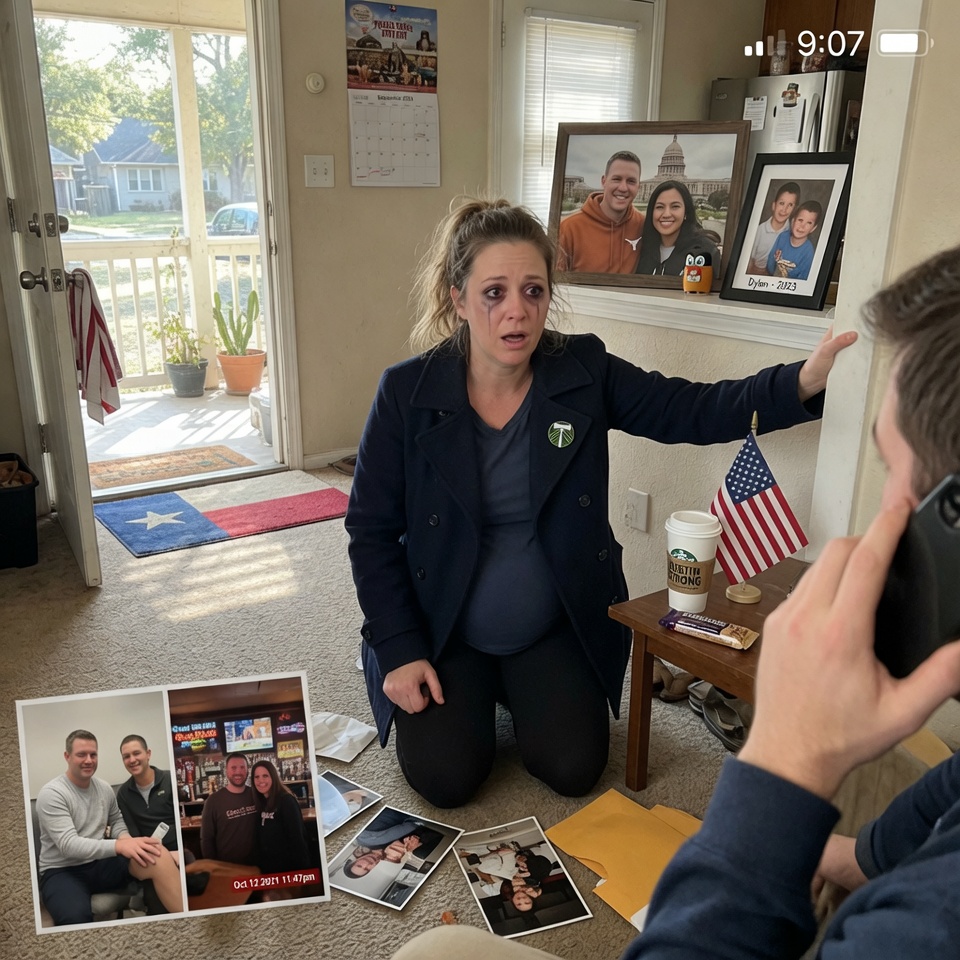
I locked eyes with Adrienne, who was still on her knees, mascara carving black rivers down her cheeks, her belly pressing against the leg of my desk. She was shaking her head, mouthing the word no, but no sound came out. I heard my own voice, steady, almost too calm, as if someone else had taken over my body.
— I need to report a trespasser in my residence. A woman refusing to leave. I’m at 1142 Bluebonnet Lane, Austin, Texas.
The operator asked a few more questions. I answered each one without looking away from Adrienne. She finally slumped back, sitting on her heels, the manila envelope crushed under her knees. The photos were scattered everywhere — her with Michael Garrett, her with the stranger in the Pearl District, her with the young guy at the gym. She looked down at them as if seeing them for the first time, or perhaps seeing herself for the first time.
— Chase, please, she whispered one more time, her voice cracking. — I’m begging you.
I didn’t answer. I just stood there, phone still in my hand, listening to the operator say a patrol car was on the way. Adrienne’s sobs filled the room, but I felt oddly detached. It was like watching a storm through a thick pane of glass. The woman who had destroyed me was now drowning, and I didn’t have to throw her a rope.
Time stretched. The house was silent except for her crying and the distant sound of a lawnmower somewhere down the street. I walked to the front window and saw the patrol car pull up, lights off, no siren. Two officers stepped out — a woman in her thirties with short-cropped hair and a no-nonsense stride, and a younger guy who looked like he’d graduated from the academy last week.
I opened the door before they could knock.
— Sir, are you the one who called? the female officer asked, her hand resting casually on her duty belt.
— Yes. The woman inside is my ex-wife. She showed up uninvited, refused to leave, and is now causing a disturbance. I need her removed.
The officers exchanged a glance and followed me inside. When they entered the living room, Adrienne scrambled to her feet, clutching the edge of my desk for support. Her belly made the movement awkward, and for a split second, something primal in me wanted to tell her to be careful. But I swallowed it.
— Ma’am, I’m Officer Torres. This is Officer Reed. What’s going on here?
Adrienne wiped her face with the back of her hand, smearing the mascara further. She looked from the officer to me, then back, her eyes wild with desperation.
— He’s my husband. I’m pregnant. I just need help. Please, I don’t have anywhere else to go.
— She’s my ex-wife, I said flatly. — Divorced two years ago. I have documentation if you need it.
Officer Torres raised an eyebrow. — Ma’am, is that true? Are you divorced?
Adrienne’s lip trembled. — Yes, but… he raised my son. He was like a father. And now I’m pregnant, and I thought… I thought he would care. I thought he’d help.
— How long have you been separated? Officer Reed asked.
— Two years, I answered before Adrienne could spin it. — She was unfaithful during our marriage. I left. I started over here. I didn’t give her my address. She hired a private investigator to find me.
Torres looked at Adrienne, her expression hardening just slightly. — Ma’am, did you hire someone to find his address?
Adrienne hesitated, then nodded weakly. — I just needed to talk to him. He disappeared. He left without a word. I didn’t know where he went.
— And now you’re on his property without his consent, Torres said. — He’s asked you to leave, is that correct?
— He didn’t give me a chance! Adrienne’s voice rose to a frantic pitch. — I just got here. I just wanted to explain. He called the police on me before I could even…
— Ma’am, please lower your voice. Torres stepped closer, and Adrienne shrank back. — The bottom line is, he doesn’t want you here. You’re trespassing. Do you understand that?
Adrienne pressed her hands to her face and sobbed into them. Her shoulders shook violently. Officer Reed shifted his weight uncomfortably, but Torres stayed focused.
— Sir, do you want to press charges for trespassing? she asked me.
I looked at Adrienne. She was a wreck — the proud, sharp operations manager I’d married was gone. In her place was a desperate woman, swollen with another man’s child, alone and begging on the floor of a house she had no right to be in. For a moment, a very small part of me remembered the good years, the laughter, the way she used to hum while making coffee, the way Dylan’s face lit up when she walked into a room. A flicker of pity.
Then I remembered the photos. The lies. The way she’d looked at me after I caught her with Michael Garrett and told me it was “just a mistake.” A mistake repeated with three different men over at least six months. Maybe more. The trust I’d given her, gutted and left to rot.
— No, I said. — I don’t want to press charges. I just want her gone. I want her to leave and never come back.
Torres nodded. She turned to Adrienne and spoke gently but firmly.
— Ma’am, we’re going to escort you out. You need to leave the property and not return. If you come back, you will be arrested for criminal trespass. Do you understand?
— No, please!
Adrienne lunged toward me, not with aggression but with a kind of broken desperation, her hands reaching out like she was falling off a cliff. Officer Reed stepped between us smoothly, blocking her with his body.
— Ma’am, you need to come with us now, he said.
— Chase! I lost everything! The hotel fired me. I can’t pay rent. I’m pregnant and alone. Please! You raised my son! You owe me something!
Her words hit me like a slap, but I didn’t flinch. I just looked at her, and for the first time since she’d stepped into my house, I felt a surge of real, cold anger.
— I owe you? I said, my voice low but sharp enough to cut glass. — I gave you seven years. I raised a child who wasn’t mine. I loved him like my own. And you repaid me by sleeping with half of Portland. I owe you nothing, Adrienne. Not a damn thing.
She stared at me, her mouth open, tears streaming, all the fight draining out of her. Her arms dropped to her sides.
— Let’s go, ma’am, Torres said, taking her gently by the elbow and guiding her toward the door.
Adrienne didn’t resist anymore. She let them lead her out, her head bowed, sobs now reduced to a quiet, hiccupping sound. I followed them to the front door and stood on the porch as they walked her down the driveway to the patrol car. The morning sun was already hot, the Texas sky a pale, washed-out blue.
The neighbor across the street, Mr. Vasquez, was pretending to water his lawn, but his eyes were glued to the scene. I knew the neighborhood would be buzzing by noon.
Officer Reed opened the back door of the cruiser and helped Adrienne inside. She didn’t look at me. She just slumped against the seat, a hand over her belly, her face turned away. Torres shut the door and walked back to me.
— She’ll be given a warning. If she comes back, call us immediately. We’ll take it from there.
— I appreciate it, I said.
Torres hesitated. — Sir, if she’s pregnant and genuinely homeless, we can refer her to some services. She might not know where to turn.
I nodded slowly. — If you think it’ll help, do what you need to do. But I can’t be part of it. I can’t open that door again.
Torres studied me for a moment, then nodded. — Understood. Take care of yourself.
She got back in the cruiser, and the patrol car pulled away, the red and blue lights still dark, no fanfare. Just a quiet exit. I stood on the porch, watching until it turned the corner and vanished.
The silence that settled over the house was heavy but clean, like the air after a summer storm. I walked inside and closed the door, twisting the deadbolt with a click that felt final.
The photos were still on the floor, scattered like fallen leaves. I knelt and started picking them up one by one. Michael Garrett’s hand on Adrienne’s knee. Her walking into the Grand View Hotel with him. Her at the bar, leaning so close she was practically in his lap. Her with the other men, faces I’d never seen, moments I’d never known about until it was too late.
After I’d gathered them all, I slid them back into the manila envelope, sealed it, and set it on my desk. I’d kept it for two years as a reminder. Maybe now the reminder had served its purpose.
I was still standing there when I heard a car pull into the driveway. The engine cut, a door opened and shut, and then the front door swung open.
Nadia walked in, a grocery bag on one hip, her sunglasses pushed up on her head. She took one look at my face, set the bag down on the entry table, and crossed the room to me.
— What happened? Her voice was calm, but I could hear the tension underneath.
— Adrienne showed up.
Her eyes widened. — What? How did she find you?
— Hired a PI. She spent months tracking me down.
Nadia’s jaw tightened. — What did she want?
— She’s pregnant. She claimed the baby was mine. She wanted help. Money. A place to stay.
Nadia’s hands found mine, her grip warm and grounding. — What did you do?
— I told her to leave. She wouldn’t. So I called the police.
— Good.
— They just took her away. She’s gone.
Nadia let out a long breath and pulled me into a hug. I buried my face in her hair and just breathed. She smelled like coconut shampoo and sunshine, so different from the heavy perfume that still lingered in the air from Adrienne.
— Are you okay? she whispered.
— Yeah. I think so.
— You did the right thing.
— I know.
I pulled back and looked at her, at the soft lines around her eyes, the steady calm she carried with her everywhere. Nadia wasn’t like Adrienne. She didn’t flatter, didn’t manipulate, didn’t hide things. She just was. And that was everything I needed.
— I’m proud of you, she said. — That couldn’t have been easy.
— It was easier than I thought it would be. I looked at the envelope on the desk. — I showed her the photos. The ones from the PI. She broke down. But it didn’t change anything. She still tried to guilt me.
— She’s desperate.
— Yes. But I’m not her safety net anymore.
Nadia nodded. She always understood without needing too many words. We stood there in the quiet of the living room, the morning light streaming through the windows, the faint scent of coffee still drifting from the kitchen. The storm had passed. I was still standing.
But I knew it wasn’t over. Not entirely. Adrienne was the kind of person who didn’t let go easily. I’d seen it in the way she’d fought the divorce, the way she’d dragged things out for months with lawyers and delays. She wouldn’t just vanish quietly. The pregnancy would give her a weapon, and I knew she’d try to use it.
Three days later, my fear was confirmed.
I was at the pharmacy, checking inventory in the back, when my personal phone rang. The screen showed an Oregon area code, but I didn’t recognize the number. My stomach tightened.
— This is Chase.
— Chase, it’s Susan. Susan Patel, my divorce attorney.
I’d kept her on retainer even after moving. She was the best I knew, and I’d learned the hard way to be prepared.
— What’s happening?
— Adrien’s filed something. She’s claiming the child she’s carrying is yours and she’s seeking a paternity suit. She wants financial support, backdated from the birth. She’s also claiming the divorce settlement should be revisited because of the new circumstances.
I leaned against the shelf of pill bottles and closed my eyes for a moment.
— That’s ridiculous. It’s been two years. We’re divorced. I haven’t been with her since before I left.
— I know. She’s grasping, but we have to take it seriously. There’s a court-mandated paternity test being ordered. I’ve already filed a motion to dismiss, but the judge will want the test done first. It’s standard procedure.
— Fine. Let’s do it.
— You’ll need to fly to Portland for the swab. They require an accredited lab. I can schedule it as soon as this week.
— Do it.
Susan paused. — Chase, I have to ask. Are you absolutely certain you’re not the father? Because if there’s even a chance…
— There’s no chance, I said flatly. — I wasn’t intimate with her for months before I left. She was running around with multiple men. The photos prove it. The timeline proves it. This baby isn’t mine.
— Good. That makes this simple. We’ll prove it, and the case will be dismissed.
— How long will this drag out?
— The test takes a few days after swabbing. Once the results are in, the court will rule. If it’s negative, she’ll be on the hook for your legal fees and the test costs. She might face sanctions for filing a frivolous suit.
I exhaled slowly. — Okay. Schedule the test. I’ll be there.
We finalized the details, and I hung up. For a few moments, I just stood there, surrounded by boxes of medications, the hum of the pharmacy’s cooler in the background. My life had been so clean and ordered for two years. Now Adrienne was pulling me back into her orbit, and I could feel the gravitational drag.
That evening, I told Nadia over dinner. We sat on the back patio, the Texas sunset painting the sky in streaks of orange and pink, a cold beer in front of each of us.
— She’s filing a paternity suit, I said.
Nadia set down her fork and looked at me. — She’s insane.
— Probably. But the court requires a test. I have to fly to Portland next week.
— Do you want me to come with you?
I reached across the table and squeezed her hand. — I’d love that, but it’s a quick trip. In and out. I’ll be fine.
— I hate this. I hate that she can still do this to you.
— She can’t, not for long. Once the results come back, she’ll have nothing. It’s the last gasp of a drowning woman.
Nadia shook her head. — You’re handling it better than I would. I’d want to scream.
I smiled faintly. — I did my screaming two years ago. Now I just want it over.
A week later, I boarded a plane at Austin-Bergstrom International Airport, a small carry-on slung over my shoulder, the September sun hot on the tarmac. The flight to Portland was just under five hours. I spent most of it staring out the window, watching the landscape shift from the brown hills of Texas to the green patchwork of the Pacific Northwest.
Portland hadn’t changed much. The air was cooler, damp with the promise of rain, and the familiar scent of pine and coffee hit me the moment I stepped out of the terminal. I rented a car — a nondescript sedan — and drove to the hotel Susan had booked for me, a quiet place in the Pearl District, far from the Grand View Hotel where Adrienne had worked.
The lab was downtown, a sterile building with white walls and a receptionist who barely looked up from her computer. Susan met me in the lobby. She looked the same — sharp, efficient, graying hair pulled back in a tight bun, piercing eyes that assessed everything in an instant.
— They’re ready for you, she said. — Adrien’s already inside with her lawyer.
I felt a twinge of something — not anger, not fear, just a cold awareness. — She brought a lawyer?
— A nervous guy in a cheap suit. He’s not a family law specialist. She probably couldn’t afford anyone better. This is going to be straightforward.
We walked down a long hallway to a small room with a table, two chairs, and a lab technician in a white coat. The technician was a middle-aged man with a receding hairline and a bored expression, who clearly processed these tests like an assembly line.
Adrienne was already seated, her lawyer hovering beside her like a moth around a dying bulb. When I walked in, she looked up, and our eyes met for the first time since the police had taken her off my porch.
She looked worse. Much worse. The pregnancy was more pronounced now, her belly round and heavy. But it was her face that struck me — hollow cheeks, dark circles so deep they looked bruised, lips cracked. She’d lost weight everywhere except her belly, which made her look even more gaunt. The confident, beautiful woman I’d married was gone, replaced by this gaunt stranger with pleading eyes.
Her lawyer, a twitchy man with a weak handshake, introduced himself. I didn’t catch his name, and I didn’t care. The technician explained the procedure — a simple cheek swab, painless, quick. He’d take a sample from each of us, label them, send them to the lab for analysis.
— Any questions? he asked.
— No, I said.
Adrienne just shook her head, her gaze never leaving my face. I could feel her trying to bridge some gap between us with just eye contact, but the bridge was burned to ashes.
The swab took seconds. A cotton-tipped stick rubbed against the inside of my cheek, sealed in a sterile tube, and I was done. Adrienne went next. The technician gently swabbed her cheek, and I saw her flinch, her hands gripping the edge of the table as if it were the only thing holding her upright.
Afterward, we were led to separate waiting areas. Susan pulled me aside.
— Results will be ready in three to five business days. The court will receive them first, then we’ll get notified. I’ll call you the moment I know.
— Thanks, Susan.
She put a hand on my arm. — I’m not worried. You shouldn’t be either.
I flew back to Texas that same afternoon. The plane ride felt longer than before, each hour dragging. I kept thinking about Adrienne’s face, the hollow desperation. She’d been so strong, so in control, back when we were together. I’d trusted that strength. Now I saw it had been a mask, and underneath was someone who couldn’t survive without someone else to hold her up. When I’d left, she’d crumbled. Part of me felt a grim satisfaction. But another part, the part that had once loved her, felt a dull ache.
I told that part to shut up.
Back in Austin, I tried to return to normal. The pharmacy was busy — flu season was approaching, and I was already placing orders for vaccines. I had a staff meeting to prepare for, a new location to scout. Nadia and I spent Sunday hiking the Greenbelt, the trails crowded with families and dogs, the air crisp and clean.
But every time my phone buzzed, my heart skipped a beat.
The call came on a Wednesday afternoon, five days after the test. I was in my office at the original Hollis Family Pharmacy on South Lamar, reviewing a contractor’s proposal for the third location. Susan’s name flashed on the screen.
I picked up before the second ring.
— Tell me.
— Negative. You’re not the father.
Even though I’d known it with absolute certainty, the words still hit me like a gust of fresh air. I leaned back in my chair and stared at the ceiling, a smile breaking across my face.
— The case is dismissed, Susan continued. — The judge was not happy with her. Adrien’s lawyer tried to argue for a delay, but there was no basis. I also filed for sanctions and costs. She’ll be responsible for your travel, the test, and my additional fees for this whole mess.
— Good. That’s more than I expected.
— She’s broke, Chase. I don’t know if you’ll ever collect, but the judgment is there. It’s a legal dead end for her. She can’t come after you again.
I closed my eyes and let the relief wash over me. — Thank you, Susan. For everything.
— You’re welcome. Go live your life.
I hung up and spun my chair around to look out the window at the South Austin skyline — low buildings, live oaks, a strip of blue sky. The weight I’d been carrying, a weight I hadn’t even fully acknowledged, lifted. I felt like I could float.
That night, Nadia and I opened a bottle of champagne. We sat on our back porch, the same spot where I’d told her about the suit, and we toasted to closure.
— To you, she said, raising her glass. — For getting through it.
— To us, I corrected. — For building something that can’t be broken.
She smiled that easy, genuine smile that had first drawn me to her. We clinked glasses and drank.
The years that followed were the kind of years you don’t dare dream about. The kind that come quietly, without fanfare, and one day you look around and realize you’re happy. Deeply, boringly, wonderfully happy.
Hollis Family Pharmacy grew beyond anything I’d imagined. The second location took off, and within eighteen months we opened a third, then a fourth. I hired good people — pharmacists who shared my belief that healthcare meant listening, not just dispensing. We started a free delivery program for elderly patients, hosted flu shot clinics at community centers, sponsored Little League teams. The name Hollis became synonymous with trust in South Austin.
Nadia and I got married on a warm May evening, on a terrace overlooking Lake Travis. It was small — just her daughter, my closest friends, Evan flying in from Portland, a few colleagues from the pharmacy. The sun set behind the hills as we said our vows, the water turning gold and copper. I looked at Nadia and saw my future, steady and bright.
She got promoted to nurse manager at Dell Children’s, and we settled into a rhythm. Sunday hikes, Friday date nights, quiet evenings cooking together. Her daughter, Maya, called me “Chase” for the first year and then shyly started calling me “Dad” one afternoon when we were building a bookshelf together. I nearly wept.
Life was good. Better than good. It was the life I’d always wanted, the one I’d never thought I’d find after Portland. But even so, there was a corner of my heart that never quite healed. A space reserved for a little boy with a baseball glove and a gap-toothed grin, who’d asked me one afternoon in the backyard, “Chase, if you leave, can I still call you?”
I thought about Dylan often. On his birthday, which I still noted on my calendar. On the first day of school, wondering how he was doing. During baseball season, remembering the way his eyes lit up when he connected with a pitch. I didn’t reach out — Adrien had made that impossible, and I didn’t want to cause him confusion or pain. But I never forgot him. Not for a single day.
The trust fund I’d set up, the one Susan had helped me lock away before the divorce, sat untouched waiting for his eighteenth birthday. I’d added to it over the years, small deposits every few months, until it grew to nearly sixty thousand dollars. College money. A future for a kid who deserved every opportunity.
I didn’t know if he’d ever find out. I hoped he would.
And then, on a Tuesday afternoon in late spring, six years after I’d left Oregon, the mail arrived.
I was at the pharmacy, in my office, catching up on paperwork. One of my techs, Lucy, knocked and handed me a stack of envelopes — bills, invoices, a couple of thank-you cards from patients. At the bottom was a plain white envelope, slightly crumpled, with a Portland postmark and handwriting I didn’t recognize.
I opened it out of curiosity, expecting a solicitation or a delayed piece of forwarded mail. Instead, I found a handwritten letter, the paper creased as if it had been folded and unfolded many times. The handwriting was a teenager’s — slightly messy, careful but uneven. I read the first line and my heart stopped.
Dear Chase,
My name is Dylan Reeves.
I don’t know if you remember me.
The letter was still in my hands, but I was no longer in my office. I was back in a backyard in Portland, tossing a baseball with a ten-year-old kid who called me “Chase” with a grin. I was sitting on porch steps, promising a little boy that no matter what happened, I loved him. I was hugging him, his tears soaking my shirt, telling him that someday, when he was older, he could find me.
I read on.
You were married to my mom for seven years. You were the closest thing to a dad I ever had.
My hand started shaking. I set the letter down on my desk, took a deep breath, and picked it up again.
I’m eighteen now. I’m finishing high school in a few weeks, and I’ll be going to college in the fall. A few months ago, I found out about a trust fund you set up for me. My mom never told me about it. When I asked her, she wouldn’t talk about you at all. But I needed to know the truth. So I did some digging.
I found the letter you left me, the one that said “Open when you’re eighteen.” Mom had hidden it, but I found it when we moved apartments last year. I read it. I read it about a hundred times.
And I just want to say thank you. Thank you for being there when my real dad wasn’t. Thank you for teaching me how to throw a baseball, and helping me with homework, and coming to my games. Thank you for not forgetting about me.
I know why you left. I’m not a kid anymore. I understand now. I don’t blame you.
I’m writing because I wanted you to know that I turned out okay. I’m starting at Portland State in the fall, studying engineering. The trust fund is going to pay for most of it, which is amazing. I don’t know how I can ever repay you for that.
But more than the money, I just wanted to say… you were a good dad to me. The best I ever had. And if you’re willing, I’d like to stay in touch. Maybe even visit sometime.
I hope you’re happy, wherever you are.
Your son,
Dylan
I read the letter three times. Then I read it again, slowly, my lips moving with each word. By the fourth time, tears were streaming down my face, and I didn’t bother wiping them away.
Lucy knocked on the door, took one look at me, and quietly backed out. I heard her murmur something to the front staff, and then the door clicked shut. I was alone with Dylan’s words, with the echo of a little boy’s voice across eight years and a thousand miles.
When I finally could move, I folded the letter carefully, almost reverently, and placed it in my inside jacket pocket, right over my heart. I sat there until closing, not getting much work done, just staring at the wall and remembering.
That night, I showed Nadia the letter. We sat on the couch, the news playing mutely in the background, and she read it while I watched her face. When she looked up, her eyes were glassy.
— Chase, this is beautiful.
— I know.
— Are you going to write him back?
— Tonight. Right now.
— Good.
She squeezed my hand. — He sounds like a wonderful young man.
— He always was.
I sat down at my desk that night with a fresh legal pad and a pen, and I started writing. It was the longest letter I’d ever written. I told Dylan how proud I was — prouder than words could capture. I told him that leaving him had been the hardest thing I’d ever done, that I’d thought about him every single day, that I’d kept his Little League photo in my wallet until it was so faded you could barely see his face.
I told him about Austin, about the pharmacy, about Nadia. I said that I didn’t know what he wanted our relationship to look like, but that I was open to anything — phone calls, letters, visits. I said there was a room in our house with his name on it if he ever wanted to come, and that I’d buy him a plane ticket tomorrow if he said the word.
I wrote about the trust fund and how I’d added to it over the years because I believed in him, even when I couldn’t be there. I told him that no matter what happened between me and his mother, he was never a mistake, never a burden. He was, and always would be, my son in every way that mattered.
I sealed the letter and mailed it the next morning. The clerk at the post office held up the envelope, noted the Oregon address, and said, “That’s a long way.”
— Not far enough, I said.
Three weeks later, Dylan flew to Austin.
I was a wreck the morning of his arrival. I changed shirts three times, paced the living room, checked my phone every thirty seconds for flight updates. Nadia watched me with a fond, exasperated smile.
— You’re going to wear a hole in the floor.
— I can’t help it. What if he’s disappointed? What if he thinks I’m just some guy?
— He wrote you a letter calling you the best dad he ever had. I think you’re safe.
Her words calmed me, but only a little. I left for the airport an hour early, found a spot in the short-term parking garage, and paced the arrivals terminal until the board showed his flight had landed.
I stood by the escalator that led up from the gates, scanning every face that came up. Families with strollers, businesspeople with rolling suitcases, college students with backpacks and sleepy eyes. And then I saw him.
He was tall. That was the first thing that hit me. He’d been a skinny ten-year-old the last time I saw him, but now he was nearly six feet, with broad shoulders and a swimmer’s lean build. His hair was darker, his jaw sharper, but his eyes were the same — that warm, curious brown I’d looked into a thousand times during homework sessions and ball games.
He saw me at the same moment. He stopped walking, his face breaking into a grin that erased all the years between us.
— Chase.
His voice was deeper than I remembered, but the way he said my name was exactly the same.
— Dylan.
I walked toward him, and he toward me, and then we were hugging, a real hug, the kind you don’t realize you’ve been missing until you’re in it. He gripped me tight, and I felt him shudder once, a stifled sob. I didn’t let go until he did.
— You look good, I said, my own voice rough.
— You too. You look… happy.
— I am. I really am.
He laughed, wiping his eyes with the back of his hand, a gesture so achingly familiar it made my chest tighten. — I can’t believe I’m here.
— Me neither. Come on, let’s get your bags.
We walked through the airport side by side, an easy silence between us. It didn’t feel awkward. It felt like picking up a conversation paused mid-sentence years ago.
Over the next few days, we caught up on everything. We ate barbecue at Franklin’s, standing in line for two hours while Dylan told me about his friends, his classes, his plans for college. We went to a Longhorns baseball game, and he narrated plays like a seasoned commentator, just like he used to when he was a kid watching Mariners games on TV. We sat on my back porch in the evenings, the cicadas buzzing, and he asked me about the pharmacy, about Nadia, about my new life.
— She’s great, Dylan said after meeting Nadia for the first time. — You picked a good one.
— I did.
He looked at me then, something serious flickering behind his eyes. — My mom… she’s not doing well. I guess you know.
— I heard some things.
— She’s in and out of jobs. The baby she had… it’s a girl. My half-sister. She’s almost six now. Mom’s raising her alone. The dad’s not in the picture.
I absorbed that. — I’m sorry to hear that. Not about your sister, but… about the situation.
— Yeah. Dylan stared at his sneakers. — I’ve had to grow up pretty fast. But I’m okay. And I don’t want you to worry about me. I just wanted you to know that I turned out alright.
— You did more than alright. You’re incredible.
He smiled, a little shy. — Thanks.
On his last day, I took him to see the original pharmacy, the one I’d built from scratch after leaving Portland. We stood on the sidewalk and looked at the sign — Hollis Family Pharmacy — with its green lettering and the little mortar-and-pestle logo.
— This is yours? he asked.
— This one, and three others.
He whistled low. — That’s amazing.
— It started as nothing. I had nothing when I came here. Just a truck full of boxes and a lot of anger. But I channeled it into something good.
Dylan was quiet for a moment. Then he said, — I remember the day you left. I mean, I know you left in the middle of the night, but I remember waking up and finding the note on my pillow. My mom was crying in the kitchen. She wouldn’t tell me what happened. I figured it out later.
— I’m sorry you had to go through that.
— I’m not. I mean, it hurt. A lot. But when I got older and I found out what Mom did… I understood. You didn’t leave me. You left her. And you made sure I had a future. That’s more than my real dad ever did.
I looked at him, this young man on the threshold of adulthood, and I felt a swell of pride so fierce it almost hurt.
— You turned out exactly how I hoped you would.
— So did you, he said.
We hugged again on the sidewalk, in front of the pharmacy, with the Austin sun beating down and traffic humming past. When we pulled back, he was smirking.
— So, can I hit you up for an internship next summer? I hear pharmacists make bank.
I laughed, the sound surprising me with its lightness. — You study hard, and we’ll talk.
That evening, I drove him to the airport. We stood at the security checkpoint, the same spot where I’d waited with so much anxiety just a few days before. Now everything felt different — lighter, fuller.
— Thanks for having me, Dylan said.
— Thanks for coming.
— I’ll text you when I land. And I’ll fly out again at Christmas, if that’s alright.
— That’s more than alright. The room’s yours.
He grinned. — See you, Chase.
— See you, Dylan.
He walked through the metal detectors, and I watched him until he disappeared into the crowd. Then I walked back to my car, sat in the driver’s seat, and let out a breath I felt like I’d been holding for eight years.
I drove home through the Austin twilight, the sky a wash of orange and purple, the city lights starting to flicker on. When I pulled into the driveway, Nadia was waiting on the porch with two glasses of iced tea. I sat down beside her, and we watched the stars come out.
— How do you feel? she asked.
— Whole, I said.
And I meant it.
The years that followed were a slow, steady unfolding of a life I’d never dared to imagine. Dylan finished his freshman year of college with honors, and true to his word, he flew out every Christmas and spent summers interning at the pharmacy, learning the business from the ground up. He was bright and hardworking, with an easy manner that made customers love him. I watched him explain a medication interaction to an elderly woman one afternoon, patient and thorough, and I felt a surge of something I could only call fatherly pride.
We talked about his mother sometimes, but only in fragments. She’d moved to a smaller town outside Portland, scraping by. Dylan was the stable force in his half-sister’s life, a role he took seriously. I offered to help where I could, but he always shook his head.
— You’ve already done enough, he’d say. — More than enough.
By the time Dylan turned twenty-one, the Hollis Family Pharmacy chain had expanded to six locations, and I was in talks to open a seventh. Nadia and I had bought a slightly bigger house with enough room for Dylan and Maya to both have their own spaces when they visited. Life was full and loud and good.
And every now and then, when the world got quiet — late at night, the house dark and still — I’d think back to that night in Portland when I’d loaded my truck and driven away at four in the morning, the city shrinking in my rearview mirror. I’d thought I was leaving everything behind. But I hadn’t. The best parts had followed me, or found their way back, in their own time.
I still had the manila envelope in my desk drawer, the photos of Adrien’s betrayals. But I rarely looked at them anymore. They were just paper. The real reminders were the life I’d built, the wife who loved me, the son who’d chosen me, and the quiet knowledge that sometimes the only way to find your future is to let the past go completely.
Adrienne had knocked on my door that morning in Austin, desperate and pregnant, hoping to pull me back into her chaos. I’d closed the door, not out of cruelty, but out of self-preservation. And in doing so, I’d kept the path clear for everything that was meant to come.
Dylan once asked me, during one of our late-night porch talks, if I regretted any of it.
— I regret the pain, I told him. — I regret that you got caught in the middle. But I don’t regret leaving. Because it led me here. And because it led you to becoming exactly who you are.
He nodded slowly. — You know, I used to be angry at you for not saying goodbye. For disappearing like that.
— I don’t blame you.
— But now I get it. You had to do it that way. If you’d stayed, she would’ve pulled you under. And you wouldn’t be the person you are now. And we wouldn’t be sitting here.
He looked out at the stars, a faint smile on his face. — I’m glad you ran.
I put my arm around his shoulders and pulled him close, the way I used to when he was a kid and the world seemed too big.
— Me too, I said.
The night deepened around us, cicadas singing in the dark, the Texas heat finally relaxing its grip. My son sat beside me, my wife was inside reading a book, and the life I’d rebuilt from ashes was standing solid around me, unshakeable at last.