That morning in Cancún, I thought I was looking at a stain.
What I was really looking at was the first crack in something far larger, a truth big enough to split open everything I believed I understood about my ex-wife, about our marriage, and about the night that had just convinced me the past could be resurrected. I would spend the following months learning how wrong a man can be about the woman he thought he knew better than anyone alive.
I had only just swung my legs out of bed when I saw it. A small red mark against the white hotel sheet. Not much. Barely anything at all. Just enough to stop the breath in my chest. Just enough to make the whole room feel suddenly quieter than it had been a second before.
Elena was standing by the window in my white shirt, the sleeves rolled loosely past her wrists, the curtains breathing in and out with the warm Caribbean wind. For one suspended second she looked almost exactly the way she used to look on Sunday mornings in our old apartment in Mexico City, back before work swallowed us whole, before resentment quietly became our second language, before silence turned out to be easier than tenderness and we let it win. The light caught the side of her face. She was somewhere far away in her own thoughts, and I remember thinking, absurdly, that she had never stopped being beautiful, not even after everything we had broken between us.
Then she turned, followed the line of my stare down to the sheet, and every trace of softness drained out of her face.
“Elena, are you hurt?” I asked.
She blinked too quickly, the way people do when they are buying a fraction of a second to arrange their expression. “No. It’s nothing.”
The answer came fast. Too fast. Almost rehearsed, as though she had known the question might arrive and had prepared the shape of her denial in advance. She crossed the room and gathered the edge of the sheet in her hand and folded it over the mark, tucking it out of view as if hiding it could unmake what I had already seen.
“It’s probably just my cycle coming early,” she said, and she did not quite manage to meet my eyes when she said it.
That should have been the end of it. A small, ordinary explanation for a small, ordinary thing. It should have dissolved into the rest of the morning and been forgotten by lunch.
It didn’t.
Because I knew Elena. Or at least I believed I still did, somewhere beneath the three years of silence that had grown up between us like a hedge left untended. I knew the particular geography of her face. I knew the difference between embarrassed and afraid, and what I was looking at that morning was not embarrassment. It was fear, plain and unmistakable, the kind that lives behind the eyes and refuses to be smiled away.
There was a tremor in her fingers as she smoothed the sheet. The color had gone out of her lips. And when she bent to lift her purse from the chair by the door, a white envelope slid halfway free from beneath it, and before she could push it back into hiding I caught the printed logo of a private clinic in Cancún stamped across the corner. Just a glimpse. Just enough.
I looked at her.
She looked away.
“Are you sure you’re all right?”
She forced a smile onto her face, and it sat there wrong, the way a borrowed coat hangs on shoulders it wasn’t cut for. “Carlos, really. I’m fine.”
But she was not fine. I could feel it the way you feel a storm gathering long before the first drop falls, that pressure in the air, that heaviness that has no name but that the body recognizes anyway. Something was moving through the room that neither of us was saying, and she was working very hard to keep it invisible.
To understand why a small red mark on a bedsheet could reach so far into me, you have to understand what Elena and I had once been to each other, and what we had failed, in the end, to remain.
We were married for six years. There was no spectacular betrayal in our story, no screaming match with glasses hurled against the wall, no third person waiting in the shadows to be discovered. Nothing so dramatic. Our marriage did not die in a single catastrophic night. It died in a thousand small ways, so gradually that neither of us noticed the exact moment it stopped breathing. Long workdays that bled into longer evenings. Dinners eaten cold, or alone, or in a silence that had teeth. Stress that followed us home from our separate offices and pulled up a chair at our table like an uninvited guest who never left. Petty arguments about nothing that never seemed important on their own but that piled up, year after year, until there was a mountain of them, and everything warm we had once had was buried somewhere underneath.
By the time we finally divorced, we were both simply exhausted. There was no fight left in either of us. We signed the papers with a kind of numb, exhausted courtesy that felt, in some ways, more tragic than any screaming match could have been. Nobody wept. Nobody begged the other to stay. Nobody made a speech. We just stopped, the way a clock stops when no one remembers to wind it.
I stayed in Mexico City and buried myself deeper in my work at a construction firm that developed hotel and resort properties along the coasts. Work had always been the thing I retreated into, and after the divorce I retreated so far I nearly disappeared inside it. Elena moved south to Quintana Roo and built a new life for herself in the tourism industry. Mutual friends brought her name up now and then, usually to tell me she was doing well, that she looked good, that she seemed happy and busy. I always nodded along as though it made no difference to me at all, and I always went home afterward and thought about her longer than I would ever have admitted.
For three years, we did not speak. Not once. Not a message, not a call, not so much as a word passed through a third party. Three years is a long time to be a stranger to someone who once knew which side of the bed you slept on and how you took your coffee and what your face did right before you cried.
Then my company sent me to Cancún.
The assignment was to evaluate a parcel of land and work through the financing details for a resort development along the Caribbean coast. Routine work, the kind I had done a dozen times before. I checked into a hotel near Boulevard Kukulcán, dropped my suitcase on the bed, answered a handful of late emails, and then went out again because the air-conditioned silence of the room was pressing on me in a way I couldn’t sit still inside.
Cancún at night can fool you into believing that life is lighter than it really is. The salt hanging in the warm air, the wind coming in off the water, the sound of the waves striking the shore with a kind of maddening, patient calm, the lights of the big hotels smeared across the black surface of the sea. It all feels staged somehow, cinematic, the kind of setting where you half expect something beautiful to begin whether you are ready for it or not.
Instead, I walked into a small bar off the main strip and saw the woman I had once promised the rest of my life to.
Elena was standing at the counter in a pale blue dress, her back to me. I knew her instantly, before she ever turned around, from the slope of her shoulders alone. Some part of the body remembers a person even when the mind has spent years trying to forget them. When she finally turned and saw me standing there, the surprise that broke across her face looked so genuine, so completely unguarded, that I believed without a shred of doubt that fate had simply decided to be cruel and generous at the very same time.
“Carlos?” she said.
I smiled, and I felt myself become thirty different versions of the man I had been, all at once. The husband. The stranger. The person who still, apparently, kept a room in his chest with her name on the door. “It’s been a long time.”
We sat down together at a small table near the window. At first we talked like diplomats from two countries that had once gone to war and were meeting again under a fragile truce. Careful. Polite. Measuring the weight of every word before we let it out. She asked if I was in the city on vacation. I told her it was work. I asked about her job, and she told me she was managing operations at a resort not far down the coast. We spoke about the weather, about the traffic, about the small safe things people say when the large things are too dangerous to touch.
Then, somewhere in the second drink, we started talking about the people we used to know. The places we used to go. The stupid old memories that had somehow survived the divorce intact, like furniture rescued from a house fire. A restaurant we had loved that had since closed. A friend’s wedding where I had spilled wine down the front of my only good shirt. A road trip to Oaxaca where the car had broken down and we had laughed instead of fought about it, back when we were still the kind of people who could laugh at a broken car.
The strangest part was how easy it became. Three years earlier, in the last months of our marriage, we could not have discussed a grocery list without turning it somehow into evidence in a private trial, each of us prosecuting the other for crimes neither of us could quite name. But that night, at that table, there were no accusations. No scorekeeping. No old wounds pried open for inspection. Time had done its quiet work and rubbed the sharpest corners off our shared history, and what was left was almost gentle.
Near midnight she asked where I was staying. I told her the name of the hotel. She smiled in a way that, at the time, I read as nothing more than mild coincidence. “I know that hotel,” she said. Then she looked out toward the dark line of the sea beyond the glass, and after a moment she asked, “Do you want to walk on the beach for a while?”
We did.
The shore was nearly empty at that hour. The waves came in over the pale sand with a sound like someone whispering behind a closed door, secrets you could almost but not quite make out. Elena walked barefoot for a long stretch, carrying her shoes hooked on two fingers of one hand. The wind kept pulling strands of her hair loose from where she had tied it, and every few minutes she reached up and pushed them back with a small, unconscious gesture I had watched her make a thousand times, and it tightened something in my chest each time she did it.
We talked more honestly out there in the dark than we had managed in years. Not about the divorce itself, not directly, but around the edges of it. About how quickly life had moved once it decided to move at all. About the strangeness of becoming a stranger to someone who had once known your every habit, your every mood, the exact sound of your footsteps in the next room. About the versions of ourselves we had somehow lost along the way, the younger and more hopeful people we had been before life sanded us down.
And then, eventually, the words ran out.
She looked at me. I looked at her. There are silences that are empty, that are simply the absence of speech. And there are silences so full they feel dangerous, so charged that you can hear your own pulse inside them. That one was the second kind.
She came back to the hotel with me.
I will not dress it up as destiny. At the time I told myself it was a lapse, a collision between memory and loneliness, one night stolen out of a life that no longer belonged to either of us. A thing that would happen once and then be quietly folded away and never spoken of again.
But it did not feel casual. Not really. Not even a little. It felt like two people stepping back into an old, familiar room and discovering, to their astonishment, that every piece of furniture was still exactly where they had left it years before. The dust cleared. The lights came up. Everything was where it had always been.
The next morning proved to me just how wrong I had been about what that night was.
After Elena folded the sheet over the mark and insisted, twice, that she was fine, she began moving around the room with a strange, restless urgency. She dressed quickly, almost roughly, as if speed itself were a kind of protection. She kept checking her phone, glancing at the screen and then setting it face down and then picking it up again a minute later. When I offered to order breakfast up to the room, she refused before I had even finished the sentence.
“I have to go,” she said.
“At least let me drive you.”
“No.”
The force of that single word landed hard enough that we both went still. Even she seemed startled by it. She softened her voice immediately, deliberately, smoothing it back down. “I have to be somewhere soon. Please. Don’t worry about me.”
She crossed the room and kissed my cheek before she left. It was a light kiss, almost formal, the kind you might give a colleague at a party, except that her lips lingered against my skin just a fraction of a second too long, just long enough to leave me confused about what it meant. At the door she stopped, still facing away from me, her hand resting on the frame, and she said something I would not understand until much later, when it was far too late to have understood it sooner.
“Please don’t make this harder than it already is.”
Then she was gone.
I stood alone in the hotel room with the whole bright expanse of the ocean shining beyond the glass, and a feeling in my stomach that would not settle no matter how I turned it over. The mark on the sheet was small. It was almost nothing. But it had rearranged the air in the room, and it went on rearranging it long after she left.
I told myself she had explained it. I told myself I was being dramatic, inventing a mystery where there was only an ordinary, private, slightly embarrassing thing that was none of my business anymore. I told myself a hundred reasonable, sensible things on the way to my morning meetings, and not one of them worked. Not one of them touched the cold knot sitting low in my gut.
I could not concentrate that day. The numbers on the financing spreadsheets blurred and swam. The site plans laid out across the conference table meant nothing to me. My colleagues talked and I nodded at the right moments and understood almost none of it. Between meetings I kept pulling out my phone and staring at the message thread with Elena, the one we had reactivated after three years of silence, the little green dot of her availability that never seemed to be lit.
Are you okay?
I sent it a little after noon.
Her reply came almost an hour later, when I had nearly convinced myself it wouldn’t come at all.
I’m fine. Don’t worry.
That was all. Four words and a wall behind them.
I tried calling that evening. It rang and rang and went to voicemail. I tried again an hour later. The same. I set the phone down on the hotel desk and looked at it as if it might change its mind.
The following day, between two appointments on opposite sides of the hotel zone, I stopped outside a pharmacy across from a private medical building to buy a bottle of water. I was halfway back to the car, the bottle sweating in my hand, when I saw her.
Elena was coming out through the entrance of the clinic across the street. She was wearing sunglasses even though the sky had gone flat and gray, the sun buried behind a thick ceiling of cloud. In one hand she carried a folded sheet of paper. In the other, a small paper bag from the pharmacy inside the building. She was walking carefully, deliberately, the way a person walks when every step has to be negotiated in advance with a body that no longer feels entirely like their own.
My chest went tight.
I called her name across the street before I had decided to.
She froze. For a full second she stood completely still, and I could see her deciding whether to pretend she hadn’t heard. Then she turned toward me, and the smile she produced was impressive in the saddest possible way. It was the smile of a person trying to hold a collapsing wall in place with nothing but their bare hands and the sheer force of not wanting you to see it fall.
“What are you doing here?” I asked, crossing to her.
“Nothing important,” she said. “Just a checkup. I’ve been getting migraines.”
“Migraines.”
“Carlos.” She glanced around at the street, at the passing cars, at anything that was not my face. There was something close to pleading in it. “Please.”
I wanted to push harder. I wanted to reach out and take the folded paper from her hand and drag whatever was written on it out into the daylight where I could look at it. But something in her expression stopped me cold. It was not that I believed her. I did not believe a single word. It was that I could see, with sudden and painful clarity, how desperately she needed me to pretend that I did. And I could not bring myself to take that pretense away from her, not right there on the street, not while she was standing so carefully upright and working so hard to hold herself together.
Before I flew back to Mexico City, I went to the resort where she worked. I told myself I needed closure, or at the very least some clarity, some solid ground to stand on instead of the shifting sand I’d been walking across for three days. A receptionist made a call, and after a long wait Elena came out to meet me, not through the bright main lobby but through a service corridor at the side, as though she did not want anyone to see the two of us standing together.
She looked tired. More than tired. She looked hollowed out, scraped thin, like a photograph of herself that had been left too long in the sun.
“I was worried about you,” I said.
“I know.”
“And I still don’t believe you’re fine.”
She folded her arms across herself as if against a chill, though the breeze coming off the water was warm and soft. “Then let me ask you something,” she said. “If I’m not fine, what exactly do you plan to do about it?”
The question irritated me, precisely because I had no clean answer to give it. “I don’t know,” I admitted. “But disappearing isn’t an answer either.”
For a moment her eyes softened, and the sight of it nearly undid me completely. Then she dropped her gaze to the ground between us. “What happened between us that night was real,” she said quietly. “It was. But that doesn’t mean you should pull it into your life and break yourself open over it.”
“Elena.”
“Please,” she said again, and this time there was real pain threaded through the word, so much of it that it silenced me. “Let it stay one night. Let it just be that. One night. Please.”
She rose up and kissed my cheek and turned and walked back inside through the service door before I could gather myself enough to stop her. I stood in the corridor listening to the door click shut, and then I went to the airport.
I flew home to Mexico City carrying a weight in my chest I could not have explained to anyone if they had asked. For weeks I turned it over and over and arrived at the wrong conclusion every time. I told myself she regretted sleeping with me. That she was embarrassed by it, ashamed even, and wanted only to put it behind her. That I was manufacturing drama out of nothing because seeing her again had stirred up a whole sediment of feeling I no longer had any right to. I told myself to let her go, again, the way I had let her go the first time. I nearly managed it.
Then, almost a month to the day after I’d left Cancún, my phone rang a little after midnight.
The name on the screen was Lucía. One of Elena’s oldest friends, from long before I had ever come into the picture. I had not spoken a word to her in years. The instant I saw her name lit up in the dark, before I even answered, I knew that something was terribly wrong.
“Carlos,” she said, when I picked up. “Are you alone?”
Her voice had that fragile, over-controlled steadiness that people reach for when they are trying with everything they have not to let a situation sound as bad as it actually is. My hand went cold around the phone.
“Yes,” I said. “What happened?”
She drew a breath. “Elena collapsed at work this evening. They took her to the hospital.”
For a moment I could not make my mouth form words. The room seemed to tilt very slightly around me.
“Why are you calling me?” I finally managed.
“Because when the paramedics went through her bag,” Lucía said, “your number was the only one she had marked as an emergency contact.”
That landed almost as hard as what came next. That single detail, that she had written my name and my number into the one place a person keeps the name of whoever they trust to be called when the worst happens, undid something in me that I had spent three years carefully tying shut.
And then Lucía told me the rest.
Elena had been diagnosed, months earlier, with cervical cancer.
I sat down heavily on the edge of my bed because my knees had simply stopped agreeing to hold me. The whole architecture of the last month rearranged itself in an instant, every piece sliding into a new and terrible position. The bleeding on the hotel sheet had not been her cycle coming early. The envelope from the private clinic. The careful, negotiated way she had walked out of that medical building. The strain carved into her face. The sunglasses on a gray day, hiding eyes she didn’t want me to read. The sudden disappearances, the unanswered calls, the four-word replies. None of it had been random. None of it had been embarrassment or regret. All of it, every piece, had been this.
She had known. The entire time I sat across from her at that little bar, the entire time we walked barefoot along that dark shore, the entire time we lay together in that hotel room believing the past had come back to life, she had already known she was sick. She had been in the middle of appointments and tests and consultations and impossible decisions about treatment. And she had hidden it from nearly everyone in her life, from her coworkers, from her family, from me. Only Lucía and one other colleague had known.
And then Lucía told me the thing that rearranged the story most completely of all.
My reunion with Elena had not been chance.
A few days before I ever arrived in Cancún, Elena had come across my name on a vendor and project document connected to the resort expansion her own company was involved with. She had seen that my firm was part of the development. She had known there was a strong chance I would be in the area, and a good chance I would be staying in one of the hotels along that strip. She had gone to that small bar that night not by accident but because she thought that if fortune allowed it, she might see me there. She had not scripted the evening exactly as it unfolded. She had not planned the beach or the hotel or the morning after. But she had gone looking. She had gone hoping. She had wanted, one last time, to see me.
I booked the first flight I could get.
By the time I reached the hospital in Cancún, the darkness outside the windows was just beginning to thin toward a gray, exhausted dawn. Lucía was waiting for me in the corridor near the oncology ward, and one look at her face told me she had not slept at all.
“Is she,” I started, and couldn’t finish it.
“Alive,” she said quickly, sparing me. “She’s stable. But she lost a lot of blood. The doctors had already been pushing her toward surgery, and now they’re certain of it.”
My throat felt raw, scraped. “Why didn’t she tell me?”
Lucía looked at me, and there was nothing cruel in her expression, only a deep and total weariness. “Because Elena would rather break in private than let someone stand there and watch it happen. You know that. You of all people know that about her.”
She was right. That was the worst part. I hated how right she was.
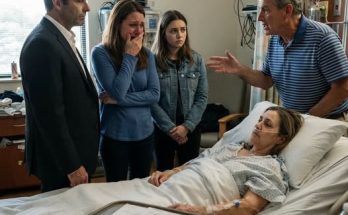
When they finally let me in to see her, Elena was lying in a hospital bed with an IV line taped to the back of her hand and the kind of bone-deep exhaustion on her face that strips a person all the way down to their most honest, unguarded self. She looked smaller than I had ever seen her, as though the illness had been quietly folding her inward for months. Her eyes opened when I stepped through the door, and for a long moment she just looked at me, and something like defeat moved slowly across her face.
“Lucía called you,” she said.
“You put me down as your emergency contact.”
Her gaze slid away from mine, down toward the folds of the blanket. “I forgot to change it.”
“No,” I said, more sharply than I meant to. “You didn’t.”
The silence gathered and thickened between us. Then I crossed the last of the distance to the bed and let the anger I’d been carrying since Lucía’s phone call come loose.
“You let me stand there in that room thinking I had hurt you. You let me ask you what was wrong, and you looked me straight in the face and you lied to me. Over and over. You let me fly home thinking you regretted the whole thing.”
Her eyes filled, but she did not look away this time. She made herself hold my gaze. “I know.”
“Why?”
She swallowed. When she answered, her voice was thin, almost nothing, but it did not waver. “Because I didn’t want you to look at me like this. The way you’re looking at me right now.”
I said nothing. There was nothing to say to it.
She drew in a slow, careful breath, the kind that costs something. “I saw your name on the project papers,” she said, “and my first thought was to ignore it. To just let you come and go and never know I’d been anywhere near. And then I thought about seeing you one more time. Just once. Somewhere that wasn’t a hospital. Somewhere I could still pretend, just for a night, that I was myself. That I was well. That I was the person you used to know instead of the person I was becoming.”
The words reached deeper into me than any dramatic, tearful confession could have.
“I didn’t want your pity, Carlos,” she went on, and the tears spilled over now, running sideways into her hair against the pillow. “That’s the truth of it. I didn’t want to become your obligation. I didn’t want the first real conversation we’d had in three years to be me sitting across from you explaining test results and survival rates and treatment options. I wanted one night where I wasn’t sick. One night where I wasn’t afraid of the next appointment. One night where I could feel like a normal woman again, with the only person who ever actually knew me. That’s all I wanted. I knew it was selfish. I took it anyway.”
I sat down heavily in the chair beside the bed because I no longer had the strength in my legs to stand.
“You should have told me,” I said, and the anger had gone out of it now, leaving only the ache underneath.
“I know.” Another tear slipped down into her hairline. “But I was terrified that the moment I told you, the night would stop being ours. It would stop being the one good thing and turn into something about mercy instead. About obligation. And I couldn’t stand the thought of that. I would rather have had it be a lie than have it be that.”
The truth was that I did not know, sitting there, which of it hurt more. That she had hidden the illness from me so completely. Or that she had felt so entirely alone in the world that she had come to believe hiding it was the only dignified choice left to her. That she had faced the worst news of her life and decided the kindest thing she could do for both of us was to carry it by herself and let me believe a lie.
I stayed.
At first I stayed because I was angry, and frightened, and because there was simply no version of me that could learn what I had learned and then turn around and walk back out of that hospital. There was no door I could have gone through. So I stayed. And then, as the days passed, the anger wore itself out the way anger always eventually does, and it left behind something older underneath it, something that had never actually gone anywhere at all. Something that had only been waiting, patient and quiet, under three years of silence and pride.
Love does not always come back the way it arrives the first time, with fireworks and speeches and certainty. Sometimes it comes back as a chair pulled close to a hospital bed at three in the morning. As consent forms signed with a shaking hand while a nurse waits patiently beside you. As coffee gone cold in a plastic cup in a waiting room that smells of antiseptic and floor wax. As the slow, humbling work of learning, far too late, how much of another person’s terror you had spent years mistaking for coldness. How much of her fear you had filed away, comfortably, as simple distance.
Elena went into treatment. There were ugly weeks. There was pain, the real kind, the kind that has no politeness in it. There was an exhaustion so complete that some days she could barely lift her head from the pillow. There were nights when she snapped at me over nothing, cruel and sharp, and apologized an hour later with tears in her eyes, and I learned to understand that both the sharpness and the apology were the illness talking through her, and to hold neither against her. There were mornings when she did not want me to see her at all, when she turned her face to the wall and asked me quietly to go, and afternoons when she did nothing but sleep for hours while I sat by the window answering work emails with the sound turned off, watching the light move across the floor of the room.
We talked more honestly in those months than we had in the last several years of our marriage combined. We talked about why we had failed the first time. About how work had become, for both of us, a place to hide from each other, a socially respectable form of abandonment. About how pride can wear the costume of dignity while it quietly poisons everything warm and living in a room. About how she had taught herself, long before the diagnosis, to carry her fears entirely alone, and how I had taught myself to call my own emotional absence discipline and even take a kind of pride in it. We saw ourselves clearly, maybe for the first time, in the merciless light of a thing that did not care about either of our defenses.
None of it was cinematic. None of it was the way it happens in films, where illness ennobles everyone and love conquers cleanly. There were bad days that were simply bad, with no redeeming beauty in them at all. There was fear that had no lesson attached. But all of it was real, and real turned out to be enough, and more than we had ever managed to give each other when things were easy.
Months later, when her scans finally came back clean enough for the doctor to allow himself the word remission, Elena wept the way she had never once wept during our entire divorce. Great, heaving, disbelieving sobs, her whole body shaking with them. And I wept too, right there in a hospital hallway that smelled of coffee and disinfectant, the two of us holding onto each other in front of strangers who politely looked away.
A week after that, we went back to the beach.
The same stretch of coast. The same warm wind coming in off the water. The same low, endless sound of the waves sliding up over the pale sand and drawing back again. But everything else was different, because this time there was nothing hidden between us. No envelope tucked under a purse. No lie waiting behind a smile. Nothing folded over to keep me from seeing it.
Elena stood barefoot near the edge of the water, her shoes in one hand, the wind pulling at her hair the way it had that first night, and she looked at me with that direct, searching expression I had loved and feared in equal measure for as long as I had known her.
“I’m not asking you to erase what happened,” she said. “Any of it. I’m not asking you to pretend that one good ending fixes everything that came before it, or that it wipes out the lie, or the years we lost, or any of it.”
I walked toward her across the sand until there was almost no space left between us. “Good,” I said. “Because I’m done pretending anything. I don’t have it in me anymore, and I don’t want it.”
She laughed then, a small, cracked, enormously relieved laugh, and for the first time since I had first seen that red mark on a white hotel sheet, the future in front of us did not feel like a threat. It felt like an open door.
We did not rush headlong into a fairy tale. We did not run off and remarry the following week just because a brush with losing everything had reminded us how much there was to lose. That would have been the easy thing, the frightened thing, and we had both spent enough of our lives making frightened choices dressed up as brave ones. Instead we did the harder thing, the slower thing. We started again, carefully, honestly, without pretending that love alone, all by itself, could repair what silence and pride had once broken. We built it back one true conversation at a time, one ordinary day at a time, with our eyes open.
Even now, years later, when people hear the story they tend to divide quickly into two camps. Some say what Elena did was cruel, that she had no right to draw me into one last night while hiding something so enormous, that she used me for a memory and let me carry the confusion of it alone. Others say that fear makes people reach for strange and desperate forms of tenderness, that all she was trying to protect was one single memory left untouched by the illness, one night that belonged to her and not to the disease, and that there is a kind of terrible love in that.
I still do not know, all this time later, which judgment is the fairer one. I have turned it over more times than I could count, and I have never landed anywhere solid.
I only know that when I think back now to that morning in Cancún, I no longer see the stain first. That is not what rises up in me anymore. What I see is Elena standing at the window in my white shirt with the curtains breathing around her, trying with everything she had left to hold herself together for one more minute, for one more morning, before the truth came for her. And I understand now, in a way I could not possibly have understood then, just how unbearably lonely a person has to have become to choose silence over being seen. To decide that carrying the worst thing entirely alone is somehow the last dignity available to them.
Maybe what she did was selfish. Maybe it was the saddest and most fragile kind of love there is. Maybe, in the end, when I am being most honest with myself, it was both of those things at once, tangled together so tightly that they can never be pulled apart. I have made my peace with not knowing. She is here. She stayed, and I stayed, and that turned out to be the only answer either of us ever really needed.