The Room at the End of the Hall
My son told me I would be better off in a nursing home, and that his family needed my room. So I packed quietly and left without an argument. A few days later, when he finally understood that I was not coming back, the color drained out of his face.
For most of my life, I believed that a mother earned her place in a family by being useful. Not by being loved. Not by simply existing and belonging the way a wall belongs to a house. By being useful. By making herself so necessary that no one could imagine the machinery of the family running without her. I do not know where I learned that, whether my own mother taught it to me or whether I assembled it myself out of the pieces of a hard life, but I believed it completely, and I lived by it for fifty years, and it very nearly cost me everything.
I worked double shifts as a nurse in Columbus, Ohio, for the better part of three decades. I packed lunches before sunrise and left them lined up on the counter with names written on the bags. I sat through freezing Saturday soccer games in a parka with a thermos of coffee, cheering until my throat hurt for boys who scored maybe twice a season. I stretched one paycheck across three growing boys after my husband Frank died of a heart attack at forty six and left me with a mortgage, a station wagon that barely ran, and more grief than I had time to feel.
When college tuition came due, I sold the last piece of farmland my father had left me, forty acres outside Marysville that had been in my family since before I was born, and I signed the papers without letting anyone see my hands shake. When my youngest son’s first company failed and the bank would not touch him, I co-signed the loan that gave him a second chance, putting my own name and my own credit on the line at an age when most women are trying to protect what little they have.
I never kept score. That may have been my first mistake. Not because a mother should keep score, but because when you refuse to count what you give, the people receiving it can also refuse to count it, and eventually a whole ledger exists in which you have contributed nothing at all.
By the time I was seventy two, my sons had all become successful men with busy calendars and polished homes. David, my oldest, was an attorney with a corner office and a firm handshake. James managed several hardware stores and was doing well enough to take his family to Florida every winter. Ryan, the youngest, the one whose company I had saved, had become a technology executive who appeared in business magazines and spoke at conferences about grit and resilience and the people who had helped him along the way.
He never mentioned me. Not once, in any interview, in any speech. I read them all. I had a folder.
For two years I had been living with David and his wife Pamela in their large house in the suburbs outside Dublin. They had insisted on it after I sold my condo, and I remember that David had put his arm around my shoulders in the parking lot of the realtor’s office and said, “You shouldn’t be alone anymore, Mom. This is your home too.”
At first, I believed him. I want to say that plainly, because I think it matters. I was not naive, exactly. I had simply spent my whole life loving these boys, and love makes you willing to accept the version of things that hurts least.
My bedroom was at the end of the upstairs hallway, a good room with a window that caught the morning. I kept Frank’s photograph on the dresser, the one from the lake where he is laughing at something outside the frame. I had my blue quilt on the bed, the one my grandmother made. I kept a ceramic bowl of peppermints on the nightstand for my grandson Eli, who was nine and who would come in without knocking and take two and tell me about his day. On Saturday mornings I made blueberry pancakes while the local news played softly on the kitchen television, and Eli would eat four of them, and for a little while it felt exactly like what David had promised. A home.
Then the small changes began, so gradually that I could not have pointed to the day they started.
Family dinners began happening without anyone telling me they were happening. I would come downstairs at six to find the table already cleared, everyone scattered, a plate covered in foil left on the stove for me like a courtesy extended to a boarder. Eli’s school events appeared on the refrigerator calendar only after they had already passed, the date crossed out in Pamela’s handwriting. Pamela bought groceries for what she called the household, but she stopped asking whether I needed anything, and so the brand of tea I drank simply stopped appearing, and I began buying my own and keeping it in my room like contraband.
And David, my David, became careful with me. Overly gentle. He started speaking to me in that particular soft voice people use when they have already made a decision about you and are waiting for the right moment to inform you of it. I recognized that voice. I had used it myself, hundreds of times, in hospital rooms, with families who did not yet know what was coming. I knew exactly what it meant. I simply could not believe I was hearing it aimed at me, from my own son.
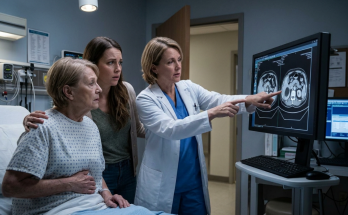
One cold February morning I became dizzy while carrying a pot of chicken soup to the counter. The kitchen tilted sideways, my knees let go, and the next thing I knew I was on the tile with the soup soaking through my sleeve and Pamela standing over me on the phone with 911.
The hospital kept me two nights because my blood pressure had spiked dangerously high. The doctor was unconcerned in the way doctors are when a problem has an obvious solution. Your medication needs adjusting, he said. We will change the dosage, you will follow up in two weeks, this is very common. I have been a nurse. I understood him perfectly. It was a Tuesday problem, not a life sentence.
On the morning I was discharged, all three of my sons arrived together.
That was how I knew. In seventy two years, my three boys had never once done anything together on a weekday morning without weeks of scheduling. They came into that hospital room in a row, David first, then James, then Ryan in a suit that probably cost more than my first car, and I looked at the three of them and I understood that something had been arranged before I woke up.
“We’ve been talking,” David began.
“About my health?” I asked.
Pamela, who had come in behind them, leaned forward. “About what’s safest for everyone.”
For everyone. I noticed that. I have thought about that phrase many times since.
Ryan took out his phone and showed me a brochure for a senior living community. The photographs were lovely. Smiling residents playing cards beside a stone fireplace. A landscaped courtyard with a fountain. An art room with easels and good light. “It’s one of the best places in the county, Mom,” he said, in the same warm confident voice he used in magazine interviews. “They have nurses on staff around the clock.”
“I had one episode,” I said. “The doctor said my medication needs adjusting. He was very clear about that. I asked him twice.”
No one answered me. That silence went on a beat too long, and in it I heard everything.
Then David came and sat on the edge of the bed and covered my hand with his, and he said, “You’ve spent your whole life taking care of everyone else, Mom. Maybe it’s time to let somebody take care of you.”
It sounded loving. It almost was. That is the terrible thing about the way people dismantle you when they still think of themselves as good. They find the sentence that would be beautiful if it were true, and they use it as a door.
I looked from one face to another, and I waited for somebody, any one of them, to say that this was only a suggestion. That we could talk about it. That the decision was mine. James looked at the floor. Ryan looked at his phone. David held my hand and smiled at me with terrible tenderness.
Nobody said it.
Pamela finally broke the silence, and she was the only honest one in the room, I will give her that much. “And honestly,” she said, “we do need the extra room. David is working from home more now, and the downstairs space just isn’t functioning as an office.”
My room.
Not a spare bedroom. Not an unused space. My room, at the end of the hall, with Frank’s photograph and my grandmother’s quilt and my books and the peppermints in the ceramic bowl and everything that was left of a seventy two year life that had been mostly spent on the people standing in that room.
David squeezed my hand. “It isn’t personal, Mom.”
Something inside me went perfectly still then. Not broken. Still. The way water goes still when it is about to freeze.
I did not cry. I did not remind them about the forty acres I had sold so David could go to law school. I did not mention the loan I had co-signed for Ryan when no one else on earth would put their name beside his. I did not bring up the double shifts or the soccer games or the thirty years of making sure that none of them ever went a single day feeling unwanted in their own home.
I simply nodded.
“All right,” I said.
And I watched relief cross all four of their faces so fast that each of them had to hide it, and I understood something in that moment that I will carry to the end of my life. They had been afraid I would fight. They had rehearsed for a fight. And what they felt when I did not fight was not sorrow. It was relief.
I went back to David’s house that afternoon. By dinnertime, there was a measuring tape and an office furniture catalog sitting on the kitchen island, and Pamela was on the phone with someone about a standing desk. Nobody moved them when I walked in. Nobody thought to.
The next morning, while the house was empty, I began to pack.
But I did not pack the way they expected. They expected boxes. They expected a sad afternoon of sorting, of me holding up items and asking whether anyone wanted them, of the slow public dismantling of an old woman’s belongings in a hallway. That was the version they had prepared for, the one where they could be kind and helpful and feel good about themselves while it happened.
I took one suitcase. My documents. My journals, thirty years of them. Frank’s photograph off the dresser. And a small locked metal box that had lived under my bed for more than twenty years, which not one of my sons had ever asked about, because not one of them had ever thought to wonder what their mother might have that they did not know about.
Everything else stayed exactly where it was. The quilt on the bed. The books on the shelf. The peppermints in the bowl.
At nine o’clock the next morning, a car pulled into the driveway. Pamela glanced out the window and assumed it belonged to the nursing home, and went back to her coffee.
It did not.
I set my house key on the kitchen counter, carried my suitcase out the front door, and left without waking anyone or saying goodbye. Nobody stopped me. Nobody came out. I got into the car, and the driver put my suitcase in the trunk, and we pulled out of that cul de sac, and I did not look back at the house because there was nothing in it that belonged to me anymore.
Three days later, David finally went into my empty room.
I know this because Pamela told me later, in a phone call I did not particularly want. It took him three days. Three days of assuming I was where they had put me, three days without a single call to check, before he opened the door at the end of the hall and saw the bed still made with the quilt still on it and the dresser bare where Frank’s photograph had stood.
He noticed the metal box was gone from beneath the bed. He had known it was there. Boys notice things and forget they noticed them. And where it had been, on the floor, he found the envelope I had left.
He opened it, read the first two lines, and sat down slowly on the edge of my bed.
Pamela asked him what was wrong.
David looked up at her, and the color went out of his face, and he said, “Mom didn’t go to the nursing home. And I think we’ve made a terrible mistake.”
The letter was not cruel. I want to be clear about that, because I wrote it carefully, over two nights, and I threw away three angrier versions before I found the one that was true.
It said that I loved them. It said that I had loved them from the first hour of each of their lives and would love them past the last hour of mine, and that nothing in the letter changed that. Then it said that I had spent fifty years believing my place in the family was something I had to keep earning, and that in the hospital room I had finally understood that I had earned it a hundred times over and it had been taken from me anyway, and that a place you can be evicted from was never really yours.
It said that I had not gone to the facility Ryan chose, because I was not confused, and I was not incapable, and I did not require supervision. My medication had been adjusted and my blood pressure was fine. It said that I had made other arrangements, that I was safe and well and among people, and that I would be in touch when I was ready, but that I would not be telling them where I was for a while, because I needed to find out who I was when I was not being useful to anyone.
And at the end it said this, which I remember exactly because I wrote it eleven times before I got it right. You told me it was not personal, David. But there is nothing in this world more personal than being told there is no room. I have decided to go where there is room.
The metal box, since I know you are wondering the same thing my son was.
Twenty three years ago, after Frank died and before the boys were grown, an insurance settlement came through from his employer. It was not enormous, but it was real money, more than I had ever had at once. Everyone assumed I spent it on the house and the boys, and I did spend a good deal of it that way. But I put some aside, and I kept putting money aside, small amounts, for twenty three years. A nurse’s overtime here. A tax refund there. The last of the farmland money that did not go to tuition. I opened an account my sons knew nothing about and I never touched it, not even in the years when things were thin, and I kept the statements and the paperwork in a locked box under my bed because I did not trust banks entirely and because Frank had once told me that a woman should always have something of her own that no one can talk her out of.
He said it in the kitchen of our first house, and I laughed at him, and he did not laugh. Always, Ellen, he said. Always have something they don’t know about. Not because you’ll need it. Because knowing you have it changes how you stand.
He was right. He was right about almost everything and he did not live long enough to know how right.
By the time I left David’s house, that account held a little over three hundred and forty thousand dollars.
I did not go to a nursing home. I went to a small apartment in a retirement community in Worthington, twenty minutes away, in a building where the residents keep their own keys and come and go as they please and nobody schedules your life for you. I had toured it eight months earlier, quietly, on an afternoon when everyone thought I was at a doctor’s appointment, because some part of me had already read the room I was living in and had begun, without quite admitting it, to prepare.
That is the part I think about most. That some deep survival instinct in me had started making arrangements months before my conscious mind was willing to accept what was coming. I had a folder of clippings about my son who never mentioned me, and I had a tour scheduled at a place I told no one about. I knew. I had known for a long while. I simply had not let myself know.
The first weeks in that apartment were the strangest of my life. I would wake at five thirty out of forty years of habit and lie there realizing there was no one to make breakfast for. No lunches to pack. No one’s schedule to accommodate. It was terrifying, at first. I understood that I did not know how to fill a day that had no one else in it. I had never once, in seventy two years, had to answer the question of what I actually wanted.
So I found out. Slowly.
I started swimming in the mornings, in the community pool, because a woman named Doris in 3B saw me sitting alone in the lobby and told me I looked like someone who needed to move her body and would not accept no. I learned to paint badly and cheerfully in a Tuesday class. I read novels in the middle of the afternoon without feeling guilty, which took months to manage. Doris and I started driving out to a diner in Delaware County on Sundays because she claimed they had the best pie in Ohio, and she was wrong, but we kept going for eleven years anyway.
I made friends. Real ones, at seventy two, which nobody tells you is possible. Women who had also raised people and buried husbands and been quietly written out of their own houses. We did not talk about it much. We did not have to. There is a particular look that passes between women who have been made small, and once you learn it you see it everywhere.
I did contact my sons, eventually. About seven weeks after I left. I called James first, because James had been the one who looked at the floor in that hospital room, and shame is a better starting place than defensiveness. He cried on the phone. He said he had known it was wrong the whole time and had not said anything because David had presented it as already decided and he had not wanted to be the difficult one. I told him I understood. I told him that going along with something is a choice too, and that I needed him to sit with that, and he said he would, and I believe he did.
Ryan sent flowers and a long email full of the word grateful. He offered to pay for a better facility. He did not understand, even then, that the facility had never been the point, that I had not left because the accommodations were insufficient. He is a good man in most ways and he loves me in the way he is capable of, which is at a distance, generously, with money. I let that be enough. There is a kind of peace in accepting the specific shape of what someone actually has to give instead of grieving forever the shape you wanted.
David took the longest.
He came to see me in the fall, alone. He had gotten my address from James eventually. He sat in my small living room, in a chair too low for a man his height, and he did not say anything for a long time. Then he said, “You left the peppermints.”
“I did,” I said.
“Eli asks about them.” His voice cracked on his son’s name. “He asks where you are, and I’ve been telling him you needed a change, and he keeps asking why you didn’t say goodbye to him, and I don’t have an answer, Mom, because the real answer is that I didn’t give you a chance to.”
I let that sit. I had learned by then not to rush in and rescue people from their own understanding, which was maybe the hardest thing I ever learned.
“I keep going over it,” he said. “The hospital. I keep hearing myself say it isn’t personal. I’ve said that sentence to clients for twenty years. It’s what you say when you’re doing something to someone and you don’t want to feel like the person doing it.” He put his face in his hands. “I did that to my mother.”
“Yes,” I said. “You did.”
He looked up, surprised, I think, that I had not softened it. Fifty years of softening things for that boy, and I finally did not, and I watched it land, and it was the most useful thing I ever gave him.
We talked for four hours that afternoon. Not all of it was pleasant. He wanted to know about the money, and when I told him about the account and about what Frank had said in the kitchen of our first house, he wept, because he had been eleven when his father died and he had never heard that story, and because he understood, finally, that his mother had been quietly protecting herself from her own children for twenty three years and had turned out to be right to.
He asked me to come back. I said no, and I said it kindly.
“I have a life here, David,” I told him. “I have friends and a class on Tuesdays and a swim in the mornings and a woman down the hall who thinks she knows where the best pie in Ohio is. I am not sitting here waiting for you to come and fix it. That’s what I need you to understand. I am not in exile. I moved.”
We rebuilt something after that. Not what we had before. Something more honest and less comfortable and, I think, more real. He brought Eli to see me twice a month, and Eli got his peppermints, and eventually the boy stopped asking why I had left and started just telling me about his day the way he used to. David and I had lunch on Thursdays. We talked about things we had never talked about, his father, my double shifts, the year I nearly went under and never told anyone.
I lived in that apartment for fourteen years. Doris died in the ninth of them and I miss her still. I painted a great many bad paintings and one that was actually quite good, of the lake where Frank is laughing in the photograph, and it hangs in David’s house now, which is its own kind of ending.
And here is what I would tell any woman who finds herself, at seventy two or fifty or eighty five, sitting in a room where the people she raised are explaining to her, very gently, that there is no longer space for her.
They will tell you it isn’t personal. It is. They will tell you it is about safety. It is about the room. They will offer you a brochure with a stone fireplace and smiling strangers, and they will be relieved, not sad, when you agree, and you will see that relief on their faces if you are brave enough to look.
And you do not have to fight them. That is the part nobody tells you. You do not have to argue, or plead, or make a scene, or list every sacrifice like a bill coming due. There is another door, and it is quieter, and it is this. You can simply decline to be where you are not wanted. You can pack one suitcase and set the key on the counter and go somewhere there is room.
I earned my place in my family for fifty years and lost it in a single conversation. It took me leaving to discover that I had never needed to earn it at all, and that the woman underneath all that usefulness, the one nobody had asked about since 1971, was still in there, waiting, patient as anything, wanting to know what I liked for breakfast.
She liked blueberry pancakes, it turned out. She made them for herself on Saturday mornings, in her own kitchen, with the news on low.