
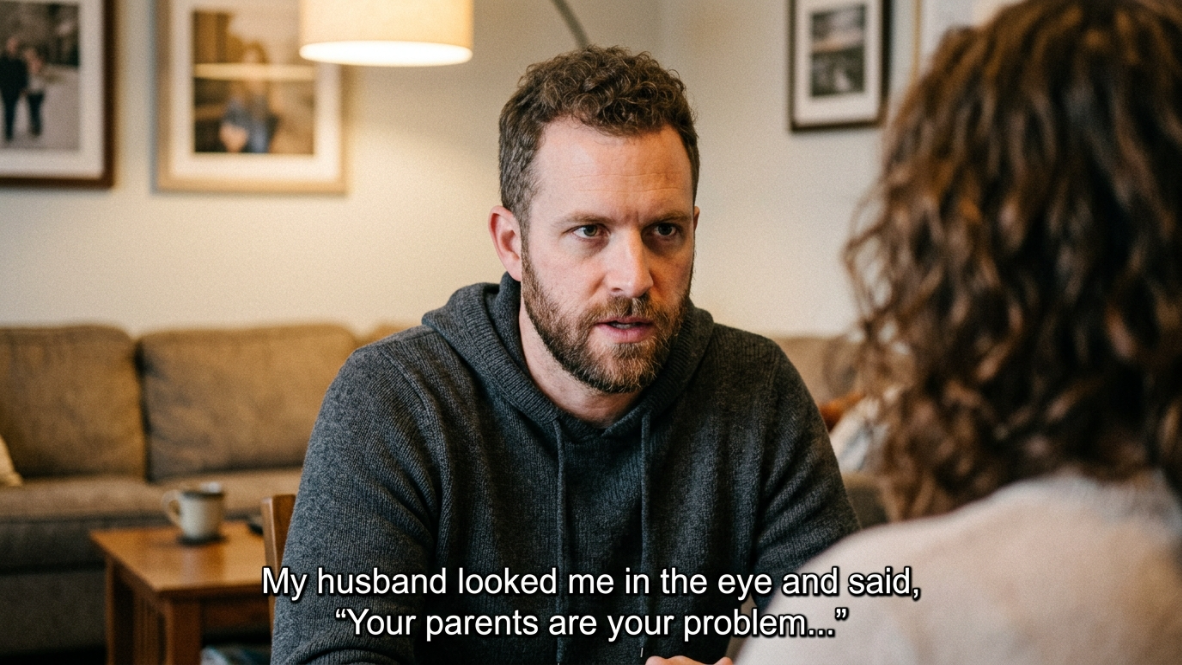
PART 3
The single word hit him harder than shouting ever could.
For several seconds he simply stared.
Then came the sentence I had heard a hundred different ways throughout our marriage.
“You’re embarrassing me.”
There it was.
Not “you’re hurting my parents.”
Not “how can we solve this together?”
Just…
“You’re embarrassing me.”
Daniel grabbed his phone and immediately called his mother.
“Mom… I’m handling it.”
He glanced at me.
“No, she’s just… confused.”
I quietly continued folding clothes.
“No, don’t worry. I’ll fix it tonight.”
He hung up and took a deep breath.
“Rebecca.”
His voice softened.
“We’ll talk about this like adults.”
I raised an eyebrow.
“I’ve been trying to.”
“You know my parents need help.”
“So do mine.”
“That’s different.”
I waited.
He didn’t seem to realize how dangerous those two words were.
“How is it different?”
“My parents don’t have enough income.”
“My father can’t work after his stroke.”
“I know.”
“My mother just had heart surgery.”
“I know.”
“So explain the difference.”
Daniel opened his mouth.
Closed it.
Opened it again.
Finally he muttered,
“It’s just…”
“They’re older.”
I blinked.
“My parents are only three years younger than yours.”
Silence.
“They’re struggling.”
“So are mine.”
“They’re family.”
“So are mine.”
Every answer he gave only trapped him further.
Finally he sighed dramatically.
“You don’t understand.”
“No.”
“I don’t.”
He sat across from me.
“My parents sacrificed everything for me.”
I looked at him for a long moment.
“My parents paid for our wedding.”
He looked away.
“My parents gave us the down payment for this house.”
Still silence.
“My father gave you his truck after yours broke down.”
Daniel rubbed his temples.
“That’s not the point.”
“No.”
“It is exactly the point.”
For the first time in our marriage…
I stopped protecting him from the truth.
“You know something I’ve never understood?”
“What?”
“You’ve never once thanked my parents.”
He frowned.
“What are you talking about?”
“I mean exactly what I said.”
“When my dad handed you the truck keys…”
“You said…”
I paused, remembering.
“‘This will save me a fortune.’”
“You never said thank you.”
His expression shifted.
“You seriously remember that?”
“I remember everything.”
Because wives always remember.
Every sacrifice.
Every dismissal.
Every time someone quietly takes without appreciating what they’ve received.
The next morning my phone rang before breakfast.
Linda.
I answered.
“Good morning.”
Her voice sounded unusually sweet.
“Rebecca, sweetheart.”
“Yes?”
“I was just wondering if there was some misunderstanding.”
“No misunderstanding.”
“The transfers stopped.”
“Yes.”
A pause.
“I’ve always considered you my daughter.”
I almost smiled.
Interesting.
For three years she’d called me Daniel’s wife.
Today I was suddenly her daughter.
“I appreciate that.”
“So…”
“I assume the bank can fix it?”
“There isn’t anything to fix.”
Silence.
Then…
“But how are we supposed to pay the mortgage?”
“I don’t know.”
“You don’t know?”
“No.”
“I’ve never seen your mortgage.”
“I’ve never signed your loan.”
“I’ve never agreed to be financially responsible for your household.”
Another silence.
Then her voice hardened.
“This is because of your parents, isn’t it?”
“No.”
“This is because of Daniel.”
She hung up.
Thirty minutes later…
Robert called.
I let it go to voicemail.
Then Megan.
Ignored.
Then Daniel’s cousin Eric.
Ignored.
By lunchtime I had twelve missed calls.
By dinner…
Twenty-seven.
Daniel came home carrying takeout.
An old habit.
Whenever he wanted forgiveness, he brought food.
He set the bags on the counter.
“Your favorite Thai.”
I smiled politely.
“Thank you.”
We ate in silence.
Finally he cleared his throat.
“My parents are really stressed.”
“I’m sorry to hear that.”
“They might lose the house.”
I took another bite.
“They’ve missed one payment.”
“It isn’t that simple.”
“I know.”
“Then help.”
I set down my fork.
“I already have.”
He frowned.
“What?”
“I’ve been helping for three years.”
“I’ve contributed ninety thousand dollars.”
His face froze.
“What?”
“I did the math.”
“$2,500 every month.”
“Thirty-six months.”
“Ninety thousand dollars.”
The number seemed to hit him for the first time.
Ninety thousand.
Enough for a house down payment.
Enough for college tuition.
Enough to pay off my parents’ medical bills several times over.
He whispered,
“I didn’t realize…”
“No.”
“You didn’t.”
After dinner I went upstairs.
Daniel stayed in the kitchen.
Half an hour later I heard raised voices.
He was on speakerphone.
His mother.
“I don’t have it!”
Daniel shouted.
“What do you mean you don’t have it?” Linda cried.
“I thought Rebecca handled everything!”
“I thought so too!”
I stopped halfway down the stairs.
Then came the sentence that changed everything.
Linda sighed dramatically.
“Well…”
“I guess you’ll have to ask Rebecca.”
Daniel replied quietly,
“She said no.”
Silence.
Then Linda asked a question neither of us expected.
“…What do you mean she said no?”
Daniel hesitated.
“I told her…”
“Our money is separate.”
There was a long pause.
Then Linda spoke again.
Only this time…
She wasn’t angry with me.
She was furious with her son.
“You said WHAT?”
Daniel blinked.
“Mom?”
“You told your wife…”
“…the money was separate?”
“Well…”
“Answer me.”
“Yes.”
Linda’s voice became ice cold.
“You idiot.”
Daniel looked stunned.
“What?”
“For three years…”
“…that woman has been paying our bills.”
“And you told her…”
“…she’s on her own?”
He looked toward the stairs, not realizing I was standing there.
“I didn’t think she’d actually stop.”
Linda practically screamed.
“You didn’t think?”
“Daniel…”
“Do you have any idea how many women would have left you after this?”
He didn’t answer.
“And another thing.”
Her voice sharpened.
“You told me you were paying most of those transfers.”
My eyebrows lifted.
Interesting.
Very interesting.
Daniel swallowed.
“I…”
“You told your father those were coming from your bonus.”
“I…”
“You let us thank you every month.”
Silence.
Complete silence.
Then Robert’s voice entered the call.
“You’ve been taking credit for Rebecca’s money?”
Daniel closed his eyes.
“Dad…”
“No.”
His father interrupted.
“Answer.”
“Yes.”
Another long silence followed.
Finally Robert spoke.
“I’m disappointed in you.”
The line went dead.
Daniel slowly lowered the phone.
When he turned around…
He found me standing on the stairs.
He looked like a little boy caught lying.
“Rebecca…”
I walked down calmly.
“Your family thought the money came from you?”
He couldn’t answer.
“They’ve been thanking you?”
Still nothing.
“You let them believe you were supporting everyone…”
“…using my salary?”
His shoulders dropped.
“I didn’t know how to explain it.”
I laughed.
Not because it was funny.
Because it was unbelievable.
“So every Mother’s Day card…”
“…every Christmas toast…”
“…every speech about how generous you were…”
I looked him directly in the eyes.
“…was built on my paycheck.”
He whispered,
“I’m sorry.”
I studied him for a long moment.
Then I asked the question that had quietly been growing inside me for years.
“Daniel…”
“If your money was always yours…”
“…why did you spend mine like it belonged to you?”
He had no answer.
None at all.
But before either of us could say another word, there was a loud knock at the front door.
Daniel frowned.
“It’s almost nine.”
I walked over and opened it.
Standing on our porch were Linda, Robert, Megan…
…and behind them, my parents.
My mother looked confused.
My father looked furious.
And in Linda’s trembling hand was a thick manila envelope.
She looked at me—not her son—and quietly said,
“Rebecca… there’s something you deserve to know before this marriage goes any further.”
PART 4
The room became so quiet that I could hear the ticking of the old clock above the fireplace.
Nobody moved.
Nobody spoke.
Everyone was looking at the document sitting on the coffee table.
Especially Daniel.
His eyes kept moving between me and the sealed envelope.
“What is that?” he asked.
Karen Ellis, the attorney, didn’t answer him.
She looked at me.
“Mrs. Whitaker, before I explain anything, I need to confirm something.”
I nodded slowly.
“What?”
“Do you understand that this document contains private information regarding your grandmother’s estate?”
“Yes.”
“And that the contents are intended only for you?”
I looked at Daniel.
Then at his family.
Then back at Karen.
“Yes.”
She nodded.
“Then I need you to open it.”
My fingers felt strangely heavy as I broke the seal.
Inside was a letter.
Not typed.
Handwritten.
The moment I saw the handwriting, my eyes burned.
My grandmother Margaret had always written letters.
She believed text messages were too easy.
She used to say:
“If something matters, put your hand on paper. Your heart should touch the words before someone else reads them.”
I unfolded the letter.
My dearest Rebecca,
If you are reading this, then I am no longer sitting across from you drinking tea and telling you that you work too hard.
I smiled through the tears.
That was exactly something she would say.
I have watched you your entire life.
You have always been the person who gives before anyone asks.
You helped your parents.
You helped your friends.
You helped people who didn’t always deserve your kindness.
My greatest fear was not that you would fail.
My greatest fear was that someone would convince you your kindness was weakness.
I stopped reading for a moment.
The words hit too close.
Marriage should be a partnership.
Not a competition.
Not a business arrangement.
Not one person sacrificing while the other collects the rewards.
My eyes slowly moved toward Daniel.
He looked away.
I met Daniel twice before your wedding.
My heart stopped.
I looked up.
“Karen…”
She nodded.
“Keep reading.”
The first time was at your engagement dinner.
The second time was when he visited our house before the wedding.
I asked him one question.
‘What will you do when Rebecca no longer has anything to give you?’
I swallowed.
He laughed.
He said, ‘That won’t happen. Rebecca is not the kind of person who stops giving.’
My stomach tightened.
Daniel shifted uncomfortably.
At the time, I hoped he meant he admired your heart.
I now realize he may have meant he expected to benefit from it.
The room went completely still.
Daniel finally spoke.
“That’s unfair.”
Everyone looked at him.
He stood with his hands clenched.
“She knew me for two meetings.”
Karen calmly interrupted.
“Mr. Whitaker, please allow Rebecca to finish.”
Daniel sat back down.
I continued.
Rebecca, I left you something because I know you.
I know you will try to refuse it.
You will say you don’t need it.
You will say someone else needs it more.
That is exactly why you should receive it.
I felt tears running down my face.
Your grandfather and I built our company from nothing.
We lost everything twice.
We learned the difference between being rich and being secure.
Money is not valuable because of what it buys.
Money is valuable because of the freedom it gives you to make choices.
I looked at Karen.
“What did she leave?”
Karen opened the portfolio.
“The first part is a trust.”
She placed a document in front of me.
“The trust was established fifteen years ago.”
I stared at the number.
My breath caught.
“$3.2 million?”
Daniel looked up.
“What?”
Karen continued.
“That is the current value.”
Nobody spoke.
“The second part…”
She placed another document down.
“Your grandmother owned a commercial property portfolio.”
She turned the page.
“She transferred ownership to a holding company.”
I frowned.
“Why?”
“Because she wanted to protect the assets.”
“From what?”
Karen looked at Daniel.
“From anyone who might believe they had a claim over your inheritance.”
The room changed.
Suddenly, this wasn’t just about money.
It was about protection.
Daniel stood again.
“Wait.”
Everyone looked at him.
“So Rebecca had millions this entire time?”
My expression hardened.
“There it is.”
“What?”
“The first thing you think about.”
He frowned.
“I’m just surprised.”
“No.”
“You aren’t surprised.”
“You’re calculating.”
His face changed.
“That’s not true.”
“Isn’t it?”
I looked around the room.
“For three years, I gave away my money.”
“I helped your family.”
“I paid bills.”
“I sacrificed.”
“And you never once asked whether I was okay.”
I pointed toward the documents.
“But now you know I have money…”
“And suddenly everyone wants to know.”
Linda looked ashamed.
“Rebecca…”
I shook my head gently.
“No.”
“You don’t need to apologize for his choices.”
She looked down.
“But I do.”
“Why?”
“Because I benefited from them.”
She wiped her eyes.
“I accepted the money.”
“I accepted the comfort.”
“I accepted the image of my son being generous.”
“Without asking where it came from.”
Karen cleared her throat.
“There is another condition.”
Everyone looked at her.
“What condition?” Daniel asked.
Karen looked at me.
“Your grandmother included one.”
I nodded.
“What is it?”
She opened another page.
“The inheritance cannot be transferred, controlled, or accessed by a spouse.”
Silence.
Daniel blinked.
“What?”
“The trust is solely Rebecca’s.”
“Completely protected.”
“Regardless of marital status.”
His face changed.
“She can’t use it for us?”
Karen shook her head.
“No.”
“For the household?”
“No.”
“For family expenses?”
“No.”
Daniel laughed nervously.
“That seems extreme.”
Karen replied calmly,
“Your grandmother was very specific.”
She read from the document.
“The person who receives this inheritance must never be made to feel that love is conditional upon financial contribution.”
I closed my eyes.
That sentence was everything.
Daniel looked at me.
“So that’s it?”
I didn’t answer.
“You have money now.”
“Your family doesn’t need help.”
“My family doesn’t need help.”
“You can just walk away?”
I studied him.
“I didn’t walk away.”
“You pushed me away.”
The next morning, I woke up before sunrise.
For the first time in years…
I didn’t wake up worried about bills.
I didn’t wake up calculating expenses.
I didn’t wake up wondering who needed money from me.
I simply woke up.
And that felt strange.
Three weeks later, I moved into a small house near my parents.
Not a mansion.
Not a luxury property.
Just a comfortable place with sunlight through the kitchen windows and enough room for my mother to visit.
Daniel moved into an apartment downtown.
We agreed to separate temporarily.
Not because I hated him.
Because I needed to hear my own thoughts without his voice influencing them.
During that time, something unexpected happened.
Daniel changed.
Not overnight.
Not dramatically.
Real change rarely happens like that.
He started therapy.
He apologized to my parents.
Not a quick apology.
A real one.
He sat with my father for almost two hours.
My father later told me:
“He finally listened.”
He apologized to his family too.
He admitted the truth.
That the money had been mine.
That he had taken credit.
That he had allowed everyone to believe a lie.
Megan returned every dollar she could.
Linda and Robert sold their large house and moved into something smaller.
They said they wanted to live within their own means.
Six months later, Daniel asked to meet me.
Not at a restaurant.
Not somewhere expensive.
A coffee shop.
The same kind of place where we had met eight years earlier.
He looked different.
Not poorer.
Not richer.
Just…
Humbler.
“I owe you an apology.”
I nodded.
“You do.”
He smiled sadly.
“I practiced that sentence for three days.”
“Why?”
“Because I wanted to say the right thing.”
“And?”
“And I realized there is no right thing.”
He looked at his coffee.
“There is only the truth.”
“I was selfish.”
“I confused being loved with being entitled.”
“I thought because you gave willingly, I deserved what you gave.”
“I was wrong.”
I listened.
“I don’t expect you to forgive me.”
“Not yet.”
“Maybe not ever.”
“But I needed you to know…”
He looked up.
“…I finally understand.”
I asked him one question.
“If you could go back to that night in the kitchen…”
“The night you said my money was mine and your money was yours…”
“What would you say?”
Daniel was quiet for a long time.
Then he answered:
“I would say…”
“Your parents are my family.”
“Your problems are not yours alone.”
“Your success is not something I get to benefit from without gratitude.”
“And your love is not something I am entitled to.”
I looked at him.
For the first time in months…
I believed him.
Not because he said the perfect words.
Because his actions had finally started matching them.
Daniel and I did not rush back into marriage.
We rebuilt slowly.
Coffee dates.
Honest conversations.
Small promises kept.
No secrets.
No hidden accounts.
No assumptions.
Just two people learning how to choose each other again.
One evening, we sat on my parents’ porch watching the sunset.
My father smiled.
“You know what the funny thing is?”
“What?”
“You stopped paying everyone else’s bills…”
“And somehow everyone became better with money.”
I laughed.
My mother smiled.
“Sometimes people don’t need saving.”
“They need the chance to stand on their own.”
Daniel reached for my hand.
This time…
He wasn’t taking.
He wasn’t expecting.
He was simply holding it.
And I realized something.
The biggest lesson wasn’t that my husband learned the value of money.
It was that I learned the value of myself.
For years, I thought love meant giving until there was nothing left.
I was wrong.
Real love doesn’t ask you to disappear.
Real love doesn’t measure your worth by what you provide.
Real love stands beside you.
Not behind you.
Not on top of you.
Beside you.
And when Daniel finally understood that…
We didn’t rebuild the marriage we had before.
We built something better.
Something honest.
Something equal.
PART 5
Six months after Daniel and I started rebuilding our relationship, I thought the hardest part was behind us.
I was wrong.
Because rebuilding trust is not like repairing a broken vase.
You cannot simply glue the pieces together and pretend the cracks are invisible.
A marriage after betrayal is more like rebuilding a house after a storm.
You have to inspect every foundation.
Every weak point.
Every place where water might leak in again.
And Daniel finally understood that.
One Saturday morning, I was sitting on my parents’ porch with coffee in my hands when Daniel arrived.
He wasn’t carrying flowers.
He wasn’t carrying expensive gifts.
That was one of the first things I noticed.
The old Daniel believed problems could be solved by buying something.
The new Daniel showed up with time.
“Good morning,” he said.
I smiled.
“Morning.”
He sat beside me.
For several minutes, we just watched my father water his garden.
Then Daniel spoke.
“I got a new job.”
I turned.
“What?”
He nodded.
“Not at Whitaker Holdings.”
“Where?”
“A small investment firm.”
“Small?”
He smiled.
“Very small.”
“Twenty employees.”
“No private office.”
“No assistant.”
“No company car.”
I laughed softly.
“That sounds difficult for you.”
“It is.”
Then he looked at me.
“And that’s exactly why I chose it.”
I waited.
Daniel took a breath.
“For most of my life, I measured myself by how much I had.”
“My house.”
“My title.”
“My income.”
“My reputation.”
He looked down.
“But when everything disappeared…”
“I realized I didn’t know who I was without those things.”
That sentence surprised me.
Because that was the first time Daniel had admitted something I had always known.
He wasn’t just arrogant.
He was afraid.
Afraid of being ordinary.
Afraid of not being admired.
Afraid that without success, he wasn’t enough.
“I want to build something again.”
“But differently.”
“Slowly.”
“Honestly.”
I nodded.
“That’s good.”
He smiled slightly.
“There’s something else.”
“What?”
“I stopped sending money to my family.”
I raised an eyebrow.
“Completely?”
“Yes.”
“But I still help.”
“How?”
“I help them make plans.”
“I don’t pay their problems away.”
He laughed quietly.
“Turns out people learn faster when you stop rescuing them.”
I smiled.
“That sounds familiar.”
He nodded.
“It does.”
A few months passed.
Things were changing.
Not perfectly.
But genuinely.
Linda started visiting my parents.
At first, it was awkward.
Two mothers who had spent years on opposite sides of an invisible wall.
But slowly…
They became friends.
My mother taught Linda her recipes.
Linda helped my mother organize medical appointments.
They discovered they had more in common than they ever imagined.
One afternoon, I walked into my parents’ kitchen and found both of them laughing.
My mother looked at me.
“Your mother-in-law is stubborn.”
Linda immediately responded,
“Your mother is worse.”
They both laughed.
And I realized something beautiful.
Sometimes people don’t need a dramatic apology.
Sometimes they just need time to become better.
But not everyone changed.
And that lesson came one evening when Daniel received a phone call.
It was Megan.
He answered.
“Hey, Megan.”
His expression changed quickly.
“What happened?”
I watched him listen.
Then his face hardened.
“No.”
A pause.
“No, I won’t do that.”
Another pause.
“Megan, I understand you’re upset.”
“But Rebecca’s inheritance is not the answer.”
My attention shifted.
Inheritance.
Again.
After he hung up, I asked,
“What happened?”
He sighed.
“My aunt found out about your trust.”
I frowned.
“Your aunt?”
“She thinks because we’re rebuilding our marriage, she has access to your money.”
I stared.
“Seriously?”
He nodded.
“She said we’re family.”
“And family shares.”
I almost laughed.
“Of course.”
Daniel looked at me.
“She asked me to convince you.”
“And what did you say?”
He smiled.
“I said no.”
That night, I realized something.
A year ago, Daniel would have handled that conversation differently.
He would have avoided conflict.
He would have tried to make everyone happy.
Even if it hurt me.
But now…
He protected the boundary.
Not because he wanted control.
Because he finally understood respect.
A week later, Daniel and I visited his parents.
Linda had something to tell us.
She looked nervous.
“I’ve been thinking.”
I smiled.
“That’s usually when trouble begins.”
She laughed.
“I deserve that.”
She placed a folder on the table.
“What is this?”
“The house.”
I looked confused.
“What about it?”
“We sold it.”
I looked at Robert.
“You sold your house?”
He nodded.
“We realized we were living beyond what we needed.”
Linda continued,
“We bought a smaller place.”
“Something we can manage ourselves.”
“And we have money left over.”
She looked embarrassed.
“Actually…”
She pushed the folder toward Daniel.
“We wanted to return some of the money.”
Daniel immediately shook his head.
“No.”
“Mom—”
“No.”
He looked surprised.
“You don’t owe us.”
Linda smiled sadly.
“We owe Rebecca.”
I looked at her.
She continued.
“Not because she paid bills.”
“But because she showed us kindness when she didn’t have to.”
That evening, after everyone left, Daniel and I walked through the neighborhood.
The air was cold.
The streets were quiet.
He held my hand.
“Can I tell you something?”
“Sure.”
“When you stopped those payments…”
“I thought you were punishing me.”
I looked at him.
“I wasn’t.”
“I know that now.”
He stopped walking.
“I thought losing the money was the hardest part.”
“But it wasn’t.”
“What was?”
He looked at me.
“Realizing I had spent years making the person who loved me feel alone.”
I didn’t answer immediately.
Because that was the first apology that didn’t ask for forgiveness.
It simply accepted responsibility.
Two years after that kitchen argument…
Daniel and I renewed our vows.
Not a huge ceremony.
No expensive venue.
No magazine photos.
Just our closest family.
My father walked me down the aisle.
Linda cried.
Robert smiled.
Megan gave a speech.
And Daniel stood there looking more nervous than he had on our first wedding day.
When it was time for him to speak, he didn’t talk about success.
He didn’t talk about money.
He didn’t promise a perfect life.
He said:
“Rebecca…”
“I spent years thinking being a husband meant providing.”
“I was wrong.”
“Being a husband means protecting.”
“Listening.”
“Choosing your partner even when nobody is watching.”
“I almost lost the best person in my life because I forgot she was a person, not a resource.”
The room became silent.
“I don’t deserve a second chance.”
“But I promise I will spend every day proving I value it.”
Later that night, after everyone went home, we stood outside under the stars.
The same woman who once sat alone in a kitchen wondering if her marriage mattered…
Was now standing beside a man who finally understood.
Daniel looked at me.
“Do you ever regret leaving?”
I thought about it.
The pain.
The anger.
The loneliness.
The lessons.
Then I smiled.
“No.”
He looked surprised.
“No?”
I shook my head.
“Because if I never left…”
“I would have stayed in a marriage where I was loved for what I gave.”
I squeezed his hand.
“But now…”
“I know I’m loved for who I am.”
And that was the real lesson.
The money was never the problem.
The $2,500 a month was never the problem.
The inheritance was never the problem.
The problem was believing that love could survive without respect.
It cannot.
A person can survive without luxury.
Without a big house.
Without expensive vacations.
But nobody can survive forever feeling invisible.
The day I stopped paying everyone else’s bills was not the day I became selfish.
It was the day I finally remembered that I mattered too.
And sometimes…
The most loving thing you can do for someone…
Is stop carrying them.
Because only when people learn to stand on their own…
Can they truly stand beside you.