PART 3 —
The Photograph That Shouldn’t Exist**
**Wade Mercer did not breathe for nearly ten seconds.**
The photograph trembled in his hands.
Lila was asleep down the hall, curled beneath a quilt with Hank guarding the door like a soldier on duty. Yet in Wade’s kitchen, the past had walked in without knocking.
The woman in the picture had dark hair, tired eyes, and one hand resting protectively over toddler Lila’s shoulder.
Wade knew her.
**Mara Bennett.**
Years ago, before war, before silence, before Wade became “Blue,” Mara had been the woman who made him believe he could still have a future.
Then he deployed.
When he came home, she was gone.
No letter. No explanation.
Only absence.
Wade turned the photo over again.
**He deserves to know she is his.**
His knees weakened.
“No,” he whispered. “No, Mara… why didn’t you tell me?”
Behind him, a small voice answered.
“She tried.”
Wade turned.
Lila stood in the hallway, holding Hank’s collar, her eyes wide with fear.
“I heard you,” she said.
Wade lowered himself slowly into a chair.
“Lila… do you know who that woman is?”
“My mama.”
His chest broke open silently.
Lila stepped closer.
“She had a box,” the child whispered. “She said it was for the man with the blue scarf. But after she died, Mrs. Harlan took it.”
Wade’s hand closed around the photograph.
**The box.**
The missing records. The stolen money. The blocked visits.
This was never just about Lila’s benefits.
It was about hiding who she was.
And who Wade was to her.
—
## **PART 4 — The Box Beneath the Floor**
The next morning, Wade called Denise Calder.
By noon, they were back at the children’s home with a court order and two state investigators.
Mrs. Harlan was gone, but her office remained exactly as she had left it: clean desk, locked cabinets, lavender perfume hanging in the air like a lie.
Lila stood beside Wade, gripping his hand.
“She kept it somewhere nobody could find,” Lila whispered.
Denise crouched. “Do you remember where?”
Lila looked toward the wall.
“The room with the broken piano.”
They found it in an old storage room, beneath loose floorboards under a dusty upright piano.
A metal box.
Inside were letters.
Dozens of them.
All addressed to Wade Mercer.
Some unopened.
Some stained with age.
Wade unfolded the first one with shaking hands.
*Wade, I don’t know if this will reach you. I’m pregnant. I tried the base, but they said you were moved. I don’t want anything from you except the truth between us. If you want this child, find me.*
The second letter was dated months later.
*Her name is Lila. She has your eyes when she’s angry. I swear she knows how to stare people down already.*
Wade covered his mouth.
Denise’s voice softened. “Blue…”
But Wade couldn’t speak.
At the bottom of the box was a birth certificate application.
Father: **Wade Thomas Mercer.**
Never filed.
Attached was a note in Mrs. Harlan’s handwriting:
**Do not process until estate matter is resolved.**
Denise went pale.
“This is bigger than I thought.”
Lila looked up at Wade.
“Are you my dad?”
The room became unbearably still.
Wade knelt before her.
“I don’t have the paper yet,” he said, voice breaking. “But my heart already knows.”
Lila touched his beard with one small hand.
“Then why did it take you so long?”
Wade closed his eyes.
“Because someone hid the road home.”
—
## **PART 5 — The Second Courtroom**
Three weeks later, the courtroom filled again.
This time, reporters waited outside.
This time, Mrs. Harlan wore no polished smile.
DNA results sat sealed on the judge’s bench.
Wade sat with Lila beside him, her hand tucked firmly in his.
Denise stood.
“Your Honor, we have evidence that Mrs. Harlan knowingly concealed documents establishing Wade Mercer as Lila Bennett’s biological father.”
Mrs. Harlan’s attorney objected.
The judge overruled him.
Denise continued.
“She also intercepted letters, withheld records, isolated the child, and prevented placement while misusing funds connected to Lila’s care.”
Mrs. Harlan finally snapped.
“You have no idea what I protected that child from!”
Every head turned.
Wade’s eyes narrowed.
The judge leaned forward. “Explain.”
Mrs. Harlan’s face twisted.
“Mara Bennett came to me terrified. She said Wade Mercer was dead inside. A soldier. A biker. A dangerous man. She said if he ever came back, Lila would be safer not knowing him.”
Wade flinched.
Denise opened another letter.
“Then why did Mara write this?”
Her voice rang through the courtroom.
*If anything happens to me, find Wade. Whatever people say, he is not cruel. He is wounded. There is a difference. He would love her if he knew.*
Mrs. Harlan’s lips parted.
The silence was absolute.
Then the judge opened the DNA report.
He read for several seconds.
Then looked at Wade.
**“The probability of paternity is 99.9998 percent.”**
Lila did not understand the numbers.
But she understood Wade’s tears.
“Does that mean yes?” she whispered.
Wade turned to her.
“Yes, baby,” he said. “It means yes.”
The courtroom exhaled.
And Lila climbed into his arms in front of everyone.
—
## **PART 6 — The House That Learned to Laugh**
Life did not become perfect.
Lila had nightmares.
Wade sometimes woke before dawn, heart racing, listening for threats that were not there.
But slowly, the house changed.
A pink toothbrush appeared beside Wade’s blue one.
Tiny sneakers sat by the door beside motorcycle boots.
Hank gained a new sleeping spot: halfway on Lila’s bed, halfway on the floor.
Every Sunday, Wade and Lila visited Mara’s grave.
At first, Lila brought flowers.
Then drawings.
Then stories.
One spring morning, Wade placed the old letters in a wooden box near the headstone.
“I’m sorry,” he whispered.
Lila leaned against him.
“Did Mama love you?”
Wade looked at the sky.
“I think she tried to. I think life got loud and people got in the way.”
Lila thought about that.
“Can people still be family if they were lost?”
Wade took her hand.
“That’s how some families are found.”
That summer, Wade’s motorcycle club held another charity ride.
But this time, Wade did not ride past the orphanage.
He stopped.
Every biker stopped with him.
They didn’t just bring toys.
They brought bookshelves, winter coats, tutoring volunteers, legal advocates, and promises written on paper.
Lila stood beside Wade wearing a small leather jacket with a patch that read:
**BLUE’S GIRL.**
One child behind the fence asked, “Are they leaving?”
Lila looked up at Wade, then back at the child.
“No,” she said. “Some people come back.”
—
## **PART 7 — The Letter From Mara**
On Lila’s seventh birthday, a package arrived with no return address.
Inside was a small cassette tape.
Wade stared at it.
His hands went cold.
The label read:
**For Lila, when she finds her father.**
Denise had found it in evidence storage, buried in the case files.
Wade borrowed an old tape player from one of the bikers.
That night, he and Lila sat on the living room rug.
Hank rested between them.
Wade pressed play.
Static crackled.
Then Mara’s voice filled the room.
Soft. Tired. Alive.
*Lila, sweetheart… if you are hearing this, then maybe the world finally did one thing right.*
Lila froze.
Wade’s eyes filled.
*Your father’s name is Wade Mercer. He may look frightening to people who don’t know him. But when he loved, he loved quietly and completely.*
Wade bowed his head.
*I was scared. I made mistakes. I listened to the wrong people. But I never wanted you to grow up thinking you were unwanted.*
Lila began to cry.
*You were wanted before you were born. By me. And by him, even if he didn’t know yet.*
The tape clicked softly, then continued.
*Wade, if you hear this… forgive me if you can. And if you cannot, love her anyway. That will be enough.*
Wade pulled Lila close.
But the tape was not finished.
Mara’s voice lowered.
*There is one more thing. The accident that killed me was no accident. I was coming to bring you the truth.*
Wade’s blood turned cold.
Then the tape ended.
—
## **PART 8 — The Truth on the Highway**
The investigation reopened within forty-eight hours.
Old reports were reviewed.
Witnesses were found.
A retired mechanic remembered Mara’s car.
“The brake line was cut,” he told Denise. “I reported it. Nobody called me back.”
The officer assigned to the old case had died years earlier.
But his private notes remained.
One name appeared again and again.
**Harlan.**
Not Mrs. Harlan.
Her husband.
A former county administrator who had overseen foster funding contracts.
Mara had discovered the misuse of children’s trust money. She had gathered records. She had planned to meet Wade and expose everything.
Instead, she died on a wet highway outside Carson City.
Mrs. Harlan had not caused the crash.
But she had hidden what came after.
Her husband had.
And when confronted, she finally broke.
“I thought I was protecting what was left,” she whispered during her final hearing.
Denise’s voice was ice.
“You protected a crime by sacrificing a child.”
Mrs. Harlan said nothing.
Months later, Wade stood again in court.
This time, not to fight for Lila.
To finalize her adoption.
The judge smiled as Lila signed her name in careful, uneven letters.
**Lila Bennett Mercer.**
Wade stared at the paper like it was the first sunrise after a decade of night.
The judge asked, “Mr. Mercer, do you have anything to say?”
Wade stood.
He looked at Lila.
Then at the courtroom.
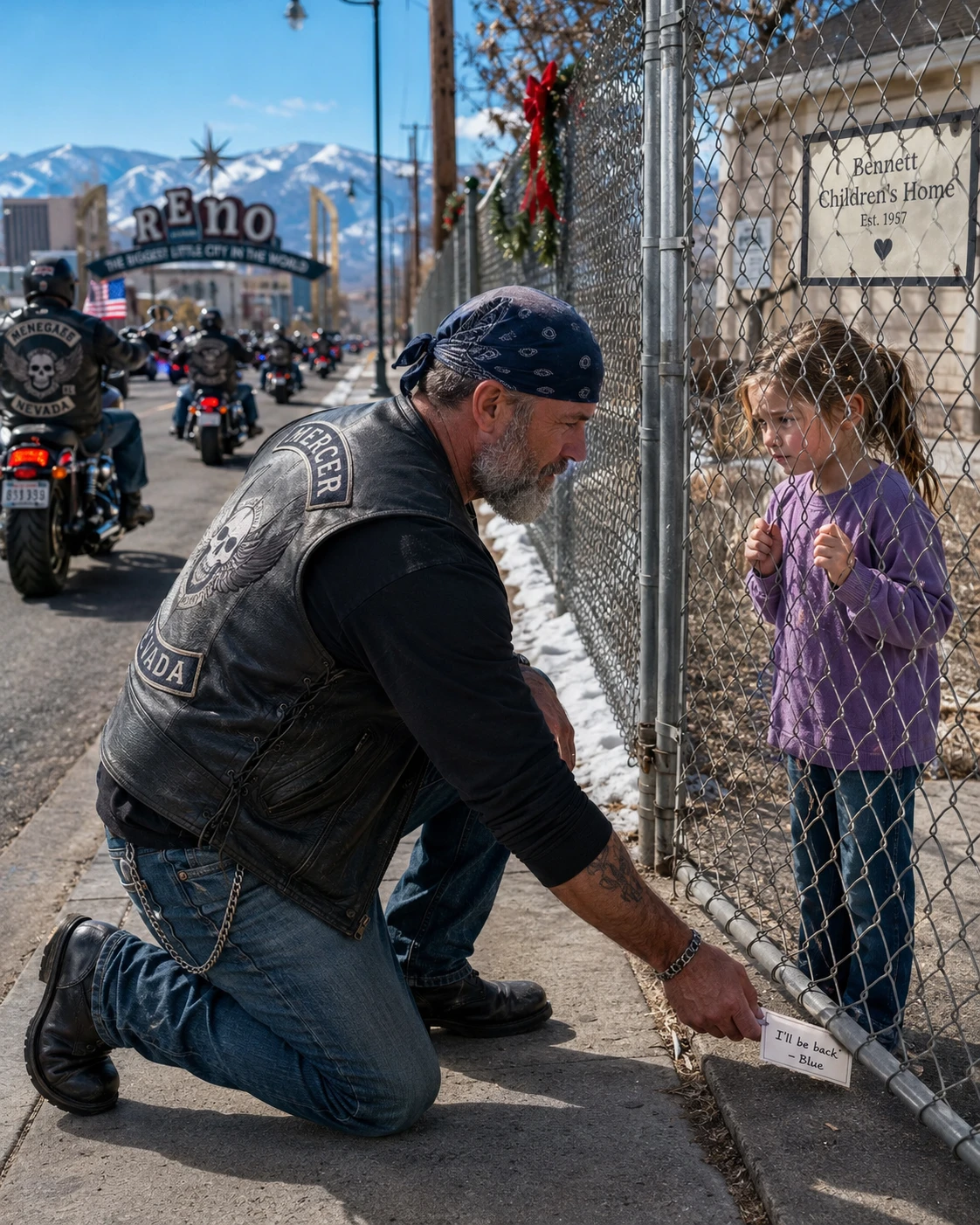
“One year ago, I stopped because a little girl didn’t run toward presents,” he said. “I thought I was keeping a promise to her.”
His voice shook.
“But the truth is, she was the promise life kept for me.”
Lila ran into his arms.
The courtroom stood.
Even Denise cried.
Outside, thirty motorcycles waited.
But Wade had one more surprise.
Parked beside his blue bike was a tiny electric motorcycle with training wheels and a purple helmet resting on the seat.
Lila gasped.
“Is that mine?”
Wade grinned.
“Only in the driveway.”
She threw her arms around him.
For the first time, Wade Mercer smiled like the whole winter had finally ended.
Years later, people would still tell the story of the biker who stopped at the fence.
But Wade knew the truth.
**He had not rescued Lila.**
**Lila had found him.**
And on the first Sunday of every December, when the charity ride passed the children’s home, Wade and Lila always stopped at the gate.
Because somewhere behind every fence, there might be one child waiting—not for a toy, not for a parade, but for someone brave enough to come back.
THE END